
Diphenhydramine Market Overview:
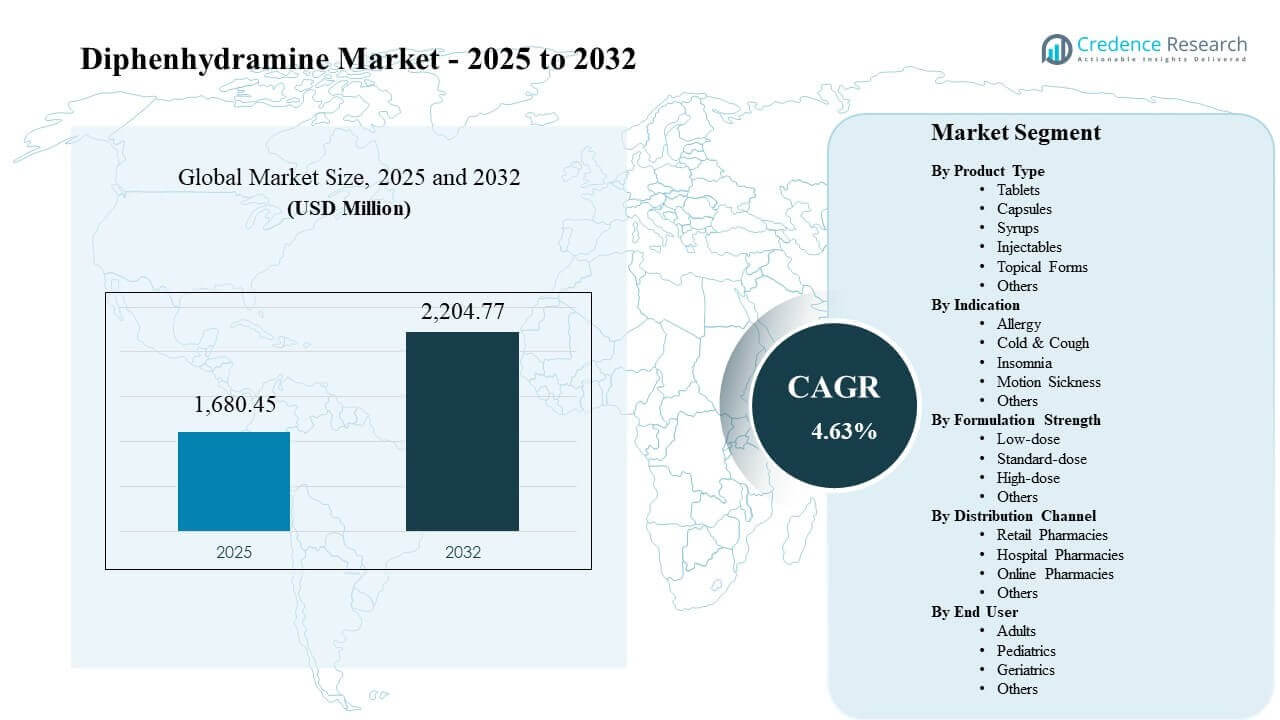
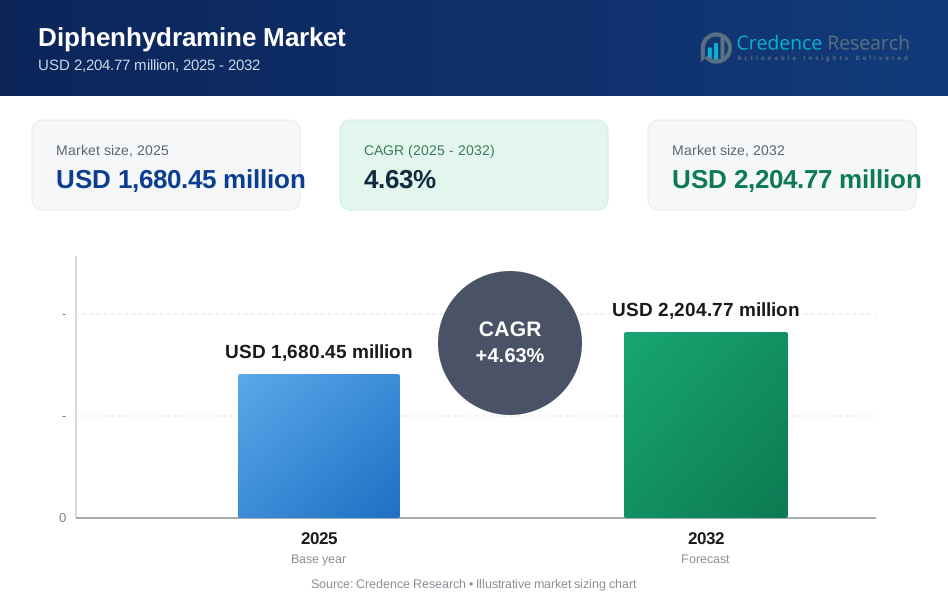
The Diphenhydramine Market size was estimated at USD 1,680.45 million in 2025 and is expected to reach USD 2,204.77 million by 2032, growing at a CAGR of 4.63% from 2025 to 2032. Demand remains anchored in self-care purchasing for allergy and common cold symptom relief, supported by broad OTC availability and high consumer familiarity with sedating antihistamines across retail channels. Regional demand concentration in North America and Europe reflects strong pharmacy access, established brand and private-label presence, and steady seasonal incidence that sustains repeat purchase cycles.
| REPORT ATTRIBUTE | DETAILS |
|---|---|
| Historical Period | 2021-2024 |
| Base Year | 2025 |
| Forecast Period | 2026-2032 |
| Diphenhydramine Market Size 2025 | USD 1,680.45 million |
| Diphenhydramine Market, CAGR | 4.63% |
| Diphenhydramine Market Size 2032 | USD 2,204.77 million |
Key Market Trends & Insights
- Diphenhydramine Market revenue totaled USD 1,680.45 million (2025), reflecting stable OTC demand across allergy, cold, and sleep-aid use cases.
- Diphenhydramine Market revenue is projected to reach USD 2,204.77 million by 2032, supported by ongoing self-medication behavior and broad channel access.
- Diphenhydramine Market growth is forecast at a 4.63% CAGR (2025–2032), indicating moderate expansion in a mature antihistamine category.
- North America accounted for 41.3% (2025), reflecting high OTC penetration and strong retail pharmacy throughput.
- Tablets held 38.6% (2025), supported by dosing convenience, shelf visibility, and consumer familiarity with solid oral formats.
Segment Analysis
Diphenhydramine Market demand is shaped by a combination of routine seasonal allergy needs, episodic cold and cough purchasing, and selective sleep-aid use where sedation is perceived as beneficial. Product selection often reflects convenience and speed-to-use, which favors familiar formats and established brand or store-brand options in retail settings. Channel performance depends on in-store accessibility, pharmacist guidance for symptom selection, and availability of multiple dosage forms that match consumer preference and age suitability.
Segment mix also reflects safety expectations and label-driven behavior, especially for sedating antihistamines. Buyers commonly prioritize clear dosing instructions, predictable onset, and pack formats that support short-cycle symptom management. Online purchasing adds convenience and broader assortment access, but compliance requirements for packaging and listing controls can influence availability of liquid products and multi-pack configurations.
By Product Type Insights
Tablets accounted for the largest share of 38.6% in 2025. Tablet formats lead because tablet dosing is simple, portable, and widely merchandised across OTC aisles and retail pharmacy front-end shelves. Tablet packaging supports clear instructions and standardized dosing cues that reduce selection friction for repeat buyers. Tablet production also enables strong private-label participation, supporting competitive pricing and wide SKU coverage.
By Indication Insights
Allergy accounted for the largest share of 33.8% in 2025. Allergy-led demand remains resilient because allergy symptoms recur seasonally and often prompt immediate OTC purchasing with limited delay. Allergy use also benefits from strong consumer recognition of antihistamine options and broad availability across retail and online channels. Allergy symptom management frequently involves repeat purchases, which sustains baseline demand even when cold and cough demand varies by season.
By Formulation Strength Insights
Formulation strength performance reflects consumer sensitivity to sedation, label guidance, and the need to align dosing with symptom severity and time-of-day use. Standard dosing typically remains the default choice when products are designed for broad OTC self-selection and predictable symptom relief. Lower-strength options can be preferred for sensitive users and cautious purchasers, while higher-strength positioning tends to face tighter suitability expectations due to drowsiness and anticholinergic effects. Retail availability and clear labeling strongly influence strength selection.
By Distribution Channel Insights
Retail pharmacies typically lead channel performance because retail pharmacies combine front-end OTC availability with pharmacist access that can guide symptom-based selection. Retail pharmacies also benefit from seasonal merchandising, broad SKU assortments, and frequent store visits that support impulse and refill purchasing. Online pharmacies strengthen access through convenience and expanded assortment, but product listing governance and packaging compliance can shape availability for certain liquid formats. Hospital pharmacies primarily serve episodic institutional needs, including injectable use where applicable.
By End User Insights
End-user demand is influenced by symptom incidence, product-format suitability, and safety considerations across age groups. Adult consumption is generally supported by self-care behavior for allergy and cold symptom management, especially in OTC retail environments. Pediatric use depends on dose flexibility and caregiver safety expectations, which can shift preference toward age-appropriate formats and stricter label adherence. Geriatric use is shaped by sensitivity to sedation and anticholinergic burden, which can affect product choice and counseling intensity.
Diphenhydramine Market Drivers
Broad OTC availability and self-care purchasing behavior
Diphenhydramine Market demand benefits from wide OTC access across pharmacies, mass retail, and e-commerce, which supports rapid symptom-response purchasing. Allergy and cold symptoms often trigger immediate self-medication decisions, keeping purchase frequency steady during seasonal peaks. High consumer familiarity reduces adoption friction and supports repeat buying for known products and store brands. Retail merchandising and category placement reinforce visibility, enabling high conversion for short-cycle symptom needs.
- For instance, Walgreens has expanded same-day delivery to more than 27,000 items in as little as 1 hour, while its Same Day Rx Delivery is available at more than 8,000 stores, highlighting how speed-based retail infrastructure can strengthen immediate symptom-response purchasing behavior.
Multi-indication utility across common symptom categories
Diphenhydramine Market usage spans allergy relief, cold symptom support, and selective sleep-aid positioning, which broadens demand sources across the year. Multi-indication overlap supports cross-shopping and repeat purchases when consumers seek a familiar antihistamine for different symptom scenarios. This flexibility also supports brand line extensions and private-label expansion across formats. The result is a stable base of demand that is less dependent on a single end-use spike.
Format diversity that supports preference and dosing convenience
Diphenhydramine Market growth is supported by availability across tablets, capsules, syrups, topical forms, and injectables, enabling coverage of multiple buyer preferences. Solid oral formats align with convenience and portability, while liquid formats support dosing flexibility for selected users. Topical forms can address localized symptom needs and provide differentiated user experience. Format breadth supports distribution reach and improves category resilience across demographic groups.
- For instance, Kenvue offers BENADRYL Allergy ULTRATABS with 25 mg per tablet and BENADRYL Extra Strength Itch Stopping Gel with 2% diphenhydramine HCl for topical use up to 3 to 4 times daily, while Pfizer’s diphenhydramine hydrochloride injection is supplied at 50 mg/mL for intravenous or intramuscular administration, showing measurable format breadth from oral OTC to topical and hospital-use presentations.
Retail pharmacy strength and seasonal merchandising advantages
Diphenhydramine Market drivers include strong retail pharmacy throughput and front-end placement that supports OTC conversion. Pharmacist proximity can improve product selection confidence, especially when symptoms overlap across allergy and cold categories. Seasonal displays and bundled promotions increase visibility during peak demand periods and encourage repeat purchase behavior. Retail chain scale also supports consistent stock availability and broad geographic coverage.
Diphenhydramine Market Challenges
Diphenhydramine Market adoption can be constrained by safety perceptions tied to sedation, next-day drowsiness, and suitability concerns for certain populations. Label warnings and consumer caution can shift demand toward non-sedating alternatives in allergy relief, particularly among working-age buyers. Product selection may also require stronger counseling in sensitive groups, which can limit impulsive purchasing for specific formats or strengths. These factors can reduce usage frequency in non-acute scenarios.
- For instance, Allegra 24 Hour Tablets use 180 mg of fexofenadine per dose, start working within one hour, provide 24-hour relief, and are marketed as having 0% brain interference from drowsiness, which helps explain why non-sedating allergy brands can attract consumers who want daytime symptom control without grogginess.
Diphenhydramine Market supply and channel execution can face quality and compliance pressures, especially for liquid products that require strict packaging standards. Brand reputation risk can rise when marketplace governance is uneven across third-party online listings. Regulatory scrutiny and retailer compliance requirements can increase operational complexity for sellers and distributors. Competitive pricing pressure from store brands and generics can further compress margins and intensify promotion dependence.
Diphenhydramine Market Trends and Opportunities
Diphenhydramine Market opportunities continue to expand through e-commerce growth, where convenience and assortment breadth support repeat purchasing for routine symptom management. Digital shelf optimization, subscription-style reorder behavior, and improved product discovery can increase conversion for established OTC categories. Retailers and manufacturers also have an opportunity to strengthen education-led merchandising that supports appropriate selection and improves buyer confidence. This trend supports steady channel diversification without requiring new clinical pathways.
- For instance, Kenvue’s BENADRYL Allergy ULTRATABS contain 25 mg of diphenhydramine HCl per tablet, and the FDA-listed package configuration includes one 100-tablet bottle plus four 12-tablet blister packs, for a total of 148 tablets, with labeled dosing of 1 to 2 tablets every 4 to 6 hours and no more than 6 doses in 24 hours.
Diphenhydramine Market trends also include portfolio rationalization and format optimization toward high-velocity SKUs, especially in solid oral forms. Packaging innovation that improves safety compliance and household usability can support differentiation in mature OTC segments. Private-label expansion remains an opportunity where retailers can capture value through reliable quality positioning and competitive pricing. Targeted product positioning for episodic use cases can further strengthen category performance during seasonal peaks.
Regional Insights
North America
Diphenhydramine Market leadership in North America reflects broad OTC penetration, strong retail pharmacy infrastructure, and high consumer familiarity with antihistamine brands and store-brand alternatives. Seasonal allergy and cold cycles support predictable purchase surges, while broad distribution coverage sustains baseline demand outside peak periods. Retail merchandising and high store density improve product visibility, which supports quick symptom-response purchasing. North America accounted for 41.3% in 2025.
Europe
Diphenhydramine Market conditions in Europe are supported by established pharmacy access and recurring demand for OTC symptom management products, though purchase pathways can vary by country. Demand is influenced by consumer preference for accessible allergy and cold relief options and by consistent retail availability across pharmacy networks. Market activity often benefits from steady seasonal incidence and a mix of branded and value-oriented offerings. Europe accounted for 24.1% in 2025.
Asia Pacific
Diphenhydramine Market growth in Asia Pacific is supported by large consumer bases, expanding pharmacy retail networks, and increasing comfort with digital purchase channels in urban markets. Demand is influenced by access improvements and broader OTC adoption for routine symptom care, alongside greater variety in product formats and pack configurations. Commercial strategies often emphasize affordability and distribution breadth across cities and secondary markets. Asia Pacific accounted for 19.4% in 2025.
Latin America
Diphenhydramine Market performance in Latin America is shaped by differences in OTC access and retail chain penetration across countries. Urban pharmacy networks support availability, while affordability sensitivity can increase demand for value offerings and private-label equivalents where present. Seasonal symptom cycles and retail promotions influence purchase timing and product mix. Latin America accounted for 6.5% in 2025.
Middle East & Africa
Diphenhydramine Market demand in the Middle East & Africa is supported by urban pharmacy expansion and broader access to OTC products in key markets. Category performance often depends on retail availability, consumer awareness of symptom-relief options, and the ability of distributors to maintain consistent stock. Private clinics and hospitals can support limited institutional demand for specific formats where applicable. Middle East & Africa accounted for 8.7% in 2025.
Competitive Landscape
Diphenhydramine Market competition is shaped by mature OTC dynamics where differentiation relies on brand trust, channel reach, pricing discipline, and portfolio breadth across dosage forms. Established consumer brands compete alongside store brands and generics, which intensifies price competition and increases promotion dependence in retail settings. Companies also compete through packaging quality, supply reliability, and line extensions that match consumer preferences for convenience and household usability.
Johnson & Johnson maintains strong category visibility through the Benadryl franchise and broad consumer health distribution, supporting consistent retail access and brand recognition. Johnson & Johnson also benefits from multi-format positioning that aligns with symptom-driven purchasing behavior in allergy and cold relief. Brand equity and shelf presence can strengthen conversion during seasonal peaks, while channel coverage supports repeat purchasing across pharmacy and mass retail outlets.
The industry research and growth report includes detailed analyses of the competitive landscape of the market and information about key companies, including:
- Johnson & Johnson
- Pfizer
- Sanofi
- Bayer
- Perrigo
- Teva Pharmaceutical
- Viatris
- Sun Pharmaceutical
- Dr. Reddy’s Laboratories
- Cipla
Qualitative and quantitative analysis of companies has been conducted to help clients understand the wider business environment as well as the strengths and weaknesses of key industry players. Data is qualitatively analyzed to categorize companies as pure play, category-focused, industry-focused, and diversified; it is quantitatively analyzed to categorize companies as dominant, leading, strong, tentative, and weak.
Recent Developments
- In March 2026, Avenacy announced the launch of Diphenhydramine Hydrochloride Injection, USP in the U.S. market, describing it as the company’s first product launch of 2026 and its 26th launch since inception.
- In September 2024, Wanbury announced a new API product portfolio for FY24-25 that includes Diphenhydramine HCl and Diphenhydramine Citrate. Wanbury also stated that it planned regulatory filings such as USDMF and CEP for several products in this portfolio, signaling an expansion of its diphenhydramine-related API pipeline
Report Scope
| Report Attribute | Details |
| Market size value in 2025 | USD 1,680.45 million |
| Revenue forecast in 2032 | USD 2,204.77 million |
| Growth rate (CAGR) | 4.63% (2025–2032) |
| Base year | 2025 |
| Forecast period | 2026-2032 |
| Quantitative units | USD million |
| Segments covered | By Product Type Outlook: Tablets, Capsules, Syrups, Injectables, Topical Forms, Others; By Indication Outlook: Allergy, Cold & Cough, Insomnia, Motion Sickness, Others; By Formulation Strength Outlook: Low-dose, Standard-dose, High-dose, Others; By Distribution Channel Outlook: Retail Pharmacies, Hospital Pharmacies, Online Pharmacies, Others; By End User Outlook: Adults, Pediatrics, Geriatrics, Others |
| Regional scope | North America, Europe, Asia Pacific, Latin America, Middle East & Africa |
| Key companies profiled | Johnson & Johnson; Pfizer; Sanofi; Bayer; Perrigo; Teva Pharmaceutical; Viatris; Sun Pharmaceutical; Dr. Reddy’s Laboratories; Cipla |
| No. of pages | 335 |
Segmentation
By Product Type
- Tablets
- Capsules
- Syrups
- Injectables
- Topical Forms
- Others
By Indication
- Allergy
- Cold & Cough
- Insomnia
- Motion Sickness
- Others
By Formulation Strength
- Low-dose
- Standard-dose
- High-dose
- Others
By Distribution Channel
- Retail Pharmacies
- Hospital Pharmacies
- Online Pharmacies
- Others
By End User
- Adults
- Pediatrics
- Geriatrics
- Others
By Region
- North America
- U.S.
- Canada
- Mexico
- Europe
- Germany
- France
- U.K.
- Italy
- Spain
- Rest of Europe
- Asia Pacific
- China
- Japan
- India
- South Korea
- South-east Asia
- Rest of Asia Pacific
- Latin America
- Brazil
- Argentina
- Rest of Latin America
- Middle East & Africa
- GCC Countries
- South Africa
- Rest of the Middle East and Africa
Request a Free Sample
Fill in your details and we'll send you a free sample report.
- Sample data tables & charts
- Research methodology
Need a Custom Version of This Report?
Tailor the scope, geography, or segments to your exact requirements.
- Custom geography or segment scope
- Direct access to our analyst team
Frequently Asked Questions
What is the market size of the Diphenhydramine Market in 2025 and the forecast for 2032?
What is the CAGR for the Diphenhydramine Market during 2025–2032?
What is the largest segment in the Diphenhydramine Market?
What are the key growth factors for the Diphenhydramine Market?
Which companies are leading participants in the Diphenhydramine Market?
Which region leads the Diphenhydramine Market?
Table of Content
Chapter 1. Report Introduction
- 1.1 Report Description & Purpose
- 1.1.1 Report Title & Market Definition
- 1.1.2 Unique Selling Propositions (USP) & Key Differentiators
- 1.1.3 Value Proposition for Stakeholders
- 1.2 Research Objectives
- 1.2.1 Market Sizing Objectives (Volume & Revenue)
- 1.2.2 Segmentation Objectives
- 1.2.3 Competitive Intelligence Objectives
- 1.2.4 Forecast & Scenario Objectives
- 1.3 Report Scope
- 1.3.1 Diphenhydramine Scope – Types & Subtypes Covered
- 1.3.2 Geographic Scope – Regions & Countries Covered
- 1.3.3 Historical Period, Base Year & Forecast Period (2025; forecast to 2032)
- 1.3.4 Inclusions & Exclusions
- 1.4 HS Code & Classification Framework
- 1.5 Currency, Units & Pricing Basis
- 1.6 Target Stakeholders
- 1.7 Limitations & Assumptions
Chapter 2. Executive Summary
- 2.1 Global Diphenhydramine Market Snapshot
- 2.1.1 Market Size – Historical (2025) & Forecast (2025-2032) (2025: USD 1,680.45 million → 2032: USD 2,204.77 million)
- 2.1.2 Volume & Revenue – Global Totals
- 2.1.3 Key Market Highlights – Top Five Facts
- 2.2 Diphenhydramine Market Segmentation Snapshot
- 2.2.1 Market Split by Region – 2025 vs. 2032
- 2.3 Competitive Snapshot
- 2.3.1 Top 10 Players by Revenue Share – 2025
- 2.3.2 Top 10 Players by Volume Share – 2025
- 2.3.3 Recent Strategic Developments (18-Month Summary)
- 2.4 Key Investment Highlights & Strategic Conclusions
Chapter 3. Diphenhydramine Market Dynamics & Industry Analysis
- 3.1 Market Overview & Context
- 3.1.1 Diphenhydramine Market Position in the Broader Automotive Value Chain
- 3.1.2 OEM vs. Replacement Market Dynamics
- 3.1.3 Market Maturity & Development Stage by Region
- 3.2 Diphenhydramine Market Drivers
- 3.3 Diphenhydramine Market Restraints & Challenges
- 3.4 Diphenhydramine Market Opportunities
- 3.5 Porter's Five Forces Analysis
- 3.5.1 Threat of New Entrants
- 3.5.2 Bargaining Power of Suppliers
- 3.5.3 Bargaining Power of Buyers
- 3.5.4 Threat of Substitutes
- 3.5.5 Competitive Rivalry – Intensity Assessment
- 3.6 Diphenhydramine Value Chain Analysis
- 3.6.1 Upstream – Raw Material/Input Suppliers
- 3.6.1.1 Raw Material/Input 1
- 3.6.1.2 Raw Material/Input 2
- 3.6.1.3 Raw Material/Input 3
- 3.6.2 Midstream – Production/Manufacturing/Service Delivery
- 3.6.2.1 Production/Process Overview
- 3.6.2.2 Key Facility Locations & Capacity by Manufacturer
- 3.6.3 Downstream – Distribution & End Consumer
- 3.6.3.1 Primary Channel – B2B/OEM
- 3.6.3.2 Secondary Channels – Dealer, Retail, Online, Direct
- 3.6.4 Value Chain Profitability Analysis
- 3.6.1 Upstream – Raw Material/Input Suppliers
- 3.7 PESTEL Analysis
- 3.7.1 Political Factors
- 3.7.2 Economic Factors
- 3.7.3 Social Factors
- 3.7.4 Technological Factors
- 3.7.5 Environmental Factors
- 3.7.6 Legal Factors
- 3.8 Diphenhydramine Supply Chain Analysis
- 3.8.1 Raw Material/Input Supply Risk Assessment
- 3.8.2 Manufacturing Concentration Risk (Geographic Exposure)
- 3.8.3 Trade Disruption Impact Analysis
- 3.9 Regulatory & Policy Landscape
Note: The regulatory and policy landscape section covers regulations based on their applicability to the market, Diphenhydramine category, geography, and scope of the study. Only regulatory frameworks with a material impact on operations, compliance, trade, sustainability, or market access are analyzed in detail.
Chapter 4. Key Investment Pockets & Opportunity Analysis
- 4.1 Diphenhydramine Market Attractiveness Analysis
- 4.1.1 By Region – Investment Attractiveness Matrix (Volume × CAGR)
- 4.2 Absolute Revenue Growth Opportunity
- 4.2.1 By Region – Absolute USD Growth Through 2032
- 4.3 Incremental Volume Opportunity
- 4.3.1 By Region – Incremental Volume Through 2032
- 4.3.2 Segment – Incremental Volume
- 4.4 Emerging Submarket Opportunity Deep Dive (Subject to Applicability)
- 4.5 Emerging Market Opportunity Scorecards
- 4.5.1 United States
- 4.5.2 Europe
- 4.5.3 Asia
- 4.5.4 Middle East & Africa
Note: Emerging Market Opportunity Scorecards will be included based on relevance and strategic importance. Regions listed are indicative and may vary depending on data availability and market dynamics.
Chapter 5. Diphenhydramine Import-Export Analysis & Trade Flows
- 5.1 Global Trade Overview
- 5.1.1 Global Export Value by Country (2025)
- 5.1.2 Global Export Volume by Country (2025)
- 5.1.3 Global Import Value by Country (2025)
- 5.1.4 Global Import Volume by Country (2025)
- 5.1.5 Net Trade Balance by Country (2025)
- 5.2 Export Analysis – Segment
- 5.2.1 Type 1 (HS Code)
- 5.2.2 Type 2 (HS Code)
- 5.2.3 Type 3 (HS Code)
- 5.2.4 Type 4 (HS Code)
- 5.2.5 Type 5 (HS Code)
- 5.3 Import Analysis – Segment
- 5.3.1 Type 1 (HS Code)
- 5.3.2 Type 2 (HS Code)
- 5.3.3 Type 3 (HS Code)
- 5.3.4 Type 4 (HS Code)
- 5.3.5 Type 5 (HS Code)
- 5.4 Average Unit Trade Prices
- 5.4.1 Average Export Price – Segment & Country
- 5.4.2 Average Import Price – Segment & Source Country
- 5.4.3 Price Trends (2025)
- 5.5 Key Trade Route Analysis
- 5.5.1 Trade Route 1
- 5.5.2 Trade Route 2
- 5.5.3 Trade Route 3
- 5.5.4 Trade Route 4
- 5.5.5 Trade Route 5
- 5.6 Trade Policy Impact Assessment
- 5.6.1 US Anti-Dumping & Section 301 Tariffs
- 5.6.2 EU Customs Union Impact
- 5.6.3 Major Free Trade Agreements
- 5.6.4 USMCA Rules of Origin
Note: Trade policy analysis will be included only where relevant to the Diphenhydramine market.
Chapter 6. Competitive Landscape & Company Benchmarking
- 6.1 Diphenhydramine Market Concentration & Structure
- 6.1.1 Herfindahl-Hirschman Index (HHI) – vs. 2025
- 6.1.2 Tier 1, Tier 2 & Tier 3 Market Structure
- 6.1.3 Global, Regional & Local Player Dynamics
- 6.2 Diphenhydramine Market Share Analysis – 2025
- 6.2.1 Global Revenue Share by Company
- 6.2.2 Global Volume Share by Company
- 6.2.3 Regional Revenue Share
- 6.2.4 Market Share Evolution ( vs. 2025)
- 6.2.5 OEM Segment Share by Company
- 6.2.6 Replacement Segment Share by Company
- 6.3 Production/Delivery Capacity & Facility Analysis
- 6.3.1 Global Installed Capacity
- 6.3.2 Capacity Utilization Rates
- 6.3.3 Production/Output Volume
- 6.3.4 Facility Locations & Capacity Map
- 6.3.5 Planned Capacity Additions
- 6.4 Diphenhydramine Competitive Benchmarking Matrix
- 6.4.1 Revenue, Volume, CAGR & Profitability Comparison
- 6.4.2 Channel Revenue Mix
- 6.4.3 Geographic Revenue Exposure
- 6.4.4 R&D Intensity
- 6.4.5 Sustainability Maturity
- 6.5 Strategic Developments in Diphenhydramine (Last 24 Months)
- 6.5.1 Mergers, Acquisitions & Divestments
- 6.5.2 New Diphenhydramine Launches
- 6.5.3 Facility Expansions
- 6.5.4 Strategic Alliances, Joint Ventures & Partnerships
- 6.5.5 Distribution Expansion & Market Entry
- 6.5.6 Sustainability & ESG Initiatives
- 6.6 Competitive Strategy Mapping
- 6.6.1 Leader, Challenger, Follower & Niche Classification
- 6.6.2 Pricing Strategy Comparison
- 6.6.3 Channel Strategy Matrix
Note: Strategic developments are included based on their materiality and the availability of reliable information.
Chapter 7. Global Diphenhydramine Market – By Distribution Channel
- 7.1 Segment Overview
- 7.1.1 Volume & Revenue Split by Channel (2025 & 2032)
- 7.1.2 Channel Mix Evolution (2025-2032)
Chapter 8. Regional Market Analysis – Global Overview
- 8.1 Global Regional Overview
- 8.1.1 Regional Volume Share
- 8.1.2 Regional Revenue Share
- 8.1.3 Regional Volume by Region
- 8.1.4 Regional Revenue by Region
- 8.1.5 Regional Forecast Through 2032
- 8.2 Cross-Regional Segment Analysis
- 8.2.1 By Distribution Channel
- 8.2.2 By Brand/Price Tier
Chapter 9. North America Diphenhydramine Market
- 9.1 United States
- 9.2 Canada
- 9.3 Mexico
Chapter 10. Europe Diphenhydramine Market
- 10.1 Germany
- 10.2 France
- 10.3 Italy
- 10.4 United Kingdom
- 10.5 Spain
- 10.6 Poland
- 10.7 Russia
- 10.8 Netherlands
- 10.9 Belgium
- 10.10 Sweden
- 10.11 Denmark
- 10.12 Norway
- 10.13 Rest of Europe
Chapter 11. Asia Pacific Diphenhydramine Market
- 11.1 China
- 11.2 India
- 11.3 Japan
- 11.4 South Korea
- 11.5 Thailand
- 11.6 Indonesia
- 11.7 Vietnam
- 11.8 Malaysia
- 11.9 Australia
- 11.10 Rest of Asia Pacific
Chapter 12. Latin America Diphenhydramine Market
- 12.1 Brazil
- 12.2 Argentina
- 12.3 Colombia
- 12.4 Chile
- 12.5 Rest of Latin America
Chapter 13. Middle East Diphenhydramine Market
- 13.1 Saudi Arabia
- 13.2 United Arab Emirates
- 13.3 Turkey
- 13.4 Israel
- 13.5 Iran
- 13.6 Rest of the Middle East
Chapter 14. Africa Diphenhydramine Market
- 14.1 South Africa
- 14.2 Egypt
- 14.3 Nigeria
- 14.4 Morocco
- 14.5 Rest of Africa
Chapter 15. Diphenhydramine Company Profiles
- 15.1 [Company 01]
- 15.1.1 Company Overview
- 15.1.2 Key Management Personnel
- 15.1.3 Products & Services Portfolio
- 15.1.4 Financial Performance
- 15.1.5 Key Market Focus & Geographic Presence
- 15.1.6 Recent Developments & Strategic Initiatives
Note: The company profile list is preliminary and may change based on research findings, market developments, data availability, and client requirements.
Chapter 16. Appendices
- Appendix A – List of Abbreviations & Acronyms
- Appendix B – Industry Classification Code Reference – Full Series
- Appendix C – Production & Capacity Data Tables
- Appendix D – End-Use & Demand Base Tables
- Appendix E – Consumption & Replacement Rate Assumptions
- Appendix F – ASP Reference Tables
- Appendix G – Manufacturing & Facility Database
- Appendix H – Import-Export Data Tables
- Appendix I – Regulatory Summary Tables
- Appendix J – Primary Research Participant List (Anonymized)
- Appendix K – Primary Research Questionnaire Framework
- Appendix L – Data Sources & Bibliography
- Appendix M – Market Size Divergence & Source Comparison
Chapter 17. Research Methodology
- 17.1 Research Framework & Philosophy
- 17.2 Secondary Research – Sources, Hierarchy & Data Extraction
- 17.3 Data Modeling – Bottom-Up & Top-Down Market Sizing
- 17.4 Primary Research – Stakeholder Framework, LOI & Sample Sizes
- 17.5 Forecast Methodology – Regression, Scenario & Sensitivity Analysis
- 17.6 Quality Control – Four-Layer Validation Framework
- 17.7 Limitations & Standard Assumptions
- 17.8 Disclaimer
