
Divalproex Sodium Market
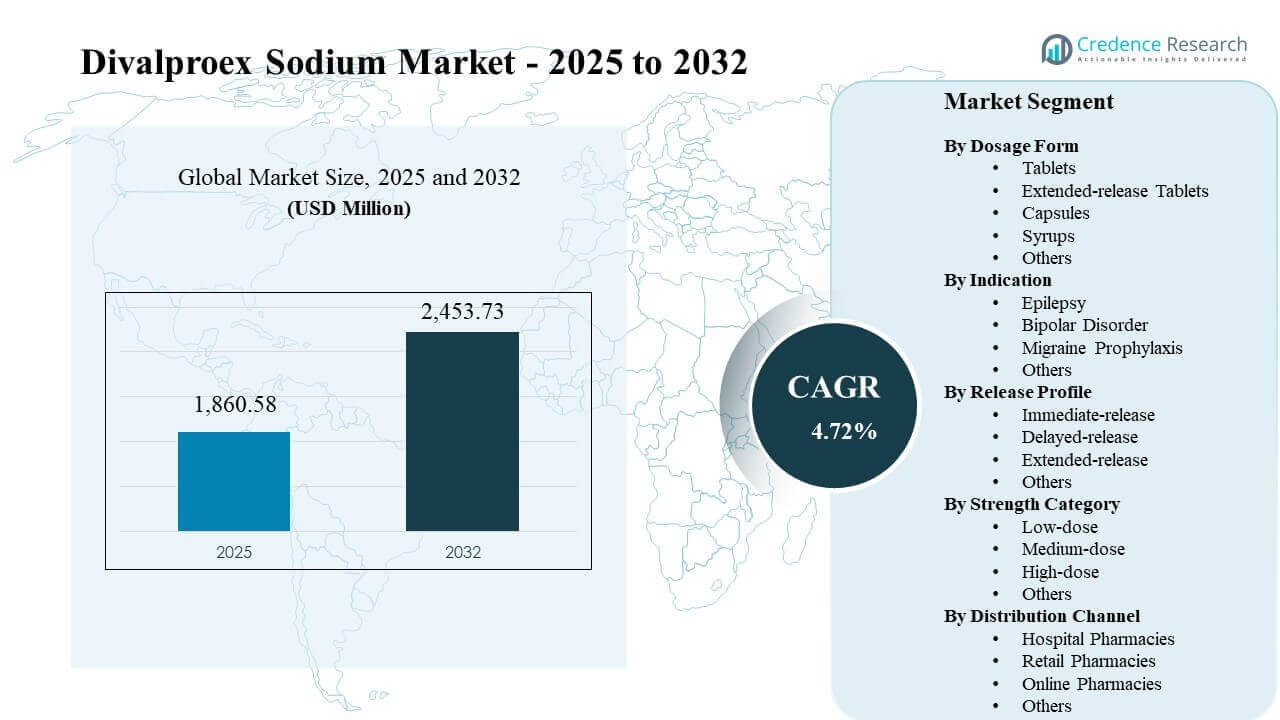
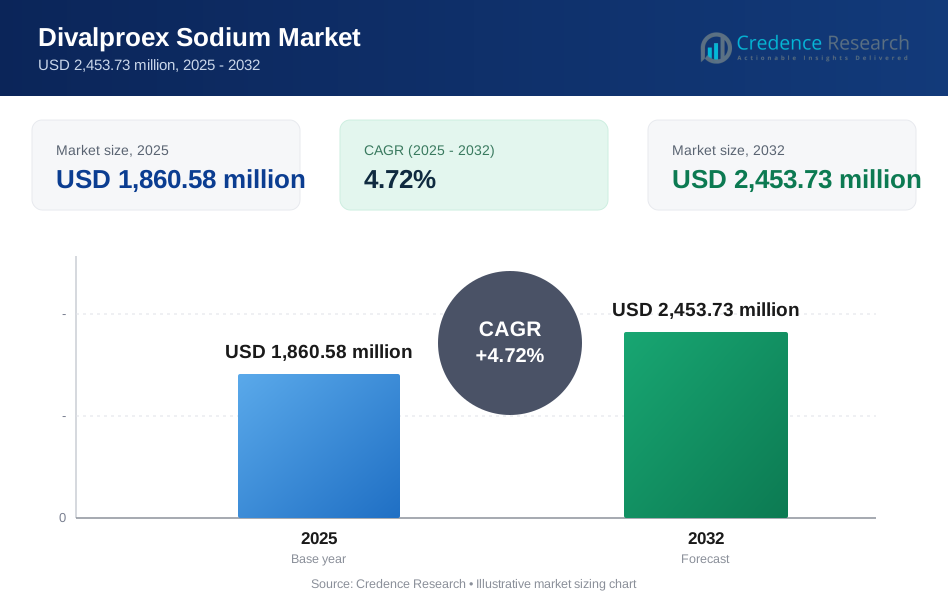
The Divalproex Sodium Market size was estimated at USD 1,860.58 million in 2025 and is expected to reach USD 2,453.73 million by 2032, growing at a CAGR of 4.72% from 2025 to 2032. Growth is primarily supported by sustained, long-term prescribing across epilepsy and bipolar disorder, where maintenance therapy drives repeat dispensing and stable volume demand. Regional expansion is reinforced by broad generic availability and improving treatment access across major outpatient pharmacy channels in both mature and emerging health systems.
| REPORT ATTRIBUTE | DETAILS |
|---|---|
| Historical Period | 2021-2024 |
| Base Year | 2025 |
| Forecast Period | 2026-2032 |
| Divalproex Sodium Market Size 2025 | USD 1,860.58 million |
| Divalproex Sodium Market, CAGR | 4.72% |
| Divalproex Sodium Market Size 2032 | USD 2,453.73 million |
Key Market Trends & Insights
- North America accounted for 35.60% of 2025 revenue, reflecting higher treated-patient spending and strong outpatient pharmacy penetration.
- Asia Pacific represented 28.10% of 2025 revenue, supported by rising access to affordable therapies and expanding neurological care capacity.
- Europe contributed 23.40% of 2025 revenue, aided by established treatment pathways and wide generic adoption.
- Extended-release formulations accounted for the largest share of 43.20% in 2025, supported by adherence-focused dosing convenience.
- The market is projected to expand from USD 1,860.58 million (2025) to USD 2,453.73 million (2032) at a 4.72% CAGR (2025–2032).
Segment Analysis
Demand concentration remains anchored in chronic neurological and psychiatric use cases, where consistent adherence and refill behavior shape purchasing patterns across retail and hospital channels. Formulation selection tends to reflect real-world persistence needs, with extended-release and delayed-release options favored when dosing simplification and steadier exposure are prioritized. Generic competition influences contract awards and stocking decisions, reinforcing a price-sensitive environment where switching remains common when payer rules allow.
Distribution dynamics are led by outpatient access, particularly where ongoing therapy management occurs through community prescribers and routine follow-up care. Online pharmacy adoption supports convenience-led procurement in select markets, but utilization varies by regulation, reimbursement, and verification requirements. Strength selection typically follows titration and maintenance pathways, with dose optimization shaped by safety considerations, tolerability, and monitoring practices over long treatment durations.
By Dosage Form Insights
Tablets accounted for the largest share in 2025. Tablets remain widely used because chronic therapy regimens prioritize familiarity, broad formulary presence, and straightforward dispensing workflows. Generic depth across tablet formats supports substitution and sustained retail throughput. Tablet dosing flexibility also helps prescribers tailor therapy to individualized response patterns across neurological and psychiatric care pathways.
By Indication Insights
Epilepsy accounted for the largest share in 2025. Epilepsy treatment supports recurring demand because long-term maintenance is common once seizure control is established. Clinical practice continues to rely on valproate-based options for appropriate patient profiles, sustaining routine prescribing in neurology settings. Treatment continuity, follow-up cadence, and refill cycles reinforce stable volumes across outpatient care networks.
By Release Profile Insights
Extended-release accounted for the largest share of 43.20% in 2025. Extended-release leadership is supported by dosing convenience that can strengthen adherence for chronic treatment populations. Regimen simplification helps reduce missed doses, which is a meaningful consideration in long-duration neurological and psychiatric management. Payer and provider preference can also favor formulations that support persistence and predictable day-to-day use.
By Strength Category Insights
Strength category leadership in 2025 reflects titration and individualized maintenance rather than a single uniform dose preference. Prescribers often adjust dosing based on response, tolerability, and patient-specific factors, which creates a mixed demand profile across low-, medium-, and high-dose products. Dose optimization is also influenced by safety counseling and monitoring practices. Broad strength availability remains important for stepwise adjustments and stable maintenance once target response is achieved.
By Distribution Channel Insights
Retail pharmacies accounted for the largest share in 2025. Retail access aligns with chronic refill behavior and routine outpatient management across epilepsy, bipolar disorder, and migraine prophylaxis use patterns. Broad generic availability supports consistent stocking and substitution, sustaining volume-led dispensing. Online pharmacies add convenience and home delivery options, but adoption depends on payer rules, verification requirements, and national dispensing regulations.
Divalproex Sodium Market Drivers
Sustained chronic prescribing across neurology and psychiatry
Chronic therapy demand supports stable market expansion as many patients remain on treatment for extended durations. Neurology and psychiatry care pathways emphasize continuity, which increases refill consistency across retail distribution. Greater screening and earlier recognition of seizure disorders and mood disorders can expand treated populations over time. Broader access to affordable generics also reinforces long-term therapy uptake in both mature and emerging health systems.
- For instance, UCB reported that among 148 patients with 12 months of continuous fenfluramine claims data before and after treatment initiation, seizure-related inpatient hospitalization claims decreased by 23.6%, seizure-related emergency room visit claims fell by 46.4%, and ambulance use declined by 61.8%, highlighting how sustained long-term neurological treatment can improve real-world care continuity.
Generic availability and payer-driven substitution
Generic depth increases affordability and expands access, especially in cost-sensitive markets. Payer formularies frequently encourage substitution, which keeps volume resilient even when unit pricing remains pressured. Competitive bidding and multi-supplier availability reduce supply concentration risk for buyers. High manufacturing capacity in key producing countries also supports steady channel replenishment and improves availability across diverse dispensing settings.
- For instance, Hikma stated that its Generics business launched seven products and submitted 10 regulatory filings in 2024, while the group reported treating 262 million patients in the same year, demonstrating the scale and operating depth that can support generic substitution and steady supply across cost-sensitive markets.
Formulation preference for adherence and regimen simplification
Adherence-focused prescribing supports demand for release profiles that simplify dosing routines. Extended-release options are commonly positioned for reduced dosing frequency, which can improve persistence for long-term conditions. Simplified regimens can lower missed-dose risk and strengthen real-world effectiveness in chronic care management. Pharmacy counseling and routine refill reminders further reinforce formulation choices that support consistent day-to-day administration.
Expansion of outpatient pharmacy access and chronic-care infrastructure
Outpatient care growth supports ongoing dispensing through community and retail channels. Broader pharmacy footprints, supply chain modernization, and e-prescribing adoption can improve refill capture and continuity. Chronic disease management programs also encourage routine follow-up that sustains therapy persistence. As healthcare access expands, treated patient pools can grow, strengthening recurring demand for established neuropsychiatric therapies.
Divalproex Sodium Market Challenges
Pricing pressure remains a key constraint because multi-supplier generic competition limits margin expansion across most channels. Buyers often prioritize cost and continuity, which intensifies tender-based competition and increases substitution frequency. Regulatory scrutiny and quality compliance requirements raise operating costs for manufacturers, particularly where inspections and documentation standards are stringent. Supply disruptions can still occur when production is concentrated, creating sporadic availability issues that influence prescriber and pharmacy preferences.
Clinical and safety considerations can constrain usage in specific patient segments, which can shift prescribing toward alternative therapies in certain scenarios. Prescriber caution, monitoring expectations, and patient counseling requirements can affect initiation and persistence for some populations. Therapy optimization demands individualized dosing, which can complicate standardization across formularies. These factors can limit rapid adoption expansion, even when broad generic access supports affordability.
- For instance, DoseMe reported expansion into 29 new countries in 2023 with advanced dosing algorithms and genetic biomarker integration, while InsightRX said its AI precision-dosing platform was deployed in more than 1,000 hospitals by late 2025, reinforcing the growing role of software-enabled dose individualization in clinical practice.
Divalproex Sodium Market Trends and Opportunities
Formulation optimization continues to shape differentiation strategies as manufacturers and marketers emphasize adherence, dosing convenience, and persistence benefits. Extended-release positioning supports steady demand in long-duration treatment pathways where simplified routines matter. Expanded patient support and pharmacy counseling programs can also improve persistence and reduce discontinuation risk. As chronic care delivery becomes more structured, brands and generics that align with adherence-focused practice can strengthen channel performance.
- For instance, Teva reported that its extended-release schizophrenia therapy UZEDY prolonged time to impending relapse by 5.0 times with once-monthly dosing and 2.7 times with once-every-two-month dosing versus placebo in the RISE study, corresponding to relapse-risk reductions of 80.0% and 62.5%, respectively, which reinforces how formulation-led convenience can support adherence-focused brand positioning.
Growth opportunities remain notable in emerging markets where diagnosis rates and access to neurological and psychiatric care continue to improve. Retail pharmacy expansion and digital dispensing infrastructure can increase refill capture and reduce friction in therapy continuation. Partnerships with distribution networks can improve geographic reach and inventory reliability. These factors can support above-average growth in countries where affordability and access improvements expand treated populations.
Regional Insights
North America
North America held 35.60% of 2025 revenue, supported by higher healthcare spending, mature retail pharmacy networks, and established treatment access for chronic neurological and psychiatric conditions. Prescribing continuity and refill behavior reinforce stable demand across outpatient channels. Payer-driven substitution supports high generic penetration, which sustains volume despite pricing pressure. Formulary management and pharmacy counseling practices also influence formulation selection and persistence patterns.
Europe
Europe represented 23.40% of 2025 revenue, supported by structured reimbursement pathways and wide generic adoption. Treatment continuity through specialist and primary care coordination supports stable refills in long-term therapy. Procurement and tender dynamics can intensify price competition, which influences supplier strategies and channel positioning. Broad pharmacy access and standardized care practices support steady demand across major countries and regional health systems.
Asia Pacific
Asia Pacific accounted for 28.10% of 2025 revenue, reflecting large patient pools and expanding access to affordable therapies. Growth is supported by improving diagnosis coverage and gradual strengthening of neurology and mental health care infrastructure. High generic availability supports uptake, especially where cost sensitivity remains elevated. Distribution scale and pharmacy footprint expansion can improve refill continuity across both urban and semi-urban settings.
Latin America
Latin America contributed 7.40% of 2025 revenue, with demand anchored in larger national markets that have expanding retail pharmacy reach. Access variability and reimbursement differences influence adoption pace across countries. Generic availability supports affordability, but channel performance can be affected by supply consistency and tender structures. Improvements in chronic-care access and dispensing infrastructure can support incremental market expansion.
Middle East & Africa
Middle East & Africa held 5.50% of 2025 revenue, reflecting uneven access and affordability constraints across several geographies. Demand is concentrated in markets with stronger urban healthcare infrastructure and expanding retail channel coverage. Ongoing investments in healthcare capacity and pharmacy distribution can improve continuity of chronic therapy. Regulatory modernization and procurement improvements can also strengthen supply reliability over the forecast period.
Competitive Landscape
Competition is shaped by a large generic footprint, broad distribution strategies, and a focus on consistent supply and formulary positioning. Manufacturers compete on pricing, channel access, regulatory compliance, and portfolio breadth across formulations and strengths. Differentiation often relies on reliability, scale, and the ability to meet tender requirements in institutional channels. Retail performance depends on stocking depth, substitution dynamics, and relationships with major wholesalers and pharmacy chains.
AbbVie specialization centers on established neuropsychiatric therapy heritage and lifecycle management expertise across branded portfolios. AbbVie’s approach typically emphasizes clinical positioning, risk communication discipline, and coordinated market access engagement where branded presence persists. AbbVie’s commercial capability can influence stakeholder education and therapy familiarity even as generics drive overall volume. AbbVie’s strategy tends to complement, rather than replace, broad generic supply across the therapy class.
The industry research and growth report includes detailed analyses of the competitive landscape of the market and information about key companies, including:
- AbbVie
- Pfizer
- Sun Pharmaceutical
- Teva Pharmaceutical
- Dr. Reddy’s Laboratories
- Lupin
- Cipla
- Zydus Lifesciences
- Mylan
- Aurobindo Pharma
Qualitative and quantitative analysis of companies has been conducted to help clients understand the wider business environment as well as the strengths and weaknesses of key industry players. Data is qualitatively analyzed to categorize companies as pure play, category-focused, industry-focused, and diversified; it is quantitatively analyzed to categorize companies as dominant, leading, strong, tentative, and weak.
Recent Developments
- In May 2025, AbbVie experienced updated prescribing information for divalproex that refined safety communication elements and strengthened risk-management messaging. The update matters because labeling changes can influence prescriber counseling practices and monitoring expectations across care settings.
- In Feb 2025, Zydus Lifesciences published an updated Medication Guide for divalproex sodium extended-release tablets that reflects current patient instructions and safety messaging used at dispensing. The update matters because standardized patient-facing guidance can influence adherence behavior and pharmacy counseling consistency.
Report Scope
| Report Attribute | Details |
| Market size value in 2025 | USD 1,860.58 million |
| Revenue forecast in 2032 | USD 2,453.73 million |
| Growth rate (CAGR) | 4.72% (2025–2032) |
| Base year | 2025 |
| Forecast period | 2026-2032 |
| Quantitative units | USD million |
| Segments covered | By Dosage Form Outlook: Tablets, Extended-release Tablets, Capsules, Syrups, Others; By Indication Outlook: Epilepsy, Bipolar Disorder, Migraine Prophylaxis, Others; By Release Profile Outlook: Immediate-release, Delayed-release, Extended-release, Others; By Strength Category Outlook: Low-dose, Medium-dose, High-dose, Others; By Distribution Channel Outlook: Hospital Pharmacies, Retail Pharmacies, Online Pharmacies, Others |
| Regional scope | North America, Europe, Asia Pacific, Latin America, Middle East & Africa |
| Key companies profiled | AbbVie, Pfizer, Sun Pharmaceutical, Teva Pharmaceutical, Dr. Reddy’s Laboratories, Lupin, Cipla, Zydus Lifesciences, Mylan, Aurobindo Pharma |
| No. of Pages | 332 |
Segmentation
By Dosage Form
- Tablets
- Extended-release Tablets
- Capsules
- Syrups
- Others
By Indication
- Epilepsy
- Bipolar Disorder
- Migraine Prophylaxis
- Others
By Release Profile
- Immediate-release
- Delayed-release
- Extended-release
- Others
By Strength Category
- Low-dose
- Medium-dose
- High-dose
- Others
By Distribution Channel
- Hospital Pharmacies
- Retail Pharmacies
- Online Pharmacies
- Others
By Region
- North America
- Europe
- Asia Pacific
- Latin America
- Middle East & Africa
Request a Free Sample
Fill in your details and we'll send you a free sample report.
- Sample data tables & charts
- Research methodology
Need a Custom Version of This Report?
Tailor the scope, geography, or segments to your exact requirements.
- Custom geography or segment scope
- Direct access to our analyst team
Frequently Asked Questions
What is the market size of the Divalproex Sodium Market in 2025 and its forecast for 2032?
What is the CAGR for the Divalproex Sodium Market during 2025–2032?
What is the largest segment in the Divalproex Sodium Market?
What factors are driving growth in the Divalproex Sodium Market?
Which companies are leading in the Divalproex Sodium Market?
Which region leads the Divalproex Sodium Market?
Table of Content
Chapter 1. Report Introduction
- 1.1 Report Description & Purpose
- 1.1.1 Report Title & Market Definition
- 1.1.2 Unique Selling Propositions (USP) & Key Differentiators
- 1.1.3 Value Proposition for Stakeholders
- 1.2 Research Objectives
- 1.2.1 Market Sizing Objectives (Volume & Revenue)
- 1.2.2 Segmentation Objectives
- 1.2.3 Competitive Intelligence Objectives
- 1.2.4 Forecast & Scenario Objectives
- 1.3 Report Scope
- 1.3.1 Divalproex Sodium Scope – Types & Subtypes Covered
- 1.3.2 Geographic Scope – Regions & Countries Covered
- 1.3.3 Historical Period, Base Year & Forecast Period (2025; forecast to 2032)
- 1.3.4 Inclusions & Exclusions
- 1.4 HS Code & Classification Framework
- 1.5 Currency, Units & Pricing Basis
- 1.6 Target Stakeholders
- 1.7 Limitations & Assumptions
Chapter 2. Executive Summary
- 2.1 Global Divalproex Sodium Market Snapshot
- 2.1.1 Market Size – Historical (2025) & Forecast (2025-2032) (2025: USD 1,860.58 million → 2032: USD 2,453.73 million)
- 2.1.2 Volume & Revenue – Global Totals
- 2.1.3 Key Market Highlights – Top Five Facts
- 2.2 Divalproex Sodium Market Segmentation Snapshot
- 2.2.1 Market Split by Region – 2025 vs. 2032
- 2.3 Competitive Snapshot
- 2.3.1 Top 10 Players by Revenue Share – 2025
- 2.3.2 Top 10 Players by Volume Share – 2025
- 2.3.3 Recent Strategic Developments (18-Month Summary)
- 2.4 Key Investment Highlights & Strategic Conclusions
Chapter 3. Divalproex Sodium Market Dynamics & Industry Analysis
- 3.1 Market Overview & Context
- 3.1.1 Divalproex Sodium Market Position in the Broader Automotive Value Chain
- 3.1.2 OEM vs. Replacement Market Dynamics
- 3.1.3 Market Maturity & Development Stage by Region
- 3.2 Divalproex Sodium Market Drivers
- 3.3 Divalproex Sodium Market Restraints & Challenges
- 3.4 Divalproex Sodium Market Opportunities
- 3.5 Porter's Five Forces Analysis
- 3.5.1 Threat of New Entrants
- 3.5.2 Bargaining Power of Suppliers
- 3.5.3 Bargaining Power of Buyers
- 3.5.4 Threat of Substitutes
- 3.5.5 Competitive Rivalry – Intensity Assessment
- 3.6 Divalproex Sodium Value Chain Analysis
- 3.6.1 Upstream – Raw Material/Input Suppliers
- 3.6.1.1 Raw Material/Input 1
- 3.6.1.2 Raw Material/Input 2
- 3.6.1.3 Raw Material/Input 3
- 3.6.2 Midstream – Production/Manufacturing/Service Delivery
- 3.6.2.1 Production/Process Overview
- 3.6.2.2 Key Facility Locations & Capacity by Manufacturer
- 3.6.3 Downstream – Distribution & End Consumer
- 3.6.3.1 Primary Channel – B2B/OEM
- 3.6.3.2 Secondary Channels – Dealer, Retail, Online, Direct
- 3.6.4 Value Chain Profitability Analysis
- 3.6.1 Upstream – Raw Material/Input Suppliers
- 3.7 PESTEL Analysis
- 3.7.1 Political Factors
- 3.7.2 Economic Factors
- 3.7.3 Social Factors
- 3.7.4 Technological Factors
- 3.7.5 Environmental Factors
- 3.7.6 Legal Factors
- 3.8 Divalproex Sodium Supply Chain Analysis
- 3.8.1 Raw Material/Input Supply Risk Assessment
- 3.8.2 Manufacturing Concentration Risk (Geographic Exposure)
- 3.8.3 Trade Disruption Impact Analysis
- 3.9 Regulatory & Policy Landscape
Note: The regulatory and policy landscape section covers regulations based on their applicability to the market, Divalproex Sodium category, geography, and scope of the study. Only regulatory frameworks with a material impact on operations, compliance, trade, sustainability, or market access are analyzed in detail.
Chapter 4. Key Investment Pockets & Opportunity Analysis
- 4.1 Divalproex Sodium Market Attractiveness Analysis
- 4.1.1 By Region – Investment Attractiveness Matrix (Volume × CAGR)
- 4.2 Absolute Revenue Growth Opportunity
- 4.2.1 By Region – Absolute USD Growth Through 2032
- 4.3 Incremental Volume Opportunity
- 4.3.1 By Region – Incremental Volume Through 2032
- 4.3.2 Segment – Incremental Volume
- 4.4 Emerging Submarket Opportunity Deep Dive (Subject to Applicability)
- 4.5 Emerging Market Opportunity Scorecards
- 4.5.1 United States
- 4.5.2 Europe
- 4.5.3 Asia
- 4.5.4 Middle East & Africa
Note: Emerging Market Opportunity Scorecards will be included based on relevance and strategic importance. Regions listed are indicative and may vary depending on data availability and market dynamics.
Chapter 5. Divalproex Sodium Import-Export Analysis & Trade Flows
- 5.1 Global Trade Overview
- 5.1.1 Global Export Value by Country (2025)
- 5.1.2 Global Export Volume by Country (2025)
- 5.1.3 Global Import Value by Country (2025)
- 5.1.4 Global Import Volume by Country (2025)
- 5.1.5 Net Trade Balance by Country (2025)
- 5.2 Export Analysis – Segment
- 5.2.1 Type 1 (HS Code)
- 5.2.2 Type 2 (HS Code)
- 5.2.3 Type 3 (HS Code)
- 5.2.4 Type 4 (HS Code)
- 5.2.5 Type 5 (HS Code)
- 5.3 Import Analysis – Segment
- 5.3.1 Type 1 (HS Code)
- 5.3.2 Type 2 (HS Code)
- 5.3.3 Type 3 (HS Code)
- 5.3.4 Type 4 (HS Code)
- 5.3.5 Type 5 (HS Code)
- 5.4 Average Unit Trade Prices
- 5.4.1 Average Export Price – Segment & Country
- 5.4.2 Average Import Price – Segment & Source Country
- 5.4.3 Price Trends (2025)
- 5.5 Key Trade Route Analysis
- 5.5.1 Trade Route 1
- 5.5.2 Trade Route 2
- 5.5.3 Trade Route 3
- 5.5.4 Trade Route 4
- 5.5.5 Trade Route 5
- 5.6 Trade Policy Impact Assessment
- 5.6.1 US Anti-Dumping & Section 301 Tariffs
- 5.6.2 EU Customs Union Impact
- 5.6.3 Major Free Trade Agreements
- 5.6.4 USMCA Rules of Origin
Note: Trade policy analysis will be included only where relevant to the Divalproex Sodium market.
Chapter 6. Competitive Landscape & Company Benchmarking
- 6.1 Divalproex Sodium Market Concentration & Structure
- 6.1.1 Herfindahl-Hirschman Index (HHI) – vs. 2025
- 6.1.2 Tier 1, Tier 2 & Tier 3 Market Structure
- 6.1.3 Global, Regional & Local Player Dynamics
- 6.2 Divalproex Sodium Market Share Analysis – 2025
- 6.2.1 Global Revenue Share by Company
- 6.2.2 Global Volume Share by Company
- 6.2.3 Regional Revenue Share
- 6.2.4 Market Share Evolution ( vs. 2025)
- 6.2.5 OEM Segment Share by Company
- 6.2.6 Replacement Segment Share by Company
- 6.3 Production/Delivery Capacity & Facility Analysis
- 6.3.1 Global Installed Capacity
- 6.3.2 Capacity Utilization Rates
- 6.3.3 Production/Output Volume
- 6.3.4 Facility Locations & Capacity Map
- 6.3.5 Planned Capacity Additions
- 6.4 Divalproex Sodium Competitive Benchmarking Matrix
- 6.4.1 Revenue, Volume, CAGR & Profitability Comparison
- 6.4.2 Channel Revenue Mix
- 6.4.3 Geographic Revenue Exposure
- 6.4.4 R&D Intensity
- 6.4.5 Sustainability Maturity
- 6.5 Strategic Developments in Divalproex Sodium (Last 24 Months)
- 6.5.1 Mergers, Acquisitions & Divestments
- 6.5.2 New Divalproex Sodium Launches
- 6.5.3 Facility Expansions
- 6.5.4 Strategic Alliances, Joint Ventures & Partnerships
- 6.5.5 Distribution Expansion & Market Entry
- 6.5.6 Sustainability & ESG Initiatives
- 6.6 Competitive Strategy Mapping
- 6.6.1 Leader, Challenger, Follower & Niche Classification
- 6.6.2 Pricing Strategy Comparison
- 6.6.3 Channel Strategy Matrix
Note: Strategic developments are included based on their materiality and the availability of reliable information.
Chapter 7. Global Divalproex Sodium Market – By Distribution Channel
- 7.1 Segment Overview
- 7.1.1 Volume & Revenue Split by Channel (2025 & 2032)
- 7.1.2 Channel Mix Evolution (2025-2032)
Chapter 8. Regional Market Analysis – Global Overview
- 8.1 Global Regional Overview
- 8.1.1 Regional Volume Share
- 8.1.2 Regional Revenue Share
- 8.1.3 Regional Volume by Region
- 8.1.4 Regional Revenue by Region
- 8.1.5 Regional Forecast Through 2032
- 8.2 Cross-Regional Segment Analysis
- 8.2.1 By Distribution Channel
- 8.2.2 By Brand/Price Tier
Chapter 9. North America Divalproex Sodium Market
- 9.1 United States
- 9.2 Canada
- 9.3 Mexico
Chapter 10. Europe Divalproex Sodium Market
- 10.1 Germany
- 10.2 France
- 10.3 Italy
- 10.4 United Kingdom
- 10.5 Spain
- 10.6 Poland
- 10.7 Russia
- 10.8 Netherlands
- 10.9 Belgium
- 10.10 Sweden
- 10.11 Denmark
- 10.12 Norway
- 10.13 Rest of Europe
Chapter 11. Asia Pacific Divalproex Sodium Market
- 11.1 China
- 11.2 India
- 11.3 Japan
- 11.4 South Korea
- 11.5 Thailand
- 11.6 Indonesia
- 11.7 Vietnam
- 11.8 Malaysia
- 11.9 Australia
- 11.10 Rest of Asia Pacific
Chapter 12. Latin America Divalproex Sodium Market
- 12.1 Brazil
- 12.2 Argentina
- 12.3 Colombia
- 12.4 Chile
- 12.5 Rest of Latin America
Chapter 13. Middle East Divalproex Sodium Market
- 13.1 Saudi Arabia
- 13.2 United Arab Emirates
- 13.3 Turkey
- 13.4 Israel
- 13.5 Iran
- 13.6 Rest of the Middle East
Chapter 14. Africa Divalproex Sodium Market
- 14.1 South Africa
- 14.2 Egypt
- 14.3 Nigeria
- 14.4 Morocco
- 14.5 Rest of Africa
Chapter 15. Divalproex Sodium Company Profiles
- 15.1 [Company 01]
- 15.1.1 Company Overview
- 15.1.2 Key Management Personnel
- 15.1.3 Products & Services Portfolio
- 15.1.4 Financial Performance
- 15.1.5 Key Market Focus & Geographic Presence
- 15.1.6 Recent Developments & Strategic Initiatives
Note: The company profile list is preliminary and may change based on research findings, market developments, data availability, and client requirements.
Chapter 16. Appendices
- Appendix A – List of Abbreviations & Acronyms
- Appendix B – Industry Classification Code Reference – Full Series
- Appendix C – Production & Capacity Data Tables
- Appendix D – End-Use & Demand Base Tables
- Appendix E – Consumption & Replacement Rate Assumptions
- Appendix F – ASP Reference Tables
- Appendix G – Manufacturing & Facility Database
- Appendix H – Import-Export Data Tables
- Appendix I – Regulatory Summary Tables
- Appendix J – Primary Research Participant List (Anonymized)
- Appendix K – Primary Research Questionnaire Framework
- Appendix L – Data Sources & Bibliography
- Appendix M – Market Size Divergence & Source Comparison
Chapter 17. Research Methodology
- 17.1 Research Framework & Philosophy
- 17.2 Secondary Research – Sources, Hierarchy & Data Extraction
- 17.3 Data Modeling – Bottom-Up & Top-Down Market Sizing
- 17.4 Primary Research – Stakeholder Framework, LOI & Sample Sizes
- 17.5 Forecast Methodology – Regression, Scenario & Sensitivity Analysis
- 17.6 Quality Control – Four-Layer Validation Framework
- 17.7 Limitations & Standard Assumptions
- 17.8 Disclaimer
