
Market Overview:
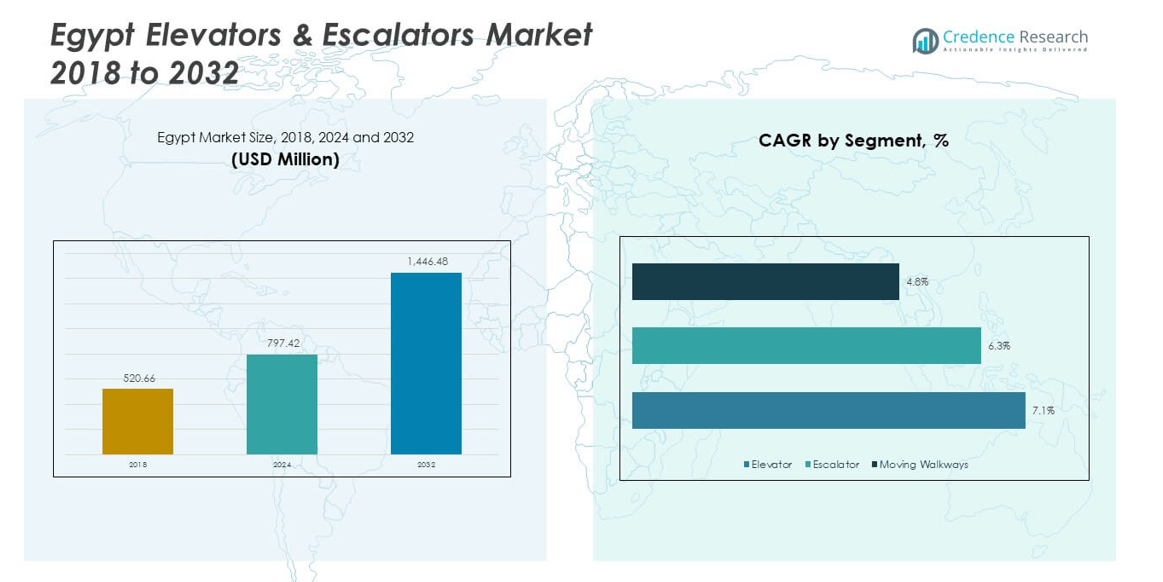
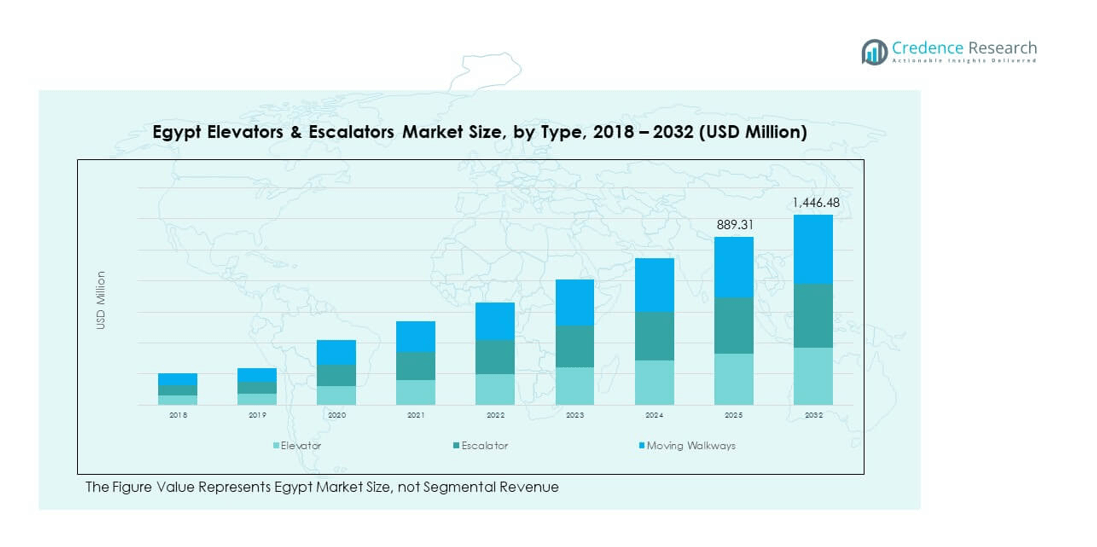
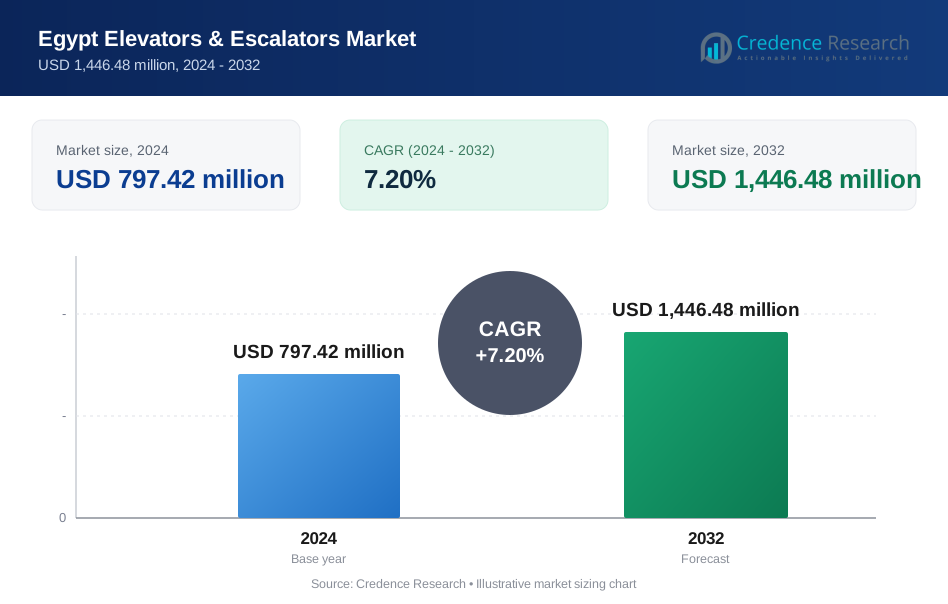
The Egypt Elevators & Escalators Market size was valued at USD 520.66 million in 2018 to USD 797.42 million in 2024 and is anticipated to reach USD 1,446.48 million by 2032, at a CAGR of 7.20% during the forecast period.
| REPORT ATTRIBUTE | DETAILS |
|---|---|
| Historical Period | 2020-2023 |
| Base Year | 2024 |
| Forecast Period | 2025-2032 |
| Egypt Elevators & Escalators Market Size 2024 | USD 797.42 million |
| Egypt Elevators & Escalators Market, CAGR | 7.20% |
| Egypt Elevators & Escalators Market Size 2032 | USD 1,446.48 million |
Strong urbanization, real estate growth, and infrastructure projects drive the demand for modern elevators and escalators in Egypt. Rising high-rise construction in commercial, residential, and hospitality sectors strengthens market expansion. Increased investments in urban transport, particularly metro and airport projects, fuel installation needs. Government-backed smart city initiatives also create opportunities for advanced elevator systems. The growing importance of energy-efficient and smart technologies pushes adoption. Consumer demand for enhanced safety features and comfort is rising. Replacement and modernization of old systems remain another key driver. Overall, rapid urban development sustains steady growth in this market.
Regional development influences the Egypt Elevators & Escalators Market significantly. Cairo leads the demand due to extensive real estate activity, while Alexandria follows with strong residential and commercial expansion. Emerging cities along the Suez Canal and new administrative capital projects are creating fresh growth corridors. Tourism-driven construction in Hurghada and Sharm El-Sheikh also supports demand. Southern regions show slower adoption but are gradually catching up due to infrastructure improvements. The Nile Delta region witnesses steady growth fueled by residential complexes. Market expansion across regions is uneven but shows a strong long-term upward trend.
Market Insights:
- The Egypt Elevators & Escalators Market was valued at USD 797.42 million in 2024 and will reach USD 1,446.48 million by 2032, growing at 7.20% CAGR.
- Strong demand drivers include urbanization, infrastructure growth, and modernization needs.
- Economic challenges and high initial investments act as restraints.
- Cairo leads demand, with Alexandria and new capital city projects emerging strongly.
- Safety compliance and modernization are shaping product choices.
- Smart and energy-efficient systems remain a critical adoption trend.
- Tourism and hospitality continue to boost installations across Egypt.
Market Drivers:
Urbanization and Rapid Infrastructure Growth Fuel Market Expansion:
The Egypt Elevators & Escalators Market benefits greatly from rapid urbanization and infrastructure projects. Expanding cities require efficient vertical mobility solutions in residential, commercial, and industrial buildings. Government-backed construction of new urban communities and housing programs adds to demand. Large-scale real estate projects in Cairo and the new administrative capital remain key contributors. Infrastructure expansion in metro rail networks, airports, and business hubs creates further growth opportunities. High-rise buildings and commercial complexes continue driving new installations. The integration of elevators and escalators in retail centers also contributes strongly. Overall, infrastructure expansion sustains long-term growth momentum.
- For instance,Otis Elevator Company supplied over 1,200 elevator units for the Cairo New Administrative Capital project, including high-speed elevators reaching speeds up to 6 meters per second to accommodate the skyscraper developments, demonstrating their capability in handling complex infrastructure demands.
Rising Demand for Smart and Energy-Efficient Systems:
Growing awareness of energy efficiency drives adoption of smart elevators and escalators. The Egypt Elevators & Escalators Market witnesses strong demand for systems with reduced power consumption. Smart technologies such as IoT integration and predictive maintenance are gaining traction. Commercial and residential builders prefer intelligent solutions to improve safety and operational efficiency. Energy-efficient systems align with global sustainability goals, making them attractive for modern projects. Demand for green building certifications further supports adoption. Manufacturers focus on launching products that reduce operational costs and enhance reliability. This shift toward smart solutions is reshaping the competitive dynamics in the market.
- For instance,Schindler’s PORT Technology, an AI-powered destination control system, has been adopted in over 500 buildings globally, reducing energy consumption by up to 30% and wait times by 40%, showcasing how smart, energy-efficient innovations are transforming modern elevator operations.
Increasing Safety Regulations and Modernization Needs:
Stringent safety regulations fuel modernization and replacement of outdated systems. The Egypt Elevators & Escalators Market sees rising demand for compliance-driven upgrades. Many older installations in Cairo and Alexandria require modernization for safety and efficiency. Government and private sector prioritize systems equipped with advanced emergency controls and automation. Regular inspection and maintenance requirements also create a steady aftermarket revenue stream. Public awareness of safety in elevators and escalators supports replacement demand. Corporate buildings and hotels seek upgraded systems to enhance user safety. This trend strengthens aftermarket opportunities while ensuring compliance with modern standards.
Growth in Tourism and Hospitality Industry Boosts Installations:
Tourism continues to expand, creating demand in hotels, resorts, and airports. The Egypt Elevators & Escalators Market experiences significant growth from the hospitality sector. Projects in Hurghada, Sharm El-Sheikh, and Luxor add installation opportunities. Airports are upgrading and expanding to handle rising passenger traffic, requiring escalators and moving walkways. High-end hotels prefer smart elevators for guest experience enhancement. Retail outlets and malls in tourist hubs also contribute to market demand. Hospitality-driven construction aligns with Egypt’s national strategy to strengthen tourism revenue. This sector will remain a consistent demand source for elevators and escalators.
Market Trends:
Adoption of IoT and AI-Enabled Elevator Systems:
The Egypt Elevators & Escalators Market is witnessing increased adoption of IoT-enabled systems. Building managers prefer AI-driven predictive maintenance to minimize downtime. Smart systems help track passenger flow and reduce waiting time. Manufacturers integrate real-time monitoring for better safety assurance. AI-based technologies enhance operational efficiency and lifecycle management. Demand for connected elevators grows across premium residential and office projects. Cloud-based platforms for service updates are gaining popularity. This trend signifies Egypt’s shift toward technologically advanced vertical transport solutions.
- For instance,KONE’s 24/7 Connected Services platform utilizes AI and IoT to monitor elevator health in real-time, performing predictive maintenance across over 700,000 connected units worldwide, which drastically lowers unplanned downtime and enhances passenger safety - a model increasingly adopted in Egypt’s premium building projects.
Growing Popularity of Machine Room-Less Elevators:
Compact design requirements fuel the demand for machine room-less (MRL) elevators. The Egypt Elevators & Escalators Market sees rapid adoption of these systems in urban spaces. MRL elevators optimize space use in residential and commercial buildings. Developers prefer them for modern apartments and office complexes. Reduced energy consumption adds to their appeal. Installation flexibility strengthens adoption in new projects. Builders consider them cost-effective over traditional models. This shift reflects Egypt’s growing preference for space-efficient designs.
Rise in Luxury Residential and Mixed-Use Projects:
High-income demand boosts installations in luxury apartments and mixed-use complexes. The Egypt Elevators & Escalators Market benefits from rising premium real estate projects. Developers install advanced elevators to attract affluent buyers. Mixed-use projects integrate commercial and retail sections requiring escalators and moving walkways. High-speed elevators are increasingly common in premium developments. Builders seek elevators with advanced design and user comfort. Aesthetic appeal plays a significant role in purchasing decisions. This trend enhances opportunities for high-end product suppliers.
Increasing Focus on After-Sales Services and Maintenance:
Aftermarket services become a critical revenue stream for market players. The Egypt Elevators & Escalators Market emphasizes long-term maintenance contracts. Builders and property managers prioritize service agreements for reliability. Modernization and retrofitting activities grow as older systems age. Manufacturers expand service offerings to enhance customer retention. Preventive maintenance reduces operational risks for end-users. Strong after-sales support differentiates leading companies from smaller firms. This focus drives recurring revenues and customer loyalty.
Market Challenges Analysis:
High Initial Investment and Economic Pressures:
The Egypt Elevators & Escalators Market faces challenges due to high installation costs. Many small developers hesitate to invest in advanced systems. Economic uncertainties and currency fluctuations affect purchasing decisions. Inflation raises costs of imported components, increasing project budgets. Limited financing options for small builders restrict growth. Some buyers opt for cheaper alternatives, lowering adoption of premium systems. Rising construction costs also delay project completion. These challenges limit faster market penetration.
Lack of Skilled Workforce and Maintenance Gaps:
Shortage of skilled technicians affects the smooth operation of systems. The Egypt Elevators & Escalators Market struggles with gaps in professional service availability. Improper maintenance leads to system breakdowns in smaller cities. Rural regions face longer response times for technical support. Training programs for technicians remain limited. Poor compliance with safety checks increases risks. These workforce challenges impact system reliability. Addressing skill shortages is vital for sustained market growth.
Market Opportunities:
Expansion of Smart Cities and Mega Projects:
The Egypt Elevators & Escalators Market gains strong opportunities from government-led smart cities. The new administrative capital and New Alamein City drive high demand. These projects require large-scale installations in residential and commercial areas. Developers prefer advanced elevators with intelligent features. Rising foreign investments in mega projects create steady opportunities. Manufacturers benefit from partnerships with local contractors. Growth in urbanization ensures a long-term demand base.
Rising Modernization and Replacement Demand:
Aging infrastructure creates modernization opportunities across Egypt. The Egypt Elevators & Escalators Market benefits from replacement of outdated systems. Builders and facility managers prioritize safety-compliant upgrades. Commercial and residential complexes drive demand for retrofitting. Hotels and office towers invest in modern designs for better efficiency. Consumers expect faster, safer, and smarter systems. The aftermarket service sector becomes increasingly profitable.
Market Segmentation Analysis:
By Type
The Egypt Elevators & Escalators Market demonstrates strong demand across elevators, escalators, and moving walkways. Elevators dominate due to their extensive use in residential and commercial high-rise projects. Escalators are prominent in metro, airport, and retail developments, reflecting transport-driven demand. Moving walkways find adoption mainly in airports and large malls. The balance among these types reflects both infrastructure growth and consumer mobility needs.
- For instance, Mitsubishi Electric has supplied escalators and moving walkways across multiple international airports, including Dubai International, known for high passenger throughput annually, highlighting the critical role of escalators and walkways in transport hubs.
By Service
Services represent a significant share, with new installations leading due to Egypt’s urban expansion. Maintenance and repair provide a consistent revenue stream as installed systems age. Elevator technology upgrades are becoming important, driven by safety and efficiency regulations. Developers value full-service contracts that cover installation and maintenance, ensuring long-term reliability.
- For instance,Otis’ ServiceLink remote monitoring service manages service requests yearly worldwide, improving response times by 35%, and similarly provides comprehensive maintenance solutions in emerging markets, demonstrating the value of integrated service contracts in sustaining elevator functionality.
By Sales Channel
Sales channels include traction elevators, machine room-less traction elevators, and hydraulic elevators. Traction models remain widely adopted in high-rise construction. Machine room-less traction elevators are gaining traction due to space-saving and energy efficiency advantages. Hydraulic elevators remain popular in low-rise buildings and cost-sensitive projects. This segmentation highlights varied adoption depending on project type and building structure.
Segmentation:
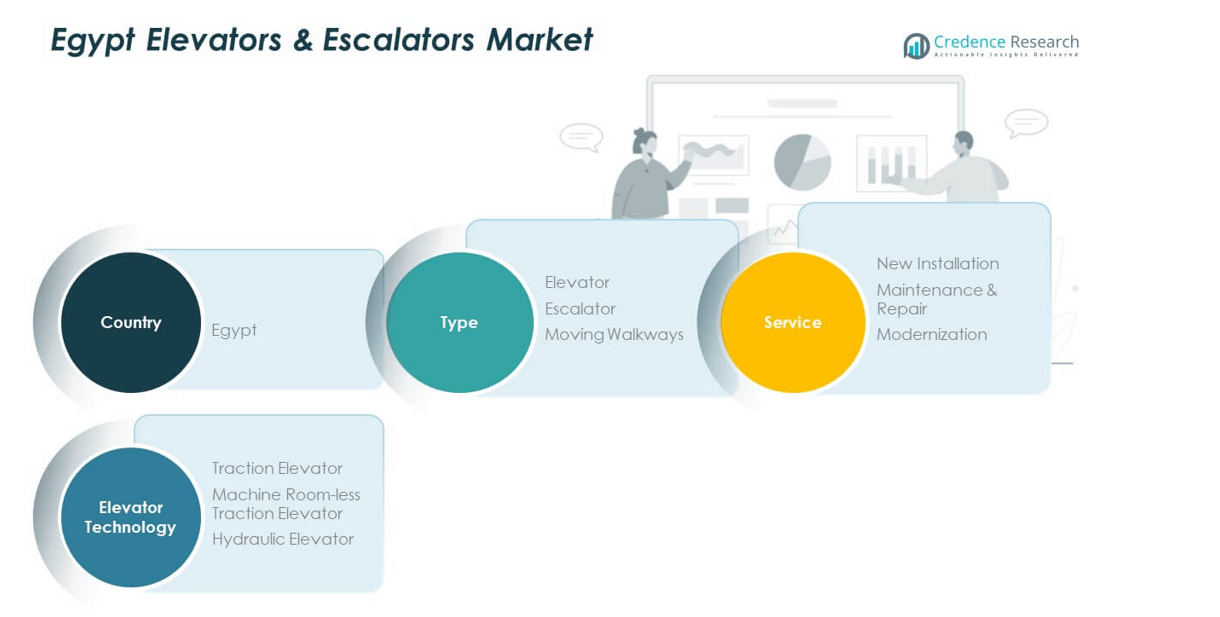
- By Type:
- Elevator
- Escalator
- Moving Walkways
- By Service:
- New Installation
- Maintenance & Repair
- Elevator Technology
- By Sales Channel:
- Traction Elevator
- Machine Room-less Traction Elevator
- Hydraulic Elevator
- By Country (Egypt):
- Cairo
- Alexandria
- Suez Canal Cities
- Delta Region
- Southern Egypt
Regional Analysis:
Cairo and Alexandria
The Egypt Elevators & Escalators Market is strongly concentrated in Cairo, which accounts for nearly 40% share of national demand. The city leads installations due to rapid high-rise construction, commercial hubs, and new residential developments. Mega projects in the new administrative capital also drive strong adoption of elevators and escalators. Alexandria follows with about 20% share, supported by expanding tourism, hospitality, and port-related infrastructure. Hotels, malls, and mid-rise residential towers in Alexandria continue to adopt advanced vertical transport solutions. Both cities represent the backbone of Egypt’s modernization drive. Their combined share highlights the concentration of demand in urbanized centers.
Suez Canal Cities and Delta Region
The Suez Canal Cities contribute nearly 15% share of the Egypt Elevators & Escalators Market. Government-backed logistics, port expansions, and industrial growth drive installations across Suez, Port Said, and Ismailia. Demand for escalators and moving walkways is rising in commercial and transit hubs. The Delta Region holds about 15% share, supported by housing projects and medium-sized commercial developments. Smaller cities in this region prefer machine room-less elevators due to affordability and space-saving benefits. The steady demand reflects growing urbanization outside Cairo and Alexandria. Together, these areas strengthen market penetration across secondary urban zones.
Southern Egypt
Southern Egypt contributes nearly 10% share, reflecting the lowest but growing part of the Egypt Elevators & Escalators Market. Installations are driven by tourism projects in Luxor and Aswan, where hotels and resorts require modern systems. Infrastructure projects supported by government investment also add momentum. Adoption is slower compared to northern regions, as urbanization levels remain limited. However, modernization of older buildings and tourism-related construction continues to create opportunities. Maintenance and service contracts are gradually expanding as the installed base increases. Southern Egypt is expected to grow steadily as infrastructure improvements gain pace.
Key Player Analysis:
Competitive Analysis:
The Egypt Elevators & Escalators Market shows medium-to-high competition with both global and regional players active. Companies like Otis Egypt, TK Elevator Egypt, and MAN Elevators dominate with strong brand recognition and advanced technology offerings. Local players, including HAUSLIFT and Eltouny, compete by offering cost-effective solutions and tailored services. The market emphasizes modernization projects, maintenance contracts, and new installations. Competitive advantage depends on service networks, safety compliance, and smart technology integration. It is expected that both multinational and domestic firms will continue to expand through partnerships and new product launches.
Recent Developments:
- In February 2025, Eltouny Elevators formed a strategic partnership with French company Sodimas to produce the first-ever Egyptian-French residential elevators in Egypt. This collaboration combines Sodimas' elevator technology expertise with Eltouny's local market knowledge, delivering high-quality, safe, and innovative home lifts that conform to European standards EN81-20 and EN81-50. Also, Eltouny has dramatically improved its production efficiency and quality through investments in Bodor laser cutting machines, resulting in a 50% increase in cutting speed and a 40% reduction in production costs, strengthening its position in Egypt's elevator market.
- In July 2025, Otis Egypt partnered with Tatweer Misr to supply and install smart vertical mobility solutions across six urban development projects involving 1,250 elevators over six years. This partnership supports Egypt's growing real estate sector with Otis's energy-efficient Gen2 elevator systems, enhancing transportation in new residential communities across key locations.
Report Coverage:
The research report offers an in-depth analysis based on type, service, and sales channel. It details leading market players, providing an overview of their business, product offerings, investments, revenue streams, and key applications. Additionally, the report includes insights into the competitive environment, SWOT analysis, current market trends, as well as the primary drivers and constraints. Furthermore, it discusses various factors that have driven market expansion in recent years. The report also explores market dynamics, regulatory scenarios, and technological advancements that are shaping the industry. It assesses the impact of external factors and global economic changes on market growth. Lastly, it provides strategic recommendations for new entrants and established companies to navigate the complexities of the market.
Future Outlook:
- Strong demand expected from real estate and commercial projects.
- Smart elevator adoption will accelerate with IoT integration.
- Energy efficiency to remain a key purchasing factor.
- Modernization of outdated systems will drive aftermarket growth.
- Maintenance services to contribute significantly to revenues.
- Hospitality and tourism projects to sustain demand.
- Government mega projects to create new opportunities.
- Safety compliance to influence modernization trends.
- Competitive intensity will rise among global and local firms.
- Egypt will remain a leading hub for elevator installations in Africa.
Request a Free Sample
Fill in your details and we'll send you a free sample report.
- Sample data tables & charts
- Research methodology
Need a Custom Version of This Report?
Tailor the scope, geography, or segments to your exact requirements.
- Custom geography or segment scope
- Direct access to our analyst team
Frequently Asked Questions
What is the current market size for the Egypt Elevators & Escalators Market, and what is its projected size in 2032?
Which Egypt Elevators & Escalators Market segment held the largest share in 2024?
What are the primary factors fueling the growth of the Egypt Elevators & Escalators Market?
Who are the leading companies in the Egypt Elevators & Escalators Market?
Table of Content
Chapter 1 Market Segmentation
- 1.1 Segmentation Framework
- 1.1.1 Product and Service Classification
- 1.1.2 Application and End-Use Classification
- 1.1.3 Technology and Solution Classification
- 1.1.4 Customer and Distribution Channel Classification
- 1.1.5 Geographic Segmentation
- 1.1.6 Market Segment Definitions and Boundaries
Chapter 2 Introduction
- 2.1 Report Objectives and Scope
- 2.2 Product Definition and Industry Terminology
- 2.3 Market Inclusions and Exclusions
- 2.4 Research Process
- 2.4.1 Primary Research and Expert Interviews
- 2.4.2 Secondary Research and Source Review
- 2.4.3 Top-Down and Bottom-Up Estimation
- 2.4.4 Data Triangulation and Verification
- 2.5 Market Size Measurement Basis
- 2.5.1 2024: USD 797.42 million → 2032: USD 1,446.48 million
- 2.6 Historical and Forecast Reference Periods
- 2.6.1 Base Year: 2024
- 2.6.2 Forecast Period: 2024-2032
- 2.7 Research Assumptions and Limitations
Chapter 3 Executive Summary
- 3.1 Market Snapshot and Key Findings
- 3.2 Base-Year Market Size, 2024
- 3.3 Forecast Market Size, 2032
- 3.4 Revenue and Volume Growth Outlook
- 3.5 Key Demand and Supply Indicators
- 3.6 Leading Market Segments
- 3.7 Fastest-Growing Market Opportunities
- 3.8 Regional Performance Highlights
- 3.9 Technology and Industry Transformation
- 3.10 Competitive Landscape Summary
- 3.11 Analyst View and Strategic Implications
Chapter 4 Egypt Elevators & Escalators Market Trends and Developments
- 4.1 Historical Industry Development
- 4.2 Recent Market Trends and Developments
- 4.3 Demand and Customer Behavior Trends
- 4.4 Technology and Product Innovation
- 4.5 Artificial Intelligence, Automation and Digitalization
- 4.6 Local Manufacturing and Supply Chain Realignment
- 4.7 Industry Partnerships, Mergers and Acquisitions
- 4.8 Sustainability and Circular Economy Developments
- 4.9 Government and Private Sector Investment Trends
- 4.10 Emerging Business Models and Commercialization
- 4.11 Industry Developments and Announcements
Chapter 5 Egypt Elevators & Escalators Market Production, Supply and Demand Analysis
- 5.1 Demand Trend and Consumption Analysis
- 5.2 Demand Forecast, 2024-2032
- 5.3 Production and Output Trend
- 5.4 Production and Output Forecast, 2024-2032
- 5.5 Installed Capacity and Capacity Utilization
- 5.6 Company-Wise Production Plants and Statistics
- 5.6.1 Installed Production Capacity
- 5.6.2 Actual Production
- 5.6.3 Planned Capacity and Expansion Targets
- 5.7 Supply Chain Structure and Procurement Trends
- 5.8 Supply-Demand Gap and Bottlenecks
- 5.9 Import Dependence and Sourcing Structure
- 5.10 Contract Manufacturing and Outsourcing
- 5.11 Regional Supply and Demand Concentration
Chapter 6 Egypt Elevators & Escalators Market Pricing Analysis
- 6.1 Pricing Structure and Measurement
- 6.2 Historical Pricing Trends
- 6.3 Pricing Outlook, 2024-2032
- 6.4 Average Selling Price and Unit Economics
- 6.5 Pricing by Product and Market Segment
- 6.6 Geographic Pricing Differences
- 6.7 Key Input, Energy, Labor and Logistics Costs
- 6.8 Contract Pricing and Purchasing Models
- 6.9 Pricing Sensitivity and Competitive Positioning
- 6.10 Price, Margin and Profitability Implications
Chapter 7 Egypt Elevators & Escalators Market Dynamics
- 7.1 Market Growth Drivers
- 7.1.1 Demand-Side Drivers
- 7.1.2 Technology and Innovation Drivers
- 7.1.3 Infrastructure and Investment Drivers
- 7.1.4 Regulatory and Policy Drivers
- 7.2 Market Restraints
- 7.2.1 Cost and Affordability Constraints
- 7.2.2 Technology and Adoption Barriers
- 7.2.3 Supply Chain and Operational Constraints
- 7.3 Market Challenges
- 7.3.1 Competitive Pressure and Margin Erosion
- 7.3.2 Skills, Infrastructure and Implementation Gaps
- 7.4 Emerging Market Opportunities
- 7.5 Market Dynamics Impact and Time-Horizon Assessment
Chapter 8 Egypt Elevators & Escalators Value Chain Analysis
- 8.1 Industry Value Chain Overview
- 8.2 Upstream Suppliers and Critical Inputs
- 8.3 Technology and Component Providers
- 8.4 Manufacturing or Service Delivery
- 8.5 Distribution, Channel Partners and Integrators
- 8.6 Downstream Applications and End Users
- 8.7 Value Addition and Profit Pools
- 8.8 Vertical Integration and Outsourcing
- 8.9 Supplier Concentration and Risk
- 8.10 Supply Chain Localization and Resilience
Chapter 9 Egypt Elevators & Escalators Market Regulations and Policies
- 9.1 Relevant Laws, Standards and Compliance Frameworks
- 9.2 Product, Service, Safety and Quality Requirements
- 9.3 Government Policies, Incentives and Subsidies
- 9.4 Imports, Exports and Trade Barriers
- 9.5 Public Procurement and Local Content Requirements
- 9.6 Environmental and Sustainability Compliance
- 9.7 Data Protection, AI and Cybersecurity Compliance
- 9.8 Upcoming Policy Changes and Market Implications
Chapter 10 Egypt Elevators & Escalators Market Hotspots and Opportunities
- 10.1 Market Opportunity Mapping and Growth Hotspots
- 10.2 High-Growth Applications and Customer Groups
- 10.3 Underserved Markets and White-Space Opportunities
- 10.4 Emerging Technology and Product Opportunities
- 10.5 New Capacity and Investment Hotspots
- 10.6 Market Entry and Expansion Opportunities
- 10.7 Distribution and Partnership Opportunities
- 10.8 Near-Term and Long-Term Commercial Potential
- 10.9 Opportunity Attractiveness and Execution Risks
Chapter 11 Egypt Elevators & Escalators Market Outlook, 2024-2032
- 11.1 Market Size and Analysis
- 11.1.1 Revenue (Market Measurement: 2024: USD 797.42 million → 2032: USD 1,446.48 million)
- 11.1.2 Market Volume and Quantity Sold
- 11.1.3 Historical Market Size
- 11.1.4 Base-Year Market Size, 2024
- 11.2 Market Forecast, 2024-2032
- 11.2.1 Revenue Forecast to 2032
- 11.2.2 Volume Forecast to 2032
- 11.2.3 CAGR and Year-on-Year Growth
- 11.2.4 Incremental Revenue Opportunity
- 11.3 Forecast Assumptions and Scenario Analysis
- 11.3.1 Base-Case Forecast
- 11.3.2 Optimistic and Conservative Scenarios
- 11.3.3 Technology, Pricing and Policy Sensitivities
- 11.4 Market Attractiveness and Growth Outlook
Chapter 12 Egypt Elevators & Escalators Market Segmentation and Outlook
- 12.1 Segmentation Summary and Market Shares, 2024
- 12.2 Largest and Fastest-Growing Segments
- 12.3 Segment Growth Comparison
- 12.4 Segment Attractiveness and Priority Matrix
Chapter 13 Egypt Elevators & Escalators Geographic Market Outlook, 2024-2032
- 13.1 Domestic Market Distribution and Demand Clusters
- 13.2 State- or Province-Wise Market Size and Forecast, 2024-2032
- 13.3 City and Metropolitan Market Outlook
- 13.4 Industrial, Manufacturing and Commercial Clusters
- 13.5 Geographic Concentration of Key End Users
- 13.6 Local Pricing and Purchasing Differences
- 13.7 Domestic Production Facilities and Capacity Map
- 13.8 Local Infrastructure and Project Pipeline
- 13.9 State-Level Policy and Incentive Differences
- 13.10 Subnational Investment Hotspots and Opportunities
- 13.11 Distribution and Logistics Networks
- 13.12 Domestic Competitive Footprint
Chapter 14 Egypt Elevators & Escalators Technology, Innovation and Sustainability Outlook
- 14.1 Technology Landscape and Maturity
- 14.2 Product, Process and Service Innovation
- 14.3 AI, Automation and Digital Tools in the Industry
- 14.4 Technology Adoption and Performance Benchmarking
- 14.5 Innovation Pipeline and R&D Investment
- 14.6 Patent and Intellectual Property Trends
- 14.7 Energy Efficiency and Resource Management
- 14.8 Sustainability, Recycling and Circularity
- 14.9 Technology Roadmap, 2024-2032
- 14.10 Risks of Obsolescence and Technology Substitution
Chapter 15 Egypt Elevators & Escalators Market Key Strategic Imperatives
- 15.1 Growth and Market Entry Priorities
- 15.2 High-Return Products and Segments
- 15.3 Pricing, Profitability and Cost Optimization
- 15.4 Technology Investment and Product Differentiation
- 15.5 Supply Chain Localization and Resilience
- 15.6 Distribution and Customer Acquisition
- 15.7 Partnership, Acquisition and Capacity Strategy
- 15.8 Regional Expansion Priorities
- 15.9 Short-, Medium- and Long-Term Actions
Chapter 16 Competition Outlook
- 16.1 Industry Competition Characteristics
- 16.2 Market Structure and Concentration
- 16.3 Market Share and Competitive Positioning, 2024
- 16.4 Company-Wise Revenue and Product Benchmarking
- 16.5 Production and Service Capacity Benchmarking
- 16.6 Technology, Pricing and Differentiation
- 16.7 Regional Footprint and Distribution Strength
- 16.8 Mergers, Acquisitions and Strategic Alliances
- 16.9 New Entrants and Competitive Threats
- 16.10 Porter's Five Forces and Industry Attractiveness
- 16.11 Competitive Outlook, 2024-2032
Chapter 17 Company Profiles
- 17.1 Company Coverage and Selection Criteria
- 17.2 Leading Market Participants – Standard Profile Structure
- 17.2.1 Business Description
- 17.2.2 Company Ownership and Geographic Presence
- 17.2.3 Product and Service Portfolio
- 17.2.4 Manufacturing and Operating Footprint
- 17.2.5 Production Capacity and Expansion Plans
- 17.2.6 Financial Performance and Investment
- 17.2.7 Market Share and Competitive Position
- 17.2.8 Technology and Innovation Capabilities
- 17.2.9 Strategic Alliances or Partnerships
- 17.2.10 Recent Developments
- 17.2.11 Growth Strategy and Outlook
- 17.3 Other Relevant Market Participants
Note: Every listed company is profiled on the structure shown under the first company. The company list is preliminary and may change based on research findings, market developments, data availability and client requirements.
Chapter 18 Disclaimer
- 18.1 Research and Forecast Disclaimer
- 18.2 Data Source and Estimation Limitations
Note: The depth of individual sections depends on data availability for this market. Volume, capacity, trade and other unit-based metrics are included where applicable.
