
Market Overview:
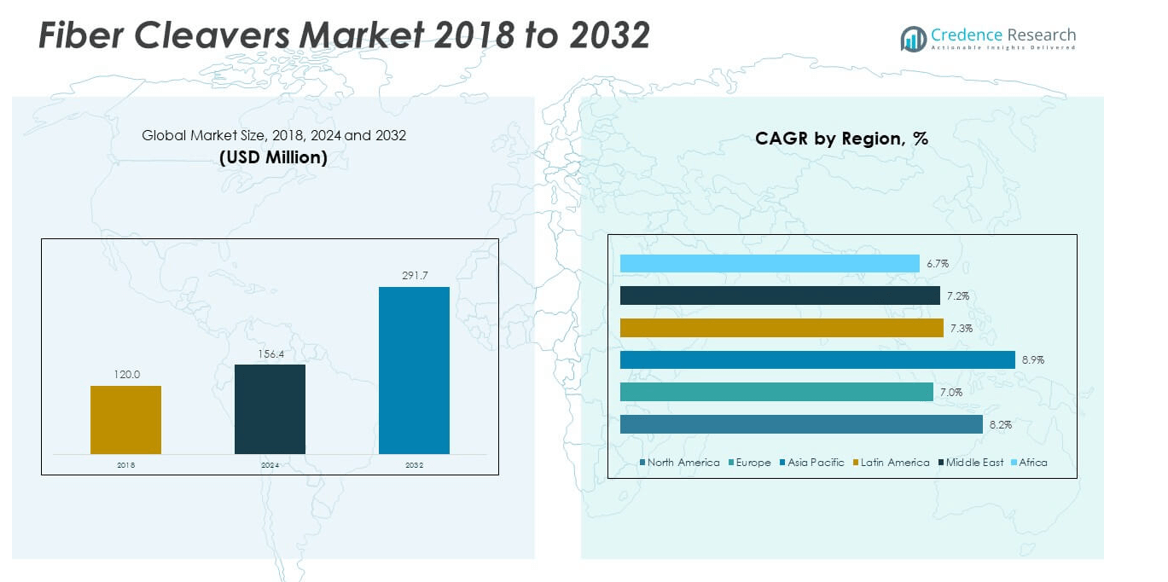
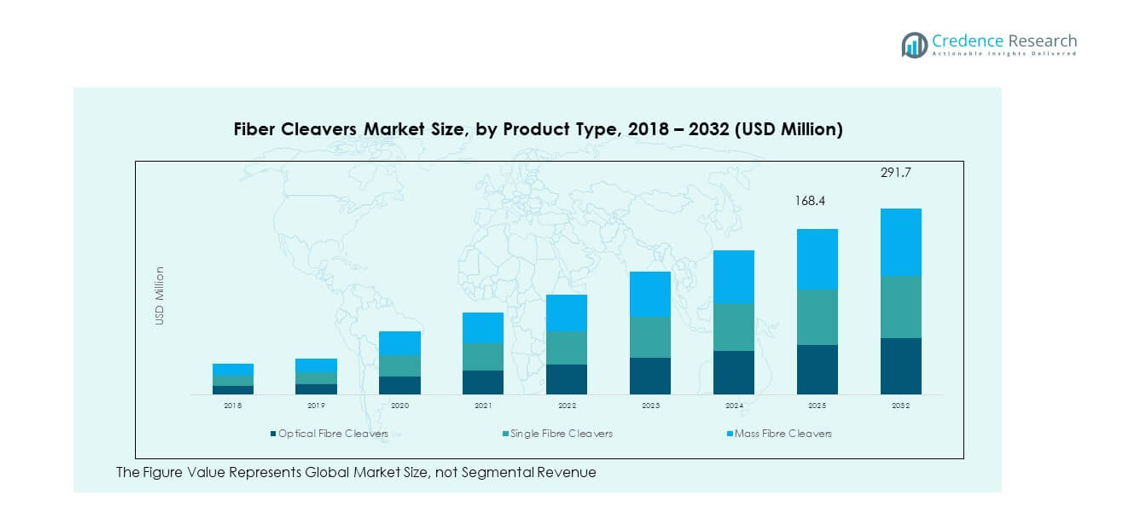
The Global Fiber Cleavers Market size was valued at USD 120.0 million in 2018, increased to USD 156.4 million in 2024, and is anticipated to reach USD 291.7 million by 2032, at a CAGR of 8.20% during the forecast period.
| REPORT ATTRIBUTE | DETAILS |
|---|---|
| Historical Period | 2020-2023 |
| Base Year | 2024 |
| Forecast Period | 2025-2032 |
| Fiber Cleavers Market Size 2024 | USD 156.4 million |
| Fiber Cleavers Market, CAGR | 8.20% |
| Fiber Cleavers Market Size 2032 | USD 291.7 million |
The market growth is fueled by rising demand for efficient and precise fiber optic splicing, driven by the rapid expansion of high-speed broadband networks, data centers, and 5G deployment. Increasing adoption of fiber-to-the-home (FTTH) connections and growing investments in telecommunication infrastructure further boost the need for advanced cleaving tools. Manufacturers focus on developing cleavers with higher precision, user-friendly designs, and automated features that improve splicing accuracy and minimize signal losses, making them essential in telecom, IT, and enterprise network operations.
Regionally, Asia-Pacific leads the Global Fiber Cleavers Market due to extensive fiber optic network expansion in countries like China, Japan, and South Korea, supported by government-backed digitalization programs. North America follows, driven by strong investment in 5G rollouts and data center infrastructure, while Europe shows steady adoption supported by broadband penetration initiatives. Emerging economies in Latin America and the Middle East are witnessing increasing adoption as governments and private players expand telecom and internet connectivity, making these regions attractive growth markets.
Market Insights:
- The Global Fiber Cleavers Market size was valued at USD 120.0 million in 2018, grew to USD 156.4 million in 2024, and is projected to reach USD 291.7 million by 2032, at a CAGR of 20% during the forecast period.
- Rising demand for fiber-to-the-home (FTTH) connections and high-speed broadband networks drives significant adoption of precision cleaving tools.
- Increasing deployment of 5G networks and rapid expansion of global data centers enhance the requirement for efficient and reliable fiber optic splicing solutions.
- High costs of advanced automated fiber cleavers limit penetration in cost-sensitive emerging markets, creating a restraint to large-scale adoption.
- Shortage of skilled technicians capable of operating high-precision cleaving equipment hampers seamless adoption across developing economies.
- Asia-Pacific leads the market, driven by extensive telecom investments in China, Japan, and South Korea, while North America follows due to strong 5G and data center infrastructure.
- Emerging markets in Latin America and the Middle East offer long-term growth potential through digital infrastructure projects and government-backed broadband initiatives.
Market Drivers:
Expanding Telecommunication Infrastructure and the Rapid Deployment of High-Speed Broadband Networks:
The Global Fiber Cleavers Market benefits significantly from the widespread deployment of fiber optic networks required for high-speed internet and broadband services. Governments and private operators invest heavily in fiber-to-the-home projects to meet growing digital connectivity needs. Telecom operators prioritize fiber optic networks over traditional copper lines to improve transmission speed and reliability. This expansion drives the demand for advanced cleavers capable of ensuring precise cuts and minimal signal loss. It strengthens the position of fiber cleavers as critical tools in achieving network efficiency. Rising urbanization and digital transformation initiatives further push the need for stable broadband connectivity. Enterprises adopt fiber networks to manage large data volumes with consistency and accuracy. The market thus gains consistent momentum from large-scale investments in digital infrastructure.
- For instance, Fujikura Ltd. launched the 13,824-fiber Spider Web Ribbon™ cable in July 2025-doubling the industry’s previous maximum fiber count while maintaining a highly compact design for hyperscale data center installations.
Increasing Demand from Data Centers and the Rising Importance of Cloud-Based Services Globally:
Data centers require efficient fiber optic connectivity to handle massive data traffic from enterprises, cloud platforms, and consumer applications. The Global Fiber Cleavers Market grows as data center operators expand facilities and prioritize low-loss connections. It ensures precise fiber cleaving, which directly supports network performance and uptime. Cloud adoption across industries intensifies this demand, driving the need for faster and more reliable data transmission. Fiber cleavers play a critical role in meeting the bandwidth requirements of AI, IoT, and big data analytics. Enterprises with multiple facilities depend on fiber solutions for scalability and resilience. Global hyperscale data center operators integrate advanced fiber management solutions into operations. This dynamic directly increases adoption across telecom and enterprise-level applications.
- For instance, Sumitomo Electric Industries Ltd. completed the acquisition of Südkabel in June 2024, significantly increasing its European manufacturing capacity for 525kV HVDC cables to meet the escalating demands of large-scale data center and grid projects.
Rising Adoption of 5G Networks and the Intensifying Focus on Seamless Communication Performance:
The Global Fiber Cleavers Market benefits strongly from the rollout of 5G networks across developed and emerging economies. Telecom operators prioritize deploying robust optical backhaul solutions to support low-latency communication. Fiber cleavers ensure precise and reliable connections during splicing, which is essential for the integrity of 5G networks. It supports higher speed, lower delay, and greater coverage required for modern applications. Governments encourage accelerated 5G deployment to improve connectivity for industrial automation, smart cities, and consumer devices. Equipment providers introduce advanced cleaving tools that integrate automation for efficiency. This evolution reinforces the role of fiber cleavers as indispensable components in 5G infrastructure. Market demand rises consistently with ongoing global expansion of next-generation telecom networks.
Growing Industrial and Enterprise Adoption of Fiber Optic Solutions for Connectivity Enhancement:
Industrial and commercial sectors increasingly rely on fiber optic networks for operational efficiency and security. The Global Fiber Cleavers Market gains traction as industries adopt digital solutions and automation that depend on reliable fiber connectivity. It addresses requirements for precise fiber preparation in manufacturing and enterprise IT networks. Smart factories and Industry 4.0 initiatives prioritize fiber-based systems to enable seamless machine-to-machine communication. Enterprises demand reliable infrastructure to manage growing dependence on cloud services, ERP platforms, and digital collaboration. Fiber cleavers support faultless splicing, ensuring uptime and reducing operational risks. Security-sensitive industries such as defence and healthcare integrate fiber solutions to secure sensitive data flows. Demand from enterprise and industrial users expands market relevance beyond telecom applications.
Market Trends:
Development of Automated Fiber Cleavers with Enhanced Precision and Operational Efficiency:
The Global Fiber Cleavers Market witnesses a shift toward automation in cleaving technology. Manufacturers design cleavers with automated mechanisms that reduce operator error and improve precision. It enables consistent splicing performance, which is critical for large-scale network deployments. Automated features also minimize skill dependency, making them attractive in diverse markets. Enterprises and telecom providers seek devices that balance accuracy with efficiency. The integration of real-time monitoring enhances performance consistency. Automated cleavers reduce maintenance downtime and increase operational reliability. This trend strongly contributes to the modernization of fiber optic installation processes.
- For instance, INNO Instrument Inc. merged with SUITA Electric in May 2025, pooling their R&D to accelerate the rollout of new automated cleavers and fusion splicers featuring advanced self-calibration and automated cleaving cycles.
Integration of Portable and Compact Fiber Cleavers Designed for Field Applications:
The Global Fiber Cleavers Market increasingly adopts compact and portable devices to support fieldwork and remote deployments. It enhances technician efficiency by enabling quick and accurate splicing in diverse environments. Portability improves usability in outdoor telecom installations and emergency repairs. Manufacturers develop lightweight models without compromising precision. Industries with geographically dispersed infrastructure prioritize such tools to maintain reliability. Compact cleavers appeal to enterprises needing rapid, flexible deployment solutions. This design innovation supports telecom contractors working on extensive rollouts. The growing use of portable cleavers strengthens field operations worldwide.
- For instance, AFL (Fujikura subsidiary) opened a manufacturing facility in Gliwice, Poland, in July 2024. Its compact cleavers, such as the Fujikura CT50 (manufactured by AFL), support cuts per blade and are optimized for fast, reliable field use across Europe and global markets.
Emphasis on Eco-Friendly Manufacturing and Sustainable Design for Optical Equipment:
The Global Fiber Cleavers Market aligns with broader industry sustainability initiatives. Manufacturers introduce cleavers designed with recyclable materials and energy-efficient processes. It reduces the environmental impact of production and disposal. Sustainability efforts also strengthen compliance with global regulatory frameworks. Enterprises prefer suppliers that demonstrate commitment to green initiatives. Eco-friendly cleavers resonate with environmentally conscious customers across telecom and IT sectors. Research investments focus on optimizing materials for durability and low environmental footprint. Sustainability-driven trends create opportunities for long-term competitive differentiation. This orientation ensures alignment with evolving customer expectations.
Expansion of Aftermarket Services and Advanced Maintenance Solutions for Fiber Cleavers:
The Global Fiber Cleavers Market experiences rising demand for aftermarket services to ensure tool longevity. Manufacturers and service providers develop advanced calibration and maintenance programs. It ensures that cleavers continue to deliver high-precision performance in long-term use. Service models include subscription-based calibration and replacement programs. Enterprises value these offerings to maintain network reliability and reduce equipment downtime. Aftermarket services create recurring revenue streams for suppliers. Vendors expand global service networks to meet rising demand from telecom and data centers. The aftermarket ecosystem strengthens overall customer trust and market adoption.
Market Challenges Analysis:
High Cost of Advanced Fiber Cleavers and Its Impact on Adoption Across Emerging Markets:
The Global Fiber Cleavers Market faces challenges related to the high cost of precision tools. Enterprises and small-scale telecom operators in emerging regions struggle to justify large upfront investment. It limits the adoption of advanced automated cleavers despite rising demand. Market penetration slows when price-sensitive buyers opt for lower-cost or refurbished alternatives. Manufacturers face pressure to balance innovation with affordability. High costs also hinder small service providers from scaling operations. This price barrier restricts broader adoption in resource-limited economies. Market players must explore cost-effective designs to address this challenge.
Shortage of Skilled Technicians and Rising Dependence on Specialized Training for Accurate Operations:
The Global Fiber Cleavers Market contends with the issue of limited technical expertise. Precise cleaving demands skilled technicians capable of handling sensitive equipment. It increases reliance on specialized training programs, which adds time and cost burdens. In emerging economies, workforce gaps make advanced cleaver adoption difficult. Errors in operation can lead to costly downtime and higher replacement rates. Enterprises face risks from improper handling of tools, which compromises network reliability. Manufacturers address this challenge by designing user-friendly and automated solutions. However, overcoming skill shortages rem ains critical for sustaining growth across geographies.
Market Opportunities:
Expansion of Digital Infrastructure Projects in Emerging Economies Creating Long-Term Growth Potential:
The Global Fiber Cleavers Market benefits from rising investment in digital infrastructure across Asia, Africa, and Latin America. Governments prioritize broadband expansion and telecom upgrades to bridge the digital divide. It generates substantial demand for fiber cleaving tools in regional rollouts. Public-private partnerships further accelerate infrastructure projects. Emerging economies create untapped opportunities for equipment providers. Increasing smartphone penetration and demand for connectivity expand this requirement. Vendors entering these markets gain strong long-term advantages.
Technological Advancements in Fiber Cleaving Tools Enabling New Applications Across Diverse Industries:
The Global Fiber Cleavers Market creates opportunities through innovation in design and performance. Automated systems, enhanced blade durability, and digital calibration improve operational reliability. It opens pathways for adoption across industries such as healthcare, aerospace, and defence. Precision requirements in specialized sectors push demand for advanced solutions. Manufacturers that offer multifunctional devices strengthen their position in high-value markets. Partnerships with enterprises accelerate innovation and market adoption. Continuous R&D investment ensures long-term growth opportunities across diverse applications.
Market Segmentation Analysis:
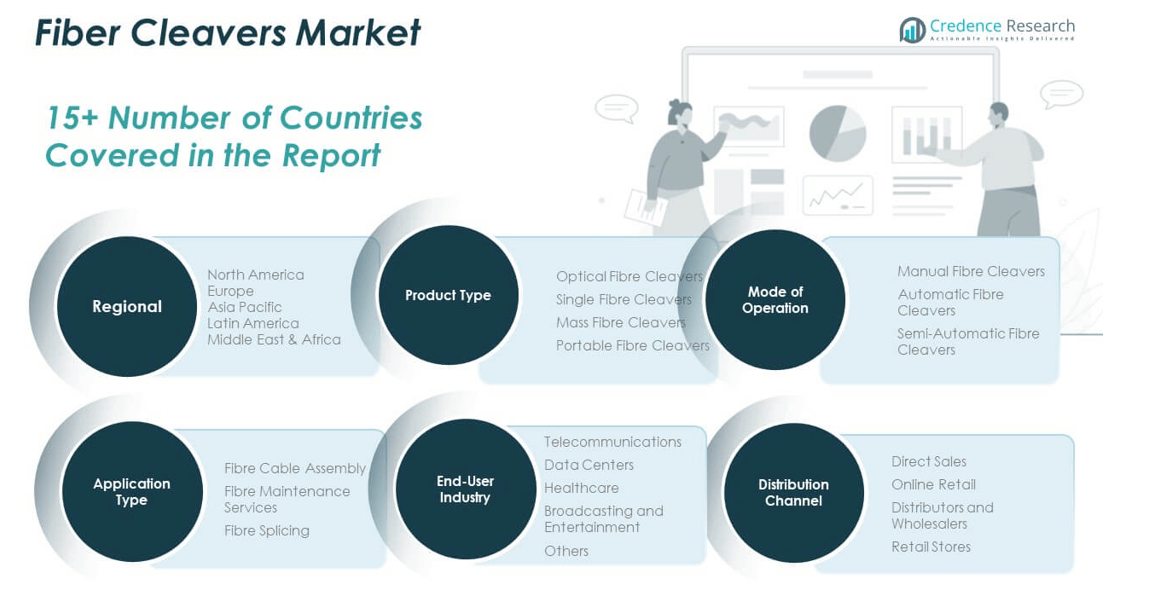
By Product Type
Optical fibre cleavers hold the leading share due to their extensive use in telecom and broadband infrastructure. Single fibre cleavers are adopted where high precision is required, particularly in specialized industries. Mass fibre cleavers find relevance in large-scale projects where multiple fibres are processed simultaneously. Portable fibre cleavers gain traction in field operations where mobility and quick deployment are critical.
- For instance, Fiber Instruments Sales, Inc. introduced the AC7 Active-Clad Alignment Splicer Kit in 2025, supporting both single and ribbon fiber cleaving to enable versatile deployment for leading broadband and enterprise clients.
By Mode of Operation
Manual fibre cleavers remain attractive for small-scale operations due to their lower cost. Automatic fibre cleavers dominate the market owing to superior accuracy, efficiency, and reduced operator dependency. Semi-automatic fibre cleavers offer a balance of affordability and advanced features, making them suitable for mid-sized enterprises and service providers.
By Application Type
Fibre cable assembly drives the largest demand as it supports telecom and broadband rollouts globally. Fibre maintenance services create steady demand through ongoing requirements for network reliability. Fibre splicing serves as a critical function across all industries where uninterrupted high-performance communication is essential.
- For instance, Fujikura Ltd. launched the 13,824-fiber Spider Web Ribbon™ (SWR™) Wrapping Tube Cable™ in July 2025, the world’s highest fiber count cable with a sub-40mm diameter. This product not only breaks the industry density record but also utilizes the dedicated Spider Web Tube™ (SWT™) breakout kit and a multi-play optical fiber fusion splicing frame, enabling multiple operators to splice simultaneously.
By End-User Industry
Telecommunications remain the dominant end-user due to continuous fibre optic network expansion. Data centers register significant growth as they require high bandwidth and reliability. Healthcare facilities deploy fibre networks for secure data handling, while broadcasting and entertainment industries rely on high-speed fibre connectivity for content delivery. Other industries adopt fibre cleavers to strengthen digital infrastructure.
By Distribution Channel
Direct sales account for the largest share as enterprises prefer customized procurement solutions. Online retail expands rapidly, driven by ease of access and cost efficiency. Distributors and wholesalers ensure regional supply and availability, while retail stores cater to smaller buyers seeking immediate purchases.
Segmentation:
By Product Type
- Optical Fibre Cleavers
- Single Fibre Cleavers
- Mass Fibre Cleavers
- Portable Fibre Cleavers
By Mode of Operation
- Manual Fibre Cleavers
- Automatic Fibre Cleavers
- Semi-Automatic Fibre Cleavers
By Application Type
- Fibre Cable Assembly
- Fibre Maintenance Services
- Fibre Splicing
By End-User Industry
- Telecommunications
- Data Centers
- Healthcare
- Broadcasting and Entertainment
- Others
By Distribution Channel
- Direct Sales
- Online Retail
- Distributors and Wholesalers
- Retail Stores
By Region
- North America - U.S. - Canada - Mexico
- Europe - UK - France - Germany - Italy - Spain - Russia - Rest of Europe
- Asia Pacific - China - Japan - South Korea - India - Australia - Southeast Asia - Rest of Asia Pacific
- Latin America - Brazil - Argentina - Rest of Latin America
- Middle East - GCC Countries - Israel - Turkey - Rest of Middle East
- Africa - South Africa - Egypt - Rest of Africa
Regional Analysis:
North America
The North America Global Fiber Cleavers Market size was valued at USD 27.1 million in 2018, reached USD 34.6 million in 2024, and is anticipated to hit USD 64.5 million by 2032, at a CAGR of 8.2% during the forecast period. North America accounts for 22.1% of the global market in 2024. The market is driven by widespread deployment of 5G infrastructure and strong demand from large data centers. It benefits from the presence of major telecom operators investing heavily in fiber optic networks. The U.S. leads adoption due to high broadband penetration and government-backed digital initiatives. Canada and Mexico also contribute through rising investment in digital infrastructure. Enterprises across healthcare and financial services accelerate demand for secure and reliable connectivity. The region emphasizes advanced technologies and automated solutions to reduce downtime. It strengthens its market position through continuous innovation and early adoption trends.
Europe
The Europe Global Fiber Cleavers Market size was valued at USD 22.1 million in 2018, grew to USD 27.2 million in 2024, and is projected to reach USD 46.7 million by 2032, at a CAGR of 7.0% during the forecast period. Europe holds 17.4% of the global market in 2024. Strong initiatives for broadband penetration under the EU Digital Agenda boost adoption across member states. Countries such as Germany, France, and the UK are key demand centers with extensive fiber-to-the-home projects. The market benefits from increased demand in broadcasting and media sectors requiring seamless high-speed networks. Healthcare institutions in Europe integrate fibre solutions for efficient and secure data transmission. Growing adoption of smart city projects drives large-scale deployment of fibre networks. Service providers in Europe also emphasize sustainability, influencing cleaver procurement. The market demonstrates steady growth supported by regulatory frameworks and long-term digital policies.
Asia Pacific
The Asia Pacific Global Fiber Cleavers Market size was valued at USD 52.3 million in 2018, grew to USD 69.9 million in 2024, and is anticipated to reach USD 137.8 million by 2032, at a CAGR of 8.9% during the forecast period. Asia Pacific commands 44.7% of the global market in 2024, making it the largest regional segment. China dominates the market with massive investments in telecom infrastructure and data centers. Japan and South Korea accelerate growth through rapid 5G rollouts and advanced digital ecosystems. India strengthens demand through government-backed broadband expansion and rising digital adoption. The region benefits from strong manufacturing bases for fibre optic equipment. Enterprises in Asia Pacific increasingly adopt fibre solutions to support industrial automation. Portable cleavers gain traction in fast-expanding rural connectivity projects. Asia Pacific’s dominance is reinforced by a large population base and rapid digitalization trends.
Latin America
The Latin America Global Fiber Cleavers Market size was valued at USD 8.5 million in 2018, expanded to USD 11.0 million in 2024, and is forecast to reach USD 19.2 million by 2032, at a CAGR of 7.3% during the forecast period. Latin America represents 7.0% of the global market in 2024. Brazil leads adoption with large-scale telecom and broadband projects. Argentina and Mexico contribute steadily as governments promote digital transformation. The market grows as enterprises adopt cloud services and require high-performance fibre networks. Cleavers gain demand for both new deployments and ongoing maintenance activities. Portable and manual cleavers see preference in cost-sensitive markets. Regional operators expand fibre networks to meet consumer demand for faster internet. The market holds long-term growth potential as infrastructure projects expand. It gains importance as digital connectivity becomes a strategic priority across Latin America.
Middle East
The Middle East Global Fiber Cleavers Market size was valued at USD 6.3 million in 2018, reached USD 7.8 million in 2024, and is set to reach USD 13.5 million by 2032, at a CAGR of 7.2% during the forecast period. The region holds 5.0% of the global market in 2024. Gulf Cooperation Council (GCC) countries dominate due to their investment in smart cities and 5G deployment. Saudi Arabia and the UAE strengthen market growth with large-scale digital initiatives. Israel shows robust adoption through high-tech industry demand. Telecom operators expand networks to support rising mobile data usage. Healthcare and defence sectors contribute to demand for secure connectivity. Cleavers with advanced automation attract investment from enterprise users. The Middle East market strengthens through government-backed digital strategies. It positions itself as a growing hub for fibre optic infrastructure.
Africa
The Africa Global Fiber Cleavers Market size was valued at USD 3.6 million in 2018, grew to USD 5.8 million in 2024, and is forecast to reach USD 10.0 million by 2032, at a CAGR of 6.7% during the forecast period. Africa accounts for 3.7% of the global market in 2024. South Africa leads adoption with strong investments in telecom and broadband connectivity. Egypt and Nigeria also emerge as important contributors with expanding ICT projects. Market growth is supported by the increasing penetration of mobile internet services. Cost-effective and portable cleavers find higher adoption due to budget constraints. International players collaborate with local operators to expand infrastructure. Governments emphasize digital inclusion to bridge connectivity gaps. Fibre networks play a critical role in supporting education and e-governance services. The region holds untapped growth potential as investments in digital infrastructure accelerate.
Key Player Analysis:
- Fujikura Ltd.
- Sumitomo Electric Industries Ltd.
- AFL (subsidiary of Fujikura)
- INNO Instrument Inc.
- Ilsintech Co., Ltd.
- Thorlabs, Inc.
- Fiber Instruments Sales, Inc.
- Greenlee (Emerson Electric)
- Ripley Tools
- Jilong Optical Communication Co., Ltd.
Competitive Analysis:
The Global Fiber Cleavers Market is moderately competitive, with key players focusing on precision, durability, and automation to strengthen their market position. Leading companies such as Fujikura Ltd., Sumitomo Electric Industries Ltd., INNO Instrument, Ilsintech Co., Ltd., and Thorlabs dominate with extensive product portfolios and global distribution networks. It benefits from continuous innovation in blade design, digital calibration, and compact portability to meet evolving demands across telecom, data centers, and industrial applications. Emerging players compete by offering cost-effective solutions for developing markets. Market leaders invest in R&D and partnerships to enhance performance and expand geographical reach. The competitive environment emphasizes technological advancement, aftersales services, and pricing strategies.
Recent Developments:
- In July 2025, Fujikura Ltd. launched a new 16-fiber Spider Web Ribbon™ (SWR™) Wrapping Tube Cable™ (WTC™) lineup. This strategic product targets the growing needs of AI and hyperscale data centers by enabling multi-fiber mass fusion splicing and supporting high-density fiber optic connectivity. The launch addresses the expanding demands driven by cloud services and artificial intelligence, offering a product range from 288 to 6,912 fibers, compatible with modern multi-fiber connectors.
- On July 18, 2025, Fujikura also announced the world’s first sale of its 13,824-fiber SWR™/WTC™ cable. This non-metallic fiber optic cable is specifically designed for hyperscale data centers, achieving double the fiber count of its previous top model while keeping the cable diameter under 40mm. Deployment of this ultra-high-capacity cable helps mitigate infrastructure constraints such as limited underground duct space.
- Sumitomo Electric Industries Ltd., in June 2024, made a significant strategic move by acquiring a majority shareholding in Südkabel, a renowned German high-voltage cable manufacturer. This acquisition allows Sumitomo Electric to increase its European cable production capacity, especially for 525kV HVDC cables, as part of major projects supporting Europe’s net-zero energy transition and infrastructure development.
- AFL, a wholly owned subsidiary of Fujikura Ltd., announced the acquisition of Forza Telecom in January 2024. This move expands AFL’s solutions portfolio to include specialized indoor and outdoor Distributed Antenna Systems (DAS) capabilities, particularly enhancing AFL’s position in wireless markets for major sports venues. The integration strengthens AFL’s offerings for energy, service provider, enterprise, hyperscale, and industrial sectors globally.
Market Concentration & Characteristics:
The Global Fiber Cleavers Market is moderately concentrated, with a few established manufacturers accounting for significant revenue share. It is characterized by high entry barriers due to technological expertise and precision manufacturing requirements. Innovation, automation, and integration of advanced features remain critical differentiators. Price sensitivity influences adoption in emerging economies, while developed regions demand high-performance automated cleavers. Strong aftermarket services, calibration support, and product reliability shape customer loyalty. Regional players compete by offering affordable solutions, though global leaders maintain dominance through brand reputation and advanced technology.
Report Coverage:
The research report offers an in-depth analysis based on Product Type, Mode of Operation, Application Type, End-User Industry, and Distribution Channel. It details leading market players, providing an overview of their business, product offerings, investments, revenue streams, and key applications. Additionally, the report includes insights into the competitive environment, SWOT analysis, current market trends, as well as the primary drivers and constraints. Furthermore, it discusses various factors that have driven market expansion in recent years. The report also explores market dynamics, regulatory scenarios, and technological advancements that are shaping the industry. It assesses the impact of external factors and global economic changes on market growth. Lastly, it provides strategic recommendations for new entrants and established companies to navigate the complexities of the market.
Future Outlook:
- Demand will rise with increasing fibre-to-the-home deployments worldwide.
- Automatic cleavers will gain traction as industries prioritize efficiency and accuracy.
- Portable cleavers will expand adoption in fieldwork and rural connectivity projects.
- Data centers will drive higher demand for precise cleaving to ensure network reliability.
- Advancements in blade durability and automation will redefine competitive positioning.
- Emerging economies will create opportunities through large-scale broadband investments.
- Telecom operators will push adoption in line with accelerated 5G infrastructure rollouts.
- Healthcare and broadcasting will expand usage, requiring secure high-speed networks.
- Online retail will strengthen as customers seek easy procurement of precision tools.
- Sustainability initiatives will encourage eco-friendly design and manufacturing practices.

Request a Free Sample
Fill in your details and we'll send you a free sample report.
- Sample data tables & charts
- Research methodology
Market Dynamics
Expansion of High-Speed Broadband and FTTH Networks
The rapid deployment of fiber-to-the-home (FTTH) and high-speed broadband networks globally is driving demand for precise and efficient fiber cleaving tools, as telecom operators and governments invest in digital infrastructure to meet growing connectivity needs.
Growth in Data Centers and Cloud Services
The proliferation of data centers and the increasing reliance on cloud-based services require high-performance fiber optic connectivity, boosting the need for advanced cleavers that ensure low-loss, reliable splicing for mission-critical applications.
Accelerated 5G Network Rollouts
The global rollout of 5G networks necessitates robust optical backhaul and precise fiber splicing, making advanced fiber cleavers essential for telecom operators to achieve the speed, reliability, and low latency required for next-generation communication.
Technological Advancements in Cleaver Automation
Manufacturers are introducing automated and user-friendly cleavers that reduce operator error and skill dependency, enabling faster, more accurate splicing and supporting large-scale network deployments in both developed and emerging markets.
Rising Industrial and Enterprise Fiber Adoption
Industries such as manufacturing, healthcare, and broadcasting are increasingly adopting fiber optic solutions for secure, high-speed data transmission, expanding the market for fiber cleavers beyond traditional telecom applications.
Need a Custom Version of This Report?
Tailor the scope, geography, or segments to your exact requirements.
- Custom geography or segment scope
- Direct access to our analyst team
Frequently Asked Questions
What is the current market size for Global Fiber Cleavers Market, and what is its projected size in 2032?
At what Compound Annual Growth Rate is the Global Fiber Cleavers Market projected to grow between 2025 and 2032?
What are the primary factors fueling the growth of the Global Fiber Cleavers Market?
Who are the leading companies in the Global Fiber Cleavers Market?
Table of Content
Chapter 1 Market Segmentation
- 1.1 Segmentation Framework
- 1.1.1 Product and Service Classification
- 1.1.2 Application and End-Use Classification
- 1.1.3 Technology and Solution Classification
- 1.1.4 Customer and Distribution Channel Classification
- 1.1.5 Geographic Segmentation
- 1.1.6 Market Segment Definitions and Boundaries
- 1.2 By Product Type
- 1.2.1 Optical Fibre Cleavers
- 1.2.2 Single Fibre Cleavers
- 1.2.3 Mass Fibre Cleavers
- 1.2.4 Portable Fibre Cleavers
- 1.3 By Application Type
- 1.3.1 Fibre Cable Assembly
- 1.3.2 Fibre Maintenance Services
- 1.3.3 Fibre Splicing
- 1.4 By End-User Industry
- 1.4.1 Telecommunications
- 1.4.2 Data Centers
- 1.4.3 Healthcare
- 1.4.4 Broadcasting and Entertainment
- 1.4.5 Others
- 1.5 By Mode of Operation
- 1.5.1 Manual Fibre Cleavers
- 1.5.2 Automatic Fibre Cleavers
- 1.5.3 Semi-Automatic Fibre Cleavers
Chapter 2 Introduction
- 2.1 Report Objectives and Scope
- 2.2 Product Definition and Industry Terminology
- 2.3 Market Inclusions and Exclusions
- 2.4 Research Process
- 2.4.1 Primary Research and Expert Interviews
- 2.4.2 Secondary Research and Source Review
- 2.4.3 Top-Down and Bottom-Up Estimation
- 2.4.4 Data Triangulation and Verification
- 2.5 Market Size Measurement Basis
- 2.5.1 2024: USD 156.4 million → 2032: USD 291.7 million
- 2.6 Historical and Forecast Reference Periods
- 2.6.1 Base Year: 2024
- 2.6.2 Forecast Period: 2024-2032
- 2.7 Research Assumptions and Limitations
Chapter 3 Executive Summary
- 3.1 Market Snapshot and Key Findings
- 3.2 Base-Year Market Size, 2024
- 3.3 Forecast Market Size, 2032
- 3.4 Revenue and Volume Growth Outlook
- 3.5 Key Demand and Supply Indicators
- 3.6 Leading Market Segments
- 3.7 Fastest-Growing Market Opportunities
- 3.8 Regional Performance Highlights
- 3.9 Technology and Industry Transformation
- 3.10 Competitive Landscape Summary
- 3.11 Analyst View and Strategic Implications
Chapter 4 Global Fiber Cleavers Market Trends and Developments
- 4.1 Historical Industry Development
- 4.2 Recent Market Trends and Developments
- 4.3 Demand and Customer Behavior Trends
- 4.4 Technology and Product Innovation
- 4.5 Artificial Intelligence, Automation and Digitalization
- 4.6 Local Manufacturing and Supply Chain Realignment
- 4.7 Industry Partnerships, Mergers and Acquisitions
- 4.8 Sustainability and Circular Economy Developments
- 4.9 Government and Private Sector Investment Trends
- 4.10 Emerging Business Models and Commercialization
- 4.11 Industry Developments and Announcements
Chapter 5 Global Fiber Cleavers Market Production, Supply and Demand Analysis
- 5.1 Demand Trend and Consumption Analysis
- 5.2 Demand Forecast, 2024-2032
- 5.3 Production and Output Trend
- 5.4 Production and Output Forecast, 2024-2032
- 5.5 Installed Capacity and Capacity Utilization
- 5.6 Company-Wise Production Plants and Statistics
- 5.6.1 Installed Production Capacity
- 5.6.2 Actual Production
- 5.6.3 Planned Capacity and Expansion Targets
- 5.7 Supply Chain Structure and Procurement Trends
- 5.8 Supply-Demand Gap and Bottlenecks
- 5.9 Import Dependence and Sourcing Structure
- 5.10 Contract Manufacturing and Outsourcing
- 5.11 Regional Supply and Demand Concentration
Chapter 6 Global Fiber Cleavers Market Pricing Analysis
- 6.1 Pricing Structure and Measurement
- 6.2 Historical Pricing Trends
- 6.3 Pricing Outlook, 2024-2032
- 6.4 Average Selling Price and Unit Economics
- 6.5 Pricing by Product and Market Segment
- 6.6 Geographic Pricing Differences
- 6.7 Key Input, Energy, Labor and Logistics Costs
- 6.8 Contract Pricing and Purchasing Models
- 6.9 Pricing Sensitivity and Competitive Positioning
- 6.10 Price, Margin and Profitability Implications
Chapter 7 Global Fiber Cleavers Market Dynamics
- 7.1 Market Growth Drivers
- 7.1.1 Demand-Side Drivers
- 7.1.2 Technology and Innovation Drivers
- 7.1.3 Infrastructure and Investment Drivers
- 7.1.4 Regulatory and Policy Drivers
- 7.2 Market Restraints
- 7.2.1 Cost and Affordability Constraints
- 7.2.2 Technology and Adoption Barriers
- 7.2.3 Supply Chain and Operational Constraints
- 7.3 Market Challenges
- 7.3.1 Competitive Pressure and Margin Erosion
- 7.3.2 Skills, Infrastructure and Implementation Gaps
- 7.4 Emerging Market Opportunities
- 7.5 Market Dynamics Impact and Time-Horizon Assessment
Chapter 8 Global Fiber Cleavers Value Chain Analysis
- 8.1 Industry Value Chain Overview
- 8.2 Upstream Suppliers and Critical Inputs
- 8.3 Technology and Component Providers
- 8.4 Manufacturing or Service Delivery
- 8.5 Distribution, Channel Partners and Integrators
- 8.6 Downstream Applications and End Users
- 8.7 Value Addition and Profit Pools
- 8.8 Vertical Integration and Outsourcing
- 8.9 Supplier Concentration and Risk
- 8.10 Supply Chain Localization and Resilience
Chapter 9 Global Fiber Cleavers Market Regulations and Policies
- 9.1 Relevant Laws, Standards and Compliance Frameworks
- 9.2 Product, Service, Safety and Quality Requirements
- 9.3 Government Policies, Incentives and Subsidies
- 9.4 Imports, Exports and Trade Barriers
- 9.5 Public Procurement and Local Content Requirements
- 9.6 Environmental and Sustainability Compliance
- 9.7 Data Protection, AI and Cybersecurity Compliance
- 9.8 Upcoming Policy Changes and Market Implications
Chapter 10 Global Fiber Cleavers Market Hotspots and Opportunities
- 10.1 Market Opportunity Mapping and Growth Hotspots
- 10.2 High-Growth Applications and Customer Groups
- 10.3 Underserved Markets and White-Space Opportunities
- 10.4 Emerging Technology and Product Opportunities
- 10.5 New Capacity and Investment Hotspots
- 10.6 Market Entry and Expansion Opportunities
- 10.7 Distribution and Partnership Opportunities
- 10.8 Near-Term and Long-Term Commercial Potential
- 10.9 Opportunity Attractiveness and Execution Risks
Chapter 11 Global Fiber Cleavers Market Outlook, 2024-2032
- 11.1 Market Size and Analysis
- 11.1.1 Revenue (Market Measurement: 2024: USD 156.4 million → 2032: USD 291.7 million)
- 11.1.2 Market Volume and Quantity Sold
- 11.1.3 Historical Market Size
- 11.1.4 Base-Year Market Size, 2024
- 11.2 Market Forecast, 2024-2032
- 11.2.1 Revenue Forecast to 2032
- 11.2.2 Volume Forecast to 2032
- 11.2.3 CAGR and Year-on-Year Growth
- 11.2.4 Incremental Revenue Opportunity
- 11.3 Forecast Assumptions and Scenario Analysis
- 11.3.1 Base-Case Forecast
- 11.3.2 Optimistic and Conservative Scenarios
- 11.3.3 Technology, Pricing and Policy Sensitivities
- 11.4 Market Attractiveness and Growth Outlook
Chapter 12 Global Fiber Cleavers Market Segmentation and Outlook
- 12.1 Segmentation Summary and Market Shares, 2024
- 12.2 Largest and Fastest-Growing Segments
- 12.3 By Product Type - Market Size and Forecast, 2024-2032
- 12.3.1 Segment Definition and Scope
- 12.3.2 Historical Market Size
- 12.3.3 Revenue Forecast, 2024-2032
- 12.3.4 Volume Forecast, 2024-2032
- 12.3.5 Base-Year Market Share, 2024
- 12.3.6 Segment CAGR and Growth Drivers
- 12.3.7 Subsegment Market Size and Forecast
- 12.3.7.1 Optical Fibre Cleavers
- 12.3.7.2 Single Fibre Cleavers
- 12.3.7.3 Mass Fibre Cleavers
- 12.3.7.4 Portable Fibre Cleavers
- 12.3.8 Subsegment Pricing and Adoption Trends
- 12.3.9 Leading Suppliers and Competition
- 12.3.10 Regional Demand and Opportunities
- 12.4 By Application Type - Market Size and Forecast, 2024-2032
- 12.4.1 Segment Definition and Scope
- 12.4.2 Historical Market Size
- 12.4.3 Revenue Forecast, 2024-2032
- 12.4.4 Volume Forecast, 2024-2032
- 12.4.5 Base-Year Market Share, 2024
- 12.4.6 Segment CAGR and Growth Drivers
- 12.4.7 Subsegment Market Size and Forecast
- 12.4.7.1 Fibre Cable Assembly
- 12.4.7.2 Fibre Maintenance Services
- 12.4.7.3 Fibre Splicing
- 12.4.8 Subsegment Pricing and Adoption Trends
- 12.4.9 Leading Suppliers and Competition
- 12.4.10 Regional Demand and Opportunities
- 12.5 By End-User Industry - Market Size and Forecast, 2024-2032
- 12.5.1 Segment Definition and Scope
- 12.5.2 Historical Market Size
- 12.5.3 Revenue Forecast, 2024-2032
- 12.5.4 Volume Forecast, 2024-2032
- 12.5.5 Base-Year Market Share, 2024
- 12.5.6 Segment CAGR and Growth Drivers
- 12.5.7 Subsegment Market Size and Forecast
- 12.5.7.1 Telecommunications
- 12.5.7.2 Data Centers
- 12.5.7.3 Healthcare
- 12.5.7.4 Broadcasting and Entertainment
- 12.5.7.5 Others
- 12.5.8 Subsegment Pricing and Adoption Trends
- 12.5.9 Leading Suppliers and Competition
- 12.5.10 Regional Demand and Opportunities
- 12.6 By Mode of Operation - Market Size and Forecast, 2024-2032
- 12.6.1 Segment Definition and Scope
- 12.6.2 Historical Market Size
- 12.6.3 Revenue Forecast, 2024-2032
- 12.6.4 Volume Forecast, 2024-2032
- 12.6.5 Base-Year Market Share, 2024
- 12.6.6 Segment CAGR and Growth Drivers
- 12.6.7 Subsegment Market Size and Forecast
- 12.6.7.1 Manual Fibre Cleavers
- 12.6.7.2 Automatic Fibre Cleavers
- 12.6.7.3 Semi-Automatic Fibre Cleavers
- 12.6.8 Subsegment Pricing and Adoption Trends
- 12.6.9 Leading Suppliers and Competition
- 12.6.10 Regional Demand and Opportunities
- 12.7 Segment Growth Comparison
- 12.8 Segment Attractiveness and Priority Matrix
Chapter 13 Global Fiber Cleavers End-Use and Application Market Outlook
- 13.1 End-Use Industry and Customer Demand Structure
- 13.2 Leading Applications and Customer Groups
- 13.3 End-Use Market Size, Share and Forecast
- 13.4 Major End-Use Industry Deep Dives
- 13.4.1 Customer Requirements and Use Cases
- 13.4.2 Demand and Replacement Cycles
- 13.4.3 Technical and Regulatory Considerations
- 13.4.4 Purchasing and Procurement Models
- 13.4.5 Leading Vendors and Distribution Channels
- 13.4.6 Forecast and Commercial Opportunities
- 13.5 Emerging Applications and Cross-Segment Demand
- 13.6 End-Use Industry Investment Priorities
Chapter 14 Global Fiber Cleavers Geographic Market Outlook, 2024-2032
- 14.1 Regional Market Size and Share, 2024
- 14.2 Regional Market Forecast, 2024-2032
- 14.3 Regional Pricing, Production and Demand Differences
- 14.4 North America
- 14.4.1 United States
- 14.4.2 Canada
- 14.4.3 Mexico
- 14.5 Europe
- 14.5.1 Germany
- 14.5.2 France
- 14.5.3 Italy
- 14.5.4 United Kingdom
- 14.5.5 Spain
- 14.5.6 Poland
- 14.5.7 Russia
- 14.5.8 Netherlands
- 14.5.9 Belgium
- 14.5.10 Sweden
- 14.5.11 Denmark
- 14.5.12 Norway
- 14.5.13 Rest of Europe
- 14.6 Asia Pacific
- 14.6.1 China
- 14.6.2 India
- 14.6.3 Japan
- 14.6.4 South Korea
- 14.6.5 Thailand
- 14.6.6 Indonesia
- 14.6.7 Vietnam
- 14.6.8 Malaysia
- 14.6.9 Australia
- 14.6.10 Rest of Asia Pacific
- 14.7 Latin America
- 14.7.1 Brazil
- 14.7.2 Argentina
- 14.7.3 Colombia
- 14.7.4 Chile
- 14.7.5 Rest of Latin America
- 14.8 Middle East
- 14.8.1 Saudi Arabia
- 14.8.2 United Arab Emirates
- 14.8.3 Turkey
- 14.8.4 Israel
- 14.8.5 Iran
- 14.8.6 Rest of the Middle East
- 14.9 Africa
- 14.9.1 South Africa
- 14.9.2 Egypt
- 14.9.3 Nigeria
- 14.9.4 Morocco
- 14.9.5 Rest of Africa
- 14.10 Regional Investment, Policy and Supply Chain Differences
- 14.11 Regional Competitive Landscape
- 14.12 Geographic Growth Hotspots
Chapter 15 Global Fiber Cleavers Technology, Innovation and Sustainability Outlook
- 15.1 Technology Landscape and Maturity
- 15.2 Product, Process and Service Innovation
- 15.3 AI, Automation and Digital Tools in the Industry
- 15.4 Technology Adoption and Performance Benchmarking
- 15.5 Innovation Pipeline and R&D Investment
- 15.6 Patent and Intellectual Property Trends
- 15.7 Energy Efficiency and Resource Management
- 15.8 Sustainability, Recycling and Circularity
- 15.9 Technology Roadmap, 2024-2032
- 15.10 Risks of Obsolescence and Technology Substitution
Chapter 16 Global Fiber Cleavers Market Key Strategic Imperatives
- 16.1 Growth and Market Entry Priorities
- 16.2 High-Return Products and Segments
- 16.3 Pricing, Profitability and Cost Optimization
- 16.4 Technology Investment and Product Differentiation
- 16.5 Supply Chain Localization and Resilience
- 16.6 Distribution and Customer Acquisition
- 16.7 Partnership, Acquisition and Capacity Strategy
- 16.8 Regional Expansion Priorities
- 16.9 Short-, Medium- and Long-Term Actions
Chapter 17 Competition Outlook
- 17.1 Industry Competition Characteristics
- 17.2 Market Structure and Concentration
- 17.3 Market Share and Competitive Positioning, 2024
- 17.4 Company-Wise Revenue and Product Benchmarking
- 17.5 Production and Service Capacity Benchmarking
- 17.6 Technology, Pricing and Differentiation
- 17.7 Regional Footprint and Distribution Strength
- 17.8 Mergers, Acquisitions and Strategic Alliances
- 17.9 New Entrants and Competitive Threats
- 17.10 Porter's Five Forces and Industry Attractiveness
- 17.11 Competitive Outlook, 2024-2032
Chapter 18 Company Profiles
- 18.1 Company Coverage and Selection Criteria
- 18.2 Fujikura Ltd.
- 18.2.1 Business Description
- 18.2.2 Company Ownership and Geographic Presence
- 18.2.3 Product and Service Portfolio
- 18.2.4 Manufacturing and Operating Footprint
- 18.2.5 Production Capacity and Expansion Plans
- 18.2.6 Financial Performance and Investment
- 18.2.7 Market Share and Competitive Position
- 18.2.8 Technology and Innovation Capabilities
- 18.2.9 Strategic Alliances or Partnerships
- 18.2.10 Recent Developments
- 18.2.11 Growth Strategy and Outlook
- 18.3 Sumitomo Electric Industries Ltd.
- 18.4 AFL (Fujikura subsidiary)
- 18.5 INNO Instrument Inc.
- 18.6 Ilsintech Co., Ltd.
- 18.7 Thorlabs, Inc.
- 18.8 Fiber Instruments Sales, Inc.
- 18.9 Greenlee (Emerson Electric)
- 18.10 Ripley Tools
- 18.11 Jilong Optical Communication Co., Ltd.
- 18.12 Other Relevant Market Participants
Note: Every listed company is profiled on the structure shown under the first company. The company list is preliminary and may change based on research findings, market developments, data availability and client requirements.
Chapter 19 Disclaimer
- 19.1 Research and Forecast Disclaimer
- 19.2 Data Source and Estimation Limitations
Note: The depth of individual sections depends on data availability for this market. Volume, capacity, trade and other unit-based metrics are included where applicable.

