Market Overview
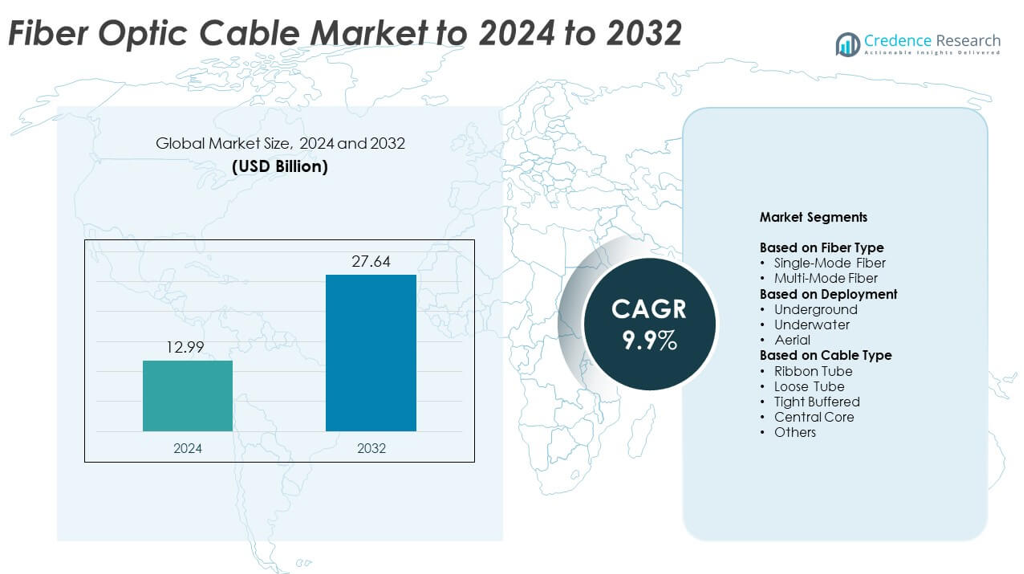
The Fiber Optic Cable market size was valued at USD 12.99 billion in 2024 and is anticipated to reach USD 27.64 billion by 2032, at a CAGR of 9.9% during the forecast period.
| REPORT ATTRIBUTE | DETAILS |
|---|---|
| Historical Period | 2020-2023 |
| Base Year | 2024 |
| Forecast Period | 2025-2032 |
| Fiber Optic Cable market Size 2024 | USD 12.99 billion |
| Fiber Optic Cable market, CAGR | 9.9% |
| Fiber Optic Cable market Size 2032 | USD 27.64 billion |
The Fiber Optic Cable market is led by key players such as Prysmian Group, Corning Incorporated, CommScope Holding Company Inc., Fujikura Ltd., Sumitomo Electric Industries Ltd., Sterlite Technologies Ltd., Lumen Tech, Yangtze Optical Fiber and Cable Joint Stock Ltd Co., Furukawa Electric, and SNL Tech. These companies focus on expanding fiber production capacity, developing advanced cable designs, and forming strategic partnerships with telecom and cloud service providers. Asia Pacific dominated the global market with a 32% share in 2024, driven by large-scale 5G rollouts, strong broadband initiatives, and rapid infrastructure modernization. North America followed with 34%, supported by extensive data center growth and digital transformation efforts.
Market Insights
- The Fiber Optic Cable market was valued at USD 12.99 billion in 2024 and is projected to reach USD 27.64 billion by 2032, growing at a CAGR of 9.9%.
- Growing demand for high-speed connectivity, 5G expansion, and data center development are major drivers fueling market growth.
- The market is witnessing strong trends in FTTH adoption, smart city infrastructure, and underwater cable network expansion across key economies.
- Competition remains intense with leading players investing in product innovation, sustainability, and large-scale global partnerships to strengthen their market presence.
- Asia Pacific led with a 32% share, followed by North America at 34%, while the single-mode fiber segment dominated with over 67% share in 2024, driven by superior long-distance transmission and low latency capabilities.
Market Segmentation Analysis:
By Fiber Type
Single-mode fiber dominated the market with over 67% share in 2024. Its dominance is driven by higher bandwidth capacity and long-distance transmission efficiency, making it ideal for 5G networks and data center interconnections. Multi-mode fiber held a smaller share due to limited range but remained relevant for short-distance communication in enterprises and campuses. Growing internet penetration, expansion of high-speed broadband infrastructure, and increased demand for cloud connectivity are major drivers supporting single-mode fiber adoption worldwide.
- For instance, Corning manufactured its 1 billionth kilometer of optical fiber in 2017 and has produced a significantly greater amount since then.
By Deployment
The underground segment accounted for around 58% share in 2024, emerging as the leading deployment method. Its dominance is supported by better protection against environmental damage and consistent signal performance. Governments and telecom operators are investing heavily in underground fiber networks to enhance reliability and reduce maintenance costs. The underwater segment is expanding rapidly due to growing intercontinental data traffic, while aerial deployment is preferred for rural or temporary installations due to cost benefits and easy setup.
- For instance, Openreach has rolled out full fibre to 20 million UK premises.
By Cable Type
Loose tube cables led the market with nearly 42% share in 2024. Their high flexibility, moisture resistance, and suitability for outdoor installations make them ideal for long-distance telecommunication networks. Ribbon tube cables are gaining momentum in data centers and FTTH applications for their high fiber density and faster splicing. Tight buffered and central core types serve specialized indoor and industrial uses. Growing demand for durable, high-performance fiber cables and rising smart city projects are fueling adoption across telecommunication and infrastructure sectors.
Key Growth Drivers
Rising 5G Network Expansion
The rollout of 5G networks is a major growth driver for the fiber optic cable market. Telecom operators are heavily investing in fiber infrastructure to support high-speed data transfer and low latency. Single-mode fiber cables are widely used for backhaul connectivity in 5G base stations. Expanding digital infrastructure in developing economies and the rising adoption of smart devices are further accelerating demand. The integration of IoT-based communication networks also strengthens fiber optic deployments for faster and more reliable data transmission.
- For instance, China Mobile announced in March 2025 that it plans to reach nearly 2.8 million 5G base stations by the end of 2025.
Growing Data Center Construction
The rising number of data centers worldwide significantly drives market growth. Cloud computing, artificial intelligence, and enterprise digitization are boosting the need for high-speed connectivity. Fiber optic cables are preferred in hyperscale and edge data centers for their bandwidth capacity and energy efficiency. Major tech companies are expanding fiber-based networks to handle massive data traffic efficiently. This trend aligns with increasing investments in submarine fiber links and colocation facilities to enhance global data exchange capabilities.
- For instance, Broadcom’s Bailly CPO switch delivers 51.2 Tbps per device.
Government-led Broadband Initiatives
Government programs promoting high-speed broadband networks are fueling fiber optic cable demand. Several nations are investing in national fiber rollouts to enhance internet access and bridge digital gaps. Public-private partnerships are increasing to deploy fiber in rural and semi-urban regions. Policies promoting smart city development and digital education further strengthen the market. These initiatives not only boost fiber cable production but also encourage innovations in cost-effective installation and maintenance technologies.
Key Trends and Opportunities
Shift Toward Fiber-to-the-Home (FTTH)
The global shift toward FTTH connections is creating major opportunities for fiber optic cable suppliers. Rising demand for high-speed home internet, driven by streaming, gaming, and remote work, is accelerating FTTH installations. Urbanization and digital transformation in residential areas are leading telecom operators to replace legacy copper networks with optical fiber. The trend also supports future-ready smart home ecosystems, improving energy management and connectivity performance.
- For instance, Verizon announced in September 2024 its plan to acquire Frontier, which, combined with its own network, is projected to enable it to pass over 25 million premises with fiber by the time the deal closes in early 2026.
Emergence of Smart Infrastructure Projects
Smart city and digital infrastructure projects are boosting the adoption of fiber networks. Governments and enterprises are deploying fiber-based connectivity to support real-time monitoring, surveillance, and automation. These projects require low-latency, high-capacity networks that only fiber can provide. Expanding investments in industrial automation, intelligent transportation, and cloud integration present strong growth potential for fiber optic cable manufacturers and installers across both developed and emerging markets.
- For instance, Google’s Dunant subsea cable provides 250 Tbps trans-Atlantic capacity.
Key Challenges
High Installation and Maintenance Costs
The high initial cost of fiber installation remains a key challenge in many regions. Laying fiber cables underground or underwater involves significant labor, equipment, and regulatory expenses. Maintenance in difficult terrains or densely populated areas further adds to operational costs. These factors often restrict adoption in low-income or rural zones where wireless alternatives seem more economical. Reducing installation costs through modular and pre-terminated cable solutions is becoming critical for broader market penetration.
Competition from Wireless Communication Technologies
Rising advancements in wireless communication, including satellite internet and fixed wireless access, pose a challenge to fiber optic cable adoption. Wireless solutions offer faster deployment and lower infrastructure requirements, appealing to remote and underdeveloped regions. Although fiber delivers superior bandwidth and reliability, competition from evolving wireless systems can slow its market penetration. The industry must focus on hybrid connectivity solutions that integrate fiber and wireless technologies to maintain long-term competitiveness.
Regional Analysis
North America
North America held a 34% share of the global fiber optic cable market in 2024. The region benefits from rapid 5G network expansion, strong data center construction, and increasing broadband adoption. The United States leads with major investments from telecom giants and cloud providers focusing on high-speed connectivity. Government programs supporting rural broadband deployment further boost fiber installations. Rising adoption of smart city projects and connected devices continues to drive demand. Canada and Mexico also contribute to market growth through ongoing infrastructure modernization and enterprise digital transformation initiatives.
Europe
Europe accounted for 28% of the fiber optic cable market in 2024. The region’s growth is driven by the expansion of FTTH networks and stringent EU policies promoting digital infrastructure. Countries such as Germany, France, and the UK are investing heavily in fiber deployment to replace copper networks. Increased demand for cloud-based services and high-speed internet across urban areas strengthens the market. Public and private partnerships are enhancing connectivity in rural regions, while advancements in data transmission technologies continue to accelerate fiber adoption across the continent.
Asia Pacific
Asia Pacific dominated the market with a 32% share in 2024, emerging as the fastest-growing region. Rapid urbanization, strong government digitalization programs, and large-scale 5G rollouts are key growth drivers. China leads with extensive national fiber networks supporting both commercial and residential connectivity. India, Japan, and South Korea are also witnessing major expansions in data centers and broadband access. Growing e-commerce, industrial automation, and IoT integration further contribute to strong regional demand for fiber optic infrastructure across telecom and enterprise applications.
Latin America
Latin America captured an 8% share of the fiber optic cable market in 2024. The region’s growth is supported by increasing broadband penetration and modernization of telecommunications networks. Brazil and Mexico are the leading contributors with heavy investments in FTTH and 5G infrastructure. Growing government support for digital inclusion programs is driving fiber installations in underserved areas. The rising demand for streaming services and cloud applications further supports expansion, while international partnerships are enhancing regional connectivity and boosting fiber manufacturing capacity.
Middle East and Africa
The Middle East and Africa region accounted for a 6% market share in 2024. Increasing investments in smart city development, 5G deployment, and cross-border data cables are fueling market growth. The UAE, Saudi Arabia, and South Africa lead the region with ongoing national broadband projects. Rapid digital transformation across industries, coupled with growing internet user bases, supports fiber optic expansion. However, high installation costs and limited rural coverage remain challenges. Efforts to enhance regional data hubs and strengthen submarine cable networks are expected to drive future growth.
Market Segmentations:
By Fiber Type
- Single-Mode Fiber
- Multi-Mode Fiber
By Deployment
- Underground
- Underwater
- Aerial
By Cable Type
- Ribbon Tube
- Loose Tube
- Tight Buffered
- Central Core
- Others
By Geography
- North America
- U.S.
- Canada
- Mexico
- Europe
- Germany
- France
- U.K.
- Italy
- Spain
- Rest of Europe
- Asia Pacific
- China
- Japan
- India
- South Korea
- South-east Asia
- Rest of Asia Pacific
- Latin America
- Brazil
- Argentina
- Rest of Latin America
- Middle East & Africa
- GCC Countries
- South Africa
- Rest of the Middle East and Africa
Competitive Landscape
The Fiber Optic Cable market is highly competitive, featuring major players such as Prysmian Group, Corning Incorporated, CommScope Holding Company Inc., Fujikura Ltd., Sumitomo Electric Industries Ltd., Sterlite Technologies Ltd., Lumen Tech, Yangtze Optical Fiber and Cable Joint Stock Ltd Co., Furukawa Electric, and SNL Tech. These companies compete through technological innovation, large-scale production capacity, and global distribution networks. Market participants focus on expanding fiber manufacturing facilities and enhancing product efficiency to meet growing 5G and broadband demands. Strategic partnerships with telecom operators, governments, and cloud providers support large infrastructure projects. Continuous R&D efforts target improved fiber durability, higher bandwidth capacity, and cost-effective installation solutions. Companies are also investing in eco-friendly manufacturing and recyclable fiber materials to align with sustainability goals. Intense competition drives pricing strategies and regional expansion, ensuring strong presence across key markets in North America, Europe, and the Asia Pacific region.
Key Player Analysis
- Prysmian Group
- Corning Incorporated
- CommScope Holding Company Inc.
- Fujikura Ltd.
- Sumitomo Electric Industries Ltd.
- Sterlite Technologies Ltd.
- Lumen Tech
- Yangtze Optical Fiber and Cable Joint Stock Ltd Co.
- Furukawa Electric
- SNL Tech
Recent Developments
- In 2024, Sterlite technologies ltd announced the production of fibre optic cables in US.
- In 2023, Corning opened a new optical cable manufacturing campus in North Carolina
- In 2023, Prysmian Group launched a 16-fiber FlexRibbon™ cable designed for high-speed data center applications.
Report Coverage
The research report offers an in-depth analysis based on Fiber Type, Deployment, Cable Type and Geography. It details leading market players, providing an overview of their business, product offerings, investments, revenue streams, and key applications. Additionally, the report includes insights into the competitive environment, SWOT analysis, current market trends, as well as the primary drivers and constraints. Furthermore, it discusses various factors that have driven market expansion in recent years. The report also explores market dynamics, regulatory scenarios, and technological advancements that are shaping the industry. It assesses the impact of external factors and global economic changes on market growth. Lastly, it provides strategic recommendations for new entrants and established companies to navigate the complexities of the market.
Future Outlook
- The market will grow rapidly due to rising global broadband and 5G network expansion.
- Increased demand for FTTH connections will drive large-scale residential fiber installations.
- Government digitalization projects and public–private partnerships will enhance fiber adoption.
- The surge in data center construction will boost long-distance and high-bandwidth fiber demand.
- Emerging smart city projects will accelerate fiber deployments across public infrastructure.
- Advancements in submarine and intercontinental fiber networks will improve global connectivity.
- The integration of IoT and AI applications will increase data traffic, strengthening fiber demand.
- Continuous innovation in lightweight and high-capacity fiber designs will improve network performance.
- Partnerships between telecom operators and technology providers will expand deployment capabilities.
- The shift toward sustainable, energy-efficient networks will encourage eco-friendly fiber manufacturing.

Request a Free Sample
Fill in your details and we'll send you a free sample report.
- Sample data tables & charts
- Research methodology
Market Dynamics
5G Network Expansion
The global rollout of 5G networks is driving significant investment in fiber optic infrastructure, as telecom operators require high-capacity, low-latency backhaul connections that only fiber can provide. This is accelerating demand for single-mode fiber cables, especially in urban and high-traffic areas.
Data Center Construction Boom
The rapid increase in hyperscale and edge data centers, fueled by cloud computing, AI, and enterprise digitization, is boosting the need for high-bandwidth, energy-efficient fiber optic cables. Fiber is preferred for its ability to handle massive data traffic and support long-distance, high-speed connectivity between facilities.
Government-led Broadband Initiatives
National and regional government programs aimed at expanding high-speed broadband access are fueling fiber optic cable deployments, particularly in underserved and rural areas. Public-private partnerships and digital inclusion policies are accelerating large-scale fiber rollouts and infrastructure modernization.
Shift Toward Fiber-to-the-Home (FTTH)
Rising consumer demand for high-speed internet, driven by streaming, gaming, and remote work, is leading telecom operators to replace legacy copper networks with fiber. The global transition to FTTH is creating substantial opportunities for fiber optic cable suppliers in residential and urban markets.
Emergence of Smart Infrastructure Projects
Smart city and digital infrastructure initiatives require robust, low-latency networks for real-time monitoring, automation, and IoT integration. Fiber optic cables are essential for supporting these applications, driving adoption across both developed and emerging economies.
Need a Custom Version of This Report?
Tailor the scope, geography, or segments to your exact requirements.
- Custom geography or segment scope
- Direct access to our analyst team
Frequently Asked Questions
What is the current market size for Fiber Optic Cable Market, and what is its projected size in 2032?
At what Compound Annual Growth Rate is the Fiber Optic Cable Market projected to grow between 2025 and 2032?
Which Fiber Optic Cable Market segment held the largest share in 2024?
What are the primary factors fueling the growth of the Fiber Optic Cable Market?
Table of Content
Chapter 1 Market Segmentation
- 1.1 Segmentation Framework
- 1.1.1 Product and Service Classification
- 1.1.2 Application and End-Use Classification
- 1.1.3 Technology and Solution Classification
- 1.1.4 Customer and Distribution Channel Classification
- 1.1.5 Geographic Segmentation
- 1.1.6 Market Segment Definitions and Boundaries
- 1.2 By Cable Type
- 1.2.1 Ribbon Tube
- 1.2.2 Loose Tube
- 1.2.3 Tight Buffered
- 1.2.4 Central Core
- 1.2.5 Others
- 1.3 By Deployment
- 1.3.1 Underground
- 1.3.2 Underwater
- 1.3.3 Aerial
- 1.4 By Fiber Type
- 1.4.1 Single-Mode Fiber
- 1.4.2 Multi-Mode Fiber
Chapter 2 Introduction
- 2.1 Report Objectives and Scope
- 2.2 Product Definition and Industry Terminology
- 2.3 Market Inclusions and Exclusions
- 2.4 Research Process
- 2.4.1 Primary Research and Expert Interviews
- 2.4.2 Secondary Research and Source Review
- 2.4.3 Top-Down and Bottom-Up Estimation
- 2.4.4 Data Triangulation and Verification
- 2.5 Market Size Measurement Basis
- 2.5.1 2024: USD 12.99 billion → 2032: USD 27.64 billion
- 2.6 Historical and Forecast Reference Periods
- 2.6.1 Base Year: 2024
- 2.6.2 Forecast Period: 2024-2032
- 2.7 Research Assumptions and Limitations
Chapter 3 Executive Summary
- 3.1 Market Snapshot and Key Findings
- 3.2 Base-Year Market Size, 2024
- 3.3 Forecast Market Size, 2032
- 3.4 Revenue and Volume Growth Outlook
- 3.5 Key Demand and Supply Indicators
- 3.6 Leading Market Segments
- 3.7 Fastest-Growing Market Opportunities
- 3.8 Regional Performance Highlights
- 3.9 Technology and Industry Transformation
- 3.10 Competitive Landscape Summary
- 3.11 Analyst View and Strategic Implications
Chapter 4 Global Fiber Optic Cables Market Trends and Developments
- 4.1 Historical Industry Development
- 4.2 Recent Market Trends and Developments
- 4.3 Demand and Customer Behavior Trends
- 4.4 Technology and Product Innovation
- 4.5 Artificial Intelligence, Automation and Digitalization
- 4.6 Local Manufacturing and Supply Chain Realignment
- 4.7 Industry Partnerships, Mergers and Acquisitions
- 4.8 Sustainability and Circular Economy Developments
- 4.9 Government and Private Sector Investment Trends
- 4.10 Emerging Business Models and Commercialization
- 4.11 Industry Developments and Announcements
Chapter 5 Global Fiber Optic Cables Market Production, Supply and Demand Analysis
- 5.1 Demand Trend and Consumption Analysis
- 5.2 Demand Forecast, 2024-2032
- 5.3 Production and Output Trend
- 5.4 Production and Output Forecast, 2024-2032
- 5.5 Installed Capacity and Capacity Utilization
- 5.6 Company-Wise Production Plants and Statistics
- 5.6.1 Installed Production Capacity
- 5.6.2 Actual Production
- 5.6.3 Planned Capacity and Expansion Targets
- 5.7 Supply Chain Structure and Procurement Trends
- 5.8 Supply-Demand Gap and Bottlenecks
- 5.9 Import Dependence and Sourcing Structure
- 5.10 Contract Manufacturing and Outsourcing
- 5.11 Regional Supply and Demand Concentration
Chapter 6 Global Fiber Optic Cables Market Pricing Analysis
- 6.1 Pricing Structure and Measurement
- 6.2 Historical Pricing Trends
- 6.3 Pricing Outlook, 2024-2032
- 6.4 Average Selling Price and Unit Economics
- 6.5 Pricing by Product and Market Segment
- 6.6 Geographic Pricing Differences
- 6.7 Key Input, Energy, Labor and Logistics Costs
- 6.8 Contract Pricing and Purchasing Models
- 6.9 Pricing Sensitivity and Competitive Positioning
- 6.10 Price, Margin and Profitability Implications
Chapter 7 Global Fiber Optic Cables Market Dynamics
- 7.1 Market Growth Drivers
- 7.1.1 Demand-Side Drivers
- 7.1.2 Technology and Innovation Drivers
- 7.1.3 Infrastructure and Investment Drivers
- 7.1.4 Regulatory and Policy Drivers
- 7.2 Market Restraints
- 7.2.1 Cost and Affordability Constraints
- 7.2.2 Technology and Adoption Barriers
- 7.2.3 Supply Chain and Operational Constraints
- 7.3 Market Challenges
- 7.3.1 Competitive Pressure and Margin Erosion
- 7.3.2 Skills, Infrastructure and Implementation Gaps
- 7.4 Emerging Market Opportunities
- 7.5 Market Dynamics Impact and Time-Horizon Assessment
Chapter 8 Global Fiber Optic Cables Value Chain Analysis
- 8.1 Industry Value Chain Overview
- 8.2 Upstream Suppliers and Critical Inputs
- 8.3 Technology and Component Providers
- 8.4 Manufacturing or Service Delivery
- 8.5 Distribution, Channel Partners and Integrators
- 8.6 Downstream Applications and End Users
- 8.7 Value Addition and Profit Pools
- 8.8 Vertical Integration and Outsourcing
- 8.9 Supplier Concentration and Risk
- 8.10 Supply Chain Localization and Resilience
Chapter 9 Global Fiber Optic Cables Market Regulations and Policies
- 9.1 Relevant Laws, Standards and Compliance Frameworks
- 9.2 Product, Service, Safety and Quality Requirements
- 9.3 Government Policies, Incentives and Subsidies
- 9.4 Imports, Exports and Trade Barriers
- 9.5 Public Procurement and Local Content Requirements
- 9.6 Environmental and Sustainability Compliance
- 9.7 Data Protection, AI and Cybersecurity Compliance
- 9.8 Upcoming Policy Changes and Market Implications
Chapter 10 Global Fiber Optic Cables Market Hotspots and Opportunities
- 10.1 Market Opportunity Mapping and Growth Hotspots
- 10.2 High-Growth Applications and Customer Groups
- 10.3 Underserved Markets and White-Space Opportunities
- 10.4 Emerging Technology and Product Opportunities
- 10.5 New Capacity and Investment Hotspots
- 10.6 Market Entry and Expansion Opportunities
- 10.7 Distribution and Partnership Opportunities
- 10.8 Near-Term and Long-Term Commercial Potential
- 10.9 Opportunity Attractiveness and Execution Risks
Chapter 11 Global Fiber Optic Cables Market Outlook, 2024-2032
- 11.1 Market Size and Analysis
- 11.1.1 Revenue (Market Measurement: 2024: USD 12.99 billion → 2032: USD 27.64 billion)
- 11.1.2 Market Volume and Quantity Sold
- 11.1.3 Historical Market Size
- 11.1.4 Base-Year Market Size, 2024
- 11.2 Market Forecast, 2024-2032
- 11.2.1 Revenue Forecast to 2032
- 11.2.2 Volume Forecast to 2032
- 11.2.3 CAGR and Year-on-Year Growth
- 11.2.4 Incremental Revenue Opportunity
- 11.3 Forecast Assumptions and Scenario Analysis
- 11.3.1 Base-Case Forecast
- 11.3.2 Optimistic and Conservative Scenarios
- 11.3.3 Technology, Pricing and Policy Sensitivities
- 11.4 Market Attractiveness and Growth Outlook
Chapter 12 Global Fiber Optic Cables Market Segmentation and Outlook
- 12.1 Segmentation Summary and Market Shares, 2024
- 12.2 Largest and Fastest-Growing Segments
- 12.3 By Cable Type - Market Size and Forecast, 2024-2032
- 12.3.1 Segment Definition and Scope
- 12.3.2 Historical Market Size
- 12.3.3 Revenue Forecast, 2024-2032
- 12.3.4 Volume Forecast, 2024-2032
- 12.3.5 Base-Year Market Share, 2024
- 12.3.6 Segment CAGR and Growth Drivers
- 12.3.7 Subsegment Market Size and Forecast
- 12.3.7.1 Ribbon Tube
- 12.3.7.2 Loose Tube
- 12.3.7.3 Tight Buffered
- 12.3.7.4 Central Core
- 12.3.7.5 Others
- 12.3.8 Subsegment Pricing and Adoption Trends
- 12.3.9 Leading Suppliers and Competition
- 12.3.10 Regional Demand and Opportunities
- 12.4 By Deployment - Market Size and Forecast, 2024-2032
- 12.4.1 Segment Definition and Scope
- 12.4.2 Historical Market Size
- 12.4.3 Revenue Forecast, 2024-2032
- 12.4.4 Volume Forecast, 2024-2032
- 12.4.5 Base-Year Market Share, 2024
- 12.4.6 Segment CAGR and Growth Drivers
- 12.4.7 Subsegment Market Size and Forecast
- 12.4.7.1 Underground
- 12.4.7.2 Underwater
- 12.4.7.3 Aerial
- 12.4.8 Subsegment Pricing and Adoption Trends
- 12.4.9 Leading Suppliers and Competition
- 12.4.10 Regional Demand and Opportunities
- 12.5 By Fiber Type - Market Size and Forecast, 2024-2032
- 12.5.1 Segment Definition and Scope
- 12.5.2 Historical Market Size
- 12.5.3 Revenue Forecast, 2024-2032
- 12.5.4 Volume Forecast, 2024-2032
- 12.5.5 Base-Year Market Share, 2024
- 12.5.6 Segment CAGR and Growth Drivers
- 12.5.7 Subsegment Market Size and Forecast
- 12.5.7.1 Single-Mode Fiber
- 12.5.7.2 Multi-Mode Fiber
- 12.5.8 Subsegment Pricing and Adoption Trends
- 12.5.9 Leading Suppliers and Competition
- 12.5.10 Regional Demand and Opportunities
- 12.6 Segment Growth Comparison
- 12.7 Segment Attractiveness and Priority Matrix
Chapter 13 Global Fiber Optic Cables Geographic Market Outlook, 2024-2032
- 13.1 Regional Market Size and Share, 2024
- 13.2 Regional Market Forecast, 2024-2032
- 13.3 Regional Pricing, Production and Demand Differences
- 13.4 North America
- 13.4.1 United States
- 13.4.2 Canada
- 13.4.3 Mexico
- 13.5 Europe
- 13.5.1 Germany
- 13.5.2 France
- 13.5.3 Italy
- 13.5.4 United Kingdom
- 13.5.5 Spain
- 13.5.6 Poland
- 13.5.7 Russia
- 13.5.8 Netherlands
- 13.5.9 Belgium
- 13.5.10 Sweden
- 13.5.11 Denmark
- 13.5.12 Norway
- 13.5.13 Rest of Europe
- 13.6 Asia Pacific
- 13.6.1 China
- 13.6.2 India
- 13.6.3 Japan
- 13.6.4 South Korea
- 13.6.5 Thailand
- 13.6.6 Indonesia
- 13.6.7 Vietnam
- 13.6.8 Malaysia
- 13.6.9 Australia
- 13.6.10 Rest of Asia Pacific
- 13.7 Latin America
- 13.7.1 Brazil
- 13.7.2 Argentina
- 13.7.3 Colombia
- 13.7.4 Chile
- 13.7.5 Rest of Latin America
- 13.8 Middle East
- 13.8.1 Saudi Arabia
- 13.8.2 United Arab Emirates
- 13.8.3 Turkey
- 13.8.4 Israel
- 13.8.5 Iran
- 13.8.6 Rest of the Middle East
- 13.9 Africa
- 13.9.1 South Africa
- 13.9.2 Egypt
- 13.9.3 Nigeria
- 13.9.4 Morocco
- 13.9.5 Rest of Africa
- 13.10 Regional Investment, Policy and Supply Chain Differences
- 13.11 Regional Competitive Landscape
- 13.12 Geographic Growth Hotspots
Chapter 14 Global Fiber Optic Cables Technology, Innovation and Sustainability Outlook
- 14.1 Technology Landscape and Maturity
- 14.2 Product, Process and Service Innovation
- 14.3 AI, Automation and Digital Tools in the Industry
- 14.4 Technology Adoption and Performance Benchmarking
- 14.5 Innovation Pipeline and R&D Investment
- 14.6 Patent and Intellectual Property Trends
- 14.7 Energy Efficiency and Resource Management
- 14.8 Sustainability, Recycling and Circularity
- 14.9 Technology Roadmap, 2024-2032
- 14.10 Risks of Obsolescence and Technology Substitution
Chapter 15 Global Fiber Optic Cables Market Key Strategic Imperatives
- 15.1 Growth and Market Entry Priorities
- 15.2 High-Return Products and Segments
- 15.3 Pricing, Profitability and Cost Optimization
- 15.4 Technology Investment and Product Differentiation
- 15.5 Supply Chain Localization and Resilience
- 15.6 Distribution and Customer Acquisition
- 15.7 Partnership, Acquisition and Capacity Strategy
- 15.8 Regional Expansion Priorities
- 15.9 Short-, Medium- and Long-Term Actions
Chapter 16 Competition Outlook
- 16.1 Industry Competition Characteristics
- 16.2 Market Structure and Concentration
- 16.3 Market Share and Competitive Positioning, 2024
- 16.4 Company-Wise Revenue and Product Benchmarking
- 16.5 Production and Service Capacity Benchmarking
- 16.6 Technology, Pricing and Differentiation
- 16.7 Regional Footprint and Distribution Strength
- 16.8 Mergers, Acquisitions and Strategic Alliances
- 16.9 New Entrants and Competitive Threats
- 16.10 Porter's Five Forces and Industry Attractiveness
- 16.11 Competitive Outlook, 2024-2032
Chapter 17 Company Profiles
- 17.1 Company Coverage and Selection Criteria
- 17.2 Prysmian Group
- 17.2.1 Business Description
- 17.2.2 Company Ownership and Geographic Presence
- 17.2.3 Product and Service Portfolio
- 17.2.4 Manufacturing and Operating Footprint
- 17.2.5 Production Capacity and Expansion Plans
- 17.2.6 Financial Performance and Investment
- 17.2.7 Market Share and Competitive Position
- 17.2.8 Technology and Innovation Capabilities
- 17.2.9 Strategic Alliances or Partnerships
- 17.2.10 Recent Developments
- 17.2.11 Growth Strategy and Outlook
- 17.3 Corning Incorporated
- 17.4 CommScope Holding Company Inc.
- 17.5 Fujikura Ltd.
- 17.6 Sumitomo Electric Industries Ltd.
- 17.7 Sterlite Technologies Ltd.
- 17.8 Lumen Tech
- 17.9 Yangtze Optical Fiber and Cable Joint Stock Ltd Co.
- 17.10 Furukawa Electric
- 17.11 SNL Tech
- 17.12 Other Relevant Market Participants
Note: Every listed company is profiled on the structure shown under the first company. The company list is preliminary and may change based on research findings, market developments, data availability and client requirements.
Chapter 18 Disclaimer
- 18.1 Research and Forecast Disclaimer
- 18.2 Data Source and Estimation Limitations
Note: The depth of individual sections depends on data availability for this market. Volume, capacity, trade and other unit-based metrics are included where applicable.