
| REPORT ATTRIBUTE | DETAILS |
|---|---|
| Historical Period | 2019-2022 |
| Base Year | 2023 |
| Forecast Period | 2024-2032 |
| Food Containers Market Size 2023 | USD 148295.2 million |
| Food Containers Market, CAGR | 4.50% |
| Food Containers Market Size 2032 | USD 220380.77 million |
Market Insights
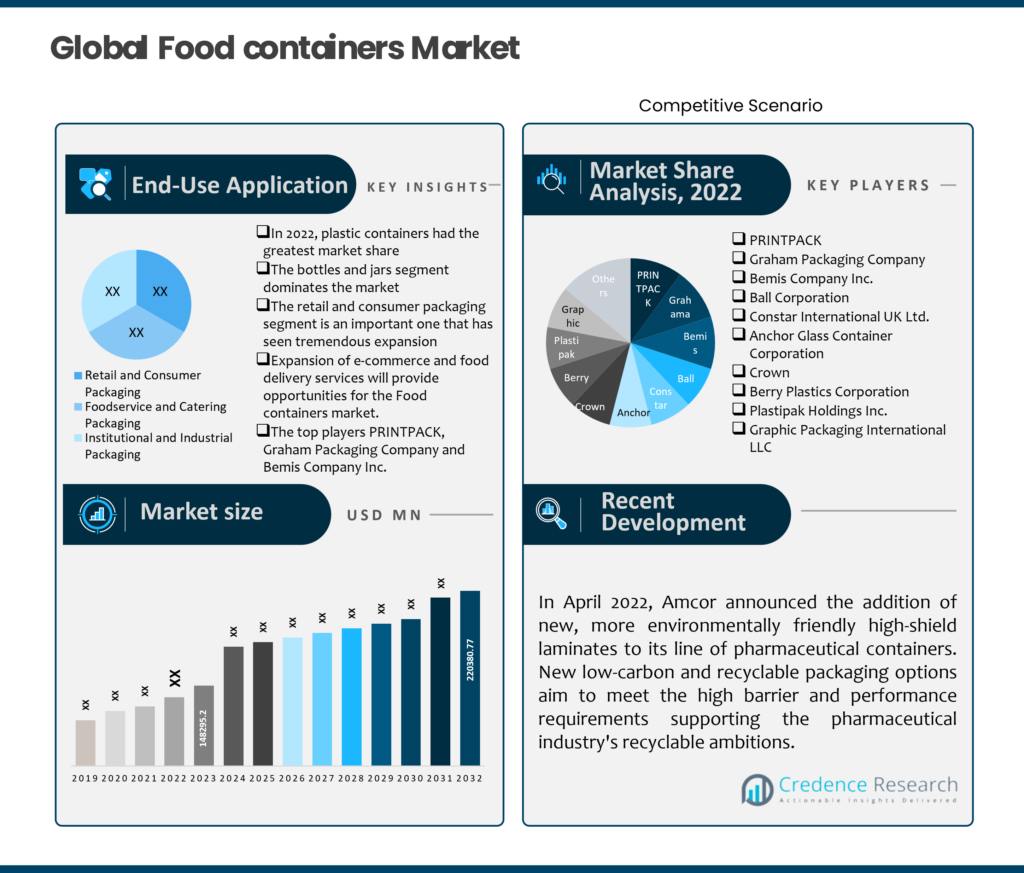
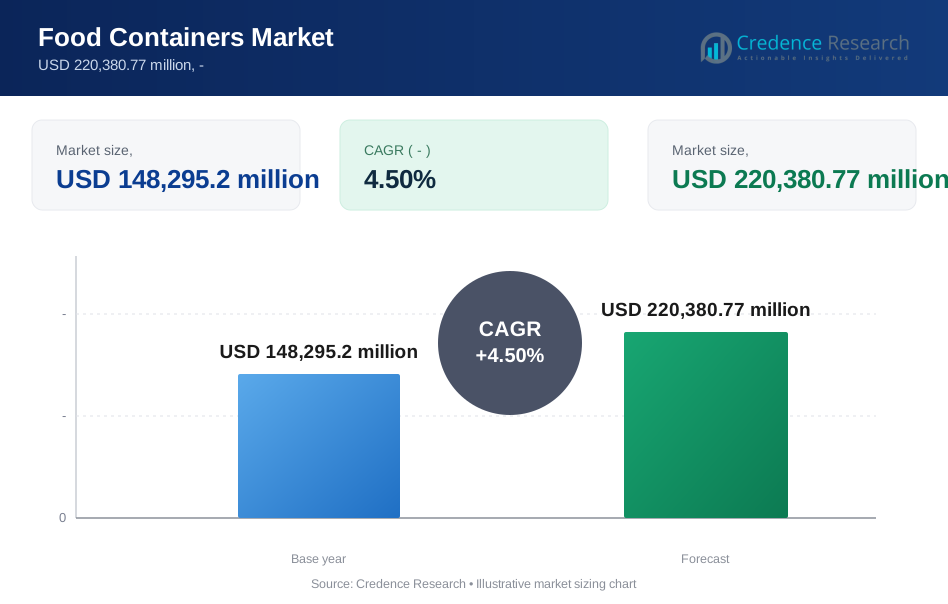
- The global market for food containers is expected to develop at a compound annual growth rate (CAGR) of 4.50% between 2024 and 2032, from its estimated USD 148295.2 million in 2023 to USD 220380.77 million in 2032.
- The largest category is plastic containers. Paperboard containers, on the other hand, are expected to grow at a strong CAGR.
- The bottles and jars category will expand at a rapid rate of growth.
- The CAGR for retail and consumer packaging is expected to be the highest during the projection period.
- The microwaveable containers will have the highest CAGR throughout the prediction period.
- Asia Pacific dominated the food container market.
- Regarding the market share of food containers, Europe is expected to come second.
- In the food containers market, North America is anticipated to grow fastest.
- The factors that are propelling the growth of the global market include the rise in food delivery applications, which requires strong packaging solutions to keep food fresh and prevent spills, and the development of transportation networks, which calls for sturdy packaging to endure handling and transit.
- The use of smart packaging technologies like freshness indicators and RFID tags, growing urbanization, and increased disposable incomes in developing countries may impact the food container industry.
Executive Summary
Market Definition
Food products are kept at room temperature in a food storage container in the refrigerator or freezer. Food goods can be stored in a variety of containers, including cartons, jars and bottles, cans, bags, cups, and tubs. Many considerations need to be made before selecting the appropriate kind of container. They take into account the manner of storage, such as freezing, refrigeration, or room temperature, the duration of the storage period, the variety of food, and the available area for storage.
Market Overview
The food containers sector is estimated to develop at a 4.50% compound annual growth rate (CAGR) between 2024 and 2032, maintaining its current upward trend. The market will continue to develop, rising from its estimated USD 148295.2 million in 2023 to USD 220380.77 million in 2032.
Containers for storing food at home help to maintain food safety and quality. Food types, packaging, and storage conditions, especially temperature and humidity, all affect how best to store food in the house. Containers can extend the shelf life of food. These days, a wide variety of food containers and packaging choices made of diverse materials are accessible. Because of the busy lifestyles that people have adopted in the modern world, particularly in industrialized nations, customers are becoming more and more concerned about maintaining the quality of their food wherever they are. Consumers seek out premium products that are visually appealing, airtight, leak-proof, and micro-capable. Currently, food container manufacturers prioritize adjusting to these evolving consumer demands.
The factors influencing market value are increased disposable income, high packaged food consumption, and strong household demand. The market is expanding as a result of shifting consumer preferences, an increase in the proportion of working-age women, and an increase in the number of dual-income households.
Segmentation by Material Type
- Plastic containers are the market leader by material type. Plastic containers are adaptable for packaging a wide range of food goods since they are available in an array of sizes, shapes, and forms. Plastic containers are suitable for holding a variety of food products, including liquids, solids, and semi-liquids, in sizes ranging from tiny individual amounts to significant bulk packaging.
- The paperboard containers category will exhibit a sizable CAGR during the projected period. A wide variety of food products are packaged in paperboard containers, including dairy products, prepared foods, and chilled or frozen foods like ice cream, frozen meals, and bakery items. Paperboard containers are also used to package dry goods like cereal, snacks, and bakery items. Additionally, fresh vegetables, candies, drinks, and specialty food items are frequently packaged using them.
- Other material types, including metal containers, glass containers, and biodegradable and compostable containers, also support the need for food containers.
Segmentation by Product Type
- Bottles and jars are considered the best product type category. Jars and bottles are adaptable food packaging containers that can hold a wide range of items, including pickled foods, cooking oils, spices, and more. Condiments include mustard, ketchup, and salad dressings.
- The boxes and cartons category will likely register a significant CAGR during forecasting. These paperboard-based containers are reasonably priced and lightweight. Products, including cereals, snacks, pasta, and baked goods, are frequently packaged with them. Due to their folding features, paperboard boxes can also be easily assembled and closed. They can also be printed and labeled with product information and branding.
- Other product types, such as trays and tubs, cups and lids, and pouches and bags, also contribute to the demand for food containers.
Segmentation by End-Use Application
- The retail and consumer packaging category is projected to grow faster over the projection period. Labeling and branding components are frequently used in retail and consumer packaging in the food containers market to tell consumers important information and set products apart on shop shelves. Product names, ingredients, nutritional information, expiration dates, cooking directions, and branding components like colors, logos, and slogans can all be found on labels. Good labeling and branding contribute to consumer trust, brand identification, and purchasing decisions.
- Other end-use applications influence the need for food containers, including food service and catering packaging and institutional and industrial packaging.
Segmentation by Special Features and Functions
- The microwaveable containers category will likely have the highest CAGR during the projection period. Microwaveable containers are available in a range of sizes and forms to suit different food kinds and portion quantities. They might have steam vents or vented lids that let steam escape while cooking, avoiding pressure buildup and guaranteeing uniform cooking.
- Other end-use industries, such as freezer-safe containers, tamper-evident packaging, recyclable and recycled content, and customizable and branded packaging, also contribute to the demand for food containers.
Segmentation by Region
- The Asia Pacific leads the food container industry. Strong government assistance has contributed to the region's rapid growth. China, Japan, and India are major contributors to the expansion of the APAC regional market.
- Europe is estimated to rank second in food container market size.
- The food container industry is predicted to flourish rapidly in North America.
- Regions such as Africa, the Middle East, and Latin America cover the remaining requirement for food containers.
The United Nations, Food and Agriculture Organization, reports that developments in food science and technology are quickly changing the landscape of food safety. Food production, processing, and packaging have all benefited from these technological developments, which have also made it easier to trace food, detect toxins in food, and monitor epidemics. The strong demand for packaging innovations that have resulted from this technological boom is a key trend for the expansion of the industry.
Based on projections, the food container market is anticipated to be controlled by Asia Pacific. Robust government support has enabled the food processing business in the region to flourish at a rapid pace. The main nations that have contributed to the development of the APAC regional market are China, Japan, and India. Eighteen mega food parks are currently operating in India, while 19 more are planned, according to Invest India. The Kraft Heinz Company, Danone, Nestle, McCain, and Mars are a few of the leading investors in the Indian food sector. In the year 2020, India exported seafood valued at USD 6.68 billion, weighing about 1,290 kilo tons.
The food containers market in North America is anticipated to expand fastest throughout the forecast. This trend can be attributed to the growing appetite for packaged and convenience foods among the working population. The food containers market expansion in the area is also being accelerated by the United States' rising demand for canned goods, such as meat and fish cans. Data from Delaware Sea Grant showed that canned shrimp, salmon, and tuna accounted for nearly 55% of all seafood consumed in the United States.
Key Highlights of the Report
The global food containers market is segmented by material type, product type, end-use application, special features and functions, and region. As far as the material type is concerned, plastic containers are the market spearhead. Bottles and jars are the top category. The retail and consumer packaging category is anticipated to increase at the highest CAGR throughout the projection period. The microwaveable containers category will experience the highest CAGR during the forecast period. The food container market is expanding mostly in the Asia Pacific.
The increased global interest in the development of biodegradable and intelligent food packaging materials is driving the growth of the food container market. Moreover, during the projection period, a notable trend away from traditional staples toward processed or packaged meals and increasing urbanization will both significantly accelerate the expansion of the food container market.
Asia Pacific is expected to account for the largest food container market globally. Innovation and the uptake of new technology in the industrial sector are well-known in the Asia Pacific area. In order to improve the sustainability and usability of food containers, cutting-edge materials, production techniques, and packaging designs are being developed. Asia Pacific can sell food containers to markets all over the world due to its strong production skills. Its dominance in the global food container market is a result of this. The North American region is also assumed to have the market's sharpest growth. The emergence of online food delivery services and e-commerce has given packaging manufacturers new market prospects. As more people place food orders online, there is an increasing demand for packaging that is not only practical but also aesthetically beautiful and resilient to shipping tribulations.
Which Key Factors Are Driving The Global Food Containers Market?
The market for food containers is expanding due to a number of causes, including an upsurge in e-commerce, which raises the need for packaging that is suitable for home delivery, and material innovation, which improves the effectiveness, safety, and sustainability of packaging.
What Are The Main Challenges Confronting The Global Food Container Market?
The key obstacles confronting the food container industry are regulations pertaining to food safety, packaging materials, and environmental concerns; also, there is volatility in the cost of raw materials and packaging waste.
What Market Opportunities Exist For Food Containers Globally?
The increasing need for green packaging, developments in biodegradable materials, and significant advances in packaging technology are all contributing to the growth of the food container market.
Market Drivers
Growing Requirement for Easy Food Packaging Options
The food service sector is dynamic, and customer preferences are always evolving. Because it can be prepared quickly and saves time in the kitchen, the demand for packaged and easy food has been growing steadily over the years. The growing demand for packaging that is convenient to handle, store, and consume right away is a result of the rise in the consumption of packaged and convenient meals. Fast food containers can aid in primary consumption, provide safe packaging, and are manageable. Items such as clamshells, cartons, cans, and so forth were lightweight and portable. Food containers help prolong the freshness and nutritional value of the foodstuffs. Food container sales may continue to be supported by the growing need for convenient, throwaway packaging.
Market Restraints
High Cost Associated With Food Storage Container
Throughout the projected period, the market growth is anticipated to be impeded by the high cost of superior food storage containers. Because it is one of the best-quality goods available on the international market and sets the benchmark for leak-proof food storage, high-grade food storage containers are expensive. Premium food storage containers don't deteriorate, distort, or discolor over years of use. These factors make food storage containers expensive, which limits market expansion. High-quality food storage containers can be expensive to produce due to personnel, manufacturing methods, and material costs. Particularly if they are made to adhere to strict quality, durability, and safety requirements, materials like glass, premium plastics, and stainless steel can be pricey. Pricing is important to both retailers and customers. High manufacturing costs frequently result in higher retail pricing, which may put off budget-conscious buyers. This may restrict sales volume and market penetration.
Opportunities
Growth And Expansion Of The E-Commerce Sector
Over the past few years, the e-commerce industry has experienced substantial growth. Global e-commerce sales were valued at USD 25.6 trillion in 2018, according to a report by the United Nations Conference on Trade and Development. The three largest e-commerce markets worldwide are the United States, China, and Japan. The e-commerce industry in the United States experienced a massive surge of 44%, nearly triple the 15% growth noted in 2019. The need for food storage containers is further driven up by the expansion and growth of e-commerce and the rising online sales of food products. This will open up a lot of doors for market expansion.
Key Players
Several major competitors exist in the fiercely competitive global food container market. The following are a few of the leading market participants and their market shares:
- PRINTPACK
- Graham Packaging Company
- Bemis Company Inc.
- Ball Corporation
- Constar International UK Ltd.
- Anchor Glass Container Corporation
- Crown
- Berry Plastics Corporation
- Plastipak Holdings Inc.
- Graphic Packaging International LLC
- Others
These companies prioritize product innovation, distribution channel expansion, mergers, and acquisitions to remain competitive.
The largest suppliers in the global food containers market continuously work to stay one step ahead of the competition by developing innovative concepts and products.
In March 2023, SIG-activated Food items from Casalasco Società Agricola were first packaged in aseptic carton packs using full-barrier packaging materials.
In January 2023, Cascades announced the introduction of environmentally friendly packaging made specifically for fresh produce. For the produce industry, the business created a closed basket made of recyclable and recycled corrugated cardboard.
In April 2022, At Anuga FoodTec in Cologne, Germany, Mondi announced the release of innovative packaging solutions designed exclusively for the food industry. Two new tray packaging materials have been introduced to help fresh food manufacturers reduce food waste by providing recyclable options.
How are Companies Performing in the Food Containers Market?
Companies in the food container industry are performing well because of several crucial factors. Renowned packaging manufacturers have established new facilities dedicated to producing food packaging, particularly in containers. Huhtamaki, a top packaging company in the world, is experimenting with various raw materials. For example, it makes considerable use of smooth molded fiber. In an effort to be more sustainable, Huhtamaki's German facility is transitioning from plastic to smooth molded fiber products. The company intends to switch 2,000 tons of plastic for fiber. It is also concentrating on expanding its production facilities. Its automated production facility in Germany, for example, has the capacity to produce up to 3.5 billion fiber products every year.
The majority of food container companies are adopting innovation to enhance their brand image. To promote their products, they go to different conferences, award ceremonies, and events. At the 6th edition of the Economic Times Polymer Awards, for example, Huhtamaki received recognition for "Excellence in Packaging."
International Paper Company also makes significant investments in brand promotion through its corporate social responsibility (CSR) programs. Recycling and the use of environmentally friendly raw materials in production are key components of the company's strategy. To increase household recycling rates, International Paper Company, for example, teamed up with the Paper and Packaging Board. The project intends to develop a market that is conducive to manufacturers and online retailers using recycled cartons. The firm donated more than 1,000 trees to North America as part of its sustainability activities.
Companies in the food container sector have flourished due to their proactive approach towards sustainability, aligning with the global shift towards eco-friendly practices. By innovating and investing in sustainable packaging solutions such as smooth molded fiber products, these companies have not only met consumer preferences but also positioned themselves as industry leaders.
Summary of Key Findings
- Rising consumer spending on fast food, the quick uptake of online food platforms, and the robust expansion of the food service sector are anticipated to aid the development of the food containers market during the forecast period.
- The market is segmented by material type, product type, end-use application, special features and functions, and region.
- In the market, plastic containers are the most widely used material type.
- Bottles and jars are the foremost product type category.
- Retail and consumer packaging is expected to grow fastest in terms of CAGR during the forecast period.
- The microwaveable containers category will likely see the highest CAGR during the anticipated time frame.
- Asia Pacific is leading market development; the market is highly competitive with key players including PRINTPACK, Graham Packaging Company, Bemis Company Inc., Ball Corporation, Constar International UK Ltd., Anchor Glass Container Corporation, Crown, Berry Plastics Corporation, Plastipak Holdings Inc., Graphic Packaging International LLC, and Others.
Future Outlook
- The food container industry is expected to increase significantly in Asia Pacific, and its outlook is positive worldwide.
- The market for food containers may be impacted by the advancements in bioplastics and other biodegradable materials.
- Price fluctuations for raw materials like metals and plastics can have an effect on the expansion of the food container industry.
- To stay ahead of the competition, key enterprises must develop new products, expand their market reach, and keep their prices competitive.
How CXOs Can Benefit from the Credence Research Food Containers Market Report
CXOs may get a detailed picture of the market in the Credence Research Food Containers Market Report, which includes:
- Market size and growth forecast: The report provides detailed estimates of the global food containers market size, segmented by material type, product type, end-use application, special features and functions, and region. It also includes forecasts for the market through 2032 based on key trends and drivers.
- Market segmentation: The research report breaks down the market for food containers into segments based on material type, product type, end-use application, special features and functions, and region. This segmentation provides CXOs with a granular understanding of the market and the opportunities in each segment.
- Competitive landscape: The research report offers a detailed analysis of the major companies in the food container industry, including information on their business plans, product lines, and earnings. CXOs can use this information to evaluate and identify their competitors.
- Key trends and drivers: The research report identifies and evaluates the main trends and factors influencing the food containers market. CXOs can use this information to make well-informed choices regarding their plans and investments.
CXOs can use the insights from the Credence Research Food Containers Market Report to:
- Identify growth opportunities: This analysis may help CXOs identify new growth opportunities in the food containers sector. For example, the report identifies the growing demand for food containers from the retail and consumer packaging industry as a key opportunity.
- Make informed investment decisions: The report helps CXOs choose food containers wisely. For example, the research study provides information on the critical factors to consider when selecting food container solutions and evaluating suppliers.
- Develop competitive strategies: CXOs can use the research report to develop competitive strategies for their food container businesses. For example, the research paper outlines the main strategies that food container suppliers utilize to differentiate themselves from competitors.
- Track market developments: This research report may help CXOs stay ahead of the curve by tracking market developments. For instance, it offers insights into the most recent developments and trends in the food containers market.
Segmentation
- By Material Type
- Plastic Containers
- Paperboard Containers
- Metal Containers
- Glass Containers
- Biodegradable and Compostable Containers
- By Product Type
- Bottles and Jars
- Boxes and Cartons
- Trays and Tubs
- Cups and Lids
- Pouches and Bags
- By End-Use Application
- Retail and Consumer Packaging
- Foodservice and Catering Packaging
- Institutional and Industrial Packaging
- By Special Features and Functions
- Microwaveable Containers
- Freezer-Safe Containers
- Tamper-Evident Packaging
- Recyclable and Recycled Content
- Customizable and Branded Packaging
- By Region
- North America
- U.S.
- Canada
- Mexico
- Europe
- Germany
- France
- UK.
- Italy
- Spain
- Rest of Europe
- Asia Pacific
- China
- Japan
- India
- South Korea
- South-east Asia
- Rest of Asia Pacific
- Latin America
- Brazil
- Argentina
- Rest of Latin America
- Middle East & Africa
- GCC Countries
- South Africa
- The Rest of the Middle East and Africa
- North America
Adjacent Markets
Several adjacent markets in the food containers market have high revenue growth opportunities. The key adjacent markets for the food containers market -
|
Adjacent Markets |
||
| Packaging Machinery | Packaging Testing and Certification | Food Delivery and Takeout Packaging |
| Flexible Packaging | Food Processing Equipment | Biodegradable Packaging |
| Packaging Design Services | Food Safety and Quality Assurance | Food Service Packaging |
Request a Free Sample
Fill in your details and we'll send you a free sample report.
- Sample data tables & charts
- Research methodology
Need a Custom Version of This Report?
Tailor the scope, geography, or segments to your exact requirements.
- Custom geography or segment scope
- Direct access to our analyst team
Frequently Asked Questions
How much does the global market currently hold for food containers?
What is the food containers market's projected growth rate between 2024 and 2032?
In terms of material type, which market category is leading?
Regarding end-use applications, which market category is in the lead?
Which special features and functions segment is estimated to have the highest CAGR throughout the forecast period?
In which region is the market for food containers expanding?
Who are the main players in the food container industry globally?
Which market factors are the primary drivers of the food container industry?
What main market challenges prevent the growth of the food containers sector?
What are the main market opportunities for the food container sector?
Table of Content
Chapter 1. Report Introduction
- 1.1 Report Description & Purpose
- 1.1.1 Report Title & Market Definition
- 1.1.2 Unique Selling Propositions (USP) & Key Differentiators
- 1.1.3 Value Proposition for Stakeholders
- 1.2 Research Objectives
- 1.2.1 Market Sizing Objectives (Volume & Revenue)
- 1.2.2 Segmentation Objectives
- 1.2.3 Competitive Intelligence Objectives
- 1.2.4 Forecast & Scenario Objectives
- 1.3 Report Scope
- 1.3.1 Food Containers Scope – Types & Subtypes Covered
- 1.3.2 Geographic Scope – Regions & Countries Covered
- 1.3.3 Historical Period, Base Year & Forecast Period (the historical period; forecast to the forecast period)
- 1.3.4 Inclusions & Exclusions
- 1.4 HS Code & Classification Framework
- 1.5 Currency, Units & Pricing Basis
- 1.6 Target Stakeholders
- 1.7 Limitations & Assumptions
Chapter 2. Executive Summary
- 2.1 Global Food Containers Market Snapshot
- 2.1.1 Market Size – Historical (the historical period) & Forecast (the forecast period) (base year: USD 148,295.2 million → forecast year: USD 220,380.77 million)
- 2.1.2 Volume & Revenue – Global Totals
- 2.1.3 Key Market Highlights – Top Five Facts
- 2.2 Food Containers Market Segmentation Snapshot
- 2.2.1 Market Split by Region – vs.
- 2.3 Competitive Snapshot
- 2.3.1 Top 10 Players by Revenue Share –
- 2.3.2 Top 10 Players by Volume Share –
- 2.3.3 Recent Strategic Developments (18-Month Summary)
- 2.4 Key Investment Highlights & Strategic Conclusions
Chapter 3. Food Containers Market Dynamics & Industry Analysis
- 3.1 Market Overview & Context
- 3.1.1 Food Containers Market Position in the Broader Automotive Value Chain
- 3.1.2 OEM vs. Replacement Market Dynamics
- 3.1.3 Market Maturity & Development Stage by Region
- 3.2 Food Containers Market Drivers
- 3.3 Food Containers Market Restraints & Challenges
- 3.4 Food Containers Market Opportunities
- 3.5 Porter's Five Forces Analysis
- 3.5.1 Threat of New Entrants
- 3.5.2 Bargaining Power of Suppliers
- 3.5.3 Bargaining Power of Buyers
- 3.5.4 Threat of Substitutes
- 3.5.5 Competitive Rivalry – Intensity Assessment
- 3.6 Food Containers Value Chain Analysis
- 3.6.1 Upstream – Raw Material/Input Suppliers
- 3.6.1.1 Raw Material/Input 1
- 3.6.1.2 Raw Material/Input 2
- 3.6.1.3 Raw Material/Input 3
- 3.6.2 Midstream – Production/Manufacturing/Service Delivery
- 3.6.2.1 Production/Process Overview
- 3.6.2.2 Key Facility Locations & Capacity by Manufacturer
- 3.6.3 Downstream – Distribution & End Consumer
- 3.6.3.1 Primary Channel – B2B/OEM
- 3.6.3.2 Secondary Channels – Dealer, Retail, Online, Direct
- 3.6.4 Value Chain Profitability Analysis
- 3.6.1 Upstream – Raw Material/Input Suppliers
- 3.7 PESTEL Analysis
- 3.7.1 Political Factors
- 3.7.2 Economic Factors
- 3.7.3 Social Factors
- 3.7.4 Technological Factors
- 3.7.5 Environmental Factors
- 3.7.6 Legal Factors
- 3.8 Food Containers Supply Chain Analysis
- 3.8.1 Raw Material/Input Supply Risk Assessment
- 3.8.2 Manufacturing Concentration Risk (Geographic Exposure)
- 3.8.3 Trade Disruption Impact Analysis
- 3.9 Regulatory & Policy Landscape
Note: The regulatory and policy landscape section covers regulations based on their applicability to the market, Food Containers category, geography, and scope of the study. Only regulatory frameworks with a material impact on operations, compliance, trade, sustainability, or market access are analyzed in detail.
Chapter 4. Key Investment Pockets & Opportunity Analysis
- 4.1 Food Containers Market Attractiveness Analysis
- 4.1.1 By Region – Investment Attractiveness Matrix (Volume × CAGR)
- 4.2 Absolute Revenue Growth Opportunity
- 4.2.1 By Region – Absolute USD Growth Through the forecast period
- 4.3 Incremental Volume Opportunity
- 4.3.1 By Region – Incremental Volume Through the forecast period
- 4.3.2 Segment – Incremental Volume
- 4.4 Emerging Submarket Opportunity Deep Dive (Subject to Applicability)
- 4.5 Emerging Market Opportunity Scorecards
- 4.5.1 United States
- 4.5.2 Europe
- 4.5.3 Asia
- 4.5.4 Middle East & Africa
Note: Emerging Market Opportunity Scorecards will be included based on relevance and strategic importance. Regions listed are indicative and may vary depending on data availability and market dynamics.
Chapter 5. Food Containers Import-Export Analysis & Trade Flows
- 5.1 Global Trade Overview
- 5.1.1 Global Export Value by Country (the historical period)
- 5.1.2 Global Export Volume by Country (the historical period)
- 5.1.3 Global Import Value by Country (the historical period)
- 5.1.4 Global Import Volume by Country (the historical period)
- 5.1.5 Net Trade Balance by Country (the historical period)
- 5.2 Export Analysis – Segment
- 5.2.1 Type 1 (HS Code)
- 5.2.2 Type 2 (HS Code)
- 5.2.3 Type 3 (HS Code)
- 5.2.4 Type 4 (HS Code)
- 5.2.5 Type 5 (HS Code)
- 5.3 Import Analysis – Segment
- 5.3.1 Type 1 (HS Code)
- 5.3.2 Type 2 (HS Code)
- 5.3.3 Type 3 (HS Code)
- 5.3.4 Type 4 (HS Code)
- 5.3.5 Type 5 (HS Code)
- 5.4 Average Unit Trade Prices
- 5.4.1 Average Export Price – Segment & Country
- 5.4.2 Average Import Price – Segment & Source Country
- 5.4.3 Price Trends (the historical period)
- 5.5 Key Trade Route Analysis
- 5.5.1 Trade Route 1
- 5.5.2 Trade Route 2
- 5.5.3 Trade Route 3
- 5.5.4 Trade Route 4
- 5.5.5 Trade Route 5
- 5.6 Trade Policy Impact Assessment
- 5.6.1 US Anti-Dumping & Section 301 Tariffs
- 5.6.2 EU Customs Union Impact
- 5.6.3 Major Free Trade Agreements
- 5.6.4 USMCA Rules of Origin
Note: Trade policy analysis will be included only where relevant to the Food Containers market.
Chapter 6. Competitive Landscape & Company Benchmarking
- 6.1 Food Containers Market Concentration & Structure
- 6.1.1 Herfindahl-Hirschman Index (HHI) – vs.
- 6.1.2 Tier 1, Tier 2 & Tier 3 Market Structure
- 6.1.3 Global, Regional & Local Player Dynamics
- 6.2 Food Containers Market Share Analysis –
- 6.2.1 Global Revenue Share by Company
- 6.2.2 Global Volume Share by Company
- 6.2.3 Regional Revenue Share
- 6.2.4 Market Share Evolution ( vs. )
- 6.2.5 OEM Segment Share by Company
- 6.2.6 Replacement Segment Share by Company
- 6.3 Production/Delivery Capacity & Facility Analysis
- 6.3.1 Global Installed Capacity
- 6.3.2 Capacity Utilization Rates
- 6.3.3 Production/Output Volume
- 6.3.4 Facility Locations & Capacity Map
- 6.3.5 Planned Capacity Additions
- 6.4 Food Containers Competitive Benchmarking Matrix
- 6.4.1 Revenue, Volume, CAGR & Profitability Comparison
- 6.4.2 Channel Revenue Mix
- 6.4.3 Geographic Revenue Exposure
- 6.4.4 R&D Intensity
- 6.4.5 Sustainability Maturity
- 6.5 Strategic Developments in Food Containers (Last 24 Months)
- 6.5.1 Mergers, Acquisitions & Divestments
- 6.5.2 New Food Containers Launches
- 6.5.3 Facility Expansions
- 6.5.4 Strategic Alliances, Joint Ventures & Partnerships
- 6.5.5 Distribution Expansion & Market Entry
- 6.5.6 Sustainability & ESG Initiatives
- 6.6 Competitive Strategy Mapping
- 6.6.1 Leader, Challenger, Follower & Niche Classification
- 6.6.2 Pricing Strategy Comparison
- 6.6.3 Channel Strategy Matrix
Note: Strategic developments are included based on their materiality and the availability of reliable information.
Chapter 7. Global Food Containers Market – By Distribution Channel
- 7.1 Segment Overview
- 7.1.1 Volume & Revenue Split by Channel ( & )
- 7.1.2 Channel Mix Evolution (the forecast period)
Chapter 8. Regional Market Analysis – Global Overview
- 8.1 Global Regional Overview
- 8.1.1 Regional Volume Share
- 8.1.2 Regional Revenue Share
- 8.1.3 Regional Volume by Region
- 8.1.4 Regional Revenue by Region
- 8.1.5 Regional Forecast Through the forecast period
- 8.2 Cross-Regional Segment Analysis
- 8.2.1 By Distribution Channel
- 8.2.2 By Brand/Price Tier
Chapter 9. North America Food Containers Market
- 9.1 United States
- 9.2 Canada
- 9.3 Mexico
Chapter 10. Europe Food Containers Market
- 10.1 Germany
- 10.2 France
- 10.3 Italy
- 10.4 United Kingdom
- 10.5 Spain
- 10.6 Poland
- 10.7 Russia
- 10.8 Netherlands
- 10.9 Belgium
- 10.10 Sweden
- 10.11 Denmark
- 10.12 Norway
- 10.13 Rest of Europe
Chapter 11. Asia Pacific Food Containers Market
- 11.1 China
- 11.2 India
- 11.3 Japan
- 11.4 South Korea
- 11.5 Thailand
- 11.6 Indonesia
- 11.7 Vietnam
- 11.8 Malaysia
- 11.9 Australia
- 11.10 Rest of Asia Pacific
Chapter 12. Latin America Food Containers Market
- 12.1 Brazil
- 12.2 Argentina
- 12.3 Colombia
- 12.4 Chile
- 12.5 Rest of Latin America
Chapter 13. Middle East Food Containers Market
- 13.1 Saudi Arabia
- 13.2 United Arab Emirates
- 13.3 Turkey
- 13.4 Israel
- 13.5 Iran
- 13.6 Rest of the Middle East
Chapter 14. Africa Food Containers Market
- 14.1 South Africa
- 14.2 Egypt
- 14.3 Nigeria
- 14.4 Morocco
- 14.5 Rest of Africa
Chapter 15. Food Containers Company Profiles
- 15.1 [Company 01]
- 15.1.1 Company Overview
- 15.1.2 Key Management Personnel
- 15.1.3 Products & Services Portfolio
- 15.1.4 Financial Performance
- 15.1.5 Key Market Focus & Geographic Presence
- 15.1.6 Recent Developments & Strategic Initiatives
Note: The company profile list is preliminary and may change based on research findings, market developments, data availability, and client requirements.
Chapter 16. Appendices
- Appendix A – List of Abbreviations & Acronyms
- Appendix B – Industry Classification Code Reference – Full Series
- Appendix C – Production & Capacity Data Tables
- Appendix D – End-Use & Demand Base Tables
- Appendix E – Consumption & Replacement Rate Assumptions
- Appendix F – ASP Reference Tables
- Appendix G – Manufacturing & Facility Database
- Appendix H – Import-Export Data Tables
- Appendix I – Regulatory Summary Tables
- Appendix J – Primary Research Participant List (Anonymized)
- Appendix K – Primary Research Questionnaire Framework
- Appendix L – Data Sources & Bibliography
- Appendix M – Market Size Divergence & Source Comparison
Chapter 17. Research Methodology
- 17.1 Research Framework & Philosophy
- 17.2 Secondary Research – Sources, Hierarchy & Data Extraction
- 17.3 Data Modeling – Bottom-Up & Top-Down Market Sizing
- 17.4 Primary Research – Stakeholder Framework, LOI & Sample Sizes
- 17.5 Forecast Methodology – Regression, Scenario & Sensitivity Analysis
- 17.6 Quality Control – Four-Layer Validation Framework
- 17.7 Limitations & Standard Assumptions
- 17.8 Disclaimer
