
Market Overview
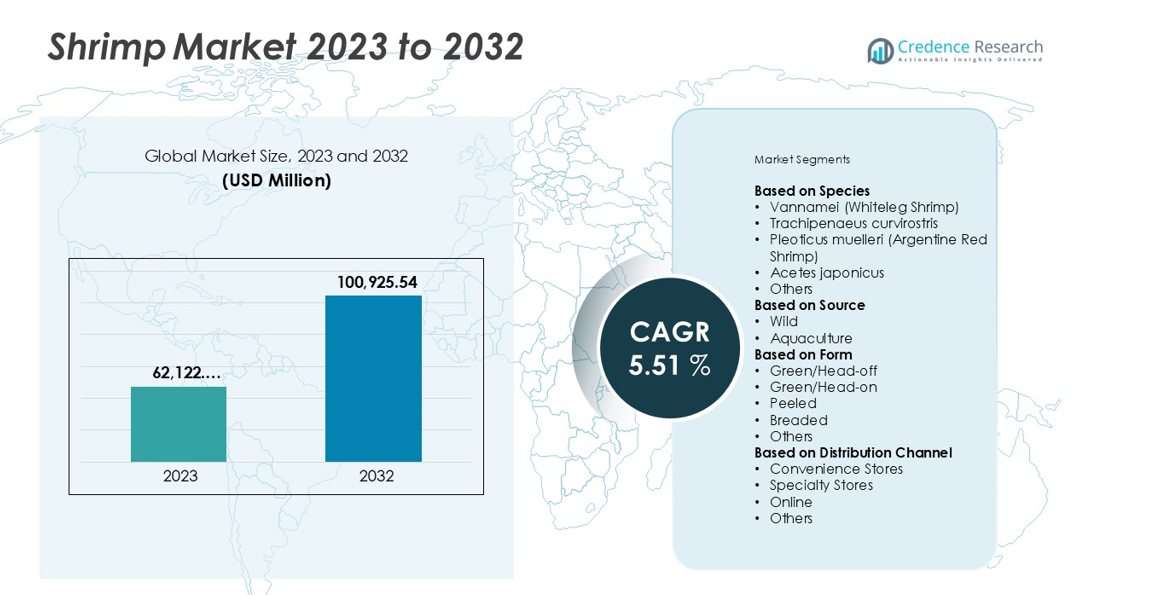
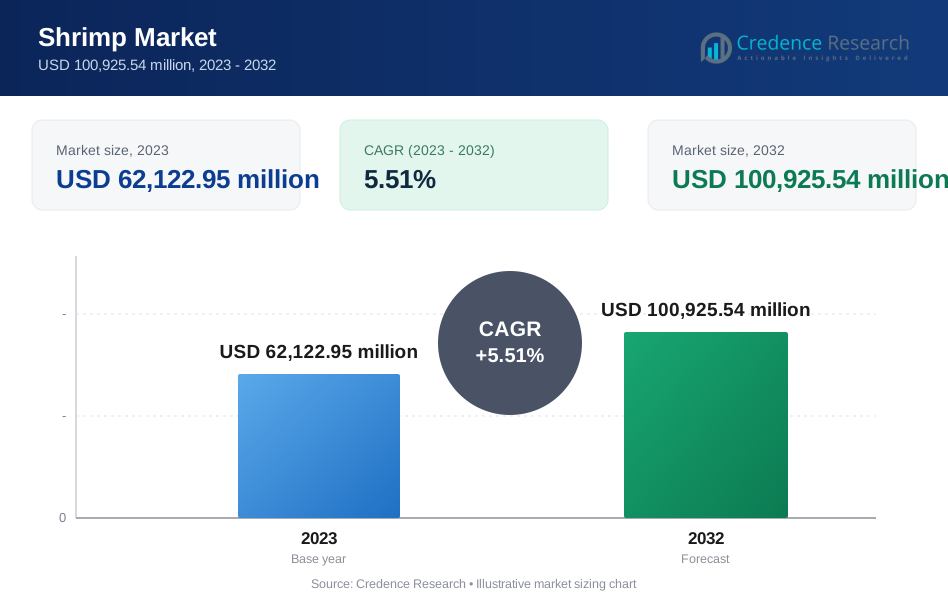
The Shrimp Market size was valued at USD 62,122.95 million in 2023 and is projected to reach USD 100,925.54 million by 2032, growing at a CAGR of 5.51% during the forecast period.
| REPORT ATTRIBUTE | DETAILS |
|---|---|
| Historical Period | 2020-2023 |
| Base Year | 2024 |
| Forecast Period | 2025-2032 |
| Shrimp Market Size 2023 | USD 62,122.95 million |
| Shrimp Market, CAGR | 5.51% |
| Shrimp Market Size 2032 | USD 100,925.54 million |
The shrimp market is led by major players such as Thai Union Group PCL, Clearwater Seafoods, Avanti Feeds Limited, High Liner Foods, Surapon Foods Public Company Limited, Mazzetta Company, Aqua Star, Nordic Seafood A/S, The Waterbase Limited, and Wild Ocean Direct. These companies dominate through large-scale aquaculture operations, advanced processing facilities, and strong export capabilities. Asia-Pacific leads the global shrimp market with approximately 46% share in 2024, supported by extensive aquaculture in India, China, Vietnam, and Thailand. Europe follows with around 25%, driven by demand for certified and premium shrimp products, while North America, holding 21%, remains a key importer and consumer of frozen and processed shrimp products.
Market Insights
- The global shrimp market was valued at USD 62,122.95 million in 2023 and is projected to reach USD 100,925.54 million by 2032, growing at a CAGR of 5.51%.
- Rising global demand for protein-rich seafood and expanding aquaculture practices are key drivers boosting shrimp production and consumption.
- Value-added and ready-to-eat shrimp products are gaining traction, supported by improved cold-chain logistics and growing retail penetration worldwide.
- Leading players such as Thai Union Group, Avanti Feeds, and High Liner Foods dominate through sustainable farming, automation, and traceable supply chains.
- Asia-Pacific leads with 46% share due to strong aquaculture infrastructure, followed by Europe at 25% and North America at 21%; vannamei shrimp holds the largest segment share at around 52%, driven by high yield and export suitability.
Market Segmentation Analysis:
By Species
The vannamei (Whiteleg Shrimp) segment dominated the shrimp market in 2024, accounting for nearly 52% of the total share. Its dominance is driven by rapid growth rates, adaptability to various salinity levels, and high yield efficiency. Vannamei shrimp farming requires less feed and offers consistent quality, making it the preferred choice for export markets. Countries like India, Ecuador, and Vietnam have expanded intensive vannamei aquaculture operations to meet global demand. Rising consumption of protein-rich seafood and favorable breeding conditions further reinforce the leadership of this species in the global shrimp trade.
- For instance, India produced approximately 565,082 metric tons of vannamei shrimp in 2024 for export, with a total production closer to 700,000–850,000 metric tons. Intensive farms in Andhra Pradesh, a leading producing state, achieve average yields between 5 and 10 tons per hectare per year, though yields vary greatly depending on farming practices and conditions.
By Source
The aquaculture segment held the largest market share of around 78% in 2024. Growth is fueled by controlled breeding practices, predictable output, and reduced reliance on wild catches. Technological improvements in water filtration, feed optimization, and disease management have made aquaculture more sustainable and profitable. Major producers such as Thailand and China have invested heavily in eco-friendly shrimp farms to meet export standards. Increasing global focus on traceability and sustainability, coupled with government incentives for inland shrimp farming, continues to boost aquaculture’s dominance over wild-caught shrimp production.
- For instance, China's annual farmed shrimp production was closer to 1.66 million metric tons in 2024. The country's aquaculture industry, which did use recirculating aquaculture systems (RAS) along with other intensive farming methods, faced an oversupply situation in 2024 that kept production from increasing significantly over previous years.
By Form
The peeled shrimp segment led the market in 2024, representing about 38% of the total share. Its popularity stems from convenience, longer shelf life, and suitability for ready-to-cook and frozen food products. Growing demand from the hospitality and foodservice sectors supports steady growth. The expansion of processed seafood facilities in regions like Southeast Asia and Latin America has further improved peeled shrimp supply capacity. Rising consumer preference for value-added seafood and frozen meal kits drives continued demand for peeled and processed shrimp forms globally.
Key Growth Drivers
Rising Global Demand for Protein-Rich Seafood
The increasing global preference for high-protein, low-fat diets is a major driver for the shrimp market. Consumers in North America, Europe, and Asia-Pacific are shifting toward seafood-based protein due to health awareness and changing dietary habits. Shrimp, being rich in omega-3 fatty acids and essential nutrients, is a top choice for fitness-conscious and aging populations. Expanding urbanization and rising disposable incomes further enhance shrimp consumption in ready-to-eat and restaurant segments. Global seafood trade liberalization and improved cold-chain logistics have made shrimp more accessible, boosting imports in markets such as Japan, the U.S., and the EU.
- For instance, in 2024, the National Fisheries Institute (U.S.) confirmed that shrimp remained the most consumed seafood in the U.S. in 2022, with annual per capita intake reaching 5.50 pounds (about 2.5 kg) based on data compiled in 2023 or 2024.
Expansion of Sustainable Aquaculture Practices
Sustainable aquaculture has become central to the shrimp industry’s long-term growth. The adoption of recirculating aquaculture systems (RAS) and biofloc technology allows for efficient water reuse, minimal waste, and controlled production. Governments and private investors are supporting eco-certified shrimp farming to meet international sustainability standards. Producers in Ecuador, India, and Indonesia are focusing on traceability and antibiotic-free production to maintain global competitiveness. Certifications from organizations like ASC and BAP are driving demand from environmentally conscious consumers. These sustainable operations not only reduce ecological impact but also stabilize supply chains, ensuring consistent production volumes and export quality.
- For instance, India’s ICAR-CIBA demonstrated biofloc shrimp farming systems that reduce water exchange by 90% while maintaining yields of 25 tons per hectare.
Technological Advancements in Processing and Distribution
Advancements in automation, cold storage, and logistics are transforming shrimp processing and distribution. Smart packaging technologies are extending product shelf life, while automated grading and peeling systems increase efficiency. Improved freezing and vacuum-sealing techniques preserve shrimp freshness during long-distance transport. Companies are also investing in digital traceability platforms to enhance transparency and compliance with import regulations. These innovations lower operational costs and support large-scale export operations, particularly from Asia-Pacific. The development of value-added shrimp products, including marinated and ready-to-cook varieties, further expands market reach and supports consistent year-round demand globally.
Key Trends & Opportunities
Rising Popularity of Value-Added and Ready-to-Eat Shrimp Products
Changing lifestyles and a growing preference for convenience food are creating opportunities in value-added shrimp segments. Pre-cooked, breaded, and marinated shrimp are gaining popularity in retail and foodservice channels. Quick-freeze technologies and efficient packaging have improved product quality, making them more appealing to consumers. Companies such as Thai Union and Minh Phu Seafood are expanding processed shrimp portfolios to cater to Western markets. The rising penetration of e-commerce and organized retail further boosts product visibility, driving sales in both developed and emerging economies.
- For instance, in 2024, Thai Union Group reported strong overall financial performance and solid organic growth across its core categories, including value-added products. Like many of its products, the company's Chicken of the Sea frozen shrimp line features ready-to-eat and oven-baked variants and targets U.S. consumers.
Emergence of Eco-Certified and Organic Shrimp Farming
Eco-certified and organic shrimp farming is emerging as a lucrative opportunity in the market. Certifications such as ASC, BAP, and GlobalG.A.P. are increasingly demanded by importers and retailers. These labels assure consumers of responsible sourcing and environmental protection. Organic shrimp production, free from antibiotics and synthetic additives, is gaining traction among premium buyers in Europe and North America. Governments and NGOs are promoting certification programs to ensure traceable and sustainable aquaculture. This shift creates a competitive edge for producers adopting green farming and helps secure access to high-value international markets.
Key Challenges
Disease Outbreaks and Biosecurity Risks
Disease outbreaks such as Early Mortality Syndrome (EMS) and White Spot Syndrome Virus (WSSV) remain serious challenges for shrimp farmers. These pathogens can cause large-scale production losses and trade restrictions. Inadequate farm management, poor water quality, and limited access to diagnostics worsen the problem. Developing countries with high shrimp production face difficulties maintaining biosecurity standards. Governments and research institutions are working on disease-resistant shrimp breeds and improved biosecurity protocols. However, high costs and inconsistent implementation continue to limit effectiveness, posing a persistent risk to production stability and global supply chains.
Price Volatility and Supply Chain Disruptions
Price fluctuations in shrimp markets often result from changing feed costs, weather impacts, and export restrictions. Extreme climate events such as El Niño can disrupt harvest cycles and reduce yields. Additionally, rising logistics costs and global trade tensions affect export profitability. Market players dependent on exports face risks from fluctuating currency rates and shifting import regulations. Supply disruptions during global crises, like pandemics, have highlighted vulnerabilities in distribution and cold-chain infrastructure. Building localized processing facilities and diversifying supply networks are critical to reducing dependency and maintaining market stability.
Regional Analysis
North America
North America accounted for around 21% of the global shrimp market share in 2024. The United States remains the dominant consumer, driven by high demand for frozen and ready-to-eat shrimp products. Strong retail and foodservice sectors, coupled with the popularity of seafood-based diets, sustain steady market growth. Imports from Latin American countries, particularly Ecuador and Mexico, fulfill much of the regional demand. The shift toward sustainably certified and traceable shrimp products is gaining traction, as consumers increasingly prefer responsibly sourced seafood. Investments in cold-chain infrastructure continue to enhance product availability across major distribution channels.
Europe
Europe held nearly 25% of the global shrimp market share in 2024. The region’s growth is supported by rising demand for high-quality, eco-certified, and organic shrimp. Countries like Spain, France, and the United Kingdom are key importers, primarily sourcing from India, Vietnam, and Ecuador. Consumers’ preference for low-fat, protein-rich seafood aligns with the expanding shrimp product range in retail and restaurants. Strict EU import regulations promote traceability and sustainable sourcing practices. Expansion of value-added products, such as breaded and marinated shrimp, has strengthened Europe’s role as a major consumption hub in global shrimp trade.
Asia-Pacific
Asia-Pacific dominated the shrimp market in 2024, holding approximately 46% of the total share. The region leads global shrimp production and exports, with India, China, Vietnam, and Thailand as major contributors. Favorable aquaculture conditions, lower production costs, and strong export-oriented infrastructure drive this dominance. Rapid population growth and dietary shifts toward seafood further boost domestic consumption. Governments in Southeast Asia are promoting sustainable aquaculture practices and disease management programs to maintain supply stability. Increasing investments in cold storage, feed technology, and automated farming systems continue to strengthen Asia-Pacific’s leadership in shrimp production and global exports.
Latin America
Latin America captured about 6% of the global shrimp market share in 2024. Ecuador is the region’s largest producer and exporter, supported by favorable coastal conditions and advanced aquaculture systems. Investments in sustainable farming and certifications have improved access to premium export markets like the U.S. and Europe. Shrimp farming expansion in Brazil and Mexico also contributes to regional growth. Rising demand for processed seafood and export diversification are key growth enablers. Government support for aquaculture innovation and digital monitoring systems is helping regional producers achieve higher yields and maintain competitive export standards.
Middle East & Africa
The Middle East & Africa accounted for around 2% of the global shrimp market share in 2024. Growth is primarily driven by increasing seafood imports in Gulf Cooperation Council (GCC) countries such as the UAE and Saudi Arabia. Rising disposable incomes, expanding retail networks, and the popularity of international cuisines fuel shrimp consumption. Limited local production due to climatic challenges has led to greater reliance on imports from Asia-Pacific and Latin America. Investments in aquaculture projects in countries like Oman and Egypt aim to enhance regional production capacity and reduce import dependency over time.
Market Segmentations:
By Species
- Vannamei (Whiteleg Shrimp)
- Trachipenaeus curvirostris
- Pleoticus muelleri (Argentine Red Shrimp)
- Acetes japonicus
- Others
By Source
- Wild
- Aquaculture
By Form
- Green/Head-off
- Green/Head-on
- Peeled
- Breaded
- Others
By Distribution Channel
- Convenience Stores
- Specialty Stores
- Online
- Others
By Geography
- North America
- U.S.
- Canada
- Mexico
- Europe
- UK
- France
- Germany
- Italy
- Spain
- Russia
- Rest of Europe
- Asia Pacific
- China
- Japan
- South Korea
- India
- Australia
- Southeast Asia
- Rest of Asia Pacific
- Latin America
- Brazil
- Argentina
- Rest of Latin America
- Middle East
- GCC Countries
- Israel
- Turkey
- Rest of Middle East
- Africa
- South Africa
- Egypt
- Rest of Africa
Competitive Landscape
The shrimp market is highly competitive, with leading companies focusing on sustainable sourcing, advanced aquaculture practices, and value-added product innovation to strengthen their global presence. Major players such as Thai Union Group PCL, Clearwater Seafoods, Avanti Feeds Limited, High Liner Foods, Surapon Foods Public Company Limited, Mazzetta Company, Aqua Star, Nordic Seafood A/S, The Waterbase Limited, and Wild Ocean Direct dominate both production and export segments. These companies invest heavily in processing automation, cold-chain logistics, and eco-certification to meet international quality standards. Strategic partnerships, capacity expansions, and vertical integration are common approaches to improve efficiency and profitability. Increasing demand for traceable and antibiotic-free shrimp is encouraging producers to adopt digital monitoring systems and sustainable feed solutions. Additionally, firms are leveraging global retail networks and e-commerce platforms to expand distribution, while innovation in ready-to-eat and frozen shrimp products continues to create differentiation in the competitive seafood industry.
Key Player Analysis
- Thai Union Group PCL
- Clearwater Seafoods
- Avanti Feeds Limited
- High Liner Foods
- Surapon Foods Public Company Limited
- Mazzetta Company, LLC
- Aqua Star
- Nordic Seafood A/S
- The Waterbase Limited
- Wild Ocean Direct
Recent Developments
- In March 2024, Clearwater Seafoods’ parent company Premium Brands Holdings Corporation announced it was poised to acquire a seafood business with CAD 40 million (USD 29.6 million) in sales. The acquisition was in the due diligence stage.
- In March 2024, Avanti Feeds acquired the remaining 50.1% stake in Srivathsa Power Projects, a 17.2-megawatt natural gas-based power plant in Andhra Pradesh, India. This acquisition made Avanti Feeds the full owner of the power company.
- In March 2024, High Liner Foods finalized a settlement agreement in legal proceedings against Mr. Brian Wynn related to the sale of Rubicon Resources, LLC. As part of the settlement, over 2.4 million shares of the company were cancelled.
Report Coverage
The research report offers an in-depth analysis based on Species, Source, Form, Distribution Channel and Geography. It details leading market players, providing an overview of their business, product offerings, investments, revenue streams, and key applications. Additionally, the report includes insights into the competitive environment, SWOT analysis, current market trends, as well as the primary drivers and constraints. Furthermore, it discusses various factors that have driven market expansion in recent years. The report also explores market dynamics, regulatory scenarios, and technological advancements that are shaping the industry. It assesses the impact of external factors and global economic changes on market growth. Lastly, it provides strategic recommendations for new entrants and established companies to navigate the complexities of the market.
Future Outlook
- The shrimp market will expand steadily driven by rising global seafood consumption.
- Sustainable aquaculture practices will become central to long-term industry growth.
- Demand for eco-certified and antibiotic-free shrimp will increase across major import regions.
- Technological innovations will improve yield efficiency and disease control in shrimp farming.
- Value-added and ready-to-eat shrimp products will see growing adoption in retail markets.
- Digital traceability systems will enhance transparency across shrimp supply chains.
- Asia-Pacific will maintain its leadership due to strong export capacity and production growth.
- Europe will grow as a major market for premium and organic shrimp products.
- Strategic mergers and partnerships will strengthen global distribution networks.
- Climate resilience and biosecurity measures will define future shrimp farming sustainability.
Request a Free Sample
Fill in your details and we'll send you a free sample report.
- Sample data tables & charts
- Research methodology
Need a Custom Version of This Report?
Tailor the scope, geography, or segments to your exact requirements.
- Custom geography or segment scope
- Direct access to our analyst team
Frequently Asked Questions
What is the projected growth of the shrimp market?
What are the key drivers of the global shrimp market?
Which region dominates the global shrimp market?
How are sustainability and traceability influencing the shrimp market?
What role does technology play in the shrimp market?
Table of Content
Chapter 1. Report Introduction
- 1.1 Report Description & Purpose
- 1.1.1 Report Title & Market Definition
- 1.1.2 Unique Selling Propositions (USP) & Key Differentiators
- 1.1.3 Value Proposition for Stakeholders
- 1.2 Research Objectives
- 1.2.1 Market Sizing Objectives (Volume & Revenue)
- 1.2.2 Segmentation Objectives
- 1.2.3 Competitive Intelligence Objectives
- 1.2.4 Forecast & Scenario Objectives
- 1.3 Report Scope
- 1.3.1 Shrimp Scope – Types & Subtypes Covered
- 1.3.2 Geographic Scope – Regions & Countries Covered
- 1.3.3 Historical Period, Base Year & Forecast Period (2023; forecast to 2032)
- 1.3.4 Inclusions & Exclusions
- 1.4 HS Code & Classification Framework
- 1.5 Currency, Units & Pricing Basis
- 1.6 Target Stakeholders
- 1.7 Limitations & Assumptions
Chapter 2. Executive Summary
- 2.1 Global Shrimp Market Snapshot
- 2.1.1 Market Size – Historical (2023) & Forecast (2023-2032) (2023: USD 62,122.95 million → 2032: USD 100,925.54 million)
- 2.1.2 Volume & Revenue – Global Totals
- 2.1.3 Key Market Highlights – Top Five Facts
- 2.2 Shrimp Market Segmentation Snapshot
- 2.2.1 Market Split by Region – 2023 vs. 2032
- 2.3 Competitive Snapshot
- 2.3.1 Top 10 Players by Revenue Share – 2023
- 2.3.2 Top 10 Players by Volume Share – 2023
- 2.3.3 Recent Strategic Developments (18-Month Summary)
- 2.4 Key Investment Highlights & Strategic Conclusions
Chapter 3. Shrimp Market Dynamics & Industry Analysis
- 3.1 Market Overview & Context
- 3.1.1 Shrimp Market Position in the Broader Automotive Value Chain
- 3.1.2 OEM vs. Replacement Market Dynamics
- 3.1.3 Market Maturity & Development Stage by Region
- 3.2 Shrimp Market Drivers
- 3.3 Shrimp Market Restraints & Challenges
- 3.4 Shrimp Market Opportunities
- 3.5 Porter's Five Forces Analysis
- 3.5.1 Threat of New Entrants
- 3.5.2 Bargaining Power of Suppliers
- 3.5.3 Bargaining Power of Buyers
- 3.5.4 Threat of Substitutes
- 3.5.5 Competitive Rivalry – Intensity Assessment
- 3.6 Shrimp Value Chain Analysis
- 3.6.1 Upstream – Raw Material/Input Suppliers
- 3.6.1.1 Raw Material/Input 1
- 3.6.1.2 Raw Material/Input 2
- 3.6.1.3 Raw Material/Input 3
- 3.6.2 Midstream – Production/Manufacturing/Service Delivery
- 3.6.2.1 Production/Process Overview
- 3.6.2.2 Key Facility Locations & Capacity by Manufacturer
- 3.6.3 Downstream – Distribution & End Consumer
- 3.6.3.1 Primary Channel – B2B/OEM
- 3.6.3.2 Secondary Channels – Dealer, Retail, Online, Direct
- 3.6.4 Value Chain Profitability Analysis
- 3.6.1 Upstream – Raw Material/Input Suppliers
- 3.7 PESTEL Analysis
- 3.7.1 Political Factors
- 3.7.2 Economic Factors
- 3.7.3 Social Factors
- 3.7.4 Technological Factors
- 3.7.5 Environmental Factors
- 3.7.6 Legal Factors
- 3.8 Shrimp Supply Chain Analysis
- 3.8.1 Raw Material/Input Supply Risk Assessment
- 3.8.2 Manufacturing Concentration Risk (Geographic Exposure)
- 3.8.3 Trade Disruption Impact Analysis
- 3.9 Regulatory & Policy Landscape
Note: The regulatory and policy landscape section covers regulations based on their applicability to the market, Shrimp category, geography, and scope of the study. Only regulatory frameworks with a material impact on operations, compliance, trade, sustainability, or market access are analyzed in detail.
Chapter 4. Key Investment Pockets & Opportunity Analysis
- 4.1 Shrimp Market Attractiveness Analysis
- 4.1.1 By Region – Investment Attractiveness Matrix (Volume × CAGR)
- 4.2 Absolute Revenue Growth Opportunity
- 4.2.1 By Region – Absolute USD Growth Through 2032
- 4.3 Incremental Volume Opportunity
- 4.3.1 By Region – Incremental Volume Through 2032
- 4.3.2 Segment – Incremental Volume
- 4.4 Emerging Submarket Opportunity Deep Dive (Subject to Applicability)
- 4.5 Emerging Market Opportunity Scorecards
- 4.5.1 United States
- 4.5.2 Europe
- 4.5.3 Asia
- 4.5.4 Middle East & Africa
Note: Emerging Market Opportunity Scorecards will be included based on relevance and strategic importance. Regions listed are indicative and may vary depending on data availability and market dynamics.
Chapter 5. Shrimp Import-Export Analysis & Trade Flows
- 5.1 Global Trade Overview
- 5.1.1 Global Export Value by Country (2023)
- 5.1.2 Global Export Volume by Country (2023)
- 5.1.3 Global Import Value by Country (2023)
- 5.1.4 Global Import Volume by Country (2023)
- 5.1.5 Net Trade Balance by Country (2023)
- 5.2 Export Analysis – Segment
- 5.2.1 Type 1 (HS Code)
- 5.2.2 Type 2 (HS Code)
- 5.2.3 Type 3 (HS Code)
- 5.2.4 Type 4 (HS Code)
- 5.2.5 Type 5 (HS Code)
- 5.3 Import Analysis – Segment
- 5.3.1 Type 1 (HS Code)
- 5.3.2 Type 2 (HS Code)
- 5.3.3 Type 3 (HS Code)
- 5.3.4 Type 4 (HS Code)
- 5.3.5 Type 5 (HS Code)
- 5.4 Average Unit Trade Prices
- 5.4.1 Average Export Price – Segment & Country
- 5.4.2 Average Import Price – Segment & Source Country
- 5.4.3 Price Trends (2023)
- 5.5 Key Trade Route Analysis
- 5.5.1 Trade Route 1
- 5.5.2 Trade Route 2
- 5.5.3 Trade Route 3
- 5.5.4 Trade Route 4
- 5.5.5 Trade Route 5
- 5.6 Trade Policy Impact Assessment
- 5.6.1 US Anti-Dumping & Section 301 Tariffs
- 5.6.2 EU Customs Union Impact
- 5.6.3 Major Free Trade Agreements
- 5.6.4 USMCA Rules of Origin
Note: Trade policy analysis will be included only where relevant to the Shrimp market.
Chapter 6. Competitive Landscape & Company Benchmarking
- 6.1 Shrimp Market Concentration & Structure
- 6.1.1 Herfindahl-Hirschman Index (HHI) – vs. 2023
- 6.1.2 Tier 1, Tier 2 & Tier 3 Market Structure
- 6.1.3 Global, Regional & Local Player Dynamics
- 6.2 Shrimp Market Share Analysis – 2023
- 6.2.1 Global Revenue Share by Company
- 6.2.2 Global Volume Share by Company
- 6.2.3 Regional Revenue Share
- 6.2.4 Market Share Evolution ( vs. 2023)
- 6.2.5 OEM Segment Share by Company
- 6.2.6 Replacement Segment Share by Company
- 6.3 Production/Delivery Capacity & Facility Analysis
- 6.3.1 Global Installed Capacity
- 6.3.2 Capacity Utilization Rates
- 6.3.3 Production/Output Volume
- 6.3.4 Facility Locations & Capacity Map
- 6.3.5 Planned Capacity Additions
- 6.4 Shrimp Competitive Benchmarking Matrix
- 6.4.1 Revenue, Volume, CAGR & Profitability Comparison
- 6.4.2 Channel Revenue Mix
- 6.4.3 Geographic Revenue Exposure
- 6.4.4 R&D Intensity
- 6.4.5 Sustainability Maturity
- 6.5 Strategic Developments in Shrimp (Last 24 Months)
- 6.5.1 Mergers, Acquisitions & Divestments
- 6.5.2 New Shrimp Launches
- 6.5.3 Facility Expansions
- 6.5.4 Strategic Alliances, Joint Ventures & Partnerships
- 6.5.5 Distribution Expansion & Market Entry
- 6.5.6 Sustainability & ESG Initiatives
- 6.6 Competitive Strategy Mapping
- 6.6.1 Leader, Challenger, Follower & Niche Classification
- 6.6.2 Pricing Strategy Comparison
- 6.6.3 Channel Strategy Matrix
Note: Strategic developments are included based on their materiality and the availability of reliable information.
Chapter 7. Global Shrimp Market – By Distribution Channel
- 7.1 Segment Overview
- 7.1.1 Volume & Revenue Split by Channel (2023 & 2032)
- 7.1.2 Channel Mix Evolution (2023-2032)
Chapter 8. Regional Market Analysis – Global Overview
- 8.1 Global Regional Overview
- 8.1.1 Regional Volume Share
- 8.1.2 Regional Revenue Share
- 8.1.3 Regional Volume by Region
- 8.1.4 Regional Revenue by Region
- 8.1.5 Regional Forecast Through 2032
- 8.2 Cross-Regional Segment Analysis
- 8.2.1 By Distribution Channel
- 8.2.2 By Brand/Price Tier
Chapter 9. North America Shrimp Market
- 9.1 United States
- 9.2 Canada
- 9.3 Mexico
Chapter 10. Europe Shrimp Market
- 10.1 Germany
- 10.2 France
- 10.3 Italy
- 10.4 United Kingdom
- 10.5 Spain
- 10.6 Poland
- 10.7 Russia
- 10.8 Netherlands
- 10.9 Belgium
- 10.10 Sweden
- 10.11 Denmark
- 10.12 Norway
- 10.13 Rest of Europe
Chapter 11. Asia Pacific Shrimp Market
- 11.1 China
- 11.2 India
- 11.3 Japan
- 11.4 South Korea
- 11.5 Thailand
- 11.6 Indonesia
- 11.7 Vietnam
- 11.8 Malaysia
- 11.9 Australia
- 11.10 Rest of Asia Pacific
Chapter 12. Latin America Shrimp Market
- 12.1 Brazil
- 12.2 Argentina
- 12.3 Colombia
- 12.4 Chile
- 12.5 Rest of Latin America
Chapter 13. Middle East Shrimp Market
- 13.1 Saudi Arabia
- 13.2 United Arab Emirates
- 13.3 Turkey
- 13.4 Israel
- 13.5 Iran
- 13.6 Rest of the Middle East
Chapter 14. Africa Shrimp Market
- 14.1 South Africa
- 14.2 Egypt
- 14.3 Nigeria
- 14.4 Morocco
- 14.5 Rest of Africa
Chapter 15. Shrimp Company Profiles
- 15.1 [Company 01]
- 15.1.1 Company Overview
- 15.1.2 Key Management Personnel
- 15.1.3 Products & Services Portfolio
- 15.1.4 Financial Performance
- 15.1.5 Key Market Focus & Geographic Presence
- 15.1.6 Recent Developments & Strategic Initiatives
Note: The company profile list is preliminary and may change based on research findings, market developments, data availability, and client requirements.
Chapter 16. Appendices
- Appendix A – List of Abbreviations & Acronyms
- Appendix B – Industry Classification Code Reference – Full Series
- Appendix C – Production & Capacity Data Tables
- Appendix D – End-Use & Demand Base Tables
- Appendix E – Consumption & Replacement Rate Assumptions
- Appendix F – ASP Reference Tables
- Appendix G – Manufacturing & Facility Database
- Appendix H – Import-Export Data Tables
- Appendix I – Regulatory Summary Tables
- Appendix J – Primary Research Participant List (Anonymized)
- Appendix K – Primary Research Questionnaire Framework
- Appendix L – Data Sources & Bibliography
- Appendix M – Market Size Divergence & Source Comparison
Chapter 17. Research Methodology
- 17.1 Research Framework & Philosophy
- 17.2 Secondary Research – Sources, Hierarchy & Data Extraction
- 17.3 Data Modeling – Bottom-Up & Top-Down Market Sizing
- 17.4 Primary Research – Stakeholder Framework, LOI & Sample Sizes
- 17.5 Forecast Methodology – Regression, Scenario & Sensitivity Analysis
- 17.6 Quality Control – Four-Layer Validation Framework
- 17.7 Limitations & Standard Assumptions
- 17.8 Disclaimer
