
Market Overview
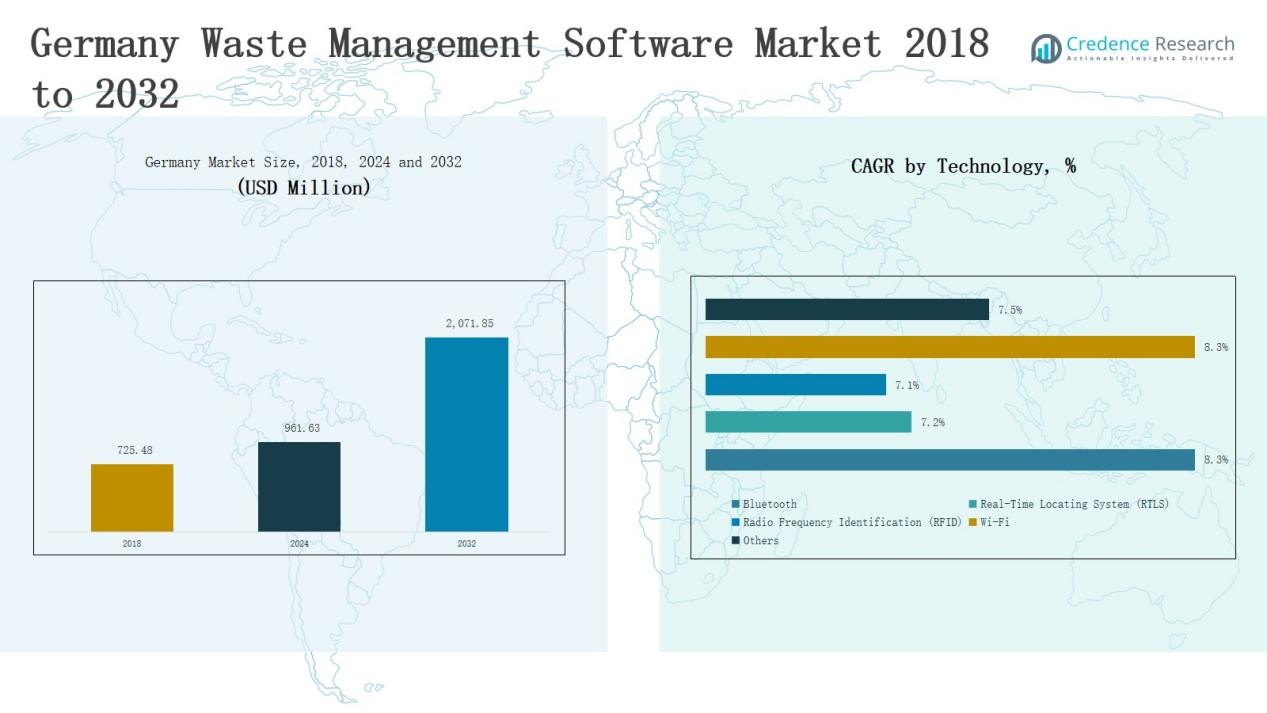
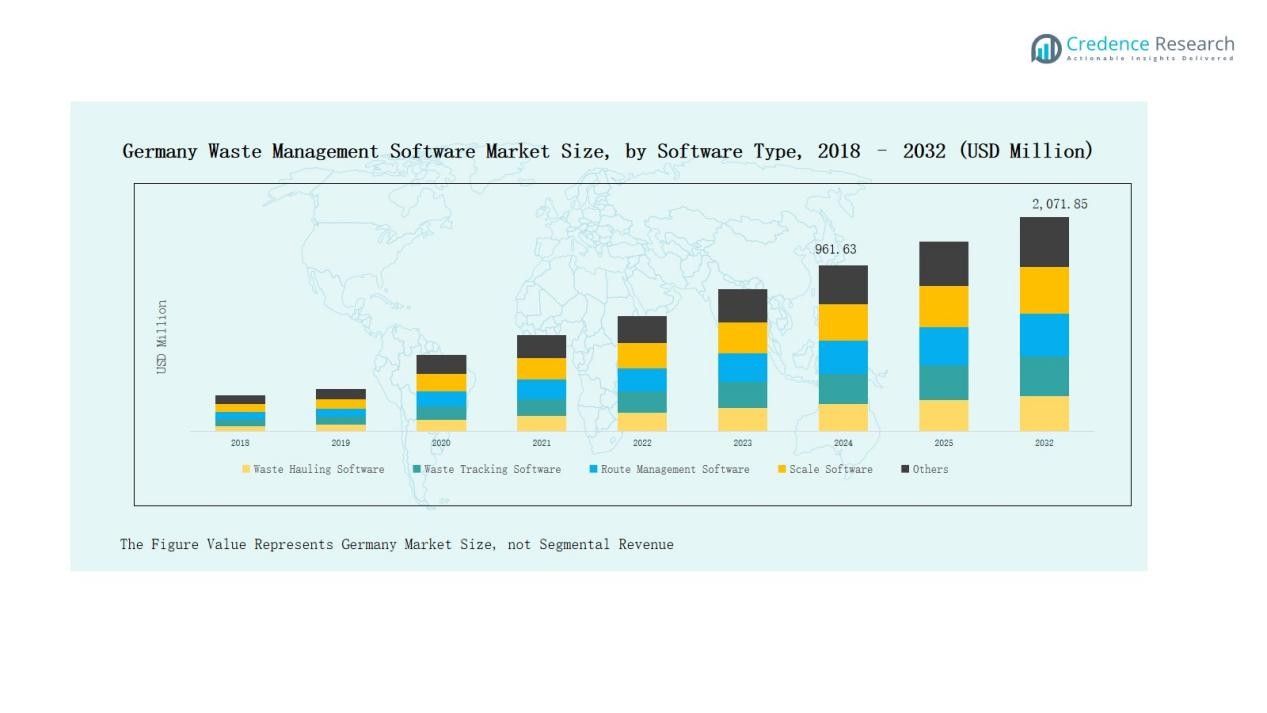
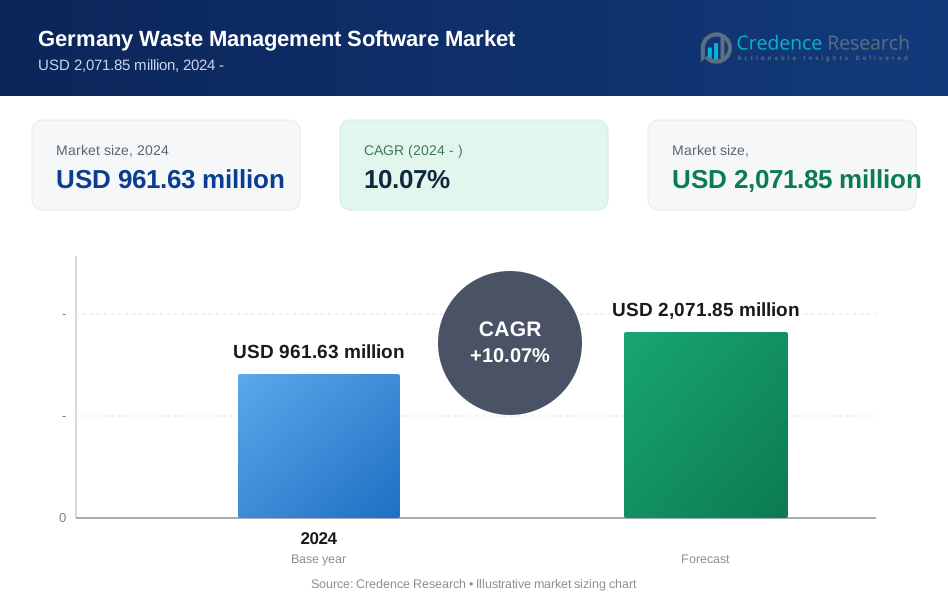
Germany Waste Management Software Market size was valued at USD 725.48 million in 2018 to USD 961.63 million in 2024 and is anticipated to reach USD 2,071.85 million by 2032, at a CAGR of 10.07% during the forecast period.
| REPORT ATTRIBUTE | DETAILS |
|---|---|
| Historical Period | 2020-2023 |
| Base Year | 2024 |
| Forecast Period | 2025-2032 |
| Germany Waste Management Software Market Size 2024 | USD 961.63 Million |
| Germany Waste Management Software Market, CAGR | 10.07% |
| Germany Waste Management Software Market Size 2032 | USD 2,071.85 Million |
The Germany Waste Management Software Market is characterized by a mix of established domestic firms and international solution providers delivering compliance-driven and technology-oriented platforms. Key players include CONWIN, Wastics, Dr. Ing. Wandrei (NSUITE), SSI SCHÄFER Plastics (DISPONDO), Lufthansa Industry Solutions (LEAP), Consist Software Solutions, all in one GmbH, c-trace GmbH, ÖKODATA GmbH, TEGOS GmbH, and 2R Software GmbH. These companies focus on route optimization, recycling compliance, cloud-based solutions, and IoT integration to enhance efficiency and sustainability. Among regional markets, Copenhagen leads with 42% share, supported by advanced recycling infrastructure, smart city projects, and strong municipal investments in digital platforms. This dominance highlights Copenhagen’s role as the hub for innovation and large-scale adoption of waste management software in Germany.
Market Insights
- The Germany Waste Management Software Market grew from USD 725.48 million in 2018 to USD 961.63 million in 2024 and is projected to reach USD 2,071.85 million by 2032.
- Leading companies such as CONWIN, Wastics, Dr. Ing. Wandrei (NSUITE), SSI SCHÄFER Plastics, Lufthansa Industry Solutions, and others focus on compliance-driven, cloud-based, and IoT-enabled platforms.
- By software type, Waste Hauling Software dominates with 30% share, supported by optimized routing, automated scheduling, and RFID integration that improve efficiency and sustainability outcomes.
- By application, Municipal segment leads with 48% share, driven by EU regulations, recycling targets, landfill diversion initiatives, and smart city programs requiring advanced digital platforms.
- By component, Cloud-Based Software holds 65% share, offering scalability, real-time collaboration, enhanced security, and mobile access, making it central to Germany’s digital transformation in waste management.
Market Segment Insights
By Software Type
Waste Hauling Software holds the dominant 30% share in the Germany Waste Management Software Market. Its strong position is supported by widespread adoption among municipalities and private contractors seeking cost-effective collection systems. Features such as optimized routing, automated scheduling, and real-time tracking enhance operational efficiency and reduce fuel costs. Integration with RFID and route management solutions further improves accountability and compliance.
By Application
Municipal applications represent the largest segment, accounting for 48% share in the Germany Waste Management Software Market. Strict national and EU regulations push local authorities to adopt digital platforms for monitoring and compliance. Municipal demand is also reinforced by initiatives to improve recycling rates, landfill diversion, and resource recovery. Cloud-based solutions enable centralized data management and reporting for multiple districts. Smart city programs further encourage adoption of advanced waste tracking and collection optimization systems.
- For instance, the city of Rosenheim utilized Sensoneo's smart waste sensors to monitor its paper waste bins. This deployment of 92 sensors resulted in an impressive average fill-level of 86% before collection, demonstrating the system's effectiveness in optimizing collection routes and preventing overflowing bins.
By Component
Cloud-Based Software dominates the market with a 65% share in the Germany Waste Management Software Market. The segment’s strength arises from growing preference for scalable, subscription-based solutions that reduce upfront IT investment. Cloud platforms enable real-time collaboration, secure remote access, and integration with IoT-enabled devices. Providers highlight advantages such as automatic updates, enhanced cybersecurity, and mobile accessibility. German companies and municipalities increasingly prefer cloud deployment for agility and compliance with sustainability goals. The ongoing shift toward digital transformation and the expansion of SaaS offerings position cloud-based solutions as the central growth engine within the market.
- For intance, Remondis, which uses a cloud platform to manage real-time data from over 3,000 IoT sensors on its waste containers, improving collection efficiency.
Key Growth Drivers
Regulatory Pressure and Compliance
Germany’s strict environmental laws and EU directives drive adoption of waste management software. Regulations like the Verpackungsgesetz and Kreislaufwirtschaftsgesetz mandate accurate data reporting, recycling targets, and producer responsibility. Municipalities and enterprises rely on digital platforms to ensure compliance, avoid penalties, and manage documentation effectively. Software solutions offering automated reporting and real-time tracking meet these needs. As environmental policies tighten further, demand for robust, scalable solutions is expected to accelerate, making regulatory compliance a primary force shaping the market’s growth trajectory.
- For instance, AMCS completed its acquisition of Berlin-based Quentic in July 2022. The deal expanded compliance and waste-management software across Europe.
Smart City and Digitalization Initiatives
The expansion of smart city programs across German municipalities significantly fuels market growth. Cities integrate IoT-enabled solutions such as RFID, GPS tracking, and route optimization to enhance waste collection and recycling efficiency. Municipal authorities prioritize digitalization to improve sustainability outcomes, reduce carbon emissions, and increase operational transparency. Waste management software enables seamless integration of these technologies with centralized data platforms. Growing public funding and private partnerships for smart infrastructure projects ensure steady investment in digital tools, strengthening their role as a vital growth driver.
- For instance, in the Coburg district, Veolia Germany piloted AMCS Guided Navigation, digitalizing experienced drivers’ route knowledge across all staff. This reduced waste-collection time by 10–15 %, while boosting service quality and transparency
Rising Sustainability and Circular Economy Goals
Germany’s commitment to sustainability and circular economy practices is a major driver. National strategies emphasize waste reduction, recycling, and resource recovery. Software platforms support these goals by offering advanced analytics, recycling performance tracking, and lifecycle assessments. Organizations use these solutions to meet environmental, social, and governance (ESG) targets while improving efficiency. The focus on lowering carbon footprints and aligning with EU Green Deal objectives creates strong incentives. As businesses and municipalities intensify sustainability commitments, demand for waste management software aligned with circular economy goals continues to rise.
Key Trends & Opportunities
Cloud-Based Deployment and SaaS Growth
Cloud-based solutions are emerging as a dominant trend in the German market. Enterprises and municipalities prefer SaaS models for scalability, reduced upfront investment, and remote accessibility. Integration with IoT devices enables real-time monitoring and predictive analytics. Providers offering modular, subscription-based systems capitalize on this shift. The demand for mobile-enabled platforms is growing, creating opportunities for vendors to expand cloud-based service offerings. As data security standards improve, confidence in cloud adoption is expected to strengthen further, reinforcing this as both a trend and long-term opportunity.
- For instance, German railway operator Deutsche Bahn partnered with KONUX to deploy a SaaS solution that uses IoT sensors on railway tracks. This enables real-time monitoring and predictive analytics, allowing Deutsche Bahn to predict maintenance needs and improve operational efficiency.
Integration of Advanced Technologies
The integration of AI, machine learning, and predictive analytics into waste management software represents a clear opportunity. These technologies enhance route planning, enable real-time monitoring, and support automated compliance reporting. Adoption of RFID, Bluetooth, and Wi-Fi–based tracking systems further improves operational visibility. Vendors investing in AI-driven dashboards and advanced forecasting tools stand to capture higher value. As sustainability becomes a priority, advanced technology integration enables data-driven decisions, cost savings, and efficiency improvements, positioning technology adoption as a critical market trend and opportunity.
- For instance, companies like Suez have implemented a 'Smart Waste' solution that uses sensors in waste bins to trigger collection when they are full, leading to a 30% reduction in collection frequency in some pilot projects and reducing associated operational costs.
Key Challenges
High Implementation and Transition Costs
The upfront costs of adopting waste management software remain a key challenge. Smaller municipalities and mid-sized enterprises face budgetary constraints when investing in new digital platforms. Costs associated with licensing, system customization, and integration with existing infrastructure can delay adoption. Resistance from stakeholders due to cost considerations often limits the speed of digital transformation. Vendors need to offer flexible pricing models and phased implementation strategies to overcome this barrier and expand market penetration across cost-sensitive segments in Germany.
Data Security and Privacy Concerns
With increased reliance on cloud platforms and IoT devices, data security has become a significant concern. Municipalities and businesses manage sensitive information, including waste volumes, recycling metrics, and compliance data, which must meet stringent GDPR requirements. Any breaches or system failures can undermine trust and hinder adoption. Vendors must continuously invest in cybersecurity, encryption, and secure access frameworks. Addressing these concerns is essential for building long-term client confidence, particularly in highly regulated sectors like healthcare and municipal waste management.
Integration Complexity with Legacy Systems
Many organizations in Germany still rely on outdated or fragmented IT systems. Integrating modern waste management software with legacy platforms creates technical challenges, requiring significant customization and training. This slows implementation and increases costs. Compatibility issues also impact performance, creating reluctance to switch from older systems. Vendors offering smooth integration, comprehensive training, and customer support are more likely to succeed. Overcoming integration challenges remains crucial for accelerating software adoption and ensuring efficient system upgrades across municipalities and enterprises.
Regional Analysis
Copenhagen
Copenhagen accounts for 42% share of the Germany Waste Management Software Market. It invests heavily in digital waste tracking and route optimization to strengthen sustainability efforts. Municipal authorities adopt cloud-based platforms that improve operational efficiency and reduce emissions. Healthcare and retail industries in the region create additional demand by focusing on compliance with strict environmental standards. Vendors find opportunities in IoT-enabled solutions integrated with waste collection infrastructure. It benefits from circular economy practices that accelerate advanced software adoption across multiple applications.
Aarhus
Aarhus holds 28% share of the Germany Waste Management Software Market. The city emphasizes industrial and manufacturing waste streams, driving demand for recycling and scale management systems. Municipal bodies and enterprises show preference for cloud-based deployment due to its flexibility. Expanding logistics and retail sectors increase adoption of waste tracking and route management software. Public-private partnerships provide a favorable environment for software vendors seeking long-term growth. It sustains consistent demand from its industrial base, ensuring continued investment in digital platforms.
Odense
Odense represents 18% share of the Germany Waste Management Software Market. Adoption grows among mid-sized enterprises and municipalities seeking efficient, cost-effective solutions. Local governments prioritize recycling and reporting modules to meet environmental regulations. Businesses benefit from scalable platforms that simplify route planning and waste documentation. Vendors expand product offerings to support diverse users in the region. It emerges as a promising hub for software adoption, fueled by policy initiatives and rising sustainability commitments from local stakeholders.
Others
Other regions collectively contribute 12% share of the Germany Waste Management Software Market. These areas include smaller municipalities and industrial clusters with emerging demand for waste software platforms. Adoption focuses on cloud-based systems that offer scalability and easier compliance management. Demand also arises from sectors such as healthcare and retail with strict reporting needs. Vendors target these regions with modular and cost-effective solutions. It adds incremental growth, complementing the dominance of larger metropolitan areas in the national market.
Market Segmentations:
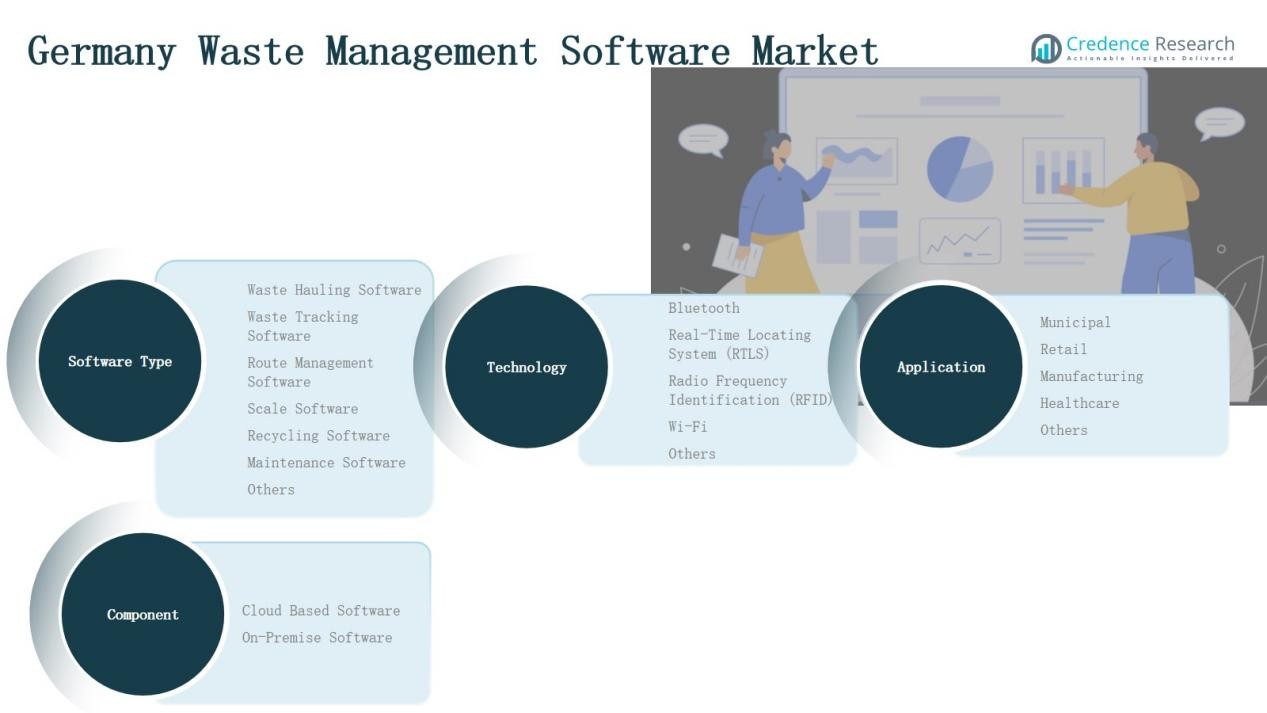
By Software Type
- Waste Hauling Software
- Waste Tracking Software
- Route Management Software
- Scale Software
- Recycling Software
- Maintenance Software
- Others
By Application
- Municipal
- Retail
- Manufacturing
- Healthcare
- Others
By Component
- Cloud-Based Software
- On-Premise Software
By Technology
- Bluetooth
- Real-Time Locating System (RTLS)
- Radio Frequency Identification (RFID)
- Wi-Fi
- Others
By Region
- Copenhagen
- Aarhus
- Odense
- Others
Competitive Landscape
The Germany Waste Management Software Market features a diverse mix of local specialists and international providers competing on innovation, compliance solutions, and service quality. Key players such as CONWIN, Wastics, Dr. Ing. Wandrei (NSUITE), SSI SCHÄFER Plastics (DISPONDO), and Lufthansa Industry Solutions (LEAP) deliver tailored software platforms supporting route optimization, recycling compliance, and data management. Vendors increasingly focus on cloud-based offerings to address growing demand for scalability, mobility, and real-time reporting. Competition is also shaped by partnerships with municipalities and industrial clients, as public-private initiatives encourage digital adoption. Companies differentiate through integration of IoT, RFID, and analytics features, which enable efficient tracking and sustainability reporting. Continuous product upgrades, adherence to EU environmental regulations, and user-centric designs remain crucial factors in vendor success. The landscape is moderately fragmented, with established firms holding strong regional networks while emerging providers target niche applications such as maintenance and healthcare compliance solutions.
Key Players
- CONWIN
- Wastics
- Ing. Wandrei (NSUITE)
- SSI SCHÄFER Plastics (DISPONDO)
- Lufthansa Industry Solutions (LEAP)
- Consist Software Solutions
- all in one GmbH
- c-trace GmbH
- ÖKODATA GmbH
- TEGOS GmbH
- 2R Software GmbH
Recent Developments
- In August 2025, Remondis acquired A. Siemer Entsorgungs GmbH to expand its waste-management operations in Germany.
- In October 2024, TOMRA Systems ASA purchased an 80% stake in c-trace GmbH, a German provider of digital waste-management solutions, strengthening its AI-driven software and international expansion strategy.
- In June 2024, Wittmann Entsorgungswirtschaft GmbH adopted the AMCS Platform to improve efficiency with automation, analytics, and integrated transport management.
- In March 2025, Positive Carbon partnered with Transgourmet in Germany to deploy AI-powered food waste reduction technology at a rehabilitation centre.
Report Coverage
The research report offers an in-depth analysis based on Software Type, Application, Component, Technology and Region. It details leading market players, providing an overview of their business, product offerings, investments, revenue streams, and key applications. Additionally, the report includes insights into the competitive environment, SWOT analysis, current market trends, as well as the primary drivers and constraints. Furthermore, it discusses various factors that have driven market expansion in recent years. The report also explores market dynamics, regulatory scenarios, and technological advancements that are shaping the industry. It assesses the impact of external factors and global economic changes on market growth. Lastly, it provides strategic recommendations for new entrants and established companies to navigate the complexities of the market.
Future Outlook
- Adoption of AI-driven analytics will improve predictive planning and enhance operational efficiency.
- Cloud-based deployment will expand further as municipalities and enterprises seek scalable solutions.
- Smart city initiatives will drive investment in real-time tracking and integrated waste platforms.
- Regulatory tightening will continue to push demand for compliance-focused digital solutions.
- Public-private partnerships will increase, enabling wider access to advanced waste management software.
- Integration with IoT devices will accelerate, supporting accurate monitoring and resource optimization.
- Municipalities will prioritize recycling modules to achieve higher circular economy targets.
- Vendors will focus on mobile-friendly platforms to enhance accessibility and workforce productivity.
- Cybersecurity enhancements will become critical to ensure trust in cloud and IoT systems.
- Competition will intensify as international providers enter and local firms expand capabilities.
Request a Free Sample
Fill in your details and we'll send you a free sample report.
- Sample data tables & charts
- Research methodology
Need a Custom Version of This Report?
Tailor the scope, geography, or segments to your exact requirements.
- Custom geography or segment scope
- Direct access to our analyst team
Frequently Asked Questions
What is the current market size for Germany Waste Management Software Market, and what is its projected size in 2032?
At what Compound Annual Growth Rate is the Germany Waste Management Software Market projected to grow between 2025 and 2032?
Which Germany Waste Management Software Market segment held the largest share in 2024?
What are the primary factors fueling the growth of the Germany Waste Management Software Market?
Who are the leading companies in the Germany Waste Management Software Market?
Which region commanded the largest share of the Germany Waste Management Software Market market in 2024?
Table of Content
Chapter 1. Report Introduction
- 1.1 Report Description & Purpose
- 1.1.1 Report Title & Market Definition
- 1.1.2 Unique Selling Propositions (USP) & Key Differentiators
- 1.1.3 Value Proposition for Stakeholders
- 1.2 Research Objectives
- 1.2.1 Market Sizing Objectives (Volume & Revenue) (Volume Where Applicable)
- 1.2.2 Segmentation Objectives
- 1.2.3 Competitive Intelligence Objectives
- 1.2.4 Forecast & Scenario Objectives
- 1.3 Report Scope
- 1.3.1 Germany Waste Management Software Scope – Segments & Subsegments Covered
- 1.3.2 Geographic Scope – Regions & Countries Covered
- 1.3.3 Historical Period, Base Year & Forecast Period (2024; forecast to the forecast period)
- 1.3.4 Inclusions & Exclusions
- 1.4 Industry Classification & Applicable Codes
- 1.5 Currency, Measurement Units & Valuation Basis
- 1.6 Target Stakeholders
- 1.7 Limitations & Assumptions
Chapter 2. Executive Summary
- 2.1 Global Germany Waste Management Software Market Snapshot
- 2.1.1 Market Size – Historical (2024) & Forecast (the forecast period) (2024: USD 961.63 million → forecast year: USD 2,071.85 million)
- 2.1.2 Volume & Revenue – Global Totals (Volume Where Applicable)
- 2.1.3 Key Market Highlights – Top Five Facts
- 2.2 Germany Waste Management Software Market Segmentation Snapshot
- 2.2.1 Market Split by Region – 2024 vs.
- 2.3 Competitive Snapshot
- 2.3.1 Top 10 Players by Revenue Share – 2024
- 2.3.2 Top 10 Players by Volume Share – 2024 (Volume Where Applicable)
- 2.3.3 Recent Strategic Developments (18-Month Summary)
- 2.4 Key Investment Highlights & Strategic Conclusions
Chapter 3. Germany Waste Management Software Market Dynamics & Industry Analysis
- 3.1 Market Overview & Context
- 3.1.1 Germany Waste Management Software Market Position in the Broader Industry Value Chain
- 3.1.2 Demand Structure & Purchasing Dynamics
- 3.1.3 Market Maturity & Development Stage by Region
- 3.2 Germany Waste Management Software Market Drivers
- 3.3 Germany Waste Management Software Market Restraints & Challenges
- 3.4 Germany Waste Management Software Market Opportunities
- 3.5 Porter's Five Forces Analysis
- 3.5.1 Threat of New Entrants
- 3.5.2 Bargaining Power of Suppliers
- 3.5.3 Bargaining Power of Buyers
- 3.5.4 Threat of Substitutes
- 3.5.5 Competitive Rivalry – Intensity Assessment
- 3.6 Germany Waste Management Software Value Chain Analysis
- 3.6.1 Upstream – Key Inputs, Resources & Suppliers
- 3.6.1.1 Key Input/Resource 1
- 3.6.1.2 Key Input/Resource 2
- 3.6.1.3 Key Input/Resource 3
- 3.6.2 Midstream – Core Operations & Value Creation
- 3.6.2.1 Operating Model & Process Overview
- 3.6.2.2 Key Operating Locations & Capabilities by Company
- 3.6.3 Downstream – Market Channels & End Users
- 3.6.3.1 Direct Sales & Customer Engagement Channels
- 3.6.3.2 Indirect Sales, Intermediaries & Partner Channels
- 3.6.4 Value Chain Profitability Analysis
- 3.6.1 Upstream – Key Inputs, Resources & Suppliers
- 3.7 PESTEL Analysis
- 3.7.1 Political Factors
- 3.7.2 Economic Factors
- 3.7.3 Social Factors
- 3.7.4 Technological Factors
- 3.7.5 Environmental Factors
- 3.7.6 Legal Factors
- 3.8 Germany Waste Management Software Supply Chain Analysis
- 3.8.1 Critical Input & Resource Availability Risk Assessment
- 3.8.2 Supplier & Operational Concentration Risk (Geographic Exposure)
- 3.8.3 Supply & Service Disruption Impact Analysis
- 3.9 Regulatory & Policy Landscape
Note: The regulatory and policy landscape section covers regulations based on their applicability to the market, Germany Waste Management Software category, geography, and scope of the study. Only regulatory frameworks with a material impact on operations, compliance, trade, sustainability, or market access are analyzed in detail.
Chapter 4. Key Investment Pockets & Opportunity Analysis
- 4.1 Germany Waste Management Software Market Attractiveness Analysis
- 4.1.1 By Region – Investment Attractiveness Matrix (Market Size × CAGR)
- 4.2 Absolute Revenue Growth Opportunity
- 4.2.1 By Region – Absolute Revenue Growth Through the forecast period
- 4.3 Incremental Demand Opportunity
- 4.3.1 By Region – Incremental Demand Through the forecast period
- 4.3.2 Segment – Incremental Demand
- 4.4 Emerging Submarket Opportunity Deep Dive (Subject to Applicability)
- 4.5 Priority Market Opportunity Scorecards
- 4.5.1 United States
- 4.5.2 Europe
- 4.5.3 Asia
- 4.5.4 Middle East & Africa
Note: Priority market opportunity scorecards reflect the geographic scope and strategic relevance of the study. Listed markets are indicative and may be adapted to the industry.
Chapter 5. Germany Waste Management Software Cross-Border Trade & Market Access Analysis
- 5.1 International Trade & Cross-Border Activity Overview
- 5.1.1 Global Export Value by Country (2024)
- 5.1.2 Global Export Volume by Country (2024) (Volume Where Applicable)
- 5.1.3 Global Import Value by Country (2024)
- 5.1.4 Global Import Volume by Country (2024) (Volume Where Applicable)
- 5.1.5 Net Trade Balance by Country (2024)
- 5.2 Export Analysis – Segment
- 5.2.1 Category 1 (Applicable Classification Code)
- 5.2.2 Category 2 (Applicable Classification Code)
- 5.2.3 Category 3 (Applicable Classification Code)
- 5.2.4 Category 4 (Applicable Classification Code)
- 5.2.5 Category 5 (Applicable Classification Code)
- 5.3 Import Analysis – Segment
- 5.3.1 Category 1 (Applicable Classification Code)
- 5.3.2 Category 2 (Applicable Classification Code)
- 5.3.3 Category 3 (Applicable Classification Code)
- 5.3.4 Category 4 (Applicable Classification Code)
- 5.3.5 Category 5 (Applicable Classification Code)
- 5.4 Cross-Border Pricing & Transaction Benchmarks
- 5.4.1 Export Pricing – Segment & Country
- 5.4.2 Import Pricing – Segment & Source Country
- 5.4.3 Price Trends (2024)
- 5.5 Key Cross-Border Trade & Delivery Routes
- 5.5.1 Cross-Border Trade/Delivery Route 1
- 5.5.2 Cross-Border Trade/Delivery Route 2
- 5.5.3 Cross-Border Trade/Delivery Route 3
- 5.5.4 Cross-Border Trade/Delivery Route 4
- 5.5.5 Cross-Border Trade/Delivery Route 5
- 5.6 Trade Policy & Market Access Impact Assessment
- 5.6.1 Tariff & Non-Tariff Barriers
- 5.6.2 Regional Trade & Economic Integration Frameworks
- 5.6.3 Bilateral & Multilateral Trade Agreements
- 5.6.4 Cross-Border Operating, Licensing & Localization Requirements
Note: This chapter applies where cross-border trade or delivery is relevant to Germany Waste Management Software. Goods, services, and digital offerings are assessed using applicable classifications and transaction measures. Import-export volumes, trade balances, and route analyses are included only where meaningful to the market.
Chapter 6. Competitive Landscape & Company Benchmarking
- 6.1 Germany Waste Management Software Market Concentration & Structure
- 6.1.1 Herfindahl-Hirschman Index (HHI) – vs. 2024
- 6.1.2 Leading, Mid-Sized & Emerging Player Structure
- 6.1.3 Global, Regional & Local Player Dynamics
- 6.2 Germany Waste Management Software Market Share Analysis – 2024
- 6.2.1 Global Revenue Share by Company
- 6.2.2 Global Volume Share by Company (Volume Where Applicable)
- 6.2.3 Regional Revenue Share
- 6.2.4 Market Share Evolution ( vs. 2024)
- 6.2.5 Company Market Share by Key Segment
- 6.2.6 Company Market Share by Customer Group
- 6.3 Operating Scale, Capacity & Infrastructure Analysis
- 6.3.1 Global Operating Scale & Supply Capacity
- 6.3.2 Resource Utilization & Operating Efficiency
- 6.3.3 Output, Service Delivery & Activity Metrics
- 6.3.4 Operating Footprint & Infrastructure Map
- 6.3.5 Planned Operational & Capacity Expansion
- 6.4 Germany Waste Management Software Competitive Benchmarking Matrix
- 6.4.1 Revenue, Growth, Profitability & Operating Metric Comparison
- 6.4.2 Channel Revenue Mix
- 6.4.3 Geographic Revenue Exposure
- 6.4.4 R&D Intensity
- 6.4.5 Sustainability Maturity
- 6.5 Strategic Developments in Germany Waste Management Software (Last 24 Months)
- 6.5.1 Mergers, Acquisitions & Divestments
- 6.5.2 New Products, Services & Solutions in Germany Waste Management Software
- 6.5.3 Operational & Infrastructure Expansions
- 6.5.4 Strategic Alliances, Joint Ventures & Partnerships
- 6.5.5 Distribution Expansion & Market Entry
- 6.5.6 Sustainability & ESG Initiatives
- 6.6 Competitive Strategy Mapping
- 6.6.1 Leader, Challenger, Follower & Niche Classification
- 6.6.2 Pricing Strategy Comparison
- 6.6.3 Channel Strategy Matrix
Note: Strategic developments are included based on their materiality and the availability of reliable information.
Chapter 7. Global Germany Waste Management Software Market – By Sales & Delivery Channel
- 7.1 Segment Overview
- 7.1.1 Volume & Revenue Split by Channel (2024 & ) (Volume Where Applicable)
- 7.1.2 Channel Mix Evolution (the forecast period)
Chapter 8. Regional Market Analysis – Global Overview
- 8.1 Global Regional Overview
- 8.1.1 Regional Volume Share (Volume Where Applicable)
- 8.1.2 Regional Revenue Share
- 8.1.3 Regional Volume by Region (Volume Where Applicable)
- 8.1.4 Regional Revenue by Region
- 8.1.5 Regional Forecast Through the forecast period
- 8.2 Cross-Regional Segment Analysis
- 8.2.1 By Sales & Delivery Channel
- 8.2.2 By Competitive Positioning & Price Tier
Chapter 9. North America Germany Waste Management Software Market
- 9.1 United States
- 9.2 Canada
- 9.3 Mexico
Chapter 10. Europe Germany Waste Management Software Market
- 10.1 Germany
- 10.2 France
- 10.3 Italy
- 10.4 United Kingdom
- 10.5 Spain
- 10.6 Poland
- 10.7 Russia
- 10.8 Netherlands
- 10.9 Belgium
- 10.10 Sweden
- 10.11 Denmark
- 10.12 Norway
- 10.13 Rest of Europe
Chapter 11. Asia Pacific Germany Waste Management Software Market
- 11.1 China
- 11.2 India
- 11.3 Japan
- 11.4 South Korea
- 11.5 Thailand
- 11.6 Indonesia
- 11.7 Vietnam
- 11.8 Malaysia
- 11.9 Australia
- 11.10 Rest of Asia Pacific
Chapter 12. Latin America Germany Waste Management Software Market
- 12.1 Brazil
- 12.2 Argentina
- 12.3 Colombia
- 12.4 Chile
- 12.5 Rest of Latin America
Chapter 13. Middle East Germany Waste Management Software Market
- 13.1 Saudi Arabia
- 13.2 United Arab Emirates
- 13.3 Turkey
- 13.4 Israel
- 13.5 Iran
- 13.6 Rest of the Middle East
Chapter 14. Africa Germany Waste Management Software Market
- 14.1 South Africa
- 14.2 Egypt
- 14.3 Nigeria
- 14.4 Morocco
- 14.5 Rest of Africa
Chapter 15. Germany Waste Management Software Company Profiles
- 15.1 [Company 01]
- 15.1.1 Company Overview
- 15.1.2 Key Management Personnel
- 15.1.3 Products & Services Portfolio
- 15.1.4 Financial Performance
- 15.1.5 Key Market Focus & Geographic Presence
- 15.1.6 Recent Developments & Strategic Initiatives
Note: The company profile list is preliminary and may change based on research findings, market developments, data availability, and client requirements.
Chapter 16. Appendices
- Appendix A – List of Abbreviations & Acronyms
- Appendix B – Industry Classification Code Reference – Full Series
- Appendix C – Supply, Output & Operating Capacity Data Tables
- Appendix D – End-Use & Demand Base Tables
- Appendix E – Demand, Adoption & Usage Assumptions
- Appendix F – Pricing & Revenue Metric Reference Tables
- Appendix G – Company Operations & Infrastructure Database
- Appendix H – Cross-Border Trade & Activity Data Tables (Where Applicable)
- Appendix I – Regulatory Summary Tables
- Appendix J – Primary Research Participant List (Anonymized)
- Appendix K – Primary Research Questionnaire Framework
- Appendix L – Data Sources & Bibliography
- Appendix M – Market Size Divergence & Source Comparison
Chapter 17. Research Methodology
- 17.1 Research Framework & Philosophy
- 17.2 Secondary Research – Sources, Hierarchy & Data Extraction
- 17.3 Data Modeling – Bottom-Up & Top-Down Market Sizing
- 17.4 Primary Research – Stakeholder Framework, LOI & Sample Sizes
- 17.5 Forecast Methodology – Regression, Scenario & Sensitivity Analysis
- 17.6 Quality Control – Four-Layer Validation Framework
- 17.7 Limitations & Standard Assumptions
- 17.8 Disclaimer
