
HR Document Management Software Market Overview:
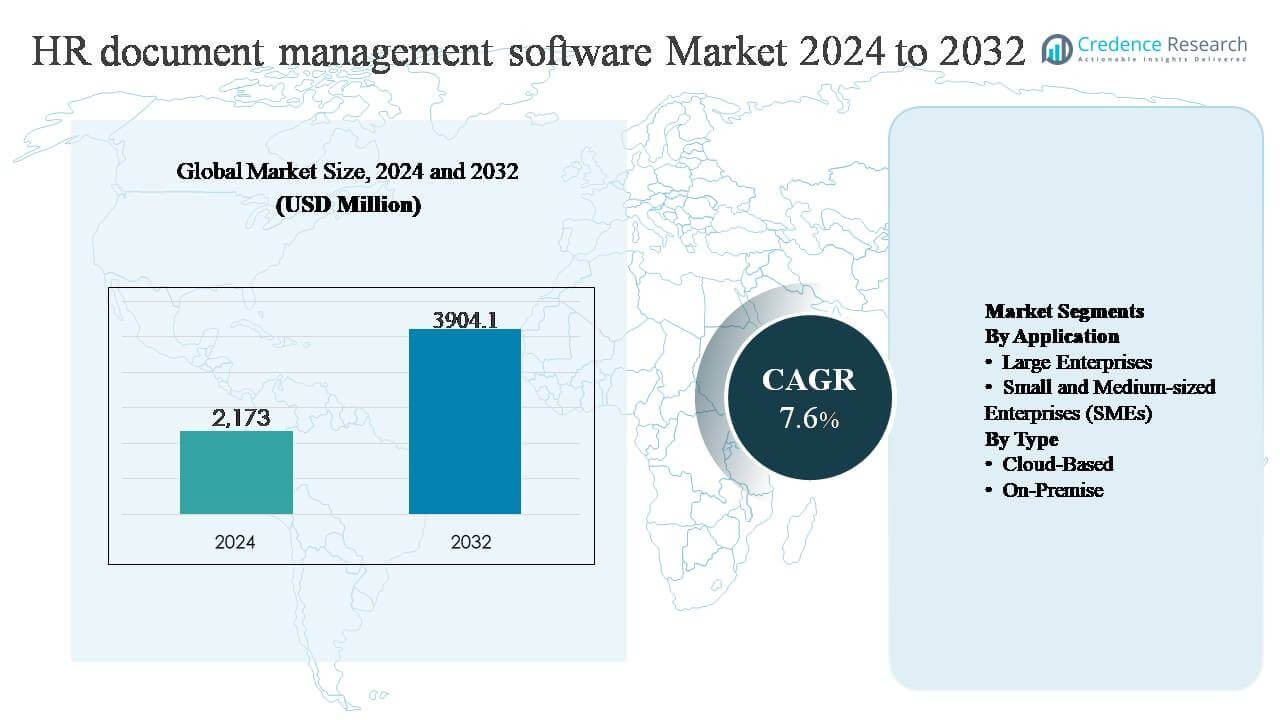
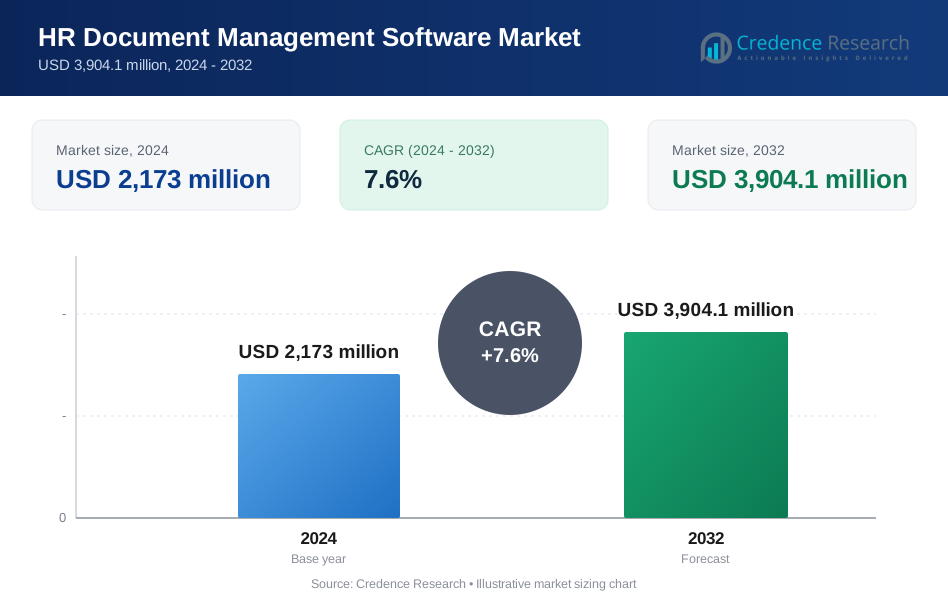
The HR Document Management Software market is witnessing steady growth as organizations increasingly adopt digital solutions to securely store, manage, and streamline employee records, compliance documents, and HR workflows. The market size was valued at USD 2,173 million in 2024 and is anticipated to reach USD 3,904.1 million by 2032, expanding at a CAGR of 7.6% during the forecast period.
| REPORT ATTRIBUTE | DETAILS |
|---|---|
| Historical Period | 2020-2023 |
| Base Year | 2024 |
| Forecast Period | 2025-2032 |
| HR Document Management Software Market Size 2024 | USD 2,173 million |
| HR Document Management Software Market, CAGR | 7.6% |
| HR Document Management Software Market Size 2032 | USD 3,904.1 million |
HR Document Management Software Market Insights
- Market growth is primarily driven by stricter labor regulations, data privacy mandates, and the need to automate employee document workflows across onboarding, compliance, and records retention, particularly within large enterprises that account for the dominant application segment share.
- Cloud-based solutions represent the leading segment by type due to scalability, lower deployment costs, and remote accessibility, while AI-enabled document indexing and workflow automation are emerging trends creating new efficiency-driven adoption opportunities.
- Competition remains moderately fragmented, with major players focusing on cloud expansion, platform integration, and security enhancements, while smaller vendors target SMEs through cost-effective and modular offerings.
- Regionally, North America leads with about 38% market share, followed by Europe at 27%, Asia-Pacific at 23%, Latin America at 7%, and the Middle East & Africa at 5%, reflecting varying levels of HR digital maturity.
HR Document Management Software Market Segmentation Analysis:
By Application:
The HR document management software market by application is dominated by large enterprises, which account for the leading market share due to their complex organizational structures, high employee volumes, and stringent regulatory and audit requirements. Large enterprises actively invest in advanced document management platforms to centralize employee records, automate compliance reporting, and ensure secure access across multiple geographies. Drivers include increasing data governance mandates, integration with enterprise HRIS and ERP systems, and the need for scalable solutions supporting mergers, acquisitions, and global workforce management. SMEs are growing steadily, but adoption remains comparatively lower due to budget sensitivity and simpler HR structures.
- For instance, SAP SuccessFactors is deployed by organizations managing workforces exceeding 500,000 employees, with its Employee Central Document Management module supporting secure storage and retrieval of tens of millions of HR records integrated directly with core ERP workflows.
By Type:
By type, cloud-based HR document management software represents the dominant sub-segment, holding the largest market share owing to its flexibility, lower upfront costs, and ease of deployment. Organizations increasingly favor cloud solutions for real-time access, automated updates, enhanced cybersecurity features, and seamless integration with cloud-based HR and payroll platforms. The shift toward remote and hybrid work models further accelerates cloud adoption. On-premise solutions maintain relevance among highly regulated industries prioritizing full data control, but their market share is constrained by higher maintenance costs and limited scalability compared to cloud-based alternatives.
- For instance, ServiceNow’s HR Service Delivery platform secures HR documents using AES-256 encryption at rest and TLS 1.2+ in transit, while maintaining SOC 2 Type II and ISO/IEC 27001 certifications to support enterprise-grade compliance requirements.
Key Growth Drivers
Rising Regulatory Compliance and Data Governance Requirements
Organizations across industries face increasing pressure to comply with labor laws, data protection regulations, and audit requirements related to employee records. HR document management software enables structured storage, version control, access tracking, and retention management of critical HR documents such as contracts, tax records, and compliance filings. Automated audit trails and role-based access controls reduce compliance risks and administrative burdens for HR teams. As governments strengthen data privacy frameworks and enforcement mechanisms, enterprises prioritize secure and compliant document systems to avoid legal exposure, penalties, and reputational damage, making regulatory compliance a primary growth driver for HR document management software adoption.
- For instance, OpenText Extended ECM for HR allows organizations to configure country-specific retention rules measured in years and apply legal hold policies that immediately suspend deletion when investigations arise.
Digital Transformation of HR Operations
Enterprises are actively modernizing HR functions by replacing paper-based and fragmented systems with centralized digital platforms. HR document management software supports end-to-end digitization of employee lifecycle documentation, including onboarding, performance reviews, training certifications, and exit records. Automation reduces manual processing, minimizes errors, and improves operational efficiency. Integration with HRIS, payroll, and workforce analytics platforms further enhances data accessibility and decision-making. As organizations pursue productivity gains and cost optimization through digital HR transformation initiatives, demand for scalable and interoperable document management solutions continues to accelerate.
- For instance, M-Files’ intelligent information management platform uses metadata-driven classification to automatically tag HR documents at ingestion, eliminating manual filing across repositories that can contain hundreds of thousands of active employee records.
Growth of Distributed and Remote Workforces
The expansion of remote, hybrid, and geographically dispersed work models has intensified the need for secure, cloud-accessible HR documentation. HR document management software enables authorized stakeholders to access employee records anytime and from any location, supporting seamless collaboration across regions. Digital workflows streamline onboarding, policy acknowledgments, and document approvals without physical presence. As global hiring and flexible work arrangements become long-term strategies rather than temporary measures, organizations increasingly rely on digital HR document platforms to ensure continuity, security, and operational consistency across distributed work environments.
Key Trends & Opportunities
Accelerated Adoption of Cloud-Based HR Platforms
Cloud-based HR document management solutions are gaining strong traction due to their scalability, rapid deployment, and reduced IT dependency. Organizations benefit from subscription-based pricing models, automatic updates, and enhanced cybersecurity frameworks offered by cloud providers. Cloud platforms also support integration with SaaS-based HR, payroll, and talent management systems, creating unified digital HR ecosystems. This trend presents significant growth opportunities for vendors offering flexible, modular, and API-enabled cloud solutions tailored to evolving enterprise and SME needs.
- For instance, Workday’s document management capabilities run on a multi-tenant cloud architecture that supports 24×7 global availability and processes millions of document transactions per day across customer tenants, with data protected using AES-256 encryption at rest and TLS 1.2+ for data in transit.
Integration of AI and Intelligent Automation
The incorporation of artificial intelligence and automation capabilities is reshaping HR document management software functionality. AI-powered features such as document classification, metadata tagging, intelligent search, and automated compliance checks improve accuracy and efficiency. Machine learning algorithms help identify missing documents, flag policy deviations, and optimize record retention schedules. Vendors that embed intelligent automation into their platforms can differentiate offerings, enhance user experience, and unlock new revenue opportunities by delivering advanced analytics-driven HR document insights.
- For instance, Document Logistix embeds OCR and rules-based automation within its ECM platform to automatically index HR documents at ingestion, supporting repositories that manage hundreds of thousands of employee files with system-level version control and time-stamped audit logs for every document action.
Key Challenges
Data Security and Privacy Concerns
Despite growing adoption, data security remains a critical challenge for HR document management software. HR records contain highly sensitive personal and financial information, making them prime targets for cyberattacks and unauthorized access. Organizations often hesitate to migrate documents to digital or cloud environments due to concerns over breaches, data residency, and third-party risk. Vendors must continuously invest in advanced encryption, compliance certifications, and security monitoring to build customer trust and address stringent data protection expectations.
Integration Complexity and Change Management
Implementing HR document management software often requires integration with existing HR, payroll, and enterprise systems, which can be complex and resource-intensive. Legacy infrastructure, data migration challenges, and resistance to change among HR staff can slow adoption and reduce return on investment. Organizations must invest in training, workflow redesign, and stakeholder alignment to ensure successful implementation. For vendors, simplifying integration and offering strong onboarding support remains essential to overcoming adoption barriers.
Regional Analysis
North America:
North America holds the largest share of the HR document management software market at approximately 38%, driven by early technology adoption, strict labor compliance requirements, and the strong presence of large enterprises. Organizations in the United States and Canada increasingly prioritize digital HR transformation, data security, and regulatory adherence, accelerating adoption of advanced document management platforms. High penetration of cloud-based HR solutions, integration with enterprise HRIS systems, and widespread remote work practices further support market leadership. Continuous investments by vendors in AI-driven automation and cybersecurity capabilities also reinforce North America’s dominant regional position.
Europe:
Europe accounts for around 27% of the global HR document management software market, supported by stringent data protection regulations and compliance mandates across the region. Enterprises focus heavily on structured document retention, audit readiness, and employee data privacy, driving consistent software adoption. Western European countries lead due to mature digital infrastructure and strong enterprise IT spending, while Central and Eastern Europe show steady growth as organizations modernize HR operations. The increasing shift toward cloud-based HR platforms, combined with multilingual and cross-border workforce management needs, sustains Europe’s significant market contribution.
Asia-Pacific:
Asia-Pacific represents approximately 23% of the HR document management software market and is the fastest-growing regional segment. Rapid expansion of SMEs, increasing digitalization initiatives, and rising adoption of cloud technologies drive market momentum. Countries such as China, India, Japan, and Australia are witnessing strong demand as organizations formalize HR processes and comply with evolving labor regulations. The region’s large workforce base, growing remote employment models, and cost-efficient cloud deployments further enhance adoption. Vendors targeting scalable and affordable solutions are well positioned to capture growth across diverse Asia-Pacific markets.
Latin America:
Latin America holds nearly 7% of the global HR document management software market, supported by gradual digital transformation across enterprises and improving IT infrastructure. Organizations increasingly adopt HR document management solutions to enhance operational efficiency and meet local compliance requirements. Brazil and Mexico lead regional demand due to expanding enterprise sectors and growing awareness of digital HR tools. While adoption remains moderate compared to developed regions, rising cloud acceptance and increasing focus on workforce formalization are expected to steadily strengthen Latin America’s market presence over the forecast period.
Middle East & Africa:
The Middle East & Africa region accounts for about 5% of the HR document management software market, driven by enterprise modernization and regulatory alignment initiatives. Large organizations in the Gulf Cooperation Council countries lead adoption, supported by investments in digital transformation and cloud infrastructure. Demand is growing for secure document management solutions that support multinational workforces and compliance with labor regulations. Although adoption levels vary across countries, increasing enterprise digitization, government-led IT initiatives, and expanding private-sector employment continue to support gradual market expansion in the region.
HR Document Management Software Market Segmentations:
By Application
- Large Enterprises
- Small and Medium-sized Enterprises (SMEs)
By Type
- Cloud-Based
- On-Premise
By Geography
- North America
- U.S.
- Canada
- Mexico
- Europe
- Germany
- France
- U.K.
- Italy
- Spain
- Rest of Europe
- Asia Pacific
- China
- Japan
- India
- South Korea
- South-east Asia
- Rest of Asia Pacific
- Latin America
- Brazil
- Argentina
- Rest of Latin America
- Middle East & Africa
- GCC Countries
- South Africa
- Rest of the Middle East and Africa
Competitive Landscape
The competitive landscape of ontrol, and seamless integration with HRIS and payroll systems. Vendors differentiate ththe HR document management software market is characterized by the presence of established enterprise software providers and specialized HR technology vendors competing on functionality, security, and platform integration. Leading players focus on delivering cloud-based, scalable solutions with advanced features such as automated compliance tracking, role-based access crough user experience, AI-enabled document classification, and robust cybersecurity frameworks. Strategic initiatives include product enhancements, partnerships with HR platform providers, and expansion into emerging markets. Competition remains moderately fragmented, with large players leveraging global reach and extensive customer bases, while niche vendors target SMEs with cost-effective, modular solutions tailored to simplified HR document workflows.
Key Player Analysis
- SAP
- ServiceNow
- M-Files
- Iron Mountain
- Zoho
- PeopleDoc
- eFileCabinet
- Document Logistix
- DocuVantage
- Breathe
Recent Developments
- In December 2025, SAP SuccessFactors announced Enterprise Service Management enhancements focused on AI- and data-driven HR service delivery, embedding SAP’s Joule AI copilot to accelerate case resolution, automate workflows, and deliver contextual insights across HR processes enabling HR teams to surface trends and recommendations directly from HR data in real time.
- In November 2025, M-Files introduced Workspaces a new context-first document management experience that visually links documents, people, processes, and projects in a unified interface driven by its AI engine M-Files Aino. Designed to reduce search friction and enhance compliance visibility across content related to work objects like projects or clients.
Report Coverage
The research report offers an in-depth analysis based on Application, Type and Geography. It details leading market players, providing an overview of their business, product offerings, investments, revenue streams, and key applications. Additionally, the report includes insights into the competitive environment, SWOT analysis, current market trends, as well as the primary drivers and constraints. Furthermore, it discusses various factors that have driven market expansion in recent years. The report also explores market dynamics, regulatory scenarios, and technological advancements that are shaping the industry. It assesses the impact of external factors and global economic changes on market growth. Lastly, it provides strategic recommendations for new entrants and established companies to navigate the complexities of the market.
Future Outlook
- Organizations will increasingly adopt cloud-based HR document management platforms to support scalability, flexibility, and remote workforce requirements.
- Integration with broader HRIS, payroll, and talent management systems will become a standard expectation across enterprises.
- Artificial intelligence will play a growing role in document classification, search optimization, and compliance monitoring.
- Demand for automated audit trails and policy enforcement will strengthen as regulatory scrutiny increases.
- Large enterprises will continue to lead adoption due to complex workforce structures and global compliance needs.
- SMEs will accelerate adoption as vendors introduce affordable, modular, and easy-to-deploy solutions.
- Data security and privacy enhancements will remain a core area of vendor investment and differentiation.
- Mobile accessibility will gain importance as HR teams and employees seek real-time document access.
- Regional expansion in Asia-Pacific and Latin America will create new growth opportunities for solution providers.
- Vendors will increasingly compete on user experience, workflow automation, and customization capabilities.
Request a Free Sample
Fill in your details and we'll send you a free sample report.
- Sample data tables & charts
- Research methodology
Need a Custom Version of This Report?
Tailor the scope, geography, or segments to your exact requirements.
- Custom geography or segment scope
- Direct access to our analyst team
Frequently Asked Questions
What is the current market size for HR document management software, and what is its projected size in 2032?
At what Compound Annual Growth Rate is the HR document management software projected to grow between 2024 and 2032?
Which HR document management software segment held the largest share in 2024?
What are the primary factors fueling the growth of the HR document management software market?
Who are the leading companies in the HR document management software market?
Which region commanded the largest share of the HR document management software market in 2024?
Table of Content
Chapter 1. Report Introduction
- 1.1 Report Description & Purpose
- 1.1.1 Report Title & Market Definition
- 1.1.2 Unique Selling Propositions (USP) & Key Differentiators
- 1.1.3 Value Proposition for Stakeholders
- 1.2 Research Objectives
- 1.2.1 Market Sizing Objectives (Volume & Revenue)
- 1.2.2 Segmentation Objectives
- 1.2.3 Competitive Intelligence Objectives
- 1.2.4 Forecast & Scenario Objectives
- 1.3 Report Scope
- 1.3.1 HR Document Management Software Scope – Types & Subtypes Covered
- 1.3.2 Geographic Scope – Regions & Countries Covered
- 1.3.3 Historical Period, Base Year & Forecast Period (2024; forecast to 2032)
- 1.3.4 Inclusions & Exclusions
- 1.4 HS Code & Classification Framework
- 1.5 Currency, Units & Pricing Basis
- 1.6 Target Stakeholders
- 1.7 Limitations & Assumptions
Chapter 2. Executive Summary
- 2.1 Global HR Document Management Software Market Snapshot
- 2.1.1 Market Size – Historical (2024) & Forecast (2024-2032) (2024: USD 2,173 million → 2032: USD 3,904.1 million)
- 2.1.2 Volume & Revenue – Global Totals
- 2.1.3 Key Market Highlights – Top Five Facts
- 2.2 HR Document Management Software Market Segmentation Snapshot
- 2.2.1 Market Split by Region – 2024 vs. 2032
- 2.3 Competitive Snapshot
- 2.3.1 Top 10 Players by Revenue Share – 2024
- 2.3.2 Top 10 Players by Volume Share – 2024
- 2.3.3 Recent Strategic Developments (18-Month Summary)
- 2.4 Key Investment Highlights & Strategic Conclusions
Chapter 3. HR Document Management Software Market Dynamics & Industry Analysis
- 3.1 Market Overview & Context
- 3.1.1 HR Document Management Software Market Position in the Broader Automotive Value Chain
- 3.1.2 OEM vs. Replacement Market Dynamics
- 3.1.3 Market Maturity & Development Stage by Region
- 3.2 HR Document Management Software Market Drivers
- 3.3 HR Document Management Software Market Restraints & Challenges
- 3.4 HR Document Management Software Market Opportunities
- 3.5 Porter's Five Forces Analysis
- 3.5.1 Threat of New Entrants
- 3.5.2 Bargaining Power of Suppliers
- 3.5.3 Bargaining Power of Buyers
- 3.5.4 Threat of Substitutes
- 3.5.5 Competitive Rivalry – Intensity Assessment
- 3.6 HR Document Management Software Value Chain Analysis
- 3.6.1 Upstream – Raw Material/Input Suppliers
- 3.6.1.1 Raw Material/Input 1
- 3.6.1.2 Raw Material/Input 2
- 3.6.1.3 Raw Material/Input 3
- 3.6.2 Midstream – Production/Manufacturing/Service Delivery
- 3.6.2.1 Production/Process Overview
- 3.6.2.2 Key Facility Locations & Capacity by Manufacturer
- 3.6.3 Downstream – Distribution & End Consumer
- 3.6.3.1 Primary Channel – B2B/OEM
- 3.6.3.2 Secondary Channels – Dealer, Retail, Online, Direct
- 3.6.4 Value Chain Profitability Analysis
- 3.6.1 Upstream – Raw Material/Input Suppliers
- 3.7 PESTEL Analysis
- 3.7.1 Political Factors
- 3.7.2 Economic Factors
- 3.7.3 Social Factors
- 3.7.4 Technological Factors
- 3.7.5 Environmental Factors
- 3.7.6 Legal Factors
- 3.8 HR Document Management Software Supply Chain Analysis
- 3.8.1 Raw Material/Input Supply Risk Assessment
- 3.8.2 Manufacturing Concentration Risk (Geographic Exposure)
- 3.8.3 Trade Disruption Impact Analysis
- 3.9 Regulatory & Policy Landscape
Note: The regulatory and policy landscape section covers regulations based on their applicability to the market, HR Document Management Software category, geography, and scope of the study. Only regulatory frameworks with a material impact on operations, compliance, trade, sustainability, or market access are analyzed in detail.
Chapter 4. Key Investment Pockets & Opportunity Analysis
- 4.1 HR Document Management Software Market Attractiveness Analysis
- 4.1.1 By Region – Investment Attractiveness Matrix (Volume × CAGR)
- 4.2 Absolute Revenue Growth Opportunity
- 4.2.1 By Region – Absolute USD Growth Through 2032
- 4.3 Incremental Volume Opportunity
- 4.3.1 By Region – Incremental Volume Through 2032
- 4.3.2 Segment – Incremental Volume
- 4.4 Emerging Submarket Opportunity Deep Dive (Subject to Applicability)
- 4.5 Emerging Market Opportunity Scorecards
- 4.5.1 United States
- 4.5.2 Europe
- 4.5.3 Asia
- 4.5.4 Middle East & Africa
Note: Emerging Market Opportunity Scorecards will be included based on relevance and strategic importance. Regions listed are indicative and may vary depending on data availability and market dynamics.
Chapter 5. HR Document Management Software Import-Export Analysis & Trade Flows
- 5.1 Global Trade Overview
- 5.1.1 Global Export Value by Country (2024)
- 5.1.2 Global Export Volume by Country (2024)
- 5.1.3 Global Import Value by Country (2024)
- 5.1.4 Global Import Volume by Country (2024)
- 5.1.5 Net Trade Balance by Country (2024)
- 5.2 Export Analysis – Segment
- 5.2.1 Type 1 (HS Code)
- 5.2.2 Type 2 (HS Code)
- 5.2.3 Type 3 (HS Code)
- 5.2.4 Type 4 (HS Code)
- 5.2.5 Type 5 (HS Code)
- 5.3 Import Analysis – Segment
- 5.3.1 Type 1 (HS Code)
- 5.3.2 Type 2 (HS Code)
- 5.3.3 Type 3 (HS Code)
- 5.3.4 Type 4 (HS Code)
- 5.3.5 Type 5 (HS Code)
- 5.4 Average Unit Trade Prices
- 5.4.1 Average Export Price – Segment & Country
- 5.4.2 Average Import Price – Segment & Source Country
- 5.4.3 Price Trends (2024)
- 5.5 Key Trade Route Analysis
- 5.5.1 Trade Route 1
- 5.5.2 Trade Route 2
- 5.5.3 Trade Route 3
- 5.5.4 Trade Route 4
- 5.5.5 Trade Route 5
- 5.6 Trade Policy Impact Assessment
- 5.6.1 US Anti-Dumping & Section 301 Tariffs
- 5.6.2 EU Customs Union Impact
- 5.6.3 Major Free Trade Agreements
- 5.6.4 USMCA Rules of Origin
Note: Trade policy analysis will be included only where relevant to the HR Document Management Software market.
Chapter 6. Competitive Landscape & Company Benchmarking
- 6.1 HR Document Management Software Market Concentration & Structure
- 6.1.1 Herfindahl-Hirschman Index (HHI) – vs. 2024
- 6.1.2 Tier 1, Tier 2 & Tier 3 Market Structure
- 6.1.3 Global, Regional & Local Player Dynamics
- 6.2 HR Document Management Software Market Share Analysis – 2024
- 6.2.1 Global Revenue Share by Company
- 6.2.2 Global Volume Share by Company
- 6.2.3 Regional Revenue Share
- 6.2.4 Market Share Evolution ( vs. 2024)
- 6.2.5 OEM Segment Share by Company
- 6.2.6 Replacement Segment Share by Company
- 6.3 Production/Delivery Capacity & Facility Analysis
- 6.3.1 Global Installed Capacity
- 6.3.2 Capacity Utilization Rates
- 6.3.3 Production/Output Volume
- 6.3.4 Facility Locations & Capacity Map
- 6.3.5 Planned Capacity Additions
- 6.4 HR Document Management Software Competitive Benchmarking Matrix
- 6.4.1 Revenue, Volume, CAGR & Profitability Comparison
- 6.4.2 Channel Revenue Mix
- 6.4.3 Geographic Revenue Exposure
- 6.4.4 R&D Intensity
- 6.4.5 Sustainability Maturity
- 6.5 Strategic Developments in HR Document Management Software (Last 24 Months)
- 6.5.1 Mergers, Acquisitions & Divestments
- 6.5.2 New HR Document Management Software Launches
- 6.5.3 Facility Expansions
- 6.5.4 Strategic Alliances, Joint Ventures & Partnerships
- 6.5.5 Distribution Expansion & Market Entry
- 6.5.6 Sustainability & ESG Initiatives
- 6.6 Competitive Strategy Mapping
- 6.6.1 Leader, Challenger, Follower & Niche Classification
- 6.6.2 Pricing Strategy Comparison
- 6.6.3 Channel Strategy Matrix
Note: Strategic developments are included based on their materiality and the availability of reliable information.
Chapter 7. Global HR Document Management Software Market – By Distribution Channel
- 7.1 Segment Overview
- 7.1.1 Volume & Revenue Split by Channel (2024 & 2032)
- 7.1.2 Channel Mix Evolution (2024-2032)
Chapter 8. Regional Market Analysis – Global Overview
- 8.1 Global Regional Overview
- 8.1.1 Regional Volume Share
- 8.1.2 Regional Revenue Share
- 8.1.3 Regional Volume by Region
- 8.1.4 Regional Revenue by Region
- 8.1.5 Regional Forecast Through 2032
- 8.2 Cross-Regional Segment Analysis
- 8.2.1 By Distribution Channel
- 8.2.2 By Brand/Price Tier
Chapter 9. North America HR Document Management Software Market
- 9.1 United States
- 9.2 Canada
- 9.3 Mexico
Chapter 10. Europe HR Document Management Software Market
- 10.1 Germany
- 10.2 France
- 10.3 Italy
- 10.4 United Kingdom
- 10.5 Spain
- 10.6 Poland
- 10.7 Russia
- 10.8 Netherlands
- 10.9 Belgium
- 10.10 Sweden
- 10.11 Denmark
- 10.12 Norway
- 10.13 Rest of Europe
Chapter 11. Asia Pacific HR Document Management Software Market
- 11.1 China
- 11.2 India
- 11.3 Japan
- 11.4 South Korea
- 11.5 Thailand
- 11.6 Indonesia
- 11.7 Vietnam
- 11.8 Malaysia
- 11.9 Australia
- 11.10 Rest of Asia Pacific
Chapter 12. Latin America HR Document Management Software Market
- 12.1 Brazil
- 12.2 Argentina
- 12.3 Colombia
- 12.4 Chile
- 12.5 Rest of Latin America
Chapter 13. Middle East HR Document Management Software Market
- 13.1 Saudi Arabia
- 13.2 United Arab Emirates
- 13.3 Turkey
- 13.4 Israel
- 13.5 Iran
- 13.6 Rest of the Middle East
Chapter 14. Africa HR Document Management Software Market
- 14.1 South Africa
- 14.2 Egypt
- 14.3 Nigeria
- 14.4 Morocco
- 14.5 Rest of Africa
Chapter 15. HR Document Management Software Company Profiles
- 15.1 [Company 01]
- 15.1.1 Company Overview
- 15.1.2 Key Management Personnel
- 15.1.3 Products & Services Portfolio
- 15.1.4 Financial Performance
- 15.1.5 Key Market Focus & Geographic Presence
- 15.1.6 Recent Developments & Strategic Initiatives
Note: The company profile list is preliminary and may change based on research findings, market developments, data availability, and client requirements.
Chapter 16. Appendices
- Appendix A – List of Abbreviations & Acronyms
- Appendix B – Industry Classification Code Reference – Full Series
- Appendix C – Production & Capacity Data Tables
- Appendix D – End-Use & Demand Base Tables
- Appendix E – Consumption & Replacement Rate Assumptions
- Appendix F – ASP Reference Tables
- Appendix G – Manufacturing & Facility Database
- Appendix H – Import-Export Data Tables
- Appendix I – Regulatory Summary Tables
- Appendix J – Primary Research Participant List (Anonymized)
- Appendix K – Primary Research Questionnaire Framework
- Appendix L – Data Sources & Bibliography
- Appendix M – Market Size Divergence & Source Comparison
Chapter 17. Research Methodology
- 17.1 Research Framework & Philosophy
- 17.2 Secondary Research – Sources, Hierarchy & Data Extraction
- 17.3 Data Modeling – Bottom-Up & Top-Down Market Sizing
- 17.4 Primary Research – Stakeholder Framework, LOI & Sample Sizes
- 17.5 Forecast Methodology – Regression, Scenario & Sensitivity Analysis
- 17.6 Quality Control – Four-Layer Validation Framework
- 17.7 Limitations & Standard Assumptions
- 17.8 Disclaimer
