
Quality Management Software Market Overview:
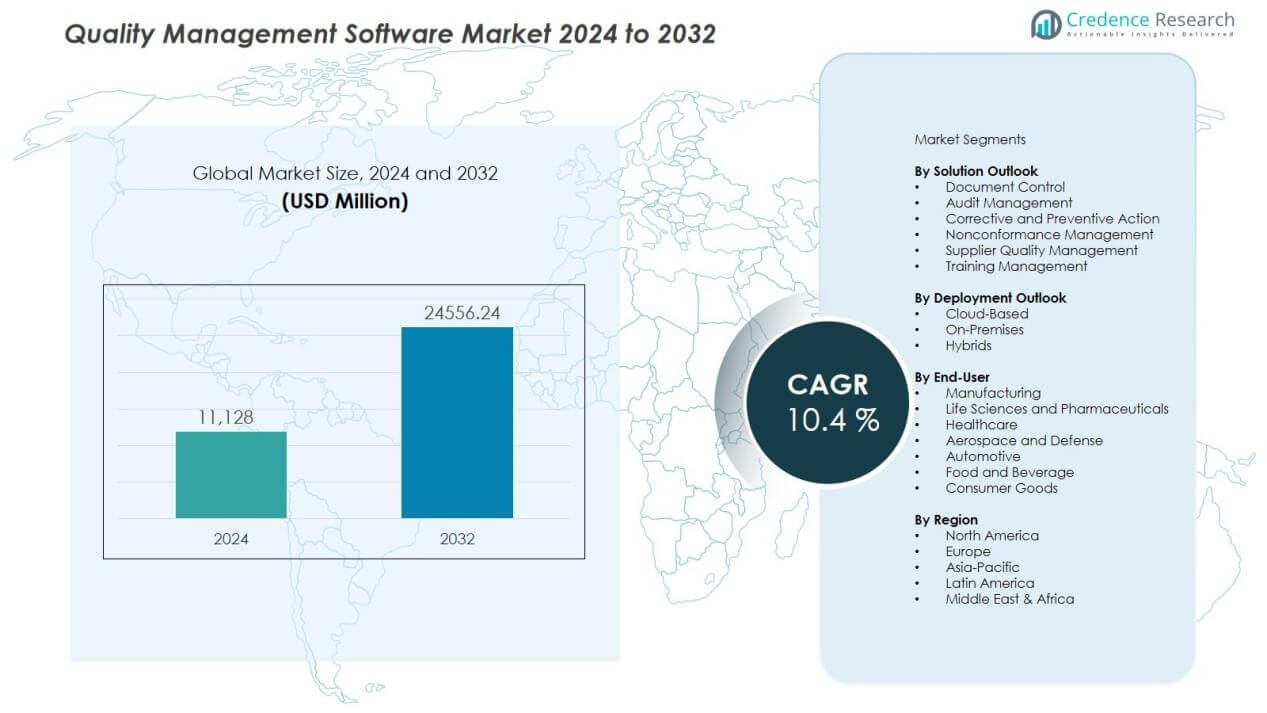
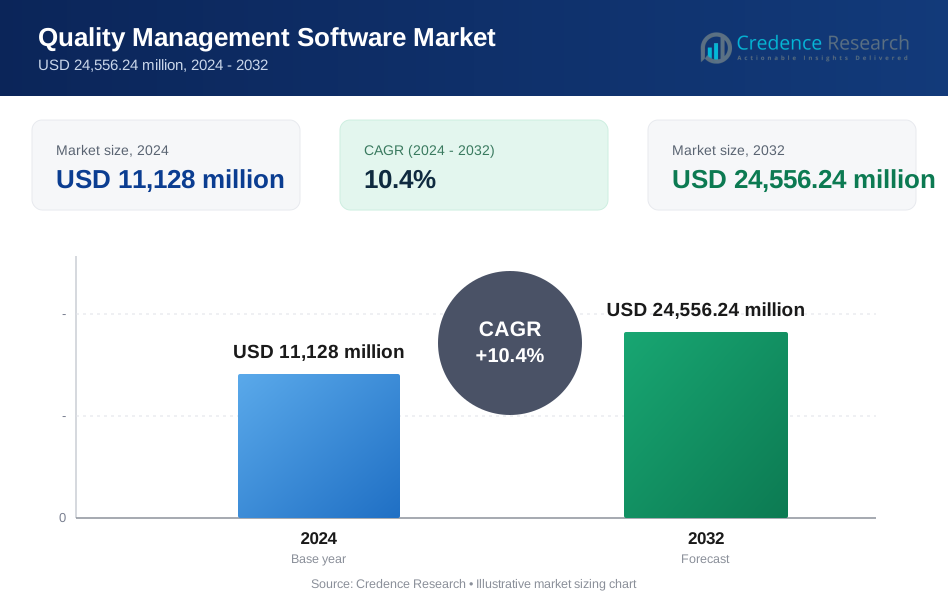
The Quality Management Software Market size was valued at USD 11,128 million in 2024 and is anticipated to reach USD 24556.24 million by 2032, at a CAGR of 10.4% during the forecast period.
| REPORT ATTRIBUTE | DETAILS |
|---|---|
| Historical Period | 2020-2024 |
| Base Year | 2025 |
| Forecast Period | 2026-2032 |
| Quality Management Software Market Size 2024 | USD 11,128 million |
| Quality Management Software Market, CAGR | 10.4% |
| Quality Management Software Market Size 2032 | USD 24556.24 million |
Quality Management Software Market Insights:
- North America held 38.6% share, Europe accounted for 27.4%, and Asia-Pacific represented 24.1% of the market, driven by regulatory rigor and high IT spending in North America, strong quality standardization in Europe, and large-scale manufacturing adoption across Asia-Pacific.
- Asia-Pacific is the fastest-growing region with a 24.1% share, supported by rapid industrialization, expanding export-oriented manufacturing, rising cloud adoption, and government-backed quality and compliance initiatives.
- By solution, Document Control and Audit Management solutions held 34.8% share, driven by mandatory compliance documentation, inspection readiness, and enterprise-wide standardization requirements across regulated industries.
- By deployment, Cloud-based solutions accounted for 46.3% share, reflecting enterprise preference for scalability, faster implementation, lower upfront cost, and centralized quality visibility across distributed operations.
Quality Management Software Market Drivers:
Escalating Regulatory Compliance and Standardization Requirements Across Industries
The Quality Management Software Market benefits from strict regulatory frameworks that govern product safety, data integrity, and operational accountability. Governments and industry bodies enforce standards such as ISO certifications, FDA regulations, and sector-specific quality mandates. Organizations rely on digital quality systems to manage audits, documentation, and compliance reporting with precision. It supports traceability and reduces exposure to regulatory penalties. Demand rises steadily across life sciences, manufacturing, and aerospace sectors.
- For instance, Medtronic implemented ISO 13485-compliant quality management software to automate audit processes across its global operations, achieving 100% traceability for over 1 million device components annually.
Enterprise Focus on Operational Excellence and Risk Reduction Strategies
The Quality Management Software Market gains momentum from enterprise priorities centered on consistency, efficiency, and risk control. Businesses deploy structured quality systems to reduce defects, standardize workflows, and strengthen corrective action processes. It enables early detection of nonconformities and supports data-driven quality decisions. Senior management teams view quality platforms as strategic tools rather than compliance utilities. This shift reinforces long-term adoption across large enterprises.
- For instance, QT9 QMS achieved top recognition in 2025 Gartner Digital Markets awards for Best Ease of Use across Capterra, Software Advice, and GetApp platforms, streamlining compliance automation for enterprises.
Digital Transformation and Integration With Core Enterprise Systems
The Quality Management Software Market advances through integration with ERP, MES, and supply chain platforms. Organizations pursue unified digital ecosystems that improve data accuracy and process visibility. It supports real-time reporting and cross-functional collaboration across quality, operations, and procurement teams. Cloud-based architectures enhance scalability and deployment speed. These capabilities attract both multinational firms and mid-sized enterprises.
Rising Customer Expectations and Competitive Differentiation Pressures
The Quality Management Software Market expands due to heightened customer expectations for consistent product and service quality. Companies use quality platforms to protect brand reputation and strengthen customer trust. It supports continuous improvement initiatives that enhance product reliability and service delivery. Competitive markets reward organizations that demonstrate superior quality performance. This pressure drives sustained investment in advanced quality management solutions.
Quality Management Software Market Trends:
Accelerated Shift Toward Cloud-Native, Scalable, and Subscription-Based Quality Platforms
The Quality Management Software Market shows a clear shift toward cloud-native architectures that support flexibility and rapid deployment. Enterprises prefer subscription models that lower upfront costs and align expenses with usage. It enables faster upgrades, centralized data access, and remote quality oversight across distributed operations. Vendors design modular platforms that allow selective adoption of core quality functions. Cybersecurity and data sovereignty features receive strong attention during vendor selection. Cloud platforms also support faster integration with enterprise systems. This trend strengthens adoption among small and mid-sized organizations.
- For instance, Spectrum QMS's modular cloud design permitted a pharma firm to integrate CAPA and audit tools selectively, reducing deployment time by 60% while supporting 10,000+ daily user sessions.
Growing Use of Advanced Analytics, Automation, and Predictive Quality Capabilities
The Quality Management Software Market increasingly incorporates advanced analytics and automation to improve decision accuracy. Vendors embed machine learning tools that detect quality deviations before failures escalate. It supports predictive risk assessment and prioritizes corrective actions based on data patterns. Automated workflows reduce manual intervention and improve audit readiness. Dashboards provide executives with real-time performance visibility. Data-driven quality strategies gain preference over reactive inspection methods. This evolution positions quality management as a strategic intelligence function.
- For Instance, Spectrum TQM’s integrated and modular architecture enables pharmaceutical organizations to selectively deploy critical modules, such as CAPA and Audit Management, ensuring full compliance with FDA 21 CFR Part 11 and cGMP standards.
Quality Management Software Market Challenges Analysis:
High Implementation Complexity and Enterprise-Wide Change Management Barriers
The Quality Management Software Market faces challenges related to complex deployment across diverse operational environments. Large enterprises often operate legacy systems that limit seamless integration. It requires structured data migration and process alignment across departments. Employees may resist standardized workflows that alter established quality practices. Training demands place pressure on internal resources. Extended implementation timelines affect return on investment expectations. These factors slow adoption in highly decentralized organizations.
Data Governance, Security Concerns, and Cost Sensitivity Among Users
The Quality Management Software Market encounters obstacles tied to data protection and long-term cost management. Organizations handle sensitive quality and compliance data that demand strict access controls. It raises concerns related to cloud security and regulatory data residency. Subscription fees and customization costs influence purchasing decisions. Budget constraints affect adoption among small and mid-sized enterprises. Vendor lock-in risks create hesitation during platform selection. These issues shape cautious investment strategies.
Quality Management Software Market Opportunities:
Expansion of Quality Digitization Across Emerging Industries and Mid-Sized Enterprises
The Quality Management Software Market presents strong opportunities through rising adoption across emerging industries and mid-sized organizations. Manufacturing modernization and service quality programs drive demand beyond traditional regulated sectors. It enables standardized quality control without extensive infrastructure investment. Cloud deployment reduces entry barriers for smaller enterprises. Regional industrial growth supports new customer acquisition. Vendors can address unmet needs through modular and industry-specific offerings. This expansion broadens the overall addressable market.
Integration of Predictive Intelligence and Value-Driven Quality Strategies
The Quality Management Software Market offers growth potential through advanced analytics and predictive quality capabilities. Enterprises seek tools that shift quality from compliance to strategic performance management. It supports proactive risk mitigation and continuous improvement initiatives. Artificial intelligence enhances defect prediction and root cause analysis. Data-driven insights strengthen executive decision-making. Integration with enterprise systems increases platform value. These advancements create long-term revenue opportunities for solution providers.
Quality Management Software Market Segmentation Analysis:
By Solution Outlook
The Quality Management Software Market shows strong segmentation by solution type, reflecting varied enterprise quality priorities. Document control and audit management solutions command significant adoption due to regulatory compliance needs. It supports standardized procedures, controlled records, and inspection readiness across operations. Corrective and preventive action and nonconformance management solutions gain traction as organizations focus on root cause resolution. Supplier quality management tools also record rising demand due to complex global supply chains.
- For instance, MasterControl's platform enabled a pharmaceutical firm to automate document approvals, achieving 99.5% compliance rate across 10,000+ documents annually.
By Deployment Outlook
Deployment-based segmentation highlights a clear preference shift toward cloud-based platforms. Cloud solutions attract enterprises seeking scalability, faster deployment, and lower upfront costs. It enables centralized access to quality data across distributed facilities. On-premises solutions retain relevance among highly regulated industries that prioritize data control. Hybrid models gain attention where security and flexibility remain equally important.
- For instance, IBM's Power10 servers deployed in financial sectors achieved approximately 2.5x faster AES encryption processing speeds per core for secure data handling, a key feature announced in 2021 due to four times the number of crypto engines per core compared to Power9.
By End-User
End-user segmentation demonstrates broad adoption across manufacturing, life sciences, healthcare, aerospace, and automotive sectors. The Quality Management Software Market benefits from manufacturing dominance due to defect reduction and process standardization needs. It supports compliance and validation requirements within life sciences and healthcare. Service industries adopt quality software to strengthen operational consistency and customer satisfaction. Diverse end-user demand reinforces stable market expansion across sectors.
Segmentations:
By Solution Outlook
- Document Control
- Audit Management
- Corrective and Preventive Action
- Nonconformance Management
- Supplier Quality Management
- Training Management
By Deployment Outlook
- Cloud-Based
- On-Premises
- Hybrid
By End-User
- Manufacturing
- Life Sciences and Pharmaceuticals
- Healthcare
- Aerospace and Defense
- Automotive
- Food and Beverage
- Consumer Goods
By Region
- North America
- U.S.
- Canada
- Mexico
- Europe
- Germany
- France
- U.K.
- Italy
- Spain
- Rest of Europe
- Asia Pacific
- China
- Japan
- India
- South Korea
- South-east Asia
- Rest of Asia Pacific
- Latin America
- Brazil
- Argentina
- Rest of Latin America
- Middle East & Africa
- GCC Countries
- South Africa
- Rest of the Middle East and Africa
Regional Analysis:
North America Maintains Leadership Through Regulatory Rigor and Digital Maturity
The Quality Management Software Market shows strong concentration in North America due to advanced digital infrastructure and strict compliance frameworks. Enterprises adopt quality platforms to meet FDA, ISO, and industry-specific mandates. It supports enterprise-wide quality standardization across complex operations. High investment in cloud computing and analytics strengthens software adoption. Large manufacturers and life sciences firms drive consistent demand. Strong vendor presence accelerates innovation and customer support. This environment sustains regional market dominance.
Europe Demonstrates Stable Growth Driven by Standardization and Sustainability Focus
The Quality Management Software Market in Europe benefits from harmonized quality standards and cross-border trade requirements. Organizations implement quality systems to ensure traceability and process transparency. It supports compliance with EU regulations across manufacturing and healthcare sectors. Sustainability and product safety priorities raise demand for structured quality controls. Medium and large enterprises continue software modernization initiatives. Public and private sector collaboration supports digital quality frameworks. These factors ensure steady regional expansion.
Asia-Pacific Emerges as the Fastest-Growing Regional Market
The Quality Management Software Market in Asia-Pacific records rapid expansion due to industrial growth and digital transformation. Manufacturers invest in quality platforms to support export compliance and operational consistency. It enables centralized oversight across expanding production bases. Cloud adoption rises due to cost efficiency and scalability. Growing presence of multinational firms strengthens demand. Government-backed industrial programs promote quality standards. These drivers position Asia-Pacific as a key growth engine.
Key Player Analysis:
- Arena Solutions, Inc.
- Cority Software Inc.
- Dassault Systemes SE
- EtQ Management Consultants, Inc.
- Ideagen Plc
- Intelex Technologies
- MasterControl, Inc.
- MetricStream, Inc.
- Microsoft Corporation
- Oracle Corporation
- Pilgrim Quality Solution
Competitive Analysis:
The Quality Management Software Market features a competitive landscape defined by global enterprise software vendors and specialized quality solution providers. Leading companies focus on comprehensive platforms that integrate document control, audit management, and corrective action workflows. It emphasizes scalability, security, and regulatory compliance to serve large enterprises and regulated industries. Vendors invest in cloud-native architectures and analytics capabilities to strengthen differentiation. Strategic partnerships with ERP and manufacturing system providers expand platform reach. Product enhancements center on automation and data visibility to improve customer value. Competitive intensity remains high as vendors target mid-sized enterprises with modular offerings. Continuous innovation and customer support quality shape long-term positioning.
Recent Developments:
- In May 2025, Oracle Corporation expanded its partnership with IBM to advance agentic AI and hybrid cloud solutions by integrating watsonx AI with Oracle Cloud Infrastructure.
- In October 2025, Oracle Corporation launched new AI agents across its Fusion Applications to advance enterprise AI functionalities.
Report Coverage:
The research report offers an in-depth analysis based on Solution Outlook, Deployment Outlook, End-User and Region. It details leading Market players, providing an overview of their business, product offerings, investments, revenue streams, and key applications. Additionally, the report includes insights into the competitive environment, SWOT analysis, current Market trends, as well as the primary drivers and constraints. Furthermore, it discusses various factors that have driven Market expansion in recent years. The report also explores Market dynamics, regulatory scenarios, and technological advancements that are shaping the industry. It assesses the impact of external factors and global economic changes on Market growth. Lastly, it provides strategic recommendations for new entrants and established companies to navigate the complexities of the Market.
Future Outlook:
- The Quality Management Software Market will continue to evolve as organizations position quality as a core business strategy rather than a compliance function.
- Enterprises will prioritize unified quality platforms that connect operations, supply chains, and customer experience management.
- Cloud-native solutions will gain preference due to scalability, faster updates, and global accessibility across distributed facilities.
- Artificial intelligence will play a stronger role in predictive quality, defect prevention, and automated root cause analysis.
- Integration with ERP, MES, and PLM systems will strengthen cross-functional decision-making and data consistency.
- Regulated industries will increase investment to support audit readiness, traceability, and real-time compliance monitoring.
- Mid-sized enterprises will adopt modular quality solutions that align with cost efficiency and phased deployment needs.
- User experience and configurability will influence vendor selection as organizations seek faster adoption and reduced training effort.
- Cybersecurity and data governance capabilities will remain critical selection criteria for cloud-based quality platforms.
- Vendors will focus on industry-specific solutions to address unique quality workflows and regulatory requirements.
Request a Free Sample
Fill in your details and we'll send you a free sample report.
- Sample data tables & charts
- Research methodology
Need a Custom Version of This Report?
Tailor the scope, geography, or segments to your exact requirements.
- Custom geography or segment scope
- Direct access to our analyst team
Frequently Asked Questions
What is the current market size of the Quality Management Software Market and its projected value by 2032?
What growth rate is expected for the Quality Management Software Market during the forecast period?
Which solution segment holds a significant share within the Quality Management Software Market?
What are the key factors driving growth in the Quality Management Software Market?
Which industries are the major end users of quality management software?
Which region accounted for the largest share of the Quality Management Software Market in 2024?
Table of Content
Chapter 1. Report Introduction
- 1.1 Report Description & Purpose
- 1.1.1 Report Title & Market Definition
- 1.1.2 Unique Selling Propositions (USP) & Key Differentiators
- 1.1.3 Value Proposition for Stakeholders
- 1.2 Research Objectives
- 1.2.1 Market Sizing Objectives (Volume & Revenue)
- 1.2.2 Segmentation Objectives
- 1.2.3 Competitive Intelligence Objectives
- 1.2.4 Forecast & Scenario Objectives
- 1.3 Report Scope
- 1.3.1 Quality Management Software Scope – Types & Subtypes Covered
- 1.3.2 Geographic Scope – Regions & Countries Covered
- 1.3.3 Historical Period, Base Year & Forecast Period (2024; forecast to 2032)
- 1.3.4 Inclusions & Exclusions
- 1.4 HS Code & Classification Framework
- 1.5 Currency, Units & Pricing Basis
- 1.6 Target Stakeholders
- 1.7 Limitations & Assumptions
Chapter 2. Executive Summary
- 2.1 Global Quality Management Software Market Snapshot
- 2.1.1 Market Size – Historical (2024) & Forecast (2024-2032) (2024: USD 11,128 million → 2032: USD 24,556.24 million)
- 2.1.2 Volume & Revenue – Global Totals
- 2.1.3 Key Market Highlights – Top Five Facts
- 2.2 Quality Management Software Market Segmentation Snapshot
- 2.2.1 Market Split by Region – 2024 vs. 2032
- 2.3 Competitive Snapshot
- 2.3.1 Top 10 Players by Revenue Share – 2024
- 2.3.2 Top 10 Players by Volume Share – 2024
- 2.3.3 Recent Strategic Developments (18-Month Summary)
- 2.4 Key Investment Highlights & Strategic Conclusions
Chapter 3. Quality Management Software Market Dynamics & Industry Analysis
- 3.1 Market Overview & Context
- 3.1.1 Quality Management Software Market Position in the Broader Automotive Value Chain
- 3.1.2 OEM vs. Replacement Market Dynamics
- 3.1.3 Market Maturity & Development Stage by Region
- 3.2 Quality Management Software Market Drivers
- 3.3 Quality Management Software Market Restraints & Challenges
- 3.4 Quality Management Software Market Opportunities
- 3.5 Porter's Five Forces Analysis
- 3.5.1 Threat of New Entrants
- 3.5.2 Bargaining Power of Suppliers
- 3.5.3 Bargaining Power of Buyers
- 3.5.4 Threat of Substitutes
- 3.5.5 Competitive Rivalry – Intensity Assessment
- 3.6 Quality Management Software Value Chain Analysis
- 3.6.1 Upstream – Raw Material/Input Suppliers
- 3.6.1.1 Raw Material/Input 1
- 3.6.1.2 Raw Material/Input 2
- 3.6.1.3 Raw Material/Input 3
- 3.6.2 Midstream – Production/Manufacturing/Service Delivery
- 3.6.2.1 Production/Process Overview
- 3.6.2.2 Key Facility Locations & Capacity by Manufacturer
- 3.6.3 Downstream – Distribution & End Consumer
- 3.6.3.1 Primary Channel – B2B/OEM
- 3.6.3.2 Secondary Channels – Dealer, Retail, Online, Direct
- 3.6.4 Value Chain Profitability Analysis
- 3.6.1 Upstream – Raw Material/Input Suppliers
- 3.7 PESTEL Analysis
- 3.7.1 Political Factors
- 3.7.2 Economic Factors
- 3.7.3 Social Factors
- 3.7.4 Technological Factors
- 3.7.5 Environmental Factors
- 3.7.6 Legal Factors
- 3.8 Quality Management Software Supply Chain Analysis
- 3.8.1 Raw Material/Input Supply Risk Assessment
- 3.8.2 Manufacturing Concentration Risk (Geographic Exposure)
- 3.8.3 Trade Disruption Impact Analysis
- 3.9 Regulatory & Policy Landscape
Note: The regulatory and policy landscape section covers regulations based on their applicability to the market, Quality Management Software category, geography, and scope of the study. Only regulatory frameworks with a material impact on operations, compliance, trade, sustainability, or market access are analyzed in detail.
Chapter 4. Key Investment Pockets & Opportunity Analysis
- 4.1 Quality Management Software Market Attractiveness Analysis
- 4.1.1 By Region – Investment Attractiveness Matrix (Volume × CAGR)
- 4.2 Absolute Revenue Growth Opportunity
- 4.2.1 By Region – Absolute USD Growth Through 2032
- 4.3 Incremental Volume Opportunity
- 4.3.1 By Region – Incremental Volume Through 2032
- 4.3.2 Segment – Incremental Volume
- 4.4 Emerging Submarket Opportunity Deep Dive (Subject to Applicability)
- 4.5 Emerging Market Opportunity Scorecards
- 4.5.1 United States
- 4.5.2 Europe
- 4.5.3 Asia
- 4.5.4 Middle East & Africa
Note: Emerging Market Opportunity Scorecards will be included based on relevance and strategic importance. Regions listed are indicative and may vary depending on data availability and market dynamics.
Chapter 5. Quality Management Software Import-Export Analysis & Trade Flows
- 5.1 Global Trade Overview
- 5.1.1 Global Export Value by Country (2024)
- 5.1.2 Global Export Volume by Country (2024)
- 5.1.3 Global Import Value by Country (2024)
- 5.1.4 Global Import Volume by Country (2024)
- 5.1.5 Net Trade Balance by Country (2024)
- 5.2 Export Analysis – Segment
- 5.2.1 Type 1 (HS Code)
- 5.2.2 Type 2 (HS Code)
- 5.2.3 Type 3 (HS Code)
- 5.2.4 Type 4 (HS Code)
- 5.2.5 Type 5 (HS Code)
- 5.3 Import Analysis – Segment
- 5.3.1 Type 1 (HS Code)
- 5.3.2 Type 2 (HS Code)
- 5.3.3 Type 3 (HS Code)
- 5.3.4 Type 4 (HS Code)
- 5.3.5 Type 5 (HS Code)
- 5.4 Average Unit Trade Prices
- 5.4.1 Average Export Price – Segment & Country
- 5.4.2 Average Import Price – Segment & Source Country
- 5.4.3 Price Trends (2024)
- 5.5 Key Trade Route Analysis
- 5.5.1 Trade Route 1
- 5.5.2 Trade Route 2
- 5.5.3 Trade Route 3
- 5.5.4 Trade Route 4
- 5.5.5 Trade Route 5
- 5.6 Trade Policy Impact Assessment
- 5.6.1 US Anti-Dumping & Section 301 Tariffs
- 5.6.2 EU Customs Union Impact
- 5.6.3 Major Free Trade Agreements
- 5.6.4 USMCA Rules of Origin
Note: Trade policy analysis will be included only where relevant to the Quality Management Software market.
Chapter 6. Competitive Landscape & Company Benchmarking
- 6.1 Quality Management Software Market Concentration & Structure
- 6.1.1 Herfindahl-Hirschman Index (HHI) – vs. 2024
- 6.1.2 Tier 1, Tier 2 & Tier 3 Market Structure
- 6.1.3 Global, Regional & Local Player Dynamics
- 6.2 Quality Management Software Market Share Analysis – 2024
- 6.2.1 Global Revenue Share by Company
- 6.2.2 Global Volume Share by Company
- 6.2.3 Regional Revenue Share
- 6.2.4 Market Share Evolution ( vs. 2024)
- 6.2.5 OEM Segment Share by Company
- 6.2.6 Replacement Segment Share by Company
- 6.3 Production/Delivery Capacity & Facility Analysis
- 6.3.1 Global Installed Capacity
- 6.3.2 Capacity Utilization Rates
- 6.3.3 Production/Output Volume
- 6.3.4 Facility Locations & Capacity Map
- 6.3.5 Planned Capacity Additions
- 6.4 Quality Management Software Competitive Benchmarking Matrix
- 6.4.1 Revenue, Volume, CAGR & Profitability Comparison
- 6.4.2 Channel Revenue Mix
- 6.4.3 Geographic Revenue Exposure
- 6.4.4 R&D Intensity
- 6.4.5 Sustainability Maturity
- 6.5 Strategic Developments in Quality Management Software (Last 24 Months)
- 6.5.1 Mergers, Acquisitions & Divestments
- 6.5.2 New Quality Management Software Launches
- 6.5.3 Facility Expansions
- 6.5.4 Strategic Alliances, Joint Ventures & Partnerships
- 6.5.5 Distribution Expansion & Market Entry
- 6.5.6 Sustainability & ESG Initiatives
- 6.6 Competitive Strategy Mapping
- 6.6.1 Leader, Challenger, Follower & Niche Classification
- 6.6.2 Pricing Strategy Comparison
- 6.6.3 Channel Strategy Matrix
Note: Strategic developments are included based on their materiality and the availability of reliable information.
Chapter 7. Global Quality Management Software Market – By Distribution Channel
- 7.1 Segment Overview
- 7.1.1 Volume & Revenue Split by Channel (2024 & 2032)
- 7.1.2 Channel Mix Evolution (2024-2032)
Chapter 8. Regional Market Analysis – Global Overview
- 8.1 Global Regional Overview
- 8.1.1 Regional Volume Share
- 8.1.2 Regional Revenue Share
- 8.1.3 Regional Volume by Region
- 8.1.4 Regional Revenue by Region
- 8.1.5 Regional Forecast Through 2032
- 8.2 Cross-Regional Segment Analysis
- 8.2.1 By Distribution Channel
- 8.2.2 By Brand/Price Tier
Chapter 9. North America Quality Management Software Market
- 9.1 United States
- 9.2 Canada
- 9.3 Mexico
Chapter 10. Europe Quality Management Software Market
- 10.1 Germany
- 10.2 France
- 10.3 Italy
- 10.4 United Kingdom
- 10.5 Spain
- 10.6 Poland
- 10.7 Russia
- 10.8 Netherlands
- 10.9 Belgium
- 10.10 Sweden
- 10.11 Denmark
- 10.12 Norway
- 10.13 Rest of Europe
Chapter 11. Asia Pacific Quality Management Software Market
- 11.1 China
- 11.2 India
- 11.3 Japan
- 11.4 South Korea
- 11.5 Thailand
- 11.6 Indonesia
- 11.7 Vietnam
- 11.8 Malaysia
- 11.9 Australia
- 11.10 Rest of Asia Pacific
Chapter 12. Latin America Quality Management Software Market
- 12.1 Brazil
- 12.2 Argentina
- 12.3 Colombia
- 12.4 Chile
- 12.5 Rest of Latin America
Chapter 13. Middle East Quality Management Software Market
- 13.1 Saudi Arabia
- 13.2 United Arab Emirates
- 13.3 Turkey
- 13.4 Israel
- 13.5 Iran
- 13.6 Rest of the Middle East
Chapter 14. Africa Quality Management Software Market
- 14.1 South Africa
- 14.2 Egypt
- 14.3 Nigeria
- 14.4 Morocco
- 14.5 Rest of Africa
Chapter 15. Quality Management Software Company Profiles
- 15.1 [Company 01]
- 15.1.1 Company Overview
- 15.1.2 Key Management Personnel
- 15.1.3 Products & Services Portfolio
- 15.1.4 Financial Performance
- 15.1.5 Key Market Focus & Geographic Presence
- 15.1.6 Recent Developments & Strategic Initiatives
Note: The company profile list is preliminary and may change based on research findings, market developments, data availability, and client requirements.
Chapter 16. Appendices
- Appendix A – List of Abbreviations & Acronyms
- Appendix B – Industry Classification Code Reference – Full Series
- Appendix C – Production & Capacity Data Tables
- Appendix D – End-Use & Demand Base Tables
- Appendix E – Consumption & Replacement Rate Assumptions
- Appendix F – ASP Reference Tables
- Appendix G – Manufacturing & Facility Database
- Appendix H – Import-Export Data Tables
- Appendix I – Regulatory Summary Tables
- Appendix J – Primary Research Participant List (Anonymized)
- Appendix K – Primary Research Questionnaire Framework
- Appendix L – Data Sources & Bibliography
- Appendix M – Market Size Divergence & Source Comparison
Chapter 17. Research Methodology
- 17.1 Research Framework & Philosophy
- 17.2 Secondary Research – Sources, Hierarchy & Data Extraction
- 17.3 Data Modeling – Bottom-Up & Top-Down Market Sizing
- 17.4 Primary Research – Stakeholder Framework, LOI & Sample Sizes
- 17.5 Forecast Methodology – Regression, Scenario & Sensitivity Analysis
- 17.6 Quality Control – Four-Layer Validation Framework
- 17.7 Limitations & Standard Assumptions
- 17.8 Disclaimer
