
Market Overview:
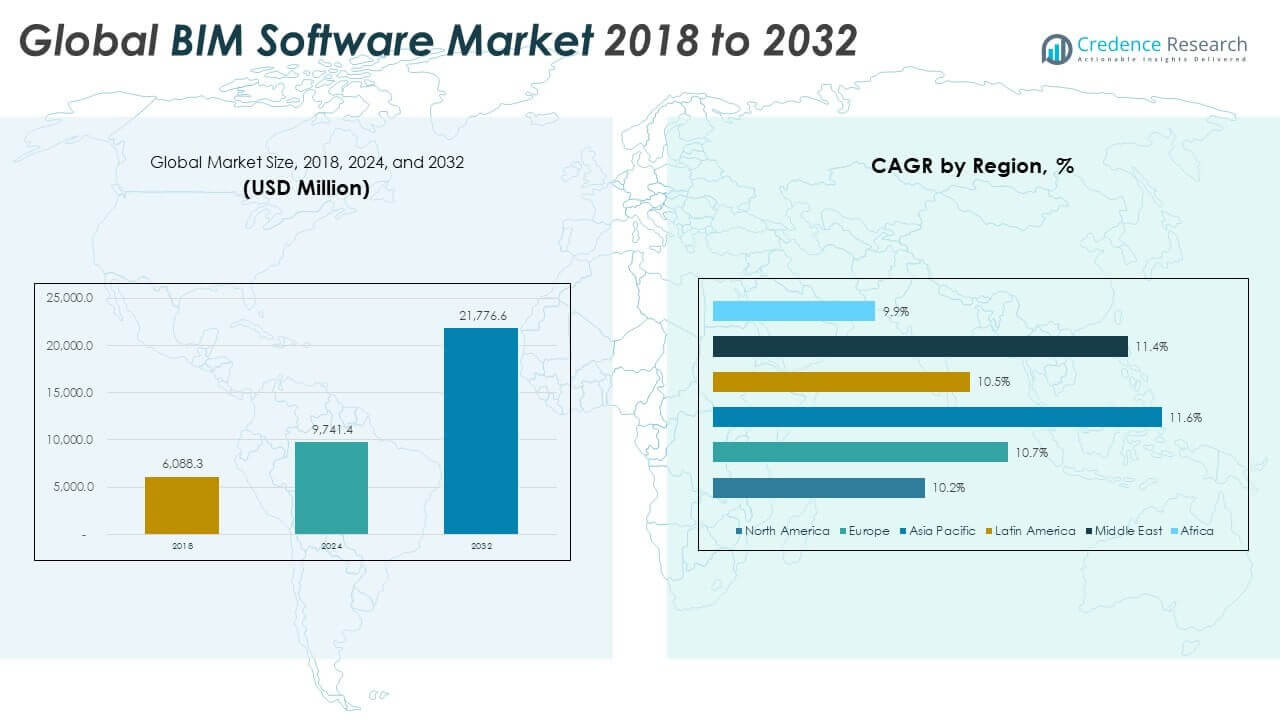
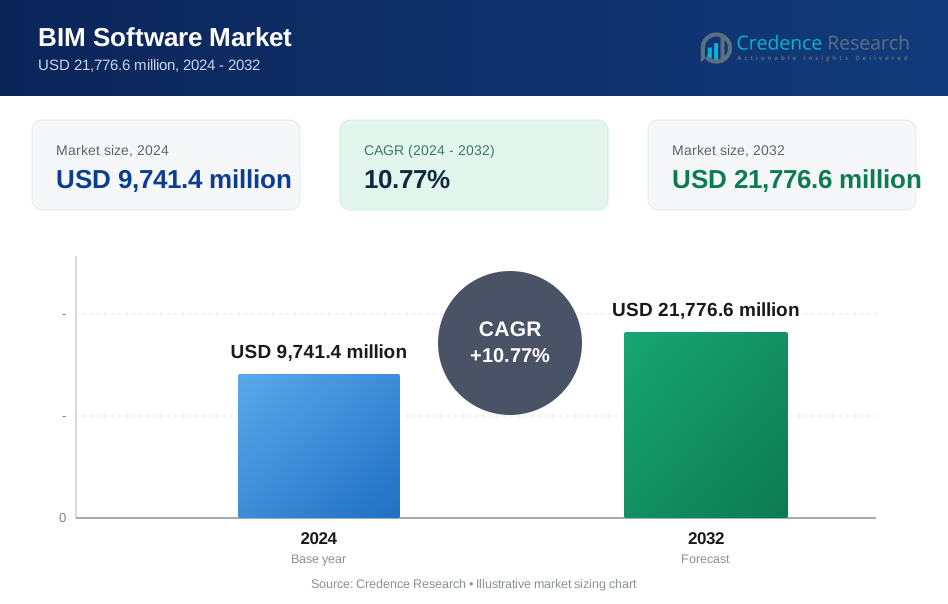
The Global BIM Software Market size was valued at USD 6,088.3 million in 2018 to USD 9,741.4 million in 2024 and is anticipated to reach USD 21,776.6 million by 2032, at a CAGR of 10.77% during the forecast period.
| REPORT ATTRIBUTE | DETAILS |
|---|---|
| Historical Period | 2020-2023 |
| Base Year | 2024 |
| Forecast Period | 2025-2032 |
| BIM Software Market Size 2024 | USD 9,741.4 million |
| BIM Software Market, CAGR | 10.77% |
| BIM Software Market Size 2032 | USD 21,776.6 million |
Growth is driven by rising demand for integrated project planning and cost control tools. Construction firms adopt BIM software to reduce rework and improve coordination accuracy. Governments promote digital construction standards for public infrastructure projects. Cloud-based BIM platforms improve collaboration across architects, engineers, and contractors. Lifecycle asset management needs support wider BIM use beyond design stages. Integration with AI and simulation tools improves risk planning and scheduling. Growing focus on sustainability pushes energy modeling and material optimization features. Training availability and vendor support also encourage adoption among mid-sized firms.
North America and Europe lead due to early digital adoption and strict building standards. The United States drives usage across commercial and infrastructure projects. Western Europe benefits from public mandates and mature construction practices. Asia Pacific is the fastest emerging region due to urban growth. China, India, and Southeast Asia expand BIM use for smart cities. Middle East countries adopt BIM for mega infrastructure projects. Latin America and Africa show gradual uptake through public sector modernization initiatives.
Market Insights:
- The Global BIM Software Market was valued at USD 6,088.3 million in 2018, reached USD 9,741.4 million in 2024, and is projected to attain USD 21,776.6 million by 2032, growing at a CAGR of 10.77%, driven by digital construction adoption and lifecycle-focused project execution.
- North America holds the largest regional share at 31.1%, followed by Europe at 29.1% and Asia Pacific at 27.1%, supported by early BIM mandates, strong infrastructure investment, and mature construction ecosystems across these regions.
- Asia Pacific is the fastest-growing region with a 27.1% share, led by rapid urbanization, smart city programs, large-scale infrastructure projects, and rising BIM adoption across China, India, and Southeast Asia.
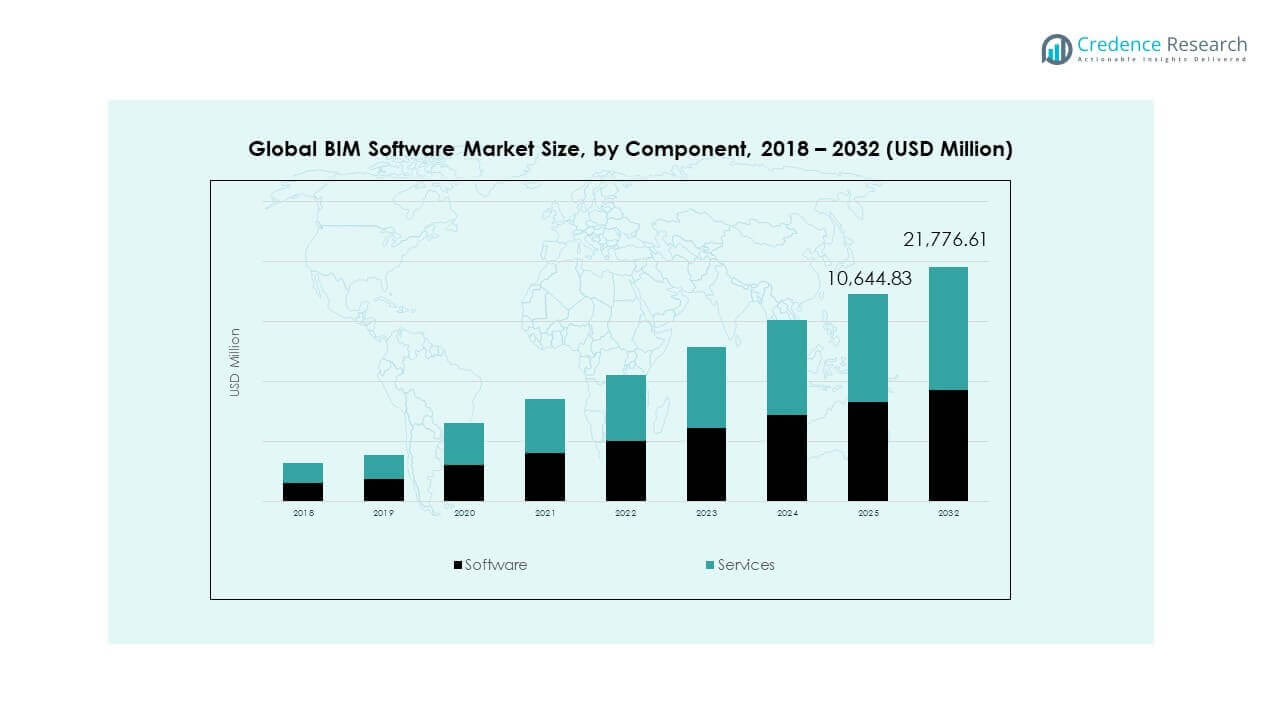
- By component, software accounts for nearly 65% share, as core BIM platforms drive modeling, coordination, simulation, and digital twin integration across project stages.
- Services contribute around 35% share, supported by growing demand for implementation, training, consulting, and system integration to ensure effective BIM adoption and long-term platform use.
Market Drivers:
Government Mandates And Digital Construction Policy Adoption Across Public Projects
Public agencies promote digital planning standards across infrastructure programs. The Global BIM Software Market gains momentum through mandatory BIM use policies for public projects. Authorities require standardized data models to improve transparency and control. Transport, energy, and urban development’s adopt BIM-first workflows. Procurement frameworks favor contractors with strong BIM capability. Compliance improves approval speed and documentation accuracy. Digital audits strengthen accountability across project phases. Policy support sustains long-term enterprise demand.
- For instance, Autodesk’s Revit 2026.3 release added accelerated graphics and expanded reality capture tools used by thousands of firms worldwide to streamline multi‑discipline coordination which supports compliance.
Rising Need For Cost Control And Risk Reduction In Large Construction Projects
Construction firms face rising cost pressure and schedule risks. The Global BIM Software Market supports accurate cost forecasting and project visibility. BIM tools reduce design clashes and coordination errors. Early-stage simulation limits material waste and rework levels. Contractors improve workflow control across complex sites. Asset owners demand predictable delivery timelines and budget discipline. Digital models support faster issue resolution during execution. Risk management needs continue to drive adoption.
- For instance, Bentley Systems’ iTwin digital twin platform helps the Minnesota Department of Transportation save an estimated USD 4 million annually by consolidating infrastructure data for analysis and maintenance planning, illustrating risk reduction use.
Growing Focus On Lifecycle Asset Management And Operational Efficiency
Asset owners seek value beyond project completion stages. The Global BIM Software Market enables lifecycle data continuity from design to operations. Facility teams rely on BIM data for maintenance planning. Digital twins extend usefulness during asset operation phases. Accurate records support operational cost control. BIM platforms enable faster retrofits and upgrades. Energy monitoring aligns with sustainability goals. Lifecycle efficiency strengthens long-term software use.
Increasing Adoption By Mid-Sized Firms Through Cloud-Based Deployment Models
Cloud platforms reduce entry barriers for smaller construction firms. The Global BIM Software Market expands beyond large enterprises through subscription models. Flexible pricing improves affordability and scalability. Remote collaboration supports distributed design teams. Faster deployment reduces dependence on internal IT resources. Vendors offer modular feature access for varied needs. Training availability improves user confidence. Mid-sized adoption broadens overall market depth.
Market Trends:
Integration Of BIM Platforms With Digital Twins And Smart Infrastructure Systems
BIM platforms increasingly connect with real-time operational data. The Global BIM Software Market evolves toward live asset modelling. Digital twins support monitoring and predictive maintenance needs. Infrastructure operators prefer connected planning environments. Data synchronization improves long-term decision quality. Smart city programs adopt integrated design systems. Simulation tools support performance forecasting. Platform convergence defines future direction.
- For instance, Bentley’s iTwin digital twin solutions help water utilities monitor real‑time performance, using data from over 80 sensors to deliver far more weekly data points than manual inspection processes, boosting operational insights.
Expansion Of Open Standards And Interoperability Across Design Ecosystems
Interoperability becomes a core buyer requirement. The Global BIM Software Market shifts toward open data standards. Stakeholders demand seamless software integration across tools. Open APIs reduce vendor lock concerns. Cross-platform workflows improve team efficiency. Design firms rely on mixed software environments. Standards bodies influence product development priorities. Open systems support broader collaboration.
- For instance, buildingSMART’s Industry Foundation Classes (IFC) standard sees adoption by BIM tool vendors worldwide, supporting neutral exchange of BIM data across platforms and improving model interoperability. Cross‑platform workflows improve team efficiency.
Growing Use Of BIM For Sustainability And Carbon Impact Assessment
Sustainability goals shape modern project planning. The Global BIM Software Market embeds energy and emissions analysis features. Design teams model carbon impact during early stages. Material selection benefits from digital simulation tools. Green certifications rely on accurate project data. Clients expect transparent environmental reporting. BIM supports lifecycle carbon tracking. Sustainability needs drive feature enhancement.
Rising Demand For Mobile And Field-Level BIM Access
Construction teams require on-site digital access. The Global BIM Software Market adapts through mobile-friendly platforms. Field staff review models in real time. Issue reporting becomes faster and clearer. Mobile access reduces communication gaps. Offline functionality supports remote sites. AR tools improve site validation. Mobility reshapes user experience design.
Market Challenges Analysis:
High Implementation Complexity And Skill Gaps Across Traditional Construction Teams
Many firms lack trained BIM professionals. The Global BIM Software Market faces adoption friction from skill shortages. Traditional workflows resist digital transition. Training costs strain smaller organizations. Poor data quality reduces confidence in outputs. Change management remains challenging. Talent gaps slow deployment timelines. Complex tools increase learning effort.
Interoperability Limits And Data Ownership Concerns Among Project Stakeholders
Project stakeholders share sensitive design data. The Global BIM Software Market encounters trust barriers across ecosystems. Data ownership disputes delay collaboration. Inconsistent standards create integration issues. Cybersecurity risks raise concern among asset owners. Legal clarity remains limited in some regions. Stakeholders demand stronger governance models. Trust gaps restrict full-scale adoption.
Market Opportunities:
Expansion Across Emerging Economies Through Smart City And Infrastructure Programs
Emerging economies increase infrastructure investment levels. The Global BIM Software Market benefits from smart city initiatives. Urban planning requires digital coordination tools. Governments seek efficiency and transparency in execution. Local firms improve technical capability. International contractors transfer BIM practices. Public funding supports technology adoption. Emerging demand opens new growth avenues.
Advancement Of AI-Driven Design Automation And Predictive Project Analytics
AI improves design speed and decision accuracy. The Global BIM Software Market advances toward intelligent automation. Predictive analytics enhance schedule reliability. Design optimization reduces manual effort. Scenario evaluation becomes faster and more precise. Vendors invest in smart feature development. Early adopters gain productivity advantages. Innovation creates long-term differentiation.
Market Segmentation Analysis:
By Component Segment
Software dominates the Global BIM Software Market due to its central role in project modeling, design, and collaboration. Feature-rich platforms support 3D to 7D BIM, simulation, and integration with other tools. Services follow in demand, driven by training, consulting, and maintenance support. It ensures users adopt systems effectively and maintain data integrity over time.
- For instance, Revit, widely recognized among BIM applications, now includes expanded reality capture and documentation enhancements to support complex project workflows worldwide.
By Deployment Segment
Cloud/SaaS deployment leads due to its scalability, accessibility, and cost efficiency for collaborative workflows. It supports remote project coordination and faster updates across stakeholders. On-premise solutions retain traction among large enterprises requiring internal data governance or high security for sensitive projects. Flexibility in deployment choice enables broader adoption.
- For instance, cloud‑based iTwin services from Bentley enable federated asset data access across 189 countries, supporting remote teams and real‑time collaboration in global projects.
By Enterprise Size Segment
Large enterprises form the primary revenue contributors by leveraging BIM at scale across complex infrastructure and commercial projects. They benefit from enterprise-grade integration and compliance features. SMEs adopt BIM to enhance competitiveness and reduce operational inefficiencies. Cloud models make adoption easier for resource-constrained firms in this segment.
By Application Segment
Planning and Modelling (3D/4D/5D/7D) remains the most used application, enabling visual coordination, cost tracking, and schedule simulations. Other key applications include design & visualization, cost & scheduling, and digital twin integration. Project lifecycle management and facility management also gain traction among asset owners seeking long-term efficiency.
By Project Phase Segment
Pre-construction leads usage, where BIM drives early-stage design validation, clash detection, and accurate planning. The construction phase uses BIM for coordination and progress tracking. Post-construction applications support maintenance, asset management, and renovations, expanding BIM’s lifecycle value.
By End User Segment
Architecture and engineering firms remain key adopters of BIM software, using it for design accuracy and compliance. Construction companies and contractors use it for project execution and coordination. Real estate developers, government agencies, and utilities increasingly use BIM to manage complex infrastructure and asset portfolios.
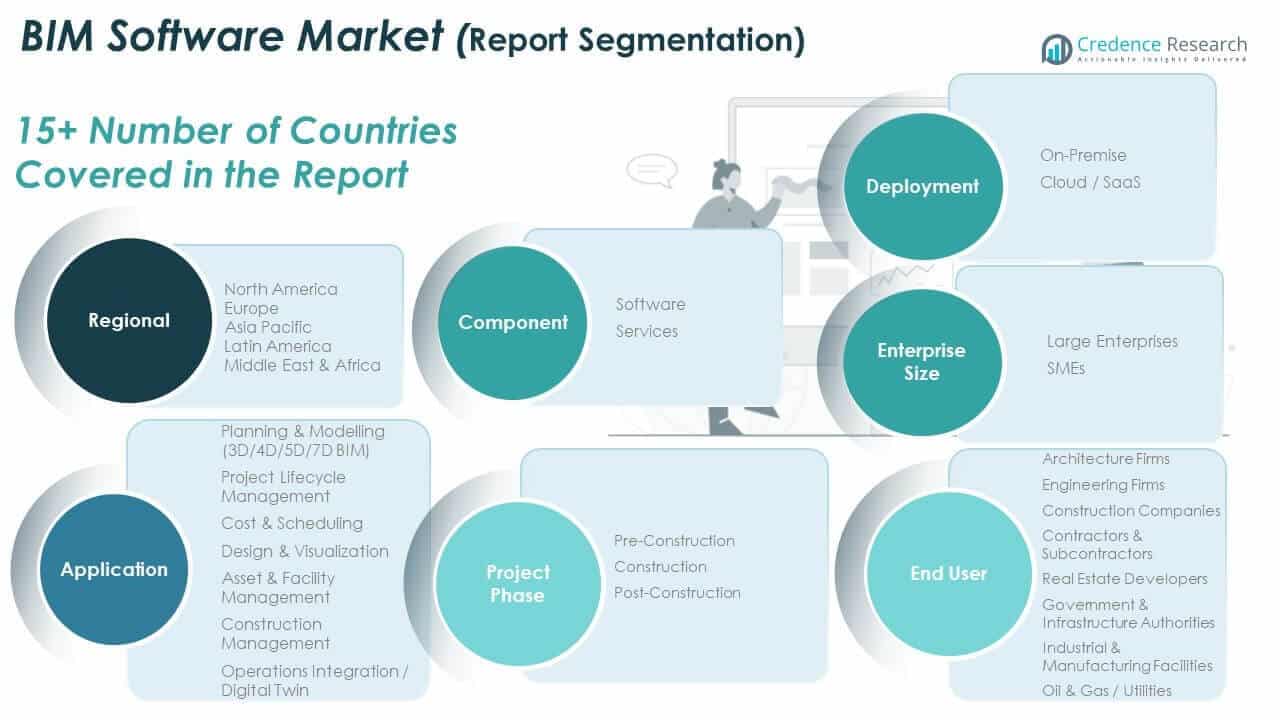
Segmentation:
By Component
- Software
- Services
By Deployment
- On-Premise
- Cloud / SaaS
By Enterprise Size
- Large Enterprises
- SMEs
By Application
- Planning & Modelling (3D/4D/5D/7D BIM)
- Project Lifecycle Management
- Cost & Scheduling
- Design & Visualization
- Asset & Facility Management
- Construction Management
- Operations Integration / Digital Twin
By Project Phase
- Pre-Construction
- Construction
- Post-Construction
By End User
- Architecture Firms
- Engineering Firms
- Construction Companies
- Contractors & Subcontractors
- Real Estate Developers
- Government & Infrastructure Authorities
- Industrial & Manufacturing Facilities
- Oil & Gas / Utilities
By Region
- North America
- U.S.
- Canada
- Mexico
- Europe
- Germany
- France
- U.K.
- Italy
- Spain
- Rest of Europe
- Asia Pacific
- China
- Japan
- India
- South Korea
- South-east Asia
- Rest of Asia Pacific
- Latin America
- Brazil
- Argentina
- Rest of Latin America
- Middle East & Africa
- GCC Countries
- South Africa
- Rest of the Middle East and Africa
Regional Analysis:
North America
The North America BIM Software Market size was valued at USD 1,954.96 million in 2018 to USD 3,039.88 million in 2024 and is anticipated to reach USD 6,532.98 million by 2032, at a CAGR of 10.2% during the forecast period. North America accounts for 31.1% of the Global BIM Software Market share. It leads due to early adoption of BIM standards, strong digital infrastructure, and government mandates. The U.S. drives growth through federal and state-level BIM regulations across public infrastructure. Large construction firms and architecture studios use advanced modeling tools for compliance and efficiency. Canada focuses on smart city development and sustainable construction. The region benefits from strong cloud infrastructure, high BIM awareness, and continuous vendor innovation. Collaboration between software vendors and construction firms accelerates deployment. It remains a mature and high-value market with stable demand.
Europe
The Europe BIM Software Market size was valued at USD 1,786.31 million in 2018 to USD 2,848.12 million in 2024 and is anticipated to reach USD 6,336.99 million by 2032, at a CAGR of 10.7% during the forecast period. Europe represents 29.1% of the global market. The region advances BIM adoption through policy enforcement such as the EU BIM Task Group. Countries like the UK, Germany, and France integrate BIM into public procurement and large-scale projects. Demand grows from both infrastructure upgrades and green building initiatives. Enterprises use BIM to meet building performance and lifecycle standards. Regional focus on energy efficiency and digital governance boosts software use. Design firms collaborate across borders using interoperable BIM systems. Education institutions also support professional training. Europe remains a regulatory-driven and standards-focused growth zone.
Asia Pacific
The Asia Pacific BIM Software Market size was valued at USD 1,441.10 million in 2018 to USD 2,416.43 million in 2024 and is anticipated to reach USD 5,731.60 million by 2032, at a CAGR of 11.6% during the forecast period. Asia Pacific holds 27.1% market share and is the fastest-growing regional market. China, India, Japan, South Korea, and Australia lead demand due to rapid urbanization, infrastructure expansion, and government digitalization efforts. BIM is integrated into smart city projects, high-speed rail, and industrial corridors. Vendors expand cloud-based solutions to address cost-sensitive SMEs. Regional governments introduce BIM mandates and training programs. Construction firms adopt BIM for time and cost savings. Demand spans both public megaprojects and private developments. Asia Pacific offers long-term volume potential supported by digital transformation momentum.
Latin America
The Latin America BIM Software Market size was valued at USD 554.04 million in 2018 to USD 873.11 million in 2024 and is anticipated to reach USD 1,911.99 million by 2032, at a CAGR of 10.5% during the forecast period. Latin America contributes 9.1% to the global market. Brazil and Mexico lead regional adoption across commercial and public sector projects. BIM is used to improve planning accuracy and resource management in infrastructure development. Slow regulatory enforcement and limited digital readiness challenge widespread uptake. However, rising construction investments and public infrastructure reforms drive interest. International firms promote BIM through local partnerships and knowledge transfer. Growth depends on government incentives, pilot programs, and training support. The region moves gradually toward structured implementation models.
Middle East
The Middle East BIM Software Market size was valued at USD 196.65 million in 2018 to USD 325.92 million in 2024 and is anticipated to reach USD 762.18 million by 2032, at a CAGR of 11.4% during the forecast period. Middle East holds 3.6% market share with strong growth driven by mega infrastructure and urban development. The UAE and Saudi Arabia adopt BIM to modernize construction practices and meet smart city objectives. Projects like NEOM and Expo-related infrastructure accelerate BIM integration. Governments promote digital design guidelines for contractors and consultants. Oil and gas facility planning also embraces BIM for lifecycle management. Cloud deployment gains traction to support regional scalability. Demand rises in both public and private sector projects. Middle East emerges as a high-value, fast-adopting market for BIM vendors.
Africa
The Africa BIM Software Market size was valued at USD 155.25 million in 2018 to USD 237.97 million in 2024 and is anticipated to reach USD 500.86 million by 2032, at a CAGR of 9.9% during the forecast period. Africa accounts for 2.4% of the global market. Adoption remains low but is gradually increasing due to rising urban infrastructure and development finance initiatives. South Africa leads regional use, followed by Nigeria and Egypt. Public housing and road projects explore BIM for better planning and budget control. Limited awareness, lack of skills, and infrastructure gaps restrict fast deployment. Regional growth depends on donor-backed initiatives, policy support, and vendor partnerships. It presents long-term potential as governments seek to modernize planning systems. Africa is an emerging market with untapped opportunities.
Key Player Analysis:
- Autodesk Inc.
- Nemetschek Group
- Bentley Systems
- Trimble Inc.
- Hexagon AB
- Planon Group
- LOD Planner Inc.
- Other Key Players
Competitive Analysis:
The Global BIM Software Market features strong competition among established technology vendors and specialized solution providers. Leading companies focus on product depth, platform integration, and long-term client retention. Large players leverage broad portfolios that combine design, construction, and asset management tools. Mid-tier firms compete through niche specialization, flexibility, and regional focus. Cloud capability and interoperability influence vendor selection decisions. Strategic partnerships with construction firms and governments strengthen market position. Continuous feature upgrades support differentiation. Competition remains innovation-driven, with emphasis on lifecycle value and enterprise scalability.
Recent Developments:
- In November 2025, Autodesk Inc. partnered with Adani Group in a three-year strategic collaboration to deploy Autodesk Construction Cloud (ACC) and BIM advisory services across Adani's infrastructure projects. This partnership aims to unify data and enhance digital transformation in construction workflows. It supports the Global BIM Software Market by integrating end-to-end design solutions for large-scale projects.
- In November 2025, Bentley Systems announced a strategic partnership with EARTHBRAIN to integrate AI-powered digital twin technology into Smart Construction workflows, enhancing safety and productivity from design through earthworks. This builds on prior collaborations and targets global expansion starting in Japan.
- In March 2025, Nemetschek Group secured a $0.5 million partnership with Ovation Services to deliver its BIM Construction Suite, including ALLPLAN SDS2 and Bluebeam, for advanced structural steel detailing in India. The deal advances digital construction technology adoption and efficiency in the AEC sector
- In March 2025, Trimble Inc. launched Tekla Structures 2025 featuring AI enhancements and improved BIM collaboration for multidisciplinary teams across construction phases. The update emphasizes connected workflows for better data quality and project delivery in structural BIM modeling.
- In January 2025, Hexagon AB acquired CAD Service to enhance its HxGN EAM with advanced visualization of CAD drawings and BIM models, targeting industries like manufacturing and energy.
Report Coverage:
The research report offers an in-depth analysis based on component, deployment, enterprise size, application, project phase, end user, and region. It details leading market players, providing an overview of their business, product offerings, investments, revenue streams, and key applications. Additionally, the report includes insights into the competitive environment, SWOT analysis, current market trends, as well as the primary drivers and constraints. Furthermore, it discusses various factors that have driven market expansion in recent years. The report also explores market dynamics, regulatory scenarios, and technological advancements that are shaping the industry. It assesses the impact of external factors and global economic changes on market growth. Lastly, it provides strategic recommendations for new entrants and established companies to navigate the complexities of the market.
Future Outlook:
- The market will witness broader adoption across infrastructure, transportation, and public sector developments.
- Cloud-based BIM platforms will gain momentum due to ease of deployment and cross-team collaboration.
- Digital twin technology will be increasingly integrated for real-time asset monitoring and management.
- Artificial intelligence will enhance design automation, clash detection, and cost estimation functions.
- Small and medium enterprises will adopt BIM through affordable SaaS models and modular feature access.
- Sustainability-focused planning will drive demand for energy modeling and carbon footprint analysis.
- Mobile and on-site access to BIM tools will improve field coordination and decision-making speed.
- Open standards and interoperability will become key factors in software selection and integration.
- Emerging economies will accelerate BIM use through smart city programs and digital policy mandates.
- Vendors will shift focus from design-only solutions to full lifecycle value offerings across sectors.
Request a Free Sample
Fill in your details and we'll send you a free sample report.
- Sample data tables & charts
- Research methodology
Need a Custom Version of This Report?
Tailor the scope, geography, or segments to your exact requirements.
- Custom geography or segment scope
- Direct access to our analyst team
Frequently Asked Questions
What is the current market size for Global BIM Software Market, and what is its projected size in 2032?
At what Compound Annual Growth Rate is the Global BIM Software Market projected to grow between 2025 and 2032?
Which Global BIM Software Market segment held the largest share in 2024?
What are the primary factors fueling the growth of the Global BIM Software Market?
Who are the leading companies in the Global BIM Software Market?
Which region commanded the largest share of the Global BIM Software Market in 2024?
Table of Content
Chapter 1. Report Introduction
- 1.1 Report Description & Purpose
- 1.1.1 Report Title & Market Definition
- 1.1.2 Unique Selling Propositions (USP) & Key Differentiators
- 1.1.3 Value Proposition for Stakeholders
- 1.2 Research Objectives
- 1.2.1 Market Sizing Objectives (Volume & Revenue)
- 1.2.2 Segmentation Objectives
- 1.2.3 Competitive Intelligence Objectives
- 1.2.4 Forecast & Scenario Objectives
- 1.3 Report Scope
- 1.3.1 BIM Software Scope – Types & Subtypes Covered
- 1.3.2 Geographic Scope – Regions & Countries Covered
- 1.3.3 Historical Period, Base Year & Forecast Period (2024; forecast to 2032)
- 1.3.4 Inclusions & Exclusions
- 1.4 HS Code & Classification Framework
- 1.5 Currency, Units & Pricing Basis
- 1.6 Target Stakeholders
- 1.7 Limitations & Assumptions
Chapter 2. Executive Summary
- 2.1 Global BIM Software Market Snapshot
- 2.1.1 Market Size – Historical (2024) & Forecast (2024-2032) (2024: USD 9,741.4 million → 2032: USD 21,776.6 million)
- 2.1.2 Volume & Revenue – Global Totals
- 2.1.3 Key Market Highlights – Top Five Facts
- 2.2 BIM Software Market Segmentation Snapshot
- 2.2.1 Market Split by Region – 2024 vs. 2032
- 2.3 Competitive Snapshot
- 2.3.1 Top 10 Players by Revenue Share – 2024
- 2.3.2 Top 10 Players by Volume Share – 2024
- 2.3.3 Recent Strategic Developments (18-Month Summary)
- 2.4 Key Investment Highlights & Strategic Conclusions
Chapter 3. BIM Software Market Dynamics & Industry Analysis
- 3.1 Market Overview & Context
- 3.1.1 BIM Software Market Position in the Broader Automotive Value Chain
- 3.1.2 OEM vs. Replacement Market Dynamics
- 3.1.3 Market Maturity & Development Stage by Region
- 3.2 BIM Software Market Drivers
- 3.3 BIM Software Market Restraints & Challenges
- 3.4 BIM Software Market Opportunities
- 3.5 Porter's Five Forces Analysis
- 3.5.1 Threat of New Entrants
- 3.5.2 Bargaining Power of Suppliers
- 3.5.3 Bargaining Power of Buyers
- 3.5.4 Threat of Substitutes
- 3.5.5 Competitive Rivalry – Intensity Assessment
- 3.6 BIM Software Value Chain Analysis
- 3.6.1 Upstream – Raw Material/Input Suppliers
- 3.6.1.1 Raw Material/Input 1
- 3.6.1.2 Raw Material/Input 2
- 3.6.1.3 Raw Material/Input 3
- 3.6.2 Midstream – Production/Manufacturing/Service Delivery
- 3.6.2.1 Production/Process Overview
- 3.6.2.2 Key Facility Locations & Capacity by Manufacturer
- 3.6.3 Downstream – Distribution & End Consumer
- 3.6.3.1 Primary Channel – B2B/OEM
- 3.6.3.2 Secondary Channels – Dealer, Retail, Online, Direct
- 3.6.4 Value Chain Profitability Analysis
- 3.6.1 Upstream – Raw Material/Input Suppliers
- 3.7 PESTEL Analysis
- 3.7.1 Political Factors
- 3.7.2 Economic Factors
- 3.7.3 Social Factors
- 3.7.4 Technological Factors
- 3.7.5 Environmental Factors
- 3.7.6 Legal Factors
- 3.8 BIM Software Supply Chain Analysis
- 3.8.1 Raw Material/Input Supply Risk Assessment
- 3.8.2 Manufacturing Concentration Risk (Geographic Exposure)
- 3.8.3 Trade Disruption Impact Analysis
- 3.9 Regulatory & Policy Landscape
Note: The regulatory and policy landscape section covers regulations based on their applicability to the market, BIM Software category, geography, and scope of the study. Only regulatory frameworks with a material impact on operations, compliance, trade, sustainability, or market access are analyzed in detail.
Chapter 4. Key Investment Pockets & Opportunity Analysis
- 4.1 BIM Software Market Attractiveness Analysis
- 4.1.1 By Region – Investment Attractiveness Matrix (Volume × CAGR)
- 4.2 Absolute Revenue Growth Opportunity
- 4.2.1 By Region – Absolute USD Growth Through 2032
- 4.3 Incremental Volume Opportunity
- 4.3.1 By Region – Incremental Volume Through 2032
- 4.3.2 Segment – Incremental Volume
- 4.4 Emerging Submarket Opportunity Deep Dive (Subject to Applicability)
- 4.5 Emerging Market Opportunity Scorecards
- 4.5.1 United States
- 4.5.2 Europe
- 4.5.3 Asia
- 4.5.4 Middle East & Africa
Note: Emerging Market Opportunity Scorecards will be included based on relevance and strategic importance. Regions listed are indicative and may vary depending on data availability and market dynamics.
Chapter 5. BIM Software Import-Export Analysis & Trade Flows
- 5.1 Global Trade Overview
- 5.1.1 Global Export Value by Country (2024)
- 5.1.2 Global Export Volume by Country (2024)
- 5.1.3 Global Import Value by Country (2024)
- 5.1.4 Global Import Volume by Country (2024)
- 5.1.5 Net Trade Balance by Country (2024)
- 5.2 Export Analysis – Segment
- 5.2.1 Type 1 (HS Code)
- 5.2.2 Type 2 (HS Code)
- 5.2.3 Type 3 (HS Code)
- 5.2.4 Type 4 (HS Code)
- 5.2.5 Type 5 (HS Code)
- 5.3 Import Analysis – Segment
- 5.3.1 Type 1 (HS Code)
- 5.3.2 Type 2 (HS Code)
- 5.3.3 Type 3 (HS Code)
- 5.3.4 Type 4 (HS Code)
- 5.3.5 Type 5 (HS Code)
- 5.4 Average Unit Trade Prices
- 5.4.1 Average Export Price – Segment & Country
- 5.4.2 Average Import Price – Segment & Source Country
- 5.4.3 Price Trends (2024)
- 5.5 Key Trade Route Analysis
- 5.5.1 Trade Route 1
- 5.5.2 Trade Route 2
- 5.5.3 Trade Route 3
- 5.5.4 Trade Route 4
- 5.5.5 Trade Route 5
- 5.6 Trade Policy Impact Assessment
- 5.6.1 US Anti-Dumping & Section 301 Tariffs
- 5.6.2 EU Customs Union Impact
- 5.6.3 Major Free Trade Agreements
- 5.6.4 USMCA Rules of Origin
Note: Trade policy analysis will be included only where relevant to the BIM Software market.
Chapter 6. Competitive Landscape & Company Benchmarking
- 6.1 BIM Software Market Concentration & Structure
- 6.1.1 Herfindahl-Hirschman Index (HHI) – vs. 2024
- 6.1.2 Tier 1, Tier 2 & Tier 3 Market Structure
- 6.1.3 Global, Regional & Local Player Dynamics
- 6.2 BIM Software Market Share Analysis – 2024
- 6.2.1 Global Revenue Share by Company
- 6.2.2 Global Volume Share by Company
- 6.2.3 Regional Revenue Share
- 6.2.4 Market Share Evolution ( vs. 2024)
- 6.2.5 OEM Segment Share by Company
- 6.2.6 Replacement Segment Share by Company
- 6.3 Production/Delivery Capacity & Facility Analysis
- 6.3.1 Global Installed Capacity
- 6.3.2 Capacity Utilization Rates
- 6.3.3 Production/Output Volume
- 6.3.4 Facility Locations & Capacity Map
- 6.3.5 Planned Capacity Additions
- 6.4 BIM Software Competitive Benchmarking Matrix
- 6.4.1 Revenue, Volume, CAGR & Profitability Comparison
- 6.4.2 Channel Revenue Mix
- 6.4.3 Geographic Revenue Exposure
- 6.4.4 R&D Intensity
- 6.4.5 Sustainability Maturity
- 6.5 Strategic Developments in BIM Software (Last 24 Months)
- 6.5.1 Mergers, Acquisitions & Divestments
- 6.5.2 New BIM Software Launches
- 6.5.3 Facility Expansions
- 6.5.4 Strategic Alliances, Joint Ventures & Partnerships
- 6.5.5 Distribution Expansion & Market Entry
- 6.5.6 Sustainability & ESG Initiatives
- 6.6 Competitive Strategy Mapping
- 6.6.1 Leader, Challenger, Follower & Niche Classification
- 6.6.2 Pricing Strategy Comparison
- 6.6.3 Channel Strategy Matrix
Note: Strategic developments are included based on their materiality and the availability of reliable information.
Chapter 7. Global BIM Software Market – By Distribution Channel
- 7.1 Segment Overview
- 7.1.1 Volume & Revenue Split by Channel (2024 & 2032)
- 7.1.2 Channel Mix Evolution (2024-2032)
Chapter 8. Regional Market Analysis – Global Overview
- 8.1 Global Regional Overview
- 8.1.1 Regional Volume Share
- 8.1.2 Regional Revenue Share
- 8.1.3 Regional Volume by Region
- 8.1.4 Regional Revenue by Region
- 8.1.5 Regional Forecast Through 2032
- 8.2 Cross-Regional Segment Analysis
- 8.2.1 By Distribution Channel
- 8.2.2 By Brand/Price Tier
Chapter 9. North America BIM Software Market
- 9.1 United States
- 9.2 Canada
- 9.3 Mexico
Chapter 10. Europe BIM Software Market
- 10.1 Germany
- 10.2 France
- 10.3 Italy
- 10.4 United Kingdom
- 10.5 Spain
- 10.6 Poland
- 10.7 Russia
- 10.8 Netherlands
- 10.9 Belgium
- 10.10 Sweden
- 10.11 Denmark
- 10.12 Norway
- 10.13 Rest of Europe
Chapter 11. Asia Pacific BIM Software Market
- 11.1 China
- 11.2 India
- 11.3 Japan
- 11.4 South Korea
- 11.5 Thailand
- 11.6 Indonesia
- 11.7 Vietnam
- 11.8 Malaysia
- 11.9 Australia
- 11.10 Rest of Asia Pacific
Chapter 12. Latin America BIM Software Market
- 12.1 Brazil
- 12.2 Argentina
- 12.3 Colombia
- 12.4 Chile
- 12.5 Rest of Latin America
Chapter 13. Middle East BIM Software Market
- 13.1 Saudi Arabia
- 13.2 United Arab Emirates
- 13.3 Turkey
- 13.4 Israel
- 13.5 Iran
- 13.6 Rest of the Middle East
Chapter 14. Africa BIM Software Market
- 14.1 South Africa
- 14.2 Egypt
- 14.3 Nigeria
- 14.4 Morocco
- 14.5 Rest of Africa
Chapter 15. BIM Software Company Profiles
- 15.1 [Company 01]
- 15.1.1 Company Overview
- 15.1.2 Key Management Personnel
- 15.1.3 Products & Services Portfolio
- 15.1.4 Financial Performance
- 15.1.5 Key Market Focus & Geographic Presence
- 15.1.6 Recent Developments & Strategic Initiatives
Note: The company profile list is preliminary and may change based on research findings, market developments, data availability, and client requirements.
Chapter 16. Appendices
- Appendix A – List of Abbreviations & Acronyms
- Appendix B – Industry Classification Code Reference – Full Series
- Appendix C – Production & Capacity Data Tables
- Appendix D – End-Use & Demand Base Tables
- Appendix E – Consumption & Replacement Rate Assumptions
- Appendix F – ASP Reference Tables
- Appendix G – Manufacturing & Facility Database
- Appendix H – Import-Export Data Tables
- Appendix I – Regulatory Summary Tables
- Appendix J – Primary Research Participant List (Anonymized)
- Appendix K – Primary Research Questionnaire Framework
- Appendix L – Data Sources & Bibliography
- Appendix M – Market Size Divergence & Source Comparison
Chapter 17. Research Methodology
- 17.1 Research Framework & Philosophy
- 17.2 Secondary Research – Sources, Hierarchy & Data Extraction
- 17.3 Data Modeling – Bottom-Up & Top-Down Market Sizing
- 17.4 Primary Research – Stakeholder Framework, LOI & Sample Sizes
- 17.5 Forecast Methodology – Regression, Scenario & Sensitivity Analysis
- 17.6 Quality Control – Four-Layer Validation Framework
- 17.7 Limitations & Standard Assumptions
- 17.8 Disclaimer
