
Global and Turkey Folding Boom Crane Market Overview:
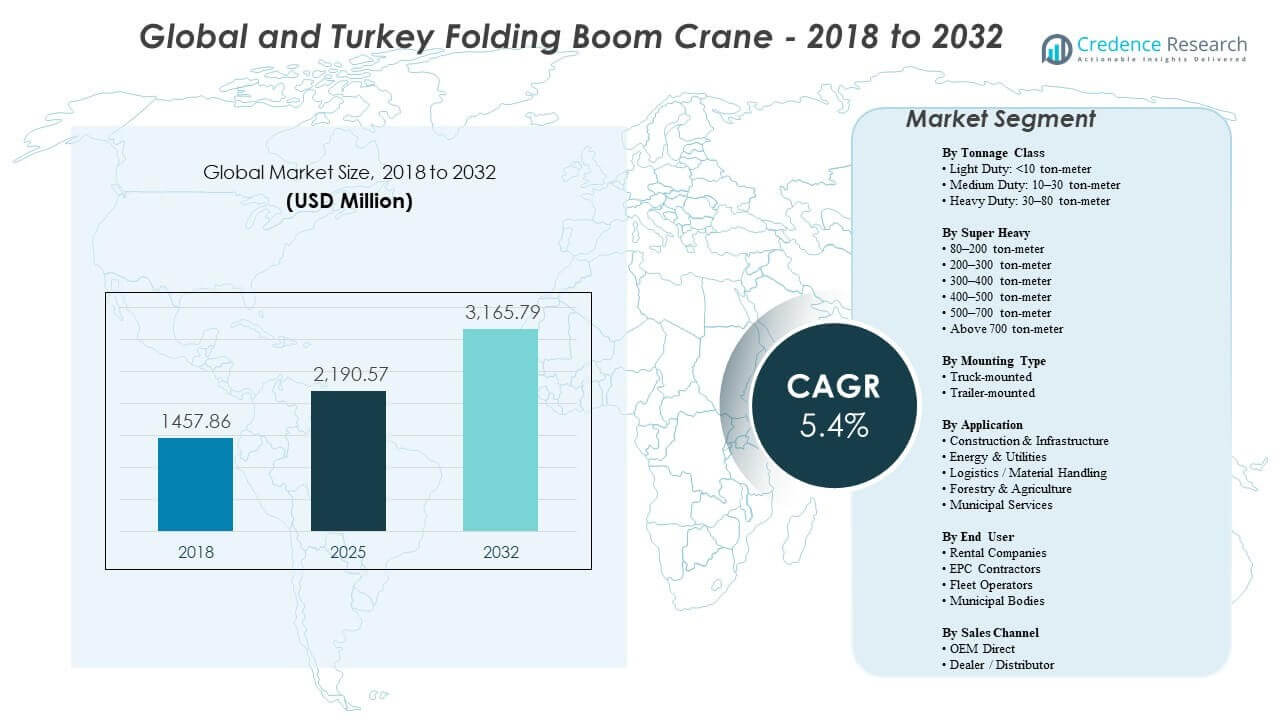
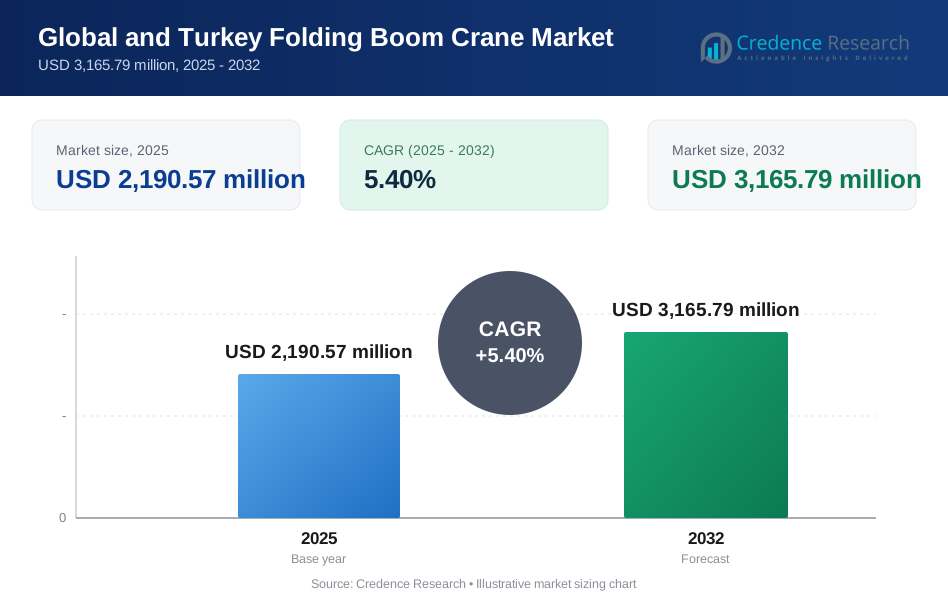
The Global and Turkey Folding Boom Crane market size was valued at USD 1,457.86 million in 2018, reached USD 2,190.57 million in 2025, and is anticipated to achieve USD 3,165.79 million by 2032, at a CAGR of 5.40% during the forecast period.
| REPORT ATTRIBUTE | DETAILS |
|---|---|
| Historical Period | 2020-2023 |
| Base Year | 2024 |
| Forecast Period | 2025-2032 |
| Global and Turkey Folding Boom Crane Market Size 2025 | USD 2,190.57 million |
| Global and Turkey Folding Boom Crane Market, CAGR | 5.40% |
| Global and Turkey Folding Boom Crane Market Size 2032 | USD 3,165.79 million |
Growing infrastructure development, rapid urbanization, and higher emphasis on operational efficiency drive adoption of folding boom cranes across industrial sectors. Users prefer equipment that delivers stable lifting performance, precise boom control, and safer operation in tight or complex environments. Technological upgrades in hydraulic systems, telematics, and remote-control units enhance productivity for field teams. The market gains momentum as contractors and utility operators prioritize cranes that reduce downtime and support diverse applications across daily operations. Increased demand from renewable energy, municipal services, and logistics networks continues to strengthen overall market growth.
Regional demand for the Global and Turkey Folding Boom Crane shows strong variation across key markets. Asia Pacific leads due to large-scale construction programs, rapid industrial growth, and rising investment in infrastructure corridors. Europe and North America maintain steady adoption driven by strict safety standards, advanced fleet modernization, and strong public utility sectors. Turkey emerges as a strategic market supported by expanding road, port, and urban renovation projects. Latin America, the Middle East, and Africa represent developing regions with growing interest as governments invest in transport, energy, and municipal modernization.
Global and Turkey Folding Boom Crane Market Insights:
- The Global and Turkey Folding Boom Crane market grew from USD 1,457.86 million in 2018 to USD 2,190.57 million in 2025 and is projected to reach USD 3,165.79 million by 2032, expanding at a CAGR of 5.40%.
- Asia Pacific held the largest market share due to extensive construction activity and major infrastructure pipelines, followed by North America with its strong utility and logistics sectors, and Europe with its regulated construction environment and advanced fleet modernization.
- Asia Pacific remains the fastest-growing region, supported by rapid industrial expansion, high urban development, and rising demand for high-reach, multi-application folding boom cranes.
- Medium and Heavy Duty tonnage classes accounted for the highest segment share, driven by their broad use in infrastructure work, industrial lifting, and urban construction projects.
- Truck-mounted cranes held a dominant share among mounting types, supported by their mobility, quick deployment capability, and suitability for diverse field operations across rental, EPC, and municipal users.
Global and Turkey Folding Boom Crane Market Drivers
Strong Infrastructure Expansion Across Global Construction and Transport Networks
Growing investment in transport corridors, ports, and industrial zones supports steady demand for the Global and Turkey Folding Boom Crane. Many builders use compact cranes for tight urban sites where mobility matters. Government funding pushes new highways, bridges, and rail tunnels in several regions. Fleet owners seek equipment that handles lifting tasks with speed and close-range accuracy. Rental firms upgrade systems to meet project deadlines with lower downtime. Manufacturers respond with safer controls and stable lifting platforms. Infrastructure agencies depend on cranes that manage mixed loads with precision. This trend strengthens long-term equipment adoption across major economies.
Rising Preference for Compact, Multi-Purpose, and High-Efficiency Lifting Equipment
Operational teams rely on the Global and Turkey Folding Boom Crane to manage tasks that need reach, flexibility, and controlled movement. Many users shift from traditional cranes toward folding boom units that work in narrow zones. Compact frames support easy mounting on trucks or trailers. Hydraulic systems now deliver smoother movement for delicate lifts. Remote-control features help operators improve safety levels on busy sites. Fleet managers aim to reduce idle time with equipment that handles varied daily tasks. High fuel efficiency and low maintenance needs drive interest from small contractors. This push highlights growing demand for versatile lifting tools.
Growing Use of Advanced Electronic, Sensor, and Stability Technologies in Lifting Systems
Developers integrate digital tools into the Global and Turkey Folding Boom Crane to support safer field operations. Load sensors warn operators of unsafe angles or excessive weight. Smart displays present real-time data to reduce human error during lifting. Sensors track boom positions to improve operating precision. Manufacturers design systems that maintain performance under changing outdoor conditions. Urban crews need equipment that works near obstacles without risk. Electronic features help companies meet stricter job-site safety rules. These upgrades encourage many buyers to replace older units with modern models.
- For instance, Fassi’s FX990 electronic control unit uses dual Ethernet lines and three CAN-bus networks to process high-speed data from stability and load sensors, enabling precise moment control through the FSC-TECHNO system even on uneven ground.
Increasing Use of Folding Boom Cranes in Energy, Utilities, Agriculture, and Municipal Operations
Broader use of the Global and Turkey Folding Boom Crane emerges as utility firms handle maintenance on towers, pipelines, and renewable plants. Energy developers install new components that require safe vertical handling. Forestry and farm operators rely on cranes for transport tasks across rough terrain. Municipal bodies use these cranes for waste handling, street repairs, and lighting work. Utility contractors value units that mount easily on trucks for rapid deployment. Many projects need flexible equipment to manage high-reach jobs. Strong growth across these service sectors supports ongoing crane demand. These applications widen the industry’s commercial base.
- For instance, Zoomlion’s ZLK series cranes, such as the ZLK8200V8 and ZLK7600V8, deliver lifting moments exceeding 100 ton-metres and offer working reaches above 20 metres with 6–8 boom sections, allowing utility and energy crews to handle high-reach maintenance tasks with precision. Their HPSC stability system supports safe operation on uneven terrain common in remote project sites.
Global and Turkey Folding Boom Crane Market Trends
Growing Integration of Automation, Telematics, and Remote Operation Features
Manufacturers add digital control features to the Global and Turkey Folding Boom Crane to support better monitoring. Telematics gives fleet managers details on usage patterns and maintenance needs. Remote operation limits risks for ground personnel. Automated boom functions support accurate load placement. Firms track crane performance to reduce downtime. Advanced dashboards help operators learn new tasks with less training time. Automated lift plans improve job-site coordination. These features set new standards in crane operations across several regions.
Shift Toward Electrified, Hybrid, and Lower-Emission Crane Platforms
The Global and Turkey Folding Boom Crane benefits from cleaner technologies that meet strict emission rules. Many buyers seek hybrid units that cut fuel use. Urban sites rely on low-noise machines for night work. Electric drives support steady torque while limiting fumes. Fleet operators plan upgrades to comply with environmental rules. Manufacturers test lighter components to support battery systems. Many cities promote low-emission fleets for public projects. These steps make sustainable lifting equipment more common.
- For instance, Hiab’s ePTO 44 electric power take-off system reduces noise levels to below 60 dB during crane operation and delivers zero on-site emissions while powering hydraulic functions with full lifting capability.
Higher Demand for Cranes Supporting Modular Construction and Prefabricated Building Methods
Growing use of modular building increases interest in the Global and Turkey Folding Boom Crane across several regions. Off-site construction needs cranes that lift finished modules on arrival. Builders want compact machines that access tight indoor and outdoor spaces. Folding booms support staged lifts with stable movement. Modular units reduce project time, so crews need reliable handling equipment. Rental firms expand fleets to match these needs. Projects with fast timelines depend on agile cranes. This shift makes folding boom systems a preferred choice.
- For instance, Zoomlion’s ZLK130 series crane provides a maximum lifting moment exceeding 130 ton-meters with an outreach of more than 20 meters, supporting modular unit placement with high precision in constrained urban job sites.
Rising Focus on Operator Safety, Human-Machine Interfaces, and Stability Control Systems
Safety rules guide companies to choose the Global and Turkey Folding Boom Crane with enhanced protection features. Human-machine interfaces help operators act faster with clear visual cues. Stability systems track movement on uneven surfaces. Load control sensors support safer lifting. Training programs use virtual tools to teach operators complex tasks. Site managers choose cranes that reduce accident risk. These improvements raise industry expectations for safe field operations. Advanced systems now influence many purchase decisions.
Global and Turkey Folding Boom Crane Market Challenges Analysis
High Upfront Costs, Long Replacement Cycles, and Operational Burden on Buyers
Many users of the Global and Turkey Folding Boom Crane face rising equipment prices that strain budgets. Long replacement cycles limit market turnover. Fleet owners weigh maintenance cost against performance gains. Small contractors often delay upgrades due to limited cash flow. Training new operators takes time and resources. Municipal buyers manage slow procurement cycles that extend decision making. Fuel prices push running costs higher for diesel units. These factors create friction for faster market growth.
Skill Shortages, Strict Safety Rules, and Complex Installation Requirements
Deploying the Global and Turkey Folding Boom Crane requires trained operators who understand advanced controls. Many regions report talent gaps that slow adoption. Safety rules require strict documentation and inspection routines. Installation on trucks or trailers needs careful alignment and load-bearing checks. Urban job sites present obstacles that demand precise maneuvering. Utility and energy tasks often occur in harsh outdoor environments. Extreme conditions reduce equipment lifespan without proper care. These issues challenge many end users across growing sectors.
Market Opportunities
Rising Demand Across Logistics, Renewable Energy, Defense, and Public Infrastructure Projects
New opportunities emerge for the Global and Turkey Folding Boom Crane as many countries expand logistics hubs and renewable energy assets. Ports install systems that require frequent lifting tasks. Wind and solar developers need cranes for tower, panel, and wiring work. Defense agencies expand field fleets for transport tasks. Public works teams seek reliable lifting tools. Municipal agencies upgrade equipment for service projects. Many private contractors plan fleet expansions within the decade. These factors open long-term growth paths.
Growing OEM Partnerships, Local Assembly Plans, and Aftermarket Service Networks
The Global and Turkey Folding Boom Crane gains new market space through stronger OEM alliances. Local assembly plans reduce delivery time and boost buyer confidence. Service centers offer maintenance packages that improve uptime. Training centers help operators learn complex lifting methods. Distributors expand regional coverage to reach small contractors. Rental firms add new units to meet steady demand. These steps improve access to modern crane technology across many regions.
Global and Turkey Folding Boom Crane Market Segmentation Analysis:
Tonnage Class segmentation
The Global and Turkey Folding Boom Crane market includes a wide range of load categories that meet diverse operational demands. Light Duty units below 10 ton-meter support municipal services, utility repairs, and small construction tasks where maneuverability matters. Medium Duty cranes in the 10–30 ton-meter class serve mid-size building projects and infrastructure work. Heavy Duty systems from 30–80 ton-meter meet industrial lifting needs with stronger reach and power. Super Heavy units ranging from 80 to above 700 ton-meter support ports, renewable energy sites, and oil and gas operations. Each tonnage class addresses different lifting profiles and shapes purchase decisions across industries.
Mounting Type Classification
Mounting choices shift between truck-mounted and trailer-mounted systems based on worksite conditions. Truck-mounted units offer strong mobility for field crews that handle daily transport and lifting duties. Trailer-mounted cranes support long-distance movement and structured job schedules. Users select mounting types that match terrain, access limits, and fleet logistics. These differences guide investment toward systems that provide consistent performance with fewer delays.
Application-Based Segmentation
Key application areas include construction and infrastructure, energy and utilities, logistics and material handling, forestry and agriculture, and municipal services. Each area depends on accurate lifting, stable boom control, and reliable cycle times. Construction teams value flexible movement in tight urban environments. Energy operators need safe handling for heavy components. Logistics firms depend on cranes for rapid cargo transfers. These varied demands strengthen adoption across multiple sectors.
- For instance, Palfinger’s PK 135.002 TEC 7 crane supports a maximum lifting moment of 125 metric tons and offers a reach of 36.4 meters, enabling efficient component installation across large-scale construction and energy facilities.
End User and Sales Channel Structure
End users include rental companies, EPC contractors, fleet operators, and municipal bodies, each with different equipment priorities. Rental firms expand fleets to meet steady project demand. EPC contractors focus on power, reach, and uptime. Municipal bodies seek dependable daily-use units. Sales channels include OEM direct options for specialized orders and distributor networks that widen access for regional buyers. This structure supports broad market participation across regions.
- For instance, Fassi’s Techno range uses the FX990 control system with dual Ethernet lines and three CAN-bus networks to manage high-speed sensor data and real-time stability control. It supports IoC remote monitoring and predictive maintenance, helping rental and EPC users reduce downtime. The system also integrates the FX991 touchscreen and V7RRC radio control to improve operational precision on complex job sites.
Global and Turkey Folding Boom Crane Market Segmentation:
By Tonnage Class
- Light Duty: <10 ton-meter
- Medium Duty: 10–30 ton-meter
- Heavy Duty: 30–80 ton-meter
By Super Heavy
- 80–200 ton-meter
- 200–300 ton-meter
- 300–400 ton-meter
- 400–500 ton-meter
- 500–700 ton-meter
- Above 700 ton-meter
By Mounting Type
- Truck-mounted
- Trailer-mounted
By Application
- Construction & Infrastructure
- Energy & Utilities
- Logistics / Material Handling
- Forestry & Agriculture
- Municipal Services
By End User
- Rental Companies
- EPC Contractors
- Fleet Operators
- Municipal Bodies
By Sales Channel
- OEM Direct
- Dealer / Distributor
Global and Turkey Folding Boom Crane Market Regional Analysis:
North America
The North America Global and Turkey Folding Boom Crane size was valued in earlier years and is projected to grow at a CAGR of 5.26% during the forecast period. The region benefits from strong demand across construction, utilities, and logistics sectors. Market growth aligns with heavy investment in transport upgrades and warehouse automation. Buyers in the United States and Canada rely on cranes with high precision and strong safety features. Rental companies expand fleets to support project pipelines in major cities. Energy firms adopt folding boom systems for maintenance of distributed assets. Manufacturers introduce advanced controls that improve operator performance.
Europe
The Europe Global and Turkey Folding Boom Crane size was valued in earlier years and is projected to grow at a CAGR of 4.69% during the forecast period. European demand reflects strong safety standards and consistent renewal of lifting equipment. Construction firms use compact cranes for urban redevelopment zones that limit space for large machines. Industrial sectors adopt cranes with improved load monitoring tools. Fleet owners favor equipment that meets emission rules and supports low-noise operation. Logistics hubs in Germany, France, and the Nordics use cranes to streamline cargo handling. Municipal bodies invest in mobile lifting tools for infrastructure upkeep.
Asia Pacific
The Asia Pacific Global and Turkey Folding Boom Crane size was valued in earlier years and is projected to grow at a CAGR of 6.32% during the forecast period. Strong growth links to rapid industrialization and large infrastructure budgets. China, India, and Southeast Asia expand construction activity across metro zones and economic corridors. Port developments create demand for cranes with high ton-meter capacity. Manufacturers strengthen local presence to meet faster delivery expectations. Rental fleets increase unit counts to serve high project turnover. Energy and utility firms use cranes for renewable installations and grid expansion.
Latin America
The Latin America Global and Turkey Folding Boom Crane size was valued in earlier years and is projected to grow at a CAGR of 3.35% during the forecast period. Demand rises in Brazil, Mexico, Chile, and Colombia where infrastructure programs progress steadily. Construction firms adopt folding boom units for mixed urban and rural environments. Energy producers require cranes for servicing remote sites. Logistics operators consider compact units for port and warehouse operations. Economic cycles influence buying patterns, pushing many users toward rental solutions. Dealer networks support market growth through localized service centers.
Middle East
The Middle East Global and Turkey Folding Boom Crane size was valued in earlier years and is projected to grow at a CAGR of 4.19% during the forecast period. Several countries invest in large-scale infrastructure and industrial diversification programs. Oil and gas operators use cranes for on-site assembly and maintenance work. Renewable energy projects require heavy-duty lifting support. Urban development in Gulf cities increases demand for compact cranes suited for dense work zones. Fleet operators seek units with strong durability under high-temperature conditions. Service partnerships help ensure equipment uptime in remote locations.
Africa
The Africa Global and Turkey Folding Boom Crane size was valued in earlier years and is projected to grow at a CAGR of 2.90% during the forecast period. Market expansion ties to incremental growth in transport, mining, and utility projects. Buyers emphasize cost efficiency and low maintenance needs. Rental companies supply most equipment due to limited capital budgets among small contractors. Urbanization creates pockets of demand for compact lifting systems. Energy access programs open new opportunities for crane deployment. Dealer support plays a crucial role in adoption due to challenging operating conditions.
Key Player Analysis:
- Hiab Corporation
- Fassi Gru S.p.A
- Tadano ltd (PM Group
- Hidrokon
- HMF Group
- Keles Vinç
- MPG Crane
- Ferrari Cranes
- Erkin World Power
- Palfinger AG
- Cormach S.r.l
- Copma Cranes S.r.l
- ATLAS GmbH
- Hyva Group
- Manitex International, Inc
- XCMG Group
- Sany Group
- Kesla Oyj
- Others
Competitive Analysis:
The Global and Turkey Folding Boom Crane market features strong competition among global manufacturers, regional suppliers, and specialized lifting solution providers. Companies focus on hydraulic performance, safety control systems, and flexible mounting options to strengthen product appeal. Many brands expand service networks to secure long-term customer loyalty. Rental firms influence pricing patterns and accelerate adoption of newer models with higher efficiency. Producers invest in digital controls and telematics to improve operating accuracy and lower downtime. Local suppliers compete through cost-focused designs tailored for construction and municipal work. Importers support market access in regions with limited domestic manufacturing. The Global and Turkey Folding Boom Crane market grows more competitive as buyers expect reliable equipment, faster delivery, and stronger technical support.
Recent Developments:
- In November 2025, Hiab Corporation signed an agreement to acquire ING Cranes, a leading Brazilian crane manufacturer. This move strengthens Hiab's position in the Brazilian market and supports its inorganic growth strategy in on-road load handling equipment, including folding boom cranes.
- In November 2025, Zoomlion delivered the ZTK120000, the world's largest folding-boom all-terrain crane, from its Chongqing facility. This five-axle model with six steering modes excels in super-large lifts, underscoring Zoomlion's innovation in high-end crane manufacturing.
- In July 2025, Zoomlion held a new product launch conference for engineering cranes in Istanbul, Turkey, showcasing high-end models including the ZLK series folding boom truck-mounted cranes with lifting capacities from 14 to 140 ton-meters and up to 8 telescopic boom sections.
- In February 2025, Fassi Gru S.p.A started a partnership with SSAB to use fossil-free steel in crane production. This collaboration enhances sustainability in manufacturing folding boom cranes like the Fassi Techno range.
Report Coverage:
The research report offers an in-depth analysis based on Tonnage Class, Super Heavy, Mounting Type, Application, End User, and Sales Channel. It details leading market players, providing an overview of their business, product offerings, investments, revenue streams, and key applications. Additionally, the report includes insights into the competitive environment, SWOT analysis, current market trends, as well as the primary drivers and constraints. Furthermore, it discusses various factors that have driven market expansion in recent years. The report also explores market dynamics, regulatory scenarios, and technological advancements that are shaping the industry. It assesses the impact of external factors and global economic changes on market growth. Lastly, it provides strategic recommendations for new entrants and established companies to navigate the complexities of the market.
Future Outlook:
- Growth strengthens as new infrastructure programs expand demand for compact lifting systems in regional and urban projects.
- Rising investment in renewable energy supports wider use of cranes with higher reach and improved stability features.
- Technology upgrades introduce smarter controls that increase accuracy and reduce operator risk on complex job sites.
- Manufacturers improve hydraulic efficiency to deliver smoother lifting performance across mixed applications.
- Rental companies shape fleet modernization trends by prioritizing durable and low-maintenance crane models.
- Upskilling programs increase operator capability and support adoption across markets with rising skill requirements.
- Equipment customization gains traction as industries request solutions aligned with mounting type and tonnage needs.
- Stronger distributor networks improve access in emerging markets that depend on service support for long-term deployment.
- Sustainability goals push interest in hybrid and low-emission cranes for urban construction and municipal operations.
- Industry partnerships foster localized production and help reduce delivery times for specialized crane configurations.
Request a Free Sample
Fill in your details and we'll send you a free sample report.
- Sample data tables & charts
- Research methodology
Need a Custom Version of This Report?
Tailor the scope, geography, or segments to your exact requirements.
- Custom geography or segment scope
- Direct access to our analyst team
Frequently Asked Questions
What is the current market size for Global and Turkey Folding Boom Crane, and what is its projected size in 2032?
At what Compound Annual Growth Rate is the Global and Turkey Folding Boom Crane projected to grow between 2025 and 2032?
Which Global and Turkey Folding Boom Crane market segment held the largest share in 2025?
What are the primary factors fueling the growth of the Global and Turkey Folding Boom Crane?
Who are the leading companies in the Global and Turkey Folding Boom Crane?
Which region commanded the largest share of the Global and Turkey Folding Boom Crane in 2025?
Table of Content
Chapter 1. Report Introduction
- 1.1 Report Description & Purpose
- 1.1.1 Report Title & Market Definition
- 1.1.2 Unique Selling Propositions (USP) & Key Differentiators
- 1.1.3 Value Proposition for Stakeholders
- 1.2 Research Objectives
- 1.2.1 Market Sizing Objectives (Volume & Revenue)
- 1.2.2 Segmentation Objectives
- 1.2.3 Competitive Intelligence Objectives
- 1.2.4 Forecast & Scenario Objectives
- 1.3 Report Scope
- 1.3.1 Global and Turkey Folding Boom Crane Scope – Types & Subtypes Covered
- 1.3.2 Geographic Scope – Regions & Countries Covered
- 1.3.3 Historical Period, Base Year & Forecast Period (2025; forecast to 2032)
- 1.3.4 Inclusions & Exclusions
- 1.4 HS Code & Classification Framework
- 1.5 Currency, Units & Pricing Basis
- 1.6 Target Stakeholders
- 1.7 Limitations & Assumptions
Chapter 2. Executive Summary
- 2.1 Global Global and Turkey Folding Boom Crane Market Snapshot
- 2.1.1 Market Size – Historical (2025) & Forecast (2025-2032) (2025: USD 2,190.57 million → 2032: USD 3,165.79 million)
- 2.1.2 Volume & Revenue – Global Totals
- 2.1.3 Key Market Highlights – Top Five Facts
- 2.2 Global and Turkey Folding Boom Crane Market Segmentation Snapshot
- 2.2.1 Market Split by Region – 2025 vs. 2032
- 2.3 Competitive Snapshot
- 2.3.1 Top 10 Players by Revenue Share – 2025
- 2.3.2 Top 10 Players by Volume Share – 2025
- 2.3.3 Recent Strategic Developments (18-Month Summary)
- 2.4 Key Investment Highlights & Strategic Conclusions
Chapter 3. Global and Turkey Folding Boom Crane Market Dynamics & Industry Analysis
- 3.1 Market Overview & Context
- 3.1.1 Global and Turkey Folding Boom Crane Market Position in the Broader Automotive Value Chain
- 3.1.2 OEM vs. Replacement Market Dynamics
- 3.1.3 Market Maturity & Development Stage by Region
- 3.2 Global and Turkey Folding Boom Crane Market Drivers
- 3.3 Global and Turkey Folding Boom Crane Market Restraints & Challenges
- 3.4 Global and Turkey Folding Boom Crane Market Opportunities
- 3.5 Porter's Five Forces Analysis
- 3.5.1 Threat of New Entrants
- 3.5.2 Bargaining Power of Suppliers
- 3.5.3 Bargaining Power of Buyers
- 3.5.4 Threat of Substitutes
- 3.5.5 Competitive Rivalry – Intensity Assessment
- 3.6 Global and Turkey Folding Boom Crane Value Chain Analysis
- 3.6.1 Upstream – Raw Material/Input Suppliers
- 3.6.1.1 Raw Material/Input 1
- 3.6.1.2 Raw Material/Input 2
- 3.6.1.3 Raw Material/Input 3
- 3.6.2 Midstream – Production/Manufacturing/Service Delivery
- 3.6.2.1 Production/Process Overview
- 3.6.2.2 Key Facility Locations & Capacity by Manufacturer
- 3.6.3 Downstream – Distribution & End Consumer
- 3.6.3.1 Primary Channel – B2B/OEM
- 3.6.3.2 Secondary Channels – Dealer, Retail, Online, Direct
- 3.6.4 Value Chain Profitability Analysis
- 3.6.1 Upstream – Raw Material/Input Suppliers
- 3.7 PESTEL Analysis
- 3.7.1 Political Factors
- 3.7.2 Economic Factors
- 3.7.3 Social Factors
- 3.7.4 Technological Factors
- 3.7.5 Environmental Factors
- 3.7.6 Legal Factors
- 3.8 Global and Turkey Folding Boom Crane Supply Chain Analysis
- 3.8.1 Raw Material/Input Supply Risk Assessment
- 3.8.2 Manufacturing Concentration Risk (Geographic Exposure)
- 3.8.3 Trade Disruption Impact Analysis
- 3.9 Regulatory & Policy Landscape
Note: The regulatory and policy landscape section covers regulations based on their applicability to the market, Global and Turkey Folding Boom Crane category, geography, and scope of the study. Only regulatory frameworks with a material impact on operations, compliance, trade, sustainability, or market access are analyzed in detail.
Chapter 4. Key Investment Pockets & Opportunity Analysis
- 4.1 Global and Turkey Folding Boom Crane Market Attractiveness Analysis
- 4.1.1 By Region – Investment Attractiveness Matrix (Volume × CAGR)
- 4.2 Absolute Revenue Growth Opportunity
- 4.2.1 By Region – Absolute USD Growth Through 2032
- 4.3 Incremental Volume Opportunity
- 4.3.1 By Region – Incremental Volume Through 2032
- 4.3.2 Segment – Incremental Volume
- 4.4 Emerging Submarket Opportunity Deep Dive (Subject to Applicability)
- 4.5 Emerging Market Opportunity Scorecards
- 4.5.1 United States
- 4.5.2 Europe
- 4.5.3 Asia
- 4.5.4 Middle East & Africa
Note: Emerging Market Opportunity Scorecards will be included based on relevance and strategic importance. Regions listed are indicative and may vary depending on data availability and market dynamics.
Chapter 5. Global and Turkey Folding Boom Crane Import-Export Analysis & Trade Flows
- 5.1 Global Trade Overview
- 5.1.1 Global Export Value by Country (2025)
- 5.1.2 Global Export Volume by Country (2025)
- 5.1.3 Global Import Value by Country (2025)
- 5.1.4 Global Import Volume by Country (2025)
- 5.1.5 Net Trade Balance by Country (2025)
- 5.2 Export Analysis – Segment
- 5.2.1 Type 1 (HS Code)
- 5.2.2 Type 2 (HS Code)
- 5.2.3 Type 3 (HS Code)
- 5.2.4 Type 4 (HS Code)
- 5.2.5 Type 5 (HS Code)
- 5.3 Import Analysis – Segment
- 5.3.1 Type 1 (HS Code)
- 5.3.2 Type 2 (HS Code)
- 5.3.3 Type 3 (HS Code)
- 5.3.4 Type 4 (HS Code)
- 5.3.5 Type 5 (HS Code)
- 5.4 Average Unit Trade Prices
- 5.4.1 Average Export Price – Segment & Country
- 5.4.2 Average Import Price – Segment & Source Country
- 5.4.3 Price Trends (2025)
- 5.5 Key Trade Route Analysis
- 5.5.1 Trade Route 1
- 5.5.2 Trade Route 2
- 5.5.3 Trade Route 3
- 5.5.4 Trade Route 4
- 5.5.5 Trade Route 5
- 5.6 Trade Policy Impact Assessment
- 5.6.1 US Anti-Dumping & Section 301 Tariffs
- 5.6.2 EU Customs Union Impact
- 5.6.3 Major Free Trade Agreements
- 5.6.4 USMCA Rules of Origin
Note: Trade policy analysis will be included only where relevant to the Global and Turkey Folding Boom Crane market.
Chapter 6. Competitive Landscape & Company Benchmarking
- 6.1 Global and Turkey Folding Boom Crane Market Concentration & Structure
- 6.1.1 Herfindahl-Hirschman Index (HHI) – vs. 2025
- 6.1.2 Tier 1, Tier 2 & Tier 3 Market Structure
- 6.1.3 Global, Regional & Local Player Dynamics
- 6.2 Global and Turkey Folding Boom Crane Market Share Analysis – 2025
- 6.2.1 Global Revenue Share by Company
- 6.2.2 Global Volume Share by Company
- 6.2.3 Regional Revenue Share
- 6.2.4 Market Share Evolution ( vs. 2025)
- 6.2.5 OEM Segment Share by Company
- 6.2.6 Replacement Segment Share by Company
- 6.3 Production/Delivery Capacity & Facility Analysis
- 6.3.1 Global Installed Capacity
- 6.3.2 Capacity Utilization Rates
- 6.3.3 Production/Output Volume
- 6.3.4 Facility Locations & Capacity Map
- 6.3.5 Planned Capacity Additions
- 6.4 Global and Turkey Folding Boom Crane Competitive Benchmarking Matrix
- 6.4.1 Revenue, Volume, CAGR & Profitability Comparison
- 6.4.2 Channel Revenue Mix
- 6.4.3 Geographic Revenue Exposure
- 6.4.4 R&D Intensity
- 6.4.5 Sustainability Maturity
- 6.5 Strategic Developments in Global and Turkey Folding Boom Crane (Last 24 Months)
- 6.5.1 Mergers, Acquisitions & Divestments
- 6.5.2 New Global and Turkey Folding Boom Crane Launches
- 6.5.3 Facility Expansions
- 6.5.4 Strategic Alliances, Joint Ventures & Partnerships
- 6.5.5 Distribution Expansion & Market Entry
- 6.5.6 Sustainability & ESG Initiatives
- 6.6 Competitive Strategy Mapping
- 6.6.1 Leader, Challenger, Follower & Niche Classification
- 6.6.2 Pricing Strategy Comparison
- 6.6.3 Channel Strategy Matrix
Note: Strategic developments are included based on their materiality and the availability of reliable information.
Chapter 7. Global Global and Turkey Folding Boom Crane Market – By Distribution Channel
- 7.1 Segment Overview
- 7.1.1 Volume & Revenue Split by Channel (2025 & 2032)
- 7.1.2 Channel Mix Evolution (2025-2032)
Chapter 8. Regional Market Analysis – Global Overview
- 8.1 Global Regional Overview
- 8.1.1 Regional Volume Share
- 8.1.2 Regional Revenue Share
- 8.1.3 Regional Volume by Region
- 8.1.4 Regional Revenue by Region
- 8.1.5 Regional Forecast Through 2032
- 8.2 Cross-Regional Segment Analysis
- 8.2.1 By Distribution Channel
- 8.2.2 By Brand/Price Tier
Chapter 9. North America Global and Turkey Folding Boom Crane Market
- 9.1 United States
- 9.2 Canada
- 9.3 Mexico
Chapter 10. Europe Global and Turkey Folding Boom Crane Market
- 10.1 Germany
- 10.2 France
- 10.3 Italy
- 10.4 United Kingdom
- 10.5 Spain
- 10.6 Poland
- 10.7 Russia
- 10.8 Netherlands
- 10.9 Belgium
- 10.10 Sweden
- 10.11 Denmark
- 10.12 Norway
- 10.13 Rest of Europe
Chapter 11. Asia Pacific Global and Turkey Folding Boom Crane Market
- 11.1 China
- 11.2 India
- 11.3 Japan
- 11.4 South Korea
- 11.5 Thailand
- 11.6 Indonesia
- 11.7 Vietnam
- 11.8 Malaysia
- 11.9 Australia
- 11.10 Rest of Asia Pacific
Chapter 12. Latin America Global and Turkey Folding Boom Crane Market
- 12.1 Brazil
- 12.2 Argentina
- 12.3 Colombia
- 12.4 Chile
- 12.5 Rest of Latin America
Chapter 13. Middle East Global and Turkey Folding Boom Crane Market
- 13.1 Saudi Arabia
- 13.2 United Arab Emirates
- 13.3 Turkey
- 13.4 Israel
- 13.5 Iran
- 13.6 Rest of the Middle East
Chapter 14. Africa Global and Turkey Folding Boom Crane Market
- 14.1 South Africa
- 14.2 Egypt
- 14.3 Nigeria
- 14.4 Morocco
- 14.5 Rest of Africa
Chapter 15. Global and Turkey Folding Boom Crane Company Profiles
- 15.1 [Company 01]
- 15.1.1 Company Overview
- 15.1.2 Key Management Personnel
- 15.1.3 Products & Services Portfolio
- 15.1.4 Financial Performance
- 15.1.5 Key Market Focus & Geographic Presence
- 15.1.6 Recent Developments & Strategic Initiatives
Note: The company profile list is preliminary and may change based on research findings, market developments, data availability, and client requirements.
Chapter 16. Appendices
- Appendix A – List of Abbreviations & Acronyms
- Appendix B – Industry Classification Code Reference – Full Series
- Appendix C – Production & Capacity Data Tables
- Appendix D – End-Use & Demand Base Tables
- Appendix E – Consumption & Replacement Rate Assumptions
- Appendix F – ASP Reference Tables
- Appendix G – Manufacturing & Facility Database
- Appendix H – Import-Export Data Tables
- Appendix I – Regulatory Summary Tables
- Appendix J – Primary Research Participant List (Anonymized)
- Appendix K – Primary Research Questionnaire Framework
- Appendix L – Data Sources & Bibliography
- Appendix M – Market Size Divergence & Source Comparison
Chapter 17. Research Methodology
- 17.1 Research Framework & Philosophy
- 17.2 Secondary Research – Sources, Hierarchy & Data Extraction
- 17.3 Data Modeling – Bottom-Up & Top-Down Market Sizing
- 17.4 Primary Research – Stakeholder Framework, LOI & Sample Sizes
- 17.5 Forecast Methodology – Regression, Scenario & Sensitivity Analysis
- 17.6 Quality Control – Four-Layer Validation Framework
- 17.7 Limitations & Standard Assumptions
- 17.8 Disclaimer
