
Market Overview
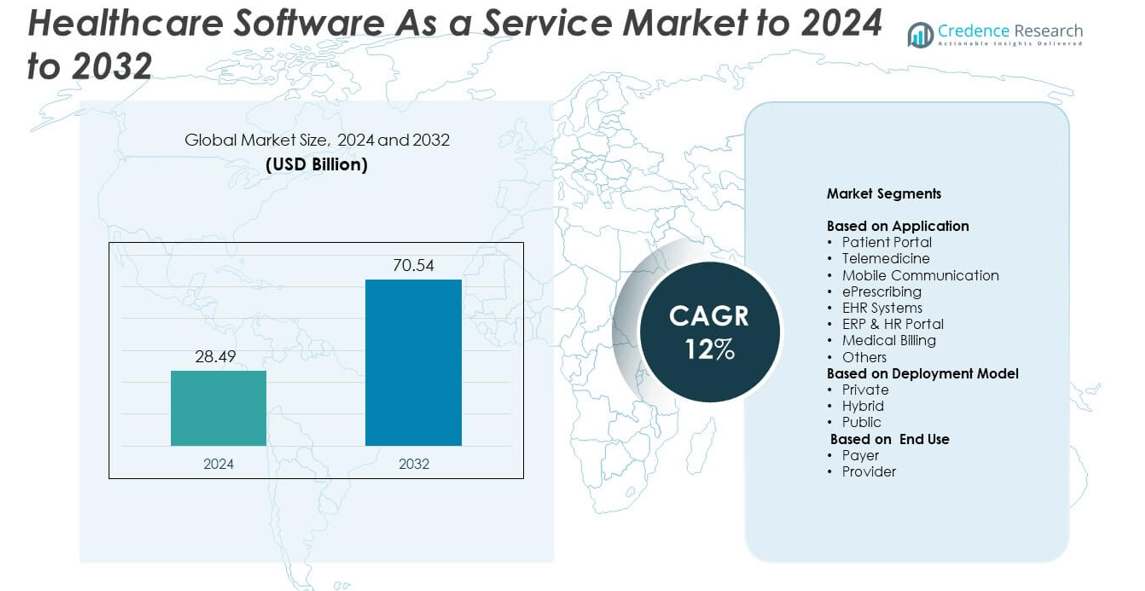
The Healthcare Software as a Service market size was valued at USD 28.49 billion in 2024 and is anticipated to reach USD 70.54 billion by 2032, growing at a CAGR of 12% during the forecast period.
| REPORT ATTRIBUTE | DETAILS |
|---|---|
| Historical Period | 2020-2023 |
| Base Year | 2024 |
| Forecast Period | 2025-2032 |
| Healthcare Software as a Service Market Size 2024 | USD 28.49 billion |
| Healthcare Software as a Service Market, CAGR | 12% |
| Healthcare Software as a Service Market Size 2032 | USD 70.54 billion |
The Healthcare Software as a Service market is dominated by key players such as Oracle, Salesforce, IBM, Microsoft, SAP, Cisco Systems, Google, and Adobe. These companies lead through continuous innovation in cloud-based healthcare solutions, AI-powered analytics, and secure data management systems. Their focus on interoperability, mobile accessibility, and compliance with healthcare regulations has strengthened global adoption. North America remains the leading region, accounting for 38% of the total market share in 2024, supported by advanced healthcare infrastructure and rapid digital transformation. Europe and Asia-Pacific follow, driven by expanding telehealth adoption and healthcare modernization initiatives.
Market Insights
- The Healthcare Software as a Service market was valued at USD 28.49 billion in 2024 and is projected to reach USD 70.54 billion by 2032, growing at a CAGR of 12%.
- Rising adoption of cloud-based healthcare platforms and telemedicine solutions is driving market growth, supported by regulatory initiatives promoting digital health transformation.
- Integration of AI, data analytics, and interoperability features in SaaS platforms is transforming patient care and operational efficiency across hospitals and clinics.
- The market is moderately consolidated, with major players focusing on innovation, cybersecurity, and strategic partnerships to expand service portfolios globally.
- North America holds 38% of the market share, followed by Europe with 27% and Asia-Pacific with 24%, while the EHR systems segment leads overall with a 32% share in 2024.
Market Segmentation Analysis:
By Application
EHR systems held the dominant share of 32% in the Healthcare Software as a Service market in 2024. Their dominance is driven by rapid digital transformation in hospitals and clinics, emphasizing patient data accuracy and interoperability. Integration of EHR with AI-based analytics and cloud storage enhances clinical decision-making and operational efficiency. Telemedicine and patient portals also gained traction due to rising demand for virtual care and personalized engagement tools. Vendors increasingly focus on offering scalable and secure SaaS-based platforms to support data-driven healthcare delivery across multiple care settings.
- For instance, In 2023, Oracle Cerner’s Real World Testing reported an average of 1,683,108 “Problems added” per month and 2,646,318 “Problems rejected” per month in the Problem reconciliation workflow.
By Deployment Model
The private cloud segment accounted for the largest share of 45% in 2024, owing to its enhanced data security, customization, and regulatory compliance advantages. Healthcare organizations prefer private SaaS deployment to ensure greater control over patient data while maintaining HIPAA and GDPR compliance. Hybrid models are gaining momentum due to their flexibility in integrating on-premises systems with cloud solutions. Public cloud adoption remains steady among small and mid-sized facilities seeking cost-effective scalability and simplified IT management through subscription-based access.
- For instance, Epic states that across its community there are over 60,000 active interfaces connecting to more than 2,000 vendors.
By End Use
The provider segment dominated the market with a 68% share in 2024, driven by increasing adoption of SaaS platforms by hospitals, clinics, and diagnostic centers for patient record management and telehealth services. Providers benefit from real-time analytics, automated billing, and seamless interoperability across systems. SaaS tools improve operational efficiency and enable remote collaboration among care teams. The payer segment is also expanding as insurance companies implement SaaS solutions for claims processing, member engagement, and fraud detection to enhance service quality and administrative accuracy.
Key Growth Drivers
Rising Demand for Cloud-Based Healthcare Solutions
The growing preference for cloud-based healthcare platforms is a primary growth driver. Hospitals and clinics are rapidly moving from traditional software to scalable SaaS systems that reduce IT costs and improve accessibility. Cloud deployment enables secure storage, real-time data sharing, and faster updates. Increasing focus on interoperability and value-based care further boosts adoption. Vendors are offering HIPAA-compliant, AI-integrated solutions that enhance clinical decision-making and streamline patient management, driving widespread implementation across healthcare networks.
- For instance, Oracle Cerner Real World Testing found that 82% (3,288/3,994) of patient visits involved sending or receiving a C-CDA document during transitions of care. The testing successfully met its target of 50% or more.
Growing Adoption of Telehealth and Remote Monitoring
The surge in telemedicine adoption has accelerated SaaS uptake in healthcare. Remote monitoring systems supported by SaaS platforms enable continuous patient engagement, especially in chronic disease management and post-discharge care. These solutions offer real-time data access for physicians and patients, improving diagnostic accuracy and reducing readmissions. Integration with mobile apps and wearable devices is expanding telehealth reach, while government initiatives supporting virtual care enhance market penetration. This trend strengthens digital transformation efforts within the healthcare ecosystem.
- For instance, Epic reports that its USCDI v3 APIs have been called over 8 billion times by app developers.
Regulatory Push for Digital Health Transformation
Global healthcare regulations encouraging electronic data management and interoperability drive SaaS deployment. Governments promote digital records and cloud-based solutions to improve transparency, data traceability, and care coordination. Regulations like the U.S. HITECH Act and Europe’s GDPR encourage secure, standardized SaaS platforms in healthcare. Vendors are focusing on compliance-ready solutions to meet these evolving legal requirements. Such mandates are compelling healthcare organizations to upgrade legacy systems, ensuring faster and safer adoption of SaaS technologies across clinical operations.
Key Trends and Opportunities
Integration of Artificial Intelligence and Analytics
Artificial intelligence and predictive analytics are increasingly integrated into healthcare SaaS platforms. AI algorithms help analyze large clinical datasets, identify health trends, and automate administrative tasks. Predictive tools enhance early diagnosis and personalized treatment planning. Vendors are embedding machine learning models to optimize workflow efficiency and detect anomalies in patient data. This trend offers opportunities for advanced clinical insights and supports evidence-based medical decisions, enabling healthcare providers to deliver more efficient and accurate patient care.
- For instance, Siemens claims that over 2 million imaging exams have been processed by AI-Rad Companion globally.
Rising Demand for Interoperability and Connected Systems
Healthcare organizations are prioritizing connected SaaS ecosystems that enable seamless data exchange across departments and systems. Interoperability between EHR, telemedicine, and billing platforms ensures unified patient records and faster decision-making. Standardized APIs and integration tools support collaboration between providers and payers. This trend drives partnerships among SaaS vendors and healthcare institutions. Growing investments in Health Information Exchanges (HIEs) are also creating opportunities for cross-platform compatibility, ultimately improving patient outcomes and operational transparency.
- For instance, Epic supports more than 60,000 interfaces across 2,000+ vendors, enabling broad system interoperation.
Expansion of Mobile and Patient-Centric Platforms
The rising use of mobile applications in healthcare is creating new SaaS opportunities. Patients increasingly rely on mobile portals to access records, schedule appointments, and track health metrics. SaaS providers are developing mobile-friendly interfaces with secure access and real-time updates. This mobility enhances patient engagement and satisfaction while enabling providers to extend care beyond clinical settings. The trend aligns with the shift toward personalized healthcare, encouraging innovation in mobile-driven SaaS delivery models.
Key Challenges
Data Security and Privacy Concerns
Cybersecurity risks remain a major challenge in healthcare SaaS adoption. The exchange of sensitive patient data across cloud platforms exposes organizations to potential breaches and compliance violations. Maintaining data encryption, user authentication, and access control are essential to building trust. Frequent ransomware attacks have made providers more cautious. Vendors must continuously update security protocols and obtain certifications to meet regulatory standards, ensuring compliance with global frameworks such as HIPAA and GDPR.
Integration with Legacy Systems
Many healthcare organizations still rely on outdated IT systems, posing challenges for SaaS integration. Compatibility issues arise when connecting modern cloud solutions to legacy infrastructure. These barriers increase implementation time and operational costs. Limited in-house IT expertise further slows migration. Vendors are addressing these gaps by offering hybrid models and migration tools to ensure smoother transitions. Overcoming these integration challenges is vital to achieving seamless interoperability and unlocking the full benefits of SaaS adoption in healthcare.
Regional Analysis
North America
North America held the largest share of 38% in the Healthcare Software as a Service market in 2024. The region’s growth is driven by advanced healthcare infrastructure, high adoption of digital technologies, and supportive government policies promoting interoperability. Major SaaS providers such as Oracle Health, Salesforce, and Athenahealth have expanded cloud-based healthcare platforms across the United States and Canada. The growing demand for telehealth, patient engagement systems, and AI-integrated analytics further supports market expansion. Increasing investments in healthcare IT modernization continue to strengthen the region’s dominant position during the forecast period.
Europe
Europe accounted for 27% of the Healthcare Software as a Service market share in 2024. Strong regulatory support for digital health transformation and emphasis on secure data management fuel market growth. Countries like Germany, the United Kingdom, and France are investing in cloud-based EHR and telemedicine platforms to improve patient outcomes. Initiatives such as the European Health Data Space are encouraging interoperability and data-driven care coordination. The rising focus on cross-border healthcare data sharing and the presence of leading SaaS vendors enhance market competitiveness across the region.
Asia-Pacific
Asia-Pacific captured a 24% share of the Healthcare Software as a Service market in 2024, showing the fastest growth rate. Rapid digitalization of healthcare systems in China, India, Japan, and Australia is driving adoption. Governments are promoting cloud-based platforms to improve rural healthcare accessibility and reduce administrative costs. The expansion of telehealth and mobile health applications has accelerated SaaS deployment across hospitals and clinics. Growing partnerships between global vendors and regional providers, along with increasing investments in healthcare IT infrastructure, are further propelling the region’s strong growth outlook.
Latin America
Latin America held a 7% share of the Healthcare Software as a Service market in 2024. The region is experiencing gradual adoption of cloud-based healthcare platforms, driven by efforts to modernize public health systems. Brazil and Mexico lead the adoption, supported by growing telemedicine use and private healthcare investments. SaaS vendors are targeting mid-sized hospitals with cost-efficient subscription models. Government digital health initiatives and regional collaborations are improving system interoperability. Although infrastructure challenges persist, the region’s focus on affordable and accessible digital healthcare solutions supports steady market expansion.
Middle East & Africa
The Middle East and Africa accounted for 4% of the Healthcare Software as a Service market share in 2024. Growth is supported by increasing digital transformation projects in Gulf Cooperation Council countries and rising healthcare investments in South Africa. Governments are prioritizing cloud-based systems to enhance efficiency and data security in public hospitals. Telehealth expansion and AI-enabled patient management tools are gaining traction. Strategic partnerships between global SaaS vendors and local healthcare providers are improving service reach, positioning the region as an emerging market with long-term development potential.
Market Segmentations:
By Application
- Patient Portal
- Telemedicine
- Mobile Communication
- ePrescribing
- EHR Systems
- ERP & HR Portal
- Medical Billing
- Others
By Deployment Model
- Private
- Hybrid
- Public
By End Use
- Payer
- Provider
By Geography
- North America
- U.S.
- Canada
- Mexico
- Europe
- Germany
- France
- U.K.
- Italy
- Spain
- Rest of Europe
- Asia Pacific
- China
- Japan
- India
- South Korea
- South-east Asia
- Rest of Asia Pacific
- Latin America
- Brazil
- Argentina
- Rest of Latin America
- Middle East & Africa
- GCC Countries
- South Africa
- Rest of the Middle East and Africa
Competitive Landscape
Leading companies such as Oracle, Salesforce, Inc., IBM, Microsoft, SAP, Cisco Systems, Inc., Google, Adobe, ServiceNow, Workday, Inc., Veeva Systems, Health Catalyst, CareCloud, Inc., Simplify Healthcare, Hyland, and Suki AI, Inc. collectively shape the competitive landscape of the Healthcare Software as a Service market. The competition is defined by technological innovation, data security, and integration capabilities across healthcare ecosystems. Companies focus on expanding AI-powered analytics, improving interoperability, and enhancing patient engagement solutions. Strategic partnerships with hospitals and insurance providers are increasing platform adoption. Vendors emphasize modular, compliance-ready architectures to meet regional regulatory standards. Continuous investments in R&D, cybersecurity, and cloud optimization are strengthening service reliability and scalability. Market players are also expanding global presence through mergers, acquisitions, and regional collaborations. The overall competitive environment remains moderately consolidated, with firms differentiating through specialization in clinical analytics, mobile SaaS, and data-driven healthcare management solutions.
Key Player Analysis
- Oracle
- Salesforce, Inc.
- IBM
- Microsoft
- SAP
- Cisco Systems, Inc.
- Adobe
- ServiceNow
- Workday, Inc.
- Veeva Systems
- Health Catalyst
- CareCloud, Inc.
- Simplify Healthcare
- Hyland
- Suki AI, Inc.
Recent Developments
- In 2024, Health Catalyst Acquired Lumeon, a UK-based healthcare SaaS provider, to enhance its ability to automate operational workflows. It also achieved HITRUST r2 and SOC 2 Type II compliance for its platforms.
- In 2024, Simplify Healthcare launches SimplifyX™, delivering AI-native SaaS solutions 50% faster and 10X better across multiple industries.
- In 2024, Hyland introduced an advanced healthcare cloud imaging SaaS solution and NilShare to enhance image collaboration.
Report Coverage
The research report offers an in-depth analysis based on Application, Deployment Model, End-Use and Geography. It details leading market players, providing an overview of their business, product offerings, investments, revenue streams, and key applications. Additionally, the report includes insights into the competitive environment, SWOT analysis, current market trends, as well as the primary drivers and constraints. Furthermore, it discusses various factors that have driven market expansion in recent years. The report also explores market dynamics, regulatory scenarios, and technological advancements that are shaping the industry. It assesses the impact of external factors and global economic changes on market growth. Lastly, it provides strategic recommendations for new entrants and established companies to navigate the complexities of the market.
Future Outlook
- The market will continue expanding with growing demand for cloud-based healthcare platforms.
- Integration of AI and predictive analytics will enhance clinical decision-making.
- Telemedicine and remote patient monitoring will remain key growth areas.
- Hybrid cloud models will gain traction for flexibility and security benefits.
- Increasing interoperability will improve data exchange across healthcare systems.
- Mobile and patient-centric SaaS platforms will drive higher engagement rates.
- Strategic partnerships between IT vendors and healthcare providers will strengthen innovation.
- Regulatory compliance and data privacy measures will shape product development.
- Emerging economies will see rapid adoption due to digital health initiatives.
- Continuous cybersecurity advancements will ensure safer SaaS implementation globally.

Request a Free Sample
Fill in your details and we'll send you a free sample report.
- Sample data tables & charts
- Research methodology
Need a Custom Version of This Report?
Tailor the scope, geography, or segments to your exact requirements.
- Custom geography or segment scope
- Direct access to our analyst team
Frequently Asked Questions
What is the current market size for Healthcare Software As a Service Market, and what is its projected size in 2032?
At what Compound Annual Growth Rate is the Healthcare Software As a Service Market projected to grow between 2025 and 2032?
Which Healthcare Software As a Service Market segment held the largest share in 2024?
What are the primary factors fueling the growth of the Healthcare Software As a Service Market?
Who are the leading companies in the Healthcare Software As a Service Market?
Table of Content
Chapter 1 Market Segmentation
- 1.1 Segmentation Framework
- 1.1.1 Product and Service Classification
- 1.1.2 Application and End-Use Classification
- 1.1.3 Technology and Solution Classification
- 1.1.4 Customer and Distribution Channel Classification
- 1.1.5 Geographic Segmentation
- 1.1.6 Market Segment Definitions and Boundaries
Chapter 2 Introduction
- 2.1 Report Objectives and Scope
- 2.2 Product Definition and Industry Terminology
- 2.3 Market Inclusions and Exclusions
- 2.4 Research Process
- 2.4.1 Primary Research and Expert Interviews
- 2.4.2 Secondary Research and Source Review
- 2.4.3 Top-Down and Bottom-Up Estimation
- 2.4.4 Data Triangulation and Verification
- 2.5 Market Size Measurement Basis
- 2.5.1 2024: USD 28.49 billion → 2032: USD 70.54 billion
- 2.6 Historical and Forecast Reference Periods
- 2.6.1 Base Year: 2024
- 2.6.2 Forecast Period: 2024-2032
- 2.7 Research Assumptions and Limitations
Chapter 3 Executive Summary
- 3.1 Market Snapshot and Key Findings
- 3.2 Base-Year Market Size, 2024
- 3.3 Forecast Market Size, 2032
- 3.4 Revenue and Volume Growth Outlook
- 3.5 Key Demand and Supply Indicators
- 3.6 Leading Market Segments
- 3.7 Fastest-Growing Market Opportunities
- 3.8 Regional Performance Highlights
- 3.9 Technology and Industry Transformation
- 3.10 Competitive Landscape Summary
- 3.11 Analyst View and Strategic Implications
Chapter 4 Global Healthcare Software as a Service Market Trends and Developments
- 4.1 Historical Industry Development
- 4.2 Recent Market Trends and Developments
- 4.3 Demand and Customer Behavior Trends
- 4.4 Technology and Product Innovation
- 4.5 Artificial Intelligence, Automation and Digitalization
- 4.6 Local Manufacturing and Supply Chain Realignment
- 4.7 Industry Partnerships, Mergers and Acquisitions
- 4.8 Sustainability and Circular Economy Developments
- 4.9 Government and Private Sector Investment Trends
- 4.10 Emerging Business Models and Commercialization
- 4.11 Industry Developments and Announcements
Chapter 5 Global Healthcare Software as a Service Market Supply and Demand Analysis
- 5.1 Demand Trend and Consumption Analysis
- 5.2 Demand Forecast, 2024-2032
- 5.3 Supply Chain Structure and Procurement Trends
- 5.4 Supply-Demand Gap and Bottlenecks
- 5.5 Import Dependence and Sourcing Structure
- 5.6 Regional Supply and Demand Concentration
Chapter 6 Global Healthcare Software as a Service Market Pricing Analysis
- 6.1 Pricing Structure and Measurement
- 6.2 Historical Pricing Trends
- 6.3 Pricing Outlook, 2024-2032
- 6.4 Pricing by Product and Market Segment
- 6.5 Geographic Pricing Differences
- 6.6 Key Input, Energy, Labor and Logistics Costs
- 6.7 Contract Pricing and Purchasing Models
- 6.8 Pricing Sensitivity and Competitive Positioning
- 6.9 Price, Margin and Profitability Implications
Chapter 7 Global Healthcare Software as a Service Market Dynamics
- 7.1 Market Growth Drivers
- 7.1.1 Demand-Side Drivers
- 7.1.2 Technology and Innovation Drivers
- 7.1.3 Infrastructure and Investment Drivers
- 7.1.4 Regulatory and Policy Drivers
- 7.2 Market Restraints
- 7.2.1 Cost and Affordability Constraints
- 7.2.2 Technology and Adoption Barriers
- 7.2.3 Supply Chain and Operational Constraints
- 7.3 Market Challenges
- 7.3.1 Competitive Pressure and Margin Erosion
- 7.3.2 Skills, Infrastructure and Implementation Gaps
- 7.4 Emerging Market Opportunities
- 7.5 Market Dynamics Impact and Time-Horizon Assessment
Chapter 8 Global Healthcare Software as a Service Value Chain Analysis
- 8.1 Industry Value Chain Overview
- 8.2 Upstream Suppliers and Critical Inputs
- 8.3 Technology and Component Providers
- 8.4 Manufacturing or Service Delivery
- 8.5 Distribution, Channel Partners and Integrators
- 8.6 Downstream Applications and End Users
- 8.7 Value Addition and Profit Pools
- 8.8 Vertical Integration and Outsourcing
- 8.9 Supplier Concentration and Risk
- 8.10 Supply Chain Localization and Resilience
Chapter 9 Global Healthcare Software as a Service Market Regulations and Policies
- 9.1 Relevant Laws, Standards and Compliance Frameworks
- 9.2 Product, Service, Safety and Quality Requirements
- 9.3 Government Policies, Incentives and Subsidies
- 9.4 Imports, Exports and Trade Barriers
- 9.5 Public Procurement and Local Content Requirements
- 9.6 Data Protection, AI and Cybersecurity Compliance
- 9.7 Upcoming Policy Changes and Market Implications
Chapter 10 Global Healthcare Software as a Service Market Hotspots and Opportunities
- 10.1 Market Opportunity Mapping and Growth Hotspots
- 10.2 High-Growth Applications and Customer Groups
- 10.3 Underserved Markets and White-Space Opportunities
- 10.4 Emerging Technology and Product Opportunities
- 10.5 New Capacity and Investment Hotspots
- 10.6 Market Entry and Expansion Opportunities
- 10.7 Distribution and Partnership Opportunities
- 10.8 Near-Term and Long-Term Commercial Potential
- 10.9 Opportunity Attractiveness and Execution Risks
Chapter 11 Global Healthcare Software as a Service Market Outlook, 2024-2032
- 11.1 Market Size and Analysis
- 11.1.1 Revenue (Market Measurement: 2024: USD 28.49 billion → 2032: USD 70.54 billion)
- 11.1.2 Historical Market Size
- 11.1.3 Base-Year Market Size, 2024
- 11.2 Market Forecast, 2024-2032
- 11.2.1 Revenue Forecast to 2032
- 11.2.2 CAGR and Year-on-Year Growth
- 11.2.3 Incremental Revenue Opportunity
- 11.3 Forecast Assumptions and Scenario Analysis
- 11.3.1 Base-Case Forecast
- 11.3.2 Optimistic and Conservative Scenarios
- 11.3.3 Technology, Pricing and Policy Sensitivities
- 11.4 Market Attractiveness and Growth Outlook
Chapter 12 Global Healthcare Software as a Service Market Segmentation and Outlook
- 12.1 Segmentation Summary and Market Shares, 2024
- 12.2 Largest and Fastest-Growing Segments
- 12.3 Segment Growth Comparison
- 12.4 Segment Attractiveness and Priority Matrix
Chapter 13 Global Healthcare Software as a Service Geographic Market Outlook, 2024-2032
- 13.1 Regional Market Size and Share, 2024
- 13.2 Regional Market Forecast, 2024-2032
- 13.3 Regional Pricing, Production and Demand Differences
- 13.4 North America
- 13.4.1 United States
- 13.4.2 Canada
- 13.4.3 Mexico
- 13.5 Europe
- 13.5.1 Germany
- 13.5.2 France
- 13.5.3 Italy
- 13.5.4 United Kingdom
- 13.5.5 Spain
- 13.5.6 Poland
- 13.5.7 Russia
- 13.5.8 Netherlands
- 13.5.9 Belgium
- 13.5.10 Sweden
- 13.5.11 Denmark
- 13.5.12 Norway
- 13.5.13 Rest of Europe
- 13.6 Asia Pacific
- 13.6.1 China
- 13.6.2 India
- 13.6.3 Japan
- 13.6.4 South Korea
- 13.6.5 Thailand
- 13.6.6 Indonesia
- 13.6.7 Vietnam
- 13.6.8 Malaysia
- 13.6.9 Australia
- 13.6.10 Rest of Asia Pacific
- 13.7 Latin America
- 13.7.1 Brazil
- 13.7.2 Argentina
- 13.7.3 Colombia
- 13.7.4 Chile
- 13.7.5 Rest of Latin America
- 13.8 Middle East
- 13.8.1 Saudi Arabia
- 13.8.2 United Arab Emirates
- 13.8.3 Turkey
- 13.8.4 Israel
- 13.8.5 Iran
- 13.8.6 Rest of the Middle East
- 13.9 Africa
- 13.9.1 South Africa
- 13.9.2 Egypt
- 13.9.3 Nigeria
- 13.9.4 Morocco
- 13.9.5 Rest of Africa
- 13.10 Regional Investment, Policy and Supply Chain Differences
- 13.11 Regional Competitive Landscape
- 13.12 Geographic Growth Hotspots
Chapter 14 Global Healthcare Software as a Service Technology, Innovation and Sustainability Outlook
- 14.1 Technology Landscape and Maturity
- 14.2 Product, Process and Service Innovation
- 14.3 AI, Automation and Digital Tools in the Industry
- 14.4 Technology Adoption and Performance Benchmarking
- 14.5 Innovation Pipeline and R&D Investment
- 14.6 Energy Efficiency and Resource Management
- 14.7 Sustainability, Recycling and Circularity
- 14.8 Technology Roadmap, 2024-2032
- 14.9 Risks of Obsolescence and Technology Substitution
Chapter 15 Global Healthcare Software as a Service Market Key Strategic Imperatives
- 15.1 Growth and Market Entry Priorities
- 15.2 High-Return Products and Segments
- 15.3 Pricing, Profitability and Cost Optimization
- 15.4 Technology Investment and Product Differentiation
- 15.5 Supply Chain Localization and Resilience
- 15.6 Distribution and Customer Acquisition
- 15.7 Partnership, Acquisition and Capacity Strategy
- 15.8 Regional Expansion Priorities
- 15.9 Short-, Medium- and Long-Term Actions
Chapter 16 Competition Outlook
- 16.1 Industry Competition Characteristics
- 16.2 Market Structure and Concentration
- 16.3 Market Share and Competitive Positioning, 2024
- 16.4 Company-Wise Revenue and Product Benchmarking
- 16.5 Production and Service Capacity Benchmarking
- 16.6 Technology, Pricing and Differentiation
- 16.7 Regional Footprint and Distribution Strength
- 16.8 Mergers, Acquisitions and Strategic Alliances
- 16.9 New Entrants and Competitive Threats
- 16.10 Porter's Five Forces and Industry Attractiveness
- 16.11 Competitive Outlook, 2024-2032
Chapter 17 Company Profiles
- 17.1 Company Coverage and Selection Criteria
- 17.2 Leading Market Participants – Standard Profile Structure
- 17.2.1 Business Description
- 17.2.2 Company Ownership and Geographic Presence
- 17.2.3 Product and Service Portfolio
- 17.2.4 Manufacturing and Operating Footprint
- 17.2.5 Financial Performance and Investment
- 17.2.6 Market Share and Competitive Position
- 17.2.7 Technology and Innovation Capabilities
- 17.2.8 Strategic Alliances or Partnerships
- 17.2.9 Recent Developments
- 17.2.10 Growth Strategy and Outlook
- 17.3 Other Relevant Market Participants
Note: Every listed company is profiled on the structure shown under the first company. The company list is preliminary and may change based on research findings, market developments, data availability and client requirements.
Chapter 18 Disclaimer
- 18.1 Research and Forecast Disclaimer
- 18.2 Data Source and Estimation Limitations
Note: The depth of individual sections depends on data availability for this market. Volume, capacity, trade and other unit-based metrics are included where applicable.

