
Asia Pacific Monoclonal Antibodies Market Overview:
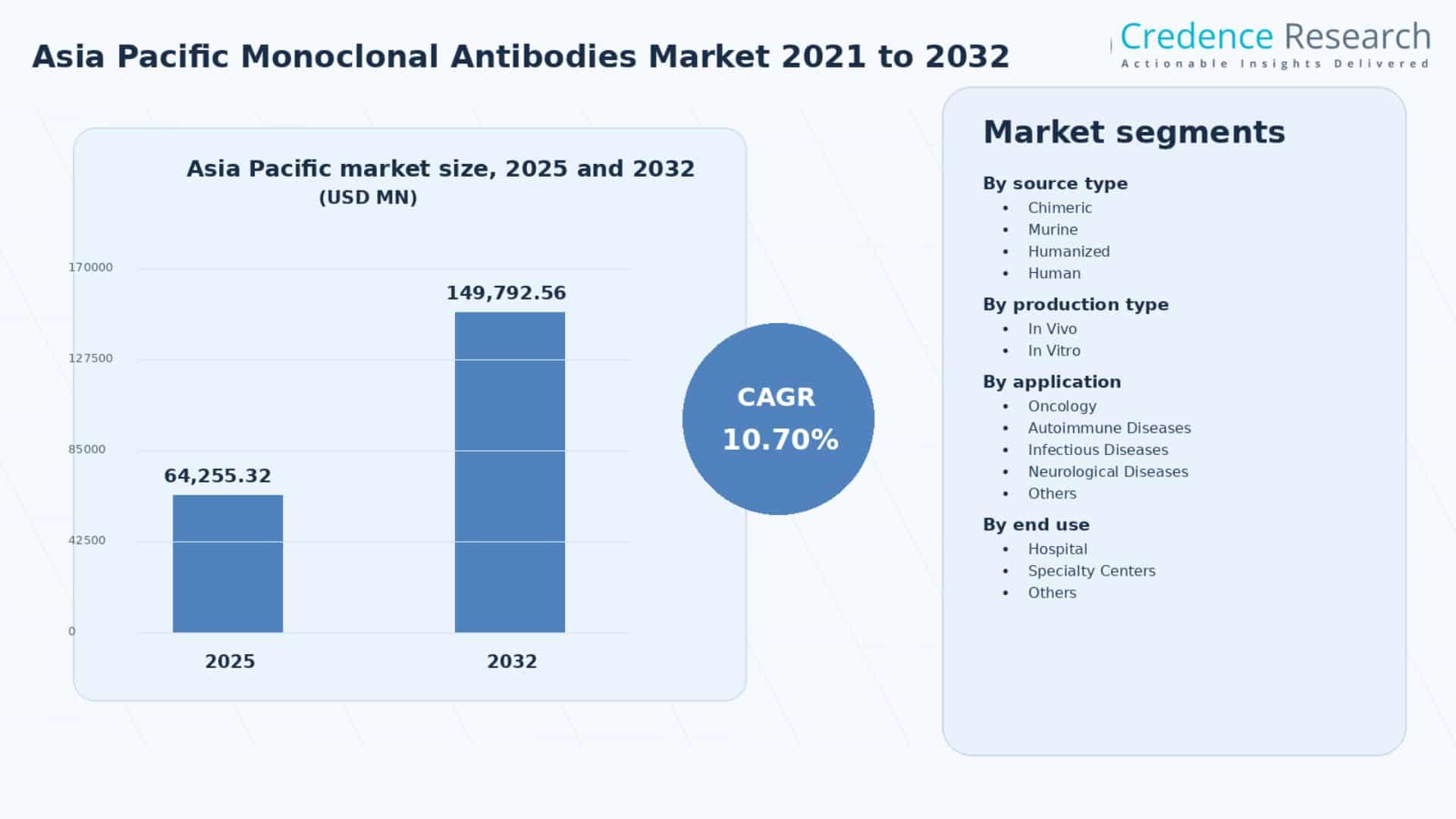
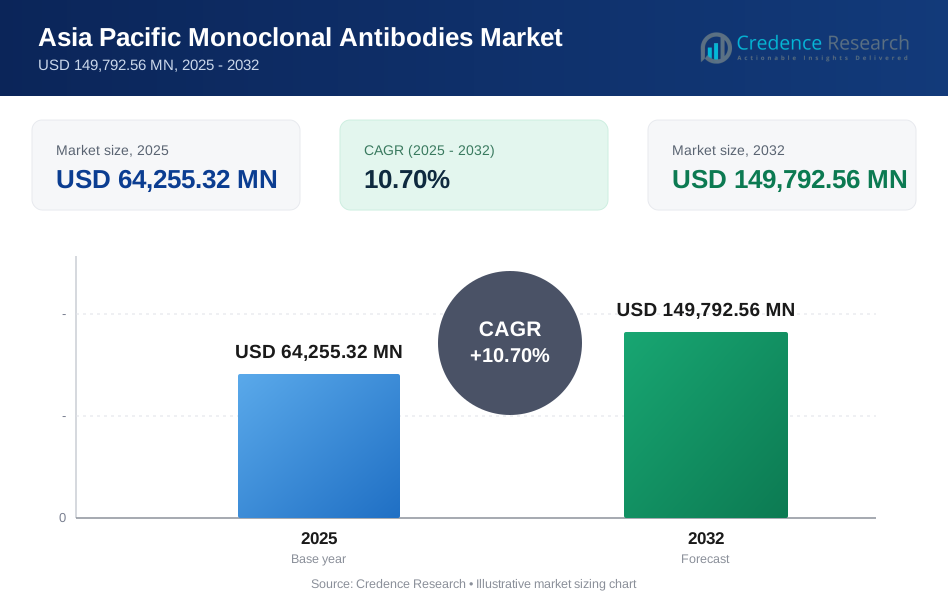
The Asia Pacific Monoclonal Antibodies Market size was valued at USD 40,541.17 MN in 2021 and reached USD 64,255.32 MN in 2025. It is anticipated to reach USD 149,792.56 MN by 2032, growing at a CAGR of 10.70% during the forecast period.
| REPORT ATTRIBUTE | DETAILS |
|---|---|
| Historical Period | 2021-2024 |
| Base Year | 2025 |
| Forecast Period | 2026-2032 |
| Asia Pacific Monoclonal Antibodies Market Size 2025 | USD 64,255.32 million |
| Asia Pacific Monoclonal Antibodies Market, CAGR | 10.70% |
| Asia Pacific Monoclonal Antibodies Market Size 2032 | USD 149,792.56 million |
Asia Pacific Monoclonal Antibodies Market Insights
- Market growth is supported by oncology biologic demand, autoimmune disease treatment expansion, antibody-drug conjugate adoption, hospital-led infusion capacity and broader use of humanized and human monoclonal antibodies.
- Humanized antibodies hold a strong position because they offer lower immunogenicity than murine antibodies and are widely used across oncology and autoimmune disease treatment.
- Oncology remains the leading application because cancer care increasingly uses checkpoint inhibitors, antibody-drug conjugates, bispecific antibodies and targeted monoclonal antibody combinations.
- Hospitals remain the leading end-use segment because monoclonal antibodies often require specialist diagnosis, infusion infrastructure, cold-chain handling, adverse event monitoring and payer documentation.
Asia Pacific Monoclonal Antibodies Market Segment Insights
By source type
By source type, Humanized held a strong position in 2025 because many established oncology and autoimmune monoclonal antibodies use humanized formats to improve tolerability and reduce immune response risk. Human antibodies are gaining momentum as development platforms prioritize lower immunogenicity, longer treatment durability and stronger chronic therapy suitability. Chimeric antibodies remain relevant in oncology and autoimmune treatment, especially in legacy biologics and biosimilars. Murine antibodies hold a smaller share because immunogenicity concerns limit long-term use, but they remain important in diagnostics, research and selected therapeutic formats. Growth will favor Humanized and Human antibodies as clinical programs focus on safety, efficacy and long-term use.
By production type
By production type, In Vitro held the strongest position in 2025 because commercial monoclonal antibody production increasingly relies on controlled cell culture systems, recombinant expression platforms and scalable bioprocessing. In Vitro production supports consistent quality, large-batch manufacturing, process control and regulatory documentation. It is highly relevant for oncology antibodies, autoimmune biologics and next-generation antibody formats. In Vivo production remains limited and is mainly used in research, early development or selected specialized applications. Manufacturing growth will depend on cell line productivity, bioreactor capacity, quality systems, process analytics and regional biologics manufacturing investment across China, Japan, South Korea, India and Australia.
By application
By application, Oncology held the strongest position in 2025 because monoclonal antibodies are central to modern cancer treatment. Checkpoint inhibitors, HER2-directed antibodies, CD20 antibodies, VEGF inhibitors, PD-1/PD-L1 antibodies, antibody-drug conjugates and bispecific antibodies support broad use across solid tumors and hematologic malignancies. Autoimmune Diseases remain a major application due to rheumatoid arthritis, psoriasis, inflammatory bowel disease and related immune-mediated conditions. Infectious Diseases support selected antibody therapies and prevention products. Neurological Diseases are gaining momentum through anti-amyloid and immune-mediated neurology therapies. Others include ophthalmology, transplant medicine, hematology and rare disease applications.
By end use
By end use, Hospital held the strongest position in 2025 because monoclonal antibody treatment often requires diagnosis, infusion, clinical monitoring and management of immune-related adverse events. Hospitals dominate oncology antibody administration, biologic initiation and inpatient management of severe disease. Specialty Centers are gaining demand because oncology centers, immunology clinics, neurology centers and infusion clinics can deliver targeted biologics in outpatient settings. Others include research institutions, diagnostic centers and home-care-linked specialty models. End-use growth will depend on infusion capacity, specialist availability, payer approval, cold-chain systems, physician confidence and patient support services.
Key Market Drivers
Rising oncology antibody demand
Rising oncology antibody demand represents a major growth driver for the Asia Pacific Monoclonal Antibodies Market. Cancer treatment increasingly depends on monoclonal antibodies, checkpoint inhibitors, antibody-drug conjugates and bispecific antibody platforms.
WHO estimates that the Western Pacific Region recorded close to 6.8 million new cancer cases in 2022, while WHO South-East Asia reported 2.37 million new cancer cases and 1.53 million cancer deaths in 2022. Supporting statement from key company data: Merck’s 2025 Form 10-K cited Japan approval of Keytruda with trastuzumab and chemotherapy for first-line HER2-positive gastric or gastroesophageal junction adenocarcinoma and China approval of Keytruda plus Lenvima with transarterial chemoembolization for unresectable, non-metastatic hepatocellular carcinoma. These developments support Oncology, Humanized and Human antibody demand across hospitals and specialty cancer centers.
Autoimmune disease biologic expansion
Autoimmune disease biologic expansion supports strong demand for monoclonal antibodies across chronic inflammatory conditions. Patients with psoriasis, inflammatory bowel disease, rheumatoid arthritis and related immune-mediated diseases increasingly use biologics after inadequate response to conventional treatment.
AbbVie reported full-year 2025 global immunology portfolio net revenues of USD 30.406 billion, including Skyrizi net revenues of USD 17.562 billion, Rinvoq net revenues of USD 8.304 billion and Humira net revenues of USD 4.540 billion. Johnson & Johnson also said Tremfya received Japan approvals in 2025 for moderate to severe ulcerative colitis and Crohn’s Disease and gained Japan approval in 2026 for subcutaneous ulcerative colitis induction therapy. This driver supports Autoimmune Diseases, Specialty Centers and hospital-led biologic initiation.
Antibody-drug conjugate and targeted oncology innovation
Antibody-drug conjugate and targeted oncology innovation is strengthening market value as companies introduce therapies that link antibody targeting with high-potency payloads. These products are increasing relevance for oncology monoclonal antibody platforms and expanding use beyond traditional antibody mechanisms.
AstraZeneca’s 2025 Form 20-F reported USD 1,798 million of Alliance Revenue related to Enhertu in 2025 and described Datroway as a TROP2-directed antibody-drug conjugate indicated in breast cancer and EGFR-mutated non-small cell lung cancer settings. Reuters also reported that Datroway was approved in Japan in December 2024 for a type of breast cancer after prior chemotherapy. These developments support Oncology, Humanized antibodies, hospitals and specialty oncology centers.
Regional approval momentum and portfolio expansion
Regional approval momentum and portfolio expansion support stronger adoption of monoclonal antibodies across Asia Pacific. Japan, China and other major markets continue to approve new indications and formats for oncology and autoimmune antibody therapies.
Bristol Myers Squibb’s 2025 filings cited Japan MHLW approval of Opdivo plus Yervoy in August 2025 for unresectable advanced or recurrent microsatellite instability-high colorectal cancer. Johnson & Johnson reported full-year 2025 results and highlighted significant innovation, including cancer therapy approvals and continuing data for antibody-based products such as Darzalex and Tremfya. This driver supports hospitals, specialty centers and broad antibody use across Oncology and Autoimmune Diseases.
Key Trends and Opportunities
Human and humanized antibodies gain preference
Human and humanized antibodies are gaining preference as developers focus on reducing immunogenicity and supporting long-term treatment. These formats are especially important in chronic autoimmune therapy and recurring oncology treatment where patients may need repeated dosing over long periods. Humanized and Human antibodies also support newer biologic formats, including checkpoint inhibitors and targeted immune therapies. Manufacturers that can combine efficacy, tolerability and convenient dosing will gain stronger physician acceptance. The trend supports premium product positioning across hospitals and specialty centers. It also reinforces demand for advanced cell culture production, quality control and biosimilar development capabilities.
Antibody-drug conjugates expand oncology use
Antibody-drug conjugates are expanding oncology use because they combine antibody targeting with cytotoxic payload delivery. This approach supports treatment in breast cancer, lung cancer, gastric cancer and other solid tumors where tumor-specific targeting improves therapeutic value. AstraZeneca and Daiichi Sankyo’s Enhertu and Datroway portfolios show how antibody-linked therapies are reshaping oncology growth. Asia Pacific is expected to gain from this trend because Japan and China remain important approval and commercialization markets. Hospitals and specialty oncology centers will remain the primary access points due to infusion requirements, monitoring needs and oncology expertise.
Specialty centers strengthen outpatient biologic delivery
Specialty centers are strengthening outpatient biologic delivery as oncology, immunology and neurology care shifts toward structured infusion and injection models. These centers can improve patient throughput, reduce hospital burden and provide therapy-specific monitoring. Specialty Centers are especially relevant for Autoimmune Diseases, Neurological Diseases and maintenance oncology therapies. Growth will depend on payer approval, physician networks, cold-chain capability and patient support programs. Companies can expand access by partnering with specialty care networks and offering education on adverse event monitoring. This trend supports recurring treatment demand and improves continuity of care.
Key Market Challenges
High treatment cost and reimbursement barriers
High treatment cost and reimbursement barriers remain major challenges for the Asia Pacific Monoclonal Antibodies Market. Monoclonal antibodies often carry premium prices due to complex manufacturing, clinical development cost and specialty distribution requirements. Reimbursement varies widely across China, Japan, India, South Korea, Australia and Southeast Asia. Patients in lower-access markets may face out-of-pocket costs or delayed access to newer therapies. Hospitals and payers may restrict use to defined disease severity, biomarker status or post-failure settings. Manufacturers must support access programs, local evidence and pricing strategies to expand adoption.
Manufacturing complexity and cold-chain requirements
Manufacturing complexity and cold-chain requirements can limit supply reliability and increase cost. Monoclonal antibodies require cell culture systems, sterile processing, analytical testing, biologic quality controls and temperature-sensitive storage. Supply chains must maintain product integrity from manufacturing to hospital or specialty center administration. Antibody-drug conjugates add additional handling complexity due to high-potency payloads. Regional manufacturing investment can improve access, but regulatory compliance and scale-up remain demanding. Companies need robust quality systems, cold-chain monitoring and reliable distribution partnerships.
Biosimilar competition and originator price pressure
Biosimilar competition and originator price pressure affect established monoclonal antibody categories. Biosimilars can expand access in oncology and autoimmune diseases but reduce revenue for originator products. Payers may encourage biosimilar switching or tender-based purchasing to manage biologic spending. Physician confidence and patient acceptance can vary by country and indication. Originator companies must differentiate through new indications, improved formulations, subcutaneous delivery, combination therapy and real-world outcomes. Price pressure will remain significant as Asia Pacific markets expand biosimilar policies and local manufacturing capacity.
Regional Analysis
China
China represents a major opportunity within the Asia Pacific Monoclonal Antibodies Market due to its large cancer patient base, fast-growing biologics industry, increasing local manufacturing and expanding hospital oncology infrastructure. Oncology remains the leading application, supported by checkpoint inhibitors, HER2 antibodies, PD-1/PD-L1 therapies, VEGF inhibitors and antibody-drug conjugates. Autoimmune Diseases are also gaining traction as biologic reimbursement improves. Hospitals dominate use due to infusion requirements and specialist prescribing, while Specialty Centers are expanding in large urban markets. Growth will depend on national reimbursement, volume-based procurement, local biosimilar competition and innovation from domestic biotech companies.
Japan
Japan supports strong monoclonal antibody demand due to mature health care infrastructure, advanced oncology care, specialist reimbursement and early adoption of targeted therapies. Hospitals and Specialty Centers use monoclonal antibodies across Oncology, Autoimmune Diseases, Neurological Diseases and rare conditions. Japan remains strategically important for global companies because of its clinical sophistication, regulatory predictability and high acceptance of innovative biologics. Recent approvals for antibody-based oncology and autoimmune therapies reinforce demand in hospital and specialty settings. Growth will depend on reimbursement, aging population needs, biomarker testing, subcutaneous delivery and competition from biosimilars.
India
India is an expanding market supported by rising cancer diagnosis, autoimmune disease awareness, biosimilar production and private hospital growth. Monoclonal antibody access remains concentrated in major cities and tertiary hospitals due to cost, specialist requirements and infusion infrastructure. Oncology and Autoimmune Diseases are key applications, while biosimilars are expected to improve affordability over time. In Vitro production and domestic biologics manufacturing are becoming strategic advantages for India’s pharmaceutical industry. Growth will depend on insurance expansion, pricing, public procurement, physician confidence in biosimilars and wider availability of diagnostics.
South Korea
South Korea represents a high-value market supported by strong biomanufacturing, biosimilar leadership, advanced hospitals and rapid clinical adoption of biologics. Oncology and Autoimmune Diseases are the leading applications, while Neurological Diseases and specialty indications are gaining interest. Hospitals dominate antibody administration, but Specialty Centers support outpatient biologic therapy and chronic disease management. South Korea also plays a strategic role as a manufacturing and biosimilar export hub. Growth will depend on global partnerships, reimbursement, local manufacturing capacity, clinical trial activity and continued innovation in antibody formats.
Australia and New Zealand
Australia and New Zealand represent mature monoclonal antibody markets supported by structured reimbursement, specialist care pathways and evidence-based medicine adoption. Oncology, Autoimmune Diseases and Neurological Diseases support steady demand across hospitals and specialty centers. Public funding and national formularies shape access to high-cost antibody therapies. Biosimilar adoption is expected to improve affordability and free budget for newer therapies. Hospitals remain the leading end-use segment due to infusion and monitoring requirements. Growth will remain steady as clinical guidelines, biomarker testing and reimbursement decisions expand treatment eligibility.
Southeast Asia
Southeast Asia offers long-term growth potential as private hospital investment, cancer care capacity, biologics reimbursement and specialty center networks expand. Singapore leads advanced biologic adoption, while Thailand, Malaysia, Indonesia, Vietnam and the Philippines are increasing access at different speeds. Oncology and Autoimmune Diseases remain the main applications. Cost remains a major barrier, which supports demand for biosimilars and access programs. Hospitals remain the primary end-use segment, but Specialty Centers will grow in urban markets. Growth will depend on affordability, diagnostics, cold-chain logistics, reimbursement and physician training.
Report Attribute details
| Report Attribute | Details |
| Historical Period | 2021–2024 |
| Base Year | 2025 |
| Forecast Period | 2025–2032 |
| Market Size in 2021 | USD 40,541.17 MN |
| Market Size in 2025 | USD 64,255.32 MN |
| Market Size in 2032 | USD 149,792.56 MN |
| CAGR | 10.70% |
| Segments Covered | Source Type, Production Type, Application, End Use and Geography |
| Key Companies Covered | Novartis AG, Pfizer Inc, Amgen Inc., GSK plc, Merck & Co., Inc., Daiichi Sankyo Company, Limited, Abbott Laboratories, AstraZeneca plc, Eli Lilly And Company, Johnson & Johnson Services, Inc., Bayer AG, Bristol Myers Squibb Company and F. Hoffman-La Roche Ltd. |
Asia Pacific Monoclonal Antibodies Market segmentations
By Source Type
- Chimeric
- Murine
- Humanized
- Human
By Production Type
- In Vivo
- In Vitro
By Application
- Oncology
- Autoimmune Diseases
- Infectious Diseases
- Neurological Diseases
- Others
By End Use
- Hospital
- Specialty Centers
- Others
Key Players
- Novartis AG
- Pfizer Inc
- Amgen Inc.
- GSK plc
- Merck & Co., Inc.
- Daiichi Sankyo Company, Limited
- Abbott Laboratories
- AstraZeneca plc
- Eli Lilly And Company
- Johnson & Johnson Services, Inc.
- Bayer AG
- Bristol Myers Squibb Company
- F. Hoffman-La Roche Ltd.
Recent developments
- In May 2025, Merck reported Japan MHLW approval of Keytruda with trastuzumab and chemotherapy for first-line HER2-positive gastric or gastroesophageal junction adenocarcinoma.
- In June 2025, Merck reported China NMPA approval of Keytruda plus Lenvima with transarterial chemoembolization for unresectable, non-metastatic hepatocellular carcinoma.
- In August 2025, Bristol Myers Squibb reported Japan MHLW approval of Opdivo plus Yervoy for unresectable advanced or recurrent microsatellite instability-high colorectal cancer.
- In February 2026, Johnson & Johnson said Japan approved Tremfya subcutaneous formulation for induction therapy in moderate to severe ulcerative colitis after inadequate response to existing treatment.
Report Coverage
The research report offers an in-depth analysis based on source type, production type, application, end use and geography. It details leading market players, providing an overview of their business positioning, monoclonal antibody portfolios, oncology antibodies, autoimmune biologics, antibody-drug conjugates, biosimilar exposure, manufacturing strategies and strategic relevance in the Asia Pacific Monoclonal Antibodies Market. The report includes insights into the competitive environment, market trends, growth drivers, restraints and opportunities. It also examines oncology treatment expansion, autoimmune biologic adoption, regional approvals, humanized antibody demand, In Vitro production, specialty center growth, biosimilar competition and cold-chain infrastructure as major factors shaping market development. The report assesses the impact of high treatment cost, reimbursement barriers, manufacturing complexity, biosimilar price pressure and country-specific access constraints on market growth. It provides strategic recommendations for pharmaceutical companies, hospitals, specialty centers, contract manufacturers, distributors, payers, investors and new entrants seeking to navigate Asia Pacific’s monoclonal antibody ecosystem.
Future Outlook
- Demand for monoclonal antibodies will continue to rise as oncology and autoimmune treatment expands across Asia Pacific.
- Humanized antibodies will remain a leading source type due to broad use in oncology and inflammatory disease treatment.
- Human antibodies will gain momentum as developers prioritize lower immunogenicity and long-term tolerability.
- In Vitro production will remain dominant because commercial antibody manufacturing requires scalable recombinant cell culture platforms.
- Oncology will remain the leading application due to checkpoint inhibitors, HER2 antibodies, PD-1/PD-L1 antibodies and antibody-drug conjugates.
- Autoimmune Diseases will grow as biologics expand in psoriasis, inflammatory bowel disease, rheumatoid arthritis and related conditions.
- Neurological Diseases will gain relevance as antibody therapies expand in Alzheimer’s disease and immune-mediated neurological disorders.
- Hospitals will remain the leading end-use segment due to infusion infrastructure, specialist oversight and monitoring needs.
- Specialty Centers will gain share as outpatient infusion, oncology and immunology care models expand.
- Competition will increase as companies compete on clinical evidence, biosimilar pricing, local manufacturing, access programs, subcutaneous delivery and regional approvals.
Request a Free Sample
Fill in your details and we'll send you a free sample report.
- Sample data tables & charts
- Research methodology
Need a Custom Version of This Report?
Tailor the scope, geography, or segments to your exact requirements.
- Custom geography or segment scope
- Direct access to our analyst team
Frequently Asked Questions
What is the current market size for the Asia Pacific Monoclonal Antibodies Market and what is its projected size in 2032?
At what CAGR is the Asia Pacific Monoclonal Antibodies Market projected to grow?
Which source type segment is expected to lead the market?
Which application supports strong market demand?
Which production type holds the strongest position?
Who are the leading companies in the market?
Which countries are important in the Asia Pacific market?
Table of Content
Chapter 1. Report Introduction
- 1.1 Report Description & Purpose
- 1.1.1 Report Title & Market Definition
- 1.1.2 Unique Selling Propositions (USP) & Key Differentiators
- 1.1.3 Value Proposition for Stakeholders
- 1.2 Research Objectives
- 1.2.1 Market Sizing Objectives (Volume & Revenue)
- 1.2.2 Segmentation Objectives
- 1.2.3 Competitive Intelligence Objectives
- 1.2.4 Forecast & Scenario Objectives
- 1.3 Report Scope
- 1.3.1 Asia Pacific Monoclonal Antibodies Scope – Types & Subtypes Covered
- 1.3.2 Geographic Scope – Regions & Countries Covered
- 1.3.3 Historical Period, Base Year & Forecast Period (2025; forecast to 2032)
- 1.3.4 Inclusions & Exclusions
- 1.4 HS Code & Classification Framework
- 1.5 Currency, Units & Pricing Basis
- 1.6 Target Stakeholders
- 1.7 Limitations & Assumptions
Chapter 2. Executive Summary
- 2.1 Global Asia Pacific Monoclonal Antibodies Market Snapshot
- 2.1.1 Market Size – Historical (2025) & Forecast (2025-2032) (2025: USD 64,255.32 MN → 2032: USD 149,792.56 MN)
- 2.1.2 Volume & Revenue – Global Totals
- 2.1.3 Key Market Highlights – Top Five Facts
- 2.2 Asia Pacific Monoclonal Antibodies Market Segmentation Snapshot
- 2.2.1 Market Split by Region – 2025 vs. 2032
- 2.3 Competitive Snapshot
- 2.3.1 Top 10 Players by Revenue Share – 2025
- 2.3.2 Top 10 Players by Volume Share – 2025
- 2.3.3 Recent Strategic Developments (18-Month Summary)
- 2.4 Key Investment Highlights & Strategic Conclusions
Chapter 3. Asia Pacific Monoclonal Antibodies Market Dynamics & Industry Analysis
- 3.1 Market Overview & Context
- 3.1.1 Asia Pacific Monoclonal Antibodies Market Position in the Broader Automotive Value Chain
- 3.1.2 OEM vs. Replacement Market Dynamics
- 3.1.3 Market Maturity & Development Stage by Region
- 3.2 Asia Pacific Monoclonal Antibodies Market Drivers
- 3.3 Asia Pacific Monoclonal Antibodies Market Restraints & Challenges
- 3.4 Asia Pacific Monoclonal Antibodies Market Opportunities
- 3.5 Porter's Five Forces Analysis
- 3.5.1 Threat of New Entrants
- 3.5.2 Bargaining Power of Suppliers
- 3.5.3 Bargaining Power of Buyers
- 3.5.4 Threat of Substitutes
- 3.5.5 Competitive Rivalry – Intensity Assessment
- 3.6 Asia Pacific Monoclonal Antibodies Value Chain Analysis
- 3.6.1 Upstream – Raw Material/Input Suppliers
- 3.6.1.1 Raw Material/Input 1
- 3.6.1.2 Raw Material/Input 2
- 3.6.1.3 Raw Material/Input 3
- 3.6.2 Midstream – Production/Manufacturing/Service Delivery
- 3.6.2.1 Production/Process Overview
- 3.6.2.2 Key Facility Locations & Capacity by Manufacturer
- 3.6.3 Downstream – Distribution & End Consumer
- 3.6.3.1 Primary Channel – B2B/OEM
- 3.6.3.2 Secondary Channels – Dealer, Retail, Online, Direct
- 3.6.4 Value Chain Profitability Analysis
- 3.6.1 Upstream – Raw Material/Input Suppliers
- 3.7 PESTEL Analysis
- 3.7.1 Political Factors
- 3.7.2 Economic Factors
- 3.7.3 Social Factors
- 3.7.4 Technological Factors
- 3.7.5 Environmental Factors
- 3.7.6 Legal Factors
- 3.8 Asia Pacific Monoclonal Antibodies Supply Chain Analysis
- 3.8.1 Raw Material/Input Supply Risk Assessment
- 3.8.2 Manufacturing Concentration Risk (Geographic Exposure)
- 3.8.3 Trade Disruption Impact Analysis
- 3.9 Regulatory & Policy Landscape
Note: The regulatory and policy landscape section covers regulations based on their applicability to the market, Asia Pacific Monoclonal Antibodies category, geography, and scope of the study. Only regulatory frameworks with a material impact on operations, compliance, trade, sustainability, or market access are analyzed in detail.
Chapter 4. Key Investment Pockets & Opportunity Analysis
- 4.1 Asia Pacific Monoclonal Antibodies Market Attractiveness Analysis
- 4.1.1 By Region – Investment Attractiveness Matrix (Volume × CAGR)
- 4.2 Absolute Revenue Growth Opportunity
- 4.2.1 By Region – Absolute USD Growth Through 2032
- 4.3 Incremental Volume Opportunity
- 4.3.1 By Region – Incremental Volume Through 2032
- 4.3.2 Segment – Incremental Volume
- 4.4 Emerging Submarket Opportunity Deep Dive (Subject to Applicability)
- 4.5 Emerging Market Opportunity Scorecards
- 4.5.1 United States
- 4.5.2 Europe
- 4.5.3 Asia
- 4.5.4 Middle East & Africa
Note: Emerging Market Opportunity Scorecards will be included based on relevance and strategic importance. Regions listed are indicative and may vary depending on data availability and market dynamics.
Chapter 5. Asia Pacific Monoclonal Antibodies Import-Export Analysis & Trade Flows
- 5.1 Global Trade Overview
- 5.1.1 Global Export Value by Country (2025)
- 5.1.2 Global Export Volume by Country (2025)
- 5.1.3 Global Import Value by Country (2025)
- 5.1.4 Global Import Volume by Country (2025)
- 5.1.5 Net Trade Balance by Country (2025)
- 5.2 Export Analysis – Segment
- 5.2.1 Type 1 (HS Code)
- 5.2.2 Type 2 (HS Code)
- 5.2.3 Type 3 (HS Code)
- 5.2.4 Type 4 (HS Code)
- 5.2.5 Type 5 (HS Code)
- 5.3 Import Analysis – Segment
- 5.3.1 Type 1 (HS Code)
- 5.3.2 Type 2 (HS Code)
- 5.3.3 Type 3 (HS Code)
- 5.3.4 Type 4 (HS Code)
- 5.3.5 Type 5 (HS Code)
- 5.4 Average Unit Trade Prices
- 5.4.1 Average Export Price – Segment & Country
- 5.4.2 Average Import Price – Segment & Source Country
- 5.4.3 Price Trends (2025)
- 5.5 Key Trade Route Analysis
- 5.5.1 Trade Route 1
- 5.5.2 Trade Route 2
- 5.5.3 Trade Route 3
- 5.5.4 Trade Route 4
- 5.5.5 Trade Route 5
- 5.6 Trade Policy Impact Assessment
- 5.6.1 US Anti-Dumping & Section 301 Tariffs
- 5.6.2 EU Customs Union Impact
- 5.6.3 Major Free Trade Agreements
- 5.6.4 USMCA Rules of Origin
Note: Trade policy analysis will be included only where relevant to the Asia Pacific Monoclonal Antibodies market.
Chapter 6. Competitive Landscape & Company Benchmarking
- 6.1 Asia Pacific Monoclonal Antibodies Market Concentration & Structure
- 6.1.1 Herfindahl-Hirschman Index (HHI) – vs. 2025
- 6.1.2 Tier 1, Tier 2 & Tier 3 Market Structure
- 6.1.3 Global, Regional & Local Player Dynamics
- 6.2 Asia Pacific Monoclonal Antibodies Market Share Analysis – 2025
- 6.2.1 Global Revenue Share by Company
- 6.2.2 Global Volume Share by Company
- 6.2.3 Regional Revenue Share
- 6.2.4 Market Share Evolution ( vs. 2025)
- 6.2.5 OEM Segment Share by Company
- 6.2.6 Replacement Segment Share by Company
- 6.3 Production/Delivery Capacity & Facility Analysis
- 6.3.1 Global Installed Capacity
- 6.3.2 Capacity Utilization Rates
- 6.3.3 Production/Output Volume
- 6.3.4 Facility Locations & Capacity Map
- 6.3.5 Planned Capacity Additions
- 6.4 Asia Pacific Monoclonal Antibodies Competitive Benchmarking Matrix
- 6.4.1 Revenue, Volume, CAGR & Profitability Comparison
- 6.4.2 Channel Revenue Mix
- 6.4.3 Geographic Revenue Exposure
- 6.4.4 R&D Intensity
- 6.4.5 Sustainability Maturity
- 6.5 Strategic Developments in Asia Pacific Monoclonal Antibodies (Last 24 Months)
- 6.5.1 Mergers, Acquisitions & Divestments
- 6.5.2 New Asia Pacific Monoclonal Antibodies Launches
- 6.5.3 Facility Expansions
- 6.5.4 Strategic Alliances, Joint Ventures & Partnerships
- 6.5.5 Distribution Expansion & Market Entry
- 6.5.6 Sustainability & ESG Initiatives
- 6.6 Competitive Strategy Mapping
- 6.6.1 Leader, Challenger, Follower & Niche Classification
- 6.6.2 Pricing Strategy Comparison
- 6.6.3 Channel Strategy Matrix
Note: Strategic developments are included based on their materiality and the availability of reliable information.
Chapter 7. Global Asia Pacific Monoclonal Antibodies Market – By Distribution Channel
- 7.1 Segment Overview
- 7.1.1 Volume & Revenue Split by Channel (2025 & 2032)
- 7.1.2 Channel Mix Evolution (2025-2032)
Chapter 8. Regional Market Analysis – Global Overview
- 8.1 Global Regional Overview
- 8.1.1 Regional Volume Share
- 8.1.2 Regional Revenue Share
- 8.1.3 Regional Volume by Region
- 8.1.4 Regional Revenue by Region
- 8.1.5 Regional Forecast Through 2032
- 8.2 Cross-Regional Segment Analysis
- 8.2.1 By Distribution Channel
- 8.2.2 By Brand/Price Tier
Chapter 9. North America Asia Pacific Monoclonal Antibodies Market
- 9.1 United States
- 9.2 Canada
- 9.3 Mexico
Chapter 10. Europe Asia Pacific Monoclonal Antibodies Market
- 10.1 Germany
- 10.2 France
- 10.3 Italy
- 10.4 United Kingdom
- 10.5 Spain
- 10.6 Poland
- 10.7 Russia
- 10.8 Netherlands
- 10.9 Belgium
- 10.10 Sweden
- 10.11 Denmark
- 10.12 Norway
- 10.13 Rest of Europe
Chapter 11. Asia Pacific Asia Pacific Monoclonal Antibodies Market
- 11.1 China
- 11.2 India
- 11.3 Japan
- 11.4 South Korea
- 11.5 Thailand
- 11.6 Indonesia
- 11.7 Vietnam
- 11.8 Malaysia
- 11.9 Australia
- 11.10 Rest of Asia Pacific
Chapter 12. Latin America Asia Pacific Monoclonal Antibodies Market
- 12.1 Brazil
- 12.2 Argentina
- 12.3 Colombia
- 12.4 Chile
- 12.5 Rest of Latin America
Chapter 13. Middle East Asia Pacific Monoclonal Antibodies Market
- 13.1 Saudi Arabia
- 13.2 United Arab Emirates
- 13.3 Turkey
- 13.4 Israel
- 13.5 Iran
- 13.6 Rest of the Middle East
Chapter 14. Africa Asia Pacific Monoclonal Antibodies Market
- 14.1 South Africa
- 14.2 Egypt
- 14.3 Nigeria
- 14.4 Morocco
- 14.5 Rest of Africa
Chapter 15. Asia Pacific Monoclonal Antibodies Company Profiles
- 15.1 [Company 01]
- 15.1.1 Company Overview
- 15.1.2 Key Management Personnel
- 15.1.3 Products & Services Portfolio
- 15.1.4 Financial Performance
- 15.1.5 Key Market Focus & Geographic Presence
- 15.1.6 Recent Developments & Strategic Initiatives
Note: The company profile list is preliminary and may change based on research findings, market developments, data availability, and client requirements.
Chapter 16. Appendices
- Appendix A – List of Abbreviations & Acronyms
- Appendix B – Industry Classification Code Reference – Full Series
- Appendix C – Production & Capacity Data Tables
- Appendix D – End-Use & Demand Base Tables
- Appendix E – Consumption & Replacement Rate Assumptions
- Appendix F – ASP Reference Tables
- Appendix G – Manufacturing & Facility Database
- Appendix H – Import-Export Data Tables
- Appendix I – Regulatory Summary Tables
- Appendix J – Primary Research Participant List (Anonymized)
- Appendix K – Primary Research Questionnaire Framework
- Appendix L – Data Sources & Bibliography
- Appendix M – Market Size Divergence & Source Comparison
Chapter 17. Research Methodology
- 17.1 Research Framework & Philosophy
- 17.2 Secondary Research – Sources, Hierarchy & Data Extraction
- 17.3 Data Modeling – Bottom-Up & Top-Down Market Sizing
- 17.4 Primary Research – Stakeholder Framework, LOI & Sample Sizes
- 17.5 Forecast Methodology – Regression, Scenario & Sensitivity Analysis
- 17.6 Quality Control – Four-Layer Validation Framework
- 17.7 Limitations & Standard Assumptions
- 17.8 Disclaimer
