
Market Overview:
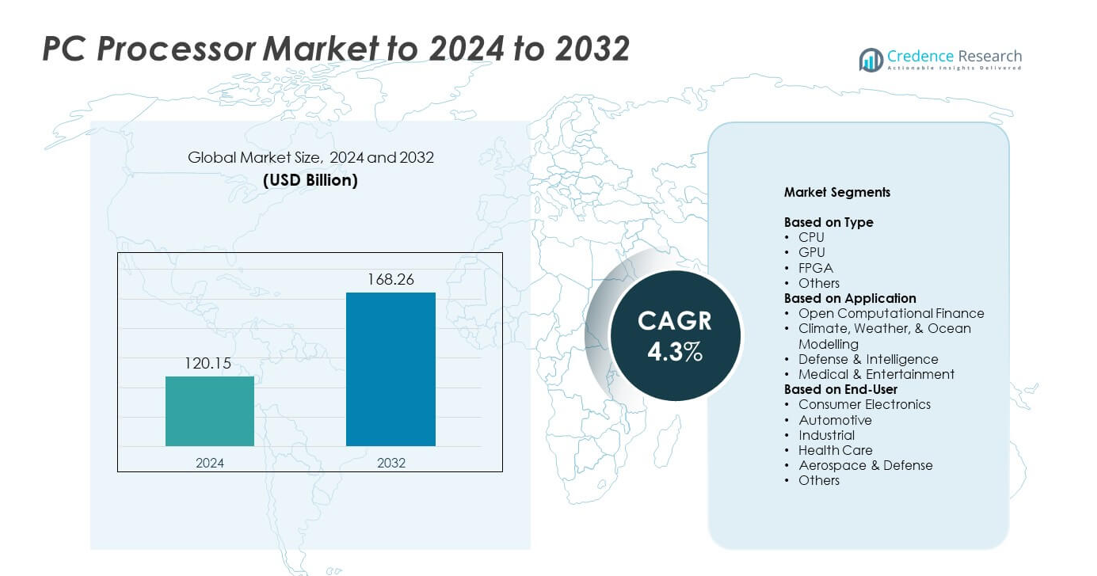
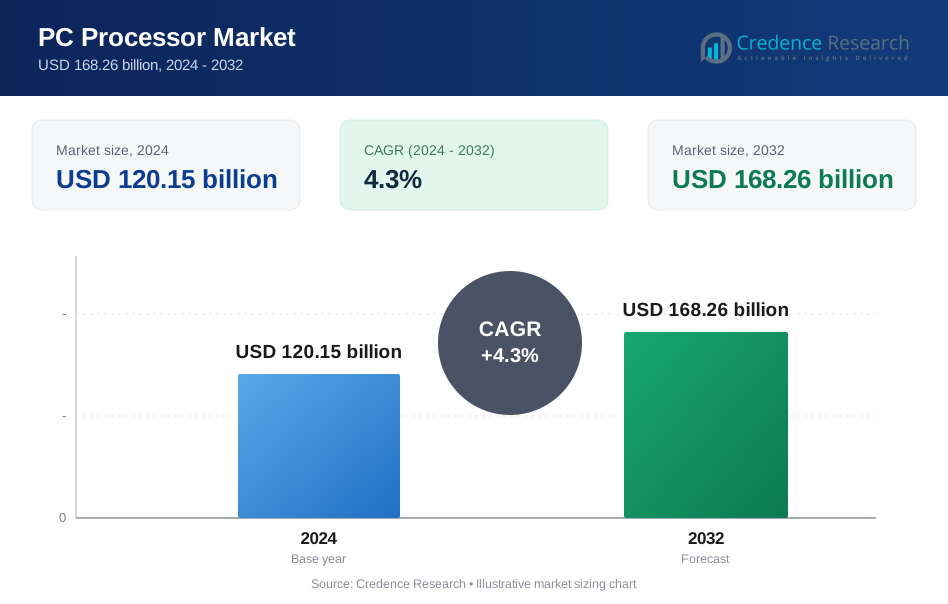
PC Processor Market size was valued USD 120.15 billion in 2024 and is anticipated to reach USD 168.26 billion by 2032, growing at a CAGR of 4.3% during the forecast period.
| REPORT ATTRIBUTE | DETAILS |
|---|---|
| Historical Period | 2020-2023 |
| Base Year | 2024 |
| Forecast Period | 2025-2032 |
| PC Processor Market Size 2024 | USD 120.15 billion |
| PC Processor Market CAGR | 4.3% |
| PC Processor Market Size 2032 | USD 168.26 billion |
The PC Processor Market is driven by leading companies such as Nvidia Corporation, Qualcomm Incorporated, Xilinx Inc, Alphabet Inc, Intel Corporation, Graphcore Ltd, TeraDeep Inc, and Advanced Micro Devices, each expanding advanced chip architectures for high-performance and energy-efficient computing. These players strengthen their position through AI-ready processors, improved integrated graphics, and faster multi-core designs. North America led the global market in 2024 with about 41% share, supported by strong demand for gaming PCs, enterprise systems, and AI-enabled laptops. Europe and Asia Pacific followed, driven by rising digital adoption, premium device upgrades, and expanding semiconductor production ecosystems.
Market Insights
- The PC Processor Market was valued at USD 120.15 billion in 2024 and is projected to reach USD 168.26 billion by 2032, growing at a CAGR of 4.3%.
- Strong demand for high-performance computing, gaming systems, and AI-enabled devices continues to drive processor adoption across consumer and enterprise segments.
- Market trends highlight rising use of energy-efficient architectures, integrated AI engines, and advanced multi-core designs, with CPUs holding about 69% share in 2024.
- Competition intensifies as global manufacturers invest in smaller nanometer nodes, improved thermal performance, and faster GPU acceleration to strengthen market presence.
- North America led the market with 41% share in 2024, followed by Europe at 27% and Asia Pacific at 24%, while consumer electronics remained the dominant end-user segment with about 54% share.
Market Segmentation Analysis:
By Type
CPU dominated the type segment in 2024 with about 69% share due to strong use in desktops, laptops, and workstations. CPU demand stayed high because leading PC brands rely on multi-core designs for faster processing and improved energy efficiency. GPU adoption grew quickly as gaming, AI workloads, and content creation gained traction across global markets. FPGA use increased in specialized computing tasks, but the scale remained smaller. Rising AI acceleration needs and improved integrated graphics continue to support overall type segment growth.
- For instance, AMD’s official 2024 specification sheet confirms the Ryzen 9 7950X has 16 cores, 32 threads, and a 5.7 GHz max boost, supporting high-performance desktop workloads.
By Application
Climate, weather, and ocean modelling led the application segment in 2024 with nearly 38% share due to heavy dependence on high-performance processors for large-scale simulations. Government agencies and research institutions used advanced multi-core chips to process real-time environmental data at higher accuracy. Open computational finance expanded as trading systems adopted low-latency processors. Medical and entertainment applications saw rising adoption driven by imaging, rendering, and VR workloads. Defense and intelligence needs continued to push demand for secure, high-speed computational processing.
- For instance, NVIDIA’s technical brief states that the A100 Tensor Core GPU delivers 19.5 teraflops FP32 performance and 312 teraflops tensor performance, enabling large-scale scientific and climate simulations.
By End-User
Consumer electronics remained the leading end-user segment in 2024 with about 54% share, supported by strong sales of laptops, desktops, tablets, and gaming systems. Users preferred higher-speed processors with improved thermal efficiency and integrated AI capabilities. The automotive sector grew due to rising demand for processors used in ADAS, infotainment, and autonomous functions. Industrial users adopted rugged processors for automation and control systems. Healthcare expanded with growing reliance on imaging and diagnostic systems, while aerospace and defense increased uptake for mission-critical computing.
Key Growth Drivers
Rising Demand for High-Performance Computing
Growing use of advanced software across gaming, AI workloads, and content creation boosts demand for high-performance PC processors. Users seek faster speeds, better multitasking, and improved graphics efficiency. Major PC brands deploy multi-core chips to support smooth execution of heavy applications. Expanding adoption of cloud gaming and professional editing tools also lifts processor upgrades. This trend strengthens the need for next-generation architectures with enhanced thermal management and power control.
- For instance, Apple’s M3 Max chip, confirmed in its 2024 specs, integrates 92 billion transistors and offers a 40-core GPU, supporting heavy compute and content-creation tasks.
Expansion of AI and Machine Learning Workloads
AI-driven applications across consumer and enterprise devices fuel higher processor adoption. Manufacturers develop chipsets with dedicated AI accelerators to handle image processing, predictive tasks, and real-time decision workflows. Developers rely on processors that support fast data transfer and low latency for training and inference tasks. Growing integration of AI in laptops, gaming rigs, and business desktops drives sustained demand. Rising interest in edge AI also boosts the requirement for advanced PC processing units.
- For instance, Qualcomm’s 2024 Snapdragon X Elite platform includes an NPU rated at 45 trillion operations per second (TOPS), enabling fast on-device AI processing.
Growth of Remote Work and Digital Productivity
Remote work adoption strengthens processor demand across laptops and desktop systems. Companies invest in devices with higher compute power to support collaboration, virtual meetings, and cloud platforms. Users rely on processors that offer stable performance for multitasking and virtualization. Education, small businesses, and creative professionals continue shifting toward performance-focused computing setups. This shift keeps the upgrade cycle active and drives consistent demand across mid-range and premium processor categories.
Key Trends and Opportunities
Shift Toward Energy-Efficient Chip Architectures
Energy-efficient processor designs gain strong traction as users prioritize longer battery life and reduced heat output. Manufacturers innovate with lower-nanometer process nodes that deliver faster performance with optimized power draw. This shift supports thin-and-light laptop adoption and benefits eco-focused device buyers. Rising demand for portable systems creates strong opportunities for efficient hybrid architectures and improved integrated GPU designs. Companies that advance performance-per-watt metrics gain a competitive advantage.
- For instance, TSMC’s official documentation and 2024 technology reports state that its original 3-nanometer (N3) process reduces power use by approximately 25–30% compared to the 5-nanometer (N5) node at equal performance, or offers a 10–15% increase in speed at the same power level.
Increasing Adoption of Integrated AI Capabilities
Integrated AI engines across modern processors create strong growth opportunities for PC makers. These chips enable faster image enhancement, voice recognition, and optimized performance tuning. Users rely on AI-enabled features for real-time automation and enhanced security. Device manufacturers promote AI-ready laptops for business, gaming, and everyday use. This trend accelerates the shift toward processors capable of on-device learning and advanced predictive processing.
- For instance, MediaTek’s 2024 Dimensity 9300 specification confirms an integrated AI engine (APU 790) capable of supporting large language models (LLMs) with up to 13 billion parameters in the original chip, with hardware and software capabilities that scale to support models of up to 33 billion parameters, running fully on-device.
Growing Opportunity in Specialized Processing Markets
Rising demand for processors tailored to specific workloads opens new growth opportunities. Segments such as gaming, simulation, robotics, healthcare imaging, and edge computing require optimized chip designs. Manufacturers focus on performance tuning, thermal control, and workload specialization. This shift helps brands expand their market reach across niche but fast-growing applications. The push for customization drives development of processors with enhanced stability and higher efficiency.
Key Challenges
High Manufacturing Costs and Complex Chip Fabrication
Advanced processor fabrication requires costly equipment, precision engineering, and continuous R&D investment. Shrinking nanometer processes increase production difficulty and raise capital expenditure. Companies face pressure to balance pricing with performance advancement. Supply chain fluctuations in semiconductor materials add further stress. These challenges limit rapid scaling and delay product launches in price-sensitive markets.
Global Supply Chain Disruptions and Component Shortages
The PC processor market faces risks from geopolitical tensions, wafer shortages, and logistics delays. Disruptions impact fabrication timelines and reduce the availability of high-performance chips. OEMs struggle to meet device production goals when processor supply becomes inconsistent. Longer lead times affect retail pricing and consumer upgrades. These challenges highlight the need for diversified manufacturing and resilient sourcing strategies.
Regional Analysis
North America
North America held about 41% share in 2024, driven by strong demand for high-performance desktops, gaming PCs, and enterprise workstations. The region benefits from advanced semiconductor design capabilities supported by leading players focusing on AI-ready chipsets and multi-core architectures. Growth in cloud services, software development, and remote work continues to lift processor upgrades across consumer and commercial systems. Expanding adoption of laptops with energy-efficient processors strengthens market momentum. Strong innovation ecosystems in the United States and Canada keep North America a leading hub for advanced processor deployment and early adoption of next-generation computing technologies.
Europe
Europe accounted for nearly 27% share in 2024, supported by rising adoption of premium laptops, gaming systems, and business computers. The region benefits from strong investments in digital transformation across enterprises, research institutions, and public sectors. Countries such as Germany, France, and the United Kingdom drive processor demand through advanced automation, cloud migration, and professional computing needs. Growth in AI applications, cybersecurity workloads, and edge computing strengthens processor requirements. Increasing preference for energy-efficient and thin-profile devices also supports steady processor upgrades across both consumer and commercial markets.
Asia Pacific
Asia Pacific captured around 24% share in 2024, driven by large-scale PC manufacturing, high consumer demand, and rapid technology adoption. Markets such as China, Japan, South Korea, and India fuel processor consumption across gaming, education, enterprise computing, and mobility devices. Strong semiconductor production capability in the region accelerates innovation and supply capacity. Rising adoption of AI-enabled laptops and advanced graphics processors strengthens demand. Expanding e-learning, digital work patterns, and growing middle-class spending continue to support long-term market growth in both entry-level and premium processor categories.
Latin America
Latin America held about 5% share in 2024, supported by growing purchases of laptops and entry-level desktops across education, home use, and small businesses. Economic recovery in major countries such as Brazil and Mexico fuels gradual improvement in PC adoption. Rising demand for online learning, remote work, and digital banking encourages upgrades to devices with better processing power. Adoption of gaming systems and content creation tools is increasing, though at a slower pace compared to advanced regions. Expanding e-commerce channels help improve processor availability across local markets.
Middle East and Africa
Middle East and Africa accounted for nearly 3% share in 2024, driven by rising digitalization, expanding IT infrastructure, and increasing adoption of performance-focused computing systems. Countries such as the UAE, Saudi Arabia, and South Africa lead demand for advanced processors used in business, education, and government applications. Growth in gaming communities, online content use, and cloud-based work platforms supports greater reliance on modern PCs. Despite price sensitivity in several markets, improving internet access and growing tech investments continue to strengthen long-term processor uptake across the region.
Market Segmentations:
By Type
- CPU
- GPU
- FPGA
- Others
By Application
- Open Computational Finance
- Climate, Weather, & Ocean Modelling
- Defense & Intelligence
- Medical & Entertainment
By End-User
- Consumer Electronics
- Automotive
- Industrial
- Health Care
- Aerospace & Defense
- Others
By Geography
- North America
- U.S.
- Canada
- Mexico
- Europe
- Germany
- France
- U.K.
- Italy
- Spain
- Rest of Europe
- Asia Pacific
- China
- Japan
- India
- South Korea
- South-east Asia
- Rest of Asia Pacific
- Latin America
- Brazil
- Argentina
- Rest of Latin America
- Middle East & Africa
- GCC Countries
- South Africa
- Rest of the Middle East and Africa
Competitive Landscape
The PC Processor Market is shaped by major companies such as Nvidia Corporation, Qualcomm Incorporated, Xilinx Inc, Alphabet Inc, Intel Corporation, Graphcore Ltd, TeraDeep Inc, and Advanced Micro Devices. These players compete through rapid advancement in multi-core architectures, integrated AI engines, and energy-efficient chip designs that support growing demand across consumer and enterprise systems. Manufacturers focus on improving performance-per-watt, thermal efficiency, and GPU acceleration to meet rising workloads in gaming, content creation, and AI-driven applications. The market also sees strong investment in smaller nanometer process technologies to deliver faster speeds and lower latency. Partnerships with PC brands, cloud providers, and device OEMs help expand adoption across laptops, desktops, workstations, and edge computing devices. Growing R&D spending, competitive pricing strategies, and frequent product refresh cycles further intensify competition, keeping innovation at the center of long-term market growth.
Key Player Analysis
- Nvidia Corporation
- Qualcomm Incorporated
- Xilinx Inc
- Alphabet Inc
- Intel Corporation
- Graphcore Ltd
- TeraDeep Inc
- Advanced Micro Devices
Recent Developments
- In 2025, Intel Corporation unveiled significant advancements at CES 2025, including the expansion of the Intel Core Ultra 200S desktop processor portfolio with new 65-watt and 35-watt models optimized for AI workloads.
- In 2025, Qualcomm Incorporated announced new Snapdragon X-series PC chips, including models with up to 8 cores, NPUs capable of 45 trillion operations per second, and GPUs optimized for AI and graphics performance.
- In 2024, Advanced Micro Devices, Inc. (AMD) introduced the 5th Gen AMD EPYC processors for AI, cloud, and enterprise application
Report Coverage
The research report offers an in-depth analysis based on Type, Application, End-User and Geography. It details leading market players, providing an overview of their business, product offerings, investments, revenue streams, and key applications. Additionally, the report includes insights into the competitive environment, SWOT analysis, current market trends, as well as the primary drivers and constraints. Furthermore, it discusses various factors that have driven market expansion in recent years. The report also explores market dynamics, regulatory scenarios, and technological advancements that are shaping the industry. It assesses the impact of external factors and global economic changes on market growth. Lastly, it provides strategic recommendations for new entrants and established companies to navigate the complexities of the market.
Future Outlook
- The market will shift toward processors designed with stronger AI and machine learning capabilities.
- Energy-efficient chip architectures will gain wider adoption across laptops and compact systems.
- Multi-core and hybrid designs will become standard for both consumer and enterprise devices.
- Demand for integrated GPUs will rise as gaming and content creation continue to expand.
- Edge computing growth will increase requirements for low-latency, high-performance processors.
- Advanced semiconductor fabrication nodes will improve performance-per-watt and reduce heat output.
- Cloud-based workloads will push enterprises to upgrade workstations with faster processing units.
- Security-focused processors will gain traction as cyber threats grow across digital platforms.
- Specialized processors for automotive and healthcare applications will create new revenue streams.
- AI-enhanced laptops and desktops will drive the next major upgrade cycle globally.
Request a Free Sample
Fill in your details and we'll send you a free sample report.
- Sample data tables & charts
- Research methodology
Need a Custom Version of This Report?
Tailor the scope, geography, or segments to your exact requirements.
- Custom geography or segment scope
- Direct access to our analyst team
Frequently Asked Questions
What is the current market size for PC Processor Market, and what is its projected size in 2032?
At what Compound Annual Growth Rate is the PC Processor Market projected to grow between 2025 and 2032?
Which is the leading region of the market for PC processors?
What are the key drivers for the growth of the PC processor market?
Who are the leading companies in the PC Processor Market?
Table of Content
Chapter 1. Report Introduction
- 1.1 Report Description & Purpose
- 1.1.1 Report Title & Market Definition
- 1.1.2 Unique Selling Propositions (USP) & Key Differentiators
- 1.1.3 Value Proposition for Stakeholders
- 1.2 Research Objectives
- 1.2.1 Market Sizing Objectives (Volume & Revenue)
- 1.2.2 Segmentation Objectives
- 1.2.3 Competitive Intelligence Objectives
- 1.2.4 Forecast & Scenario Objectives
- 1.3 Report Scope
- 1.3.1 PC Processor Scope – Types & Subtypes Covered
- 1.3.2 Geographic Scope – Regions & Countries Covered
- 1.3.3 Historical Period, Base Year & Forecast Period (2024; forecast to 2032)
- 1.3.4 Inclusions & Exclusions
- 1.4 HS Code & Classification Framework
- 1.5 Currency, Units & Pricing Basis
- 1.6 Target Stakeholders
- 1.7 Limitations & Assumptions
Chapter 2. Executive Summary
- 2.1 Global PC Processor Market Snapshot
- 2.1.1 Market Size – Historical (2024) & Forecast (2024-2032) (2024: USD 120.15 billion → 2032: USD 168.26 billion)
- 2.1.2 Volume & Revenue – Global Totals
- 2.1.3 Key Market Highlights – Top Five Facts
- 2.2 PC Processor Market Segmentation Snapshot
- 2.2.1 Market Split by Region – 2024 vs. 2032
- 2.3 Competitive Snapshot
- 2.3.1 Top 10 Players by Revenue Share – 2024
- 2.3.2 Top 10 Players by Volume Share – 2024
- 2.3.3 Recent Strategic Developments (18-Month Summary)
- 2.4 Key Investment Highlights & Strategic Conclusions
Chapter 3. PC Processor Market Dynamics & Industry Analysis
- 3.1 Market Overview & Context
- 3.1.1 PC Processor Market Position in the Broader Automotive Value Chain
- 3.1.2 OEM vs. Replacement Market Dynamics
- 3.1.3 Market Maturity & Development Stage by Region
- 3.2 PC Processor Market Drivers
- 3.3 PC Processor Market Restraints & Challenges
- 3.4 PC Processor Market Opportunities
- 3.5 Porter's Five Forces Analysis
- 3.5.1 Threat of New Entrants
- 3.5.2 Bargaining Power of Suppliers
- 3.5.3 Bargaining Power of Buyers
- 3.5.4 Threat of Substitutes
- 3.5.5 Competitive Rivalry – Intensity Assessment
- 3.6 PC Processor Value Chain Analysis
- 3.6.1 Upstream – Raw Material/Input Suppliers
- 3.6.1.1 Raw Material/Input 1
- 3.6.1.2 Raw Material/Input 2
- 3.6.1.3 Raw Material/Input 3
- 3.6.2 Midstream – Production/Manufacturing/Service Delivery
- 3.6.2.1 Production/Process Overview
- 3.6.2.2 Key Facility Locations & Capacity by Manufacturer
- 3.6.3 Downstream – Distribution & End Consumer
- 3.6.3.1 Primary Channel – B2B/OEM
- 3.6.3.2 Secondary Channels – Dealer, Retail, Online, Direct
- 3.6.4 Value Chain Profitability Analysis
- 3.6.1 Upstream – Raw Material/Input Suppliers
- 3.7 PESTEL Analysis
- 3.7.1 Political Factors
- 3.7.2 Economic Factors
- 3.7.3 Social Factors
- 3.7.4 Technological Factors
- 3.7.5 Environmental Factors
- 3.7.6 Legal Factors
- 3.8 PC Processor Supply Chain Analysis
- 3.8.1 Raw Material/Input Supply Risk Assessment
- 3.8.2 Manufacturing Concentration Risk (Geographic Exposure)
- 3.8.3 Trade Disruption Impact Analysis
- 3.9 Regulatory & Policy Landscape
Note: The regulatory and policy landscape section covers regulations based on their applicability to the market, PC Processor category, geography, and scope of the study. Only regulatory frameworks with a material impact on operations, compliance, trade, sustainability, or market access are analyzed in detail.
Chapter 4. Key Investment Pockets & Opportunity Analysis
- 4.1 PC Processor Market Attractiveness Analysis
- 4.1.1 By Region – Investment Attractiveness Matrix (Volume × CAGR)
- 4.2 Absolute Revenue Growth Opportunity
- 4.2.1 By Region – Absolute USD Growth Through 2032
- 4.3 Incremental Volume Opportunity
- 4.3.1 By Region – Incremental Volume Through 2032
- 4.3.2 Segment – Incremental Volume
- 4.4 Emerging Submarket Opportunity Deep Dive (Subject to Applicability)
- 4.5 Emerging Market Opportunity Scorecards
- 4.5.1 United States
- 4.5.2 Europe
- 4.5.3 Asia
- 4.5.4 Middle East & Africa
Note: Emerging Market Opportunity Scorecards will be included based on relevance and strategic importance. Regions listed are indicative and may vary depending on data availability and market dynamics.
Chapter 5. PC Processor Import-Export Analysis & Trade Flows
- 5.1 Global Trade Overview
- 5.1.1 Global Export Value by Country (2024)
- 5.1.2 Global Export Volume by Country (2024)
- 5.1.3 Global Import Value by Country (2024)
- 5.1.4 Global Import Volume by Country (2024)
- 5.1.5 Net Trade Balance by Country (2024)
- 5.2 Export Analysis – Segment
- 5.2.1 Type 1 (HS Code)
- 5.2.2 Type 2 (HS Code)
- 5.2.3 Type 3 (HS Code)
- 5.2.4 Type 4 (HS Code)
- 5.2.5 Type 5 (HS Code)
- 5.3 Import Analysis – Segment
- 5.3.1 Type 1 (HS Code)
- 5.3.2 Type 2 (HS Code)
- 5.3.3 Type 3 (HS Code)
- 5.3.4 Type 4 (HS Code)
- 5.3.5 Type 5 (HS Code)
- 5.4 Average Unit Trade Prices
- 5.4.1 Average Export Price – Segment & Country
- 5.4.2 Average Import Price – Segment & Source Country
- 5.4.3 Price Trends (2024)
- 5.5 Key Trade Route Analysis
- 5.5.1 Trade Route 1
- 5.5.2 Trade Route 2
- 5.5.3 Trade Route 3
- 5.5.4 Trade Route 4
- 5.5.5 Trade Route 5
- 5.6 Trade Policy Impact Assessment
- 5.6.1 US Anti-Dumping & Section 301 Tariffs
- 5.6.2 EU Customs Union Impact
- 5.6.3 Major Free Trade Agreements
- 5.6.4 USMCA Rules of Origin
Note: Trade policy analysis will be included only where relevant to the PC Processor market.
Chapter 6. Competitive Landscape & Company Benchmarking
- 6.1 PC Processor Market Concentration & Structure
- 6.1.1 Herfindahl-Hirschman Index (HHI) – vs. 2024
- 6.1.2 Tier 1, Tier 2 & Tier 3 Market Structure
- 6.1.3 Global, Regional & Local Player Dynamics
- 6.2 PC Processor Market Share Analysis – 2024
- 6.2.1 Global Revenue Share by Company
- 6.2.2 Global Volume Share by Company
- 6.2.3 Regional Revenue Share
- 6.2.4 Market Share Evolution ( vs. 2024)
- 6.2.5 OEM Segment Share by Company
- 6.2.6 Replacement Segment Share by Company
- 6.3 Production/Delivery Capacity & Facility Analysis
- 6.3.1 Global Installed Capacity
- 6.3.2 Capacity Utilization Rates
- 6.3.3 Production/Output Volume
- 6.3.4 Facility Locations & Capacity Map
- 6.3.5 Planned Capacity Additions
- 6.4 PC Processor Competitive Benchmarking Matrix
- 6.4.1 Revenue, Volume, CAGR & Profitability Comparison
- 6.4.2 Channel Revenue Mix
- 6.4.3 Geographic Revenue Exposure
- 6.4.4 R&D Intensity
- 6.4.5 Sustainability Maturity
- 6.5 Strategic Developments in PC Processor (Last 24 Months)
- 6.5.1 Mergers, Acquisitions & Divestments
- 6.5.2 New PC Processor Launches
- 6.5.3 Facility Expansions
- 6.5.4 Strategic Alliances, Joint Ventures & Partnerships
- 6.5.5 Distribution Expansion & Market Entry
- 6.5.6 Sustainability & ESG Initiatives
- 6.6 Competitive Strategy Mapping
- 6.6.1 Leader, Challenger, Follower & Niche Classification
- 6.6.2 Pricing Strategy Comparison
- 6.6.3 Channel Strategy Matrix
Note: Strategic developments are included based on their materiality and the availability of reliable information.
Chapter 7. Global PC Processor Market – By Distribution Channel
- 7.1 Segment Overview
- 7.1.1 Volume & Revenue Split by Channel (2024 & 2032)
- 7.1.2 Channel Mix Evolution (2024-2032)
Chapter 8. Regional Market Analysis – Global Overview
- 8.1 Global Regional Overview
- 8.1.1 Regional Volume Share
- 8.1.2 Regional Revenue Share
- 8.1.3 Regional Volume by Region
- 8.1.4 Regional Revenue by Region
- 8.1.5 Regional Forecast Through 2032
- 8.2 Cross-Regional Segment Analysis
- 8.2.1 By Distribution Channel
- 8.2.2 By Brand/Price Tier
Chapter 9. North America PC Processor Market
- 9.1 United States
- 9.2 Canada
- 9.3 Mexico
Chapter 10. Europe PC Processor Market
- 10.1 Germany
- 10.2 France
- 10.3 Italy
- 10.4 United Kingdom
- 10.5 Spain
- 10.6 Poland
- 10.7 Russia
- 10.8 Netherlands
- 10.9 Belgium
- 10.10 Sweden
- 10.11 Denmark
- 10.12 Norway
- 10.13 Rest of Europe
Chapter 11. Asia Pacific PC Processor Market
- 11.1 China
- 11.2 India
- 11.3 Japan
- 11.4 South Korea
- 11.5 Thailand
- 11.6 Indonesia
- 11.7 Vietnam
- 11.8 Malaysia
- 11.9 Australia
- 11.10 Rest of Asia Pacific
Chapter 12. Latin America PC Processor Market
- 12.1 Brazil
- 12.2 Argentina
- 12.3 Colombia
- 12.4 Chile
- 12.5 Rest of Latin America
Chapter 13. Middle East PC Processor Market
- 13.1 Saudi Arabia
- 13.2 United Arab Emirates
- 13.3 Turkey
- 13.4 Israel
- 13.5 Iran
- 13.6 Rest of the Middle East
Chapter 14. Africa PC Processor Market
- 14.1 South Africa
- 14.2 Egypt
- 14.3 Nigeria
- 14.4 Morocco
- 14.5 Rest of Africa
Chapter 15. PC Processor Company Profiles
- 15.1 [Company 01]
- 15.1.1 Company Overview
- 15.1.2 Key Management Personnel
- 15.1.3 Products & Services Portfolio
- 15.1.4 Financial Performance
- 15.1.5 Key Market Focus & Geographic Presence
- 15.1.6 Recent Developments & Strategic Initiatives
Note: The company profile list is preliminary and may change based on research findings, market developments, data availability, and client requirements.
Chapter 16. Appendices
- Appendix A – List of Abbreviations & Acronyms
- Appendix B – Industry Classification Code Reference – Full Series
- Appendix C – Production & Capacity Data Tables
- Appendix D – End-Use & Demand Base Tables
- Appendix E – Consumption & Replacement Rate Assumptions
- Appendix F – ASP Reference Tables
- Appendix G – Manufacturing & Facility Database
- Appendix H – Import-Export Data Tables
- Appendix I – Regulatory Summary Tables
- Appendix J – Primary Research Participant List (Anonymized)
- Appendix K – Primary Research Questionnaire Framework
- Appendix L – Data Sources & Bibliography
- Appendix M – Market Size Divergence & Source Comparison
Chapter 17. Research Methodology
- 17.1 Research Framework & Philosophy
- 17.2 Secondary Research – Sources, Hierarchy & Data Extraction
- 17.3 Data Modeling – Bottom-Up & Top-Down Market Sizing
- 17.4 Primary Research – Stakeholder Framework, LOI & Sample Sizes
- 17.5 Forecast Methodology – Regression, Scenario & Sensitivity Analysis
- 17.6 Quality Control – Four-Layer Validation Framework
- 17.7 Limitations & Standard Assumptions
- 17.8 Disclaimer
