Impact Modifier Market Overview:
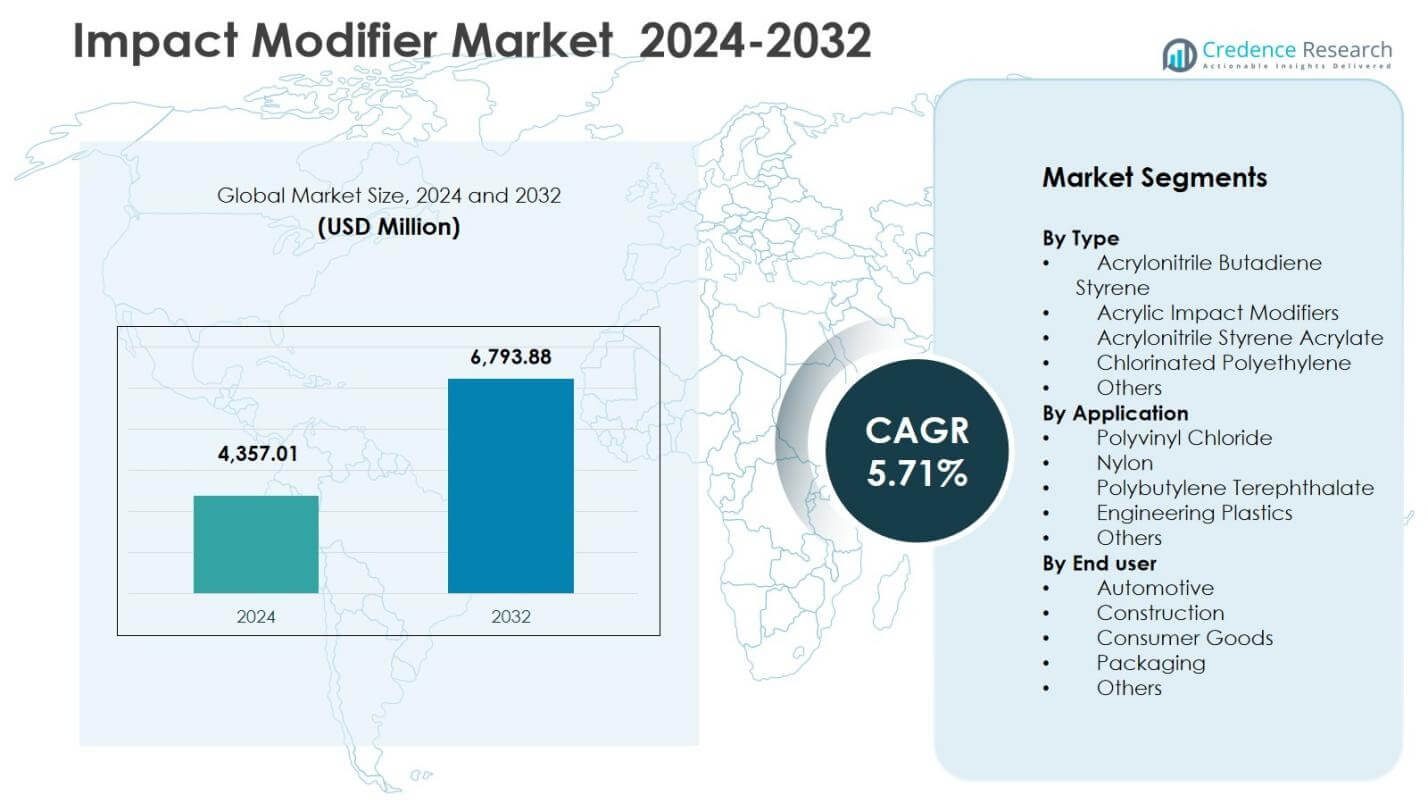
Impact Modifier Market size was valued USD 4,357.01 Million in 2024 and is anticipated to reach USD 6,793.88 Million by 2032, at a CAGR of 5.71% during the forecast period.
| REPORT ATTRIBUTE | DETAILS |
|---|---|
| Historical Period | 2020-2023 |
| Base Year | 2024 |
| Forecast Period | 2025-2032 |
| Impact Modifier Market Size 2024 | USD 4,357.01 million |
| Impact Modifier Market, CAGR | 5.71% |
| Impact Modifier Market Size 2032 | USD 6,793.88 million |
Impact Modifier Market Insights
- Growth is driven by rising demand for impact-resistant polymers in construction, automotive, and industrial applications, particularly for high-performance PVC, ABS, and engineering plastics that require toughness, durability, and weather resistance.
- Key trends include the shift toward sustainable and bio-based impact modifiers, adoption of low-VOC formulations, and increasing use of high-performance engineering plastics in advanced manufacturing and electrical applications.
- The market is led by major players such as Arkema S.A., Dow Inc., BASF SE, Evonik Industries AG, LG Chem Ltd., Kaneka Corporation, Mitsubishi Chemical Corporation, LANXESS AG, Formosa Plastics Corporation, and Shandong Ruifeng Chemical Co., Ltd., who focus on innovation, strategic partnerships, and regional expansion.
- Asia-Pacific held the largest share at 38.9% in 2024, followed by North America at 26.8% and Europe at 23.5%, with construction and PVC segments dominating regional consumption.
Impact Modifier Market Segmentation Analysis:
By Type
The Impact Modifier Market by type remains driven by performance-enhancing additives that improve toughness in rigid polymers. Acrylic Impact Modifiers dominated the segment with a 32.6% share in 2024, supported by their high weatherability, clarity retention, and suitability for outdoor PVC applications such as window profiles and siding. Demand strengthened as manufacturers prioritized long-term durability in construction and exterior products. Acrylonitrile Butadiene Styrene, Acrylonitrile Styrene Acrylate, Chlorinated Polyethylene, and other niche modifiers continued to serve specialized engineering plastics and high-impact applications, but their combined share remained lower than acrylic grades due to cost sensitivity and processing flexibility advantages of acrylic systems.
- For instance, Akdeniz Chemson's DMA 650 acrylic impact modifier delivers high impact resistance and UV stability for complex PVC profiles extruded at high rates, reducing stabilizer needs in formulations.
By Application
The market by application is led by Polyvinyl Chloride (PVC), which accounted for 46.3% of the segment share in 2024, driven by extensive use of impact-modified PVC in pipes, fittings, window frames, doors, and profiles that require high impact resistance and dimensional stability. Growth in infrastructure, housing renovation, and utility projects increased consumption of toughened PVC compounds across construction and utilities. Nylon, Polybutylene Terephthalate, Engineering Plastics, and other polymer applications generated rising demand in automotive and electrical components, but their collective share remained below PVC due to the large-volume usage of rigid PVC in structural and weather-exposed applications.
- For instance, Indofil Industries' KM 4000 acrylic impact modifier enhances impact properties in PVC pipes and fittings for building applications, providing excellent weatherability and retention of color at lower dosages.
By End User
Across end users, Construction emerged as the dominant segment with a 37.4% share in 2024, supported by large-scale consumption of impact-modified PVC and engineering plastics in building profiles, pipes, roofing components, flooring, and façade materials where impact strength, outdoor durability, and crack resistance are critical. Urbanization, infrastructure modernization, and residential upgrade activities significantly increased product uptake across Asia-Pacific and Europe. Automotive, Consumer Goods, Packaging, and Other industries continued to expand adoption of impact-modified polymers for lightweighting, safety, and product durability, but their combined share trailed construction due to the higher material intensity of building and infrastructure applications.
Key Growth Drivers
Rising Demand for High-Performance and Weather-Resistant Polymers
The Impact Modifier Market grows strongly as end-use industries increasingly prefer high-performance plastics with enhanced toughness, flexibility, and impact resistance. Construction, automotive, and electrical applications rely on impact-modified PVC, ABS, and engineering plastics to improve durability in harsh outdoor and mechanical environments. The expansion of infrastructure projects, especially in Asia-Pacific and Europe, accelerates the use of weatherable acrylic and chlorinated polyethylene impact modifiers. Manufacturers also focus on product reliability standards and long-service-life materials, which strengthens adoption across structural components, pipes, fittings, window frames, and exterior building products, thereby driving consistent market demand.
- For instance, Dow’s PARALOID™ impact modifiers are widely adopted in rigid PVC formulations for construction materials like pipes and window frames, offering improved toughness and color stability in varying climates.
Light weighting and Safety Requirements in the Automotive and Transportation Sector
Automotive manufacturers increasingly integrate impact-modified engineering plastics to achieve lightweighting, crash resistance, and fuel-efficiency targets without compromising material strength. Impact modifiers enable improved toughness in bumpers, trims, interior panels, under-the-hood components, and electrical housings, supporting the transition from metal to polymer-based parts. The growth of electric vehicles further amplifies demand for high-impact and vibration-resistant polymers. Regulatory pressure to enhance passenger safety, reduce vehicle weight, and meet emission standards encourages broader use of modified plastics across OEMs and Tier-1 suppliers, reinforcing the role of impact modifiers in mobility and transport applications.
- For instance, BASF supplied Ultramid polyamide for the world's first rear axle transmission crossbeam in the Mercedes-Benz S-Class, replacing die-cast aluminum. This component weighs 25% less while maintaining structural integrity and crash performance.
Growing Use of PVC and Engineering Plastics in Construction and Industrial Applications
Rapid urbanization, smart city initiatives, and infrastructure modernization programs significantly boost consumption of rigid PVC and engineering plastics strengthened with impact modifiers. These materials are widely used in pipes, doors, cladding, flooring, fittings, façades, and industrial components where structural performance, crack resistance, and durability are critical. The shift toward sustainable, long-lifespan building materials encourages the adoption of impact-modified products in renovation and green-construction projects. Industrial automation and machinery sectors also rely on modified polymers for gears, enclosures, and load-bearing parts, strengthening market growth across manufacturing and civil engineering environments.
Key Trends & Opportunities
Shift Toward Bio-Based, Low-VOC, and Sustainable Impact Modifier Solutions
A major trend shaping the Impact Modifier Market is the transition toward eco-friendly and low-emission formulations that align with global sustainability and regulatory frameworks. Manufacturers increasingly invest in bio-based acrylics, recyclable polymer blends, and low-VOC additive technologies to support circular economy objectives and reduce carbon footprints. Construction, packaging, and consumer goods industries actively adopt environmentally compliant materials to meet green-building and product-safety certifications. This shift creates opportunities for product innovation, premium-grade modifier development, and strategic partnerships focused on sustainable performance-enhancement solutions across multiple polymer processing applications.
- For instance, Dow developed ENGAGE™ REN polyolefin elastomers using Ecolibrium™ technology with bio-circular feedstocks, certified to ISCC+ standards, which reduce fossil fuel consumption while delivering the same flexibility and impact strength in automotive TPO applications like bumpers.
Rising Adoption of High-Performance Engineering Plastics in Advanced Manufacturing
The expansion of high-precision and technologically advanced manufacturing across automotive electronics, electricals, and industrial equipment opens strong opportunities for impact-modified materials. Demand grows for engineering plastics with superior toughness, heat stability, and dimensional reliability used in connectors, housings, battery components, and smart devices. Emerging markets invest in polymer processing technologies such as extrusion, compounding, and injection molding, which increases the penetration of specialty impact modifiers. The rise of automation, lightweight components, and high-functionality product design accelerates the need for toughness-enhanced polymers, positioning the market for long-term structural and value-added growth.
- For instance, LANXESS supplies Durethan BC550Z 900116 DUSXBL, an unreinforced impact-modified polyamide 6, for BMW Motorrad motorcycle fuel tanks. The material forms two half-shells via injection molding and hot plate welding, enabling cost-effective production of complex geometries while undershooting fuel emission limits.
Key Challenges
Volatility in Raw Material Prices and Dependency on Petrochemical Feedstocks
The Impact Modifier Market faces challenges due to fluctuating prices of petrochemical-derived raw materials such as acrylates, chlorinated compounds, and butadiene-based monomers. Supply chain disruptions, geopolitical instability, and energy-cost variations increase production expenses and pressure manufacturers’ profit margins. Small and mid-scale processors experience cost-pass-through limitations, which affect material adoption in price-sensitive applications. Additionally, environmental compliance standards and restrictions on certain chemical additives create regulatory complexities. These factors collectively hinder production stability and require continuous material innovation, sourcing diversification, and strategic pricing mechanisms across the value chain.
Performance Trade-Offs and Processing Compatibility Constraints in End-Use Applications
Although impact modifiers enhance toughness, they may introduce challenges related to stiffness reduction, transparency loss, or processing limitations in specific polymer systems. Achieving the right balance between impact strength, heat resistance, and mechanical stability remains technically demanding. Compatibility issues may arise in multi-polymer blends, recycling applications, or high-temperature engineering plastics, leading to performance variability in end-use components. Industries with stringent quality and safety standards require extensive testing and formulation optimization, increasing development costs and cycle times. These constraints slow adoption in emerging product categories and require ongoing technical advancements in modifier chemistry and processing design.
Regional Analysis
North America
North America held a significant position in the Impact Modifier Market, accounting for 26.8% share in 2024, driven by strong demand from the automotive, construction, and electrical components sectors in the United States and Canada. The region benefits from advanced polymer processing capabilities, high standards for product durability, and steady investment in infrastructure renovation and residential upgrades. The use of impact-modified PVC, engineering plastics, and ABS in pipes, window frames, automotive trims, and industrial components continues to rise. Growing adoption of lightweight materials and regulatory focus on performance-enhanced polymers further strengthens market expansion across key manufacturing clusters.
Europe
Europe captured 23.5% share of the Impact Modifier Market in 2024, supported by robust consumption in construction products, automotive manufacturing, and industrial machinery applications across Germany, France, Italy, and the United Kingdom. The region emphasizes energy-efficient construction materials, weather-resistant PVC profiles, and high-impact engineering plastics for mobility and infrastructure solutions. Demand is reinforced by strict environmental and performance compliance standards, encouraging the adoption of advanced acrylic and ASA-based impact modifiers. Growth in renovation programs, sustainable building initiatives, and technological innovation in polymer compounding continues to drive material uptake across both Western and Eastern European economies.
Asia-Pacific
Asia-Pacific emerged as the leading regional market with 38.9% share in 2024, driven by rapid urbanization, large-scale infrastructure development, and expanding automotive and consumer goods manufacturing in China, India, Japan, and Southeast Asia. High demand for impact-modified PVC pipes, fittings, window profiles, and engineering plastic components supports strong production growth across regional compounding and plastics processing industries. Cost-effective manufacturing ecosystems, rising household construction activity, and industrial modernization initiatives fuel material consumption. The expansion of electricals, packaging, and transportation sectors further accelerates the adoption of high-impact and weather-resistant polymer solutions throughout the region.
Latin America
Latin America accounted for 6.4% share of the Impact Modifier Market in 2024, supported by growing demand for construction materials, packaging components, and automotive plastic parts in Brazil, Mexico, Argentina, and Chile. Increased investment in housing, utilities, and infrastructure modernization enhances the use of impact-modified PVC pipes, doors, and profiles. Expanding consumer goods manufacturing and polymer processing industries further stimulate product adoption. While economic fluctuations influence industrial output, rising urban development and adoption of durable, cost-efficient plastics continue to create growth opportunities for impact modifiers across emerging regional manufacturing hubs.
Middle East & Africa
The Middle East & Africa region represented 4.4% share of the Impact Modifier Market in 2024, driven by infrastructure construction, real estate development, and industrial expansion across the Gulf countries, South Africa, and North Africa. The use of impact-modified PVC in pipes, water distribution networks, window profiles, and exterior building components continues to increase as governments invest in utilities and urban development projects. Demand also grows in packaging and automotive component production. Although the market remains developing, rising industrialization, climate-resilient construction needs, and polymer processing capacity expansion support steady regional growth.
Impact Modifier Market Segmentations:
By Type
- Acrylonitrile Butadiene Styrene
- Acrylic Impact Modifiers
- Acrylonitrile Styrene Acrylate
- Chlorinated Polyethylene
- Others
By Application
- Polyvinyl Chloride
- Nylon
- Polybutylene Terephthalate
- Engineering Plastics
- Others
By End user
- Automotive
- Construction
- Consumer Goods
- Packaging
- Others
By Geography
- North America
- U.S.
- Canada
- Mexico
- Europe
- Germany
- France
- U.K.
- Italy
- Spain
- Rest of Europe
- Asia Pacific
- China
- Japan
- India
- South Korea
- South-east Asia
- Rest of Asia Pacific
- Latin America
- Brazil
- Argentina
- Rest of Latin America
- Middle East & Africa
- GCC Countries
- South Africa
- Rest of the Middle East and Africa
Competitive Landscape
The Impact Modifier Market is dominated by key players including Arkema S.A., Dow Inc., BASF SE, Evonik Industries AG, LG Chem Ltd., Kaneka Corporation, Mitsubishi Chemical Corporation, LANXESS AG, Formosa Plastics Corporation, and Shandong Ruifeng Chemical Co., Ltd. These companies focus on expanding product portfolios, enhancing R&D capabilities, and entering strategic partnerships to strengthen global reach. Innovation in acrylic, MBS, and ASA-based impact modifiers enables tailored solutions for automotive, construction, and consumer goods applications. Market players increasingly invest in sustainable and bio-based formulations to meet regulatory requirements and end-user demand for eco-friendly polymers. Regional manufacturing hubs, especially in Asia-Pacific, North America, and Europe, support high-volume production and cost optimization. Strategic collaborations with polymer processors, distributors, and OEMs further enhance market penetration. Competitive pricing, technological differentiation, and the ability to supply high-performance, weather-resistant modifiers remain critical factors driving market leadership and long-term growth.
Key Player Analysis
- Arkema S.A.
- Dow Inc.
- BASF SE
- Evonik Industries AG
- LG Chem Ltd.
- Kaneka Corporation
- Mitsubishi Chemical Corporation
- LANXESS AG
- Formosa Plastics Corporation
- Shandong Ruifeng Chemical Co., Ltd.
Recent Developments
- In October 2025, BASF continued advancement of its additive solutions at the K 2025 trade fair by highlighting new enhancements in its VALERAS® portfolio and showcasing additive technologies that support plastics circularity and durability, reinforcing its commitment to innovation in high-performance additives.
- In September 2025, Arkema prepared to showcase a suite of specialty additives including Durastrength®, Clearstrength®, and Biostrength® impact modifiers at industry exhibitions, emphasizing enhanced performance for durable and weather‑resistant applications in PVC and other polymers.
- In March 2023, SK Functional Polymer launched Lotader AX impact modifiers.These reactive terpolymers, including Lotader AX8750 and AX8930, enhance processability and impact resistance for Polyphenylene Sulfide (PPS) compounds.
Report Coverage
The research report offers an in-depth analysis based on Type, Application, End User and Geography. It details leading market players, providing an overview of their business, product offerings, investments, revenue streams, and key applications. Additionally, the report includes insights into the competitive environment, SWOT analysis, current market trends, as well as the primary drivers and constraints. Furthermore, it discusses various factors that have driven market expansion in recent years. The report also explores market dynamics, regulatory scenarios, and technological advancements that are shaping the industry. It assesses the impact of external factors and global economic changes on market growth. Lastly, it provides strategic recommendations for new entrants and established companies to navigate the complexities of the market.
Future Outlook
- The market is expected to grow steadily driven by rising demand for impact-resistant polymers in automotive and construction sectors.
- Adoption of lightweight and durable materials in electric vehicles will boost impact modifier consumption.
- Increasing infrastructure development and urbanization in emerging economies will support market expansion.
- Sustainable and bio-based impact modifiers will gain prominence due to environmental regulations and consumer preference.
- Growth in high-performance engineering plastics across electronics and industrial equipment will create new opportunities.
- Expansion of polymer processing and compounding facilities in Asia-Pacific will strengthen regional supply chains.
- Technological advancements in acrylic, ASA, and MBS modifiers will enhance product performance and application versatility.
- Strategic partnerships, mergers, and acquisitions will intensify market competition and innovation.
- Rising demand for weatherable and long-life building materials will drive construction-related applications.
- Increasing focus on lightweighting, safety, and fuel efficiency will sustain automotive sector demand for impact modifiers.

Request a Free Sample
Fill in your details and we'll send you a free sample report.
- Sample data tables & charts
- Research methodology
Need a Custom Version of This Report?
Tailor the scope, geography, or segments to your exact requirements.
- Custom geography or segment scope
- Direct access to our analyst team
Frequently Asked Questions
What is the current market size for Impact Modifier Market, and what is its projected size in 2032?
At what Compound Annual Growth Rate is the Impact Modifier Market projected to grow between 2024 and 2032?
Which Impact Modifier Market segment held the largest share in 2024?
What are the primary factors fueling the growth of the Impact Modifier Market?
Who are the leading companies in the Impact Modifier Market?
Which region commanded the largest share of the Impact Modifier Market in 2024?
Table of Content
Chapter 1 Market Segmentation
- 1.1 Segmentation Framework
- 1.1.1 Product and Service Classification
- 1.1.2 Application and End-Use Classification
- 1.1.3 Technology and Solution Classification
- 1.1.4 Customer and Distribution Channel Classification
- 1.1.5 Geographic Segmentation
- 1.1.6 Market Segment Definitions and Boundaries
Chapter 2 Introduction
- 2.1 Report Objectives and Scope
- 2.2 Product Definition and Industry Terminology
- 2.3 Market Inclusions and Exclusions
- 2.4 Research Process
- 2.4.1 Primary Research and Expert Interviews
- 2.4.2 Secondary Research and Source Review
- 2.4.3 Top-Down and Bottom-Up Estimation
- 2.4.4 Data Triangulation and Verification
- 2.5 Market Size Measurement Basis
- 2.5.1 2024: USD 4,357.01 Million → 2032: USD 6,793.88 Million
- 2.6 Historical and Forecast Reference Periods
- 2.6.1 Base Year: 2024
- 2.6.2 Forecast Period: 2024-2032
- 2.7 Research Assumptions and Limitations
Chapter 3 Executive Summary
- 3.1 Market Snapshot and Key Findings
- 3.2 Base-Year Market Size, 2024
- 3.3 Forecast Market Size, 2032
- 3.4 Revenue and Volume Growth Outlook
- 3.5 Key Demand and Supply Indicators
- 3.6 Leading Market Segments
- 3.7 Fastest-Growing Market Opportunities
- 3.8 Regional Performance Highlights
- 3.9 Technology and Industry Transformation
- 3.10 Competitive Landscape Summary
- 3.11 Analyst View and Strategic Implications
Chapter 4 Global Impact Modifier Market Trends and Developments
- 4.1 Historical Industry Development
- 4.2 Recent Market Trends and Developments
- 4.3 Demand and Customer Behavior Trends
- 4.4 Technology and Product Innovation
- 4.5 Artificial Intelligence, Automation and Digitalization
- 4.6 Local Manufacturing and Supply Chain Realignment
- 4.7 Industry Partnerships, Mergers and Acquisitions
- 4.8 Sustainability and Circular Economy Developments
- 4.9 Government and Private Sector Investment Trends
- 4.10 Emerging Business Models and Commercialization
- 4.11 Industry Developments and Announcements
Chapter 5 Global Impact Modifier Market Production, Supply and Demand Analysis
- 5.1 Demand Trend and Consumption Analysis
- 5.2 Demand Forecast, 2024-2032
- 5.3 Production and Output Trend
- 5.4 Production and Output Forecast, 2024-2032
- 5.5 Installed Capacity and Capacity Utilization
- 5.6 Company-Wise Production Plants and Statistics
- 5.6.1 Installed Production Capacity
- 5.6.2 Actual Production
- 5.6.3 Planned Capacity and Expansion Targets
- 5.7 Supply Chain Structure and Procurement Trends
- 5.8 Supply-Demand Gap and Bottlenecks
- 5.9 Import Dependence and Sourcing Structure
- 5.10 Contract Manufacturing and Outsourcing
- 5.11 Regional Supply and Demand Concentration
Chapter 6 Global Impact Modifier Market Pricing Analysis
- 6.1 Pricing Structure and Measurement
- 6.2 Historical Pricing Trends
- 6.3 Pricing Outlook, 2024-2032
- 6.4 Average Selling Price and Unit Economics
- 6.5 Pricing by Product and Market Segment
- 6.6 Geographic Pricing Differences
- 6.7 Key Input, Energy, Labor and Logistics Costs
- 6.8 Contract Pricing and Purchasing Models
- 6.9 Pricing Sensitivity and Competitive Positioning
- 6.10 Price, Margin and Profitability Implications
Chapter 7 Global Impact Modifier Market Dynamics
- 7.1 Market Growth Drivers
- 7.1.1 Demand-Side Drivers
- 7.1.2 Technology and Innovation Drivers
- 7.1.3 Infrastructure and Investment Drivers
- 7.1.4 Regulatory and Policy Drivers
- 7.2 Market Restraints
- 7.2.1 Cost and Affordability Constraints
- 7.2.2 Technology and Adoption Barriers
- 7.2.3 Supply Chain and Operational Constraints
- 7.3 Market Challenges
- 7.3.1 Competitive Pressure and Margin Erosion
- 7.3.2 Skills, Infrastructure and Implementation Gaps
- 7.4 Emerging Market Opportunities
- 7.5 Market Dynamics Impact and Time-Horizon Assessment
Chapter 8 Global Impact Modifier Value Chain Analysis
- 8.1 Industry Value Chain Overview
- 8.2 Upstream Suppliers and Critical Inputs
- 8.3 Technology and Component Providers
- 8.4 Manufacturing or Service Delivery
- 8.5 Distribution, Channel Partners and Integrators
- 8.6 Downstream Applications and End Users
- 8.7 Value Addition and Profit Pools
- 8.8 Vertical Integration and Outsourcing
- 8.9 Supplier Concentration and Risk
- 8.10 Supply Chain Localization and Resilience
Chapter 9 Global Impact Modifier Market Regulations and Policies
- 9.1 Relevant Laws, Standards and Compliance Frameworks
- 9.2 Product, Service, Safety and Quality Requirements
- 9.3 Government Policies, Incentives and Subsidies
- 9.4 Imports, Exports and Trade Barriers
- 9.5 Public Procurement and Local Content Requirements
- 9.6 Environmental and Sustainability Compliance
- 9.7 Upcoming Policy Changes and Market Implications
Chapter 10 Global Impact Modifier Market Hotspots and Opportunities
- 10.1 Market Opportunity Mapping and Growth Hotspots
- 10.2 High-Growth Applications and Customer Groups
- 10.3 Underserved Markets and White-Space Opportunities
- 10.4 Emerging Technology and Product Opportunities
- 10.5 New Capacity and Investment Hotspots
- 10.6 Market Entry and Expansion Opportunities
- 10.7 Distribution and Partnership Opportunities
- 10.8 Near-Term and Long-Term Commercial Potential
- 10.9 Opportunity Attractiveness and Execution Risks
Chapter 11 Global Impact Modifier Market Outlook, 2024-2032
- 11.1 Market Size and Analysis
- 11.1.1 Revenue (Market Measurement: 2024: USD 4,357.01 Million → 2032: USD 6,793.88 Million)
- 11.1.2 Market Volume and Quantity Sold
- 11.1.3 Historical Market Size
- 11.1.4 Base-Year Market Size, 2024
- 11.2 Market Forecast, 2024-2032
- 11.2.1 Revenue Forecast to 2032
- 11.2.2 Volume Forecast to 2032
- 11.2.3 CAGR and Year-on-Year Growth
- 11.2.4 Incremental Revenue Opportunity
- 11.3 Forecast Assumptions and Scenario Analysis
- 11.3.1 Base-Case Forecast
- 11.3.2 Optimistic and Conservative Scenarios
- 11.3.3 Technology, Pricing and Policy Sensitivities
- 11.4 Market Attractiveness and Growth Outlook
Chapter 12 Global Impact Modifier Market Segmentation and Outlook
- 12.1 Segmentation Summary and Market Shares, 2024
- 12.2 Largest and Fastest-Growing Segments
- 12.3 Segment Growth Comparison
- 12.4 Segment Attractiveness and Priority Matrix
Chapter 13 Global Impact Modifier Geographic Market Outlook, 2024-2032
- 13.1 Regional Market Size and Share, 2024
- 13.2 Regional Market Forecast, 2024-2032
- 13.3 Regional Pricing, Production and Demand Differences
- 13.4 North America
- 13.4.1 United States
- 13.4.2 Canada
- 13.4.3 Mexico
- 13.5 Europe
- 13.5.1 Germany
- 13.5.2 France
- 13.5.3 Italy
- 13.5.4 United Kingdom
- 13.5.5 Spain
- 13.5.6 Poland
- 13.5.7 Russia
- 13.5.8 Netherlands
- 13.5.9 Belgium
- 13.5.10 Sweden
- 13.5.11 Denmark
- 13.5.12 Norway
- 13.5.13 Rest of Europe
- 13.6 Asia Pacific
- 13.6.1 China
- 13.6.2 India
- 13.6.3 Japan
- 13.6.4 South Korea
- 13.6.5 Thailand
- 13.6.6 Indonesia
- 13.6.7 Vietnam
- 13.6.8 Malaysia
- 13.6.9 Australia
- 13.6.10 Rest of Asia Pacific
- 13.7 Latin America
- 13.7.1 Brazil
- 13.7.2 Argentina
- 13.7.3 Colombia
- 13.7.4 Chile
- 13.7.5 Rest of Latin America
- 13.8 Middle East
- 13.8.1 Saudi Arabia
- 13.8.2 United Arab Emirates
- 13.8.3 Turkey
- 13.8.4 Israel
- 13.8.5 Iran
- 13.8.6 Rest of the Middle East
- 13.9 Africa
- 13.9.1 South Africa
- 13.9.2 Egypt
- 13.9.3 Nigeria
- 13.9.4 Morocco
- 13.9.5 Rest of Africa
- 13.10 Regional Investment, Policy and Supply Chain Differences
- 13.11 Regional Competitive Landscape
- 13.12 Geographic Growth Hotspots
Chapter 14 Global Impact Modifier Technology, Innovation and Sustainability Outlook
- 14.1 Technology Landscape and Maturity
- 14.2 Product, Process and Service Innovation
- 14.3 AI, Automation and Digital Tools in the Industry
- 14.4 Technology Adoption and Performance Benchmarking
- 14.5 Innovation Pipeline and R&D Investment
- 14.6 Patent and Intellectual Property Trends
- 14.7 Energy Efficiency and Resource Management
- 14.8 Sustainability, Recycling and Circularity
- 14.9 Technology Roadmap, 2024-2032
- 14.10 Risks of Obsolescence and Technology Substitution
Chapter 15 Global Impact Modifier Market Key Strategic Imperatives
- 15.1 Growth and Market Entry Priorities
- 15.2 High-Return Products and Segments
- 15.3 Pricing, Profitability and Cost Optimization
- 15.4 Technology Investment and Product Differentiation
- 15.5 Supply Chain Localization and Resilience
- 15.6 Distribution and Customer Acquisition
- 15.7 Partnership, Acquisition and Capacity Strategy
- 15.8 Regional Expansion Priorities
- 15.9 Short-, Medium- and Long-Term Actions
Chapter 16 Competition Outlook
- 16.1 Industry Competition Characteristics
- 16.2 Market Structure and Concentration
- 16.3 Market Share and Competitive Positioning, 2024
- 16.4 Company-Wise Revenue and Product Benchmarking
- 16.5 Production and Service Capacity Benchmarking
- 16.6 Technology, Pricing and Differentiation
- 16.7 Regional Footprint and Distribution Strength
- 16.8 Mergers, Acquisitions and Strategic Alliances
- 16.9 New Entrants and Competitive Threats
- 16.10 Porter's Five Forces and Industry Attractiveness
- 16.11 Competitive Outlook, 2024-2032
Chapter 17 Company Profiles
- 17.1 Company Coverage and Selection Criteria
- 17.2 Leading Market Participants – Standard Profile Structure
- 17.2.1 Business Description
- 17.2.2 Company Ownership and Geographic Presence
- 17.2.3 Product and Service Portfolio
- 17.2.4 Manufacturing and Operating Footprint
- 17.2.5 Production Capacity and Expansion Plans
- 17.2.6 Financial Performance and Investment
- 17.2.7 Market Share and Competitive Position
- 17.2.8 Technology and Innovation Capabilities
- 17.2.9 Strategic Alliances or Partnerships
- 17.2.10 Recent Developments
- 17.2.11 Growth Strategy and Outlook
- 17.3 Other Relevant Market Participants
Note: Every listed company is profiled on the structure shown under the first company. The company list is preliminary and may change based on research findings, market developments, data availability and client requirements.
Chapter 18 Disclaimer
- 18.1 Research and Forecast Disclaimer
- 18.2 Data Source and Estimation Limitations
Note: The depth of individual sections depends on data availability for this market. Volume, capacity, trade and other unit-based metrics are included where applicable.