
In-vehicle Infotainment Market Overview:
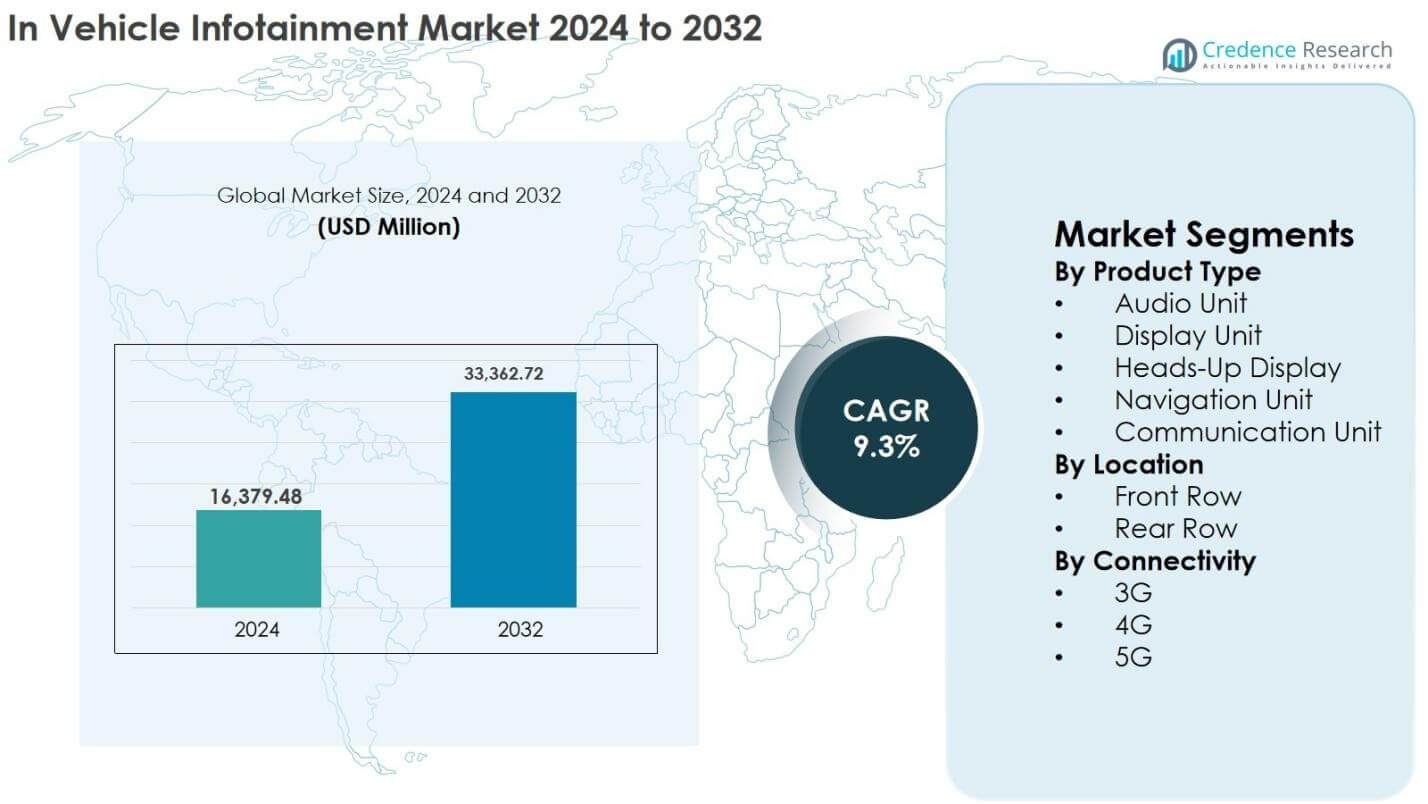
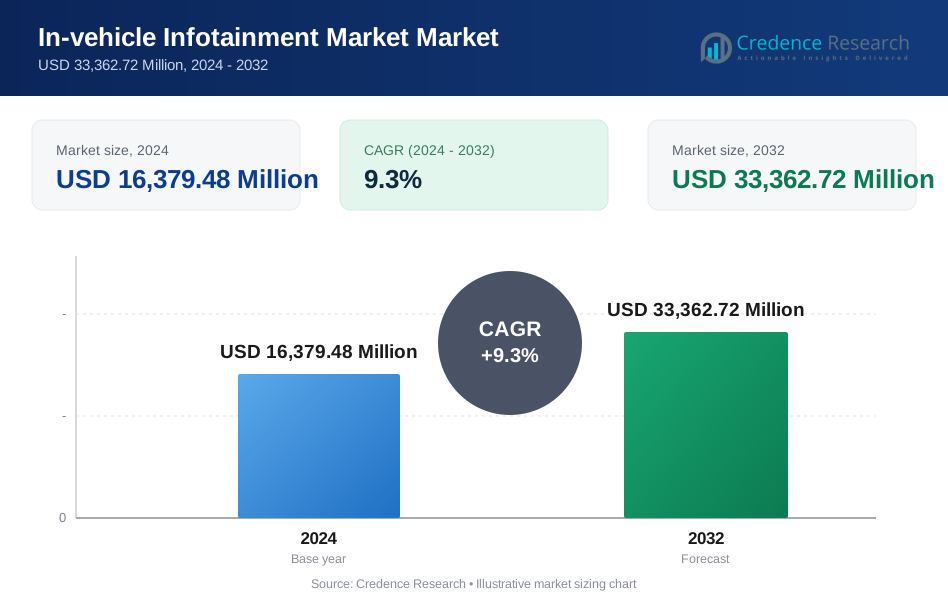
In-vehicle Infotainment Market size was valued at USD 16,379.48 Million in 2024 and is anticipated to reach USD 33,362.72 Million by 2032, at a CAGR of 9.3% during the forecast period.
| REPORT ATTRIBUTE | DETAILS |
|---|---|
| Historical Period | 2020-2023 |
| Base Year | 2024 |
| Forecast Period | 2025-2032 |
| In-vehicle Infotainment Market Size 2024 | USD 16,379.48 million |
| In-vehicle Infotainment Market, CAGR | 9.3% |
| In-vehicle Infotainment Market Size 2032 | USD 33,362.72 million |
In-vehicle Infotainment Market Insights
- Rising demand for connected vehicles and integration of smartphones, cloud services, and telematics solutions are driving market growth. Consumers increasingly prefer real-time navigation, streaming, and personalized infotainment experiences in both luxury and mid-range vehicles.
- Key trends include the adoption of advanced user interfaces, heads-up displays, augmented reality navigation, and rear-seat entertainment systems. The shift toward electric and hybrid vehicles is creating opportunities for larger, more interactive infotainment systems.
- The market is highly competitive with top players such as Harman International, Panasonic Corporation, Robert Bosch GmbH, Continental AG, and Pioneer Corporation focusing on innovation, OEM partnerships, and advanced connectivity solutions.
- North America leads with 32.8% share, Europe follows with 28.6%, Asia-Pacific accounts for 24.1%, and the Rest of the World holds 14.5%. Growth is supported by rising vehicle sales, EV adoption, and increasing consumer demand for enhanced in-car experiences.
In-vehicle Infotainment Market Segmentation Analysis:
By Product Type
In the Vehicle Infotainment market, the Audio Unit segment dominated in 2024, accounting for 38.5% of the market share. Its growth is driven by increasing consumer demand for high-quality in-car entertainment and premium audio experiences. Advancements in digital sound processing, integration with voice assistants, and compatibility with streaming services have further fueled adoption. The Display Unit and Navigation Unit segments are witnessing significant growth due to enhanced user interfaces and real-time navigation features. The rising trend of connected vehicles and infotainment customization continues to support expansion across all product types, particularly in luxury and mid-range vehicle segments.
- For instance, Bose offers branded premium audio systems in models like the Nissan Altima and Mazda CX-5, featuring multi-speaker setups and advanced tuning for immersive sound.
By Location
The Front Row segment held a dominant share of 72.4% in 2024 within the Vehicle Infotainment market. This is largely due to the front row being the primary interface for driver and passenger interaction with infotainment systems, including navigation, audio, and communication functions. The Rear Row segment is gaining traction with increasing demand for rear-seat entertainment in premium vehicles, especially in family and executive cars. Key drivers include rising consumer preference for immersive in-car experiences, technological advancements in screens and wireless connectivity, and OEM focus on enhancing passenger comfort and convenience.
- For instance, Tesla’s central touchscreen in the Model 3 and Model Y consolidates navigation, media, and vehicle controls into a single front-row hub, making it the focal point for all in-car digital interactions.
By Connectivity
Within the Vehicle Infotainment market, the 4G segment led with a market share of 46.7% in 2024, supported by widespread cellular network coverage and reliable data transmission for streaming, navigation, and communication services. The 5G segment is rapidly emerging due to ultra-low latency, high-speed connectivity, and enhanced vehicle-to-everything (V2X) communication potential, particularly in connected and autonomous vehicles. 3G adoption is declining as automakers and consumers migrate to faster, more efficient networks. Overall, advancements in mobile connectivity, increased demand for real-time services, and the push for connected car ecosystems are driving segment growth across all network types.
Key Growth Drivers
Rising Demand for Connected Vehicles
The increasing adoption of connected vehicles is a primary driver for the Vehicle Infotainment market, as consumers seek seamless integration of smartphones, cloud services, and advanced navigation systems. In 2024, connected car adoption is expanding globally, particularly in North America and Europe, where over 65% of new vehicles feature integrated infotainment platforms. Advanced telematics, Wi-Fi hotspots, and in-car apps are enhancing user convenience, creating opportunities for OEMs to offer personalized services. Growth is further fueled by partnerships between automakers and technology companies to provide real-time updates, streaming services, and remote diagnostics, driving higher consumer engagement and elevating infotainment system penetration across both luxury and mid-range vehicle segments.
- For instance, BMW’s ConnectedDrive platform provides over-the-air map updates, in-car apps, and integrated eSIM-based connectivity for services like real-time traffic and online entertainment.
Consumer Preference for Enhanced In-Car Entertainment
Growing consumer interest in immersive in-car entertainment experiences is propelling the Vehicle Infotainment market. Audio, display, and heads-up systems are increasingly equipped with high-resolution screens, premium audio, and multi-media streaming options, enhancing passenger experience. Families and tech-savvy consumers are driving demand for rear-seat entertainment and advanced navigation features, while urbanization and rising disposable incomes encourage spending on premium infotainment. Integration with voice assistants, augmented reality displays, and interactive user interfaces further stimulate adoption. Manufacturers are responding with customizable solutions, bolstering market growth. By 2024, infotainment adoption in mid-to-high-end vehicle segments has reached approximately 58%, highlighting strong market potential driven by enhanced entertainment expectations.
- For instance, Mercedes-Benz’s MBUX system offers high-resolution touch displays with augmented-reality navigation overlays and voice control activated by “Hey Mercedes,” creating a more engaging, immersive cockpit.
Technological Advancements and Network Connectivity
Rapid advancements in technology and mobile connectivity are key growth drivers for the Vehicle Infotainment market. The rollout of 5G networks, high-speed 4G coverage, and vehicle-to-everything (V2X) communication enable real-time data streaming, cloud-based applications, and enhanced navigation accuracy. Integration of AI-driven voice assistants, touchless controls, and augmented reality navigation improves usability and safety. OEMs are increasingly incorporating over-the-air updates, enhancing system functionality post-sale. Additionally, the rising adoption of IoT-enabled vehicles supports predictive maintenance, infotainment personalization, and multi-device connectivity. These technological innovations are accelerating consumer adoption and boosting market growth, with 4G infotainment systems currently leading at 46.7% share in 2024, while 5G systems are projected to gain significant traction in the coming years.
Key Trends & Opportunities
Integration of Advanced User Interfaces
One significant trend in the Vehicle Infotainment market is the integration of advanced user interfaces such as touchscreens, heads-up displays, and gesture controls. OEMs are increasingly focusing on creating intuitive, interactive, and customizable interfaces that enhance driver engagement and safety. Augmented reality navigation, haptic feedback, and voice-controlled functionalities are becoming mainstream, providing real-time information without distracting drivers. Opportunities exist for software developers and OEMs to offer scalable, modular systems compatible across multiple vehicle models. By 2024, vehicles with multi-modal infotainment interfaces are estimated to account for over 40% of new car sales in premium segments, reflecting strong consumer acceptance and opening avenues for cross-industry collaborations with tech firms to deliver innovative in-car experiences.
- For instance, Audi’s head-up display in models like the Q7 projects speed and navigation prompts onto the windshield, while haptic feedback on touch surfaces confirms driver inputs.
Growth of Electric and Hybrid Vehicles
The rise of electric vehicles (EVs) and hybrid vehicles presents a lucrative opportunity for the Vehicle Infotainment market. EVs typically offer larger interior space and require enhanced driver information systems, including battery status, charging station navigation, and energy management dashboards, which integrate seamlessly with infotainment systems. OEMs are leveraging this trend to differentiate offerings through advanced displays, real-time connectivity, and entertainment options. With EV sales growing at a CAGR exceeding 20% in key regions like Europe, China, and North America, the infotainment market benefits from increased system standardization, advanced features, and consumer willingness to invest in premium in-car technologies. This trend is expected to accelerate adoption and innovation within the sector through 2032.
- For instance, Hyundai’s IONIQ 5 and Kia EV6 offer integrated EV route planning that factors in charging stops and state-of-charge information directly within their infotainment displays.
Key Challenges
High Cost of Advanced Infotainment Systems
The high manufacturing and integration cost of advanced Vehicle Infotainment systems remains a critical challenge. Premium audio units, multi-display setups, 5G connectivity modules, and heads-up displays increase vehicle production costs, particularly in mid-range and economy segments. Consumers may be unwilling to pay a premium for sophisticated features, limiting adoption. Additionally, OEMs face challenges in balancing cost, functionality, and system reliability while complying with automotive safety standards. By 2024, the integration of multi-modal infotainment systems represents a significant portion of vehicle manufacturing costs, constraining growth in price-sensitive markets and creating pressure for cost-effective solutions without compromising performance or user experience.
Data Security and Privacy Concerns
Increasing connectivity in Vehicle Infotainment systems exposes vehicles to cybersecurity risks and data privacy issues. Real-time navigation, cloud integration, and connected services generate sensitive user data that can be vulnerable to hacking or unauthorized access. Automakers must invest heavily in secure platforms, encryption, and over-the-air software updates to mitigate potential breaches. Regulatory compliance with GDPR, CCPA, and other regional data protection laws further adds complexity and costs. These security challenges can slow market adoption, particularly in regions with heightened privacy awareness, as consumers prioritize safety and confidentiality when selecting connected infotainment solutions.
Regional Analysis
North America
The North America Vehicle Infotainment market held a leading share of 32.8% in 2024, driven by high consumer adoption of connected vehicles, advanced telematics, and premium in-car entertainment systems. The United States dominates due to rising disposable income, strong automotive manufacturing presence, and rapid integration of 4G and 5G networks in vehicles. Canada also contributes with growing demand for luxury and mid-range vehicles equipped with advanced infotainment. Key growth is supported by OEM partnerships with tech companies, integration of voice assistants, and over-the-air software updates, enhancing system functionality and consumer experience across passenger cars and commercial vehicles.
Europe
Europe accounted for 28.6% of the Vehicle Infotainment market in 2024, led by Germany, France, and the UK, where consumers prioritize safety, connectivity, and high-quality audio experiences. Stringent regulations and incentives for connected and semi-autonomous vehicles drive adoption of advanced infotainment systems. Automotive OEMs focus on integrating multi-modal interfaces, augmented reality navigation, and rear-seat entertainment to differentiate products in competitive markets. Increasing penetration of EVs and hybrids supports infotainment adoption by offering larger interior space for advanced displays and interactive solutions. Consumer preference for integrated, personalized systems further boosts growth in the region.
Asia-Pacific
The Asia-Pacific region captured 24.1% of the Vehicle Infotainment market in 2024, led by China, Japan, and India. Rapid urbanization, rising disposable income, and growing demand for premium and mid-range vehicles drive infotainment adoption. China’s strong EV growth and Japan’s technological expertise enhance demand for connected and intelligent systems. OEMs are focusing on localization of infotainment solutions, integrating voice assistants, navigation, and real-time connectivity services to meet regional consumer expectations. Expansion of 4G and 5G networks further facilitates adoption. The trend of rear-seat entertainment in family-oriented vehicles also contributes to the growing regional market share.
Rest of the World (RoW)
The Rest of the World (RoW) region accounted for 14.5% of the Vehicle Infotainment market in 2024, driven by gradual adoption of connected car technologies in Latin America, the Middle East, and Africa. Growth is supported by rising urbanization, increasing vehicle sales, and consumer demand for enhanced in-car experiences. OEMs are introducing region-specific infotainment solutions, including multi-language navigation, localized content, and audio customization. Expansion of mobile connectivity infrastructure and partnerships with technology providers help overcome adoption barriers. Though market penetration remains lower than developed regions, emerging economies present significant growth opportunities for infotainment integration across passenger and commercial vehicles.
In-vehicle Infotainment Market Segmentations:
By Product Type
- Audio Unit
- Display Unit
- Heads-Up Display
- Navigation Unit
- Communication Unit
By Location
- Front Row
- Rear Row
By Connectivity
- 3G
- 4G
- 5G
By Geography
- North America
- U.S.
- Canada
- Mexico
- Europe
- Germany
- France
- U.K.
- Italy
- Spain
- Rest of Europe
- Asia Pacific
- China
- Japan
- India
- South Korea
- South-east Asia
- Rest of Asia Pacific
- Latin America
- Brazil
- Argentina
- Rest of Latin America
- Middle East & Africa
- GCC Countries
- South Africa
- Rest of the Middle East and Africa
Competitive Landscape
The Vehicle Infotainment market is dominated by several established global players, including Harman International, Panasonic Corporation, Alps Alpine Co Ltd, Robert Bosch GmbH, Continental AG, Clarion Corporation, Sin Seiki Ltd, JVC Kenwood, Pioneer Corporation, and Alpine Electronics Inc. These companies focus on continuous innovation, strategic partnerships, and product differentiation to maintain market leadership. Key strategies include the integration of advanced audio and display units, 4G/5G connectivity, and user-friendly interfaces to enhance in-car experiences. Collaborations with automakers for OEM-specific solutions and investments in research and development for AI-driven infotainment, augmented reality navigation, and voice-controlled systems further strengthen their position. North America and Europe are primary markets for these players, collectively accounting for over 60% of the market share in 2024, while Asia-Pacific is emerging rapidly due to EV adoption and growing consumer demand for connected vehicles. Intense competition drives technological advancement and system customization across segments.
Key Player Analysis
- Continental AG
- JVC Kenwood
- Pioneer Corporation
- Robert Bosch GmbH
- Harman International
- Panasonic Corporation
- Alpine Electronics Inc.
- Clarion Corporation
- Alps Alpine Co Ltd
- Sin Seiki Ltd
Recent Developments
- In June 2025, Harman introduced its Neo QLED automotive display technology, which made its debut in the Tata Harrier EV, marking the first in-vehicle implementation of this premium display innovation.
- In January 2025, BMW unveiled its Panoramic iDrive Technology at CES, featuring a full-width windshield display powered by Operating System X, which is built on the Android Open Source Project. The system integrates advanced 3D head-up display functions along with upgraded AI-driven Intelligent Personal Assistant capabilities.
- In January 2023, Holoride, a startup backed by Audi, launched a new device at CES 2023 in Las Vegas designed to deliver immersive virtual-reality entertainment experiences inside vehicles. The product represents a major milestone for the company, which has relied heavily on partnerships with automakers to scale its technology.
Report Coverage
The research report offers an in-depth analysis based on Product Type, Location, Connectivity and Geography. It details leading market players, providing an overview of their business, product offerings, investments, revenue streams, and key applications. Additionally, the report includes insights into the competitive environment, SWOT analysis, current market trends, as well as the primary drivers and constraints. Furthermore, it discusses various factors that have driven market expansion in recent years. The report also explores market dynamics, regulatory scenarios, and technological advancements that are shaping the industry. It assesses the impact of external factors and global economic changes on market growth. Lastly, it provides strategic recommendations for new entrants and established companies to navigate the complexities of the market.
Future Outlook
- Adoption of connected and autonomous vehicles will continue to drive infotainment system integration.
- 5G connectivity will enable faster, low-latency streaming and enhanced real-time navigation features.
- Advanced user interfaces, including touchscreens, gesture control, and voice assistants, will become standard in mid-to-premium vehicles.
- Rear-seat entertainment and multi-display systems will see growing demand in family and luxury vehicle segments.
- Integration of augmented reality and heads-up displays will enhance driver safety and navigation experience.
- Electric and hybrid vehicles will drive the development of energy-efficient and larger infotainment systems.
- OEMs will increasingly focus on over-the-air updates to improve system functionality post-sale.
- AI-driven personalization and predictive services will improve user engagement and satisfaction.
- Strategic collaborations between automakers and technology companies will foster innovation and market expansion.
- Consumer preference for immersive audio and multimedia experiences will continue to support market growth.
Request a Free Sample
Fill in your details and we'll send you a free sample report.
- Sample data tables & charts
- Research methodology
Need a Custom Version of This Report?
Tailor the scope, geography, or segments to your exact requirements.
- Custom geography or segment scope
- Direct access to our analyst team
Frequently Asked Questions
What is the current market size for In Vehicle Infotainment market, and what is its projected size in 2032?
At what Compound Annual Growth Rate is the In Vehicle Infotainment market projected to grow between 2024 and 2032?
Which In Vehicle Infotainment market segment held the largest share in 2024?
What are the primary factors fueling the growth of the In Vehicle Infotainment market?
Who are the leading companies in the In Vehicle Infotainment market?
Which region commanded the largest share of the In Vehicle Infotainment market in 2024?
Table of Content
Chapter 1. Report Introduction
- 1.1 Report Description & Purpose
- 1.1.1 Report Title & Market Definition
- 1.1.2 Unique Selling Propositions (USP) & Key Differentiators
- 1.1.3 Value Proposition for Stakeholders
- 1.2 Research Objectives
- 1.2.1 Market Sizing Objectives (Volume & Revenue)
- 1.2.2 Segmentation Objectives
- 1.2.3 Competitive Intelligence Objectives
- 1.2.4 Forecast & Scenario Objectives
- 1.3 Report Scope
- 1.3.1 In-vehicle Infotainment Market Scope – Types & Subtypes Covered
- 1.3.2 Geographic Scope – Regions & Countries Covered
- 1.3.3 Historical Period, Base Year & Forecast Period (2024; forecast to 2032)
- 1.3.4 Inclusions & Exclusions
- 1.4 HS Code & Classification Framework
- 1.5 Currency, Units & Pricing Basis
- 1.6 Target Stakeholders
- 1.7 Limitations & Assumptions
Chapter 2. Executive Summary
- 2.1 Global In-vehicle Infotainment Market Market Snapshot
- 2.1.1 Market Size – Historical (2024) & Forecast (2024-2032) (2024: USD 16,379.48 Million → 2032: USD 33,362.72 Million)
- 2.1.2 Volume & Revenue – Global Totals
- 2.1.3 Key Market Highlights – Top Five Facts
- 2.2 In-vehicle Infotainment Market Market Segmentation Snapshot
- 2.2.1 Market Split by Region – 2024 vs. 2032
- 2.3 Competitive Snapshot
- 2.3.1 Top 10 Players by Revenue Share – 2024
- 2.3.2 Top 10 Players by Volume Share – 2024
- 2.3.3 Recent Strategic Developments (18-Month Summary)
- 2.4 Key Investment Highlights & Strategic Conclusions
Chapter 3. In-vehicle Infotainment Market Market Dynamics & Industry Analysis
- 3.1 Market Overview & Context
- 3.1.1 In-vehicle Infotainment Market Market Position in the Broader Automotive Value Chain
- 3.1.2 OEM vs. Replacement Market Dynamics
- 3.1.3 Market Maturity & Development Stage by Region
- 3.2 In-vehicle Infotainment Market Market Drivers
- 3.3 In-vehicle Infotainment Market Market Restraints & Challenges
- 3.4 In-vehicle Infotainment Market Market Opportunities
- 3.5 Porter's Five Forces Analysis
- 3.5.1 Threat of New Entrants
- 3.5.2 Bargaining Power of Suppliers
- 3.5.3 Bargaining Power of Buyers
- 3.5.4 Threat of Substitutes
- 3.5.5 Competitive Rivalry – Intensity Assessment
- 3.6 In-vehicle Infotainment Market Value Chain Analysis
- 3.6.1 Upstream – Raw Material/Input Suppliers
- 3.6.1.1 Raw Material/Input 1
- 3.6.1.2 Raw Material/Input 2
- 3.6.1.3 Raw Material/Input 3
- 3.6.2 Midstream – Production/Manufacturing/Service Delivery
- 3.6.2.1 Production/Process Overview
- 3.6.2.2 Key Facility Locations & Capacity by Manufacturer
- 3.6.3 Downstream – Distribution & End Consumer
- 3.6.3.1 Primary Channel – B2B/OEM
- 3.6.3.2 Secondary Channels – Dealer, Retail, Online, Direct
- 3.6.4 Value Chain Profitability Analysis
- 3.6.1 Upstream – Raw Material/Input Suppliers
- 3.7 PESTEL Analysis
- 3.7.1 Political Factors
- 3.7.2 Economic Factors
- 3.7.3 Social Factors
- 3.7.4 Technological Factors
- 3.7.5 Environmental Factors
- 3.7.6 Legal Factors
- 3.8 In-vehicle Infotainment Market Supply Chain Analysis
- 3.8.1 Raw Material/Input Supply Risk Assessment
- 3.8.2 Manufacturing Concentration Risk (Geographic Exposure)
- 3.8.3 Trade Disruption Impact Analysis
- 3.9 Regulatory & Policy Landscape
Note: The regulatory and policy landscape section covers regulations based on their applicability to the market, In-vehicle Infotainment Market category, geography, and scope of the study. Only regulatory frameworks with a material impact on operations, compliance, trade, sustainability, or market access are analyzed in detail.
Chapter 4. Key Investment Pockets & Opportunity Analysis
- 4.1 In-vehicle Infotainment Market Market Attractiveness Analysis
- 4.1.1 By Region – Investment Attractiveness Matrix (Volume × CAGR)
- 4.2 Absolute Revenue Growth Opportunity
- 4.2.1 By Region – Absolute USD Growth Through 2032
- 4.3 Incremental Volume Opportunity
- 4.3.1 By Region – Incremental Volume Through 2032
- 4.3.2 Segment – Incremental Volume
- 4.4 Emerging Submarket Opportunity Deep Dive (Subject to Applicability)
- 4.5 Emerging Market Opportunity Scorecards
- 4.5.1 United States
- 4.5.2 Europe
- 4.5.3 Asia
- 4.5.4 Middle East & Africa
Note: Emerging Market Opportunity Scorecards will be included based on relevance and strategic importance. Regions listed are indicative and may vary depending on data availability and market dynamics.
Chapter 5. In-vehicle Infotainment Market Import-Export Analysis & Trade Flows
- 5.1 Global Trade Overview
- 5.1.1 Global Export Value by Country (2024)
- 5.1.2 Global Export Volume by Country (2024)
- 5.1.3 Global Import Value by Country (2024)
- 5.1.4 Global Import Volume by Country (2024)
- 5.1.5 Net Trade Balance by Country (2024)
- 5.2 Export Analysis – Segment
- 5.2.1 Type 1 (HS Code)
- 5.2.2 Type 2 (HS Code)
- 5.2.3 Type 3 (HS Code)
- 5.2.4 Type 4 (HS Code)
- 5.2.5 Type 5 (HS Code)
- 5.3 Import Analysis – Segment
- 5.3.1 Type 1 (HS Code)
- 5.3.2 Type 2 (HS Code)
- 5.3.3 Type 3 (HS Code)
- 5.3.4 Type 4 (HS Code)
- 5.3.5 Type 5 (HS Code)
- 5.4 Average Unit Trade Prices
- 5.4.1 Average Export Price – Segment & Country
- 5.4.2 Average Import Price – Segment & Source Country
- 5.4.3 Price Trends (2024)
- 5.5 Key Trade Route Analysis
- 5.5.1 Trade Route 1
- 5.5.2 Trade Route 2
- 5.5.3 Trade Route 3
- 5.5.4 Trade Route 4
- 5.5.5 Trade Route 5
- 5.6 Trade Policy Impact Assessment
- 5.6.1 US Anti-Dumping & Section 301 Tariffs
- 5.6.2 EU Customs Union Impact
- 5.6.3 Major Free Trade Agreements
- 5.6.4 USMCA Rules of Origin
Note: Trade policy analysis will be included only where relevant to the In-vehicle Infotainment Market market.
Chapter 6. Competitive Landscape & Company Benchmarking
- 6.1 In-vehicle Infotainment Market Market Concentration & Structure
- 6.1.1 Herfindahl-Hirschman Index (HHI) – vs. 2024
- 6.1.2 Tier 1, Tier 2 & Tier 3 Market Structure
- 6.1.3 Global, Regional & Local Player Dynamics
- 6.2 In-vehicle Infotainment Market Market Share Analysis – 2024
- 6.2.1 Global Revenue Share by Company
- 6.2.2 Global Volume Share by Company
- 6.2.3 Regional Revenue Share
- 6.2.4 Market Share Evolution ( vs. 2024)
- 6.2.5 OEM Segment Share by Company
- 6.2.6 Replacement Segment Share by Company
- 6.3 Production/Delivery Capacity & Facility Analysis
- 6.3.1 Global Installed Capacity
- 6.3.2 Capacity Utilization Rates
- 6.3.3 Production/Output Volume
- 6.3.4 Facility Locations & Capacity Map
- 6.3.5 Planned Capacity Additions
- 6.4 In-vehicle Infotainment Market Competitive Benchmarking Matrix
- 6.4.1 Revenue, Volume, CAGR & Profitability Comparison
- 6.4.2 Channel Revenue Mix
- 6.4.3 Geographic Revenue Exposure
- 6.4.4 R&D Intensity
- 6.4.5 Sustainability Maturity
- 6.5 Strategic Developments in In-vehicle Infotainment Market (Last 24 Months)
- 6.5.1 Mergers, Acquisitions & Divestments
- 6.5.2 New In-vehicle Infotainment Market Launches
- 6.5.3 Facility Expansions
- 6.5.4 Strategic Alliances, Joint Ventures & Partnerships
- 6.5.5 Distribution Expansion & Market Entry
- 6.5.6 Sustainability & ESG Initiatives
- 6.6 Competitive Strategy Mapping
- 6.6.1 Leader, Challenger, Follower & Niche Classification
- 6.6.2 Pricing Strategy Comparison
- 6.6.3 Channel Strategy Matrix
Note: Strategic developments are included based on their materiality and the availability of reliable information.
Chapter 7. Global In-vehicle Infotainment Market Market – By Distribution Channel
- 7.1 Segment Overview
- 7.1.1 Volume & Revenue Split by Channel (2024 & 2032)
- 7.1.2 Channel Mix Evolution (2024-2032)
Chapter 8. Regional Market Analysis – Global Overview
- 8.1 Global Regional Overview
- 8.1.1 Regional Volume Share
- 8.1.2 Regional Revenue Share
- 8.1.3 Regional Volume by Region
- 8.1.4 Regional Revenue by Region
- 8.1.5 Regional Forecast Through 2032
- 8.2 Cross-Regional Segment Analysis
- 8.2.1 By Distribution Channel
- 8.2.2 By Brand/Price Tier
Chapter 9. North America In-vehicle Infotainment Market Market
- 9.1 United States
- 9.2 Canada
- 9.3 Mexico
Chapter 10. Europe In-vehicle Infotainment Market Market
- 10.1 Germany
- 10.2 France
- 10.3 Italy
- 10.4 United Kingdom
- 10.5 Spain
- 10.6 Poland
- 10.7 Russia
- 10.8 Netherlands
- 10.9 Belgium
- 10.10 Sweden
- 10.11 Denmark
- 10.12 Norway
- 10.13 Rest of Europe
Chapter 11. Asia Pacific In-vehicle Infotainment Market Market
- 11.1 China
- 11.2 India
- 11.3 Japan
- 11.4 South Korea
- 11.5 Thailand
- 11.6 Indonesia
- 11.7 Vietnam
- 11.8 Malaysia
- 11.9 Australia
- 11.10 Rest of Asia Pacific
Chapter 12. Latin America In-vehicle Infotainment Market Market
- 12.1 Brazil
- 12.2 Argentina
- 12.3 Colombia
- 12.4 Chile
- 12.5 Rest of Latin America
Chapter 13. Middle East In-vehicle Infotainment Market Market
- 13.1 Saudi Arabia
- 13.2 United Arab Emirates
- 13.3 Turkey
- 13.4 Israel
- 13.5 Iran
- 13.6 Rest of the Middle East
Chapter 14. Africa In-vehicle Infotainment Market Market
- 14.1 South Africa
- 14.2 Egypt
- 14.3 Nigeria
- 14.4 Morocco
- 14.5 Rest of Africa
Chapter 15. In-vehicle Infotainment Market Company Profiles
- 15.1 [Company 01]
- 15.1.1 Company Overview
- 15.1.2 Key Management Personnel
- 15.1.3 Products & Services Portfolio
- 15.1.4 Financial Performance
- 15.1.5 Key Market Focus & Geographic Presence
- 15.1.6 Recent Developments & Strategic Initiatives
Note: The company profile list is preliminary and may change based on research findings, market developments, data availability, and client requirements.
Chapter 16. Appendices
- Appendix A – List of Abbreviations & Acronyms
- Appendix B – Industry Classification Code Reference – Full Series
- Appendix C – Production & Capacity Data Tables
- Appendix D – End-Use & Demand Base Tables
- Appendix E – Consumption & Replacement Rate Assumptions
- Appendix F – ASP Reference Tables
- Appendix G – Manufacturing & Facility Database
- Appendix H – Import-Export Data Tables
- Appendix I – Regulatory Summary Tables
- Appendix J – Primary Research Participant List (Anonymized)
- Appendix K – Primary Research Questionnaire Framework
- Appendix L – Data Sources & Bibliography
- Appendix M – Market Size Divergence & Source Comparison
Chapter 17. Research Methodology
- 17.1 Research Framework & Philosophy
- 17.2 Secondary Research – Sources, Hierarchy & Data Extraction
- 17.3 Data Modeling – Bottom-Up & Top-Down Market Sizing
- 17.4 Primary Research – Stakeholder Framework, LOI & Sample Sizes
- 17.5 Forecast Methodology – Regression, Scenario & Sensitivity Analysis
- 17.6 Quality Control – Four-Layer Validation Framework
- 17.7 Limitations & Standard Assumptions
- 17.8 Disclaimer
