
Market Overview:
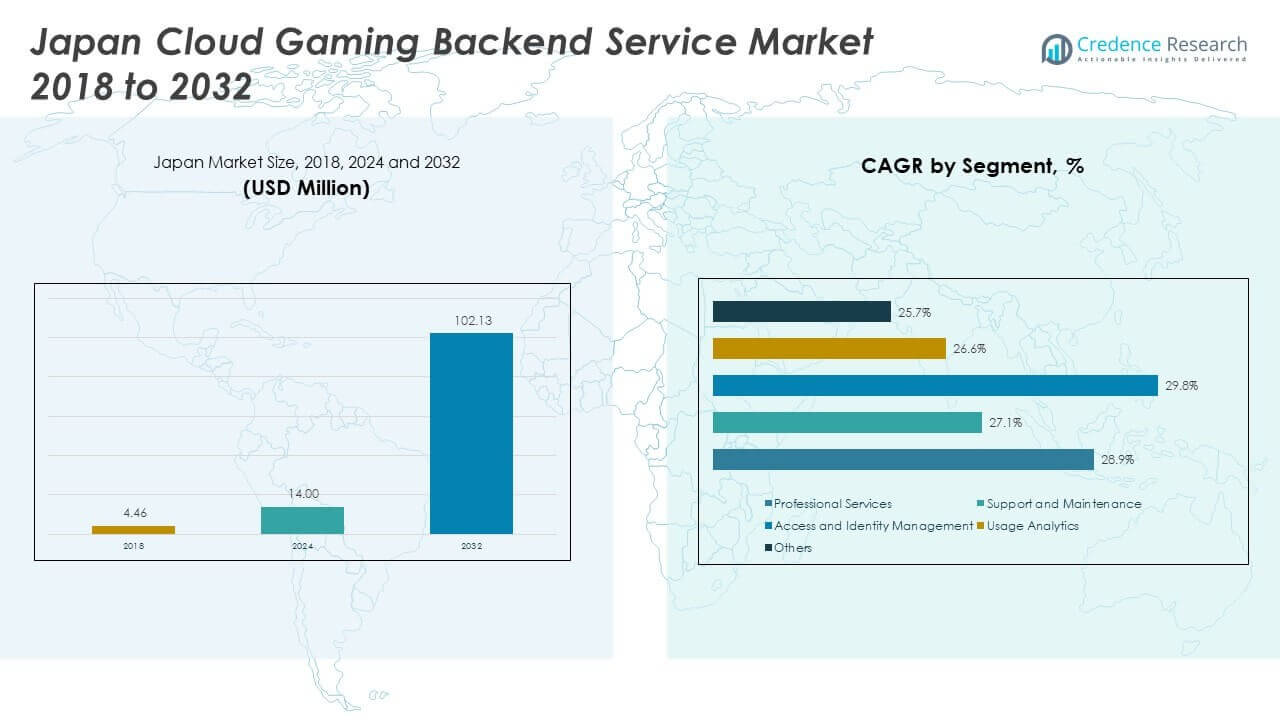
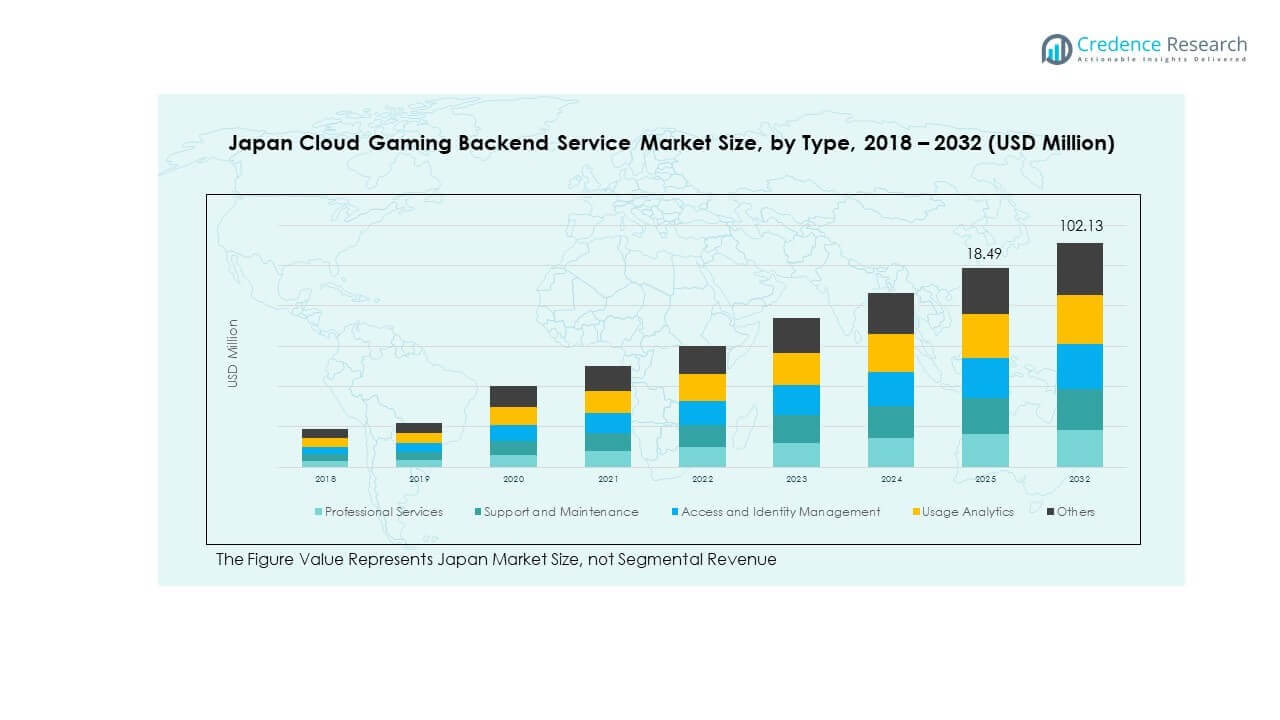
The Japan Cloud Gaming Backend Service Market size was valued at USD 4.46 million in 2018 to USD 14.00 million in 2024 and is anticipated to reach USD 102.13 million by 2032, at a CAGR of 27.66% during the forecast period.
| REPORT ATTRIBUTE | DETAILS |
|---|---|
| Historical Period | 2020-2023 |
| Base Year | 2024 |
| Forecast Period | 2025-2032 |
| Japan Cloud Gaming Backend Service Market Size 2024 | USD 14.00 Million |
| Japan Cloud Gaming Backend Service Market, CAGR | 27.66% |
| Japan Cloud Gaming Backend Service Market Size 2032 | USD 102.13 Million |
The market is driven by growing demand for immersive and high-quality gaming experiences in Japan. Rising internet penetration, 5G rollout, and widespread adoption of smartphones and connected devices support market expansion. Increasing investments by technology providers to enhance backend infrastructure strengthen service quality. Japanese consumers’ preference for seamless access to gaming content across platforms fuels demand. Developers and publishers also leverage backend services to ensure efficient content distribution, player data management, and secure identity access. Cloud-native technologies and scalable backend solutions create strong momentum for the sector, positioning it as a central pillar in Japan’s gaming ecosystem.
From a geographic perspective, Japan leads the Asia-Pacific region in cloud gaming adoption due to its advanced digital infrastructure and strong gaming culture. Neighboring countries like South Korea and China are also emerging, driven by large gaming populations and government support for digital ecosystems. Southeast Asian markets are gradually gaining traction with improving connectivity and rising interest in mobile-based gaming. Japan’s established consumer base and technological readiness make it a pioneer, while emerging economies in the region build on affordability, rising smartphone penetration, and expanding digital payment systems to accelerate growth in this segment.
Market Insights
- The Japan Cloud Gaming Backend Service Market was valued at USD 4.46 million in 2018, reached USD 14.00 million in 2024, and is projected to hit USD 102.13 million by 2032, growing at a CAGR of 27.66%.
- The Global Cloud Gaming Backend Service Market size was valued at USD 93.44 million in 2018 to USD 525.00 million in 2024 and is anticipated to reach USD 3,129.24 million by 2032, at a CAGR of 25.00% during the forecast period.
- Kanto led with 45% share in 2024, driven by advanced infrastructure, strong consumer base, and presence of global gaming companies. Kansai followed with 30% due to expanding data centers and developer networks, while Kyushu and other subregions held 25% supported by connectivity improvements.
- Kyushu and other subregions are the fastest-growing at 25%, fueled by rising smartphone penetration, affordable internet access, and increasing adoption of mobile-based gaming platforms.
- Professional Services accounted for the largest segment share at 38% in 2024, driven by integration, customization, and cross-platform optimization needs.
- Large Enterprises commanded 62% of the market in 2024, supported by higher investments in scalable backend systems and advanced multiplayer infrastructures.
Market Drivers
Rising Demand for Seamless Cross-Platform Gaming Experiences
The Japan Cloud Gaming Backend Service Market is experiencing growth driven by rising consumer expectations for seamless gaming across devices. Players increasingly want instant access without hardware limitations. High-performance backend services enable smooth synchronization of game progress across PCs, consoles, and mobile devices. It supports developers in delivering consistent user experiences across platforms. Growing demand for immersive gameplay pushes companies to invest in advanced infrastructure. These solutions optimize latency and provide stable server environments. Strong consumer interest in flexibility and convenience is strengthening adoption. The trend positions backend services as a crucial element in sustaining player engagement.
Expansion of High-Speed Internet and 5G Networks Across Japan
The rollout of high-speed broadband and 5G networks is a major driver of adoption. It enhances data transfer speeds and reduces latency, enabling real-time gaming. Network reliability allows providers to deliver uninterrupted cloud-based services. Increasing mobile internet penetration strengthens access to streaming platforms. Consumers in urban areas demand consistent connectivity for cloud gaming. Telecom providers are expanding their reach to rural regions, opening new opportunities. Improved internet infrastructure empowers backend systems to scale effectively. This environment accelerates the adoption of cloud gaming across the country.
- For example, NTT DOCOMO launched Japan’s fastest 5G Standalone (SA) service on August 1, 2024, using New Radio–Dual Connectivity across three bands 3.7 GHz, 4.5 GHz, and 28 GHz to deliver peak download speeds of up to 6 Gbps in select zones within Tokyo and Kanagawa Prefecture.
Growing Investments in Cloud Infrastructure and Data Centers
Heavy investments in cloud infrastructure are shaping backend service growth. Data centers across Japan are expanding capacity to meet rising traffic. It allows developers to deploy scalable and flexible solutions. Providers invest in servers, storage, and virtualization to enhance performance. Strong capital inflows from technology firms fuel innovation in backend systems. Partnerships between telecom operators and cloud companies create robust ecosystems. These investments strengthen reliability, security, and efficiency of service delivery. Increasing enterprise focus on advanced backend systems drives growth further.
- For example, in October 2022, Google announced a US$730 million investment in Japanese infrastructure through 2024, which included opening its first fully owned data center in Inzai City, Chiba, beginning operations in March 2023. This facility enhances the speed and reliability of Google Cloud services in Japan, improving access to tools for local game publishers and scalable backend operations.
Rising Preference for Subscription-Based Gaming Models
Subscription-based platforms are expanding demand for backend services. The model offers consumers access to large game libraries at affordable costs. It reduces dependence on expensive hardware upgrades. Backend services support billing, content delivery, and account management. The shift toward subscription gaming accelerates service adoption. It encourages publishers to streamline operations with scalable backend infrastructure. Consumer preference for predictable pricing supports steady revenue flows. This model is strengthening the role of backend solutions in Japan’s gaming industry.
Market Trends
Adoption of AI and Machine Learning in Game Personalization
Artificial intelligence and machine learning integration is shaping backend solutions. It allows developers to analyze player behavior and customize experiences. Predictive analytics helps optimize game difficulty and reward systems. Personalized gameplay enhances retention and user satisfaction. The Japan Cloud Gaming Backend Service Market is witnessing stronger focus on AI-enabled engagement. Service providers leverage AI to improve matchmaking and reduce churn. It supports real-time decision-making, enhancing overall gaming quality. This trend strengthens competitiveness among service providers.
Emergence of Hybrid Gaming Models with Edge Computing Integration
Hybrid gaming models are gaining traction through edge computing adoption. The approach minimizes latency by processing data closer to users. Edge servers complement centralized cloud infrastructure to enhance responsiveness. It allows developers to optimize performance in high-demand regions. Integration supports real-time streaming and multiplayer gaming. Telecom operators deploy edge nodes to improve service quality. This trend improves stability of backend services. The hybrid model ensures reliable, localized solutions for growing user bases.
Rising Popularity of Social and Community-Driven Gaming Platforms
Social interaction is becoming central to cloud gaming adoption. Backend services are adapting to support multiplayer engagement features. Real-time chat, leaderboards, and social sharing drive community growth. The Japan Cloud Gaming Backend Service Market is evolving with demand for interactive platforms. It enables developers to foster loyalty and long-term user participation. Community-driven experiences strengthen brand recognition. Social integration expands the role of backend solutions in gaming. This trend is redefining user expectations of digital entertainment.
- For example, Nakama is an open-source social multiplayer backend designed to support real-time multiplayer and social gaming. It provides features such as real-time chat, community leaderboards, and social authentication, and has been adopted by studios worldwide, including developers in Japan, to power scalable and interactive game experiences.
Integration of Blockchain for Secure In-Game Assets and Transactions
Blockchain adoption is reshaping digital ownership in gaming. Secure transactions enable players to trade and own digital assets. Backend services are being updated to manage blockchain-based features. It enhances transparency and prevents fraud in virtual economies. Developers integrate blockchain to create new revenue streams. Demand for decentralized solutions is rising among tech-savvy gamers. The trend is gaining momentum in Japan’s digital gaming ecosystem. It creates trust and enhances engagement in premium game models.
- For example, Sega announced a collaboration with double jump.tokyo to create a blockchain-based game inspired by its Sangokushi Taisen The project leverages the Oasys blockchain network to enable secure digital asset trading and transparent in-game transactions.
Market Challenges Analysis
High Infrastructure Costs and Scalability Limitations in Service Deployment
The Japan Cloud Gaming Backend Service Market faces significant challenges due to high infrastructure costs. Building and maintaining large-scale data centers requires heavy investment. Smaller providers struggle to compete with established firms. It creates barriers for new entrants seeking market share. Scalability is another obstacle, as services must handle unpredictable surges in demand. Upgrading systems to meet peak usage is resource-intensive. Limited resources may impact service quality, affecting user retention. Sustained financial commitment is essential to overcome these barriers.
Data Privacy Concerns and Regulatory Compliance Requirements
Data privacy is a pressing challenge in cloud gaming services. Managing user accounts, payment information, and gaming activity requires strict safeguards. It places pressure on providers to ensure compliance with regulations. Failure to protect sensitive data can harm brand reputation. Companies must adapt to evolving cybersecurity standards. High-profile breaches increase scrutiny and reduce consumer trust. Complex compliance requirements add costs for backend service operators. These issues slow down adoption rates among cautious users.
Market Opportunities
Expansion of Cloud-Based Gaming Services in Untapped Demographics
The Japan Cloud Gaming Backend Service Market holds opportunities in untapped demographics. Rising interest among casual and mobile gamers creates new growth areas. Expanding outreach to non-traditional gaming audiences can increase adoption. It allows providers to diversify service offerings beyond hardcore gamers. Educational and casual gaming solutions expand market boundaries. Increasing affordability of internet services supports this opportunity. This shift strengthens demand for scalable backend services. Companies can unlock long-term value by targeting broader user groups.
Growing Collaboration Between Technology Providers and Telecom Operators
Collaboration with telecom operators creates new avenues for growth. Joint ventures enhance infrastructure deployment and service reliability. It allows providers to extend reach into new markets efficiently. Partnerships ensure access to stable networks and reduced latency. Telecom firms benefit from bundled service offerings. Technology providers gain opportunities to scale operations quickly. Such collaborations reinforce industry resilience and strengthen competitiveness. This synergy supports long-term sustainability of backend service adoption.
Market Segmentation Analysis
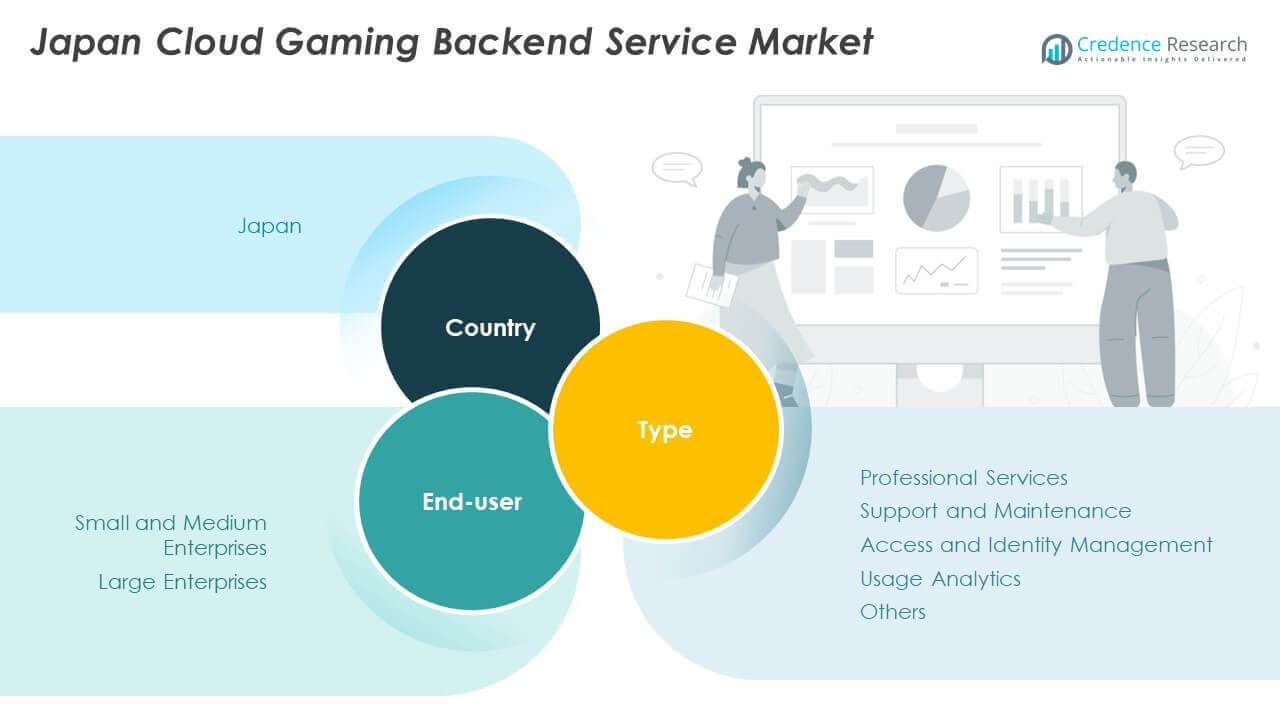
The Japan Cloud Gaming Backend Service Market is segmented
By type into Professional Services, Support and Maintenance, Access and Identity Management, Usage Analytics, and Others. Professional Services dominate due to their critical role in deployment, integration, and customization of backend systems. It enables developers to ensure seamless performance across platforms. Support and Maintenance contribute steadily by ensuring system stability and reducing downtime. Access and Identity Management is expanding as demand for secure authentication and data protection rises. Usage Analytics is gaining momentum with developers using insights to improve engagement and retention. Other services continue to add value by covering specialized backend requirements across diverse gaming models.
- For example, Amazon GameLift provides automated scaling and session management for multiplayer games, enabling developers to efficiently deploy, operate, and scale dedicated servers. The service integrates seamlessly with AWS, as documented in Amazon’s official technical guides.
By end-user, the market is divided into Small and Medium Enterprises (SMEs) and Large Enterprises. SMEs represent a fast-growing segment, adopting backend services to access scalable solutions without large infrastructure costs. It allows smaller developers to compete effectively in the gaming ecosystem. Large Enterprises retain significant share due to established resources and advanced service integration. Their investments in subscription-based models, AI-driven personalization, and multiplayer ecosystems strengthen their dominance. Together, these segments highlight the diverse demand base supporting the growth trajectory of the Japan Cloud Gaming Backend Service Market.
- For example, PlayFab’s free tier provides indie developers with backend services at no cost, supporting up to 100,000 player accounts. This offering is documented on the official PlayFab site and Microsoft developer resources, making it a valuable entry point for smaller studios.
Segmentation
By Type
- Professional Services
- Support and Maintenance
- Access and Identity Management
- Usage Analytics
- Others
By End-User
- Small and Medium Enterprises
- Large Enterprises
Regional Analysis
Kanto Region – The Technology and Gaming Core
The Kanto region dominates the Japan Cloud Gaming Backend Service Market with a share of 45%. Tokyo and its surrounding areas serve as the primary hub for technology development, advanced infrastructure, and gaming innovation. Strong broadband penetration and widespread 5G networks drive seamless adoption of backend services. It benefits from the presence of global technology players and local gaming giants, making it a critical growth driver. High consumer spending power and digital readiness create favorable conditions for premium subscription-based models. Enterprises in the region continue to expand investments in advanced cloud infrastructure, consolidating Kanto’s leadership in the market.
Kansai Region – A Rising Growth Hub with Expanding Infrastructure
The Kansai region accounts for 30% of the market share, supported by Osaka, Kyoto, and Kobe’s expanding technology ecosystems. The region is witnessing strong demand for backend services due to its growing developer community and gaming culture. It benefits from large-scale data center projects and increased collaborations with telecom providers. Enterprises in Kansai are adopting scalable backend systems to cater to multiplayer and high-quality gaming needs. Affordable internet services and a growing middle-class base are supporting rapid expansion. The region’s government-driven digital initiatives further enhance infrastructure and boost adoption rates. Kansai is positioning itself as a strategic growth hub for the industry.
Kyushu and Other Subregions – Emerging Opportunities with Niche Growth
Kyushu and other subregions together hold 25% of the market share, with steady growth supported by rising connectivity. Regional cities are adopting cloud-based gaming due to improved broadband access and increasing smartphone penetration. It provides opportunities for smaller players and startups to enter with localized solutions. Cloud infrastructure development in these areas is creating new demand for backend services. Consumer preference for mobile gaming is a strong factor shaping adoption patterns. While the infrastructure is less advanced compared to Kanto and Kansai, ongoing expansions signal long-term growth potential. These subregions are expected to emerge as competitive contributors in the coming years.
Key Player Analysis
- Tencent
- Naver
- NetEase
- Sony Interactive Entertainment
- Alibaba Cloud
- Blacknut
- Microsoft Azure
- NVIDIA GeForce Now
- Ubitus
- Garena
Competitive Analysis
The Japan Cloud Gaming Backend Service Market features intense competition among global and domestic players striving to strengthen market presence. Key participants include Tencent, Sony Interactive Entertainment, Microsoft Azure, NVIDIA GeForce Now, Alibaba Cloud, NetEase, Ubitus, Naver, Blacknut, and Garena. It is driven by diverse strategies such as cloud infrastructure expansion, exclusive content development, and partnerships with telecom operators. Players are focusing on latency reduction, scalable infrastructure, and advanced data management capabilities to enhance service delivery. Sony and Ubitus leverage strong local networks, while global giants like Tencent and Microsoft Azure emphasize cross-platform scalability and content reach. Naver and NetEase are expanding through regional collaborations and service diversification. Cloud infrastructure providers such as Alibaba Cloud enhance the ecosystem by offering reliable backend frameworks. Competitive intensity is heightened by continuous product innovation, acquisitions, and aggressive market expansion. The market is evolving with strong focus on technology-led differentiation and long-term consumer engagement.
Recent Developments
- In August 2025, NetEase reported international growth in its Q2 earnings, with its gaming segment-including titles and backend expansion-driven by new product launches and established franchises in Japan and globally. The company highlighted success in Japan from its global expansion strategy.
- In April 2025, Tencent Cloud launched a new cloud region in Osaka, Japan, establishing its third availability zone in the country and expanding its support for Japanese game studios and cloud gaming clients. This move strengthens Tencent's infrastructure and deepens its collaboration with media clients and game developers in Japan.
- In March 2025, Naver Cloud announced a strategic partnership with NVIDIA to create localized AI systems for the East Asian market, specifically tailoring cloud computing for Japanese clients and applications in the gaming industry. In July 2025, Naver also reinforced its commitment to Japan's B2B sector by enhancing its Line Works business messaging and AI-driven workflow solutions for corporate clients.
Report Coverage
The research report offers an in-depth analysis based on type and end-user. It details leading market players, providing an overview of their business, product offerings, investments, revenue streams, and key applications. Additionally, the report includes insights into the competitive environment, SWOT analysis, current market trends, as well as the primary drivers and constraints. Furthermore, it discusses various factors that have driven market expansion in recent years. The report also explores market dynamics, regulatory scenarios, and technological advancements that are shaping the industry. It assesses the impact of external factors and global economic changes on market growth. Lastly, it provides strategic recommendations for new entrants and established companies to navigate the complexities of the market.
Future Outlook
- The Japan Cloud Gaming Backend Service Market will witness rapid adoption with growing cross-platform gaming demand.
- Strong penetration of 5G and high-speed internet will enhance service reliability and scalability.
- Cloud-native backend systems will expand, enabling developers to deliver flexible and efficient solutions.
- Subscription-based gaming models will drive consistent revenue streams and expand consumer reach.
- AI and machine learning integration will personalize user experiences and improve retention rates.
- Edge computing will reduce latency, strengthening multiplayer and real-time gaming services.
- Blockchain adoption will support secure transactions and foster new revenue channels for developers.
- Partnerships between telecom operators and technology providers will expand infrastructure coverage.
- Kansai and Kyushu regions will gain momentum as alternative hubs, diversifying growth sources.
- Competition will intensify with global and domestic players focusing on innovation and localized offerings.

Request a Free Sample
Fill in your details and we'll send you a free sample report.
- Sample data tables & charts
- Research methodology
Market Dynamics
Expansion of High-Speed Internet and 5G Networks
The rollout of high-speed broadband and 5G networks across Japan is enabling real-time, low-latency gaming experiences, making cloud gaming backend services more reliable and accessible to a wider audience.
Growing Investments in Cloud Infrastructure and Data Centers
Significant investments by technology providers and cloud companies in Japanese data centers and infrastructure are enhancing the scalability, reliability, and performance of backend services, supporting the needs of both developers and end-users.
Rising Preference for Seamless Cross-Platform Gaming
Japanese consumers increasingly expect to play games seamlessly across devices, driving demand for backend services that enable synchronization, content distribution, and consistent user experiences regardless of platform.
Adoption of Subscription-Based Gaming Models
The shift toward subscription-based gaming platforms is increasing the need for robust backend services to manage billing, content delivery, and user accounts, supporting predictable revenue streams and broader consumer adoption.
Integration of AI, Edge Computing, and Blockchain
The adoption of AI for personalization, edge computing for latency reduction, and blockchain for secure transactions is driving innovation in backend services, enhancing user engagement and enabling new business models in the Japanese gaming ecosystem.
Need a Custom Version of This Report?
Tailor the scope, geography, or segments to your exact requirements.
- Custom geography or segment scope
- Direct access to our analyst team
Frequently Asked Questions
What is the current market size for Japan Cloud Gaming Backend Service Market, and what is its projected size in 2032?
At what Compound Annual Growth Rate is the Japan Cloud Gaming Backend Service Market projected to grow between 2024 and 2032?
Which Japan Cloud Gaming Backend Service Market segment held the largest share in 2024?
What are the primary factors fueling the growth of the Japan Cloud Gaming Backend Service Market?
Who are the leading companies in the Japan Cloud Gaming Backend Service Market?
Which region commanded the largest share of the Japan Cloud Gaming Backend Service Market in 2024?
Table of Content
Chapter 1 Market Segmentation
- 1.1 Segmentation Framework
- 1.1.1 Product and Service Classification
- 1.1.2 Application and End-Use Classification
- 1.1.3 Technology and Solution Classification
- 1.1.4 Customer and Distribution Channel Classification
- 1.1.5 Geographic Segmentation
- 1.1.6 Market Segment Definitions and Boundaries
- 1.2 By Type
- 1.2.1 Professional Services
- 1.2.2 Support and Maintenance
- 1.2.3 Access and Identity Management
- 1.2.4 Usage Analytics
- 1.2.5 Others
- 1.3 By End-User
- 1.3.1 Small and Medium Enterprises
- 1.3.2 Large Enterprises
- 1.4 By Application
- 1.4.1 Multiplayer Game Hosting
- 1.4.2 Content Distribution
- 1.4.3 Player Data Management
- 1.4.4 Identity and Access Control
Chapter 2 Introduction
- 2.1 Report Objectives and Scope
- 2.2 Product Definition and Industry Terminology
- 2.3 Market Inclusions and Exclusions
- 2.4 Research Process
- 2.4.1 Primary Research and Expert Interviews
- 2.4.2 Secondary Research and Source Review
- 2.4.3 Top-Down and Bottom-Up Estimation
- 2.4.4 Data Triangulation and Verification
- 2.5 Market Size Measurement Basis
- 2.5.1 2024: USD 14.00 million → 2032: USD 102.13 million
- 2.6 Historical and Forecast Reference Periods
- 2.6.1 Base Year: 2024
- 2.6.2 Forecast Period: 2024-2032
- 2.7 Research Assumptions and Limitations
Chapter 3 Executive Summary
- 3.1 Market Snapshot and Key Findings
- 3.2 Base-Year Market Size, 2024
- 3.3 Forecast Market Size, 2032
- 3.4 Revenue and Volume Growth Outlook
- 3.5 Key Demand and Supply Indicators
- 3.6 Leading Market Segments
- 3.7 Fastest-Growing Market Opportunities
- 3.8 Regional Performance Highlights
- 3.9 Technology and Industry Transformation
- 3.10 Competitive Landscape Summary
- 3.11 Analyst View and Strategic Implications
Chapter 4 Japan Cloud Gaming Backend Service Market Trends and Developments
- 4.1 Historical Industry Development
- 4.2 Recent Market Trends and Developments
- 4.3 Demand and Customer Behavior Trends
- 4.4 Technology and Product Innovation
- 4.5 Artificial Intelligence, Automation and Digitalization
- 4.6 Local Manufacturing and Supply Chain Realignment
- 4.7 Industry Partnerships, Mergers and Acquisitions
- 4.8 Sustainability and Circular Economy Developments
- 4.9 Government and Private Sector Investment Trends
- 4.10 Emerging Business Models and Commercialization
- 4.11 Industry Developments and Announcements
Chapter 5 Japan Cloud Gaming Backend Service Market Supply and Demand Analysis
- 5.1 Demand Trend and Consumption Analysis
- 5.2 Demand Forecast, 2024-2032
- 5.3 Supply Chain Structure and Procurement Trends
- 5.4 Supply-Demand Gap and Bottlenecks
- 5.5 Import Dependence and Sourcing Structure
- 5.6 Regional Supply and Demand Concentration
Chapter 6 Japan Cloud Gaming Backend Service Market Pricing Analysis
- 6.1 Pricing Structure and Measurement
- 6.2 Historical Pricing Trends
- 6.3 Pricing Outlook, 2024-2032
- 6.4 Pricing by Product and Market Segment
- 6.5 Geographic Pricing Differences
- 6.6 Key Input, Energy, Labor and Logistics Costs
- 6.7 Contract Pricing and Purchasing Models
- 6.8 Pricing Sensitivity and Competitive Positioning
- 6.9 Price, Margin and Profitability Implications
Chapter 7 Japan Cloud Gaming Backend Service Market Dynamics
- 7.1 Market Growth Drivers
- 7.1.1 Demand-Side Drivers
- 7.1.2 Technology and Innovation Drivers
- 7.1.3 Infrastructure and Investment Drivers
- 7.1.4 Regulatory and Policy Drivers
- 7.2 Market Restraints
- 7.2.1 Cost and Affordability Constraints
- 7.2.2 Technology and Adoption Barriers
- 7.2.3 Supply Chain and Operational Constraints
- 7.3 Market Challenges
- 7.3.1 Competitive Pressure and Margin Erosion
- 7.3.2 Skills, Infrastructure and Implementation Gaps
- 7.4 Emerging Market Opportunities
- 7.5 Market Dynamics Impact and Time-Horizon Assessment
Chapter 8 Japan Cloud Gaming Backend Service Value Chain Analysis
- 8.1 Industry Value Chain Overview
- 8.2 Upstream Suppliers and Critical Inputs
- 8.3 Technology and Component Providers
- 8.4 Manufacturing or Service Delivery
- 8.5 Distribution, Channel Partners and Integrators
- 8.6 Downstream Applications and End Users
- 8.7 Value Addition and Profit Pools
- 8.8 Vertical Integration and Outsourcing
- 8.9 Supplier Concentration and Risk
- 8.10 Supply Chain Localization and Resilience
Chapter 9 Japan Cloud Gaming Backend Service Market Regulations and Policies
- 9.1 Relevant Laws, Standards and Compliance Frameworks
- 9.2 Product, Service, Safety and Quality Requirements
- 9.3 Government Policies, Incentives and Subsidies
- 9.4 Imports, Exports and Trade Barriers
- 9.5 Public Procurement and Local Content Requirements
- 9.6 Data Protection, AI and Cybersecurity Compliance
- 9.7 Upcoming Policy Changes and Market Implications
Chapter 10 Japan Cloud Gaming Backend Service Market Hotspots and Opportunities
- 10.1 Market Opportunity Mapping and Growth Hotspots
- 10.2 High-Growth Applications and Customer Groups
- 10.3 Underserved Markets and White-Space Opportunities
- 10.4 Emerging Technology and Product Opportunities
- 10.5 New Capacity and Investment Hotspots
- 10.6 Market Entry and Expansion Opportunities
- 10.7 Distribution and Partnership Opportunities
- 10.8 Near-Term and Long-Term Commercial Potential
- 10.9 Opportunity Attractiveness and Execution Risks
Chapter 11 Japan Cloud Gaming Backend Service Market Outlook, 2024-2032
- 11.1 Market Size and Analysis
- 11.1.1 Revenue (Market Measurement: 2024: USD 14.00 million → 2032: USD 102.13 million)
- 11.1.2 Historical Market Size
- 11.1.3 Base-Year Market Size, 2024
- 11.2 Market Forecast, 2024-2032
- 11.2.1 Revenue Forecast to 2032
- 11.2.2 CAGR and Year-on-Year Growth
- 11.2.3 Incremental Revenue Opportunity
- 11.3 Forecast Assumptions and Scenario Analysis
- 11.3.1 Base-Case Forecast
- 11.3.2 Optimistic and Conservative Scenarios
- 11.3.3 Technology, Pricing and Policy Sensitivities
- 11.4 Market Attractiveness and Growth Outlook
Chapter 12 Japan Cloud Gaming Backend Service Market Segmentation and Outlook
- 12.1 Segmentation Summary and Market Shares, 2024
- 12.2 Largest and Fastest-Growing Segments
- 12.3 By Type - Market Size and Forecast, 2024-2032
- 12.3.1 Segment Definition and Scope
- 12.3.2 Historical Market Size
- 12.3.3 Revenue Forecast, 2024-2032
- 12.3.4 Base-Year Market Share, 2024
- 12.3.5 Segment CAGR and Growth Drivers
- 12.3.6 Subsegment Market Size and Forecast
- 12.3.6.1 Professional Services
- 12.3.6.2 Support and Maintenance
- 12.3.6.3 Access and Identity Management
- 12.3.6.4 Usage Analytics
- 12.3.6.5 Others
- 12.3.7 Subsegment Pricing and Adoption Trends
- 12.3.8 Leading Suppliers and Competition
- 12.3.9 Regional Demand and Opportunities
- 12.4 By End-User - Market Size and Forecast, 2024-2032
- 12.4.1 Segment Definition and Scope
- 12.4.2 Historical Market Size
- 12.4.3 Revenue Forecast, 2024-2032
- 12.4.4 Base-Year Market Share, 2024
- 12.4.5 Segment CAGR and Growth Drivers
- 12.4.6 Subsegment Market Size and Forecast
- 12.4.6.1 Small and Medium Enterprises
- 12.4.6.2 Large Enterprises
- 12.4.7 Subsegment Pricing and Adoption Trends
- 12.4.8 Leading Suppliers and Competition
- 12.4.9 Regional Demand and Opportunities
- 12.5 By Application - Market Size and Forecast, 2024-2032
- 12.5.1 Segment Definition and Scope
- 12.5.2 Historical Market Size
- 12.5.3 Revenue Forecast, 2024-2032
- 12.5.4 Base-Year Market Share, 2024
- 12.5.5 Segment CAGR and Growth Drivers
- 12.5.6 Subsegment Market Size and Forecast
- 12.5.6.1 Multiplayer Game Hosting
- 12.5.6.2 Content Distribution
- 12.5.6.3 Player Data Management
- 12.5.6.4 Identity and Access Control
- 12.5.7 Subsegment Pricing and Adoption Trends
- 12.5.8 Leading Suppliers and Competition
- 12.5.9 Regional Demand and Opportunities
- 12.6 Segment Growth Comparison
- 12.7 Segment Attractiveness and Priority Matrix
Chapter 13 Japan Cloud Gaming Backend Service End-Use and Application Market Outlook
- 13.1 End-Use Industry and Customer Demand Structure
- 13.2 Leading Applications and Customer Groups
- 13.3 End-Use Market Size, Share and Forecast
- 13.4 Major End-Use Industry Deep Dives
- 13.4.1 Customer Requirements and Use Cases
- 13.4.2 Demand and Replacement Cycles
- 13.4.3 Technical and Regulatory Considerations
- 13.4.4 Purchasing and Procurement Models
- 13.4.5 Leading Vendors and Distribution Channels
- 13.4.6 Forecast and Commercial Opportunities
- 13.5 Emerging Applications and Cross-Segment Demand
- 13.6 End-Use Industry Investment Priorities
Chapter 14 Japan Cloud Gaming Backend Service Geographic Market Outlook, 2024-2032
- 14.1 Domestic Market Distribution and Demand Clusters
- 14.2 State- or Province-Wise Market Size and Forecast, 2024-2032
- 14.3 City and Metropolitan Market Outlook
- 14.4 Industrial, Manufacturing and Commercial Clusters
- 14.5 Geographic Concentration of Key End Users
- 14.6 Local Pricing and Purchasing Differences
- 14.7 Domestic Production Facilities and Capacity Map
- 14.8 Local Infrastructure and Project Pipeline
- 14.9 State-Level Policy and Incentive Differences
- 14.10 Subnational Investment Hotspots and Opportunities
- 14.11 Distribution and Logistics Networks
- 14.12 Domestic Competitive Footprint
Chapter 15 Japan Cloud Gaming Backend Service Technology, Innovation and Sustainability Outlook
- 15.1 Technology Landscape and Maturity
- 15.2 Product, Process and Service Innovation
- 15.3 AI, Automation and Digital Tools in the Industry
- 15.4 Technology Adoption and Performance Benchmarking
- 15.5 Innovation Pipeline and R&D Investment
- 15.6 Energy Efficiency and Resource Management
- 15.7 Sustainability, Recycling and Circularity
- 15.8 Technology Roadmap, 2024-2032
- 15.9 Risks of Obsolescence and Technology Substitution
Chapter 16 Japan Cloud Gaming Backend Service Market Key Strategic Imperatives
- 16.1 Growth and Market Entry Priorities
- 16.2 High-Return Products and Segments
- 16.3 Pricing, Profitability and Cost Optimization
- 16.4 Technology Investment and Product Differentiation
- 16.5 Supply Chain Localization and Resilience
- 16.6 Distribution and Customer Acquisition
- 16.7 Partnership, Acquisition and Capacity Strategy
- 16.8 Regional Expansion Priorities
- 16.9 Short-, Medium- and Long-Term Actions
Chapter 17 Competition Outlook
- 17.1 Industry Competition Characteristics
- 17.2 Market Structure and Concentration
- 17.3 Market Share and Competitive Positioning, 2024
- 17.4 Company-Wise Revenue and Product Benchmarking
- 17.5 Production and Service Capacity Benchmarking
- 17.6 Technology, Pricing and Differentiation
- 17.7 Regional Footprint and Distribution Strength
- 17.8 Mergers, Acquisitions and Strategic Alliances
- 17.9 New Entrants and Competitive Threats
- 17.10 Porter's Five Forces and Industry Attractiveness
- 17.11 Competitive Outlook, 2024-2032
Chapter 18 Company Profiles
- 18.1 Company Coverage and Selection Criteria
- 18.2 Tencent
- 18.2.1 Business Description
- 18.2.2 Company Ownership and Geographic Presence
- 18.2.3 Product and Service Portfolio
- 18.2.4 Manufacturing and Operating Footprint
- 18.2.5 Financial Performance and Investment
- 18.2.6 Market Share and Competitive Position
- 18.2.7 Technology and Innovation Capabilities
- 18.2.8 Strategic Alliances or Partnerships
- 18.2.9 Recent Developments
- 18.2.10 Growth Strategy and Outlook
- 18.3 Naver
- 18.4 NetEase
- 18.5 Sony Interactive Entertainment
- 18.6 Alibaba Cloud
- 18.7 Blacknut
- 18.8 Microsoft Azure
- 18.9 NVIDIA GeForce Now
- 18.10 Ubitus
- 18.11 Garena
- 18.12 Other Relevant Market Participants
Note: Every listed company is profiled on the structure shown under the first company. The company list is preliminary and may change based on research findings, market developments, data availability and client requirements.
Chapter 19 Disclaimer
- 19.1 Research and Forecast Disclaimer
- 19.2 Data Source and Estimation Limitations
Note: The depth of individual sections depends on data availability for this market. Volume, capacity, trade and other unit-based metrics are included where applicable.

