
Market Overview:
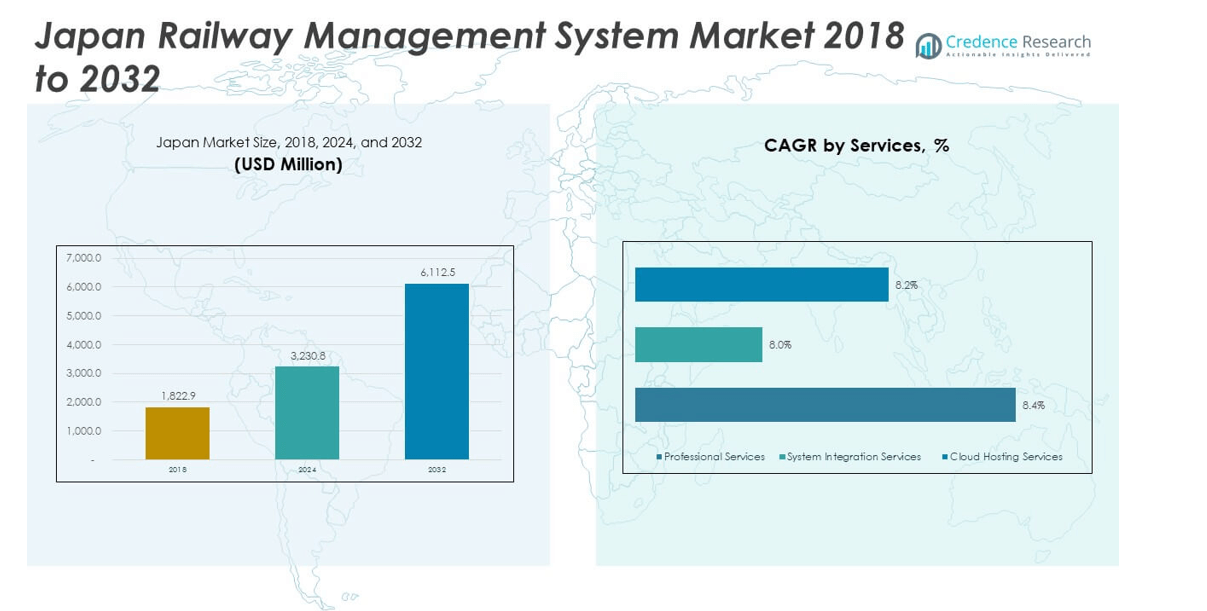
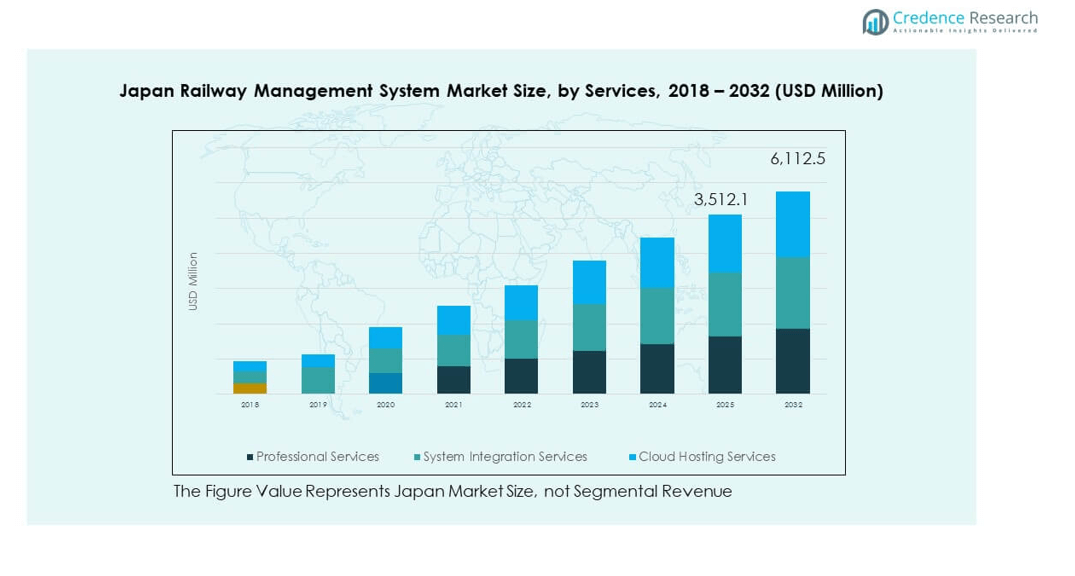
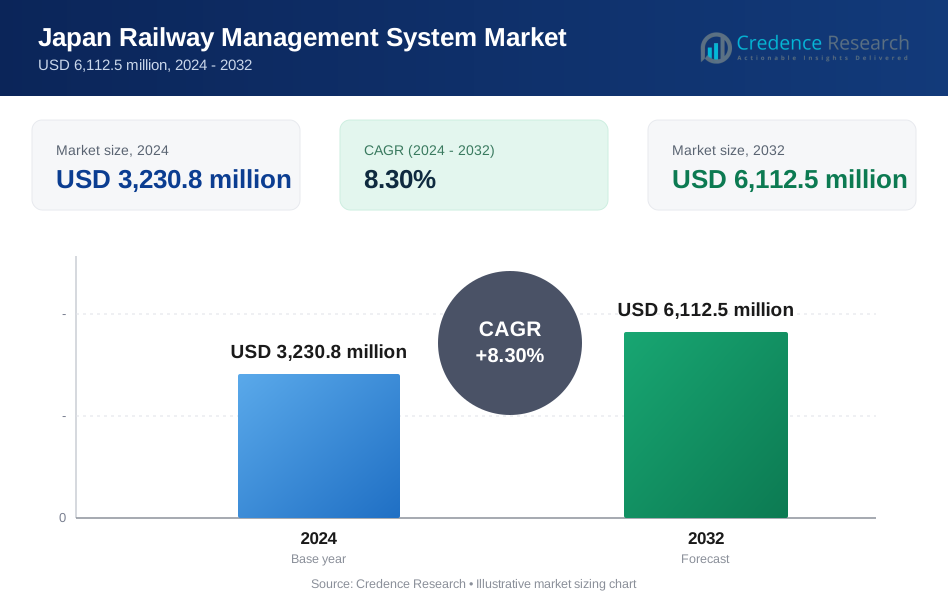
The Japan Railway Management System Market size was valued at USD 1,822.9 million in 2018 to USD 3,230.8 million in 2024 and is anticipated to reach USD 6,112.5 million by 2032, at a CAGR of 8.30% during the forecast period.
| REPORT ATTRIBUTE | DETAILS |
|---|---|
| Historical Period | 2020-2023 |
| Base Year | 2024 |
| Forecast Period | 2025-2032 |
| Japan Railway Management System Market Size 2024 | USD 3,230.8 million |
| Japan Railway Management System Market, CAGR | 8.30% |
| Japan Railway Management System Market Size 2032 | USD 6,112.5 million |
The Japan Railway Management System Market is driven by rising demand for efficient urban mobility, government-led initiatives for sustainable transport, and the adoption of automation technologies. Operators are investing in AI, IoT, and predictive maintenance tools to improve scheduling, enhance passenger safety, and reduce downtime. Growing urbanization has increased the need for smart ticketing, real-time monitoring, and integrated traffic control. Policy support encouraging carbon reduction and digital transformation continues to strengthen the market’s long-term prospects.
Eastern Japan leads the market due to its dense networks, high passenger volumes, and rapid adoption of advanced digital systems. Tokyo’s Shinkansen operations set global benchmarks in safety and reliability, reinforcing regional dominance. Western Japan, including Osaka and Kyoto, is modernizing suburban and intercity rail corridors to improve connectivity and passenger experience. Northern and Southern Japan are emerging regions, focusing on scalable digital solutions to improve efficiency and address weather-related challenges. This geographic distribution highlights how the market balances advanced leadership with gradual adoption in developing corridors.
Market Insights
- The Japan Railway Management System Market was valued at USD 1,822.9 million in 2018, reached USD 3,230.8 million in 2024, and is projected to touch USD 6,112.5 million by 2032, registering a CAGR of 8.30%.
- Eastern Japan holds the largest regional share at 52%, driven by Tokyo’s dense network and Shinkansen operations. Western Japan follows with 33%, supported by Osaka and Kyoto rail corridors, while Northern and Southern Japan together contribute 15% through steady modernization.
- Northern and Southern Japan represent the fastest-growing subregion with a combined 15% share, driven by investments in weather-resilient systems and high-speed rail enhancements in Kyushu and Hokkaido.
- Professional Services account for 42% of the Japan Railway Management System Market by services, driven by strong demand for consulting, training, and operational support.
- System Integration Services represent 38% share, reflecting the need for seamless upgrades across legacy networks, while Cloud Hosting Services make up the remainder, highlighting growth in scalable digital adoption.
Market Drivers
Rising Investments in Railway Infrastructure and Digital Transformation
The Japan Railway Management System Market benefits from strong investments in modern rail infrastructure and digital transformation programs. Government-backed projects emphasize the adoption of smart signaling, traffic control, and automation technologies to improve operational efficiency. Growing demand for reliable passenger services fuels the need for advanced scheduling and monitoring systems. Urban population growth requires efficient transportation systems that reduce congestion and improve connectivity across regions. Integration of advanced analytics helps optimize capacity, energy use, and safety protocols. Rail operators are aligning with national policies targeting sustainable mobility and lower emissions. Increased funding supports research into IoT and AI-based solutions for predictive maintenance. It enhances efficiency, strengthens safety, and improves the passenger travel experience.
- For instance, East Japan Railway Company (JR East) has introduced condition-based and risk-based maintenance supported by IoT sensors and AI analytics to improve monitoring of rolling stock and track systems. The company highlights these initiatives as part of its digital transformation strategy to enhance safety, efficiency, and predictive maintenance capabilities across its network.
Adoption of Smart Transportation Systems for Passenger Safety and Reliability
Passenger safety and reliability remain primary drivers of growth for the Japan Railway Management System Market. Modern systems integrate real-time monitoring, automated signaling, and AI-driven decision-making to enhance operational performance. Rail operators invest in predictive safety solutions to minimize accidents and delays. Continuous upgrades in communication-based train control and automated traffic management improve system responsiveness. Smart ticketing and passenger information systems help address service quality expectations. The rising adoption of data-driven platforms ensures faster response times to operational disruptions. Increased emphasis on reliable performance creates opportunities for scalable deployment across different routes. It supports long-term goals of building resilient and future-ready transportation networks.
- For instance, Central Japan Railway Company (JR Central) operates the Tokaido Shinkansen which set a global benchmark for punctuality with an average delay per train of only 1.6 minutes in FY2023, despite carrying over 150 million passengers per year. This operational excellence is driven by continued investment in advanced automation, safety protocols, and high-frequency scheduling that maintain a maximum speed of 285 km/h between Tokyo and Shin-Osaka.
Government Policies Supporting Green Mobility and Efficient Railway Systems
Strong policy frameworks play a crucial role in shaping the Japan Railway Management System Market. The government promotes green mobility to reduce carbon emissions and improve energy efficiency. National railway policies encourage the replacement of outdated systems with automated and digitalized platforms. Incentives for sustainable rail operations push operators to adopt low-energy technologies. Policy-driven support accelerates investments in integrated traffic control and asset management solutions. Energy-efficient rolling stock management systems reduce operating costs and environmental impact. Operators are encouraged to incorporate IoT-enabled systems for better efficiency and transparency. It aligns with Japan’s climate commitments while driving modernization of the entire railway network.
Integration of Advanced Technologies to Improve System Efficiency and Performance
The integration of AI, IoT, and data analytics drives performance improvements in the Japan Railway Management System Market. Predictive maintenance tools reduce downtime and improve asset lifecycle management. AI-enabled scheduling and traffic control optimize train operations and reduce delays. Data analytics platforms allow operators to assess demand and allocate resources effectively. Cloud-based solutions support real-time communication across stakeholders, enhancing coordination. Automated systems help manage rising passenger volumes efficiently while maintaining safety. Adoption of machine learning improves forecasting accuracy and passenger flow management. It creates opportunities for innovation in system upgrades and ensures continued competitiveness of Japanese railway operations.
Market Trends
Growing Role of Digital Twins and Simulation Models for Railway Optimization
The Japan Railway Management System Market is experiencing a growing trend in the adoption of digital twins and simulation technologies. These tools replicate railway infrastructure and operations in real-time for predictive analysis. Operators use simulation models to test scenarios, optimize schedules, and manage resources. Digital twins help in anticipating maintenance needs and minimizing disruptions. The technology supports energy-efficient rail operations by modeling power consumption patterns. Railway authorities integrate these solutions to plan expansions and improve passenger capacity. Adoption of simulation models reduces risks linked to infrastructure upgrades. It strengthens operational planning and boosts system resilience in complex railway environments.
Expansion of Cloud-Based Platforms for Improved Data Access and Scalability
Cloud computing is transforming the Japan Railway Management System Market by enabling scalable and accessible solutions. Operators deploy cloud-based systems for real-time data sharing across control centers, stations, and onboard units. Cloud integration allows railway authorities to centralize monitoring and reduce infrastructure costs. It enables faster deployment of updates and ensures secure access to critical information. Cloud-driven solutions support seamless communication across multiple stakeholders. Growing demand for cost-efficient infrastructure encourages wider adoption of cloud platforms. Improved cybersecurity frameworks support trust in cloud integration. It strengthens transparency and ensures greater adaptability of railway management operations.
Rising Use of Biometrics and AI in Passenger Experience Enhancement
Passenger experience enhancement is a significant trend in the Japan Railway Management System Market. Biometric ticketing and AI-powered identity verification systems improve boarding efficiency and security. AI-driven analytics track passenger flows and support crowd management. Intelligent chatbots provide real-time updates on schedules, delays, and ticketing. Rail operators explore smart kiosks and self-service solutions for faster transactions. AI-assisted platforms ensure accurate demand forecasting and capacity management. Biometric access controls also enhance security measures across busy terminals. It transforms passenger service delivery and builds stronger confidence in railway networks.
- For example, Keisei Electric Railway launched an AI-powered facial recognition ticketing system, “Face Check in Go,” for its Skyliner rapid service connecting Ueno Station, Tokyo, and Narita International Airport. This technology officially started operation on January 24, 2025, enabling passengers to register their biometric data online and pass through boarding gates using face scans.
Growing Emphasis on Cybersecurity and Protection of Railway Data Infrastructure
Cybersecurity is becoming a critical trend in the Japan Railway Management System Market. Increasing reliance on digital platforms exposes railway infrastructure to cyber threats. Operators invest in advanced cybersecurity solutions to safeguard operational data and passenger information. AI-based intrusion detection systems and multi-layer security frameworks reduce vulnerabilities. Regulatory compliance demands strong protection of data-sharing networks. Cyber resilience becomes a priority in upgrading management systems. Enhanced encryption and secure communication tools improve trust among stakeholders. It ensures operational continuity and protects the digital backbone of modern railway systems.
- For instance, Japanese rail operators are increasingly aligning with IEC 62443 international standards for cybersecurity to strengthen protection of railway control systems. Schneider Electric Japan offers IEC 62443-3-3 Level 1 certified solutions and provides architectural frameworks designed to enhance security across industrial and transportation infrastructure.
Market Challenges Analysis
High Costs of Implementation and Maintenance of Advanced Railway Systems
The Japan Railway Management System Market faces challenges due to high costs linked with implementation and maintenance. Modernizing infrastructure with advanced technologies requires significant capital expenditure. Smaller operators struggle with budget limitations, slowing adoption rates across certain routes. High integration costs of AI, IoT, and automation platforms act as barriers for widespread deployment. Maintenance expenses rise with the adoption of smart monitoring and digital assets. Operators must balance profitability with long-term sustainability goals. Financial constraints delay modernization projects in less profitable regions. It impacts the pace of digital transformation across Japan’s railway ecosystem.
Complexity of Integration Across Legacy Systems and Modern Platforms
Integration complexity is another challenge impacting the Japan Railway Management System Market. Japan’s extensive railway infrastructure includes legacy systems that are difficult to integrate with new technologies. Operators face issues in synchronizing real-time data across old and modern platforms. Technical challenges slow down deployment of advanced traffic management and scheduling systems. Interoperability between different vendor solutions creates operational bottlenecks. Skilled workforce shortages further complicate smooth integration. Ensuring reliability during upgrades requires significant planning and technical expertise. It creates delays and increases operational risks during system transitions.
Market Opportunities
Rising Global Demand for Export of Japanese Railway Technologies and Expertise
The Japan Railway Management System Market presents opportunities in exporting advanced technologies and expertise worldwide. Japan has a strong reputation in high-speed rail systems and efficient management platforms. Emerging economies in Asia, Africa, and the Middle East are seeking proven solutions for their growing transport networks. Japanese firms can capitalize on this demand by offering advanced signaling, monitoring, and predictive maintenance systems. Export contracts strengthen Japan’s influence in international railway projects. Demand for sustainable and efficient rail solutions increases opportunities for cross-border partnerships. It enhances global competitiveness and drives new revenue streams for Japanese railway firms.
Adoption of AI and IoT for Smart Mobility and Predictive Maintenance Solutions
The adoption of AI and IoT creates strong opportunities for the Japan Railway Management System Market. Intelligent platforms improve predictive maintenance by reducing downtime and ensuring safety. IoT-enabled sensors deliver real-time insights into track conditions and train performance. AI-based analytics optimize resource allocation and support energy efficiency targets. Operators can reduce operational costs through better maintenance planning and scheduling. Smart mobility solutions enhance passenger convenience and system reliability. Growing urbanization supports adoption across both intercity and metro rail networks. It creates strong opportunities for long-term technological growth in Japan’s railway sector.
Market Segmentation Analysis
The Japan Railway Management System Market
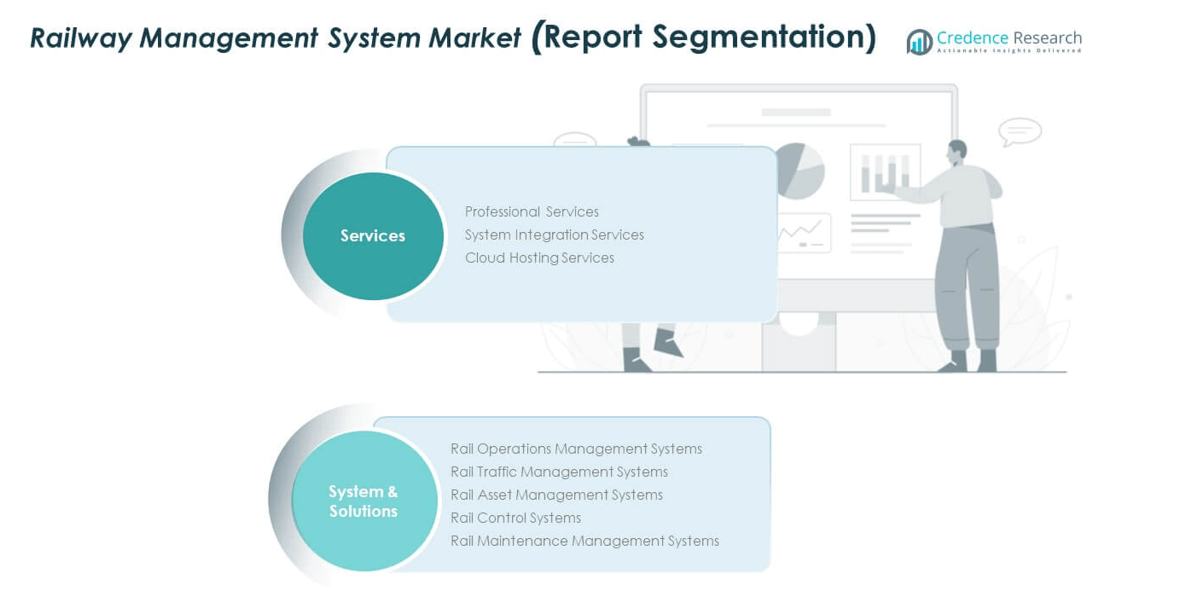
By services is divided into professional services, system integration services, and cloud hosting services. Professional services account for strong demand due to the need for consulting, design, and training across operators modernizing infrastructure. System integration services are widely deployed to ensure seamless adoption of advanced signaling, traffic management, and passenger information solutions across legacy networks. Cloud hosting services are gaining traction as operators shift toward scalable, cost-effective platforms that enable real-time data sharing and secure remote access. It reflects a growing demand for services that improve efficiency while ensuring reliability.
- For instance, Toshiba provides its "Remote Monitoring Service" for railway vehicles using IoT technologies, enabling condition-based monitoring and analysis in almost real time via a cloud platform, aiding Japanese railway operators in maintenance and remote diagnostics efforts as of March 2025
By system and solution, the market includes rail operations management systems, rail traffic management systems, rail asset management systems, rail control systems, and rail maintenance management systems. Rail operations management systems lead adoption due to their role in optimizing scheduling, capacity utilization, and passenger flow across dense urban corridors. Rail traffic management systems are essential for controlling high-frequency train movements and ensuring safe coordination. Asset management solutions support lifecycle optimization, predictive maintenance, and resource allocation, which directly reduce costs. Rail control systems remain critical for automation and communication-based signaling across high-speed and suburban routes. Rail maintenance management systems focus on predictive analytics, reducing downtime, and enhancing asset reliability. It showcases strong adoption of integrated platforms that enhance operational performance, safety, and sustainability in Japan’s railway ecosystem.
- For instance, Fujitsu and Japan Freight Railway Company (JR Freight) launched a nationwide digital maintenance and management platform in March 2024, digitizing inspection cycles and reporting a reduction in administrative man-hours and optimization of periodic inspection costs for rolling stock.
Segmentation
By Services
- Professional Services
- System Integration Services
- Cloud Hosting Services
By System & Solution
- Rail Operations Management Systems
- Rail Traffic Management Systems
- Rail Asset Management Systems
- Rail Control Systems
- Rail Maintenance Management Systems
Regional Analysis
Eastern Japan – Greater Tokyo and Surrounding Prefectures
Eastern Japan dominates the Japan Railway Management System Market with a share of 52%, supported by Tokyo’s dense urban network and high-speed Shinkansen operations. The region invests heavily in automated signaling, advanced traffic control, and AI-enabled scheduling to handle daily commuter volumes. Integration of IoT platforms in stations enhances passenger safety and operational reliability. Local authorities emphasize sustainability through energy-efficient rail systems and digital monitoring. Operators in Tokyo and nearby prefectures adopt predictive maintenance solutions to ensure smooth operations. It remains the central hub of innovation and sets benchmarks for railway modernization.
Western Japan – Osaka, Kyoto, and Regional Rail Corridors
Western Japan holds 33% of the Japan Railway Management System Market, driven by Osaka, Kyoto, and surrounding rail corridors. The region prioritizes modernization of intercity and suburban rail lines to meet rising demand. Investments in smart ticketing and digital passenger information systems improve customer experience. Strong focus on rail freight management supports logistics growth in industrial hubs. Operators are adopting cloud-based platforms to improve connectivity and efficiency across regional networks. It demonstrates steady adoption of smart technologies while aligning with the national digital mobility strategy.
Northern and Southern Japan – Hokkaido and Kyushu Regions
Northern and Southern Japan account for a combined 15% share of the Japan Railway Management System Market. Hokkaido focuses on digital monitoring systems to manage extreme weather challenges and improve rail safety. Kyushu invests in enhancing high-speed rail and integrating automated solutions into regional transport. Both regions deploy scalable railway management platforms to increase efficiency and reduce operational disruptions. Investments are smaller compared to Tokyo and Osaka but reflect gradual modernization efforts. It is emerging as an important contributor, supported by regional government programs promoting smart infrastructure growth.
Key Player Analysis
- Hitachi Ltd.
- Toshiba
- Alstom
- Fujitsu Limited
- Kyosan
- TOKYO KEIKI
- NIPPON SIGNAL CO., LTD.
- Transreport Limited
- Indra Sistemas
- Other Key Players
Competitive Analysis
The Japan Railway Management System Market features strong competition among domestic and international players, each striving to enhance their technological edge. Companies such as Hitachi Ltd., Toshiba, Fujitsu Limited, and Nippon Signal lead the market with advanced portfolios in signaling, control systems, and predictive maintenance technologies. Global leaders like Alstom and Indra Sistemas strengthen competition by introducing innovative solutions tailored to Japan’s regulatory and operational standards. Smaller firms including Kyosan, TOKYO KEIKI, and Transreport add diversity with niche services and specialized systems. Competitive strategies focus on mergers, technology integration, and regional expansion. It is shaped by continuous investment in automation, AI-driven solutions, and partnerships with rail operators to achieve sustainability, safety, and efficiency goals.
Recent Developments
- In September 2025, East Japan Railway Company (JR East) and SkyDrive announced an expansion of their collaborative efforts by holding a prominent exhibition in Tokyo to showcase the integration potential of rail and eVTOL (electric vertical takeoff and landing) travel. This event followed a July 2025 financial investment by JR East into SkyDrive.
- In March 2025, West Japan Railway Company (JR West) announced a new partnership with Saffron Brand Consultants for the ongoing Setouchi Palette Project. This initiative focuses on place branding aimed at revitalizing the Setouchi region and enhancing its global appeal for tourists and residents alike.
- In February 2025, Transreport partnered with Hankyu Corporation to prepare a new web application called Passenger Assistance Web. The solution lets passengers store their access needs ahead of travel through a single profile. Frontline railway staff receive advance notice to better serve passengers requiring assistance. The launch aims to improve accessibility across Japan’s public transport network.
Report Coverage
The research report offers an in-depth analysis based on Services and System & Solution. It details leading market players, providing an overview of their business, product offerings, investments, revenue streams, and key applications. Additionally, the report includes insights into the competitive environment, SWOT analysis, current market trends, as well as the primary drivers and constraints. Furthermore, it discusses various factors that have driven market expansion in recent years. The report also explores market dynamics, regulatory scenarios, and technological advancements that are shaping the industry. It assesses the impact of external factors and global economic changes on market growth. Lastly, it provides strategic recommendations for new entrants and established companies to navigate the complexities of the market.
Future Outlook
- The Japan Railway Management System Market will see wider adoption of AI-driven scheduling tools to improve efficiency.
- Expansion of IoT-based monitoring platforms will strengthen predictive maintenance across urban and regional networks.
- Passenger-focused solutions such as biometric ticketing and digital kiosks will become more common nationwide.
- Cloud-based systems will dominate deployments, offering scalability and secure data management for railway operators.
- Rising emphasis on cybersecurity will push firms to implement multi-layer defense strategies for digital platforms.
- High-speed rail modernization will remain a priority, driving investment in automated control and signaling systems.
- Government-backed sustainability programs will increase demand for energy-efficient railway management platforms.
- Export opportunities will expand as Japanese firms share expertise with international transport networks.
- Regional corridors outside Tokyo and Osaka will witness gradual technology adoption to support connectivity.
- Strategic collaborations among domestic and global companies will boost innovation and accelerate system integration.
Request a Free Sample
Fill in your details and we'll send you a free sample report.
- Sample data tables & charts
- Research methodology
Need a Custom Version of This Report?
Tailor the scope, geography, or segments to your exact requirements.
- Custom geography or segment scope
- Direct access to our analyst team
Frequently Asked Questions
What is the current market size for Japan Railway Management System Market, and what is its projected size in 2032?
At what Compound Annual Growth Rate is the Japan Railway Management System Market projected to grow between 2024 and 2032?
Which Japan Railway Management System Market segment held the largest share in 2024?
What are the primary factors fueling the growth of the Japan Railway Management System Market?
Who are the leading companies in the Japan Railway Management System Market?
Table of Content
Chapter 1. Report Introduction
- 1.1 Report Description & Purpose
- 1.1.1 Report Title & Market Definition
- 1.1.2 Unique Selling Propositions (USP) & Key Differentiators
- 1.1.3 Value Proposition for Stakeholders
- 1.2 Research Objectives
- 1.2.1 Market Sizing Objectives (Volume & Revenue)
- 1.2.2 Segmentation Objectives
- 1.2.3 Competitive Intelligence Objectives
- 1.2.4 Forecast & Scenario Objectives
- 1.3 Report Scope
- 1.3.1 Japan Railway Management System Scope – Types & Subtypes Covered
- 1.3.2 Geographic Scope – Regions & Countries Covered
- 1.3.3 Historical Period, Base Year & Forecast Period (2024; forecast to 2032)
- 1.3.4 Inclusions & Exclusions
- 1.4 HS Code & Classification Framework
- 1.5 Currency, Units & Pricing Basis
- 1.6 Target Stakeholders
- 1.7 Limitations & Assumptions
Chapter 2. Executive Summary
- 2.1 Global Japan Railway Management System Market Snapshot
- 2.1.1 Market Size – Historical (2024) & Forecast (2024-2032) (2024: USD 3,230.8 million → 2032: USD 6,112.5 million)
- 2.1.2 Volume & Revenue – Global Totals
- 2.1.3 Key Market Highlights – Top Five Facts
- 2.2 Japan Railway Management System Market Segmentation Snapshot
- 2.2.1 Market Split by Region – 2024 vs. 2032
- 2.3 Competitive Snapshot
- 2.3.1 Top 10 Players by Revenue Share – 2024
- 2.3.2 Top 10 Players by Volume Share – 2024
- 2.3.3 Recent Strategic Developments (18-Month Summary)
- 2.4 Key Investment Highlights & Strategic Conclusions
Chapter 3. Japan Railway Management System Market Dynamics & Industry Analysis
- 3.1 Market Overview & Context
- 3.1.1 Japan Railway Management System Market Position in the Broader Automotive Value Chain
- 3.1.2 OEM vs. Replacement Market Dynamics
- 3.1.3 Market Maturity & Development Stage by Region
- 3.2 Japan Railway Management System Market Drivers
- 3.3 Japan Railway Management System Market Restraints & Challenges
- 3.4 Japan Railway Management System Market Opportunities
- 3.5 Porter's Five Forces Analysis
- 3.5.1 Threat of New Entrants
- 3.5.2 Bargaining Power of Suppliers
- 3.5.3 Bargaining Power of Buyers
- 3.5.4 Threat of Substitutes
- 3.5.5 Competitive Rivalry – Intensity Assessment
- 3.6 Japan Railway Management System Value Chain Analysis
- 3.6.1 Upstream – Raw Material/Input Suppliers
- 3.6.1.1 Raw Material/Input 1
- 3.6.1.2 Raw Material/Input 2
- 3.6.1.3 Raw Material/Input 3
- 3.6.2 Midstream – Production/Manufacturing/Service Delivery
- 3.6.2.1 Production/Process Overview
- 3.6.2.2 Key Facility Locations & Capacity by Manufacturer
- 3.6.3 Downstream – Distribution & End Consumer
- 3.6.3.1 Primary Channel – B2B/OEM
- 3.6.3.2 Secondary Channels – Dealer, Retail, Online, Direct
- 3.6.4 Value Chain Profitability Analysis
- 3.6.1 Upstream – Raw Material/Input Suppliers
- 3.7 PESTEL Analysis
- 3.7.1 Political Factors
- 3.7.2 Economic Factors
- 3.7.3 Social Factors
- 3.7.4 Technological Factors
- 3.7.5 Environmental Factors
- 3.7.6 Legal Factors
- 3.8 Japan Railway Management System Supply Chain Analysis
- 3.8.1 Raw Material/Input Supply Risk Assessment
- 3.8.2 Manufacturing Concentration Risk (Geographic Exposure)
- 3.8.3 Trade Disruption Impact Analysis
- 3.9 Regulatory & Policy Landscape
Note: The regulatory and policy landscape section covers regulations based on their applicability to the market, Japan Railway Management System category, geography, and scope of the study. Only regulatory frameworks with a material impact on operations, compliance, trade, sustainability, or market access are analyzed in detail.
Chapter 4. Key Investment Pockets & Opportunity Analysis
- 4.1 Japan Railway Management System Market Attractiveness Analysis
- 4.1.1 By Region – Investment Attractiveness Matrix (Volume × CAGR)
- 4.2 Absolute Revenue Growth Opportunity
- 4.2.1 By Region – Absolute USD Growth Through 2032
- 4.3 Incremental Volume Opportunity
- 4.3.1 By Region – Incremental Volume Through 2032
- 4.3.2 Segment – Incremental Volume
- 4.4 Emerging Submarket Opportunity Deep Dive (Subject to Applicability)
- 4.5 Emerging Market Opportunity Scorecards
- 4.5.1 United States
- 4.5.2 Europe
- 4.5.3 Asia
- 4.5.4 Middle East & Africa
Note: Emerging Market Opportunity Scorecards will be included based on relevance and strategic importance. Regions listed are indicative and may vary depending on data availability and market dynamics.
Chapter 5. Japan Railway Management System Import-Export Analysis & Trade Flows
- 5.1 Global Trade Overview
- 5.1.1 Global Export Value by Country (2024)
- 5.1.2 Global Export Volume by Country (2024)
- 5.1.3 Global Import Value by Country (2024)
- 5.1.4 Global Import Volume by Country (2024)
- 5.1.5 Net Trade Balance by Country (2024)
- 5.2 Export Analysis – Segment
- 5.2.1 Type 1 (HS Code)
- 5.2.2 Type 2 (HS Code)
- 5.2.3 Type 3 (HS Code)
- 5.2.4 Type 4 (HS Code)
- 5.2.5 Type 5 (HS Code)
- 5.3 Import Analysis – Segment
- 5.3.1 Type 1 (HS Code)
- 5.3.2 Type 2 (HS Code)
- 5.3.3 Type 3 (HS Code)
- 5.3.4 Type 4 (HS Code)
- 5.3.5 Type 5 (HS Code)
- 5.4 Average Unit Trade Prices
- 5.4.1 Average Export Price – Segment & Country
- 5.4.2 Average Import Price – Segment & Source Country
- 5.4.3 Price Trends (2024)
- 5.5 Key Trade Route Analysis
- 5.5.1 Trade Route 1
- 5.5.2 Trade Route 2
- 5.5.3 Trade Route 3
- 5.5.4 Trade Route 4
- 5.5.5 Trade Route 5
- 5.6 Trade Policy Impact Assessment
- 5.6.1 US Anti-Dumping & Section 301 Tariffs
- 5.6.2 EU Customs Union Impact
- 5.6.3 Major Free Trade Agreements
- 5.6.4 USMCA Rules of Origin
Note: Trade policy analysis will be included only where relevant to the Japan Railway Management System market.
Chapter 6. Competitive Landscape & Company Benchmarking
- 6.1 Japan Railway Management System Market Concentration & Structure
- 6.1.1 Herfindahl-Hirschman Index (HHI) – vs. 2024
- 6.1.2 Tier 1, Tier 2 & Tier 3 Market Structure
- 6.1.3 Global, Regional & Local Player Dynamics
- 6.2 Japan Railway Management System Market Share Analysis – 2024
- 6.2.1 Global Revenue Share by Company
- 6.2.2 Global Volume Share by Company
- 6.2.3 Regional Revenue Share
- 6.2.4 Market Share Evolution ( vs. 2024)
- 6.2.5 OEM Segment Share by Company
- 6.2.6 Replacement Segment Share by Company
- 6.3 Production/Delivery Capacity & Facility Analysis
- 6.3.1 Global Installed Capacity
- 6.3.2 Capacity Utilization Rates
- 6.3.3 Production/Output Volume
- 6.3.4 Facility Locations & Capacity Map
- 6.3.5 Planned Capacity Additions
- 6.4 Japan Railway Management System Competitive Benchmarking Matrix
- 6.4.1 Revenue, Volume, CAGR & Profitability Comparison
- 6.4.2 Channel Revenue Mix
- 6.4.3 Geographic Revenue Exposure
- 6.4.4 R&D Intensity
- 6.4.5 Sustainability Maturity
- 6.5 Strategic Developments in Japan Railway Management System (Last 24 Months)
- 6.5.1 Mergers, Acquisitions & Divestments
- 6.5.2 New Japan Railway Management System Launches
- 6.5.3 Facility Expansions
- 6.5.4 Strategic Alliances, Joint Ventures & Partnerships
- 6.5.5 Distribution Expansion & Market Entry
- 6.5.6 Sustainability & ESG Initiatives
- 6.6 Competitive Strategy Mapping
- 6.6.1 Leader, Challenger, Follower & Niche Classification
- 6.6.2 Pricing Strategy Comparison
- 6.6.3 Channel Strategy Matrix
Note: Strategic developments are included based on their materiality and the availability of reliable information.
Chapter 7. Global Japan Railway Management System Market – By Distribution Channel
- 7.1 Segment Overview
- 7.1.1 Volume & Revenue Split by Channel (2024 & 2032)
- 7.1.2 Channel Mix Evolution (2024-2032)
Chapter 8. Regional Market Analysis – Global Overview
- 8.1 Global Regional Overview
- 8.1.1 Regional Volume Share
- 8.1.2 Regional Revenue Share
- 8.1.3 Regional Volume by Region
- 8.1.4 Regional Revenue by Region
- 8.1.5 Regional Forecast Through 2032
- 8.2 Cross-Regional Segment Analysis
- 8.2.1 By Distribution Channel
- 8.2.2 By Brand/Price Tier
Chapter 9. North America Japan Railway Management System Market
- 9.1 United States
- 9.2 Canada
- 9.3 Mexico
Chapter 10. Europe Japan Railway Management System Market
- 10.1 Germany
- 10.2 France
- 10.3 Italy
- 10.4 United Kingdom
- 10.5 Spain
- 10.6 Poland
- 10.7 Russia
- 10.8 Netherlands
- 10.9 Belgium
- 10.10 Sweden
- 10.11 Denmark
- 10.12 Norway
- 10.13 Rest of Europe
Chapter 11. Asia Pacific Japan Railway Management System Market
- 11.1 China
- 11.2 India
- 11.3 Japan
- 11.4 South Korea
- 11.5 Thailand
- 11.6 Indonesia
- 11.7 Vietnam
- 11.8 Malaysia
- 11.9 Australia
- 11.10 Rest of Asia Pacific
Chapter 12. Latin America Japan Railway Management System Market
- 12.1 Brazil
- 12.2 Argentina
- 12.3 Colombia
- 12.4 Chile
- 12.5 Rest of Latin America
Chapter 13. Middle East Japan Railway Management System Market
- 13.1 Saudi Arabia
- 13.2 United Arab Emirates
- 13.3 Turkey
- 13.4 Israel
- 13.5 Iran
- 13.6 Rest of the Middle East
Chapter 14. Africa Japan Railway Management System Market
- 14.1 South Africa
- 14.2 Egypt
- 14.3 Nigeria
- 14.4 Morocco
- 14.5 Rest of Africa
Chapter 15. Japan Railway Management System Company Profiles
- 15.1 [Company 01]
- 15.1.1 Company Overview
- 15.1.2 Key Management Personnel
- 15.1.3 Products & Services Portfolio
- 15.1.4 Financial Performance
- 15.1.5 Key Market Focus & Geographic Presence
- 15.1.6 Recent Developments & Strategic Initiatives
Note: The company profile list is preliminary and may change based on research findings, market developments, data availability, and client requirements.
Chapter 16. Appendices
- Appendix A – List of Abbreviations & Acronyms
- Appendix B – Industry Classification Code Reference – Full Series
- Appendix C – Production & Capacity Data Tables
- Appendix D – End-Use & Demand Base Tables
- Appendix E – Consumption & Replacement Rate Assumptions
- Appendix F – ASP Reference Tables
- Appendix G – Manufacturing & Facility Database
- Appendix H – Import-Export Data Tables
- Appendix I – Regulatory Summary Tables
- Appendix J – Primary Research Participant List (Anonymized)
- Appendix K – Primary Research Questionnaire Framework
- Appendix L – Data Sources & Bibliography
- Appendix M – Market Size Divergence & Source Comparison
Chapter 17. Research Methodology
- 17.1 Research Framework & Philosophy
- 17.2 Secondary Research – Sources, Hierarchy & Data Extraction
- 17.3 Data Modeling – Bottom-Up & Top-Down Market Sizing
- 17.4 Primary Research – Stakeholder Framework, LOI & Sample Sizes
- 17.5 Forecast Methodology – Regression, Scenario & Sensitivity Analysis
- 17.6 Quality Control – Four-Layer Validation Framework
- 17.7 Limitations & Standard Assumptions
- 17.8 Disclaimer
