
Magnetic Filter Market Overview:
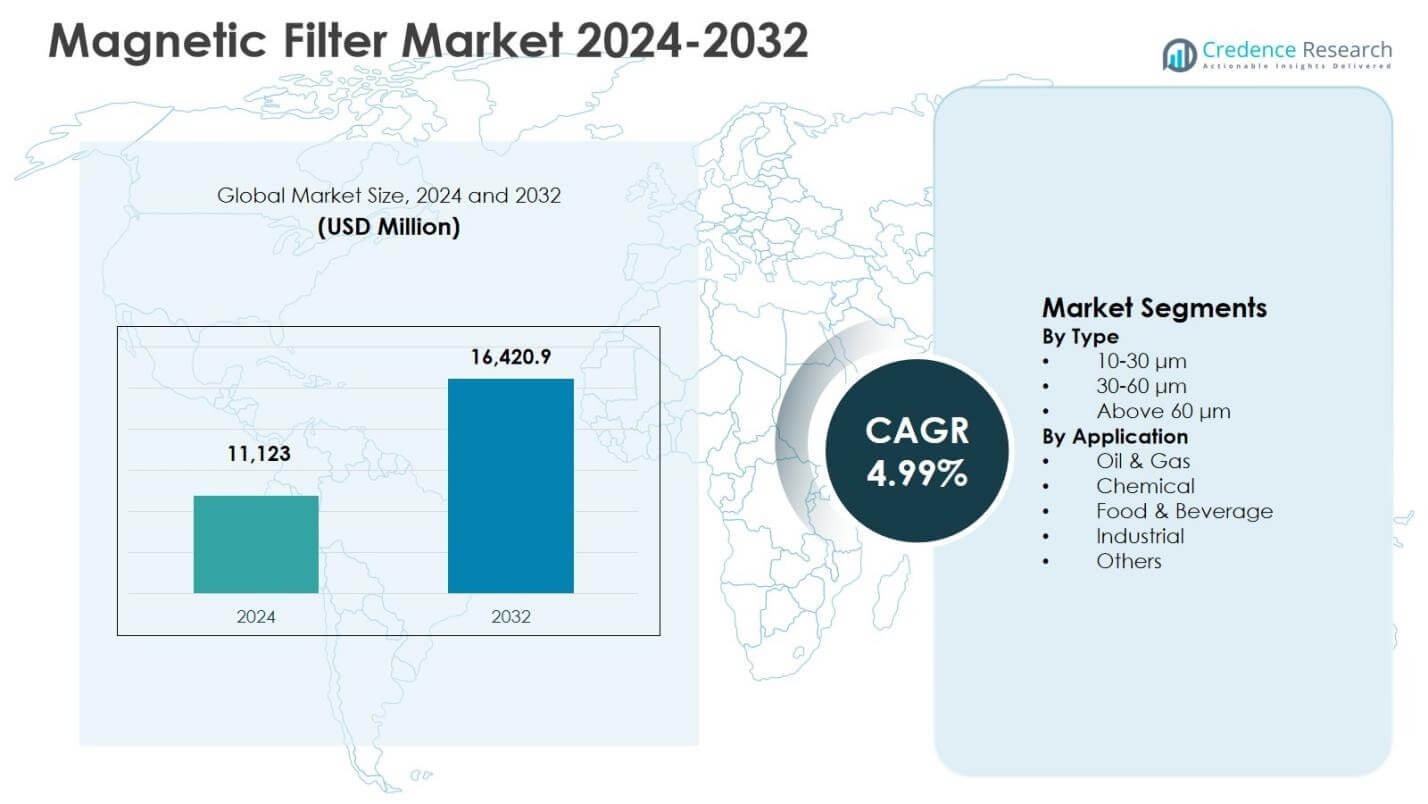
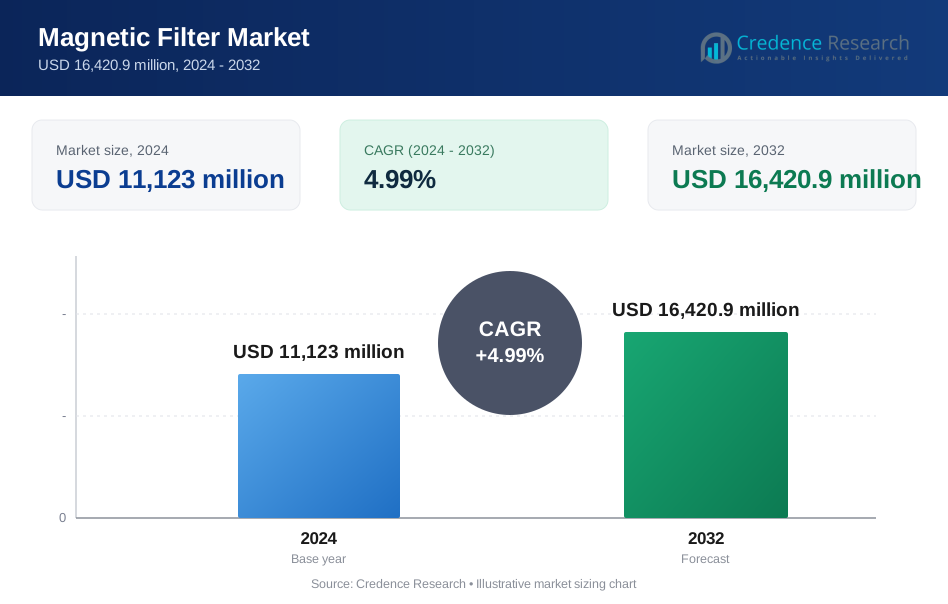
The Magnetic Filter Market size was valued at USD 11,123 million in 2024 and is anticipated to reach USD 16,420.9 million by 2032, growing at a CAGR of 4.99% during the forecast period.
| EPORT ATTRIBUTE | DETAILS |
|---|---|
| Historical Period | 2020-2023 |
| Base Year | 2024 |
| Forecast Period | 2025-2032 |
| Magnetic Filter Market Size 2024 | USD 11,123 million |
| Magnetic Filter Market, CAGR | 4.99% |
| Magnetic Filter Market Size 2032 | USD 16,420.9 million |
Magnetic Filter Market Insights
- Growth of the Magnetic Filter Market is driven by rising focus on equipment protection, preventive maintenance, and operational efficiency across industrial manufacturing, oil & gas, chemical, and food processing sectors.
- The market is witnessing strong demand for fine filtration solutions, with the 10–30 μm segment holding 46.8% share in 2024, supported by its effectiveness in capturing fine ferrous contaminants and reducing equipment downtime.
- Market structure remains moderately fragmented, with players competing on magnetic strength, customization capability, hygienic designs, and application-specific performance across regulated and heavy-duty industries.
- Regionally, Asia-Pacific led with 34.9% share in 2024, followed by North America at 28.4% and Europe at 26.7%, while Latin America and Middle East & Africa together accounted for the remaining share, supported by gradual industrial expansion.
Magnetic Filter Market Size Segmentation Analysis:
By Type:
The Magnetic Filter Market, by type, is led by the 10–30 μm segment, which accounted for 46.8% market share in 2024, driven by its high efficiency in capturing fine ferrous contaminants across critical industrial processes. This segment benefits from widespread adoption in precision filtration applications where equipment protection and product purity are essential. The 30–60 μm segment follows, supported by moderate-duty filtration requirements, while the above 60 μm segment serves coarse filtration needs in heavy industries. Rising demand for fine-particle separation, reduced equipment downtime, and improved process reliability continues to strengthen dominance of the 10–30 μm category.
- For instance, Eclipse Magnetics' Filtramag+ magnetic filter captures ferrous particles including those from steel and cast iron down to sub-micron sizes in CNC cutting fluids and coolants, preventing equipment wear while maintaining flow rates up to 500 liters/min.
By Application:
By application, the Magnetic Filter Market is dominated by the industrial segment, which held 38.5% market share in 2024, supported by extensive use in manufacturing, metal processing, power generation, and machinery protection systems. Industrial facilities increasingly deploy magnetic filters to enhance operational efficiency, prevent equipment wear, and reduce maintenance costs. The oil & gas and chemical segments follow, driven by contamination control and safety compliance, while food & beverage adoption grows due to hygiene regulations. Continuous industrial automation and stringent quality standards remain the primary drivers sustaining industrial application leadership.
- For instance, One Eye Industries applied magnetic filtration in power generation, designing high-performance bypass filters with minimal flow restriction to protect equipment continuously from wear contaminants.
Key Growth Drivers
Rising Emphasis on Equipment Protection and Operational Efficiency
The Magnetic Filter Market is strongly driven by increasing emphasis on protecting industrial equipment and improving operational efficiency across manufacturing, energy, and process industries. Magnetic filters effectively remove ferrous contaminants from fluids, preventing abrasion, blockages, and premature wear of pumps, valves, and pipelines. Industries are prioritizing preventive maintenance strategies to reduce unplanned downtime and extend equipment life, which directly supports higher adoption of magnetic filtration systems. The ability of magnetic filters to operate continuously without consumables further enhances cost efficiency, making them a preferred solution in both heavy-duty and precision industrial applications.
- For instance, Eclipse Magnetics supplied Filtramag+ filters to a leading automotive components manufacturer for camshaft grinding machines. These filters reduced downtime costs by 50% and extended coolant life, minimizing wear on equipment from ferrous particles.
Expansion of Industrial Automation and Process Optimization
Rapid growth in industrial automation and process optimization is a major driver for the Magnetic Filter Market. Automated production lines require consistent fluid purity to maintain accuracy, product quality, and system reliability. Magnetic filters support these requirements by delivering uninterrupted contaminant removal without pressure drop or manual intervention. As smart factories and Industry 4.0 initiatives expand globally, manufacturers increasingly integrate magnetic filtration into closed-loop systems. This integration helps stabilize process parameters, minimize production losses, and meet tighter quality tolerances, reinforcing sustained demand across automated industrial environments.
- For instance, Schaudt Mikrosa in Germany used Filtramag in camshaft grinding, reducing downtime by 50% and extending grinding wheel life by 30%.
Stringent Quality and Safety Regulations Across End-use Industries
Stricter quality, safety, and environmental regulations significantly drive growth in the Magnetic Filter Market. Industries such as food & beverage, chemical processing, oil & gas, and pharmaceuticals face rising compliance requirements related to contamination control and product integrity. Magnetic filters offer a reliable, chemical-free solution to meet regulatory standards without altering process chemistry. Their hygienic design, ease of cleaning, and traceability advantages support compliance audits and quality certifications. Regulatory pressure, combined with increasing liability risks, continues to accelerate the adoption of magnetic filtration solutions across regulated industries.
Key Trends & Opportunities
Growing Adoption in Food, Beverage, and Pharmaceutical Processing
A key trend in the Magnetic Filter Market is expanding adoption within food, beverage, and pharmaceutical processing, where contamination tolerance is extremely low. Manufacturers increasingly deploy magnetic filters to remove metal particles from liquids, powders, and slurries to protect consumers and comply with food safety standards. Opportunities are emerging for hygienic, easy-to-clean, and high-intensity magnetic filters designed for sanitary environments. Customizable designs, compact footprints, and integration with existing processing equipment are creating new revenue avenues for suppliers targeting premium, compliance-driven end-use sectors.
- For instance, Dial Corporation's food processing facility in Fort Madison installed One Eye Industries (OEI) Magnetic Funnel Scrubbers on multi-product lines handling varied densities and viscosities.
Technological Advancements in High-Intensity and Custom Magnetic Systems
Technological advancements present strong opportunities in the Magnetic Filter Market, particularly in high-intensity rare-earth magnets and application-specific designs. Innovations focus on improving capture efficiency for finer particles, enhancing magnetic strength, and enabling modular configurations for diverse industrial needs. Advanced materials and optimized magnetic circuits allow filters to perform effectively in high-temperature, high-pressure, and corrosive environments. These developments open opportunities in specialized sectors such as renewable energy, advanced manufacturing, and specialty chemicals, where conventional filtration systems often face performance limitations.
- For instance, Bunting developed this high-intensity electromagnetic filter generating 3,500 to 5,000 Gauss, peaking at 12,000 Gauss on the matrix for capturing fine ferrous particles in powders used in mineral processing and ceramics.
Key Challenges
High Initial Investment and Customization Costs
One of the key challenges in the Magnetic Filter Market is the relatively high initial investment, especially for customized or high-intensity magnetic filtration systems. Small and medium-sized enterprises may hesitate to adopt advanced magnetic filters due to upfront costs, despite long-term operational savings. Custom engineering requirements, material selection, and installation complexity further add to capital expenditure. This challenge is more pronounced in price-sensitive markets, where traditional filtration solutions still dominate purchasing decisions, slowing penetration of advanced magnetic filtration technologies.
Limited Effectiveness for Non-Ferrous Contaminants
Another major challenge facing the Magnetic Filter Market is the limited effectiveness of magnetic filters in removing non-ferrous contaminants. While highly efficient for ferrous and weakly magnetic particles, these systems often require complementary filtration technologies to address non-magnetic impurities. This limitation increases system complexity and overall filtration costs for end users. Industries dealing with mixed-contaminant streams may prefer multi-stage filtration systems, which can reduce reliance on magnetic filters alone and create competition from alternative filtration technologies.
Regional Analysis
North America
The Magnetic Filter Market in North America accounted for 28.4% market share in 2024, supported by strong adoption across oil & gas, chemical processing, food & beverage, and advanced manufacturing industries. The region benefits from high awareness of preventive maintenance, stringent quality standards, and widespread use of automated production systems. Magnetic filters are increasingly deployed to protect high-value equipment, reduce downtime, and comply with safety regulations. The presence of established industrial infrastructure and continued investments in process optimization and smart manufacturing further reinforce demand, positioning North America as a mature yet steadily expanding regional market.
Europe
Europe captured 26.7% market share in 2024 in the Magnetic Filter Market, driven by strict environmental regulations, high manufacturing standards, and strong emphasis on contamination control. Industries such as chemicals, pharmaceuticals, food processing, and industrial machinery extensively deploy magnetic filtration systems to meet compliance requirements and improve operational reliability. The region’s focus on energy efficiency, equipment longevity, and sustainability supports long-term adoption. Germany, the UK, France, and Italy lead demand due to their robust industrial bases and technological expertise, while increasing modernization of processing facilities continues to support regional growth.
Asia-Pacific
Asia-Pacific dominated the Magnetic Filter Market with 34.9% market share in 2024, supported by rapid industrialization, expanding manufacturing capacity, and growing investments in oil & gas, chemicals, and food processing. Countries such as China, India, Japan, and South Korea drive strong demand due to rising production volumes and increasing focus on equipment protection. The region benefits from large-scale infrastructure development, cost-sensitive industries seeking low-maintenance filtration solutions, and expanding automation. Growing regulatory enforcement and modernization of industrial plants further strengthen Asia-Pacific’s leadership position in the global market.
Latin America
Latin America held 6.1% market share in 2024 in the Magnetic Filter Market, supported by steady growth in oil & gas, mining, food processing, and industrial manufacturing sectors. Brazil, Mexico, and Argentina lead regional demand as industries invest in equipment protection and contamination control to improve operational efficiency. Increasing adoption of magnetic filters is driven by the need to reduce maintenance costs and extend machinery life in challenging operating environments. Although infrastructure development remains uneven, gradual industrial upgrades and rising awareness of preventive maintenance continue to support moderate regional market expansion.
Middle East & Africa
The Middle East & Africa accounted for 3.9% market share in 2024 in the Magnetic Filter Market, driven primarily by oil & gas, petrochemical, water treatment, and industrial processing activities. Countries such as Saudi Arabia, the UAE, and South Africa are key contributors, supported by investments in energy infrastructure and industrial diversification initiatives. Magnetic filters are increasingly used to enhance equipment reliability under harsh operating conditions. While adoption remains lower than other regions, growing industrial development, regulatory improvements, and focus on operational efficiency are gradually strengthening regional demand.
Magnetic Filter Market Size Segmentations:
By Type
- 10-30 μm
- 30-60 μm
- Above 60 μm
By Application
- Oil & Gas
- Chemical
- Food & Beverage
- Industrial
- Others
By Geography
- North America
- U.S.
- Canada
- Mexico
- Europe
- Germany
- France
- U.K.
- Italy
- Spain
- Rest of Europe
- Asia Pacific
- China
- Japan
- India
- South Korea
- South-east Asia
- Rest of Asia Pacific
- Latin America
- Brazil
- Argentina
- Rest of Latin America
- Middle East & Africa
- GCC Countries
- South Africa
- Rest of the Middle East and Africa
Competitive Landscape
Competitive landscape analysis of the Magnetic Filter Market features key players such as Eclipse Magnetics, Bunting, Goudsmit Magnetics, Permanent Magnets Ltd, Magnetix, Magnom, Metso Outotec, Procema, Inta, and Worcester Bosch. The market remains moderately fragmented, with competition driven by product performance, magnetic strength, customization capability, and application-specific solutions. Leading companies focus on high-intensity magnetic filters, hygienic designs, and robust systems suited for harsh industrial environments. Continuous investments in R&D support advancements in rare-earth magnet technology, fine-particle separation, and low-maintenance designs. Strategic initiatives such as product portfolio expansion, customized engineering solutions, and long-term supply contracts strengthen market positioning. Players increasingly target regulated industries including food & beverage, chemicals, and oil & gas to secure stable demand. Global presence, technical expertise, and after-sales support remain critical differentiators influencing competitive dynamics.
Key Player Analysis
- Magnom
- Worcester Bosch
- Procema
- Permanent Magnets Ltd
- Inta
- Goudsmit Magnetics
- Magnetix
- Metso Outotec
- Bunting
- Eclipse Magnetics
Recent Developments
- In October 2025, Kolari Vision announced the launch of its magnetic OLPF Clip-In Filter for Panasonic Lumix L-Mount cameras, designed to reduce moiré and false color with an easy magnetic install.
- In November 2025, Kensington formed a strategic partnership with espresso Displays to integrate high-clarity magnetic privacy screen filters with espresso Pro, espresso Touch, and espresso non-touch portable monitors, enhancing data privacy and clarity for mobile professionals.
Report Coverage
The research report offers an in-depth analysis based on Type, Application and Geography. It details leading market players, providing an overview of their business, product offerings, investments, revenue streams, and key applications. Additionally, the report includes insights into the competitive environment, SWOT analysis, current market trends, as well as the primary drivers and constraints. Furthermore, it discusses various factors that have driven market expansion in recent years. The report also explores market dynamics, regulatory scenarios, and technological advancements that are shaping the industry. It assesses the impact of external factors and global economic changes on market growth. Lastly, it provides strategic recommendations for new entrants and established companies to navigate the complexities of the market.
Future Outlook
- Magnetic filters will see sustained adoption as industries prioritize equipment protection and preventive maintenance.
- Demand will increase with the expansion of automated and continuous processing systems.
- High-intensity and fine-particle magnetic filtration solutions will gain wider acceptance.
- Food, beverage, and pharmaceutical industries will drive growth through stricter contamination control requirements.
- Industrial manufacturing will remain the largest end-use sector due to heavy machinery protection needs.
- Technological advancements will improve magnetic strength, durability, and operating efficiency.
- Custom-engineered magnetic filters will gain traction across specialized industrial applications.
- Integration with multi-stage filtration systems will expand overall market penetration.
- Emerging economies will offer new growth opportunities through industrial expansion and infrastructure development.
- Sustainability and reduced consumable waste will support long-term preference for magnetic filtration solutions.
Request a Free Sample
Fill in your details and we'll send you a free sample report.
- Sample data tables & charts
- Research methodology
Need a Custom Version of This Report?
Tailor the scope, geography, or segments to your exact requirements.
- Custom geography or segment scope
- Direct access to our analyst team
Frequently Asked Questions
What is the current market size for the Magnetic Filter Market, and what is its projected size in 2032?
At what Compound Annual Growth Rate is the Magnetic Filter Market projected to grow between 2024 and 2032?
Which Magnetic Filter Market segment held the largest share in 2024?
What are the primary factors fueling the growth of the Magnetic Filter Market?
Who are the leading companies in the Magnetic Filter Market?
Which region commanded the largest share of the Magnetic Filter Market in 2024?
Table of Content
Chapter 1. Report Introduction
- 1.1 Report Description & Purpose
- 1.1.1 Report Title & Market Definition
- 1.1.2 Unique Selling Propositions (USP) & Key Differentiators
- 1.1.3 Value Proposition for Stakeholders
- 1.2 Research Objectives
- 1.2.1 Market Sizing Objectives (Volume & Revenue) (Volume Where Applicable)
- 1.2.2 Segmentation Objectives
- 1.2.3 Competitive Intelligence Objectives
- 1.2.4 Forecast & Scenario Objectives
- 1.3 Report Scope
- 1.3.1 Magnetic Filter Scope – Segments & Subsegments Covered
- 1.3.2 Geographic Scope – Regions & Countries Covered
- 1.3.3 Historical Period, Base Year & Forecast Period (2024; forecast to 2032)
- 1.3.4 Inclusions & Exclusions
- 1.4 Industry Classification & Applicable Codes
- 1.5 Currency, Measurement Units & Valuation Basis
- 1.6 Target Stakeholders
- 1.7 Limitations & Assumptions
Chapter 2. Executive Summary
- 2.1 Global Magnetic Filter Market Snapshot
- 2.1.1 Market Size – Historical (2024) & Forecast (2024-2032) (2024: USD 11,123 million → 2032: USD 16,420.9 million)
- 2.1.2 Volume & Revenue – Global Totals (Volume Where Applicable)
- 2.1.3 Key Market Highlights – Top Five Facts
- 2.2 Magnetic Filter Market Segmentation Snapshot
- 2.2.1 Market Split by Region – 2024 vs. 2032
- 2.3 Competitive Snapshot
- 2.3.1 Top 10 Players by Revenue Share – 2024
- 2.3.2 Top 10 Players by Volume Share – 2024 (Volume Where Applicable)
- 2.3.3 Recent Strategic Developments (18-Month Summary)
- 2.4 Key Investment Highlights & Strategic Conclusions
Chapter 3. Magnetic Filter Market Dynamics & Industry Analysis
- 3.1 Market Overview & Context
- 3.1.1 Magnetic Filter Market Position in the Broader Industry Value Chain
- 3.1.2 Demand Structure & Purchasing Dynamics
- 3.1.3 Market Maturity & Development Stage by Region
- 3.2 Magnetic Filter Market Drivers
- 3.3 Magnetic Filter Market Restraints & Challenges
- 3.4 Magnetic Filter Market Opportunities
- 3.5 Porter's Five Forces Analysis
- 3.5.1 Threat of New Entrants
- 3.5.2 Bargaining Power of Suppliers
- 3.5.3 Bargaining Power of Buyers
- 3.5.4 Threat of Substitutes
- 3.5.5 Competitive Rivalry – Intensity Assessment
- 3.6 Magnetic Filter Value Chain Analysis
- 3.6.1 Upstream – Key Inputs, Resources & Suppliers
- 3.6.1.1 Key Input/Resource 1
- 3.6.1.2 Key Input/Resource 2
- 3.6.1.3 Key Input/Resource 3
- 3.6.2 Midstream – Core Operations & Value Creation
- 3.6.2.1 Operating Model & Process Overview
- 3.6.2.2 Key Operating Locations & Capabilities by Company
- 3.6.3 Downstream – Market Channels & End Users
- 3.6.3.1 Direct Sales & Customer Engagement Channels
- 3.6.3.2 Indirect Sales, Intermediaries & Partner Channels
- 3.6.4 Value Chain Profitability Analysis
- 3.6.1 Upstream – Key Inputs, Resources & Suppliers
- 3.7 PESTEL Analysis
- 3.7.1 Political Factors
- 3.7.2 Economic Factors
- 3.7.3 Social Factors
- 3.7.4 Technological Factors
- 3.7.5 Environmental Factors
- 3.7.6 Legal Factors
- 3.8 Magnetic Filter Supply Chain Analysis
- 3.8.1 Critical Input & Resource Availability Risk Assessment
- 3.8.2 Supplier & Operational Concentration Risk (Geographic Exposure)
- 3.8.3 Supply & Service Disruption Impact Analysis
- 3.9 Regulatory & Policy Landscape
Note: The regulatory and policy landscape section covers regulations based on their applicability to the market, Magnetic Filter category, geography, and scope of the study. Only regulatory frameworks with a material impact on operations, compliance, trade, sustainability, or market access are analyzed in detail.
Chapter 4. Key Investment Pockets & Opportunity Analysis
- 4.1 Magnetic Filter Market Attractiveness Analysis
- 4.1.1 By Region – Investment Attractiveness Matrix (Market Size × CAGR)
- 4.2 Absolute Revenue Growth Opportunity
- 4.2.1 By Region – Absolute Revenue Growth Through 2032
- 4.3 Incremental Demand Opportunity
- 4.3.1 By Region – Incremental Demand Through 2032
- 4.3.2 Segment – Incremental Demand
- 4.4 Emerging Submarket Opportunity Deep Dive (Subject to Applicability)
- 4.5 Priority Market Opportunity Scorecards
- 4.5.1 United States
- 4.5.2 Europe
- 4.5.3 Asia
- 4.5.4 Middle East & Africa
Note: Priority market opportunity scorecards reflect the geographic scope and strategic relevance of the study. Listed markets are indicative and may be adapted to the industry.
Chapter 5. Magnetic Filter Cross-Border Trade & Market Access Analysis
- 5.1 International Trade & Cross-Border Activity Overview
- 5.1.1 Global Export Value by Country (2024)
- 5.1.2 Global Export Volume by Country (2024) (Volume Where Applicable)
- 5.1.3 Global Import Value by Country (2024)
- 5.1.4 Global Import Volume by Country (2024) (Volume Where Applicable)
- 5.1.5 Net Trade Balance by Country (2024)
- 5.2 Export Analysis – Segment
- 5.2.1 Category 1 (Applicable Classification Code)
- 5.2.2 Category 2 (Applicable Classification Code)
- 5.2.3 Category 3 (Applicable Classification Code)
- 5.2.4 Category 4 (Applicable Classification Code)
- 5.2.5 Category 5 (Applicable Classification Code)
- 5.3 Import Analysis – Segment
- 5.3.1 Category 1 (Applicable Classification Code)
- 5.3.2 Category 2 (Applicable Classification Code)
- 5.3.3 Category 3 (Applicable Classification Code)
- 5.3.4 Category 4 (Applicable Classification Code)
- 5.3.5 Category 5 (Applicable Classification Code)
- 5.4 Cross-Border Pricing & Transaction Benchmarks
- 5.4.1 Export Pricing – Segment & Country
- 5.4.2 Import Pricing – Segment & Source Country
- 5.4.3 Price Trends (2024)
- 5.5 Key Cross-Border Trade & Delivery Routes
- 5.5.1 Cross-Border Trade/Delivery Route 1
- 5.5.2 Cross-Border Trade/Delivery Route 2
- 5.5.3 Cross-Border Trade/Delivery Route 3
- 5.5.4 Cross-Border Trade/Delivery Route 4
- 5.5.5 Cross-Border Trade/Delivery Route 5
- 5.6 Trade Policy & Market Access Impact Assessment
- 5.6.1 Tariff & Non-Tariff Barriers
- 5.6.2 Regional Trade & Economic Integration Frameworks
- 5.6.3 Bilateral & Multilateral Trade Agreements
- 5.6.4 Cross-Border Operating, Licensing & Localization Requirements
Note: This chapter applies where cross-border trade or delivery is relevant to Magnetic Filter. Goods, services, and digital offerings are assessed using applicable classifications and transaction measures. Import-export volumes, trade balances, and route analyses are included only where meaningful to the market.
Chapter 6. Competitive Landscape & Company Benchmarking
- 6.1 Magnetic Filter Market Concentration & Structure
- 6.1.1 Herfindahl-Hirschman Index (HHI) – vs. 2024
- 6.1.2 Leading, Mid-Sized & Emerging Player Structure
- 6.1.3 Global, Regional & Local Player Dynamics
- 6.2 Magnetic Filter Market Share Analysis – 2024
- 6.2.1 Global Revenue Share by Company
- 6.2.2 Global Volume Share by Company (Volume Where Applicable)
- 6.2.3 Regional Revenue Share
- 6.2.4 Market Share Evolution ( vs. 2024)
- 6.2.5 Company Market Share by Key Segment
- 6.2.6 Company Market Share by Customer Group
- 6.3 Operating Scale, Capacity & Infrastructure Analysis
- 6.3.1 Global Operating Scale & Supply Capacity
- 6.3.2 Resource Utilization & Operating Efficiency
- 6.3.3 Output, Service Delivery & Activity Metrics
- 6.3.4 Operating Footprint & Infrastructure Map
- 6.3.5 Planned Operational & Capacity Expansion
- 6.4 Magnetic Filter Competitive Benchmarking Matrix
- 6.4.1 Revenue, Growth, Profitability & Operating Metric Comparison
- 6.4.2 Channel Revenue Mix
- 6.4.3 Geographic Revenue Exposure
- 6.4.4 R&D Intensity
- 6.4.5 Sustainability Maturity
- 6.5 Strategic Developments in Magnetic Filter (Last 24 Months)
- 6.5.1 Mergers, Acquisitions & Divestments
- 6.5.2 New Products, Services & Solutions in Magnetic Filter
- 6.5.3 Operational & Infrastructure Expansions
- 6.5.4 Strategic Alliances, Joint Ventures & Partnerships
- 6.5.5 Distribution Expansion & Market Entry
- 6.5.6 Sustainability & ESG Initiatives
- 6.6 Competitive Strategy Mapping
- 6.6.1 Leader, Challenger, Follower & Niche Classification
- 6.6.2 Pricing Strategy Comparison
- 6.6.3 Channel Strategy Matrix
Note: Strategic developments are included based on their materiality and the availability of reliable information.
Chapter 7. Global Magnetic Filter Market – By Sales & Delivery Channel
- 7.1 Segment Overview
- 7.1.1 Volume & Revenue Split by Channel (2024 & 2032) (Volume Where Applicable)
- 7.1.2 Channel Mix Evolution (2024-2032)
Chapter 8. Regional Market Analysis – Global Overview
- 8.1 Global Regional Overview
- 8.1.1 Regional Volume Share (Volume Where Applicable)
- 8.1.2 Regional Revenue Share
- 8.1.3 Regional Volume by Region (Volume Where Applicable)
- 8.1.4 Regional Revenue by Region
- 8.1.5 Regional Forecast Through 2032
- 8.2 Cross-Regional Segment Analysis
- 8.2.1 By Sales & Delivery Channel
- 8.2.2 By Competitive Positioning & Price Tier
Chapter 9. North America Magnetic Filter Market
- 9.1 United States
- 9.2 Canada
- 9.3 Mexico
Chapter 10. Europe Magnetic Filter Market
- 10.1 Germany
- 10.2 France
- 10.3 Italy
- 10.4 United Kingdom
- 10.5 Spain
- 10.6 Poland
- 10.7 Russia
- 10.8 Netherlands
- 10.9 Belgium
- 10.10 Sweden
- 10.11 Denmark
- 10.12 Norway
- 10.13 Rest of Europe
Chapter 11. Asia Pacific Magnetic Filter Market
- 11.1 China
- 11.2 India
- 11.3 Japan
- 11.4 South Korea
- 11.5 Thailand
- 11.6 Indonesia
- 11.7 Vietnam
- 11.8 Malaysia
- 11.9 Australia
- 11.10 Rest of Asia Pacific
Chapter 12. Latin America Magnetic Filter Market
- 12.1 Brazil
- 12.2 Argentina
- 12.3 Colombia
- 12.4 Chile
- 12.5 Rest of Latin America
Chapter 13. Middle East Magnetic Filter Market
- 13.1 Saudi Arabia
- 13.2 United Arab Emirates
- 13.3 Turkey
- 13.4 Israel
- 13.5 Iran
- 13.6 Rest of the Middle East
Chapter 14. Africa Magnetic Filter Market
- 14.1 South Africa
- 14.2 Egypt
- 14.3 Nigeria
- 14.4 Morocco
- 14.5 Rest of Africa
Chapter 15. Magnetic Filter Company Profiles
- 15.1 [Company 01]
- 15.1.1 Company Overview
- 15.1.2 Key Management Personnel
- 15.1.3 Products & Services Portfolio
- 15.1.4 Financial Performance
- 15.1.5 Key Market Focus & Geographic Presence
- 15.1.6 Recent Developments & Strategic Initiatives
Note: The company profile list is preliminary and may change based on research findings, market developments, data availability, and client requirements.
Chapter 16. Appendices
- Appendix A – List of Abbreviations & Acronyms
- Appendix B – Industry Classification Code Reference – Full Series
- Appendix C – Supply, Output & Operating Capacity Data Tables
- Appendix D – End-Use & Demand Base Tables
- Appendix E – Demand, Adoption & Usage Assumptions
- Appendix F – Pricing & Revenue Metric Reference Tables
- Appendix G – Company Operations & Infrastructure Database
- Appendix H – Cross-Border Trade & Activity Data Tables (Where Applicable)
- Appendix I – Regulatory Summary Tables
- Appendix J – Primary Research Participant List (Anonymized)
- Appendix K – Primary Research Questionnaire Framework
- Appendix L – Data Sources & Bibliography
- Appendix M – Market Size Divergence & Source Comparison
Chapter 17. Research Methodology
- 17.1 Research Framework & Philosophy
- 17.2 Secondary Research – Sources, Hierarchy & Data Extraction
- 17.3 Data Modeling – Bottom-Up & Top-Down Market Sizing
- 17.4 Primary Research – Stakeholder Framework, LOI & Sample Sizes
- 17.5 Forecast Methodology – Regression, Scenario & Sensitivity Analysis
- 17.6 Quality Control – Four-Layer Validation Framework
- 17.7 Limitations & Standard Assumptions
- 17.8 Disclaimer
