
| REPORT ATTRIBUTE | DETAILS |
|---|---|
| Historical Period | 2019-2022 |
| Base Year | 2023 |
| Forecast Period | 2024-2032 |
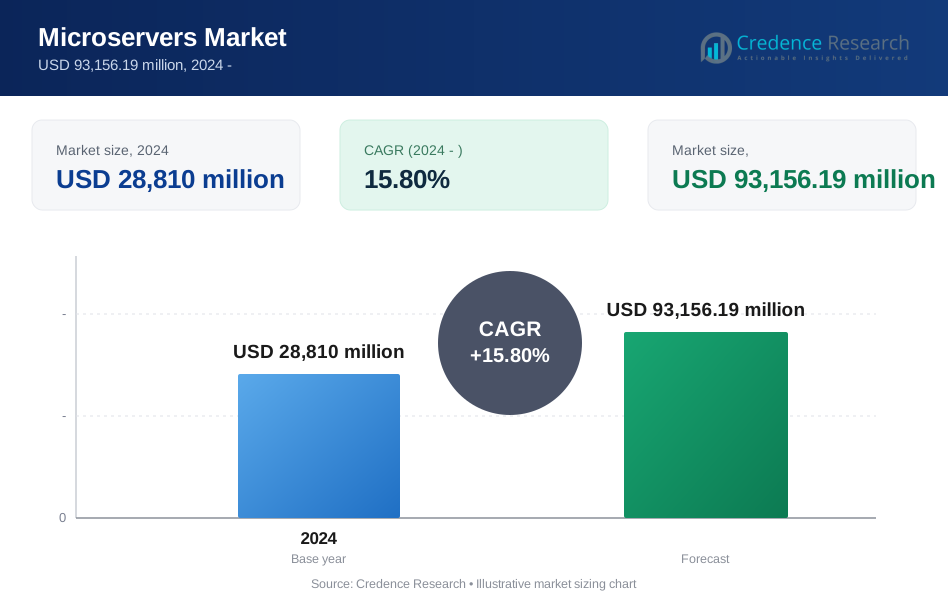
| microservers market Size 2024 | USD 28,810 million |
| microservers market, CAGR | 15.8% |
| microservers market Size 2032 | USD 93,156.19 million |
Market Overview:
The global microservers market is positioned for substantial growth, with projections indicating an increase from USD 28,810 million in 2024 to USD 93,156.19 million by 2032, registering a remarkable CAGR of 15.8% over the forecast period. This rapid expansion is attributed to the increasing demand for compact, energy-efficient, and low-cost servers, as organizations worldwide prioritize data storage and computing infrastructure solutions to support cloud-based operations and IoT applications. Enhanced focus on minimizing total cost of ownership (TCO) while maintaining high-performance levels also continues to elevate the market trajectory for microservers.
Key drivers propelling the market include the widespread adoption of data-driven technologies and growing demand from small to medium-sized enterprises (SMEs) for scalable, low-power servers. Microservers, known for their energy efficiency and lower capital expense, are particularly attractive to SMEs looking to achieve optimal performance without substantial hardware investments. Additionally, the rapid expansion of hyperscale data centers and demand for edge computing capabilities, which prioritize energy-efficient systems, are expected to drive substantial demand for microservers in the coming years. Emerging trends, such as the proliferation of AI and machine learning applications, further underscore the need for efficient server solutions capable of handling high computational loads at minimal operational costs.
Regionally, North America is expected to maintain a leading position in the microservers market due to the presence of major tech firms and data centers, alongside a strong focus on adopting advanced technologies. Meanwhile, the Asia-Pacific region is forecasted to witness the highest growth, spurred by booming data center investments in countries like China, India, and Japan, as well as the expansion of cloud-based services. Europe also demonstrates a growing market share, attributed to the rising trend of digitization among enterprises. This robust regional demand reinforces the global growth outlook for the microservers market.
Market Drivers:
Rising Demand for Energy-Efficient Solutions:
The increasing emphasis on energy efficiency in IT infrastructure is a significant driver for the microservers market. Organizations are increasingly focused on reducing energy consumption due to rising operational costs and environmental concerns. Microservers, which are optimized for low power consumption, address this need effectively. For instance, a report by the U.S. Department of Energy indicates that data centers in the United States consume approximately 2% of the country's total electricity, and energy-efficient solutions could save up to 20% in operational costs annually. This focus on energy efficiency is driving companies to adopt microservers as a viable alternative to traditional, power-intensive servers.
Demand from SMEs and Edge Computing Requirements:
Small and medium-sized enterprises (SMEs) are rapidly adopting microservers due to their scalability and cost-efficiency, which align well with limited budgets and evolving needs. Microservers provide a scalable solution that enables SMEs to upgrade and expand their computing resources without substantial capital expenditure. Additionally, as edge computing expands across industries, companies are shifting to microservers that support localized data processing while maintaining low energy and operational costs. According to a survey by the European Commission, over 40% of SMEs in Europe have planned to increase their IT budgets for edge computing, which could positively impact the demand for microservers.
Expansion of Cloud Services and Data Center Infrastructure:
The proliferation of cloud-based services and hyperscale data centers is another major driver in the microservers market. Major tech companies are heavily investing in microserver infrastructure to support large-scale cloud computing needs. For example, Google and Amazon have both ramped up investments in microserver technologies to boost cloud service efficiency. As cloud services continue to expand globally, the demand for microservers, known for their high-density and energy-saving attributes, is expected to grow in tandem with data center expansions.
Increased Adoption of AI and IoT Applications:
Microservers are also gaining traction due to the rise of AI and IoT applications, which require efficient processing power and support high data traffic. AI-enabled systems, for instance, require robust computing to handle massive datasets in real time, and microservers offer a practical solution for these demands. According to a survey by IBM, 61% of organizations in North America are planning to implement AI solutions in the next five years, suggesting significant potential for microservers to meet the unique computational needs of AI-driven infrastructures.
Market Trends:
Increasing Deployment of ARM-Based Microservers:
A significant trend in the microservers market is the growing adoption of ARM-based microservers, known for their power efficiency and high performance in processing parallel tasks. ARM architecture is becoming popular among data centers and cloud service providers aiming to reduce power consumption and operational costs. For instance, Amazon Web Services (AWS) has introduced Graviton processors, which are ARM-based, in their data centers, claiming up to 40% better price-performance than traditional x86 processors. This shift highlights the increasing preference for ARM-based microservers to handle workloads in high-density data environments.
Surge in Demand for Modular Server Infrastructure:
Companies are increasingly adopting modular server infrastructure, where microservers are deployed in a flexible and scalable manner to meet fluctuating demands. This trend is especially notable among organizations that require agility in scaling their IT resources without a complete overhaul of existing infrastructure. Government data from the UK’s Digital Transformation Strategy indicates that over 60% of public sector IT projects are now prioritizing modular and scalable server setups. Such an approach allows for seamless integration of microservers in data centers, ensuring optimal use of resources as computational needs expand.
Rise of Hybrid Cloud Adoption:
With the rapid adoption of hybrid cloud strategies, microservers are gaining traction as a practical solution to support on-premises and cloud-based environments concurrently. Hybrid cloud environments require servers that can handle diverse and distributed workloads, which microservers efficiently provide. For instance, A recent survey by Microsoft revealed that 54% of enterprises in North America are investing in hybrid cloud infrastructure, with many citing the need for cost-effective, flexible server options. This trend emphasizes the role of microservers in bridging the gap between on-premises and cloud operations, enhancing resource allocation and data accessibility.
Emphasis on Green Data Centers:
As environmental sustainability becomes a corporate priority, the development of green data centers has emerged as a prominent trend. Microservers are increasingly being deployed to meet the demand for eco-friendly IT solutions due to their lower power requirements and smaller carbon footprint. In a study conducted by the European Environment Agency, it was noted that transitioning to energy-efficient servers, including microservers, could reduce data center emissions by nearly 30% in the region by 2030. This trend underlines the commitment of enterprises and governments to sustainable practices, driving the adoption of microservers in environmentally-conscious data centers.
Market Challenges Analysis:
Limited Processing Power and Scalability Concerns:
A primary restraint in the microservers market is their limited processing power compared to traditional servers, which can hinder performance in high-computation environments. While microservers are efficient for lightweight and parallel processing tasks, they may struggle with workloads requiring substantial computational power, such as complex data analytics and AI applications. This limitation may reduce their appeal for enterprises prioritizing robust performance, posing a challenge to market growth. The U.S. Department of Energy has noted that organizations handling large-scale computations might face challenges when relying solely on microservers, emphasizing the need for hybrid approaches.
Compatibility Issues with Existing Infrastructure:
Microservers can pose compatibility issues within existing IT infrastructure, particularly in large organizations with established systems based on x86 architecture. Many microservers are ARM-based, which can complicate integration and lead to compatibility issues that require additional adjustments or investments in specialized software. Government data from the European Telecommunications Standards Institute (ETSI) highlights that 35% of companies transitioning to microserver setups report integration difficulties, slowing the adoption rate among organizations that cannot afford downtime or additional IT restructuring.
Limited Market Awareness and Technical Expertise:
The relatively new presence of microservers in the mainstream market means that awareness and understanding of their potential applications remain limited. Many IT professionals lack experience with microserver technology, which can create barriers to implementation. According to a recent survey by the National Institute of Standards and Technology (NIST), approximately 42% of U.S.-based IT departments expressed hesitance in adopting microservers due to unfamiliarity with deployment strategies and maintenance requirements. This lack of expertise could hinder the growth of the market, as organizations may prefer traditional servers with established support and maintenance systems.
Cost Barriers for Small-Scale Adoption:
While microservers are generally cost-effective in large-scale deployments, smaller businesses may find the initial investment challenging. Setting up microserver infrastructure often requires specialized equipment and software, which can be costly upfront. The Small Business Administration (SBA) reports that 52% of small enterprises consider cost a significant barrier to adopting advanced server solutions like microservers, limiting their accessibility for cost-sensitive sectors.
Market Segmentation Analysis:
By Type
The microservers market can be segmented by type into ARM-based and x86-based microservers. ARM-based microservers are gaining popularity due to their high energy efficiency and suitability for handling parallel, low-power tasks, making them ideal for applications in data centers and cloud environments. In contrast, x86-based microservers continue to attract enterprises with legacy systems due to their compatibility with existing software and infrastructure, especially for businesses that require a balance of power and efficiency.
By Technology
By technology, the microservers market is segmented into blade and rack-mounted systems. Blade microservers are valued for their compact design, which allows them to be densely packed, saving valuable space in data centers while reducing power consumption. Rack-mounted microservers are preferred for their scalability and ease of maintenance, making them suitable for organizations that anticipate expanding their data processing capabilities. Both technologies provide flexibility in deployment, catering to varied enterprise needs based on space and computational demands.
By End User
End-user segmentation includes small and medium-sized enterprises (SMEs), large enterprises, and data centers. SMEs are increasingly adopting microservers due to their cost efficiency and scalability, which align well with budget constraints and the need for growth-ready infrastructure. Large enterprises and data centers drive significant demand due to their need for efficient data handling and energy savings in large-scale operations. The versatility of microservers makes them attractive to diverse industries, from cloud service providers to IoT-based businesses, underscoring their broad appeal across different market segments.
Segmentations:
By Processor Type
- Intel
- AMD
- ARM
- Others
By Application
- Data Center
- Cloud Computing
- Media Storage
- Data Analytics
By End-user
- · SMEs
- · Large Enterprises
By Geography
- North America
- U.S.
- Canada
- Mexico
- Europe
- Germany
- France
- U.K.
- Italy
- Spain
- Rest of Europe
- Asia Pacific
- China
- Japan
- India
- South Korea
- South-east Asia
- Rest of Asia Pacific
- Latin America
- Brazil
- Argentina
- Rest of Latin America
- Middle East & Africa
- GCC Countries
- South Africa
- Rest of the Middle East and Africa
Regional Analysis:
North America
North America holds the largest share in the global microservers market, accounting for approximately 35% of the total market share. This dominance is driven by the presence of numerous technology giants and data centers across the United States and Canada, coupled with an early adoption rate of advanced server technologies. The U.S., in particular, leads the region's market, supported by strong investment in cloud computing and AI initiatives. Government incentives for energy-efficient data centers further accelerate the adoption of microservers as organizations seek to lower operational costs and reduce environmental impact. The robust IT infrastructure in North America and the push towards energy-efficient solutions place the region at the forefront of the microservers market.
Europe
Europe holds the second-largest market share at around 25%, with a growing emphasis on sustainability and energy efficiency driving adoption. The European Union's stringent regulations regarding carbon emissions and energy use have made microservers an attractive option for enterprises and data centers. Countries like Germany, France, and the United Kingdom lead in adoption, particularly in sectors such as financial services and telecommunications, where data processing needs are high, yet efficient, eco-friendly solutions are prioritized. The European Commission’s digital strategy, which includes investments in cloud infrastructure and edge computing, is anticipated to further support market growth in the region.
Asia-Pacific
The Asia-Pacific region is experiencing the fastest growth in the microservers market, capturing approximately 20% of the market share. This growth is fueled by rapid digital transformation in economies such as China, Japan, and India. The expansion of cloud services, combined with significant investment in data center infrastructure, has driven the adoption of microservers across various industries. China is the regional leader due to the rapid expansion of its tech sector and data center facilities, while India is catching up with increasing cloud adoption among SMEs. Additionally, government initiatives in the region, such as the “Digital India” campaign, encourage digital infrastructure development, further enhancing the market’s growth trajectory.
Latin America
Latin America holds a smaller but steadily growing share of the microservers market, accounting for about 10%. The region’s market expansion is largely attributed to increased investments in digital infrastructure, particularly in Brazil and Mexico. While adoption rates are not as high as in North America or Europe, Latin America is gradually embracing microserver technology due to its cost-efficiency and suitability for handling moderate workloads. The growth of e-commerce and cloud computing is also creating demand for microservers, especially among local enterprises looking to enhance data processing without substantial capital investment.
Middle East and Africa
The Middle East and Africa account for the remaining 10% of the global market share. The region’s adoption is primarily driven by the expansion of data centers in the Gulf Cooperation Council (GCC) countries and South Africa. Governments in the UAE and Saudi Arabia are investing in digital transformation initiatives, which support the demand for scalable, energy-efficient servers. While the adoption rate is still moderate, ongoing investments in IT infrastructure and the growing need for cloud services in sectors like banking and telecommunications are expected to gradually increase the adoption of microservers across the region.
Key Player Analysis:
- Hewlett Packard Enterprise (HPE)
- Dell Technologies
- IBM Corporation
- Fujitsu Ltd.
- ARM Holdings
- Advanced Micro Devices (AMD)
- Intel Corporation
- Marvell Technology Group
- Super Micro Computer, Inc.
- Quanta Computer Inc.
Competitive Analysis:
The microservers market is highly competitive, with key players focusing on technological innovation, product differentiation, and strategic partnerships to strengthen their market positions. Companies like Hewlett Packard Enterprise, Dell Technologies, and IBM Corporation are investing heavily in research and development to enhance performance, energy efficiency, and scalability of microservers. ARM Holdings and Intel Corporation are significant contributors to advancing processing architectures, with ARM gaining traction for energy-efficient solutions and Intel leading in x86-based designs. Meanwhile, Marvell Technology Group and Advanced Micro Devices (AMD) are capturing market share by catering to specialized workloads in cloud computing and data centers. Strategic alliances and collaborations are common, with major players collaborating with cloud providers and data center operators to expand their customer base. The competition is also influenced by regional expansions and acquisitions, as companies aim to capitalize on growing demand across Asia-Pacific and other emerging markets.
Recent Developments:
- In 2023, Hewlett Packard Enterprise (HPE) introduced its ProLiant Gen11 servers, optimized for cloud-native workloads and AI applications. These servers feature advanced security measures and are available through HPE GreenLake, providing a flexible, cloud-managed solution that enhances energy efficiency and operational insights across distributed environments.
- Dell Technologies, in collaboration with NVIDIA in 2023, launched the Spectrum-X Ethernet networking platform designed for generative AI. This system, combining Dell’s PowerEdge servers with NVIDIA’s accelerated networking technology, enables higher data throughput, making it ideal for AI workloads in enterprise data centers. Availability is expected in early 2024.
- In 2024, HPE announced record fiscal results, attributing growth to strategic investments in AI, edge computing, and hybrid cloud. This reflects HPE’s edge-to-cloud strategy, where the company has significantly expanded its intelligent edge and high-performance computing (HPC) offerings to meet rising AI demands.
- Lenovo, partnering with NVIDIA, announced in 2024 the development of new microserver systems optimized for AI applications. These systems integrate NVIDIA’s Spectrum-4 Ethernet switches and BlueField-3 DPUs, enabling scalable, secure, and efficient data management specifically designed for handling AI-driven, multi-tenant workloads in data centers.
Market Concentration & Characteristics:
The microservers market demonstrates moderate to high market concentration, with a few major players, such as Hewlett Packard Enterprise (HPE), Dell Technologies, and IBM, holding significant shares due to their robust infrastructure solutions, strong R&D investments, and advanced technologies. Key characteristics of this market include rapid innovation in low-power, high-efficiency servers and a focus on scalable, cloud-compatible architectures suitable for edge computing and AI workloads. High entry barriers exist, driven by the need for substantial capital investment and expertise in server technology. Additionally, collaborations with tech giants, such as NVIDIA, reflect the industry’s emphasis on meeting demand for AI and machine learning applications. The market’s concentration is likely to persist as established players continue to innovate and integrate cloud-native and AI-specific capabilities to differentiate themselves from emerging competitors.
Report Coverage:
The research report offers an in-depth analysis based on Processor Type, Application, End-user, and Geography. It details leading market players, providing an overview of their business, product offerings, investments, revenue streams, and key applications. Additionally, the report includes insights into the competitive environment, SWOT analysis, current market trends, as well as the primary drivers and constraints. Furthermore, it discusses various factors that have driven market expansion in recent years. The report also explores market dynamics, regulatory scenarios, and technological advancements that are shaping the industry. It assesses the impact of external factors and global economic changes on market growth. Lastly, it provides strategic recommendations for new entrants and established companies to navigate the complexities of the market.
Future Outlook:
- Microservers are anticipated to see increased adoption across cloud data centers due to their energy efficiency and compatibility with distributed, lightweight workloads.
- Growing demand for edge computing will drive the need for microservers, as these servers are ideal for decentralized data processing and support low-latency applications.
- AI and machine learning workloads are expected to further influence microserver designs, promoting innovations focused on handling parallel data processing and enhanced performance efficiency.
- Rising environmental regulations globally are likely to encourage microserver adoption, given their reduced power consumption and lower carbon footprint compared to traditional servers.
- ARM-based microservers are projected to gain popularity, particularly within hyperscale data centers, due to their cost efficiency and energy-saving advantages.
- Hybrid cloud deployments will boost demand, as organizations seek flexible, scalable, and cloud-compatible solutions for managing diverse workloads.
- Increased investment in IoT infrastructure will contribute to microserver demand, as businesses require compact, efficient processing units to handle large volumes of data at the edge.
- Technological advancements in modular and rack-mounted systems will improve microserver scalability, making them more adaptable to evolving enterprise requirements.
- Enhanced security features tailored for microservers will become critical, as data privacy concerns intensify with the rise of edge computing.
- Expanding data centers in emerging markets, especially within Asia-Pacific, will likely spur microserver adoption, given the region’s focus on digital transformation and cloud technology expansion.
Request a Free Sample
Fill in your details and we'll send you a free sample report.
- Sample data tables & charts
- Research methodology
Need a Custom Version of This Report?
Tailor the scope, geography, or segments to your exact requirements.
- Custom geography or segment scope
- Direct access to our analyst team
Frequently Asked Questions
What is the current size of the Microservers Market?
What factors are driving the growth of the Microservers Market?
What are some challenges faced by the Microservers Market?
Who are the major players in the Microservers Market?
Which segment is leading the market share?
Table of Content
Chapter 1. Report Introduction
- 1.1 Report Description & Purpose
- 1.1.1 Report Title & Market Definition
- 1.1.2 Unique Selling Propositions (USP) & Key Differentiators
- 1.1.3 Value Proposition for Stakeholders
- 1.2 Research Objectives
- 1.2.1 Market Sizing Objectives (Volume & Revenue)
- 1.2.2 Segmentation Objectives
- 1.2.3 Competitive Intelligence Objectives
- 1.2.4 Forecast & Scenario Objectives
- 1.3 Report Scope
- 1.3.1 Microservers Scope – Types & Subtypes Covered
- 1.3.2 Geographic Scope – Regions & Countries Covered
- 1.3.3 Historical Period, Base Year & Forecast Period (2024; forecast to the forecast period)
- 1.3.4 Inclusions & Exclusions
- 1.4 HS Code & Classification Framework
- 1.5 Currency, Units & Pricing Basis
- 1.6 Target Stakeholders
- 1.7 Limitations & Assumptions
Chapter 2. Executive Summary
- 2.1 Global Microservers Market Snapshot
- 2.1.1 Market Size – Historical (2024) & Forecast (the forecast period) (2024: USD 28,810 million → forecast year: USD 93,156.19 million)
- 2.1.2 Volume & Revenue – Global Totals
- 2.1.3 Key Market Highlights – Top Five Facts
- 2.2 Microservers Market Segmentation Snapshot
- 2.2.1 Market Split by Region – 2024 vs.
- 2.3 Competitive Snapshot
- 2.3.1 Top 10 Players by Revenue Share – 2024
- 2.3.2 Top 10 Players by Volume Share – 2024
- 2.3.3 Recent Strategic Developments (18-Month Summary)
- 2.4 Key Investment Highlights & Strategic Conclusions
Chapter 3. Microservers Market Dynamics & Industry Analysis
- 3.1 Market Overview & Context
- 3.1.1 Microservers Market Position in the Broader Automotive Value Chain
- 3.1.2 OEM vs. Replacement Market Dynamics
- 3.1.3 Market Maturity & Development Stage by Region
- 3.2 Microservers Market Drivers
- 3.3 Microservers Market Restraints & Challenges
- 3.4 Microservers Market Opportunities
- 3.5 Porter's Five Forces Analysis
- 3.5.1 Threat of New Entrants
- 3.5.2 Bargaining Power of Suppliers
- 3.5.3 Bargaining Power of Buyers
- 3.5.4 Threat of Substitutes
- 3.5.5 Competitive Rivalry – Intensity Assessment
- 3.6 Microservers Value Chain Analysis
- 3.6.1 Upstream – Raw Material/Input Suppliers
- 3.6.1.1 Raw Material/Input 1
- 3.6.1.2 Raw Material/Input 2
- 3.6.1.3 Raw Material/Input 3
- 3.6.2 Midstream – Production/Manufacturing/Service Delivery
- 3.6.2.1 Production/Process Overview
- 3.6.2.2 Key Facility Locations & Capacity by Manufacturer
- 3.6.3 Downstream – Distribution & End Consumer
- 3.6.3.1 Primary Channel – B2B/OEM
- 3.6.3.2 Secondary Channels – Dealer, Retail, Online, Direct
- 3.6.4 Value Chain Profitability Analysis
- 3.6.1 Upstream – Raw Material/Input Suppliers
- 3.7 PESTEL Analysis
- 3.7.1 Political Factors
- 3.7.2 Economic Factors
- 3.7.3 Social Factors
- 3.7.4 Technological Factors
- 3.7.5 Environmental Factors
- 3.7.6 Legal Factors
- 3.8 Microservers Supply Chain Analysis
- 3.8.1 Raw Material/Input Supply Risk Assessment
- 3.8.2 Manufacturing Concentration Risk (Geographic Exposure)
- 3.8.3 Trade Disruption Impact Analysis
- 3.9 Regulatory & Policy Landscape
Note: The regulatory and policy landscape section covers regulations based on their applicability to the market, Microservers category, geography, and scope of the study. Only regulatory frameworks with a material impact on operations, compliance, trade, sustainability, or market access are analyzed in detail.
Chapter 4. Key Investment Pockets & Opportunity Analysis
- 4.1 Microservers Market Attractiveness Analysis
- 4.1.1 By Region – Investment Attractiveness Matrix (Volume × CAGR)
- 4.2 Absolute Revenue Growth Opportunity
- 4.2.1 By Region – Absolute USD Growth Through the forecast period
- 4.3 Incremental Volume Opportunity
- 4.3.1 By Region – Incremental Volume Through the forecast period
- 4.3.2 Segment – Incremental Volume
- 4.4 Emerging Submarket Opportunity Deep Dive (Subject to Applicability)
- 4.5 Emerging Market Opportunity Scorecards
- 4.5.1 United States
- 4.5.2 Europe
- 4.5.3 Asia
- 4.5.4 Middle East & Africa
Note: Emerging Market Opportunity Scorecards will be included based on relevance and strategic importance. Regions listed are indicative and may vary depending on data availability and market dynamics.
Chapter 5. Microservers Import-Export Analysis & Trade Flows
- 5.1 Global Trade Overview
- 5.1.1 Global Export Value by Country (2024)
- 5.1.2 Global Export Volume by Country (2024)
- 5.1.3 Global Import Value by Country (2024)
- 5.1.4 Global Import Volume by Country (2024)
- 5.1.5 Net Trade Balance by Country (2024)
- 5.2 Export Analysis – Segment
- 5.2.1 Type 1 (HS Code)
- 5.2.2 Type 2 (HS Code)
- 5.2.3 Type 3 (HS Code)
- 5.2.4 Type 4 (HS Code)
- 5.2.5 Type 5 (HS Code)
- 5.3 Import Analysis – Segment
- 5.3.1 Type 1 (HS Code)
- 5.3.2 Type 2 (HS Code)
- 5.3.3 Type 3 (HS Code)
- 5.3.4 Type 4 (HS Code)
- 5.3.5 Type 5 (HS Code)
- 5.4 Average Unit Trade Prices
- 5.4.1 Average Export Price – Segment & Country
- 5.4.2 Average Import Price – Segment & Source Country
- 5.4.3 Price Trends (2024)
- 5.5 Key Trade Route Analysis
- 5.5.1 Trade Route 1
- 5.5.2 Trade Route 2
- 5.5.3 Trade Route 3
- 5.5.4 Trade Route 4
- 5.5.5 Trade Route 5
- 5.6 Trade Policy Impact Assessment
- 5.6.1 US Anti-Dumping & Section 301 Tariffs
- 5.6.2 EU Customs Union Impact
- 5.6.3 Major Free Trade Agreements
- 5.6.4 USMCA Rules of Origin
Note: Trade policy analysis will be included only where relevant to the Microservers market.
Chapter 6. Competitive Landscape & Company Benchmarking
- 6.1 Microservers Market Concentration & Structure
- 6.1.1 Herfindahl-Hirschman Index (HHI) – vs. 2024
- 6.1.2 Tier 1, Tier 2 & Tier 3 Market Structure
- 6.1.3 Global, Regional & Local Player Dynamics
- 6.2 Microservers Market Share Analysis – 2024
- 6.2.1 Global Revenue Share by Company
- 6.2.2 Global Volume Share by Company
- 6.2.3 Regional Revenue Share
- 6.2.4 Market Share Evolution ( vs. 2024)
- 6.2.5 OEM Segment Share by Company
- 6.2.6 Replacement Segment Share by Company
- 6.3 Production/Delivery Capacity & Facility Analysis
- 6.3.1 Global Installed Capacity
- 6.3.2 Capacity Utilization Rates
- 6.3.3 Production/Output Volume
- 6.3.4 Facility Locations & Capacity Map
- 6.3.5 Planned Capacity Additions
- 6.4 Microservers Competitive Benchmarking Matrix
- 6.4.1 Revenue, Volume, CAGR & Profitability Comparison
- 6.4.2 Channel Revenue Mix
- 6.4.3 Geographic Revenue Exposure
- 6.4.4 R&D Intensity
- 6.4.5 Sustainability Maturity
- 6.5 Strategic Developments in Microservers (Last 24 Months)
- 6.5.1 Mergers, Acquisitions & Divestments
- 6.5.2 New Microservers Launches
- 6.5.3 Facility Expansions
- 6.5.4 Strategic Alliances, Joint Ventures & Partnerships
- 6.5.5 Distribution Expansion & Market Entry
- 6.5.6 Sustainability & ESG Initiatives
- 6.6 Competitive Strategy Mapping
- 6.6.1 Leader, Challenger, Follower & Niche Classification
- 6.6.2 Pricing Strategy Comparison
- 6.6.3 Channel Strategy Matrix
Note: Strategic developments are included based on their materiality and the availability of reliable information.
Chapter 7. Global Microservers Market – By Distribution Channel
- 7.1 Segment Overview
- 7.1.1 Volume & Revenue Split by Channel (2024 & )
- 7.1.2 Channel Mix Evolution (the forecast period)
Chapter 8. Regional Market Analysis – Global Overview
- 8.1 Global Regional Overview
- 8.1.1 Regional Volume Share
- 8.1.2 Regional Revenue Share
- 8.1.3 Regional Volume by Region
- 8.1.4 Regional Revenue by Region
- 8.1.5 Regional Forecast Through the forecast period
- 8.2 Cross-Regional Segment Analysis
- 8.2.1 By Distribution Channel
- 8.2.2 By Brand/Price Tier
Chapter 9. North America Microservers Market
- 9.1 United States
- 9.2 Canada
- 9.3 Mexico
Chapter 10. Europe Microservers Market
- 10.1 Germany
- 10.2 France
- 10.3 Italy
- 10.4 United Kingdom
- 10.5 Spain
- 10.6 Poland
- 10.7 Russia
- 10.8 Netherlands
- 10.9 Belgium
- 10.10 Sweden
- 10.11 Denmark
- 10.12 Norway
- 10.13 Rest of Europe
Chapter 11. Asia Pacific Microservers Market
- 11.1 China
- 11.2 India
- 11.3 Japan
- 11.4 South Korea
- 11.5 Thailand
- 11.6 Indonesia
- 11.7 Vietnam
- 11.8 Malaysia
- 11.9 Australia
- 11.10 Rest of Asia Pacific
Chapter 12. Latin America Microservers Market
- 12.1 Brazil
- 12.2 Argentina
- 12.3 Colombia
- 12.4 Chile
- 12.5 Rest of Latin America
Chapter 13. Middle East Microservers Market
- 13.1 Saudi Arabia
- 13.2 United Arab Emirates
- 13.3 Turkey
- 13.4 Israel
- 13.5 Iran
- 13.6 Rest of the Middle East
Chapter 14. Africa Microservers Market
- 14.1 South Africa
- 14.2 Egypt
- 14.3 Nigeria
- 14.4 Morocco
- 14.5 Rest of Africa
Chapter 15. Microservers Company Profiles
- 15.1 [Company 01]
- 15.1.1 Company Overview
- 15.1.2 Key Management Personnel
- 15.1.3 Products & Services Portfolio
- 15.1.4 Financial Performance
- 15.1.5 Key Market Focus & Geographic Presence
- 15.1.6 Recent Developments & Strategic Initiatives
Note: The company profile list is preliminary and may change based on research findings, market developments, data availability, and client requirements.
Chapter 16. Appendices
- Appendix A – List of Abbreviations & Acronyms
- Appendix B – Industry Classification Code Reference – Full Series
- Appendix C – Production & Capacity Data Tables
- Appendix D – End-Use & Demand Base Tables
- Appendix E – Consumption & Replacement Rate Assumptions
- Appendix F – ASP Reference Tables
- Appendix G – Manufacturing & Facility Database
- Appendix H – Import-Export Data Tables
- Appendix I – Regulatory Summary Tables
- Appendix J – Primary Research Participant List (Anonymized)
- Appendix K – Primary Research Questionnaire Framework
- Appendix L – Data Sources & Bibliography
- Appendix M – Market Size Divergence & Source Comparison
Chapter 17. Research Methodology
- 17.1 Research Framework & Philosophy
- 17.2 Secondary Research – Sources, Hierarchy & Data Extraction
- 17.3 Data Modeling – Bottom-Up & Top-Down Market Sizing
- 17.4 Primary Research – Stakeholder Framework, LOI & Sample Sizes
- 17.5 Forecast Methodology – Regression, Scenario & Sensitivity Analysis
- 17.6 Quality Control – Four-Layer Validation Framework
- 17.7 Limitations & Standard Assumptions
- 17.8 Disclaimer
