
Market Overview
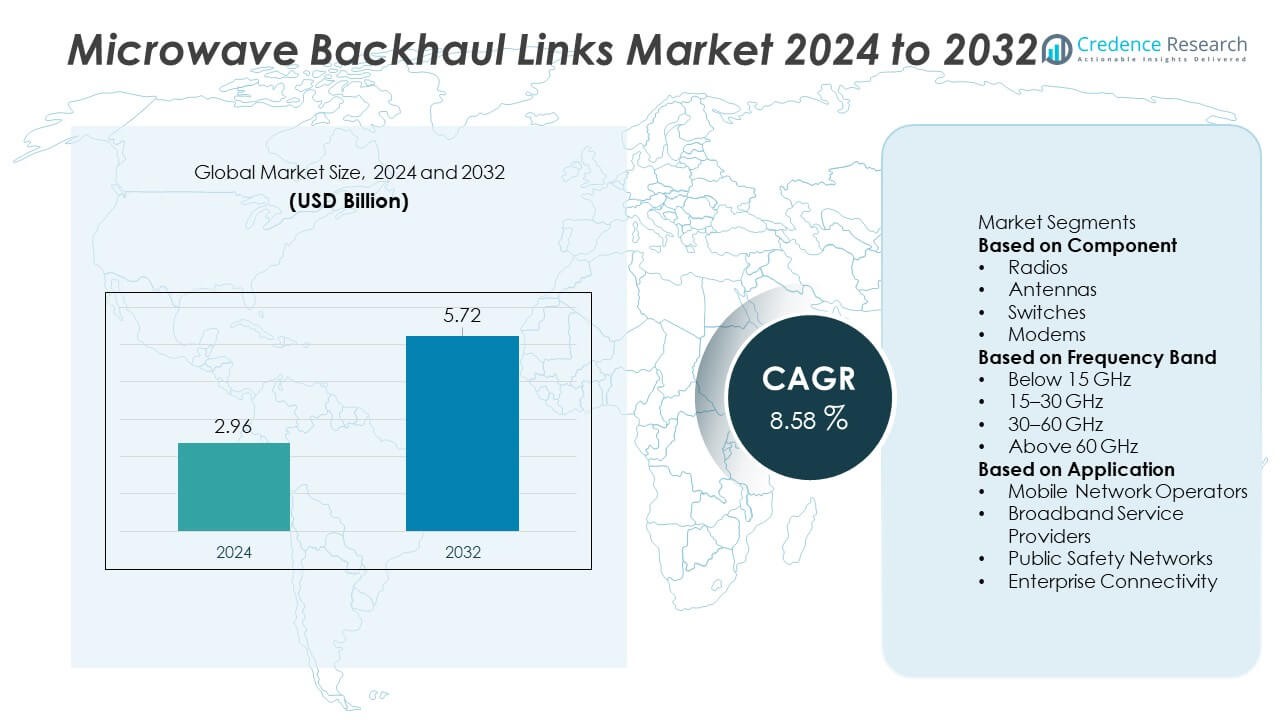
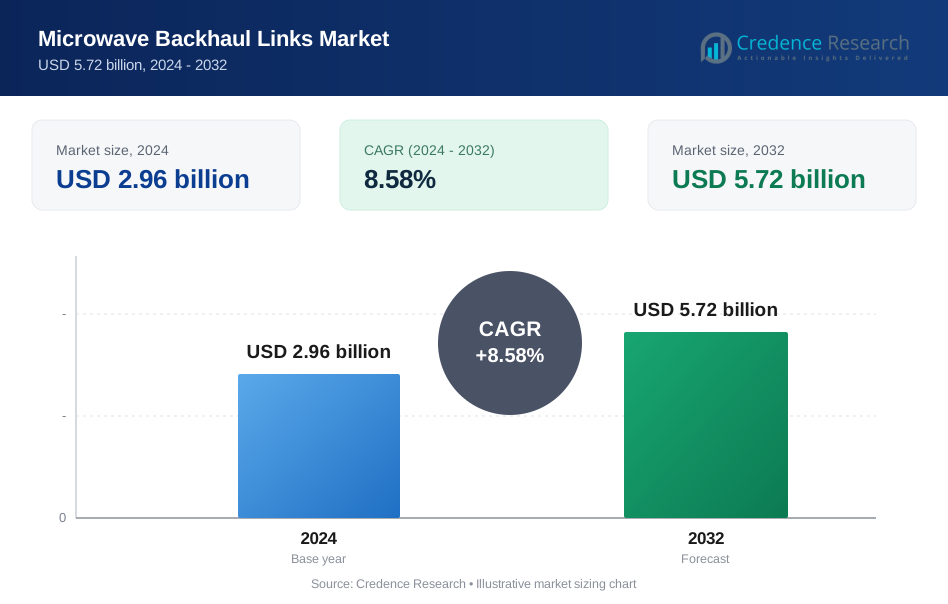
Microwave Backhaul Links Market size was valued at USD 2.96 billion in 2024 and is expected to reach USD 5.72 billion by 2032, registering a CAGR of 8.58% during the forecast period.
| REPORT ATTRIBUTE | DETAILS |
|---|---|
| Historical Period | 2020-2023 |
| Base Year | 2024 |
| Forecast Period | 2025-2032 |
| Microwave Backhaul Links Market Size 2024 | USD 2.96 Billion |
| Microwave Backhaul Links Market, CAGR | 8.58% |
| Microwave Backhaul Links Market Size 2032 | USD 5.72 Billion |
The Microwave Backhaul Links market features top players such as Huawei, Ericsson, Nokia, NEC, Ceragon Networks, Aviat Networks, ZTE, Siklu Communication, SIAE Microelettronica, and DragonWave-X, each strengthening capacity, efficiency, and multi-band performance across modern transport networks. These vendors compete through advanced radio platforms, millimeter-wave innovations, and software-driven optimization tools that support dense 4G and 5G deployments. North America leads the market with 34% share, supported by strong operator investment and widespread modernization. Asia Pacific follows with 30% share, driven by large subscriber bases and extensive mobile rollout programs, while Europe maintains 28% share through balanced adoption across urban and rural zones.
Market Insights
- The Microwave Backhaul Links market reached USD 2.96 billion in 2024 and is set to reach USD 5.72 billion by 2032, registering a CAGR of 8.58% during the forecast period.
- Strong market drivers include rapid 5G rollout, rising data traffic, and the need for high-capacity transport networks. Radios lead the component segment with 41% share, supported by increasing demand for multi-band, high-efficiency radio units.
- Key trends include wider adoption of millimeter-wave systems for dense urban sites and growing deployment of carrier aggregation technologies that boost throughput without heavy infrastructure expansion.
- The competitive landscape is shaped by Huawei, Ericsson, Nokia, NEC, Ceragon Networks, Aviat Networks, ZTE, Siklu, SIAE Microelettronica, and DragonWave-X, all focusing on high-capacity radios, spectrum-efficient designs, and software-driven optimization tools.
- Regionally, North America holds 34% share, Asia Pacific follows with 30%, and Europe maintains 28%, while Latin America and Middle East & Africa account for 5% and 3%, driven by cost-efficient wireless backhaul adoption.
Market Segmentation Analysis:
By Component
Radios held the dominant share of 41%, supported by strong demand for high-capacity links in 4G and 5G rollouts. Network operators rely on advanced radio units to boost throughput and maintain stable long-distance transmission. Antennas followed due to rising multi-band configurations that improve link reliability in dense urban zones. Switches and modems gained steady traction as operators modernized aggregation sites and expanded IP-based transport systems. Growth across all components reflects increased traffic loads, wider deployment of microwave backhaul in rural areas, and continuous upgrades to support low-latency mobility services.
- For instance, Huawei’s original RTN 380 system provided an air-interface capacity of up to 4 Gbps using 64QAM modulation in commercial deployments. Later models, such as the RTN 380AX, support a 10 Gbps capacity with modulation up to 1024QAM.
By Frequency Band
The 15–30 GHz band accounted for the largest share of 38%, driven by its balance of high capacity and long-reach performance. Operators use this band to support 5G transport requirements without costly fiber upgrades. Below 15 GHz bands remained essential for long-haul and rural deployments due to superior propagation and weather resistance. The 30–60 GHz band expanded with small-cell backhaul needs in dense urban sites. Above 60 GHz frequencies grew as enterprises and operators adopted millimeter-wave links for short-range, high-throughput communication. Demand across all bands rose with traffic growth and spectrum optimization initiatives.
- For instance, NEC's iPASOLINK EX Advanced delivered up to 10 Gbps using the E-band (70-80 GHz) spectrum. Later iterations, such as the iPASOLINK EX Advanced Dual, increased this capacity to 20 Gbps in a single box, or up to 25 Gbps in transparent mode.
By Application
Mobile Network Operators dominated the market with a 52% share, supported by nationwide 4G densification and early 5G transport expansion. These operators rely on microwave backhaul to enhance capacity, extend coverage, and reduce fiber dependency in challenging locations. Broadband service providers increased adoption to improve last-mile performance and support suburban expansion projects. Public safety networks used microwave links to ensure secure, low-latency communication for mission-critical operations. Enterprise connectivity gained traction as companies upgraded remote sites and industrial facilities. The overall application landscape expanded with rising data consumption and growing demand for reliable wireless transport.
Key Growth Drivers
Rising 5G Deployment and Traffic Load Expansion
5G rollout pushes operators to upgrade transport networks for higher capacity. Microwave backhaul supports dense cell sites where fiber installation faces delays. The technology helps manage rising video traffic, IoT connections, and low-latency services. Mobile operators use multi-band radios to improve link efficiency and reduce congestion. Growing spectrum availability supports wider adoption across urban and rural zones. Small-cell networks also depend on high-capacity microwave paths. Continuous expansion of advanced mobile services creates strong demand for scalable transport links.
- For instance, the Ericsson MINI-LINK 6600 platform supports radio links with a capacity of up to 2.5 Gbps per link using 112 MHz channels and 4096QAM modulation in traditional microwave frequencies, and can achieve capacities up to 10 Gbps per hop in the E-band (70/80 GHz) or using multi-band booster configurations.
Cost-Effective Alternative to Fiber in Challenging Terrains
Microwave backhaul offers faster deployment than fiber in remote or uneven regions. Operators use it to bypass digging restrictions, high trenching costs, and right-of-way issues. The solution delivers reliable performance for long-distance and mid-mile links. Rural coverage projects rely on microwave bridges to widen network reach. Governments promote digital expansion programs, which support rapid wireless backhaul adoption. The low installation time makes microwave links ideal for urgent capacity upgrades. Demand grows as operators seek affordable and flexible connectivity options.
- For instance, Aviat Networks previously implemented a very long all-IP backhaul connection across 193 km of open water in Central America using a 6 GHz radio with QPSK modulation, achieving around 200 Mbps tested throughput.
Growing Enterprise Connectivity and Private Network Adoption
Enterprises adopt microwave backhaul to support secure site-to-site communication. Industrial plants, logistics hubs, and energy facilities use microwave paths for reliable operations. Private 4G and 5G networks depend on stable backhaul transport. Companies choose microwave solutions to avoid fiber delays and maintain full deployment control. High-capacity radios help support automation, surveillance, and data-heavy workloads. The shift toward digital operations accelerates enterprise demand. Businesses also value strong uptime and easy scalability across remote or temporary locations.
Key Trends & Opportunities
Expansion of Multi-Band and Carrier Aggregation Technologies
Multi-band radios improve throughput by combining several frequency layers. Operators use this approach to overcome congestion in dense areas. Carrier aggregation raises link capacity without requiring new tower sites. The trend helps networks handle growing traffic more efficiently. Vendors offer flexible radios that support quick spectrum upgrades. This shift creates strong opportunities for high-capacity backhaul solutions. Multi-band adoption also supports seamless evolution from 4G toward advanced 5G transport.
- For instance, Nokia’s Wavence UBT-m radio supported dual-band aggregation with a combined tested capacity of 12 Gbps across 112 MHz and 224 MHz channels at 28 GHz and 18 GHz, validated across 14 metropolitan sites.
Increasing Role of Millimeter-Wave for Short-Range High-Capacity Links
Millimeter-wave bands support extreme capacity for short distances. Urban small-cell clusters benefit from these high-throughput links. Enterprises also use mmWave for campus-level data transmission. Vendors enhance radio designs to reduce rain fading and boost stability. The rising demand for low-latency services drives broader adoption. This creates new opportunities in hotspots, stadiums, and smart-city deployments. mmWave backhaul continues to grow as networks demand faster and denser transport layers.
- For instance, Ceragon validated 15.2 Gbps throughput on its E-band multi-core radio across 1.1 km using 1024QAM and adaptive coding, deployed in 13 smart-city pilot corridors.
Key Challenges
Spectrum Limitations and Interference Constraints
Spectrum scarcity restricts large-scale backhaul deployment in many regions. Operators struggle to manage interference in dense urban clusters. Weather impacts also affect higher bands, reducing link stability. Regulatory delays slow access to new frequencies. Networks must use advanced planning tools to avoid signal disruption. Coordination challenges rise as traffic volume grows. These constraints raise operational complexity for service providers.
Infrastructure Accessibility and Deployment Barriers
Many regions lack suitable tower sites for microwave installation. Physical obstructions reduce line-of-sight availability. urban zoning rules restrict new tower construction. Remote regions face limited power supply and mounting space. Operators also face long approval cycles for equipment placement. These barriers delay network expansion and raise deployment costs. Complex site conditions slow backhaul modernization across multiple markets.
Regional Analysis
North America
North America led the market with 34% share, driven by rapid 5G deployment and strong investment from major mobile operators. The region benefits from dense urban networks that require high-capacity backhaul to support rising mobile traffic. Operators use multi-band microwave systems to expand coverage in suburban and rural zones where fiber extension is slower. Growing enterprise demand for private wireless networks also supports adoption. Regulatory clarity across spectrum bands enables smoother rollouts. The combination of strong infrastructure, high data usage, and ongoing modernization projects keeps the region a major contributor to market expansion.
Europe
Europe accounted for 28% share, supported by extensive use of microwave backhaul in countries with mixed fiber availability. Operators adopt high-frequency and multi-band solutions to enhance capacity in dense urban corridors. Cross-border harmonization of spectrum rules encourages broader network upgrades. Rural broadband initiatives in Eastern Europe further increase reliance on long-haul microwave links. Energy-efficient radio systems gain traction due to strict sustainability standards. Growing demand for 5G fixed wireless access strengthens backhaul requirements. Europe’s balanced mix of dense cities and challenging terrains ensures steady market growth across the region.
Asia Pacific
Asia Pacific held the largest growth momentum with 30% share, supported by massive mobile subscriber expansion and ongoing 4G and 5G rollouts. Microwave backhaul is widely used to cover remote areas where fiber deployment remains costly. Densely populated cities in China, India, and Southeast Asia drive strong demand for high-capacity radios and millimeter-wave systems. Governments support digital connectivity programs, increasing investment across telecom networks. Operators rely on scalable microwave systems to manage heavy traffic loads and rapid tower expansion. The region’s diverse geography and fast-growing telecom base sustain long-term backhaul adoption.
Latin America
Latin America captured 5% share, supported by rising demand for cost-efficient backhaul in areas with limited fiber coverage. Operators deploy microwave links to strengthen rural and semi-urban connectivity and meet data consumption growth. Economic pressures encourage preference for wireless transport due to lower installation costs and faster deployment cycles. Urban centers in Brazil, Mexico, and Colombia adopt higher-frequency solutions to improve network performance. Regulatory support for additional spectrum bands also boosts market activity. Despite budget constraints, the region shows steady progress toward network modernization and improved mobile coverage.
Middle East & Africa
The Middle East & Africa region represented 3% share, driven by strong adoption of microwave backhaul in markets with challenging terrain and limited fiber reach. Gulf nations invest in advanced multi-band systems to support 5G services and smart-city projects. African operators rely heavily on long-reach microwave links to extend connectivity across remote communities. Expansion of mobile broadband accelerates demand for high-capacity radios. Governments support digital inclusion, encouraging operators to upgrade transport networks. Although infrastructure gaps remain, the region continues to expand microwave deployment as a practical and scalable alternative to fiber.
Market Segmentations:
By Component
- Radios
- Antennas
- Switches
- Modems
By Frequency Band
- Below 15 GHz
- 15–30 GHz
- 30–60 GHz
- Above 60 GHz
By Application
- Mobile Network Operators
- Broadband Service Providers
- Public Safety Networks
- Enterprise Connectivity
By Geography
- North America
- U.S.
- Canada
- Mexico
- Europe
- Germany
- France
- U.K.
- Italy
- Spain
- Rest of Europe
- Asia Pacific
- China
- Japan
- India
- South Korea
- South-east Asia
- Rest of Asia Pacific
- Latin America
- Brazil
- Argentina
- Rest of Latin America
- Middle East & Africa
- GCC Countries
- South Africa
- Rest of the Middle East and Africa
Competitive Landscape
Competitive landscape analysis highlights leading companies such as Huawei, Ericsson, Nokia, NEC, Ceragon Networks, Aviat Networks, ZTE, Siklu Communication, SIAE Microelettronica, and DragonWave-X, which shape innovation and supply strength in the Microwave Backhaul Links market. These vendors focus on high-capacity radios, multi-band systems, and energy-efficient architectures to support 4G and 5G transport networks. Product portfolios expand with advanced modulation schemes, carrier aggregation features, and enhanced millimeter-wave solutions for dense urban sites. Strategic partnerships with mobile operators help vendors strengthen market reach and accelerate deployment cycles. Many companies invest in software-defined management tools that improve link reliability and reduce operational costs. Ongoing upgrades in remote and underserved regions create new opportunities for scalable microwave solutions. Competition remains strong as vendors compete on performance, spectrum efficiency, and long-term service support.
Key Player Analysis
- Huawei Technologies Co., Ltd.
- Ericsson
- Nokia Corporation
- NEC Corporation
- Ceragon Networks Ltd.
- Aviat Networks, Inc.
- ZTE Corporation
- Siklu Communication Ltd.
- SIAE Microelettronica
- DragonWave-X
Recent Developments
- In October 2025, Ericsson published its “Microwave Outlook 2025” report, forecasting a near-equal split (49 % microwave vs 51 % fibre) in mobile backhaul by 2030 and highlighting microwave’s support for 75 % of live 5G networks.
- In March 2025, Huawei launched its innovative "Uranus" point-to-multipoint (PtMP) microwave solution at Mobile World Congress (MWC) 2025. This solution is aimed at hub-site microwave deployment and supports 5G-Advanced evolution.
- In March 2023, Huawei Technologies Co., Ltd. and Cellnex deployed a long-reach E-band backhaul solution in Poland, achieving a 10 km link distance, 56 % higher capacity, and 30 % less service disruption.
Report Coverage
The research report offers an in-depth analysis based on Component, Frequency Band, Application and Geography. It details leading market players, providing an overview of their business, product offerings, investments, revenue streams, and key applications. Additionally, the report includes insights into the competitive environment, SWOT analysis, current market trends, as well as the primary drivers and constraints. Furthermore, it discusses various factors that have driven market expansion in recent years. The report also explores market dynamics, regulatory scenarios, and technological advancements that are shaping the industry. It assesses the impact of external factors and global economic changes on market growth. Lastly, it provides strategic recommendations for new entrants and established companies to navigate the complexities of the market.
Future Outlook
- Future networks will rely on higher-capacity microwave links to support dense 5G expansion.
- Operators will adopt more multi-band and carrier aggregation systems to improve throughput.
- Millimeter-wave backhaul will gain traction in urban small-cell clusters and hotspot zones.
- Energy-efficient radios will see rising demand as operators focus on lower operating costs.
- AI-driven link optimization will become standard to enhance reliability and reduce downtime.
- Private 5G and enterprise networks will increase adoption of microwave transport for secure connectivity.
- Hybrid fiber-microwave architectures will expand as operators balance cost and performance.
- Long-haul microwave systems will grow in rural regions where fiber rollout remains limited.
- Vendors will develop lighter, more integrated radio units to simplify tower deployment.
- Regulatory support for new spectrum bands will accelerate market expansion across emerging economies.
Request a Free Sample
Fill in your details and we'll send you a free sample report.
- Sample data tables & charts
- Research methodology
Need a Custom Version of This Report?
Tailor the scope, geography, or segments to your exact requirements.
- Custom geography or segment scope
- Direct access to our analyst team
Frequently Asked Questions
What is the current market size for the Microwave Backhaul Links market, and what is its projected size in 2032?
At what Compound Annual Growth Rate is the Microwave Backhaul Links market projected to grow between 2025 and 2032?
Which Microwave Backhaul Links market segment held the largest share in 2024?
What are the primary factors fueling the growth of the Microwave Backhaul Links market?
Who are the leading companies in the Microwave Backhaul Links market?
Which region commanded the largest share of the Microwave Backhaul Links market in 2024?
Table of Content
Chapter 1 Market Segmentation
- 1.1 Segmentation Framework
- 1.1.1 Product and Service Classification
- 1.1.2 Application and End-Use Classification
- 1.1.3 Technology and Solution Classification
- 1.1.4 Customer and Distribution Channel Classification
- 1.1.5 Geographic Segmentation
- 1.1.6 Market Segment Definitions and Boundaries
Chapter 2 Introduction
- 2.1 Report Objectives and Scope
- 2.2 Product Definition and Industry Terminology
- 2.3 Market Inclusions and Exclusions
- 2.4 Research Process
- 2.4.1 Primary Research and Expert Interviews
- 2.4.2 Secondary Research and Source Review
- 2.4.3 Top-Down and Bottom-Up Estimation
- 2.4.4 Data Triangulation and Verification
- 2.5 Market Size Measurement Basis
- 2.5.1 2024: USD 2.96 billion → 2032: USD 5.72 billion
- 2.6 Historical and Forecast Reference Periods
- 2.6.1 Base Year: 2024
- 2.6.2 Forecast Period: 2024-2032
- 2.7 Research Assumptions and Limitations
Chapter 3 Executive Summary
- 3.1 Market Snapshot and Key Findings
- 3.2 Base-Year Market Size, 2024
- 3.3 Forecast Market Size, 2032
- 3.4 Revenue and Volume Growth Outlook
- 3.5 Key Demand and Supply Indicators
- 3.6 Leading Market Segments
- 3.7 Fastest-Growing Market Opportunities
- 3.8 Regional Performance Highlights
- 3.9 Technology and Industry Transformation
- 3.10 Competitive Landscape Summary
- 3.11 Analyst View and Strategic Implications
Chapter 4 Global Microwave Backhaul Links Market Trends and Developments
- 4.1 Historical Industry Development
- 4.2 Recent Market Trends and Developments
- 4.3 Demand and Customer Behavior Trends
- 4.4 Technology and Product Innovation
- 4.5 Artificial Intelligence, Automation and Digitalization
- 4.6 Local Manufacturing and Supply Chain Realignment
- 4.7 Industry Partnerships, Mergers and Acquisitions
- 4.8 Sustainability and Circular Economy Developments
- 4.9 Government and Private Sector Investment Trends
- 4.10 Emerging Business Models and Commercialization
- 4.11 Industry Developments and Announcements
Chapter 5 Global Microwave Backhaul Links Market Production, Supply and Demand Analysis
- 5.1 Demand Trend and Consumption Analysis
- 5.2 Demand Forecast, 2024-2032
- 5.3 Production and Output Trend
- 5.4 Production and Output Forecast, 2024-2032
- 5.5 Installed Capacity and Capacity Utilization
- 5.6 Company-Wise Production Plants and Statistics
- 5.6.1 Installed Production Capacity
- 5.6.2 Actual Production
- 5.6.3 Planned Capacity and Expansion Targets
- 5.7 Supply Chain Structure and Procurement Trends
- 5.8 Supply-Demand Gap and Bottlenecks
- 5.9 Import Dependence and Sourcing Structure
- 5.10 Contract Manufacturing and Outsourcing
- 5.11 Regional Supply and Demand Concentration
Chapter 6 Global Microwave Backhaul Links Market Pricing Analysis
- 6.1 Pricing Structure and Measurement
- 6.2 Historical Pricing Trends
- 6.3 Pricing Outlook, 2024-2032
- 6.4 Average Selling Price and Unit Economics
- 6.5 Pricing by Product and Market Segment
- 6.6 Geographic Pricing Differences
- 6.7 Key Input, Energy, Labor and Logistics Costs
- 6.8 Contract Pricing and Purchasing Models
- 6.9 Pricing Sensitivity and Competitive Positioning
- 6.10 Price, Margin and Profitability Implications
Chapter 7 Global Microwave Backhaul Links Market Dynamics
- 7.1 Market Growth Drivers
- 7.1.1 Demand-Side Drivers
- 7.1.2 Technology and Innovation Drivers
- 7.1.3 Infrastructure and Investment Drivers
- 7.1.4 Regulatory and Policy Drivers
- 7.2 Market Restraints
- 7.2.1 Cost and Affordability Constraints
- 7.2.2 Technology and Adoption Barriers
- 7.2.3 Supply Chain and Operational Constraints
- 7.3 Market Challenges
- 7.3.1 Competitive Pressure and Margin Erosion
- 7.3.2 Skills, Infrastructure and Implementation Gaps
- 7.4 Emerging Market Opportunities
- 7.5 Market Dynamics Impact and Time-Horizon Assessment
Chapter 8 Global Microwave Backhaul Links Value Chain Analysis
- 8.1 Industry Value Chain Overview
- 8.2 Upstream Suppliers and Critical Inputs
- 8.3 Technology and Component Providers
- 8.4 Manufacturing or Service Delivery
- 8.5 Distribution, Channel Partners and Integrators
- 8.6 Downstream Applications and End Users
- 8.7 Value Addition and Profit Pools
- 8.8 Vertical Integration and Outsourcing
- 8.9 Supplier Concentration and Risk
- 8.10 Supply Chain Localization and Resilience
Chapter 9 Global Microwave Backhaul Links Market Regulations and Policies
- 9.1 Relevant Laws, Standards and Compliance Frameworks
- 9.2 Product, Service, Safety and Quality Requirements
- 9.3 Government Policies, Incentives and Subsidies
- 9.4 Imports, Exports and Trade Barriers
- 9.5 Public Procurement and Local Content Requirements
- 9.6 Environmental and Sustainability Compliance
- 9.7 Data Protection, AI and Cybersecurity Compliance
- 9.8 Upcoming Policy Changes and Market Implications
Chapter 10 Global Microwave Backhaul Links Market Hotspots and Opportunities
- 10.1 Market Opportunity Mapping and Growth Hotspots
- 10.2 High-Growth Applications and Customer Groups
- 10.3 Underserved Markets and White-Space Opportunities
- 10.4 Emerging Technology and Product Opportunities
- 10.5 New Capacity and Investment Hotspots
- 10.6 Market Entry and Expansion Opportunities
- 10.7 Distribution and Partnership Opportunities
- 10.8 Near-Term and Long-Term Commercial Potential
- 10.9 Opportunity Attractiveness and Execution Risks
Chapter 11 Global Microwave Backhaul Links Market Outlook, 2024-2032
- 11.1 Market Size and Analysis
- 11.1.1 Revenue (Market Measurement: 2024: USD 2.96 billion → 2032: USD 5.72 billion)
- 11.1.2 Market Volume and Quantity Sold
- 11.1.3 Historical Market Size
- 11.1.4 Base-Year Market Size, 2024
- 11.2 Market Forecast, 2024-2032
- 11.2.1 Revenue Forecast to 2032
- 11.2.2 Volume Forecast to 2032
- 11.2.3 CAGR and Year-on-Year Growth
- 11.2.4 Incremental Revenue Opportunity
- 11.3 Forecast Assumptions and Scenario Analysis
- 11.3.1 Base-Case Forecast
- 11.3.2 Optimistic and Conservative Scenarios
- 11.3.3 Technology, Pricing and Policy Sensitivities
- 11.4 Market Attractiveness and Growth Outlook
Chapter 12 Global Microwave Backhaul Links Market Segmentation and Outlook
- 12.1 Segmentation Summary and Market Shares, 2024
- 12.2 Largest and Fastest-Growing Segments
- 12.3 Segment Growth Comparison
- 12.4 Segment Attractiveness and Priority Matrix
Chapter 13 Global Microwave Backhaul Links Geographic Market Outlook, 2024-2032
- 13.1 Regional Market Size and Share, 2024
- 13.2 Regional Market Forecast, 2024-2032
- 13.3 Regional Pricing, Production and Demand Differences
- 13.4 North America
- 13.4.1 United States
- 13.4.2 Canada
- 13.4.3 Mexico
- 13.5 Europe
- 13.5.1 Germany
- 13.5.2 France
- 13.5.3 Italy
- 13.5.4 United Kingdom
- 13.5.5 Spain
- 13.5.6 Poland
- 13.5.7 Russia
- 13.5.8 Netherlands
- 13.5.9 Belgium
- 13.5.10 Sweden
- 13.5.11 Denmark
- 13.5.12 Norway
- 13.5.13 Rest of Europe
- 13.6 Asia Pacific
- 13.6.1 China
- 13.6.2 India
- 13.6.3 Japan
- 13.6.4 South Korea
- 13.6.5 Thailand
- 13.6.6 Indonesia
- 13.6.7 Vietnam
- 13.6.8 Malaysia
- 13.6.9 Australia
- 13.6.10 Rest of Asia Pacific
- 13.7 Latin America
- 13.7.1 Brazil
- 13.7.2 Argentina
- 13.7.3 Colombia
- 13.7.4 Chile
- 13.7.5 Rest of Latin America
- 13.8 Middle East
- 13.8.1 Saudi Arabia
- 13.8.2 United Arab Emirates
- 13.8.3 Turkey
- 13.8.4 Israel
- 13.8.5 Iran
- 13.8.6 Rest of the Middle East
- 13.9 Africa
- 13.9.1 South Africa
- 13.9.2 Egypt
- 13.9.3 Nigeria
- 13.9.4 Morocco
- 13.9.5 Rest of Africa
- 13.10 Regional Investment, Policy and Supply Chain Differences
- 13.11 Regional Competitive Landscape
- 13.12 Geographic Growth Hotspots
Chapter 14 Global Microwave Backhaul Links Technology, Innovation and Sustainability Outlook
- 14.1 Technology Landscape and Maturity
- 14.2 Product, Process and Service Innovation
- 14.3 AI, Automation and Digital Tools in the Industry
- 14.4 Technology Adoption and Performance Benchmarking
- 14.5 Innovation Pipeline and R&D Investment
- 14.6 Patent and Intellectual Property Trends
- 14.7 Energy Efficiency and Resource Management
- 14.8 Sustainability, Recycling and Circularity
- 14.9 Technology Roadmap, 2024-2032
- 14.10 Risks of Obsolescence and Technology Substitution
Chapter 15 Global Microwave Backhaul Links Market Key Strategic Imperatives
- 15.1 Growth and Market Entry Priorities
- 15.2 High-Return Products and Segments
- 15.3 Pricing, Profitability and Cost Optimization
- 15.4 Technology Investment and Product Differentiation
- 15.5 Supply Chain Localization and Resilience
- 15.6 Distribution and Customer Acquisition
- 15.7 Partnership, Acquisition and Capacity Strategy
- 15.8 Regional Expansion Priorities
- 15.9 Short-, Medium- and Long-Term Actions
Chapter 16 Competition Outlook
- 16.1 Industry Competition Characteristics
- 16.2 Market Structure and Concentration
- 16.3 Market Share and Competitive Positioning, 2024
- 16.4 Company-Wise Revenue and Product Benchmarking
- 16.5 Production and Service Capacity Benchmarking
- 16.6 Technology, Pricing and Differentiation
- 16.7 Regional Footprint and Distribution Strength
- 16.8 Mergers, Acquisitions and Strategic Alliances
- 16.9 New Entrants and Competitive Threats
- 16.10 Porter's Five Forces and Industry Attractiveness
- 16.11 Competitive Outlook, 2024-2032
Chapter 17 Company Profiles
- 17.1 Company Coverage and Selection Criteria
- 17.2 Leading Market Participants – Standard Profile Structure
- 17.2.1 Business Description
- 17.2.2 Company Ownership and Geographic Presence
- 17.2.3 Product and Service Portfolio
- 17.2.4 Manufacturing and Operating Footprint
- 17.2.5 Production Capacity and Expansion Plans
- 17.2.6 Financial Performance and Investment
- 17.2.7 Market Share and Competitive Position
- 17.2.8 Technology and Innovation Capabilities
- 17.2.9 Strategic Alliances or Partnerships
- 17.2.10 Recent Developments
- 17.2.11 Growth Strategy and Outlook
- 17.3 Other Relevant Market Participants
Note: Every listed company is profiled on the structure shown under the first company. The company list is preliminary and may change based on research findings, market developments, data availability and client requirements.
Chapter 18 Disclaimer
- 18.1 Research and Forecast Disclaimer
- 18.2 Data Source and Estimation Limitations
Note: The depth of individual sections depends on data availability for this market. Volume, capacity, trade and other unit-based metrics are included where applicable.
