
| REPORT ATTRIBUTE | DETAILS |
|---|---|
| Historical Period | 2019-2022 |
| Base Year | 2023 |
| Forecast Period | 2024-2032 |
| Middle East Artificial Intelligence (AI) in Finance Market Size 2023 | USD 625 million |
| Middle East Artificial Intelligence (AI) in Finance Market, CAGR | 25.1% |
| Middle East Artificial Intelligence (AI) in Finance Market Size 2032 | USD 4,704 million |
Market Overview
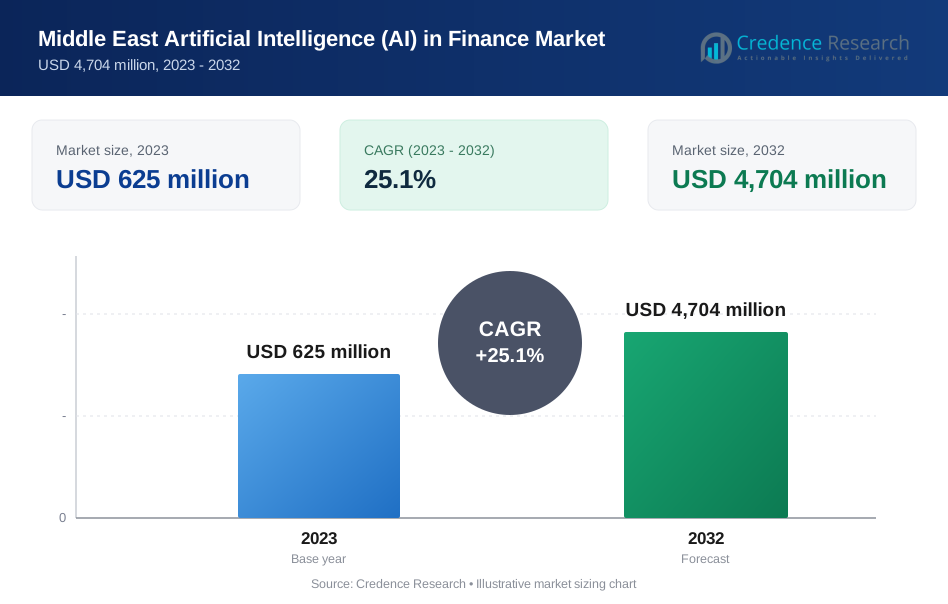
The Middle East Artificial Intelligence (AI) in Finance Market is projected to grow from USD 625 million in 2023 to an estimated USD 4,704 million by 2032, registering a compound annual growth rate (CAGR) of 25.1% from 2024 to 2032.
Key market drivers and trends include the rising demand for enhanced operational efficiency, personalized banking experiences, and fraud prevention mechanisms. AI-driven analytics and machine learning models enable financial institutions to offer tailored services while optimizing risk management. Additionally, the growth of fintech startups and increased government investments in AI-driven digital economies, particularly in the United Arab Emirates (UAE) and Saudi Arabia, contribute to market expansion. The adoption of conversational AI, robo-advisors, and AI-based cybersecurity solutions continues to shape the industry.
Geographically, the UAE and Saudi Arabia dominate the market due to their strong digital infrastructure, AI-friendly regulations, and significant investments in financial technology. Other countries, including Qatar and Bahrain, are also witnessing growth, driven by fintech initiatives and partnerships. Leading market players include IBM, Microsoft, Google, SAS Institute, and local fintech firms, which are expanding their AI capabilities to cater to the growing demand for intelligent financial solutions in the region.
Market Insights
- The Middle East AI in Finance Market is projected to grow from USD 625 million in 2023 to USD 4,704 million by 2032, with a CAGR of 25.1% from 2024 to 2032.
- AI is transforming risk assessment, fraud detection, customer service automation, and algorithmic trading, driving market expansion.
- Governments in the UAE, Saudi Arabia, and Qatar are promoting AI adoption through national AI strategies, digital transformation initiatives, and fintech investments.
- The demand for operational efficiency, AI-powered analytics, personalized banking, and fraud prevention is fueling AI growth in financial institutions.
- Regulatory complexities, data privacy concerns, high AI implementation costs, and a shortage of AI talent pose challenges to widespread adoption.
- The UAE and Saudi Arabia dominate the market, followed by Qatar and Bahrain, as AI-friendly policies and fintech partnerships drive regional growth.
- Leading market players include IBM, Microsoft, Google, SAS Institute, and regional fintech firms, continuously expanding AI-driven financial solutions.
Market Drivers
Accelerated Digital Transformation in the Financial Sector
The financial sector in the Middle East is undergoing a significant digital transformation, with artificial intelligence (AI) playing a pivotal role. For instance, banks in the UAE have implemented AI-driven systems for automating loan approvals and credit risk assessments. This integration streamlines back-end operations, significantly reducing processing times and enabling quicker responses to customer needs. Additionally, AI-powered chatbots are becoming commonplace, providing 24/7 customer service that enhances engagement and satisfaction by delivering instant responses to inquiries. The rise of open banking frameworks is further encouraging the development of AI-powered applications, allowing seamless transactions and predictive financial advisory services. This shift towards AI-driven finance is evident in the increased adoption of blockchain-based solutions for secure transactions, ultimately modernizing banking and financial services while optimizing operational efficiency.
Growing Need for Fraud Detection and Risk Management
As cyber threats become increasingly sophisticated, the demand for AI-powered security solutions in the financial sector has intensified. Financial institutions are deploying AI-driven fraud detection systems to monitor transactions in real time, identifying anomalies before they result in significant losses. For example, a major bank reported that integrating machine learning algorithms into their fraud prevention processes led to a marked decrease in false positives. This allows compliance teams to focus on genuine threats rather than being overwhelmed by irrelevant alerts. Furthermore, AI-powered risk management solutions assist banks in assessing credit risks and predicting loan defaults more efficiently than traditional methods. The introduction of AI-based Know Your Customer (KYC) solutions has also improved identity verification processes, enhancing trust between financial institutions and customers while bolstering anti-money laundering efforts.
Advancements in AI-Powered Customer Experience and Personalization
AI technologies are reshaping customer experiences in the financial sector by enabling hyper-personalized banking services. Financial institutions leverage AI to analyze customer behavior, transaction history, and preferences to deliver tailored financial products and investment recommendations. For instance, robo-advisors provide personalized investment advice based on real-time market analysis and individual risk profiles, significantly enhancing client experiences. Additionally, chatbots powered by Natural Language Processing (NLP) offer instant support and financial advice, improving customer engagement. AI-powered sentiment analysis tools further allow banks to understand customer emotions and expectations, refining their services accordingly. By leveraging big data and predictive analytics, banks can anticipate customer needs and offer proactive financial solutions, strengthening relationships and fostering brand loyalty among clients.
Strong Government Initiatives and Investments in AI Adoption
Governments across the Middle East are crucial in promoting AI adoption within the financial sector through strategic policies and funding initiatives. The UAE's National AI Strategy 2031 exemplifies this commitment by aiming to integrate AI across various industries, including finance. This strategic approach encourages both traditional banks and fintech companies to innovate with AI solutions. Similarly, Saudi Arabia’s Vision 2030 emphasizes AI-powered financial services as a key component of economic diversification plans. Moreover, governments are establishing AI research centers and innovation hubs that allow financial institutions and startups to test new technologies in controlled environments before widespread implementation. This influx of support is further bolstered by sovereign wealth funds investing heavily in AI-focused fintech startups, accelerating the development of advanced solutions such as algorithmic trading platforms and AI-driven credit scoring systems that enhance the region's financial landscape.
Market Trends
Expansion of AI-Powered Digital Banking and Fintech Innovations
The Middle East is experiencing a surge in digital banking and fintech innovations, with AI playing a pivotal role in reshaping traditional financial services. Governments and regulatory bodies are actively promoting digital finance initiatives, leading to a rise in AI-driven neobanks, mobile banking platforms, and fintech startups. For instance, there are now over 20 neobanks operating in the region, catering to nearly 15 million customers. These digital-only banks, such as Liv. by Emirates NBD and Mashreq Neo, leverage AI technologies for enhanced customer experiences, utilizing automated onboarding, personalized financial advice, and advanced credit scoring systems.Additionally, fintech companies are incorporating AI into various products like peer-to-peer lending and buy-now-pay-later (BNPL) services, enhancing financial inclusion across the region. The growth of digital-only banking platforms has been particularly substantial in the UAE and Saudi Arabia. Furthermore, AI-driven RegTech solutions are becoming prevalent, ensuring compliance with financial regulations through real-time monitoring for anti-money laundering (AML) and risk assessment. This integration of AI not only streamlines operations but also transforms customer engagement, making financial services more accessible and efficient.
Increased Adoption of AI-Powered Fraud Detection and Cybersecurity Solutions
As digital transactions and online banking rise in the Middle East, financial institutions face increasing threats from fraud and cybersecurity risks. Consequently, the adoption of AI-powered fraud detection and cybersecurity solutions is accelerating. Real-time fraud detection systems powered by machine learning algorithms are essential for monitoring transactions and preventing fraudulent activities. For instance, some banks have reported up to a 40% reduction in fraudulent transactions due to these advanced systems.Moreover, AI-based biometric authentication methods like facial recognition and voice authentication enhance security across mobile and online banking platforms. Financial institutions are also deploying AI-driven cyber threat intelligence platforms to predict and mitigate cyber threats by analyzing vast amounts of security data. Additionally, AI-integrated blockchain security solutions are improving transaction security by detecting fraudulent activities and ensuring tamper-proof exchanges. As cyber threats evolve continuously, reliance on AI to safeguard digital ecosystems is becoming increasingly critical for maintaining trust in financial services.
Growth of AI-Driven Personalization in Financial Services
The demand for hyper-personalized financial services is growing rapidly, with AI at the forefront of delivering customized banking and investment experiences. Financial institutions utilize big data analytics, customer segmentation, and predictive modeling to offer tailored solutions that meet individual needs. For example, AI-powered chatbots revolutionize customer service by employing Natural Language Processing (NLP) to respond to inquiries instantaneously.Furthermore, predictive analytics enables banks to anticipate customer needs effectively, providing personalized products such as loans and investment options based on individual financial goals. The emergence of robo-advisors is transforming wealth management by offering automated investment strategies that assess market trends and evaluate risk tolerance. Additionally, AI-powered sentiment analysis helps gauge customer emotions and feedback, allowing financial institutions to adjust their offerings accordingly. As the demand for personalized experiences continues to rise, AI-driven solutions will play a crucial role in shaping the future of the finance sector in the Middle East.
Government and Regulatory Support for AI Integration in Financial Services
Governments and regulatory bodies in the Middle East are significantly driving AI adoption within the financial sector through national strategies and regulatory frameworks. Initiatives such as the UAE’s National AI Strategy 2031 and Saudi Arabia’s Vision 2030 emphasize creating AI-driven financial ecosystems essential for economic growth. These strategies not only promote technological advancements but also facilitate partnerships between traditional banks and fintech startups.For instance, regulatory sandboxes are being established to allow fintech startups to experiment with AI-driven products in a controlled environment. Additionally, governments are investing in research centers and innovation hubs to further develop cutting-edge solutions like credit scoring models and blockchain technologies. This supportive environment fosters innovation while ensuring compliance with financial regulations. As a result, financial institutions can integrate AI-powered RegTech solutions that streamline compliance processes and improve transparency. These initiatives contribute significantly to the region's continued growth and digital transformation in the financial landscape.
Market Challenges
Data Privacy and Regulatory Complexities
The growing use of AI in financial services raises significant concerns about data privacy, security, and regulatory compliance. Financial institutions handle vast amounts of sensitive customer data, making them prime targets for cyber threats and data breaches. For instance, in the Middle East, institutions navigate a complex regulatory landscape characterized by diverse data protection laws across countries like the UAE, Saudi Arabia, and Qatar. Each nation has implemented its own set of regulations, leading to inconsistencies that create compliance challenges for institutions operating across borders. While the UAE has established guidelines promoting the ethical use of AI, concerns regarding data localization and cross-border data transfers persist. This necessitates substantial investment in compliance infrastructure as institutions must adapt to rapidly evolving legal frameworks. Additionally, the risk of data misuse and ethical concerns related to AI decision-making further complicate the landscape, highlighting the need for robust governance policies. As regulatory frameworks continue to evolve, financial institutions must remain vigilant and proactive in addressing these complexities to safeguard customer data and ensure compliance.
High Implementation Costs and Skills Shortages
Deploying AI-driven financial solutions requires substantial investment in technology infrastructure, cloud computing, and machine learning models. Many financial institutions, particularly small and mid-sized firms, face financial constraints when integrating AI into their operations. For instance, the high costs associated with AI software development and cybersecurity measures can be prohibitive for these organizations. This challenge is compounded by a notable shortage of skilled professionals in the Middle East; many report difficulties in finding qualified data scientists and AI engineers. Despite ongoing government initiatives aimed at enhancing AI education and training programs, bridging this talent gap remains a long-term endeavor that is critical for successful AI adoption in financial services. Without a sufficient AI-skilled workforce, financial institutions may struggle to develop, manage, and optimize AI-driven solutions effectively. Thus, while AI holds transformative potential for improving efficiency and enhancing customer experiences in finance, high implementation costs and skills shortages present significant hurdles that must be addressed for successful integration.
Market Opportunities
AI-Driven Financial Inclusion and Digital Banking Expansion
AI is significantly enhancing financial inclusion across the Middle East, particularly in regions with substantial unbanked populations. For instance, AI-driven digital banking platforms are enabling seamless access to financial services for individuals who previously had limited or no access. These platforms allow users to open accounts, conduct transactions, and access various financial products directly from their mobile devices. By leveraging alternative credit scoring models that analyze non-traditional data sources-such as mobile phone usage and utility payments-financial institutions can effectively assess the creditworthiness of individuals without traditional credit histories. This capability has opened doors for many underserved customers to obtain loans and other financial services that were previously inaccessible.Moreover, regulatory support from governments in countries like the UAE and Saudi Arabia is fostering an environment conducive to fintech innovation. Initiatives like regulatory sandboxes allow fintech companies to test their solutions in a controlled environment, facilitating the development of AI-powered tools that enhance customer experiences and operational efficiency. For example, AI-powered chatbots are being deployed by banks to provide 24/7 customer support, addressing inquiries and assisting with transactions, which further improves service accessibility for users across different demographics.
Expansion of AI-Powered Investment and Wealth Management Solutions
In the realm of investment and wealth management, AI is transforming how financial institutions cater to high-net-worth individuals (HNWIs) and institutional investors. The increasing adoption of AI in wealth management presents lucrative opportunities for financial firms. For instance, AI-driven robo-advisors are becoming increasingly popular, offering personalized investment strategies based on detailed analyses of client data, including risk tolerance and investment goals. This not only enhances the efficiency of portfolio management but also democratizes access to sophisticated investment strategies that were once limited to elite clients.Additionally, algorithmic trading platforms powered by AI are optimizing investment strategies by providing data-driven insights and risk assessments. High-net-worth individuals are increasingly relying on predictive analytics to make informed decisions about asset management. As AI technology advances, financial firms have the opportunity to develop customized AI-based investment products tailored to individual client needs. This integration of AI not only enhances market efficiency but also drives further innovation in financial services, ultimately contributing to the growth of a more inclusive and accessible investment landscape in the Middle East.
Market Segmentation Analysis
By Component:
The AI in Finance Market is primarily divided into solutions and services. The solutions segment is dominated by AI-driven financial tools such as fraud detection systems, AI-based risk management platforms, and algorithmic trading software. There is growing demand for advanced technologies like predictive analytics, robo-advisors, and AI-powered cybersecurity, all of which contribute to the market's expansion. On the other hand, the services segment includes AI implementation-related consulting, integration, and managed services, which are essential for financial institutions adopting AI technologies. Increasing investments in AI-as-a-Service (AIaaS) models are helping organizations enhance operational efficiency, automate decision-making, and streamline financial workflows.
By Deployment Mode:
In terms of deployment, on-premise and cloud solutions are the two primary models used in the AI in finance sector. Large financial institutions and organizations with stringent regulatory requirements prefer on-premise solutions due to concerns over data security and compliance. These solutions offer greater control over data management, AI model customization, and system security. On the other hand, cloud-based AI is experiencing significant growth, driven by its scalability, cost-effectiveness, and ease of integration. Financial firms are increasingly adopting cloud-based Software-as-a-Service (SaaS) platforms for applications such as fraud detection, virtual assistants, and risk analytics, benefiting from the real-time processing and flexibility offered by cloud computing.
Segments
Based on component
- Solution
- Services
Based on deployment mode
- On-premise
- Cloud
Based on technology
- Generative AI
- Other AI Technologies
Based on Application
- Virtual Assistant (Chatbots)
- Business Analytics and Reporting
- Fraud Detection
- Quantitative and Asset Management
- Others
Based on region
- United Arab Emirates (UAE)
- Saudi Arabia
- Qatar and Bahrain
Regional Analysis
United Arab Emirates (40%):
The UAE is at the forefront of AI adoption in the Middle East, particularly within its finance sector. With significant investments in AI research and development, the UAE has positioned itself as a regional leader in financial technology innovation. Banks and financial institutions in the UAE are leveraging AI for fraud detection, risk management, automated customer service, and personalized banking experiences. As of 2024, the UAE commands approximately 40% of the Middle East AI in finance market share. Government initiatives, including the UAE Artificial Intelligence Strategy 2031, are further accelerating the adoption of AI technologies.
Saudi Arabia (30%):
Saudi Arabia has emerged as another key player in the AI-driven transformation of the financial industry. The country’s Vision 2030 plan has placed a strong emphasis on technological innovation and digital transformation across various sectors, including finance. Financial institutions in Saudi Arabia are increasingly incorporating AI for predictive analytics, automated trading, and digital customer support. Saudi Arabia holds a market share of approximately 30% in the region as of 2024. The government's support for fintech development, along with the rising number of tech startups, is expected to boost AI adoption in the coming years.
Key players
- Salesforce, Inc.
- Nuance Communications, Inc.
- SAP SE
- Intel Corporation
- Hewlett Packard Enterprise (HPE)
- Oracle Corporation
- Amazon Web Services (AWS)
- Microsoft Corporation
- Google LLC
- IBM Corporation
Competitive Analysis
The Middle East AI in Finance Market is highly competitive, with key global technology firms leading AI-driven financial innovations. Salesforce, Microsoft, and Oracle dominate the market by offering AI-powered customer relationship management (CRM), cloud computing, and data analytics solutions. IBM and SAP SE leverage AI for predictive analytics, business intelligence, and process automation in financial institutions. Intel and HPE focus on AI-driven hardware and computing infrastructure, enabling financial firms to enhance processing power for AI applications. Google and Amazon Web Services (AWS) lead in cloud-based AI solutions, providing scalable machine learning models for financial analytics and risk management. Nuance Communications specializes in AI-powered voice recognition and virtual assistants, improving customer service automation. These companies compete on innovation, AI capabilities, cloud services, and strategic partnerships to expand their presence in the Middle Eastern financial sector. Growing investments in AI research, cybersecurity, and digital banking solutions further intensify market competition.
Recent Developments
- In January 2025, Salesforce announced plans to expand its presence in Saudi Arabia by establishing a new regional headquarters in Riyadh. This expansion includes a partnership with IBM to open an AI Innovation Center of Excellence, which aims to enhance productivity and drive digital transformation through AI solutions. Additionally, Salesforce pledged to upskill 30,000 Saudi citizens in AI by 2030, focusing on inclusivity and workforce participation for women.
- As of early 2025, Nuance continues to enhance its conversational AI solutions tailored for the financial services sector. While specific recent announcements were not highlighted in the search results, the company's ongoing focus on improving customer interactions through AI-driven technologies remains a key aspect of its strategy in the Middle East.
- On January 25, 2025, SAP highlighted the transformative impact of Generative AI on career opportunities within the Middle East. The company emphasized that businesses are increasingly adopting AI-driven tools within their ERP systems to optimize finance and customer service operations. This shift is expected to create new roles and demand for skilled professionals in AI integration.
- In May 2024, Intel announced a strategic collaboration with Presight to develop AI products focused on smart city initiatives across the Middle East. This partnership aims to leverage Intel's technology capabilities alongside Presight's expertise in big data analytics to drive innovation in various sectors, including finance.
- In February 2025, HPE unveiled its 'Saudi Made' servers following the opening of a production facility in Riyadh. This initiative supports the growing demand for IT infrastructure driven by emerging technologies like AI within the financial sector. HPE is committed to enhancing local tech ecosystems and creating skilled job opportunities as part of Saudi Arabia's Vision 2030.
- On January 29, 2025, Oracle announced a significant initiative to train and certify 350,000 individuals across key Middle Eastern countries in advanced technologies, including AI. This program aims to meet the increasing demand for Oracle Cloud services and enhance local expertise in AI applications within the finance sector.
- In October 2024, AWS entered into a $1 billion cloud agreement with UAE-based telco e& to enhance cloud services across various industries, including finance. This collaboration focuses on integrating AWS technologies to improve AI capabilities for customers in heavily regulated sectors like healthcare and finance.
- In September 2024, Microsoft announced the opening of its first AI for Good Lab in Abu Dhabi. This center will focus on harnessing AI to address economic and societal challenges while collaborating with local organizations to develop responsible AI practices. The initiative aims to enhance efficiency across industries, including finance.
- In December 2024, IBM introduced an Agentic AI solution designed for real-time compliance monitoring within financial services. This tool autonomously detects fraud and adapts to regulatory changes, showcasing IBM's commitment to enhancing security and operational efficiency within the finance sector.
Market Concentration and Characteristics
The Middle East Artificial Intelligence (AI) in Finance Market exhibits a moderate to high market concentration, dominated by global technology giants such as Microsoft, Google, IBM, Amazon Web Services (AWS), Oracle, and SAP SE, alongside regional fintech firms and financial institutions integrating AI-driven solutions. The market is characterized by rapid digital transformation, increasing regulatory support, and growing demand for AI-powered automation in banking, investment, and fraud detection. Cloud-based AI services, predictive analytics, robo-advisors, and AI-driven cybersecurity solutions are key features shaping the sector. The market is highly competitive, with players focusing on AI innovation, strategic partnerships, and expanding AI-based financial services. Additionally, the region’s strong government support, particularly in the UAE, Saudi Arabia, and Qatar, fosters AI adoption, making it a rapidly evolving financial technology hub.
Report Coverage
The research report offers an in-depth analysis based on Component, Deployment Mode, Technology, Application and Region. It details leading market players, providing an overview of their business, product offerings, investments, revenue streams, and key applications. Additionally, the report includes insights into the competitive environment, SWOT analysis, current market trends, as well as the primary drivers and constraints. Furthermore, it discusses various factors that have driven market expansion in recent years. The report also explores market dynamics, regulatory scenarios, and technological advancements that are shaping the industry. It assesses the impact of external factors and global economic changes on market growth. Lastly, it provides strategic recommendations for new entrants and established companies to navigate the complexities of the market.
Future Outlook
- Financial institutions in the Middle East will increasingly adopt AI for automated banking, risk assessment, and fraud detection, enhancing efficiency and security.
- The rise of neobanks, AI-driven financial platforms, and personalized digital banking services will reshape the regional financial landscape, driven by evolving consumer preferences.
- AI-powered robo-advisors, predictive investment analytics, and algorithmic trading platforms will gain traction, catering to high-net-worth individuals (HNWIs) and retail investors.
- Financial firms will leverage Generative AI for advanced financial modeling, risk simulations, and AI-assisted financial reporting, improving decision-making processes.
- AI-powered fraud detection and cybersecurity solutions will become more sophisticated, using machine learning algorithms and real-time analytics to combat financial crime.
- AI-driven RegTech solutions will streamline compliance processes, ensuring adherence to evolving financial regulations and enhancing transparency in the financial sector.
- Governments and financial institutions will invest heavily in AI-driven financial innovation, fostering collaborations between AI startups, banks, and technology firms.
- AI-based virtual assistants, sentiment analysis, and hyper-personalized financial solutions will redefine customer interactions and satisfaction levels.
- Countries like the UAE, Saudi Arabia, and Qatar will continue launching AI-friendly policies and national AI strategies to strengthen AI’s role in financial services.
- AI will enhance blockchain-based financial solutions, digital payments, and cryptocurrency risk assessment, fostering innovation in financial transactions and security.
Request a Free Sample
Fill in your details and we'll send you a free sample report.
- Sample data tables & charts
- Research methodology
Need a Custom Version of This Report?
Tailor the scope, geography, or segments to your exact requirements.
- Custom geography or segment scope
- Direct access to our analyst team
Frequently Asked Questions
What is the market size of the Middle East AI in Finance Market in 2023 and 2032, and its CAGR?
What are the key drivers of AI adoption in the financial sector?
Which countries are leading AI integration in financial services?
What role do fintech startups play in the AI-driven financial market?
who is the major players in the Middle East AI in Finance Market?
Table of Content
Chapter 1. Report Introduction
- 1.1 Report Description & Purpose
- 1.1.1 Report Title & Market Definition
- 1.1.2 Unique Selling Propositions (USP) & Key Differentiators
- 1.1.3 Value Proposition for Stakeholders
- 1.2 Research Objectives
- 1.2.1 Market Sizing Objectives (Volume & Revenue) (Volume Where Applicable)
- 1.2.2 Segmentation Objectives
- 1.2.3 Competitive Intelligence Objectives
- 1.2.4 Forecast & Scenario Objectives
- 1.3 Report Scope
- 1.3.1 Middle East Artificial Intelligence (AI) in Finance Scope – Segments & Subsegments Covered
- 1.3.2 Geographic Scope – Regions & Countries Covered
- 1.3.3 Historical Period, Base Year & Forecast Period (2023; forecast to 2032)
- 1.3.4 Inclusions & Exclusions
- 1.4 Industry Classification & Applicable Codes
- 1.5 Currency, Measurement Units & Valuation Basis
- 1.6 Target Stakeholders
- 1.7 Limitations & Assumptions
Chapter 2. Executive Summary
- 2.1 Global Middle East Artificial Intelligence (AI) in Finance Market Snapshot
- 2.1.1 Market Size – Historical (2023) & Forecast (2023-2032) (2023: USD 625 million → 2032: USD 4,704 million)
- 2.1.2 Volume & Revenue – Global Totals (Volume Where Applicable)
- 2.1.3 Key Market Highlights – Top Five Facts
- 2.2 Middle East Artificial Intelligence (AI) in Finance Market Segmentation Snapshot
- 2.2.1 Market Split by Region – 2023 vs. 2032
- 2.3 Competitive Snapshot
- 2.3.1 Top 10 Players by Revenue Share – 2023
- 2.3.2 Top 10 Players by Volume Share – 2023 (Volume Where Applicable)
- 2.3.3 Recent Strategic Developments (18-Month Summary)
- 2.4 Key Investment Highlights & Strategic Conclusions
Chapter 3. Middle East Artificial Intelligence (AI) in Finance Market Dynamics & Industry Analysis
- 3.1 Market Overview & Context
- 3.1.1 Middle East Artificial Intelligence (AI) in Finance Market Position in the Broader Industry Value Chain
- 3.1.2 Demand Structure & Purchasing Dynamics
- 3.1.3 Market Maturity & Development Stage by Region
- 3.2 Middle East Artificial Intelligence (AI) in Finance Market Drivers
- 3.3 Middle East Artificial Intelligence (AI) in Finance Market Restraints & Challenges
- 3.4 Middle East Artificial Intelligence (AI) in Finance Market Opportunities
- 3.5 Porter's Five Forces Analysis
- 3.5.1 Threat of New Entrants
- 3.5.2 Bargaining Power of Suppliers
- 3.5.3 Bargaining Power of Buyers
- 3.5.4 Threat of Substitutes
- 3.5.5 Competitive Rivalry – Intensity Assessment
- 3.6 Middle East Artificial Intelligence (AI) in Finance Value Chain Analysis
- 3.6.1 Upstream – Key Inputs, Resources & Suppliers
- 3.6.1.1 Key Input/Resource 1
- 3.6.1.2 Key Input/Resource 2
- 3.6.1.3 Key Input/Resource 3
- 3.6.2 Midstream – Core Operations & Value Creation
- 3.6.2.1 Operating Model & Process Overview
- 3.6.2.2 Key Operating Locations & Capabilities by Company
- 3.6.3 Downstream – Market Channels & End Users
- 3.6.3.1 Direct Sales & Customer Engagement Channels
- 3.6.3.2 Indirect Sales, Intermediaries & Partner Channels
- 3.6.4 Value Chain Profitability Analysis
- 3.6.1 Upstream – Key Inputs, Resources & Suppliers
- 3.7 PESTEL Analysis
- 3.7.1 Political Factors
- 3.7.2 Economic Factors
- 3.7.3 Social Factors
- 3.7.4 Technological Factors
- 3.7.5 Environmental Factors
- 3.7.6 Legal Factors
- 3.8 Middle East Artificial Intelligence (AI) in Finance Supply Chain Analysis
- 3.8.1 Critical Input & Resource Availability Risk Assessment
- 3.8.2 Supplier & Operational Concentration Risk (Geographic Exposure)
- 3.8.3 Supply & Service Disruption Impact Analysis
- 3.9 Regulatory & Policy Landscape
Note: The regulatory and policy landscape section covers regulations based on their applicability to the market, Middle East Artificial Intelligence (AI) in Finance category, geography, and scope of the study. Only regulatory frameworks with a material impact on operations, compliance, trade, sustainability, or market access are analyzed in detail.
Chapter 4. Key Investment Pockets & Opportunity Analysis
- 4.1 Middle East Artificial Intelligence (AI) in Finance Market Attractiveness Analysis
- 4.1.1 By Region – Investment Attractiveness Matrix (Market Size × CAGR)
- 4.2 Absolute Revenue Growth Opportunity
- 4.2.1 By Region – Absolute Revenue Growth Through 2032
- 4.3 Incremental Demand Opportunity
- 4.3.1 By Region – Incremental Demand Through 2032
- 4.3.2 Segment – Incremental Demand
- 4.4 Emerging Submarket Opportunity Deep Dive (Subject to Applicability)
- 4.5 Priority Market Opportunity Scorecards
- 4.5.1 United States
- 4.5.2 Europe
- 4.5.3 Asia
- 4.5.4 Middle East & Africa
Note: Priority market opportunity scorecards reflect the geographic scope and strategic relevance of the study. Listed markets are indicative and may be adapted to the industry.
Chapter 5. Middle East Artificial Intelligence (AI) in Finance Cross-Border Trade & Market Access Analysis
- 5.1 International Trade & Cross-Border Activity Overview
- 5.1.1 Global Export Value by Country (2023)
- 5.1.2 Global Export Volume by Country (2023) (Volume Where Applicable)
- 5.1.3 Global Import Value by Country (2023)
- 5.1.4 Global Import Volume by Country (2023) (Volume Where Applicable)
- 5.1.5 Net Trade Balance by Country (2023)
- 5.2 Export Analysis – Segment
- 5.2.1 Category 1 (Applicable Classification Code)
- 5.2.2 Category 2 (Applicable Classification Code)
- 5.2.3 Category 3 (Applicable Classification Code)
- 5.2.4 Category 4 (Applicable Classification Code)
- 5.2.5 Category 5 (Applicable Classification Code)
- 5.3 Import Analysis – Segment
- 5.3.1 Category 1 (Applicable Classification Code)
- 5.3.2 Category 2 (Applicable Classification Code)
- 5.3.3 Category 3 (Applicable Classification Code)
- 5.3.4 Category 4 (Applicable Classification Code)
- 5.3.5 Category 5 (Applicable Classification Code)
- 5.4 Cross-Border Pricing & Transaction Benchmarks
- 5.4.1 Export Pricing – Segment & Country
- 5.4.2 Import Pricing – Segment & Source Country
- 5.4.3 Price Trends (2023)
- 5.5 Key Cross-Border Trade & Delivery Routes
- 5.5.1 Cross-Border Trade/Delivery Route 1
- 5.5.2 Cross-Border Trade/Delivery Route 2
- 5.5.3 Cross-Border Trade/Delivery Route 3
- 5.5.4 Cross-Border Trade/Delivery Route 4
- 5.5.5 Cross-Border Trade/Delivery Route 5
- 5.6 Trade Policy & Market Access Impact Assessment
- 5.6.1 Tariff & Non-Tariff Barriers
- 5.6.2 Regional Trade & Economic Integration Frameworks
- 5.6.3 Bilateral & Multilateral Trade Agreements
- 5.6.4 Cross-Border Operating, Licensing & Localization Requirements
Note: This chapter applies where cross-border trade or delivery is relevant to Middle East Artificial Intelligence (AI) in Finance. Goods, services, and digital offerings are assessed using applicable classifications and transaction measures. Import-export volumes, trade balances, and route analyses are included only where meaningful to the market.
Chapter 6. Competitive Landscape & Company Benchmarking
- 6.1 Middle East Artificial Intelligence (AI) in Finance Market Concentration & Structure
- 6.1.1 Herfindahl-Hirschman Index (HHI) – vs. 2023
- 6.1.2 Leading, Mid-Sized & Emerging Player Structure
- 6.1.3 Global, Regional & Local Player Dynamics
- 6.2 Middle East Artificial Intelligence (AI) in Finance Market Share Analysis – 2023
- 6.2.1 Global Revenue Share by Company
- 6.2.2 Global Volume Share by Company (Volume Where Applicable)
- 6.2.3 Regional Revenue Share
- 6.2.4 Market Share Evolution ( vs. 2023)
- 6.2.5 Company Market Share by Key Segment
- 6.2.6 Company Market Share by Customer Group
- 6.3 Operating Scale, Capacity & Infrastructure Analysis
- 6.3.1 Global Operating Scale & Supply Capacity
- 6.3.2 Resource Utilization & Operating Efficiency
- 6.3.3 Output, Service Delivery & Activity Metrics
- 6.3.4 Operating Footprint & Infrastructure Map
- 6.3.5 Planned Operational & Capacity Expansion
- 6.4 Middle East Artificial Intelligence (AI) in Finance Competitive Benchmarking Matrix
- 6.4.1 Revenue, Growth, Profitability & Operating Metric Comparison
- 6.4.2 Channel Revenue Mix
- 6.4.3 Geographic Revenue Exposure
- 6.4.4 R&D Intensity
- 6.4.5 Sustainability Maturity
- 6.5 Strategic Developments in Middle East Artificial Intelligence (AI) in Finance (Last 24 Months)
- 6.5.1 Mergers, Acquisitions & Divestments
- 6.5.2 New Products, Services & Solutions in Middle East Artificial Intelligence (AI) in Finance
- 6.5.3 Operational & Infrastructure Expansions
- 6.5.4 Strategic Alliances, Joint Ventures & Partnerships
- 6.5.5 Distribution Expansion & Market Entry
- 6.5.6 Sustainability & ESG Initiatives
- 6.6 Competitive Strategy Mapping
- 6.6.1 Leader, Challenger, Follower & Niche Classification
- 6.6.2 Pricing Strategy Comparison
- 6.6.3 Channel Strategy Matrix
Note: Strategic developments are included based on their materiality and the availability of reliable information.
Chapter 7. Global Middle East Artificial Intelligence (AI) in Finance Market – By Sales & Delivery Channel
- 7.1 Segment Overview
- 7.1.1 Volume & Revenue Split by Channel (2023 & 2032) (Volume Where Applicable)
- 7.1.2 Channel Mix Evolution (2023-2032)
Chapter 8. Regional Market Analysis – Global Overview
- 8.1 Global Regional Overview
- 8.1.1 Regional Volume Share (Volume Where Applicable)
- 8.1.2 Regional Revenue Share
- 8.1.3 Regional Volume by Region (Volume Where Applicable)
- 8.1.4 Regional Revenue by Region
- 8.1.5 Regional Forecast Through 2032
- 8.2 Cross-Regional Segment Analysis
- 8.2.1 By Sales & Delivery Channel
- 8.2.2 By Competitive Positioning & Price Tier
Chapter 9. North America Middle East Artificial Intelligence (AI) in Finance Market
- 9.1 United States
- 9.2 Canada
- 9.3 Mexico
Chapter 10. Europe Middle East Artificial Intelligence (AI) in Finance Market
- 10.1 Germany
- 10.2 France
- 10.3 Italy
- 10.4 United Kingdom
- 10.5 Spain
- 10.6 Poland
- 10.7 Russia
- 10.8 Netherlands
- 10.9 Belgium
- 10.10 Sweden
- 10.11 Denmark
- 10.12 Norway
- 10.13 Rest of Europe
Chapter 11. Asia Pacific Middle East Artificial Intelligence (AI) in Finance Market
- 11.1 China
- 11.2 India
- 11.3 Japan
- 11.4 South Korea
- 11.5 Thailand
- 11.6 Indonesia
- 11.7 Vietnam
- 11.8 Malaysia
- 11.9 Australia
- 11.10 Rest of Asia Pacific
Chapter 12. Latin America Middle East Artificial Intelligence (AI) in Finance Market
- 12.1 Brazil
- 12.2 Argentina
- 12.3 Colombia
- 12.4 Chile
- 12.5 Rest of Latin America
Chapter 13. Middle East Middle East Artificial Intelligence (AI) in Finance Market
- 13.1 Saudi Arabia
- 13.2 United Arab Emirates
- 13.3 Turkey
- 13.4 Israel
- 13.5 Iran
- 13.6 Rest of the Middle East
Chapter 14. Africa Middle East Artificial Intelligence (AI) in Finance Market
- 14.1 South Africa
- 14.2 Egypt
- 14.3 Nigeria
- 14.4 Morocco
- 14.5 Rest of Africa
Chapter 15. Middle East Artificial Intelligence (AI) in Finance Company Profiles
- 15.1 [Company 01]
- 15.1.1 Company Overview
- 15.1.2 Key Management Personnel
- 15.1.3 Products & Services Portfolio
- 15.1.4 Financial Performance
- 15.1.5 Key Market Focus & Geographic Presence
- 15.1.6 Recent Developments & Strategic Initiatives
Note: The company profile list is preliminary and may change based on research findings, market developments, data availability, and client requirements.
Chapter 16. Appendices
- Appendix A – List of Abbreviations & Acronyms
- Appendix B – Industry Classification Code Reference – Full Series
- Appendix C – Supply, Output & Operating Capacity Data Tables
- Appendix D – End-Use & Demand Base Tables
- Appendix E – Demand, Adoption & Usage Assumptions
- Appendix F – Pricing & Revenue Metric Reference Tables
- Appendix G – Company Operations & Infrastructure Database
- Appendix H – Cross-Border Trade & Activity Data Tables (Where Applicable)
- Appendix I – Regulatory Summary Tables
- Appendix J – Primary Research Participant List (Anonymized)
- Appendix K – Primary Research Questionnaire Framework
- Appendix L – Data Sources & Bibliography
- Appendix M – Market Size Divergence & Source Comparison
Chapter 17. Research Methodology
- 17.1 Research Framework & Philosophy
- 17.2 Secondary Research – Sources, Hierarchy & Data Extraction
- 17.3 Data Modeling – Bottom-Up & Top-Down Market Sizing
- 17.4 Primary Research – Stakeholder Framework, LOI & Sample Sizes
- 17.5 Forecast Methodology – Regression, Scenario & Sensitivity Analysis
- 17.6 Quality Control – Four-Layer Validation Framework
- 17.7 Limitations & Standard Assumptions
- 17.8 Disclaimer
