
Market Overview
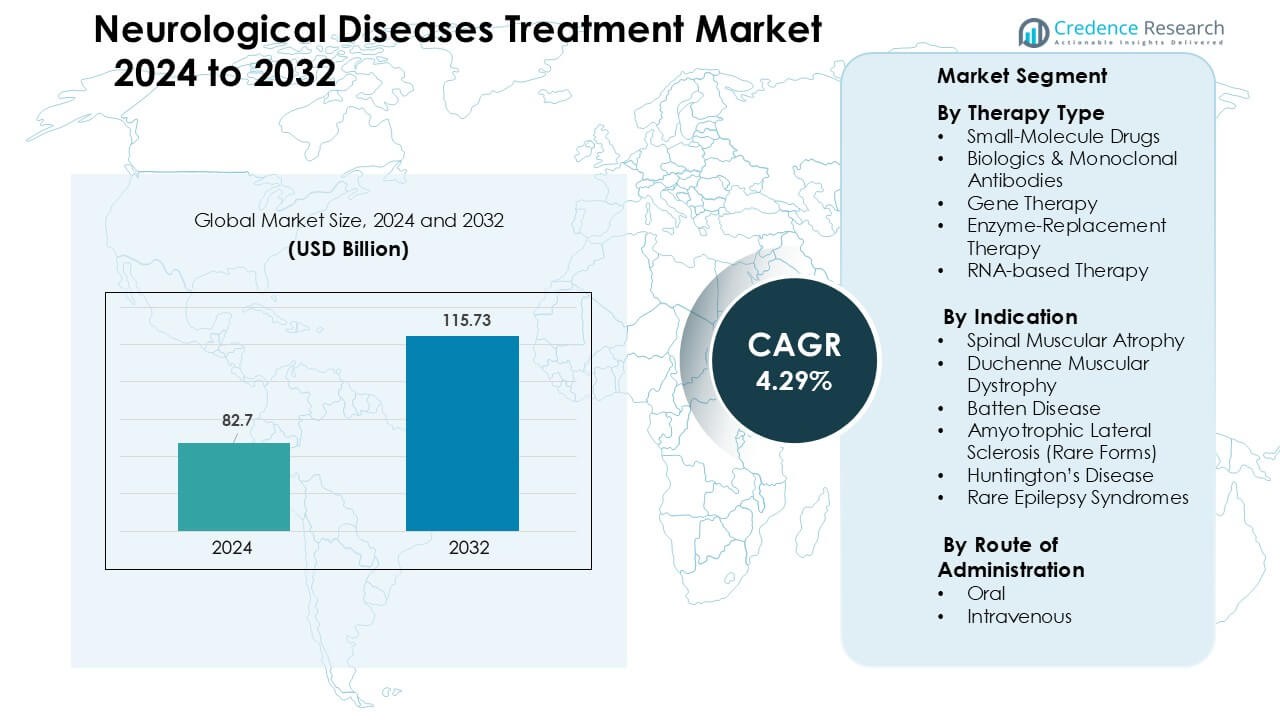
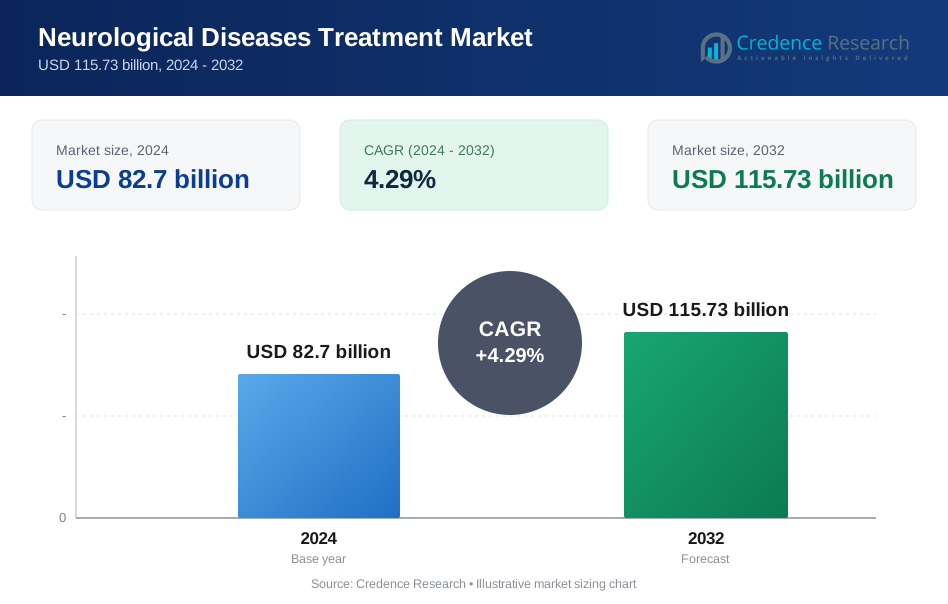
Neurological Diseases Treatment Market was valued at USD 82.7 billion in 2024 and is anticipated to reach USD 115.73 billion by 2032, growing at a CAGR of 4.29 % during the forecast period.
| REPORT ATTRIBUTE | DETAILS |
|---|---|
| Historical Period | 2020-2023 |
| Base Year | 2024 |
| Forecast Period | 2025-2032 |
| Neurological Diseases Treatment Market Size 2024 | USD 82.7 Billion |
| Neurological Diseases Treatment Market, CAGR | 4.29 % |
| Neurological Diseases Treatment Market Size 2032 | USD 115.73 Billion |
Leading players in the neurological diseases treatment market include Biogen, Novartis, Roche, Ionis Pharmaceuticals, Sarepta Therapeutics, PTC Therapeutics, and Bluebird Bio, each advancing strong portfolios in gene therapy, RNA-based drugs, and biologics for SMA, DMD, ALS, Huntington’s disease, and rare epilepsy syndromes. These companies compete through accelerated clinical pipelines, expanded vector manufacturing, and deeper collaboration with global neurology centers. North America led the market with a 38% share in 2024, supported by broad access to advanced therapies, strong reimbursement structures, and high adoption of precision-medicine platforms.
Market Insights
- The neurological diseases treatment market reached USD 82.7 billion in 2024 and is projected to hit USD 115.73 billion by 2032, expanding at a CAGR of 4.29% during the forecast period.
- Demand grows due to rising cases of SMA, DMD, ALS, and rare epilepsies, supported by expanding newborn screening, improved diagnostics, and strong adoption of gene and RNA-based therapies.
- Major trends include rapid advancement in precision medicine, increasing approvals of antisense and AAV-based therapies, and wider use of digital biomarkers and remote neurological monitoring.
- Biogen, Novartis, Roche, Ionis Pharmaceuticals, Sarepta Therapeutics, and PTC Therapeutics shape competitive activity through accelerated pipelines, manufacturing expansion, and global research collaborations; restraints include high therapy costs and limited long-term safety data.
- North America led with 38% share, followed by Europe at 31%; Asia Pacific grew fastest at 23%, driven by rising genetic testing, while the oral therapy segment dominated with 55% share in administration preferences
Market Segmentation Analysis:
By Therapy Type
Small-molecule drugs held the dominant share of about 46% in 2024, driven by wide availability, lower development costs, and strong use in chronic neurological disorders. These drugs remain the first-line choice for many conditions because of their predictable pharmacokinetics and easier scaling in manufacturing. Biologics and monoclonal antibodies expanded due to targeted action in neuroinflammation. Gene therapy and RNA-based therapy grew fast as approvals for SMA and DMD increased. Enzyme-replacement therapy stayed limited to a smaller set of rare enzyme-deficiency disorders.
- For instance, Eli Lilly and Novo Nordisk developed xanomeline, a small-molecule muscarinic M₁/M₄ agonist, which has a brain‑to‑plasma ratio of over 10:1, enabling high CNS penetration.
By Indication
Spinal muscular atrophy led the indication segment with nearly 34% share in 2024, supported by strong adoption of gene therapy and antisense drugs in infant and pediatric cases. SMA treatments gained momentum due to clear clinical gains in motor function and high global screening rates. Duchenne muscular dystrophy grew with new exon-skipping approvals. Huntington’s disease and ALS (rare forms) recorded steady uptake, aided by emerging RNA-based pipelines. Batten disease and rare epilepsy syndromes saw niche but rising treatment demand through expanded compassionate-use programs.
- For instance, as of early 2024, 33 countries have newborn screening (NBS) programs for SMA, and in 2023, 1,176 newborns were diagnosed via these screens.
By Route of Administration
The oral route dominated with about 55% share in 2024, backed by strong adherence, ease of long-term therapy, and wide availability of small-molecule neurological drugs. Oral regimens remained the preferred format for chronic neurodegenerative conditions, supporting broader patient access. Intravenous delivery-maintained demand in biologics, gene therapies, and enzyme-replacement therapies, where targeted delivery and controlled dosing are required. Growth in IV treatments came from hospital-based infusion programs and rising approvals of monoclonal antibodies for rare neurological disorders.
Key Growth Drivers
Rising Prevalence of Rare and Degenerative Neurological Disorders
Growing incidence of rare and degenerative neurological disorders drives strong demand for advanced treatment options. Higher diagnosis rates for conditions such as SMA, Huntington’s disease, DMD, and rare epilepsy syndromes push healthcare systems to adopt newer therapeutic classes. Wider newborn screening, improved genetic testing, and increased disease awareness help identify patients earlier, leading to faster treatment uptake. Many countries also expanded reimbursement for high-value neurological medicines, which improved therapy access. Clinical guidelines now favor early intervention for rare neurological diseases, which boosts prescription volume. Strong unmet needs in progressive disorders continue to attract investment from biotech and pharma companies, supporting market expansion across major regions.
- For instance, the global prevalence of Duchenne muscular dystrophy (DMD) is estimated at 4.8 cases per 100,000 males, highlighting both the rarity and the concentrated unmet need in this population.
Advances in Gene, RNA, and Precision Medicine Therapies
Breakthroughs in gene therapy, antisense oligonucleotides, and RNA-based platforms significantly accelerate market growth. These technologies enable targeted intervention at the genetic or molecular level, which improves outcomes in disorders with clear mutations. Multiple regulatory approvals in SMA, DMD, and rare epilepsies validate the commercial potential of precision therapies, encouraging more companies to scale development. Strong funding flows into biotech firms help expand pipelines for rare neurological conditions with no standard treatments. Increased availability of viral vectors, improved delivery systems, and manufacturing innovation also support faster production. These clinical advances raise patient survival rates and deliver long-term functional benefits, making advanced modalities central to future neurological treatment models.
- For instance, Novartis’s gene therapy Zolgensma® (onasemnogene abeparvovec) has now been administered to over 3,700 patients globally, demonstrating sustained SMN protein expression and durable motor benefits in SMA.
Expanding Global Investment and Regulatory Support
Governments and global health agencies now prioritize rare neurological diseases, creating a strong funding and regulatory environment. Incentives such as orphan-drug status, fast-track designations, and accelerated approvals shorten development timelines and reduce commercial risks. Public-private partnerships promote research on neurodegenerative conditions, while academic-industry collaborations expand innovation. Investment firms have increased financing for neurological pipelines as high-value therapies show strong market performance. Reimbursement policies for severe neurological conditions also improved in North America, Europe, and parts of Asia, allowing broader treatment access. This supportive landscape encourages pharma and biotech companies to scale R&D, clinical programs, and manufacturing capacity in neurological therapeutics.
Key Trends & Opportunities
Growing Shift Toward RNA-Based and Gene-Editing Technologies
RNA-based therapies, CRISPR gene editing, and viral-vector delivery systems are emerging as central trends in neurological treatment. Companies explore next-generation platforms that target disease-causing mutations with higher precision and fewer systemic effects. Advancements in AAV vectors and lipid nanoparticles improve delivery to neural tissues, expanding opportunities for previously untreatable conditions. Many firms also invest in modular RNA platforms that reduce development costs and shorten clinical timelines. These innovations enable therapy personalization, offering patients more durable outcomes. The rapid expansion of RNA and editing technologies creates strong commercial opportunities for rare neurological diseases with well-mapped genetic pathways.
- For instance, Intellia Therapeutics has teamed up with Regeneron to use its Nme2Cas9 CRISPR system delivered via Regeneron’s engineered AAV vectors to target neurological and muscular disease genes in vivo.
Rise of Biomarkers, Digital Tools, and Early Diagnosis Technologies
Biomarker-driven diagnostics and digital health tools are transforming the neurological disease landscape. Liquid biopsies, advanced imaging, and genetic assays help detect conditions earlier, improving treatment response rates. Wearables, cognitive-tracking apps, and remote monitoring systems help physicians measure disease progression with more accuracy. These technologies support real-world data generation, which enhances clinical decision-making and accelerates approvals for new therapies. Opportunities are strong for companies integrating AI-based diagnostic platforms with clinical workflows. Improved early detection continues to expand the eligible patient pool for high-value neurological treatments, supporting long-term market growth.
- For instance, BioSerenity’s Neuronaute smart-wearable system, used in neurology, processes data from smart clothing and sensors to identify digital biomarkers the company reports contributing to the diagnosis of 30,000 patients per year.
Expansion of Specialty Care Centers and Infusion-Based Services
Many healthcare systems invest in specialized neurology centers and infusion facilities to manage complex therapies such as monoclonal antibodies, gene therapies, and enzyme-replacement treatments. These centers enable safe administration, better monitoring, and improved patient outcomes. Partnerships between hospitals and biotech companies help create structured care programs for rare neurological diseases. Growing investment in outpatient infusion clinics increases treatment accessibility and reduces hospital burdens. This trend opens opportunities for firms offering infusion-ready formulations, care-coordination services, and long-term follow-up systems for neurological patients.
Key Challenges
High Therapy Costs and Limited Affordability
Many advanced neurological treatments including gene therapy and antisense drugs remain extremely expensive, limiting access for patients worldwide. High manufacturing costs, complex supply chains, and limited production capacity drive prices upward. Reimbursement is inconsistent across regions, creating accessibility gaps and slowing adoption. Patients in low- and middle-income countries face significant affordability barriers, restricting market penetration. Even in developed regions, insurers impose strict eligibility criteria, delaying or preventing treatment initiation. The high economic burden of care challenges healthcare systems and restricts the reach of innovative neurological therapies.
Difficulties in Targeted Delivery and Treatment Durability
Delivering therapies effectively to neural tissues remains a major challenge due to the blood-brain barrier and the complexity of neurological pathways. Many treatments require invasive administration or specialized delivery systems, which limits their widespread adoption. Durable and consistent therapeutic effects are also hard to achieve, especially in progressive disorders with rapid degeneration. Some therapies show reduced long-term efficacy or require repeated administration, increasing patient burden. Safety concerns, particularly with viral vectors and gene-editing tools, also complicate clinical development. These hurdles slow approval timelines and constrain the scalability of innovative neurological treatments.
Regional Analysis
North America
North America held the largest share of about 38% in 2024, supported by strong adoption of advanced neurological therapies, high diagnosis rates, and broad insurance coverage for rare disease treatments. The region benefits from robust R&D output, widespread genetic testing, and early access to gene and RNA-based therapies. Extensive clinical trial activity across the U.S. and Canada strengthens innovation for SMA, DMD, and rare epilepsy syndromes. Growing investment in specialty neurology centers and infusion facilities further expands treatment reach. Favorable regulatory programs, including accelerated approvals, continue to anchor North America’s leading position in this market.
Europe
Europe accounted for nearly 31% market share in 2024, driven by strong adoption of biologics, gene therapies, and advanced diagnostics across major countries. The presence of well-funded rare disease networks and supportive reimbursement frameworks boosts uptake of SMA, DMD, and Huntington’s disease treatments. Expanded newborn screening and earlier intervention programs improve clinical outcomes. Germany, France, and the U.K. lead clinical research, while Nordic nations show high adoption of personalized neurological therapies. Continued investment in neurological research hubs and cross-border treatment pathways positions Europe as a key growth region for innovative neurotherapeutics.
Asia Pacific
Asia Pacific captured about 23% share in 2024, supported by rising diagnosis rates, growing healthcare investment, and improved access to specialty neurological care. Japan, South Korea, China, and Australia drive demand for gene therapy, monoclonal antibodies, and rare disease treatments. Expansion of genomic testing and national rare disease registries increases early detection. Governments in China and India expand reimbursement for severe neurological disorders, supporting wider therapy access. Rapid growth in biotech manufacturing and clinical trial activity strengthens regional capabilities. APAC remains one of the fastest-growing regions due to its large patient base and improving treatment infrastructure.
Latin America
Latin America accounted for nearly 5% market share in 2024, shaped by gradual expansion in genetic testing, improved clinical capacity, and selective reimbursement for high-value neurological therapies. Brazil, Mexico, and Argentina show rising demand for treatments targeting SMA, rare epilepsies, and DMD, supported by better diagnosis and awareness programs. Limited healthcare budgets slow adoption of advanced gene or RNA therapies, but partnerships with global pharmaceutical companies help expand access. Increasing investment in neurology centers and cross-border treatment programs supports slow but steady growth across the region.
Middle East & Africa
The Middle East & Africa region held about 3% share in 2024, driven by rising investment in specialized neurology services and improved access to advanced diagnostics in Gulf nations. Countries such as the UAE, Saudi Arabia, and Qatar lead adoption due to strong healthcare spending and early access programs for rare disease therapies. Broader regions in Africa face challenges in affordability, diagnostic gaps, and limited clinical capacity, which restrict market penetration. International collaborations and government-led rare disease initiatives gradually expand treatment availability, supporting moderate long-term growth.
Market Segmentations:
By Therapy Type
- Small-Molecule Drugs
- Biologics & Monoclonal Antibodies
- Gene Therapy
- Enzyme-Replacement Therapy
- RNA-based Therapy
By Indication
- Spinal Muscular Atrophy
- Duchenne Muscular Dystrophy
- Batten Disease
- Amyotrophic Lateral Sclerosis (Rare Forms)
- Huntington’s Disease
- Rare Epilepsy Syndromes
By Route of Administration
- Oral
- Intravenous
By Geography
- North America
- U.S.
- Canada
- Mexico
- Europe
- Germany
- France
- U.K.
- Italy
- Spain
- Rest of Europe
- Asia Pacific
- China
- Japan
- India
- South Korea
- South-east Asia
- Rest of Asia Pacific
- Latin America
- Brazil
- Argentina
- Rest of Latin America
- Middle East & Africa
- GCC Countries
- South Africa
- Rest of the Middle East and Africa
Competitive Landscape
Leading companies in the neurological diseases treatment market include Biogen, Novartis, Roche, Ionis Pharmaceuticals, Sarepta Therapeutics, PTC Therapeutics, and Bluebird Bio, each advancing portfolios across gene therapy, RNA-based therapy, and biologics. These firms focus on rare and high-burden disorders such as SMA, DMD, ALS, Huntington’s disease, and rare epilepsies, where unmet clinical needs remain significant. Competition intensifies as companies accelerate clinical pipelines, expand manufacturing for viral vectors and antisense platforms, and secure global regulatory designations. Strategic moves include licensing agreements, biomarker-driven trials, and collaborations with academic neurology centers to support faster innovation. Many players also invest in long-term real-world data programs to strengthen therapy adoption. Growing interest from emerging biotech companies adds competitive pressure, especially in precision medicine segments.
Key Player Analysis
- NIHON KOHDEN CORPORATION.
- Bio-Rad Laboratories, Inc.
- CANON MEDICAL SYSTEMS CORPORATION.
- General Electric Company.
- Thermo Fisher Scientific, Inc.
- QIAGEN N.V.
- FUJIFILM Holdings Corporation.
- Mitsar Co, LTD.
- Siemens AG.
- Koninklijke Philips N.V.
Recent Developments
- In April 2025, NIHON KOHDEN CORPORATION Announced the second-generation Live-View Panel Pro, enabling interactive continuous EEG (cEEG) viewing and improved remote/real-time monitoring for high-risk neurology patients (supports EMU and ICU workflows).
- In March 2025, Canon Medical Systems Corporation (Canon Medical) received U.S. FDA regulatory clearance for major AI enhancements to its Aquilion ONE / INSIGHT Edition CT platform, specifically expanding the availability of the high-resolution PIQE 1024 matrix (Precise IQ Engine deep learning reconstruction) and SilverBeam filter for a wider range of clinical applications.
- In November 2024, NIHON KOHDEN CORPORATION Acquired Ad-Tech Medical Instrument Corporation to strengthen its EEG electrode portfolio and “comprehensive epilepsy care” capabilities, expanding Nihon Kohden’s reach across the epilepsy monitoring / EEG ecosystem.
Report Coverage
The research report offers an in-depth analysis based on Therapy Type, Indication, Route of Administration and Geography. It details leading market players, providing an overview of their business, product offerings, investments, revenue streams, and key applications. Additionally, the report includes insights into the competitive environment, SWOT analysis, current market trends, as well as the primary drivers and constraints. Furthermore, it discusses various factors that have driven market expansion in recent years. The report also explores market dynamics, regulatory scenarios, and technological advancements that are shaping the industry. It assesses the impact of external factors and global economic changes on market growth. Lastly, it provides strategic recommendations for new entrants and established companies to navigate the complexities of the market.
Future Outlook
- Precision medicine will expand as genetic mapping improves treatment targeting.
- Gene therapy and RNA-based platforms will gain wider global approvals.
- Digital biomarkers will support earlier diagnosis and faster clinical decisions.
- Manufacturing capacity for viral vectors will increase to meet demand.
- More countries will adopt newborn screening for rare neurological disorders.
- Oral targeted therapies will grow alongside advanced biologics and gene therapies.
- Partnerships between biotech firms and neurology centers will accelerate innovation.
- Real-world evidence programs will strengthen long-term treatment validation.
- AI-driven diagnostic tools will improve detection of progressive neurological diseases.
- Emerging markets will adopt advanced neurological treatments as infrastructure improves.
Request a Free Sample
Fill in your details and we'll send you a free sample report.
- Sample data tables & charts
- Research methodology
Need a Custom Version of This Report?
Tailor the scope, geography, or segments to your exact requirements.
- Custom geography or segment scope
- Direct access to our analyst team
Frequently Asked Questions
What is the current market size for Neurological Diseases Treatment market, and what is its projected size in 2032?
At what Compound Annual Growth Rate is the Neurological Diseases Treatment market projected to grow between 2025 and 2032?
Which Neurological Diseases Treatment market segment held the largest share in 2024?
What are the primary factors fueling the growth of the Neurological Diseases Treatment market?
Who are the leading companies in the Neurological Diseases Treatment market?
Which region commanded the largest share of the Neurological Diseases Treatment market?
Table of Content
Chapter 1. Report Introduction
- 1.1 Report Description & Purpose
- 1.1.1 Report Title & Market Definition
- 1.1.2 Unique Selling Propositions (USP) & Key Differentiators
- 1.1.3 Value Proposition for Stakeholders
- 1.2 Research Objectives
- 1.2.1 Market Sizing Objectives (Volume & Revenue)
- 1.2.2 Segmentation Objectives
- 1.2.3 Competitive Intelligence Objectives
- 1.2.4 Forecast & Scenario Objectives
- 1.3 Report Scope
- 1.3.1 Neurological Diseases Treatment Scope – Types & Subtypes Covered
- 1.3.2 Geographic Scope – Regions & Countries Covered
- 1.3.3 Historical Period, Base Year & Forecast Period (2024; forecast to 2032)
- 1.3.4 Inclusions & Exclusions
- 1.4 HS Code & Classification Framework
- 1.5 Currency, Units & Pricing Basis
- 1.6 Target Stakeholders
- 1.7 Limitations & Assumptions
Chapter 2. Executive Summary
- 2.1 Global Neurological Diseases Treatment Market Snapshot
- 2.1.1 Market Size – Historical (2024) & Forecast (2024-2032) (2024: USD 82.7 billion → 2032: USD 115.73 billion)
- 2.1.2 Volume & Revenue – Global Totals
- 2.1.3 Key Market Highlights – Top Five Facts
- 2.2 Neurological Diseases Treatment Market Segmentation Snapshot
- 2.2.1 Market Split by Region – 2024 vs. 2032
- 2.3 Competitive Snapshot
- 2.3.1 Top 10 Players by Revenue Share – 2024
- 2.3.2 Top 10 Players by Volume Share – 2024
- 2.3.3 Recent Strategic Developments (18-Month Summary)
- 2.4 Key Investment Highlights & Strategic Conclusions
Chapter 3. Neurological Diseases Treatment Market Dynamics & Industry Analysis
- 3.1 Market Overview & Context
- 3.1.1 Neurological Diseases Treatment Market Position in the Broader Automotive Value Chain
- 3.1.2 OEM vs. Replacement Market Dynamics
- 3.1.3 Market Maturity & Development Stage by Region
- 3.2 Neurological Diseases Treatment Market Drivers
- 3.3 Neurological Diseases Treatment Market Restraints & Challenges
- 3.4 Neurological Diseases Treatment Market Opportunities
- 3.5 Porter's Five Forces Analysis
- 3.5.1 Threat of New Entrants
- 3.5.2 Bargaining Power of Suppliers
- 3.5.3 Bargaining Power of Buyers
- 3.5.4 Threat of Substitutes
- 3.5.5 Competitive Rivalry – Intensity Assessment
- 3.6 Neurological Diseases Treatment Value Chain Analysis
- 3.6.1 Upstream – Raw Material/Input Suppliers
- 3.6.1.1 Raw Material/Input 1
- 3.6.1.2 Raw Material/Input 2
- 3.6.1.3 Raw Material/Input 3
- 3.6.2 Midstream – Production/Manufacturing/Service Delivery
- 3.6.2.1 Production/Process Overview
- 3.6.2.2 Key Facility Locations & Capacity by Manufacturer
- 3.6.3 Downstream – Distribution & End Consumer
- 3.6.3.1 Primary Channel – B2B/OEM
- 3.6.3.2 Secondary Channels – Dealer, Retail, Online, Direct
- 3.6.4 Value Chain Profitability Analysis
- 3.6.1 Upstream – Raw Material/Input Suppliers
- 3.7 PESTEL Analysis
- 3.7.1 Political Factors
- 3.7.2 Economic Factors
- 3.7.3 Social Factors
- 3.7.4 Technological Factors
- 3.7.5 Environmental Factors
- 3.7.6 Legal Factors
- 3.8 Neurological Diseases Treatment Supply Chain Analysis
- 3.8.1 Raw Material/Input Supply Risk Assessment
- 3.8.2 Manufacturing Concentration Risk (Geographic Exposure)
- 3.8.3 Trade Disruption Impact Analysis
- 3.9 Regulatory & Policy Landscape
Note: The regulatory and policy landscape section covers regulations based on their applicability to the market, Neurological Diseases Treatment category, geography, and scope of the study. Only regulatory frameworks with a material impact on operations, compliance, trade, sustainability, or market access are analyzed in detail.
Chapter 4. Key Investment Pockets & Opportunity Analysis
- 4.1 Neurological Diseases Treatment Market Attractiveness Analysis
- 4.1.1 By Region – Investment Attractiveness Matrix (Volume × CAGR)
- 4.2 Absolute Revenue Growth Opportunity
- 4.2.1 By Region – Absolute USD Growth Through 2032
- 4.3 Incremental Volume Opportunity
- 4.3.1 By Region – Incremental Volume Through 2032
- 4.3.2 Segment – Incremental Volume
- 4.4 Emerging Submarket Opportunity Deep Dive (Subject to Applicability)
- 4.5 Emerging Market Opportunity Scorecards
- 4.5.1 United States
- 4.5.2 Europe
- 4.5.3 Asia
- 4.5.4 Middle East & Africa
Note: Emerging Market Opportunity Scorecards will be included based on relevance and strategic importance. Regions listed are indicative and may vary depending on data availability and market dynamics.
Chapter 5. Neurological Diseases Treatment Import-Export Analysis & Trade Flows
- 5.1 Global Trade Overview
- 5.1.1 Global Export Value by Country (2024)
- 5.1.2 Global Export Volume by Country (2024)
- 5.1.3 Global Import Value by Country (2024)
- 5.1.4 Global Import Volume by Country (2024)
- 5.1.5 Net Trade Balance by Country (2024)
- 5.2 Export Analysis – Segment
- 5.2.1 Type 1 (HS Code)
- 5.2.2 Type 2 (HS Code)
- 5.2.3 Type 3 (HS Code)
- 5.2.4 Type 4 (HS Code)
- 5.2.5 Type 5 (HS Code)
- 5.3 Import Analysis – Segment
- 5.3.1 Type 1 (HS Code)
- 5.3.2 Type 2 (HS Code)
- 5.3.3 Type 3 (HS Code)
- 5.3.4 Type 4 (HS Code)
- 5.3.5 Type 5 (HS Code)
- 5.4 Average Unit Trade Prices
- 5.4.1 Average Export Price – Segment & Country
- 5.4.2 Average Import Price – Segment & Source Country
- 5.4.3 Price Trends (2024)
- 5.5 Key Trade Route Analysis
- 5.5.1 Trade Route 1
- 5.5.2 Trade Route 2
- 5.5.3 Trade Route 3
- 5.5.4 Trade Route 4
- 5.5.5 Trade Route 5
- 5.6 Trade Policy Impact Assessment
- 5.6.1 US Anti-Dumping & Section 301 Tariffs
- 5.6.2 EU Customs Union Impact
- 5.6.3 Major Free Trade Agreements
- 5.6.4 USMCA Rules of Origin
Note: Trade policy analysis will be included only where relevant to the Neurological Diseases Treatment market.
Chapter 6. Competitive Landscape & Company Benchmarking
- 6.1 Neurological Diseases Treatment Market Concentration & Structure
- 6.1.1 Herfindahl-Hirschman Index (HHI) – vs. 2024
- 6.1.2 Tier 1, Tier 2 & Tier 3 Market Structure
- 6.1.3 Global, Regional & Local Player Dynamics
- 6.2 Neurological Diseases Treatment Market Share Analysis – 2024
- 6.2.1 Global Revenue Share by Company
- 6.2.2 Global Volume Share by Company
- 6.2.3 Regional Revenue Share
- 6.2.4 Market Share Evolution ( vs. 2024)
- 6.2.5 OEM Segment Share by Company
- 6.2.6 Replacement Segment Share by Company
- 6.3 Production/Delivery Capacity & Facility Analysis
- 6.3.1 Global Installed Capacity
- 6.3.2 Capacity Utilization Rates
- 6.3.3 Production/Output Volume
- 6.3.4 Facility Locations & Capacity Map
- 6.3.5 Planned Capacity Additions
- 6.4 Neurological Diseases Treatment Competitive Benchmarking Matrix
- 6.4.1 Revenue, Volume, CAGR & Profitability Comparison
- 6.4.2 Channel Revenue Mix
- 6.4.3 Geographic Revenue Exposure
- 6.4.4 R&D Intensity
- 6.4.5 Sustainability Maturity
- 6.5 Strategic Developments in Neurological Diseases Treatment (Last 24 Months)
- 6.5.1 Mergers, Acquisitions & Divestments
- 6.5.2 New Neurological Diseases Treatment Launches
- 6.5.3 Facility Expansions
- 6.5.4 Strategic Alliances, Joint Ventures & Partnerships
- 6.5.5 Distribution Expansion & Market Entry
- 6.5.6 Sustainability & ESG Initiatives
- 6.6 Competitive Strategy Mapping
- 6.6.1 Leader, Challenger, Follower & Niche Classification
- 6.6.2 Pricing Strategy Comparison
- 6.6.3 Channel Strategy Matrix
Note: Strategic developments are included based on their materiality and the availability of reliable information.
Chapter 7. Global Neurological Diseases Treatment Market – By Distribution Channel
- 7.1 Segment Overview
- 7.1.1 Volume & Revenue Split by Channel (2024 & 2032)
- 7.1.2 Channel Mix Evolution (2024-2032)
Chapter 8. Regional Market Analysis – Global Overview
- 8.1 Global Regional Overview
- 8.1.1 Regional Volume Share
- 8.1.2 Regional Revenue Share
- 8.1.3 Regional Volume by Region
- 8.1.4 Regional Revenue by Region
- 8.1.5 Regional Forecast Through 2032
- 8.2 Cross-Regional Segment Analysis
- 8.2.1 By Distribution Channel
- 8.2.2 By Brand/Price Tier
Chapter 9. North America Neurological Diseases Treatment Market
- 9.1 United States
- 9.2 Canada
- 9.3 Mexico
Chapter 10. Europe Neurological Diseases Treatment Market
- 10.1 Germany
- 10.2 France
- 10.3 Italy
- 10.4 United Kingdom
- 10.5 Spain
- 10.6 Poland
- 10.7 Russia
- 10.8 Netherlands
- 10.9 Belgium
- 10.10 Sweden
- 10.11 Denmark
- 10.12 Norway
- 10.13 Rest of Europe
Chapter 11. Asia Pacific Neurological Diseases Treatment Market
- 11.1 China
- 11.2 India
- 11.3 Japan
- 11.4 South Korea
- 11.5 Thailand
- 11.6 Indonesia
- 11.7 Vietnam
- 11.8 Malaysia
- 11.9 Australia
- 11.10 Rest of Asia Pacific
Chapter 12. Latin America Neurological Diseases Treatment Market
- 12.1 Brazil
- 12.2 Argentina
- 12.3 Colombia
- 12.4 Chile
- 12.5 Rest of Latin America
Chapter 13. Middle East Neurological Diseases Treatment Market
- 13.1 Saudi Arabia
- 13.2 United Arab Emirates
- 13.3 Turkey
- 13.4 Israel
- 13.5 Iran
- 13.6 Rest of the Middle East
Chapter 14. Africa Neurological Diseases Treatment Market
- 14.1 South Africa
- 14.2 Egypt
- 14.3 Nigeria
- 14.4 Morocco
- 14.5 Rest of Africa
Chapter 15. Neurological Diseases Treatment Company Profiles
- 15.1 [Company 01]
- 15.1.1 Company Overview
- 15.1.2 Key Management Personnel
- 15.1.3 Products & Services Portfolio
- 15.1.4 Financial Performance
- 15.1.5 Key Market Focus & Geographic Presence
- 15.1.6 Recent Developments & Strategic Initiatives
Note: The company profile list is preliminary and may change based on research findings, market developments, data availability, and client requirements.
Chapter 16. Appendices
- Appendix A – List of Abbreviations & Acronyms
- Appendix B – Industry Classification Code Reference – Full Series
- Appendix C – Production & Capacity Data Tables
- Appendix D – End-Use & Demand Base Tables
- Appendix E – Consumption & Replacement Rate Assumptions
- Appendix F – ASP Reference Tables
- Appendix G – Manufacturing & Facility Database
- Appendix H – Import-Export Data Tables
- Appendix I – Regulatory Summary Tables
- Appendix J – Primary Research Participant List (Anonymized)
- Appendix K – Primary Research Questionnaire Framework
- Appendix L – Data Sources & Bibliography
- Appendix M – Market Size Divergence & Source Comparison
Chapter 17. Research Methodology
- 17.1 Research Framework & Philosophy
- 17.2 Secondary Research – Sources, Hierarchy & Data Extraction
- 17.3 Data Modeling – Bottom-Up & Top-Down Market Sizing
- 17.4 Primary Research – Stakeholder Framework, LOI & Sample Sizes
- 17.5 Forecast Methodology – Regression, Scenario & Sensitivity Analysis
- 17.6 Quality Control – Four-Layer Validation Framework
- 17.7 Limitations & Standard Assumptions
- 17.8 Disclaimer
