Market Overview
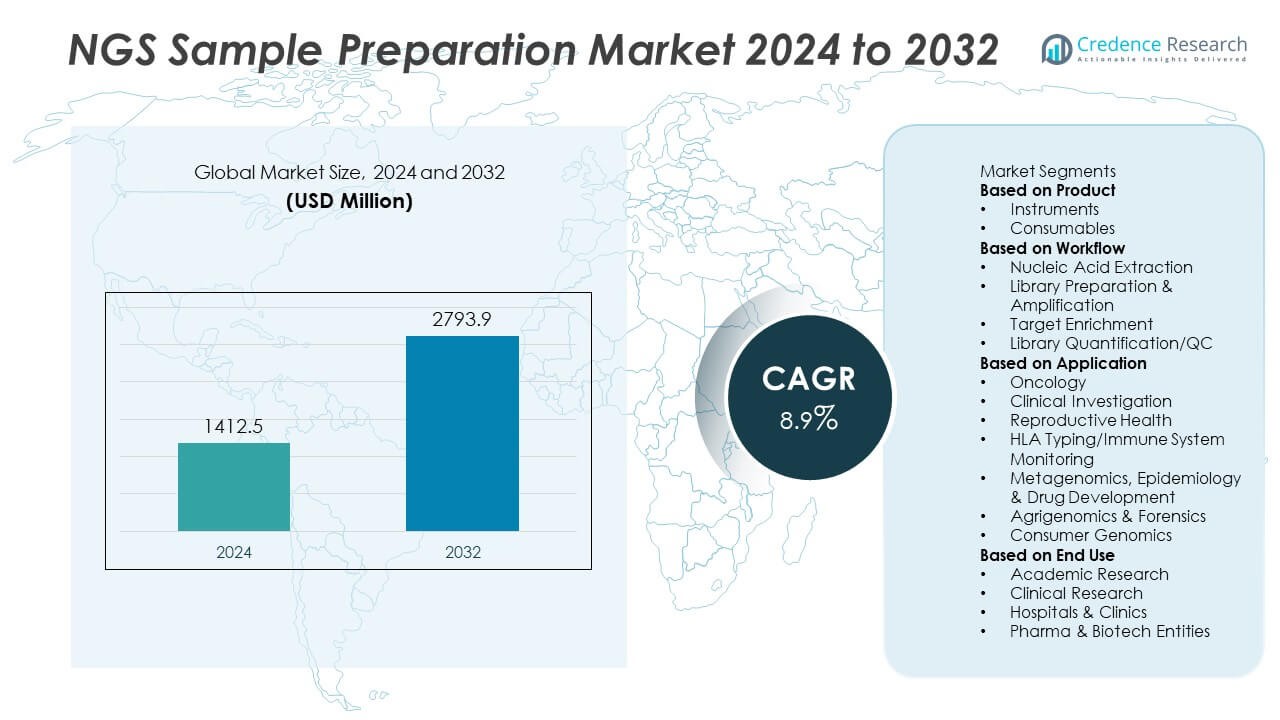
The NGS (Next-Generation Sequencing) Sample Preparation Market was valued at USD 1,412.5 million in 2024 and is projected to reach USD 2,793.9 million by 2032, expanding at a CAGR of 8.9% during the forecast period.
| REPORT ATTRIBUTE | DETAILS |
|---|---|
| Historical Period | 2020-2024 |
| Base Year | 2024 |
| Forecast Period | 2025-2032 |
| NGS Sample Preparation Market Size 2024 | USD 1,412.5 Million |
| NGS Sample Preparation Market, CAGR | 8.9% |
| NGS Sample Preparation Market Size 2032 | USD 2,793.9 Million |
The NGS Sample Preparation Market advances due to rising adoption of next-generation sequencing in clinical diagnostics, oncology, and population genomics. Demand increases for automation-compatible kits, single-cell processing, and standardized workflows that support high-throughput applications. Precision medicine initiatives and regulatory approvals for NGS-based testing drive consistent investment across healthcare and research institutions.
The NGS Sample Preparation Market demonstrates strong geographical diversity, with North America leading in technological innovation and clinical adoption, driven by robust research funding and advanced healthcare infrastructure. Europe follows with a focus on regulatory-compliant diagnostics and national genomic programs across countries such as Germany, the UK, and France. Asia-Pacific is expanding rapidly due to increasing investment in genomic research, population health initiatives, and growing demand for localized sequencing solutions in China, Japan, and India. Latin America and the Middle East & Africa show emerging potential through public health genomics and academic collaborations. Key players in this market include Illumina, Inc., which offers a comprehensive suite of sample prep solutions for clinical and research applications; Thermo Fisher Scientific Inc., known for its scalable automation-ready platforms; and QIAGEN, which provides customizable library prep.
Market Insights
- The NGS Sample Preparation Market was valued at USD 1,412.5 million in 2024 and is projected to reach USD 2,793.9 million by 2032, growing at a CAGR of 8.9% during the forecast period.
- Rising adoption of next-generation sequencing in clinical diagnostics, oncology, and infectious disease monitoring continues to drive demand for reliable, high-throughput sample preparation workflows.
- The market shows a strong shift toward automation-compatible, pre-validated kits that minimize hands-on time, improve reproducibility, and support high-volume sequencing labs.
- Leading companies such as Illumina, Thermo Fisher Scientific, QIAGEN, and Agilent Technologies actively expand their product portfolios and invest in integration with robotic platforms and cloud-based digital tools.
- High cost of reagents, instruments, and workflow complexity remains a barrier to adoption among smaller labs and institutions with limited technical capacity or budget constraints.
- North America leads the market with strong infrastructure and research funding, followed by Europe with regulatory-backed adoption; Asia-Pacific is emerging rapidly with government-supported genomic programs.
- Increasing demand for cartridge-based systems, single-cell sample prep kits, and AI-supported workflow tracking solutions reflects a growing focus on scalability, accuracy, and lab efficiency.
Market Drivers
Increasing Adoption of NGS in Clinical Diagnostics and Precision Medicine
The NGS Sample Preparation Market is gaining momentum due to the expanding role of next-generation sequencing in clinical settings. Hospitals and diagnostic labs integrate NGS for applications such as inherited disease screening, oncology profiling, and infectious disease detection. The demand for reliable, high-throughput sample preparation protocols is growing with the adoption of precision medicine. Regulatory approvals for companion diagnostics further drive clinical utility, pushing laboratories to standardize workflows. Sample preparation kits tailored for specific applications streamline testing and reduce turnaround time. It supports the shift toward patient-specific treatment strategies and evidence-based clinical decisions.
- For instance, Illumina and Ovation are launching an integrated dataset of phenotypic, genomic, and proteomic data from patients treated with GLP-1 therapies, including therapy-responsive and nonresponsive populations.
Expanding Applications in Oncology, Agrigenomics, and Infectious Disease Research
The NGS Sample Preparation Market benefits from diverse application areas beyond human genomics. Researchers apply NGS in crop improvement, livestock breeding, and pathogen surveillance. Cancer research relies heavily on tumor profiling and liquid biopsy techniques, both requiring robust sample preparation methods. Public health agencies use metagenomic sequencing to monitor outbreaks and track antimicrobial resistance. Demand for uniform nucleic acid extraction and library construction kits continues to grow across research domains. It enables consistent, reproducible outcomes across a variety of sample types and organisms.
Automation and Workflow Standardization Support Scalability in Laboratories
Automation drives operational efficiency and consistency across sequencing workflows, increasing adoption of NGS platforms in high-throughput labs. The NGS Sample Preparation Market responds with pre-validated, automation-compatible kits that minimize user error and hands-on time. Vendors invest in robotic integration and platform-agnostic sample prep solutions. Standardized protocols help laboratories meet quality assurance requirements and accreditation standards. These innovations reduce turnaround time and operating costs. It facilitates scalable sequencing operations without compromising data quality.
- For instance, Agilent’s Bravo NGS Workstation with ODTC reduces touchpoints by up to 67% and automates runs of up to 96 samples.
Growth in Global Genomic Initiatives and Biobanking Infrastructure
National genome programs and international collaborations fuel demand for reliable sample preparation across regions. The NGS Sample Preparation Market plays a foundational role in enabling population-scale sequencing projects. Governments allocate funding for genome mapping, personalized medicine, and disease gene discovery. Biobanks require standardized sample preparation to support long-term storage and downstream sequencing. Industrial-scale sequencing partners depend on consistency and batch-to-batch reproducibility. It underpins the global shift toward genomic data-driven healthcare and biomedical discovery.
Market Trends
Shift Toward Automation-Compatible and Pre-Validated Sample Prep Kits
Laboratories increasingly adopt automation-ready solutions to meet the demand for high-throughput sequencing. The NGS Sample Preparation Market responds with kits designed for robotic platforms, reducing manual intervention and improving reproducibility. These products offer pre-validated protocols, minimizing the need for method development. Vendors focus on integration with liquid handling systems and thermal cyclers to support seamless workflows. Automation reduces variability and supports clinical-grade sequencing environments. It accelerates processing time and enables labs to manage growing sample volumes efficiently.
- For instance, Leiden University Medical Center implemented the Illumina DNA Prep kit on the flowbot ONE liquid handler and compared 16 bacterial library preparations processed both manually and automatically. The automated workflow reduced hands-on time from 125 minutes to 25 minutes, maintained comparable DNA yields (median 1.5‑fold difference), and achieved 100 percent concordance in multilocus sequence typing across samples.
Integration of Single-Cell and Low-Input Sample Preparation Technologies
Researchers seek advanced tools to prepare low-input and single-cell samples without compromising data integrity. The NGS Sample Preparation Market supports this trend with kits optimized for limited DNA or RNA quantities. Single-cell genomics is expanding in oncology, immunology, and neuroscience, requiring highly sensitive workflows. New chemistries and reagent formulations allow accurate profiling from minimal starting material. These innovations improve detection of rare variants and enhance transcriptomic resolution. It enables researchers to explore cell heterogeneity at unprecedented scale.
- For instance, the NEBNext Single Cell/Low Input RNA Library Prep Kit for Illumina enables library generation from as little as 2 pg of total RNA up to 200 ng, with high yields, uniform coverage, and enhanced detection of low-abundance transcripts.
Emphasis on Customization and Target Enrichment Strategies
Targeted sequencing gains popularity for its cost efficiency and clinical relevance in gene panel testing. The NGS Sample Preparation Market adapts by offering customizable enrichment kits and modular designs. Customers select panels based on disease-specific or research-specific genes of interest. Hybrid capture and amplicon-based enrichment methods evolve to improve coverage uniformity and sensitivity. Protocol flexibility supports a wide range of applications from somatic variant detection to rare mutation analysis. It empowers users to tailor sample prep strategies to meet precise analytical goals.
Growth in Cloud-Connected Sample Prep Platforms and Digital Workflow Solutions
Digital solutions gain traction to simplify sample tracking, reduce documentation errors, and support regulatory compliance. The NGS Sample Preparation Market incorporates cloud-based interfaces and LIMS-compatible systems. These tools monitor reagent usage, automate batch records, and provide real-time quality metrics. Integration with sequencing data pipelines enhances traceability and audit readiness. Software-linked platforms offer end-to-end visibility into the sample lifecycle. It improves transparency and standardization in both research and clinical environments.
Market Challenges Analysis
High Cost of Reagents, Kits, and Instruments Limits Accessibility for Smaller Labs
The NGS Sample Preparation Market faces pricing pressures that limit its accessibility in resource-constrained settings. Reagent and consumable costs remain high, especially for advanced kits with automation compatibility or specialized chemistries. Smaller laboratories and academic institutions often struggle to maintain consistent sequencing workflows due to budget limitations. The requirement for precision instruments, cold storage, and controlled environments adds to operational expenses. These constraints affect the scalability of projects and slow down adoption in emerging markets. It restricts the broader implementation of NGS in decentralized healthcare or low-throughput research environments.
Technical Complexity and Risk of Sample Loss Hinder Workflow Efficiency
Despite advancements, many NGS sample preparation protocols remain complex and require specialized training. The NGS Sample Preparation Market contends with challenges related to manual errors, cross-contamination, and inconsistent nucleic acid quality. Multi-step workflows increase the risk of degradation, especially in low-input or degraded samples. Inconsistent handling may compromise downstream sequencing accuracy, affecting overall data integrity. The need for precise thermal cycling, enzymatic reactions, and clean environments adds procedural rigidity. It reduces flexibility in sample types and limits throughput in high-volume settings.
Market Opportunities
Expansion of NGS-Based Testing in Emerging Markets Unlocks Commercial Potential
Rapid healthcare infrastructure development and increased research funding create strong demand for genomic technologies across emerging economies. The NGS Sample Preparation Market has the opportunity to grow by addressing unmet needs in countries investing in precision medicine, population genomics, and infectious disease surveillance. Localized production of sample prep reagents and distribution partnerships can reduce costs and improve availability. Public-private initiatives to establish national biobanks and genome mapping programs support market penetration. Technology transfer and training programs further enhance laboratory capabilities in underserved regions. It enables companies to build long-term presence in high-growth geographies.
Development of AI-Driven and Cartridge-Based Sample Prep Systems Enhances Usability
The rising demand for simplified, point-of-care-compatible sequencing solutions opens new avenues for innovation. The NGS Sample Preparation Market can capitalize on miniaturized, cartridge-based systems that integrate all steps into a closed, automated platform. These formats reduce error rates, improve biosafety, and minimize hands-on time for clinical and decentralized labs. AI-driven protocols can guide operators through quality checks, reagent tracking, and real-time error correction. Integration with cloud-based sequencing platforms enhances ease of use in diagnostics and field applications. It positions the market to support broader adoption across non-specialist settings.
Market Segmentation Analysis:
By Product:
The NGS Sample Preparation Market includes products such as reagents and consumables, instruments, and accessories. Reagents and consumables dominate the segment due to their recurring use in every sequencing run. High-throughput laboratories depend on high-quality reagents for nucleic acid extraction, quantification, fragmentation, and library preparation. Instrument sales grow steadily with the expansion of automation-compatible platforms and liquid handling systems. Demand for reliable accessories such as purification columns, pipette tips, and magnetic beads supports consistent workflow execution. It emphasizes the importance of performance consistency and scalability in sequencing environments.
- For instance, Illumina’s DNA PCR‑Free Prep kit completes a whole-genome sequencing library in roughly 90 minutes, with input DNA ranging from 25 ng to 300 ng, and supports up to 384-plex with unique dual indexes.
By Workflow:
Key workflows in the market include library preparation, target enrichment, fragmentation and end-repair, adapter ligation, and quality control. Library preparation remains the most critical and resource-intensive stage, requiring precise handling of enzymes, buffers, and clean-up reagents. Target enrichment techniques such as hybrid capture and amplicon-based methods continue to evolve, offering enhanced specificity for disease-focused applications. Fragmentation and end-repair protocols adapt to various input qualities, supporting both fresh and degraded samples. Adapter ligation and indexing drive multiplex sequencing, reducing per-sample costs and increasing efficiency. It enables high-throughput labs to meet clinical and research requirements without sacrificing accuracy.
By End-User:
End-users in the NGS Sample Preparation Market include academic and research institutes, hospitals and clinical laboratories, pharmaceutical and biotechnology companies, and contract research organizations (CROs). Academic institutions lead in early-stage innovation and protocol development, driving demand for flexible and customizable kits. Clinical labs require automation-ready, regulatory-compliant workflows to ensure reproducibility and traceability. Pharmaceutical firms utilize sample preparation in biomarker discovery, companion diagnostics, and clinical trial genomics. CROs support outsourcing of sequencing services and depend on scalable, standardized sample prep solutions. It serves a broad spectrum of user needs, from exploratory research to regulated diagnostics.
- For instance, Covaris introduced the truCOVER WGS PCR-free Library Prep Kit, which merges precise acoustic DNA shearing (via AFA® technology) with library prep in a single tube-enhancing accuracy, workflow efficiency, and reducing variability in whole-genome sequencing prep.
Segments:
Based on Product
- Instruments
- Consumables
Based on Workflow
- Nucleic Acid Extraction
- Library Preparation & Amplification
- Target Enrichment
- Library Quantification/QC
Based on Application
- Oncology
- Clinical Investigation
- Reproductive Health
- HLA Typing/Immune System Monitoring
- Metagenomics, Epidemiology & Drug Development
- Agrigenomics & Forensics
- Consumer Genomics
Based on End Use
- Academic Research
- Clinical Research
- Hospitals & Clinics
- Pharma & Biotech Entities
Based on the Geography:
- North America
- U.S.
- Canada
- Mexico
- Europe
- UK
- France
- Germany
- Italy
- Spain
- Russia
- Belgium
- Netherlands
- Austria
- Sweden
- Poland
- Denmark
- Switzerland
- Rest of Europe
- Asia Pacific
- China
- Japan
- South Korea
- India
- Australia
- Thailand
- Indonesia
- Vietnam
- Malaysia
- Philippines
- Taiwan
- Rest of Asia Pacific
- Latin America
- Brazil
- Argentina
- Peru
- Chile
- Colombia
- Rest of Latin America
- Middle East
- UAE
- KSA
- Israel
- Turkey
- Iran
- Rest of Middle East
- Africa
- Egypt
- Nigeria
- Algeria
- Morocco
- Rest of Africa
Regional Analysis
North America
North America leads the NGS Sample Preparation Market, accounting for 38.4% of global revenue in 2024. The region benefits from a mature genomic infrastructure, strong research funding, and high adoption of NGS-based diagnostics in oncology and rare disease testing. Major sequencing companies such as Illumina, Thermo Fisher Scientific, and Agilent Technologies operate extensive manufacturing and distribution networks across the U.S. and Canada. Clinical laboratories and academic centers utilize NGS for personalized treatment plans, especially in cancer care and inherited disease profiling. Public initiatives like the NIH All of Us Research Program and Canada's Genomics Enterprise continue to drive sequencing volume. It supports sustained demand for high-quality, regulatory-compliant sample preparation kits and automation-compatible platforms. Strong collaborations between research institutes and biotech firms further strengthen the region’s technological leadership.
Europe
Europe represents 27.1% of the global NGS Sample Preparation Market and maintains a strong position through academic research and government-backed healthcare genomics programs. Countries such as Germany, the United Kingdom, France, and the Netherlands invest in precision medicine initiatives and national genome sequencing efforts. The European Union's Horizon Europe framework allocates substantial funding for research in genomics, rare disease, and cancer diagnostics. Clinical labs across the region adopt CE-IVD marked NGS kits for diagnostic testing under evolving IVDR compliance requirements. Biobanking programs across Sweden and Finland demand standardized sample processing protocols for long-term genomic studies. It drives the uptake of automated, high-throughput sample prep solutions, particularly in hospital-affiliated labs and centralized research facilities.
Asia-Pacific
Asia-Pacific holds 22.6% of the market and represents the fastest-growing region, supported by strong investments in national genomics infrastructure, increasing healthcare digitization, and growing awareness of precision medicine. China, Japan, South Korea, and Australia lead adoption across both research and clinical environments. China’s 100K Genome Project and Japan’s Genome Medical Project accelerate the need for large-scale sample preparation tools that meet international quality standards. Local manufacturers expand partnerships with global NGS leaders to support regional distribution of kits and reagents. Expanding cancer diagnostics and infectious disease surveillance programs across India and Southeast Asia contribute to rising demand. It creates opportunities for cost-efficient, scalable sample prep platforms tailored to local needs.
Latin America
Latin America captures 6.3% of the global NGS Sample Preparation Market, with Brazil and Mexico as leading contributors. The region shows steady progress in adopting NGS technologies in oncology diagnostics, academic research, and public health programs. Regional laboratories explore partnerships with international genomic service providers to increase access to sequencing tools. Government-supported precision medicine programs and oncology-focused genome mapping projects are gaining traction. Resource limitations pose challenges, but growing demand for decentralized testing drives interest in simplified, portable sample prep workflows. It enables broader implementation in both public and private healthcare systems across Latin America.
Middle East & Africa
The Middle East & Africa region accounts for 5.6% of the market, supported by emerging investments in healthcare innovation and genomic research. Countries such as the United Arab Emirates, Saudi Arabia, and South Africa lead in sequencing adoption through national health transformation plans. Genomic initiatives like the UAE Genomics Council aim to integrate whole genome sequencing into routine care, fueling demand for standardized sample preparation kits. Academic centers in Egypt and Kenya explore NGS applications in disease surveillance and genetic disease research. It remains a developing market, with potential for significant growth through international collaborations and government-backed healthcare modernization efforts.
Key Player Analysis
- Eurofins Scientific
- Illumina, Inc.
- BGI Genomics
- Thermo Fisher Scientific Inc.
- Agilent Technologies, Inc.
- Danaher Corporation (Beckman Coulter)
- QIAGEN
- Bio-Rad Laboratories, Inc.
- Hoffmann-La Roche Ltd
- PerkinElmer Inc.
Competitive Analysis
The NGS Sample Preparation Market remains highly competitive, driven by innovation, product diversification, and global expansion strategies. Leading players include Illumina, Inc., Thermo Fisher Scientific Inc., QIAGEN, Agilent Technologies, Inc., Bio-Rad Laboratories, Inc., PerkinElmer Inc., F. Hoffmann-La Roche Ltd, BGI Genomics, Danaher Corporation (Beckman Coulter), and Eurofins Scientific. These companies focus on automation-ready, platform-agnostic kits designed to enhance workflow efficiency and reduce turnaround time. Illumina maintains a strong position with integrated sample-to-sequencer solutions and proprietary library prep technologies. Thermo Fisher Scientific leverages its extensive instrumentation and consumables portfolio to offer end-to-end workflow coverage. QIAGEN emphasizes customizable nucleic acid extraction and target enrichment kits tailored for clinical and research applications. Agilent Technologies invests in high-throughput, robotics-compatible solutions and quality control tools to serve both academic and diagnostic markets. Bio-Rad Laboratories and PerkinElmer strengthen their presence through targeted acquisitions and automation-friendly reagent platforms. Roche and Danaher (Beckman Coulter) focus on expanding molecular diagnostics capabilities with scalable, regulatory-compliant sample prep offerings. BGI Genomics and Eurofins Scientific support large-scale population studies and sequencing services, emphasizing global reach and cost-effective solutions. Competitive advantage is defined by innovation, regulatory approvals, automation integration, and strategic partnerships across clinical, pharmaceutical, and research sectors.
Recent Developments
- In May 2025, Illumina partnered with Ovation.io to create a large clinical multiomic dataset from 25,000 patients treated with GLP‑1 therapies.
- In April 2025, Agilent Technologies showcased its advanced cancer research tools at the American Association for Cancer Research (AACR) Annual Meeting, including the expanded Avida DNA Cancer Panels. These panels enable simultaneous DNA and methylation profiling from a single sample, allowing for deeper multiomic insights into cancer.
- In June 2024, Illumina incorporated its newest chemistry called XLEAP-SBS™ for all reagents, including those for the NextSeq 1000 and NextSeq 2000 NGS instruments.
Market Concentration & Characteristics
The NGS Sample Preparation Market exhibits moderate to high market concentration, with a few multinational players dominating product innovation, distribution, and strategic collaborations. It is characterized by a strong focus on workflow automation, platform compatibility, and protocol standardization to meet clinical, research, and regulatory demands. Key companies such as Illumina, Thermo Fisher Scientific, QIAGEN, and Agilent Technologies maintain competitive advantage through proprietary technologies, integrated platforms, and recurring consumable sales. The market favors companies with robust R&D pipelines, global manufacturing capacity, and established relationships with clinical labs and research institutions. High entry barriers exist due to technical complexity, regulatory compliance requirements, and the need for precision-engineered instrumentation. It supports sustained innovation in target enrichment, low-input DNA/RNA handling, and high-throughput processing. Product differentiation depends on ease of use, automation readiness, sample compatibility, and validated performance across sequencing platforms. The market evolves rapidly with rising demand for scalable, digital, and point-of-care–oriented solutions that streamline genomic workflows.
Report Coverage
The research report offers an in-depth analysis based on Product, Workflow, Application, End Use and Geography. It details leading market players, providing an overview of their business, product offerings, investments, revenue streams, and key applications. Additionally, the report includes insights into the competitive environment, SWOT analysis, current market trends, as well as the primary drivers and constraints. Furthermore, it discusses various factors that have driven market expansion in recent years. The report also explores market dynamics, regulatory scenarios, and technological advancements that are shaping the industry. It assesses the impact of external factors and global economic changes on market growth. Lastly, it provides strategic recommendations for new entrants and established companies to navigate the complexities of the market.
Future Outlook
- Demand for automated, hands‑off sample preparation workflows will rise sharply across clinical and high‑throughput laboratories.
- Single‑cell and low‑input preparation kits will gain traction in research fields like oncology, immunology, and neuroscience.
- Cartridge‑based or closed‑system solutions will expand into decentralized and point‑of‑care settings.
- Integration of AI‑driven QC and workflow guidance will enhance reproducibility and reduce human error.
- Modular, customizable enrichment panels will serve specialized disease panels and targeted sequencing needs.
- Partnerships between kit providers and LIMS or cloud platforms will improve traceability and audit capabilities.
- Biobanks and national genomic initiatives will increase demand for standardized, batch‑consistent sample prep solutions.
- Emerging economies will adopt cost‑effective, compact sample prep platforms tailored for local clinical and research use.
- Innovations will focus on compatibility with long‑read and third‑generation sequencing technologies.
- Sustainability considerations will drive development of low‑waste, recyclable consumables and reduced‑volume workflows.

Request a Free Sample
Fill in your details and we'll send you a free sample report.
- Sample data tables & charts
- Research methodology
Market Dynamics
Increasing Adoption of NGS in Clinical Diagnostics and Precision Medicine
The integration of next-generation sequencing in hospitals and diagnostic labs for applications such as inherited disease screening, oncology profiling, and infectious disease detection is driving demand for reliable, high-throughput sample preparation protocols. Regulatory approvals for NGS-based companion diagnostics further accelerate clinical adoption and standardization.
Expansion of Applications in Oncology, Agrigenomics, and Infectious Disease Research
NGS sample preparation is critical for diverse research areas including cancer profiling, crop improvement, and pathogen surveillance. The need for robust, reproducible sample prep methods across a wide range of sample types and organisms is fueling market growth.
Automation and Workflow Standardization
Laboratories are increasingly adopting automation-compatible, pre-validated sample prep kits to minimize hands-on time, reduce user error, and support high-throughput sequencing. This trend is enabling scalable operations and improving reproducibility, especially in clinical and large research settings.
Growth in Global Genomic Initiatives and Biobanking
National genome projects, biobanking, and international collaborations are driving demand for standardized, batch-consistent sample preparation solutions. These initiatives require reliable protocols to support population-scale sequencing and long-term sample storage, underpinning the global expansion of genomic medicine.
Emergence of Single-Cell and Low-Input Sample Prep Technologies
The rise of single-cell genomics and low-input applications in oncology, immunology, and neuroscience is increasing demand for highly sensitive, specialized sample prep kits. These innovations enable accurate analysis from minimal starting material, expanding the utility of NGS in advanced research.
Need a Custom Version of This Report?
Tailor the scope, geography, or segments to your exact requirements.
- Custom geography or segment scope
- Direct access to our analyst team
Frequently Asked Questions
What is the current market size for NGS Sample Preparation, and what is its projected size in 2032?
At what Compound Annual Growth Rate is the NGS Sample Preparation market projected to grow between 2025 and 2032?
Which NGS Sample Preparation market segment held the largest share in 2024?
What are the primary factors fueling the growth of the NGS Sample Preparation market?
Who are the leading companies in the NGS Sample Preparation market?
Which region commanded the largest share of the NGS Sample Preparation market in 2024?
Table of Content
Chapter 1 Market Segmentation
- 1.1 Segmentation Framework
- 1.1.1 Product and Service Classification
- 1.1.2 Application and End-Use Classification
- 1.1.3 Technology and Solution Classification
- 1.1.4 Customer and Distribution Channel Classification
- 1.1.5 Geographic Segmentation
- 1.1.6 Market Segment Definitions and Boundaries
- 1.2 By End Use
- 1.2.1 Academic Research
- 1.2.2 Clinical Research
- 1.2.3 Hospitals & Clinics
- 1.2.4 Pharma & Biotech Entities
- 1.3 By Product
- 1.3.1 Instruments
- 1.3.2 Consumables
- 1.4 By Workflow
- 1.4.1 Nucleic Acid Extraction
- 1.4.2 Library Preparation & Amplification
- 1.4.3 Target Enrichment
- 1.4.4 Library Quantification/QC
- 1.5 By Application
- 1.5.1 Oncology
- 1.5.2 Clinical Investigation
- 1.5.3 Reproductive Health
- 1.5.4 Metagenomics, Epidemiology & Drug Development
- 1.5.5 Agrigenomics & Forensics
- 1.5.6 Consumer Genomics
Chapter 2 Introduction
- 2.1 Report Objectives and Scope
- 2.2 Product Definition and Industry Terminology
- 2.3 Market Inclusions and Exclusions
- 2.4 Research Process
- 2.4.1 Primary Research and Expert Interviews
- 2.4.2 Secondary Research and Source Review
- 2.4.3 Top-Down and Bottom-Up Estimation
- 2.4.4 Data Triangulation and Verification
- 2.5 Market Size Measurement Basis
- 2.5.1 2024: USD 1,412.5 million → 2032: USD 2,793.9 million
- 2.6 Historical and Forecast Reference Periods
- 2.6.1 Base Year: 2024
- 2.6.2 Forecast Period: 2024-2032
- 2.7 Research Assumptions and Limitations
Chapter 3 Executive Summary
- 3.1 Market Snapshot and Key Findings
- 3.2 Base-Year Market Size, 2024
- 3.3 Forecast Market Size, 2032
- 3.4 Revenue and Volume Growth Outlook
- 3.5 Key Demand and Supply Indicators
- 3.6 Leading Market Segments
- 3.7 Fastest-Growing Market Opportunities
- 3.8 Regional Performance Highlights
- 3.9 Technology and Industry Transformation
- 3.10 Competitive Landscape Summary
- 3.11 Analyst View and Strategic Implications
Chapter 4 Global NGS Sample Preparation Market Trends and Developments
- 4.1 Historical Industry Development
- 4.2 Recent Market Trends and Developments
- 4.3 Demand and Customer Behavior Trends
- 4.4 Technology and Product Innovation
- 4.5 Artificial Intelligence, Automation and Digitalization
- 4.6 Local Manufacturing and Supply Chain Realignment
- 4.7 Industry Partnerships, Mergers and Acquisitions
- 4.8 Sustainability and Circular Economy Developments
- 4.9 Government and Private Sector Investment Trends
- 4.10 Emerging Business Models and Commercialization
- 4.11 Industry Developments and Announcements
Chapter 5 Global NGS Sample Preparation Market Production, Supply and Demand Analysis
- 5.1 Demand Trend and Consumption Analysis
- 5.2 Demand Forecast, 2024-2032
- 5.3 Production and Output Trend
- 5.4 Production and Output Forecast, 2024-2032
- 5.5 Installed Capacity and Capacity Utilization
- 5.6 Company-Wise Production Plants and Statistics
- 5.6.1 Installed Production Capacity
- 5.6.2 Actual Production
- 5.6.3 Planned Capacity and Expansion Targets
- 5.7 Supply Chain Structure and Procurement Trends
- 5.8 Supply-Demand Gap and Bottlenecks
- 5.9 Import Dependence and Sourcing Structure
- 5.10 Contract Manufacturing and Outsourcing
- 5.11 Regional Supply and Demand Concentration
Chapter 6 Global NGS Sample Preparation Market Pricing Analysis
- 6.1 Pricing Structure and Measurement
- 6.2 Historical Pricing Trends
- 6.3 Pricing Outlook, 2024-2032
- 6.4 Average Selling Price and Unit Economics
- 6.5 Pricing by Product and Market Segment
- 6.6 Geographic Pricing Differences
- 6.7 Key Input, Energy, Labor and Logistics Costs
- 6.8 Contract Pricing and Purchasing Models
- 6.9 Pricing Sensitivity and Competitive Positioning
- 6.10 Price, Margin and Profitability Implications
Chapter 7 Global NGS Sample Preparation Market Dynamics
- 7.1 Market Growth Drivers
- 7.1.1 Demand-Side Drivers
- 7.1.2 Technology and Innovation Drivers
- 7.1.3 Infrastructure and Investment Drivers
- 7.1.4 Regulatory and Policy Drivers
- 7.2 Market Restraints
- 7.2.1 Cost and Affordability Constraints
- 7.2.2 Technology and Adoption Barriers
- 7.2.3 Supply Chain and Operational Constraints
- 7.3 Market Challenges
- 7.3.1 Competitive Pressure and Margin Erosion
- 7.3.2 Skills, Infrastructure and Implementation Gaps
- 7.4 Emerging Market Opportunities
- 7.5 Market Dynamics Impact and Time-Horizon Assessment
Chapter 8 Global NGS Sample Preparation Value Chain Analysis
- 8.1 Industry Value Chain Overview
- 8.2 Upstream Suppliers and Critical Inputs
- 8.3 Technology and Component Providers
- 8.4 Manufacturing or Service Delivery
- 8.5 Distribution, Channel Partners and Integrators
- 8.6 Downstream Applications and End Users
- 8.7 Value Addition and Profit Pools
- 8.8 Vertical Integration and Outsourcing
- 8.9 Supplier Concentration and Risk
- 8.10 Supply Chain Localization and Resilience
Chapter 9 Global NGS Sample Preparation Market Regulations and Policies
- 9.1 Relevant Laws, Standards and Compliance Frameworks
- 9.2 Product, Service, Safety and Quality Requirements
- 9.3 Government Policies, Incentives and Subsidies
- 9.4 Imports, Exports and Trade Barriers
- 9.5 Public Procurement and Local Content Requirements
- 9.6 Environmental and Sustainability Compliance
- 9.7 Upcoming Policy Changes and Market Implications
Chapter 10 Global NGS Sample Preparation Market Hotspots and Opportunities
- 10.1 Market Opportunity Mapping and Growth Hotspots
- 10.2 High-Growth Applications and Customer Groups
- 10.3 Underserved Markets and White-Space Opportunities
- 10.4 Emerging Technology and Product Opportunities
- 10.5 New Capacity and Investment Hotspots
- 10.6 Market Entry and Expansion Opportunities
- 10.7 Distribution and Partnership Opportunities
- 10.8 Near-Term and Long-Term Commercial Potential
- 10.9 Opportunity Attractiveness and Execution Risks
Chapter 11 Global NGS Sample Preparation Market Outlook, 2024-2032
- 11.1 Market Size and Analysis
- 11.1.1 Revenue (Market Measurement: 2024: USD 1,412.5 million → 2032: USD 2,793.9 million)
- 11.1.2 Market Volume and Quantity Sold
- 11.1.3 Historical Market Size
- 11.1.4 Base-Year Market Size, 2024
- 11.2 Market Forecast, 2024-2032
- 11.2.1 Revenue Forecast to 2032
- 11.2.2 Volume Forecast to 2032
- 11.2.3 CAGR and Year-on-Year Growth
- 11.2.4 Incremental Revenue Opportunity
- 11.3 Forecast Assumptions and Scenario Analysis
- 11.3.1 Base-Case Forecast
- 11.3.2 Optimistic and Conservative Scenarios
- 11.3.3 Technology, Pricing and Policy Sensitivities
- 11.4 Market Attractiveness and Growth Outlook
Chapter 12 Global NGS Sample Preparation Market Segmentation and Outlook
- 12.1 Segmentation Summary and Market Shares, 2024
- 12.2 Largest and Fastest-Growing Segments
- 12.3 By End Use - Market Size and Forecast, 2024-2032
- 12.3.1 Segment Definition and Scope
- 12.3.2 Historical Market Size
- 12.3.3 Revenue Forecast, 2024-2032
- 12.3.4 Volume Forecast, 2024-2032
- 12.3.5 Base-Year Market Share, 2024
- 12.3.6 Segment CAGR and Growth Drivers
- 12.3.7 Subsegment Market Size and Forecast
- 12.3.7.1 Academic Research
- 12.3.7.2 Clinical Research
- 12.3.7.3 Hospitals & Clinics
- 12.3.7.4 Pharma & Biotech Entities
- 12.3.8 Subsegment Pricing and Adoption Trends
- 12.3.9 Leading Suppliers and Competition
- 12.3.10 Regional Demand and Opportunities
- 12.4 By Product - Market Size and Forecast, 2024-2032
- 12.4.1 Segment Definition and Scope
- 12.4.2 Historical Market Size
- 12.4.3 Revenue Forecast, 2024-2032
- 12.4.4 Volume Forecast, 2024-2032
- 12.4.5 Base-Year Market Share, 2024
- 12.4.6 Segment CAGR and Growth Drivers
- 12.4.7 Subsegment Market Size and Forecast
- 12.4.7.1 Instruments
- 12.4.7.2 Consumables
- 12.4.8 Subsegment Pricing and Adoption Trends
- 12.4.9 Leading Suppliers and Competition
- 12.4.10 Regional Demand and Opportunities
- 12.5 By Workflow - Market Size and Forecast, 2024-2032
- 12.5.1 Segment Definition and Scope
- 12.5.2 Historical Market Size
- 12.5.3 Revenue Forecast, 2024-2032
- 12.5.4 Volume Forecast, 2024-2032
- 12.5.5 Base-Year Market Share, 2024
- 12.5.6 Segment CAGR and Growth Drivers
- 12.5.7 Subsegment Market Size and Forecast
- 12.5.7.1 Nucleic Acid Extraction
- 12.5.7.2 Library Preparation & Amplification
- 12.5.7.3 Target Enrichment
- 12.5.7.4 Library Quantification/QC
- 12.5.8 Subsegment Pricing and Adoption Trends
- 12.5.9 Leading Suppliers and Competition
- 12.5.10 Regional Demand and Opportunities
- 12.6 By Application - Market Size and Forecast, 2024-2032
- 12.6.1 Segment Definition and Scope
- 12.6.2 Historical Market Size
- 12.6.3 Revenue Forecast, 2024-2032
- 12.6.4 Volume Forecast, 2024-2032
- 12.6.5 Base-Year Market Share, 2024
- 12.6.6 Segment CAGR and Growth Drivers
- 12.6.7 Subsegment Market Size and Forecast
- 12.6.7.1 Oncology
- 12.6.7.2 Clinical Investigation
- 12.6.7.3 Reproductive Health
- 12.6.7.4 Metagenomics, Epidemiology & Drug Development
- 12.6.7.5 Agrigenomics & Forensics
- 12.6.7.6 Consumer Genomics
- 12.6.8 Subsegment Pricing and Adoption Trends
- 12.6.9 Leading Suppliers and Competition
- 12.6.10 Regional Demand and Opportunities
- 12.7 Segment Growth Comparison
- 12.8 Segment Attractiveness and Priority Matrix
Chapter 13 Global NGS Sample Preparation End-Use and Application Market Outlook
- 13.1 End-Use Industry and Customer Demand Structure
- 13.2 Leading Applications and Customer Groups
- 13.3 End-Use Market Size, Share and Forecast
- 13.4 Major End-Use Industry Deep Dives
- 13.4.1 Customer Requirements and Use Cases
- 13.4.2 Demand and Replacement Cycles
- 13.4.3 Technical and Regulatory Considerations
- 13.4.4 Purchasing and Procurement Models
- 13.4.5 Leading Vendors and Distribution Channels
- 13.4.6 Forecast and Commercial Opportunities
- 13.5 Emerging Applications and Cross-Segment Demand
- 13.6 End-Use Industry Investment Priorities
Chapter 14 Global NGS Sample Preparation Geographic Market Outlook, 2024-2032
- 14.1 Regional Market Size and Share, 2024
- 14.2 Regional Market Forecast, 2024-2032
- 14.3 Regional Pricing, Production and Demand Differences
- 14.4 North America
- 14.4.1 United States
- 14.4.2 Canada
- 14.4.3 Mexico
- 14.5 Europe
- 14.5.1 Germany
- 14.5.2 France
- 14.5.3 Italy
- 14.5.4 United Kingdom
- 14.5.5 Spain
- 14.5.6 Poland
- 14.5.7 Russia
- 14.5.8 Netherlands
- 14.5.9 Belgium
- 14.5.10 Sweden
- 14.5.11 Denmark
- 14.5.12 Norway
- 14.5.13 Rest of Europe
- 14.6 Asia Pacific
- 14.6.1 China
- 14.6.2 India
- 14.6.3 Japan
- 14.6.4 South Korea
- 14.6.5 Thailand
- 14.6.6 Indonesia
- 14.6.7 Vietnam
- 14.6.8 Malaysia
- 14.6.9 Australia
- 14.6.10 Rest of Asia Pacific
- 14.7 Latin America
- 14.7.1 Brazil
- 14.7.2 Argentina
- 14.7.3 Colombia
- 14.7.4 Chile
- 14.7.5 Rest of Latin America
- 14.8 Middle East
- 14.8.1 Saudi Arabia
- 14.8.2 United Arab Emirates
- 14.8.3 Turkey
- 14.8.4 Israel
- 14.8.5 Iran
- 14.8.6 Rest of the Middle East
- 14.9 Africa
- 14.9.1 South Africa
- 14.9.2 Egypt
- 14.9.3 Nigeria
- 14.9.4 Morocco
- 14.9.5 Rest of Africa
- 14.10 Regional Investment, Policy and Supply Chain Differences
- 14.11 Regional Competitive Landscape
- 14.12 Geographic Growth Hotspots
Chapter 15 Global NGS Sample Preparation Technology, Innovation and Sustainability Outlook
- 15.1 Technology Landscape and Maturity
- 15.2 Product, Process and Service Innovation
- 15.3 AI, Automation and Digital Tools in the Industry
- 15.4 Technology Adoption and Performance Benchmarking
- 15.5 Innovation Pipeline and R&D Investment
- 15.6 Patent and Intellectual Property Trends
- 15.7 Energy Efficiency and Resource Management
- 15.8 Sustainability, Recycling and Circularity
- 15.9 Technology Roadmap, 2024-2032
- 15.10 Risks of Obsolescence and Technology Substitution
Chapter 16 Global NGS Sample Preparation Market Key Strategic Imperatives
- 16.1 Growth and Market Entry Priorities
- 16.2 High-Return Products and Segments
- 16.3 Pricing, Profitability and Cost Optimization
- 16.4 Technology Investment and Product Differentiation
- 16.5 Supply Chain Localization and Resilience
- 16.6 Distribution and Customer Acquisition
- 16.7 Partnership, Acquisition and Capacity Strategy
- 16.8 Regional Expansion Priorities
- 16.9 Short-, Medium- and Long-Term Actions
Chapter 17 Competition Outlook
- 17.1 Industry Competition Characteristics
- 17.2 Market Structure and Concentration
- 17.3 Market Share and Competitive Positioning, 2024
- 17.4 Company-Wise Revenue and Product Benchmarking
- 17.5 Production and Service Capacity Benchmarking
- 17.6 Technology, Pricing and Differentiation
- 17.7 Regional Footprint and Distribution Strength
- 17.8 Mergers, Acquisitions and Strategic Alliances
- 17.9 New Entrants and Competitive Threats
- 17.10 Porter's Five Forces and Industry Attractiveness
- 17.11 Competitive Outlook, 2024-2032
Chapter 18 Company Profiles
- 18.1 Company Coverage and Selection Criteria
- 18.2 Illumina, Inc.
- 18.2.1 Business Description
- 18.2.2 Company Ownership and Geographic Presence
- 18.2.3 Product and Service Portfolio
- 18.2.4 Manufacturing and Operating Footprint
- 18.2.5 Production Capacity and Expansion Plans
- 18.2.6 Financial Performance and Investment
- 18.2.7 Market Share and Competitive Position
- 18.2.8 Technology and Innovation Capabilities
- 18.2.9 Strategic Alliances or Partnerships
- 18.2.10 Recent Developments
- 18.2.11 Growth Strategy and Outlook
- 18.3 Thermo Fisher Scientific Inc.
- 18.4 QIAGEN
- 18.5 Agilent Technologies, Inc.
- 18.6 Bio-Rad Laboratories, Inc.
- 18.7 PerkinElmer Inc.
- 18.8 F. Hoffmann-La Roche Ltd
- 18.9 BGI Genomics
- 18.10 Danaher Corporation (Beckman Coulter)
- 18.11 Eurofins Scientific
- 18.12 Other Relevant Market Participants
Note: Every listed company is profiled on the structure shown under the first company. The company list is preliminary and may change based on research findings, market developments, data availability and client requirements.
Chapter 19 Disclaimer
- 19.1 Research and Forecast Disclaimer
- 19.2 Data Source and Estimation Limitations
Note: The depth of individual sections depends on data availability for this market. Volume, capacity, trade and other unit-based metrics are included where applicable.