DNA Storage for Data Archiving Market Overview:
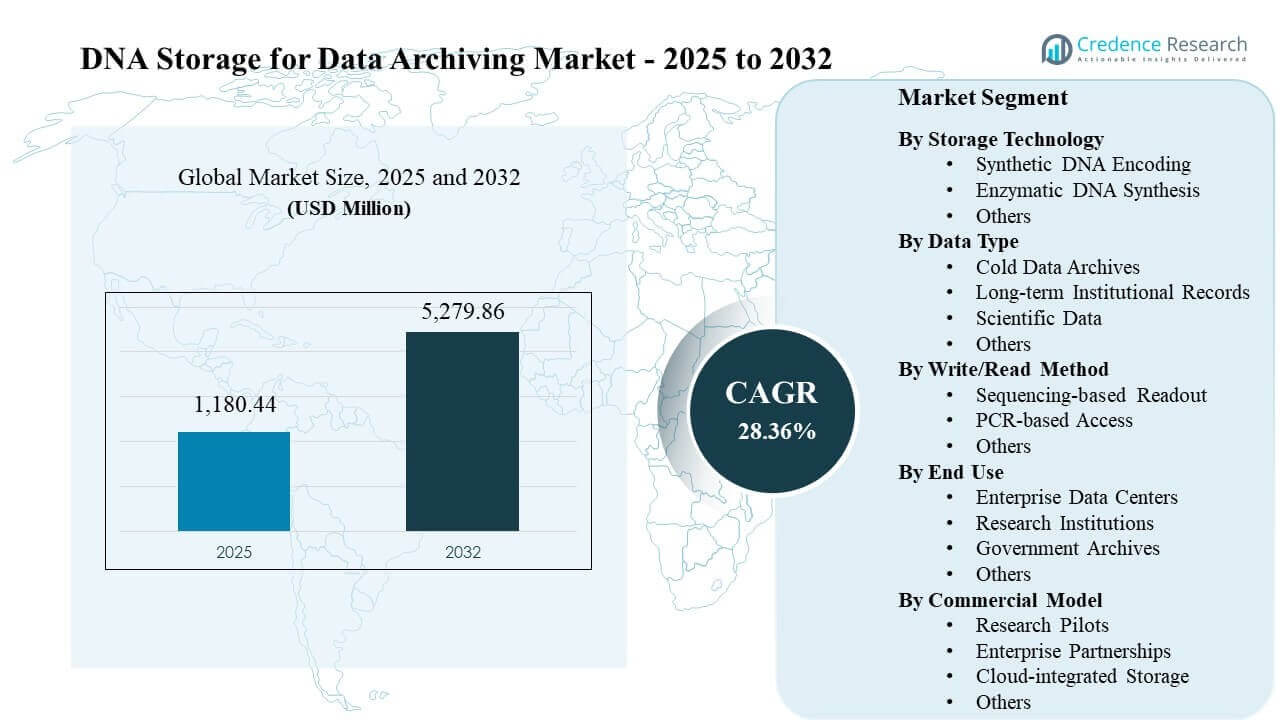
The DNA Storage for Data Archiving Market size was estimated at USD 1,180.44 million in 2025 and is expected to reach USD 5,279.86 million by 2032, growing at a CAGR of 28.36% from 2025 to 2032. Demand is rising as enterprises and institutions confront long-duration retention needs that strain conventional archival media through refresh cycles, physical footprint, and durability constraints. North America remains a primary commercialization hub, and Europe and Asia Pacific show expanding pilot activity as synthesis, sequencing, and decoding workflows move closer to packaged archival services.
| REPORT ATTRIBUTE | DETAILS |
|---|---|
| Historical Period | 2020-2024 |
| Base Year | 2025 |
| Forecast Period | 2026-2032 |
| DNA Storage for Data Archiving Market Size 2025 | USD 1,180.44 million |
| DNA Storage for Data Archiving Market, CAGR | 28.36% |
| DNA Storage for Data Archiving Market Size 2032 | USD 5,279.86 million |
Key Market Trends & Insights
- Market revenue is expected to rise from USD 1,180.44 million in 2025 to USD 5,279.86 million by 2032.
- North America accounted for 33.7% of 2025 revenue, reflecting concentration of early R&D-to-commercial pathways.
- Synthetic DNA Encoding represented the leading storage technology with a 53.4% share in 2025, supported by maturing encoding and error-correction approaches.
- Cloud-integrated Storage led commercial models with a 61.9% share in 2025, signaling preference for service-led adoption over stand-alone deployments.
Segment Analysis
DNA-based archival storage is advancing from research demonstrations toward pilot deployments that emphasize retention longevity, physical density, and resilience. Buyer evaluation often centers on end-to-end workflow readiness, including encoding, synthesis, storage handling, sequencing readout, and decoding software that supports integrity checks and predictable retrieval performance. Early adopters tend to prioritize high-value archives and regulated records where long-horizon preservation and auditability outweigh higher near-term costs and latency tradeoffs. Procurement cycles also reflect the need for validation protocols, chain-of-custody style controls, and repeatable recovery benchmarks.
Commercial traction is increasingly tied to integration with existing archival practices and operational models rather than isolated laboratory capability. Service-centric offerings can reduce barriers by bundling synthesis, sequencing, and decoding into managed workflows that align with enterprise governance and retention policies. Partnerships across data infrastructure providers and life sciences tooling vendors remain a core route to scale because DNA storage requires coordinated progress across chemistry, instrumentation, and software. Adoption pace is expected to accelerate as automation improves throughput and reduces per-unit write and read cost.
By Storage Technology Insights
Synthetic DNA Encoding accounted for the largest share of 53.4% in 2025. Adoption is supported by improving encoding schemes that enhance error tolerance and enable practical indexing for selective retrieval. Software advances strengthen data integrity verification and reduce recovery complexity in archival workflows. Progress in automation across encode-to-synthesize pipelines improves repeatability and reduces operational friction for pilot programs.
By Data Type Insights
Cold data archives remain a primary target because retention obligations keep expanding and refresh cycles increase operational burden for conventional media. Long-term institutional records draw interest when durability, integrity validation, and audit readiness are prioritized over frequent access. Scientific data archives add momentum as large datasets require preservation without proportional expansion of physical storage infrastructure. Buyer priorities often focus on predictable recovery, governance alignment, and risk reduction for long-horizon retention.
By Write/Read Method Insights
Sequencing-based readout remains central because sequencing ecosystems provide established instrumentation pathways and a mature tooling base for recovery workflows. Decoding reliability depends on robust error correction, sample handling consistency, and repeatable library preparation steps. PCR-based access supports selective retrieval concepts that can reduce read volume for targeted data access scenarios. Workflow integration improvements, including automation and standardized indexing, are important for operational adoption in archival settings.
By End Use Insights
Enterprise data centers evaluate DNA storage as a long-term tier for archives where durability and footprint reduction can complement existing cold storage strategies. Research institutions adopt pilots to preserve high-value datasets and strengthen reproducibility through stable long-duration storage. Government archives value disaster resilience and multi-decade retention, which aligns with DNA’s long-horizon preservation proposition. Adoption patterns reflect the need for governance controls, validation protocols, and predictable service-level expectations.
By Commercial Model Insights
Cloud-integrated Storage accounted for the largest share of 61.9% in 2025. Service delivery can package synthesis, sequencing, and decoding into an operational model that reduces in-house laboratory requirements. Integration with archival tiers and governance tooling supports procurement decisions that favor managed workflows. Partnership-led commercialization remains common because successful deployment requires coordinated progress across chemistry, instrumentation, and software.
DNA Storage for Data Archiving Market Drivers
Long-duration retention pressure across enterprise and public archives
Organizations face growing retention obligations that increase media refresh cycles, physical footprint, and operational complexity for conventional archival approaches. DNA storage offers a pathway to multi-decade preservation with high density and reduced space requirements. Demand strengthens when archives must remain verifiable, tamper-evident, and recoverable under strict governance. Procurement interest rises as workflow automation improves repeatability and reduces the specialized handling burden. Service models further accelerate adoption by lowering entry barriers for pilots.
Convergence of synthesis, sequencing, and decoding into workable archival workflows
Progress across synthesis chemistry, sequencing throughput, and decoding software is improving the practicality of DNA storage for real archives. Encoding advances support stronger error correction and indexing for selective retrieval and integrity checks. Instrumentation ecosystems provide a familiar base for readout workflows in institutional environments. Automation reduces variability across steps such as sample preparation and library handling. These improvements help stakeholders evaluate DNA storage as a viable archival tier rather than a lab-only concept.
- For instance, Evonetix has developed a semiconductor-driven synthesis platform with 10,000 individually controlled reaction sites on a silicon chip, demonstrating how parallelized DNA writing can support more standardized archival workflows.
Rising value of regulated records and integrity-focused archives
Highly regulated records emphasize immutability, auditability, and long-horizon preservation, which strengthens interest in DNA-based archival media. Institutions often seek durable storage that reduces risk from bit rot, media degradation, or repeated migration. Integrity verification workflows align with governance frameworks that require predictable validation and recovery. Demand expands as standards for archival authenticity evolve and organizations seek long-lived preservation options. The market benefits when service providers offer repeatable validation benchmarks and operational controls.
- For instance, Oxford Nanopore has reported duplex sequencing read accuracy above 99%, a meaningful threshold for archive operators that need dependable verification of DNA-encoded records during retrieval and compliance review.
Expansion of partnership-led commercialization and service packaging
DNA storage adoption is influenced by collaboration among data infrastructure players, synthetic DNA suppliers, sequencing platform providers, and software developers. Partnerships help unify end-to-end workflows and reduce fragmentation across the stack. Service packaging enables enterprises to test archival use cases without building specialized lab infrastructure. Commercial pilots gain momentum when integration supports retention policies, governance tooling, and tiered archival workflows. These dynamics accelerate movement from prototypes to structured pilot deployments.
DNA Storage for Data Archiving Market Challenges
DNA storage adoption faces cost and throughput constraints that limit broad deployment beyond pilot programs. Write cost remains sensitive to synthesis throughput, automation maturity, and quality control requirements across production steps. Read workflows can require specialized handling and sequencing processes that add operational complexity and latency. Standardization gaps across file formats, indexing, and retrieval protocols complicate interoperability. Buyer concerns also include validation rigor, repeatability under real-world conditions, and service-level predictability.
- For instance, Microsoft and the University of Washington demonstrated a fully automated end-to-end DNA storage system, but the published system completed only a 5-byte write-store-read cycle, and the related study noted that 5 bytes in 21 hours was not commercially viable, underscoring how automation maturity and throughput still constrain deployment.
Operational integration remains a challenge because most archival systems were built around established media and access patterns. DNA storage requires new pipelines for encoding, sample handling, storage logistics, and decoding that must integrate with governance and audit systems. Selective retrieval at scale remains a gating capability for many use cases that cannot tolerate full readout workflows for each query. Security and chain-of-custody requirements add controls that can slow adoption. Enterprise procurement may remain cautious until reference deployments demonstrate stable performance and predictable cost curves.
Market Trends and Opportunities
Service-led adoption is gaining traction as vendors package synthesis, sequencing, and decoding into managed archival offerings that reduce internal lab requirements. Cloud-integrated models can align DNA storage with existing tiered archival strategies and compliance workflows. Partnerships among platform providers, synthetic DNA producers, and data infrastructure firms are improving end-to-end integration. Workflow automation is trending toward standardized pipelines that improve repeatability and reduce handling complexity. These shifts expand the addressable buyer base beyond specialized research environments.
- For instance, Microsoft demonstrated an automated end-to-end DNA storage system with the University of Washington and recovered 1GB of DNA-stored data synthesized by Twist Bioscience, while Biomemory targets up to 150 years of retention with error resilience above 10E-16 UBER; meanwhile, workflow automation is moving toward standardized pipelines that improve repeatability and simplify handling.
Selective retrieval and indexing innovation remains a major opportunity that can improve practical utility for real archives. Stronger addressing schemes and decoding pipelines can reduce read volume, improve latency expectations, and support targeted recovery scenarios. Opportunities also emerge in regulated vertical archives where durability and authenticity provide high value. Long-horizon institutional records and scientific preservation use cases can anchor early scale as validation frameworks mature. Broader adoption becomes more likely as automation and standardization reduce operational friction.
Regional Insights
North America
North America held a 33.7% share in 2025, supported by active commercialization pathways and a concentration of ecosystem collaboration. Enterprise and institutional buyers in the region show stronger pilot appetite when service models reduce deployment complexity. The region benefits from mature sequencing and synthetic DNA supply ecosystems that support workflow development. Partnerships linking data infrastructure needs with life sciences tooling continue to influence early deployments.
Europe
Europe accounted for 28.9% of 2025 revenue, driven by strong institutional archiving needs and a policy environment that emphasizes data governance and long-term preservation. Research infrastructure and cross-border collaboration support pilots that target regulated records and high-value archives. Adoption interest rises when workflow integration aligns with compliance requirements and verification protocols. Service-led models can support broader deployment by reducing specialized operational burden.
Asia Pacific
Asia Pacific represented 26.8% of 2025 revenue, supported by rapid data creation and expanding research and technology ecosystems. Institutional pilots are influenced by investments in genomics infrastructure and digital preservation initiatives. Adoption growth depends on improvements in automation, cost curves, and integration into existing archival governance. Regional partnerships can accelerate deployment by connecting data-intensive sectors with scalable service offerings.
Latin America
Latin America reached 5.9% of 2025 revenue, reflecting earlier-stage adoption and a narrower concentration of pilots. Interest is strongest where institutional archives and scientific preservation needs justify longer-horizon retention strategies. Adoption can expand through service-based models that reduce the need for specialized internal capability. Investment in research infrastructure and digital record modernization can strengthen regional uptake over time.
Middle East & Africa
Middle East and Africa captured 4.7% of 2025 revenue, supported by emerging digitization agendas and selective institutional preservation initiatives. Adoption is constrained by limited deployment scale and a smaller base of integrated archival workflows. Government-led archival modernization and resilience planning can support pilots where long-horizon retention is prioritized. Service packaging and partner-led delivery can improve feasibility by reducing operational complexity.
Competitive Landscape
Competition is shaped by the ability to deliver end-to-end archival workflows spanning encoding software, synthesis capability, storage handling, sequencing readout, and decoding pipelines. Market participants differentiate through automation depth, error correction performance, selective retrieval approaches, and integration into enterprise governance and archival tiers. Partnerships remain central because no single provider typically controls the full stack at scale. Commercial success depends on demonstrating repeatable recovery, predictable cost trajectories, and operationally manageable services for institutional archives.
Microsoft is positioned around research-driven system integration and software innovation that improves reliability, encoding efficiency, and retrieval accuracy for DNA data storage workflows. Microsoft’s approach emphasizes practical architectures that connect encoding and decoding methods with lab automation and sequencing ecosystems. Progress in error correction and workflow design supports higher confidence recovery for archival use cases. Collaboration with ecosystem partners can help translate research advances into scalable service models and reference deployments.
The industry research and growth report includes detailed analyses of the competitive landscape of the market and information about key companies, including:
- Microsoft
- Twist Bioscience
- Illumina
- Catalog Technologies
- Western Digital
- DNA Script
- Evonetix
- Molecular Assemblies
- Roche Diagnostics
- BGI Genomics
Qualitative and quantitative analysis of companies has been conducted to help clients understand the wider business environment as well as the strengths and weaknesses of key industry players. Data is qualitatively analyzed to categorize companies as pure play, category-focused, industry-focused, and diversified; it is quantitatively analyzed to categorize companies as dominant, leading, strong, tentative, and weak.
Recent Developments
- In March 2026, Atlas Data Storage entered into a strategic partnership with imec to accelerate the development of synthetic DNA-based data storage for long-term archiving. The collaboration combines Atlas’s DNA synthesis and ASIC design capabilities with imec’s semiconductor fabrication and integration expertise, and imec is also investing in Atlas as part of the deal.
- In March 2026, Biomemory announced the acquisition of the assets of Catalog Technologies, a Boston-based pioneer in DNA data storage and computing. Through this acquisition, Biomemory added Catalog’s printing, reading, and computing technologies along with its patent portfolio to strengthen its roadmap for scalable DNA-based archival and cybersecurity storage solutions.
- In December 2025, Atlas Data Storage launched Atlas Eon 100, which it described as the world’s first scalable DNA data storage service for long-duration digital preservation. The company said this launch marked the first product in its DNA storage portfolio and officially showcased the offering at the AMIA 2025 conference in Baltimore.
- In May 2025, Twist Bioscience launched Atlas Data Storage as a dedicated DNA data storage company through a spinout of its DNA storage business. The move gave Atlas licensed DNA storage assets and fresh funding to accelerate commercialization of end-to-end DNA storage solutions for archival use cases.
Report Scope
| Report Attribute | Details |
| Market size value in 2025 | USD 1,180.44 million |
| Revenue forecast in 2032 | USD 5,279.86 million |
| Growth rate (CAGR) | 28.36% (2025–2032) |
| Base year | 2025 |
| Forecast period | 2026-2032 |
| Quantitative units | USD million |
| Segments covered | By Storage Technology; By Data Type; By Write/Read Method; By End Use; By Commercial Model |
| Regional scope | North America, Europe, Asia Pacific, Latin America, Middle East & Africa |
| Key companies profiled | Microsoft; Twist Bioscience; Illumina; Catalog Technologies; Western Digital; DNA Script; Evonetix; Molecular Assemblies; Roche Diagnostics; BGI Genomics |
| No. of Pages | 327 |
Segmentation
By Storage Technology
- Synthetic DNA Encoding
- Enzymatic DNA Synthesis
- Others
By Data Type
- Cold Data Archives
- Long-term Institutional Records
- Scientific Data
- Others
By Write/Read Method
- Sequencing-based Readout
- PCR-based Access
- Others
By End Use
- Enterprise Data Centers
- Research Institutions
- Government Archives
- Others
By Commercial Model
- Research Pilots
- Enterprise Partnerships
- Cloud-integrated Storage
- Others
By Region
- North America
- U.S.
- Canada
- Mexico
- Europe
- Germany
- France
- U.K.
- Italy
- Spain
- Rest of Europe
- Asia Pacific
- China
- Japan
- India
- South Korea
- South-east Asia
- Rest of Asia Pacific
- Latin America
- Brazil
- Argentina
- Rest of Latin America
- Middle East & Africa
- GCC Countries
- South Africa
- Rest of the Middle East and Africa

Request a Free Sample
Fill in your details and we'll send you a free sample report.
- Sample data tables & charts
- Research methodology
Need a Custom Version of This Report?
Tailor the scope, geography, or segments to your exact requirements.
- Custom geography or segment scope
- Direct access to our analyst team
Frequently Asked Questions
What is the market size and forecast for the DNA Storage for Data Archiving Market?
What is the CAGR for the DNA Storage for Data Archiving Market?
What is the largest segment in the DNA Storage for Data Archiving Market?
What factors are driving growth in the DNA Storage for Data Archiving Market?
Which companies are leading in the DNA Storage for Data Archiving Market?
Which region leads the DNA Storage for Data Archiving Market?
Table of Content
Chapter 1 Market Segmentation
- 1.1 Segmentation Framework
- 1.1.1 Product and Service Classification
- 1.1.2 Application and End-Use Classification
- 1.1.3 Technology and Solution Classification
- 1.1.4 Customer and Distribution Channel Classification
- 1.1.5 Geographic Segmentation
- 1.1.6 Market Segment Definitions and Boundaries
Chapter 2 Introduction
- 2.1 Report Objectives and Scope
- 2.2 Product Definition and Industry Terminology
- 2.3 Market Inclusions and Exclusions
- 2.4 Research Process
- 2.4.1 Primary Research and Expert Interviews
- 2.4.2 Secondary Research and Source Review
- 2.4.3 Top-Down and Bottom-Up Estimation
- 2.4.4 Data Triangulation and Verification
- 2.5 Market Size Measurement Basis
- 2.5.1 2025: USD 1,180.44 million → 2032: USD 5,279.86 million
- 2.6 Historical and Forecast Reference Periods
- 2.6.1 Base Year: 2025
- 2.6.2 Forecast Period: 2025-2032
- 2.7 Research Assumptions and Limitations
Chapter 3 Executive Summary
- 3.1 Market Snapshot and Key Findings
- 3.2 Base-Year Market Size, 2025
- 3.3 Forecast Market Size, 2032
- 3.4 Revenue and Volume Growth Outlook
- 3.5 Key Demand and Supply Indicators
- 3.6 Leading Market Segments
- 3.7 Fastest-Growing Market Opportunities
- 3.8 Regional Performance Highlights
- 3.9 Technology and Industry Transformation
- 3.10 Competitive Landscape Summary
- 3.11 Analyst View and Strategic Implications
Chapter 4 Global DNA Storage for Data Archiving Market Trends and Developments
- 4.1 Historical Industry Development
- 4.2 Recent Market Trends and Developments
- 4.3 Demand and Customer Behavior Trends
- 4.4 Technology and Product Innovation
- 4.5 Artificial Intelligence, Automation and Digitalization
- 4.6 Local Manufacturing and Supply Chain Realignment
- 4.7 Industry Partnerships, Mergers and Acquisitions
- 4.8 Sustainability and Circular Economy Developments
- 4.9 Government and Private Sector Investment Trends
- 4.10 Emerging Business Models and Commercialization
- 4.11 Industry Developments and Announcements
Chapter 5 Global DNA Storage for Data Archiving Market Production, Supply and Demand Analysis
- 5.1 Demand Trend and Consumption Analysis
- 5.2 Demand Forecast, 2025-2032
- 5.3 Production and Output Trend
- 5.4 Production and Output Forecast, 2025-2032
- 5.5 Installed Capacity and Capacity Utilization
- 5.6 Company-Wise Production Plants and Statistics
- 5.6.1 Installed Production Capacity
- 5.6.2 Actual Production
- 5.6.3 Planned Capacity and Expansion Targets
- 5.7 Supply Chain Structure and Procurement Trends
- 5.8 Supply-Demand Gap and Bottlenecks
- 5.9 Import Dependence and Sourcing Structure
- 5.10 Contract Manufacturing and Outsourcing
- 5.11 Regional Supply and Demand Concentration
Chapter 6 Global DNA Storage for Data Archiving Market Pricing Analysis
- 6.1 Pricing Structure and Measurement
- 6.2 Historical Pricing Trends
- 6.3 Pricing Outlook, 2025-2032
- 6.4 Average Selling Price and Unit Economics
- 6.5 Pricing by Product and Market Segment
- 6.6 Geographic Pricing Differences
- 6.7 Key Input, Energy, Labor and Logistics Costs
- 6.8 Contract Pricing and Purchasing Models
- 6.9 Pricing Sensitivity and Competitive Positioning
- 6.10 Price, Margin and Profitability Implications
Chapter 7 Global DNA Storage for Data Archiving Market Dynamics
- 7.1 Market Growth Drivers
- 7.1.1 Demand-Side Drivers
- 7.1.2 Technology and Innovation Drivers
- 7.1.3 Infrastructure and Investment Drivers
- 7.1.4 Regulatory and Policy Drivers
- 7.2 Market Restraints
- 7.2.1 Cost and Affordability Constraints
- 7.2.2 Technology and Adoption Barriers
- 7.2.3 Supply Chain and Operational Constraints
- 7.3 Market Challenges
- 7.3.1 Competitive Pressure and Margin Erosion
- 7.3.2 Skills, Infrastructure and Implementation Gaps
- 7.4 Emerging Market Opportunities
- 7.5 Market Dynamics Impact and Time-Horizon Assessment
Chapter 8 Global DNA Storage for Data Archiving Value Chain Analysis
- 8.1 Industry Value Chain Overview
- 8.2 Upstream Suppliers and Critical Inputs
- 8.3 Technology and Component Providers
- 8.4 Manufacturing or Service Delivery
- 8.5 Distribution, Channel Partners and Integrators
- 8.6 Downstream Applications and End Users
- 8.7 Value Addition and Profit Pools
- 8.8 Vertical Integration and Outsourcing
- 8.9 Supplier Concentration and Risk
- 8.10 Supply Chain Localization and Resilience
Chapter 9 Global DNA Storage for Data Archiving Market Regulations and Policies
- 9.1 Relevant Laws, Standards and Compliance Frameworks
- 9.2 Product, Service, Safety and Quality Requirements
- 9.3 Government Policies, Incentives and Subsidies
- 9.4 Imports, Exports and Trade Barriers
- 9.5 Public Procurement and Local Content Requirements
- 9.6 Environmental and Sustainability Compliance
- 9.7 Upcoming Policy Changes and Market Implications
Chapter 10 Global DNA Storage for Data Archiving Market Hotspots and Opportunities
- 10.1 Market Opportunity Mapping and Growth Hotspots
- 10.2 High-Growth Applications and Customer Groups
- 10.3 Underserved Markets and White-Space Opportunities
- 10.4 Emerging Technology and Product Opportunities
- 10.5 New Capacity and Investment Hotspots
- 10.6 Market Entry and Expansion Opportunities
- 10.7 Distribution and Partnership Opportunities
- 10.8 Near-Term and Long-Term Commercial Potential
- 10.9 Opportunity Attractiveness and Execution Risks
Chapter 11 Global DNA Storage for Data Archiving Market Outlook, 2025-2032
- 11.1 Market Size and Analysis
- 11.1.1 Revenue (Market Measurement: 2025: USD 1,180.44 million → 2032: USD 5,279.86 million)
- 11.1.2 Market Volume and Quantity Sold
- 11.1.3 Historical Market Size
- 11.1.4 Base-Year Market Size, 2025
- 11.2 Market Forecast, 2025-2032
- 11.2.1 Revenue Forecast to 2032
- 11.2.2 Volume Forecast to 2032
- 11.2.3 CAGR and Year-on-Year Growth
- 11.2.4 Incremental Revenue Opportunity
- 11.3 Forecast Assumptions and Scenario Analysis
- 11.3.1 Base-Case Forecast
- 11.3.2 Optimistic and Conservative Scenarios
- 11.3.3 Technology, Pricing and Policy Sensitivities
- 11.4 Market Attractiveness and Growth Outlook
Chapter 12 Global DNA Storage for Data Archiving Market Segmentation and Outlook
- 12.1 Segmentation Summary and Market Shares, 2025
- 12.2 Largest and Fastest-Growing Segments
- 12.3 Segment Growth Comparison
- 12.4 Segment Attractiveness and Priority Matrix
Chapter 13 Global DNA Storage for Data Archiving Geographic Market Outlook, 2025-2032
- 13.1 Regional Market Size and Share, 2025
- 13.2 Regional Market Forecast, 2025-2032
- 13.3 Regional Pricing, Production and Demand Differences
- 13.4 North America
- 13.4.1 United States
- 13.4.2 Canada
- 13.4.3 Mexico
- 13.5 Europe
- 13.5.1 Germany
- 13.5.2 France
- 13.5.3 Italy
- 13.5.4 United Kingdom
- 13.5.5 Spain
- 13.5.6 Poland
- 13.5.7 Russia
- 13.5.8 Netherlands
- 13.5.9 Belgium
- 13.5.10 Sweden
- 13.5.11 Denmark
- 13.5.12 Norway
- 13.5.13 Rest of Europe
- 13.6 Asia Pacific
- 13.6.1 China
- 13.6.2 India
- 13.6.3 Japan
- 13.6.4 South Korea
- 13.6.5 Thailand
- 13.6.6 Indonesia
- 13.6.7 Vietnam
- 13.6.8 Malaysia
- 13.6.9 Australia
- 13.6.10 Rest of Asia Pacific
- 13.7 Latin America
- 13.7.1 Brazil
- 13.7.2 Argentina
- 13.7.3 Colombia
- 13.7.4 Chile
- 13.7.5 Rest of Latin America
- 13.8 Middle East
- 13.8.1 Saudi Arabia
- 13.8.2 United Arab Emirates
- 13.8.3 Turkey
- 13.8.4 Israel
- 13.8.5 Iran
- 13.8.6 Rest of the Middle East
- 13.9 Africa
- 13.9.1 South Africa
- 13.9.2 Egypt
- 13.9.3 Nigeria
- 13.9.4 Morocco
- 13.9.5 Rest of Africa
- 13.10 Regional Investment, Policy and Supply Chain Differences
- 13.11 Regional Competitive Landscape
- 13.12 Geographic Growth Hotspots
Chapter 14 Global DNA Storage for Data Archiving Technology, Innovation and Sustainability Outlook
- 14.1 Technology Landscape and Maturity
- 14.2 Product, Process and Service Innovation
- 14.3 AI, Automation and Digital Tools in the Industry
- 14.4 Technology Adoption and Performance Benchmarking
- 14.5 Innovation Pipeline and R&D Investment
- 14.6 Patent and Intellectual Property Trends
- 14.7 Energy Efficiency and Resource Management
- 14.8 Sustainability, Recycling and Circularity
- 14.9 Technology Roadmap, 2025-2032
- 14.10 Risks of Obsolescence and Technology Substitution
Chapter 15 Global DNA Storage for Data Archiving Market Key Strategic Imperatives
- 15.1 Growth and Market Entry Priorities
- 15.2 High-Return Products and Segments
- 15.3 Pricing, Profitability and Cost Optimization
- 15.4 Technology Investment and Product Differentiation
- 15.5 Supply Chain Localization and Resilience
- 15.6 Distribution and Customer Acquisition
- 15.7 Partnership, Acquisition and Capacity Strategy
- 15.8 Regional Expansion Priorities
- 15.9 Short-, Medium- and Long-Term Actions
Chapter 16 Competition Outlook
- 16.1 Industry Competition Characteristics
- 16.2 Market Structure and Concentration
- 16.3 Market Share and Competitive Positioning, 2025
- 16.4 Company-Wise Revenue and Product Benchmarking
- 16.5 Production and Service Capacity Benchmarking
- 16.6 Technology, Pricing and Differentiation
- 16.7 Regional Footprint and Distribution Strength
- 16.8 Mergers, Acquisitions and Strategic Alliances
- 16.9 New Entrants and Competitive Threats
- 16.10 Porter's Five Forces and Industry Attractiveness
- 16.11 Competitive Outlook, 2025-2032
Chapter 17 Company Profiles
- 17.1 Company Coverage and Selection Criteria
- 17.2 Leading Market Participants – Standard Profile Structure
- 17.2.1 Business Description
- 17.2.2 Company Ownership and Geographic Presence
- 17.2.3 Product and Service Portfolio
- 17.2.4 Manufacturing and Operating Footprint
- 17.2.5 Production Capacity and Expansion Plans
- 17.2.6 Financial Performance and Investment
- 17.2.7 Market Share and Competitive Position
- 17.2.8 Technology and Innovation Capabilities
- 17.2.9 Strategic Alliances or Partnerships
- 17.2.10 Recent Developments
- 17.2.11 Growth Strategy and Outlook
- 17.3 Other Relevant Market Participants
Note: Every listed company is profiled on the structure shown under the first company. The company list is preliminary and may change based on research findings, market developments, data availability and client requirements.
Chapter 18 Disclaimer
- 18.1 Research and Forecast Disclaimer
- 18.2 Data Source and Estimation Limitations
Note: The depth of individual sections depends on data availability for this market. Volume, capacity, trade and other unit-based metrics are included where applicable.