
North America Antidiabetics Drug Market Overview:
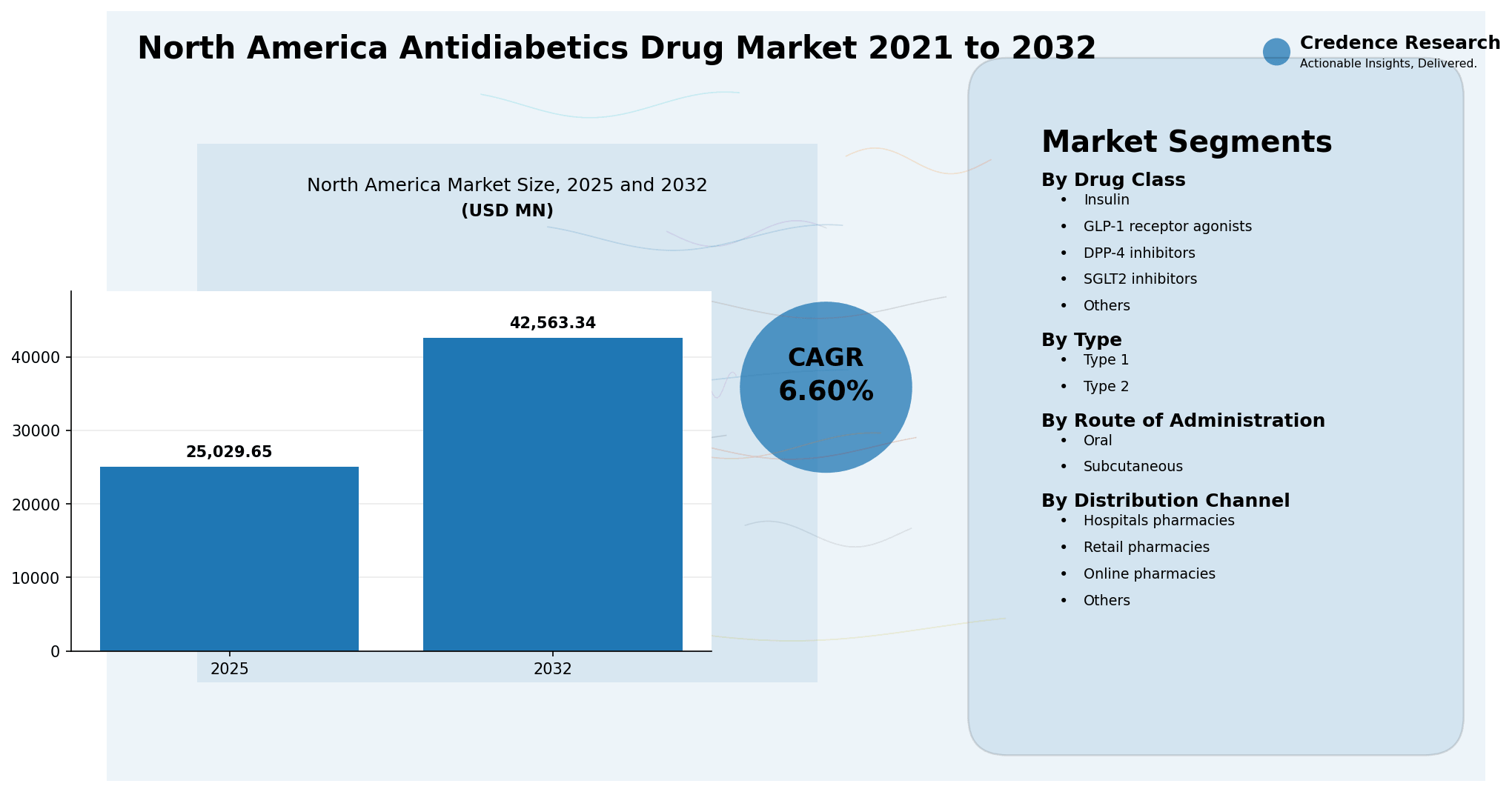
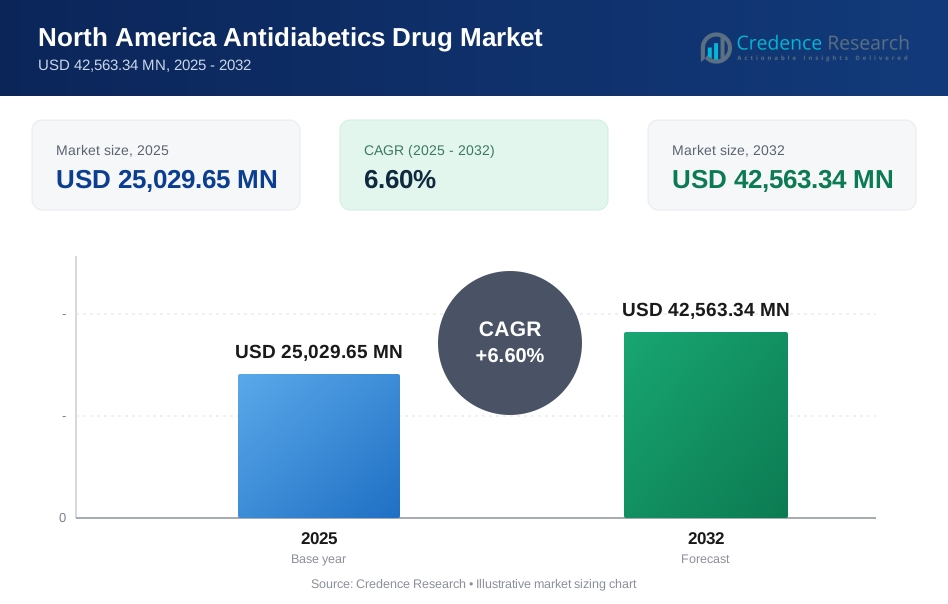
The North America Antidiabetics Drug Market size was valued at USD 18,811.60 MN in 2021 and reached USD 25,029.65 MN in 2025. It is anticipated to reach USD 42,563.34 MN by 2032, growing at a CAGR of 6.60% during the forecast period.
| REPORT ATTRIBUTE | DETAILS |
|---|---|
| Historical Period | 2021-2024 |
| Base Year | 2025 |
| Forecast Period | 2025-2032 |
| North America Antidiabetics Drug Market Size 2025 | USD 25,029.65 million |
| North America Antidiabetics Drug Market, CAGR | 6.60% |
| North America Antidiabetics Drug Market Size 2032 | USD 42,563.34 million |
North America Antidiabetics Drug Market Insights
- Market growth is supported by high diabetes prevalence, GLP-1 receptor agonist adoption, insulin innovation, SGLT2 inhibitor use, chronic refill demand and stronger access to specialty diabetes therapies.
- Insulin holds a strong position because Type 1 diabetes requires lifelong insulin therapy, while many Type 2 patients require insulin intensification as disease progresses.
- GLP-1 Receptor Agonists are gaining strong momentum due to glycemic control benefits, weight management relevance, cardiometabolic value and rapid adoption of injectable therapies.
- Retail Pharmacies remain a leading distribution channel because antidiabetic drugs are used for long-term outpatient treatment, chronic refills and ongoing disease management.
North America Antidiabetics Drug Market Segment Insights
By drug class
By drug class, Insulin held a strong position in 2025 because it remains essential for Type 1 diabetes and continues to support advanced Type 2 diabetes treatment when oral therapies or other injectable drugs are insufficient. GLP-1 Receptor Agonists are gaining momentum due to strong clinical use in Type 2 diabetes, weight-linked metabolic management and broader physician adoption. SGLT2 Inhibitors remain important because they support glycemic control and have cardiorenal relevance in selected patients. DPP-4 Inhibitors continue to serve patients who require oral therapy with established safety and tolerability. Others include sulfonylureas, biguanides, thiazolidinediones, alpha-glucosidase inhibitors and emerging diabetes drug classes. Growth across drug classes will depend on clinical guidelines, payer access, pricing, safety profile and long-term adherence.
By type
By type, Type 2 held the strongest position in 2025 because it accounts for the largest treated patient population and requires a broad range of oral and injectable therapies. Type 2 diabetes treatment commonly begins with oral therapies and can advance to GLP-1 Receptor Agonists, SGLT2 Inhibitors, DPP-4 Inhibitors and Insulin depending on disease severity and comorbidities. Type 1 diabetes remains a smaller but clinically essential category because patients require continuous insulin therapy. Subcutaneous administration dominates Type 1 treatment, while Type 2 uses both Oral and Subcutaneous options. Demand across both types is expected to rise as diagnosis, treatment intensification and chronic disease management improve across North America.
By route of administration
By route of administration, Oral held a strong position in 2025 because many Type 2 diabetes therapies are administered through tablets and support daily outpatient management. Oral therapies include DPP-4 Inhibitors, SGLT2 Inhibitors and other established antidiabetic drugs. Subcutaneous administration is growing strongly because Insulin and GLP-1 Receptor Agonists are central to modern diabetes management. Injectable formats support high-value therapy adoption, especially when physicians seek stronger glycemic control or broader metabolic benefit. Convenience remains important across both routes, and manufacturers are investing in pens, once-weekly dosing and simpler administration formats. Route preference will depend on disease stage, patient comfort, adherence, insurance coverage and physician recommendation.
By distribution channel
By distribution channel, Retail Pharmacies held a strong position in 2025 because antidiabetic drugs require frequent prescription refills and long-term adherence support. Patients use community pharmacies for Oral therapies, Insulin, GLP-1 Receptor Agonists, pen needles, glucose-related supplies and counseling. Hospital Pharmacies remain important for inpatient diabetes management, therapy initiation, specialist care and transition planning after hospitalization. Online Pharmacies are gaining traction because chronic medication users increasingly seek home delivery, digital refill reminders and price comparison. Others include specialty pharmacies, mail-order channels and integrated payer-provider pharmacy models. Channel growth will favor providers that improve refill continuity, patient education and access to high-demand injectable therapies.
Key market drivers
High diabetes prevalence and chronic treatment need
High diabetes prevalence and chronic treatment need represent a major growth driver for the North America Antidiabetics Drug Market. Diabetes requires long-term pharmacological management, frequent therapy adjustment and continuous prescription access, creating sustained demand across Insulin, GLP-1 Receptor Agonists, SGLT2 Inhibitors, DPP-4 Inhibitors and other antidiabetic drugs. Type 2 diabetes drives the largest treated population, while Type 1 diabetes supports essential lifelong insulin demand.
CDC’s National Diabetes Statistics Report estimates that 38.4 million people in the U.S. have diabetes, equal to 11.6% of the U.S. population, and that 38.1 million adults have diabetes, equal to 14.7% of U.S. adults. This burden supports long-term drug utilization across retail, hospital and online pharmacy channels.
GLP-1 receptor agonist adoption
GLP-1 receptor agonist adoption supports strong market growth as these drugs gain broad use in Type 2 diabetes management and metabolic risk reduction. GLP-1 therapies are valued because they improve glycemic control and support weight-linked treatment goals in appropriate patients. Demand is strongest for Subcutaneous therapies, but oral formulations are also shaping the route-of-administration mix.
Novo Nordisk reported that Diabetes care sales increased 4% at constant exchange rates to DKK 207,109 million in 2025, mainly driven by GLP-1-based products, while Ozempic sales increased 10% at constant exchange rates to DKK 127,089 million. Eli Lilly also reported Q4 2025 revenue growth driven by Mounjaro and Zepbound volume growth, showing strong market momentum for incretin-based therapies.
Insulin innovation and dosing convenience
Insulin innovation and dosing convenience continue to support the market because many patients require basal, prandial or combination insulin therapy. Insulin remains essential for Type 1 diabetes and remains important in Type 2 diabetes when glycemic control requires treatment intensification. Manufacturers are improving convenience through pens, biosimilars, rapid-acting products and longer-acting formulations.
FDA approved the first rapid-acting insulin biosimilar product for diabetes in February 2025, and Novo Nordisk announced in March 2026 that FDA approved Awiqli, the first and only once-weekly long-acting basal insulin for adults with Type 2 diabetes. These developments support affordability, adherence and differentiated insulin options.
SGLT2 inhibitors and cardiorenal relevance
SGLT2 inhibitors and cardiorenal relevance are strengthening demand for antidiabetic therapies used beyond glucose lowering. SGLT2 Inhibitors have become important for patients with Type 2 diabetes and comorbid cardiovascular or kidney risk because clinical labels increasingly recognize broader benefit.
FDA’s DailyMed label for Farxiga states that dapagliflozin is indicated to improve glycemic control in adults and pediatric patients aged 10 years and older with Type 2 diabetes and to reduce the risk of hospitalization for heart failure in adults with Type 2 diabetes and cardiovascular disease or multiple cardiovascular risk factors. This wider clinical role supports use across endocrinology, cardiology, nephrology and primary care pathways.
Key Trends and Opportunities
Incretin-based therapy competition intensifies
Incretin-based therapy competition is becoming a major opportunity as GLP-1 Receptor Agonists and related metabolic therapies expand in Type 2 diabetes. Strong physician adoption, patient demand and cardiometabolic relevance are creating a premium drug category with significant commercial value. Competition between Novo Nordisk, Eli Lilly and other manufacturers is expected to intensify as companies pursue differentiated dosing, stronger efficacy, oral options and broader outcomes evidence. Retail Pharmacies, Hospital Pharmacies and Online Pharmacies will need stronger inventory planning and patient support to handle therapy demand. The opportunity will remain strongest where payer access, adherence support and clinical outcomes align.
Oral and injectable therapy pathways converge
Oral and injectable therapy pathways are converging as Type 2 diabetes care becomes more personalized. Many patients begin on Oral medications such as DPP-4 Inhibitors, SGLT2 Inhibitors or other established agents, then move to Subcutaneous GLP-1 therapies or Insulin as clinical needs evolve. This creates opportunities for stepwise treatment models and combination care pathways. Manufacturers that offer products across different administration routes can support broader patient coverage. Pharmacies also benefit when they provide counseling on route transitions, device use and adherence. The trend supports sustained demand across both Oral and Subcutaneous categories.
Digital pharmacy and chronic refill management expand
Digital pharmacy and chronic refill management are expanding as diabetes patients require consistent medication access and adherence support. Online Pharmacies and mail-order channels can support home delivery, refill reminders, prescription synchronization and affordability comparison. Retail Pharmacies are also expanding chronic disease services, including counseling and diabetes care support. These models are important because missed refills can weaken glycemic control and raise complication risk. Digital tools can also support adherence for injectable therapies by reminding patients about dosing schedules and refill timing. Distribution channel innovation will remain a key opportunity through 2032.
Key Market Challenges
Affordability and payer access pressure
Affordability and payer access pressure remain key challenges for the North America Antidiabetics Drug Market. Premium GLP-1 Receptor Agonists, branded SGLT2 Inhibitors, newer insulin products and specialty diabetes therapies can face formulary controls and prior authorization. Patients may also face out-of-pocket cost barriers, especially for branded therapies and injectable products. Generic and biosimilar approvals support access, but premium therapies still require strong coverage and patient assistance programs. Manufacturers must show clear clinical value, adherence benefit and health economic relevance to sustain access. Pricing pressure will remain important across public and private payer systems.
Supply constraints for high-demand injectables
Supply constraints for high-demand injectables can affect market access and patient continuity. Rapid uptake of GLP-1 Receptor Agonists and other injectable metabolic therapies can strain production, fill-finish capacity, pen device supply and pharmacy inventory. Pharmacies must manage allocation, substitution limits and patient communication during demand surges. Providers may need to adjust therapy choices when specific products are unavailable. Manufacturers are investing in capacity expansion, but supply stability remains a key competitive factor. Companies with stronger manufacturing networks and demand planning will hold an advantage.
Adherence and therapy persistence
Adherence and therapy persistence create long-term challenges because diabetes management requires continuous treatment and lifestyle coordination. Patients may discontinue therapy due to side effects, injection concerns, cost, complex regimens or limited perceived benefit. Oral drugs require daily adherence, while Subcutaneous therapies require proper device use and dosing schedule awareness. Retail Pharmacies and Online Pharmacies can support adherence through counseling, refill reminders and medication synchronization. Manufacturers can improve persistence through simpler dosing, patient education and support programs. Market growth depends on prescriptions being converted into sustained therapy use.
Regional Analysis
United States
The United States leads the North America Antidiabetics Drug Market due to its large diabetes population, advanced treatment access, strong pharmaceutical spending and broad use of branded therapies. Demand is strong across Insulin, GLP-1 Receptor Agonists, SGLT2 Inhibitors and DPP-4 Inhibitors. Retail Pharmacies remain central because diabetes drugs require long-term outpatient refills and adherence support. Hospital Pharmacies support inpatient glucose management, therapy initiation and specialist-led care transitions. The U.S. also drives premium adoption because Novo Nordisk, Eli Lilly, Sanofi, Merck, AstraZeneca and other companies prioritize U.S. launches, payer access and patient support programs. It is expected to remain the primary revenue contributor through 2032.
Canada
Canada represents a steady market supported by public health systems, private insurance, primary care management and rising use of newer antidiabetic therapies. Demand is strongest across Type 2 diabetes, where Oral therapies, GLP-1 Receptor Agonists, SGLT2 Inhibitors and Insulin all play roles in treatment. Retail Pharmacies support chronic refill access and medication counseling. Hospital Pharmacies support inpatient treatment and endocrinology-linked therapy initiation. Market access depends on health technology assessment, provincial reimbursement and formulary decisions. Growth will remain steady as diabetes prevalence, obesity-linked risk and clinical use of newer therapies continue to shape demand.
Mexico
Mexico offers a smaller but expanding opportunity within North America. Demand is supported by rising Type 2 diabetes burden, growing private health care access, retail pharmacy penetration and broader availability of branded and generic therapies. Oral medications remain central because affordability and access influence treatment choices. Insulin and GLP-1 Receptor Agonists are gaining importance where specialist care and insurance coverage support adoption. Online Pharmacies are emerging gradually as patients seek convenience and refill access. Growth will depend on diagnosis rates, affordability, physician prescribing, retail pharmacy reach and access to premium therapies.
Report Attribute Details
| Report Attribute | Details |
| Historical Period | 2021–2024 |
| Base Year | 2025 |
| Forecast Period | 2025–2032 |
| Market Size in 2021 | USD 18,811.60 MN |
| Market Size in 2025 | USD 25,029.65 MN |
| Market Size in 2032 | USD 42,563.34 MN |
| CAGR | 6.60% |
| Segments Covered | Drug Class, Type, Route of Administration, Distribution Channel and Geography |
| Key Companies Covered | Novo Nordisk, Eli Lilly and Company, Sanofi, Merck & Co., Inc., AstraZeneca plc, Johnson & Johnson Services Inc., Novartis AG, Takeda Pharmaceutical Company, Bayer AG, USV Private Ltd, Sun Pharmaceutical Industries Ltd. and Lupin Limited |
North America Antidiabetics Drug Market Segmentations
By Drug Class
- Insulin
- GLP-1 Receptor Agonists
- DPP-4 Inhibitors
- SGLT2 Inhibitors
- Others
By Type
- Type 1
- Type 2
By Route of Administration
- Oral
- Subcutaneous
By Distribution Channel
- Hospital Pharmacies
- Retail Pharmacies
- Online Pharmacies
- Others
Key Players
- Novo Nordisk
- Eli Lilly and Company
- Sanofi
- Merck & Co., Inc.
- AstraZeneca plc
- Johnson & Johnson Services Inc.
- Novartis AG
- Takeda Pharmaceutical Company
- Bayer AG
- USV Private Ltd
- Sun Pharmaceutical Industries Ltd.
- Lupin Limited
Recent Developments
- In March 2026, Novo Nordisk announced that FDA approved Awiqli, the first and only once-weekly long-acting basal insulin for adults with Type 2 diabetes.
- In February 2025, FDA approved the first rapid-acting insulin biosimilar product for treatment of diabetes, expanding insulin biosimilar access in the U.S.
- In December 2024, FDA approved the first generic once-daily GLP-1 injection referencing Victoza to improve glycemic control in adults and pediatric patients aged 10 and older with Type 2 diabetes.
- In 2025, Novo Nordisk reported Ozempic sales of DKK 127,089 million, up 10% at constant exchange rates, supporting continued commercial momentum in GLP-1-based diabetes treatment.
Report Coverage
The research report offers an in-depth analysis based on drug class, type, route of administration, distribution channel and geography. It details leading market players, providing an overview of their business positioning, diabetes portfolios, injectable and oral therapy strategies, market access capabilities and strategic relevance in the North America Antidiabetics Drug Market. The report includes insights into the competitive environment, market trends, growth drivers, restraints and opportunities. It also examines diabetes prevalence, GLP-1 adoption, insulin innovation, SGLT2 inhibitor use, chronic refill demand and pharmacy channel evolution as major factors shaping market development. The report assesses the impact of affordability, payer access, supply constraints and adherence challenges on market growth. It provides strategic recommendations for pharmaceutical companies, hospital systems, retail pharmacy networks, online pharmacies, payers, distributors, investors and new entrants seeking to navigate North America’s antidiabetic drugs ecosystem.
Future Outlook
- Demand for antidiabetic drugs will continue to rise as diabetes prevalence, Type 2 treatment intensification and long-term therapy needs expand across North America.
- Insulin will remain essential because Type 1 diabetes requires lifelong therapy and advanced Type 2 diabetes often requires treatment intensification.
- GLP-1 Receptor Agonists will remain a high-growth category due to strong clinical adoption and broader cardiometabolic relevance.
- SGLT2 Inhibitors will continue to gain relevance because they serve diabetes patients with broader cardiovascular and kidney risk profiles.
- DPP-4 Inhibitors will remain relevant for patients requiring oral therapy with established safety and tolerability.
- Oral therapies will remain important for early and moderate Type 2 diabetes management.
- Subcutaneous therapies will gain value through GLP-1 receptor agonists, insulin products and dosing convenience innovation.
- Retail Pharmacies will remain central to chronic medication access, refill continuity and adherence support.
- Online Pharmacies will gain share as home delivery, refill reminders and digital chronic care models expand.
- Competitive intensity will increase as companies compete on efficacy, dosing convenience, supply reliability, payer coverage, device usability and patient support.
Request a Free Sample
Fill in your details and we'll send you a free sample report.
- Sample data tables & charts
- Research methodology
Need a Custom Version of This Report?
Tailor the scope, geography, or segments to your exact requirements.
- Custom geography or segment scope
- Direct access to our analyst team
Frequently Asked Questions
What is the current market size for the North America Antidiabetics Drug Market and what is its projected size in 2032?
At what CAGR is the North America Antidiabetics Drug Market projected to grow?
Which drug class segment is expected to lead the market?
Which type segment supports strong market demand?
Which route of administration holds strong demand?
Who are the leading companies in the market?
Which geography leads the North America market?
Table of Content
Chapter 1. Report Introduction
- 1.1 Report Description & Purpose
- 1.1.1 Report Title & Market Definition
- 1.1.2 Unique Selling Propositions (USP) & Key Differentiators
- 1.1.3 Value Proposition for Stakeholders
- 1.2 Research Objectives
- 1.2.1 Market Sizing Objectives (Volume & Revenue)
- 1.2.2 Segmentation Objectives
- 1.2.3 Competitive Intelligence Objectives
- 1.2.4 Forecast & Scenario Objectives
- 1.3 Report Scope
- 1.3.1 North America Antidiabetics Drug Scope – Types & Subtypes Covered
- 1.3.2 Geographic Scope – Regions & Countries Covered
- 1.3.3 Historical Period, Base Year & Forecast Period (2025; forecast to 2032)
- 1.3.4 Inclusions & Exclusions
- 1.4 HS Code & Classification Framework
- 1.5 Currency, Units & Pricing Basis
- 1.6 Target Stakeholders
- 1.7 Limitations & Assumptions
Chapter 2. Executive Summary
- 2.1 Global North America Antidiabetics Drug Market Snapshot
- 2.1.1 Market Size – Historical (2025) & Forecast (2025-2032) (2025: USD 25,029.65 MN → 2032: USD 42,563.34 MN)
- 2.1.2 Volume & Revenue – Global Totals
- 2.1.3 Key Market Highlights – Top Five Facts
- 2.2 North America Antidiabetics Drug Market Segmentation Snapshot
- 2.2.1 Market Split by Region – 2025 vs. 2032
- 2.3 Competitive Snapshot
- 2.3.1 Top 10 Players by Revenue Share – 2025
- 2.3.2 Top 10 Players by Volume Share – 2025
- 2.3.3 Recent Strategic Developments (18-Month Summary)
- 2.4 Key Investment Highlights & Strategic Conclusions
Chapter 3. North America Antidiabetics Drug Market Dynamics & Industry Analysis
- 3.1 Market Overview & Context
- 3.1.1 North America Antidiabetics Drug Market Position in the Broader Automotive Value Chain
- 3.1.2 OEM vs. Replacement Market Dynamics
- 3.1.3 Market Maturity & Development Stage by Region
- 3.2 North America Antidiabetics Drug Market Drivers
- 3.3 North America Antidiabetics Drug Market Restraints & Challenges
- 3.4 North America Antidiabetics Drug Market Opportunities
- 3.5 Porter's Five Forces Analysis
- 3.5.1 Threat of New Entrants
- 3.5.2 Bargaining Power of Suppliers
- 3.5.3 Bargaining Power of Buyers
- 3.5.4 Threat of Substitutes
- 3.5.5 Competitive Rivalry – Intensity Assessment
- 3.6 North America Antidiabetics Drug Value Chain Analysis
- 3.6.1 Upstream – Raw Material/Input Suppliers
- 3.6.1.1 Raw Material/Input 1
- 3.6.1.2 Raw Material/Input 2
- 3.6.1.3 Raw Material/Input 3
- 3.6.2 Midstream – Production/Manufacturing/Service Delivery
- 3.6.2.1 Production/Process Overview
- 3.6.2.2 Key Facility Locations & Capacity by Manufacturer
- 3.6.3 Downstream – Distribution & End Consumer
- 3.6.3.1 Primary Channel – B2B/OEM
- 3.6.3.2 Secondary Channels – Dealer, Retail, Online, Direct
- 3.6.4 Value Chain Profitability Analysis
- 3.6.1 Upstream – Raw Material/Input Suppliers
- 3.7 PESTEL Analysis
- 3.7.1 Political Factors
- 3.7.2 Economic Factors
- 3.7.3 Social Factors
- 3.7.4 Technological Factors
- 3.7.5 Environmental Factors
- 3.7.6 Legal Factors
- 3.8 North America Antidiabetics Drug Supply Chain Analysis
- 3.8.1 Raw Material/Input Supply Risk Assessment
- 3.8.2 Manufacturing Concentration Risk (Geographic Exposure)
- 3.8.3 Trade Disruption Impact Analysis
- 3.9 Regulatory & Policy Landscape
Note: The regulatory and policy landscape section covers regulations based on their applicability to the market, North America Antidiabetics Drug category, geography, and scope of the study. Only regulatory frameworks with a material impact on operations, compliance, trade, sustainability, or market access are analyzed in detail.
Chapter 4. Key Investment Pockets & Opportunity Analysis
- 4.1 North America Antidiabetics Drug Market Attractiveness Analysis
- 4.1.1 By Region – Investment Attractiveness Matrix (Volume × CAGR)
- 4.2 Absolute Revenue Growth Opportunity
- 4.2.1 By Region – Absolute USD Growth Through 2032
- 4.3 Incremental Volume Opportunity
- 4.3.1 By Region – Incremental Volume Through 2032
- 4.3.2 Segment – Incremental Volume
- 4.4 Emerging Submarket Opportunity Deep Dive (Subject to Applicability)
- 4.5 Emerging Market Opportunity Scorecards
- 4.5.1 United States
- 4.5.2 Europe
- 4.5.3 Asia
- 4.5.4 Middle East & Africa
Note: Emerging Market Opportunity Scorecards will be included based on relevance and strategic importance. Regions listed are indicative and may vary depending on data availability and market dynamics.
Chapter 5. North America Antidiabetics Drug Import-Export Analysis & Trade Flows
- 5.1 Global Trade Overview
- 5.1.1 Global Export Value by Country (2025)
- 5.1.2 Global Export Volume by Country (2025)
- 5.1.3 Global Import Value by Country (2025)
- 5.1.4 Global Import Volume by Country (2025)
- 5.1.5 Net Trade Balance by Country (2025)
- 5.2 Export Analysis – Segment
- 5.2.1 Type 1 (HS Code)
- 5.2.2 Type 2 (HS Code)
- 5.2.3 Type 3 (HS Code)
- 5.2.4 Type 4 (HS Code)
- 5.2.5 Type 5 (HS Code)
- 5.3 Import Analysis – Segment
- 5.3.1 Type 1 (HS Code)
- 5.3.2 Type 2 (HS Code)
- 5.3.3 Type 3 (HS Code)
- 5.3.4 Type 4 (HS Code)
- 5.3.5 Type 5 (HS Code)
- 5.4 Average Unit Trade Prices
- 5.4.1 Average Export Price – Segment & Country
- 5.4.2 Average Import Price – Segment & Source Country
- 5.4.3 Price Trends (2025)
- 5.5 Key Trade Route Analysis
- 5.5.1 Trade Route 1
- 5.5.2 Trade Route 2
- 5.5.3 Trade Route 3
- 5.5.4 Trade Route 4
- 5.5.5 Trade Route 5
- 5.6 Trade Policy Impact Assessment
- 5.6.1 US Anti-Dumping & Section 301 Tariffs
- 5.6.2 EU Customs Union Impact
- 5.6.3 Major Free Trade Agreements
- 5.6.4 USMCA Rules of Origin
Note: Trade policy analysis will be included only where relevant to the North America Antidiabetics Drug market.
Chapter 6. Competitive Landscape & Company Benchmarking
- 6.1 North America Antidiabetics Drug Market Concentration & Structure
- 6.1.1 Herfindahl-Hirschman Index (HHI) – vs. 2025
- 6.1.2 Tier 1, Tier 2 & Tier 3 Market Structure
- 6.1.3 Global, Regional & Local Player Dynamics
- 6.2 North America Antidiabetics Drug Market Share Analysis – 2025
- 6.2.1 Global Revenue Share by Company
- 6.2.2 Global Volume Share by Company
- 6.2.3 Regional Revenue Share
- 6.2.4 Market Share Evolution ( vs. 2025)
- 6.2.5 OEM Segment Share by Company
- 6.2.6 Replacement Segment Share by Company
- 6.3 Production/Delivery Capacity & Facility Analysis
- 6.3.1 Global Installed Capacity
- 6.3.2 Capacity Utilization Rates
- 6.3.3 Production/Output Volume
- 6.3.4 Facility Locations & Capacity Map
- 6.3.5 Planned Capacity Additions
- 6.4 North America Antidiabetics Drug Competitive Benchmarking Matrix
- 6.4.1 Revenue, Volume, CAGR & Profitability Comparison
- 6.4.2 Channel Revenue Mix
- 6.4.3 Geographic Revenue Exposure
- 6.4.4 R&D Intensity
- 6.4.5 Sustainability Maturity
- 6.5 Strategic Developments in North America Antidiabetics Drug (Last 24 Months)
- 6.5.1 Mergers, Acquisitions & Divestments
- 6.5.2 New North America Antidiabetics Drug Launches
- 6.5.3 Facility Expansions
- 6.5.4 Strategic Alliances, Joint Ventures & Partnerships
- 6.5.5 Distribution Expansion & Market Entry
- 6.5.6 Sustainability & ESG Initiatives
- 6.6 Competitive Strategy Mapping
- 6.6.1 Leader, Challenger, Follower & Niche Classification
- 6.6.2 Pricing Strategy Comparison
- 6.6.3 Channel Strategy Matrix
Note: Strategic developments are included based on their materiality and the availability of reliable information.
Chapter 7. Global North America Antidiabetics Drug Market – By Distribution Channel
- 7.1 Segment Overview
- 7.1.1 Volume & Revenue Split by Channel (2025 & 2032)
- 7.1.2 Channel Mix Evolution (2025-2032)
Chapter 8. Regional Market Analysis – Global Overview
- 8.1 Global Regional Overview
- 8.1.1 Regional Volume Share
- 8.1.2 Regional Revenue Share
- 8.1.3 Regional Volume by Region
- 8.1.4 Regional Revenue by Region
- 8.1.5 Regional Forecast Through 2032
- 8.2 Cross-Regional Segment Analysis
- 8.2.1 By Distribution Channel
- 8.2.2 By Brand/Price Tier
Chapter 9. North America North America Antidiabetics Drug Market
- 9.1 United States
- 9.2 Canada
- 9.3 Mexico
Chapter 10. Europe North America Antidiabetics Drug Market
- 10.1 Germany
- 10.2 France
- 10.3 Italy
- 10.4 United Kingdom
- 10.5 Spain
- 10.6 Poland
- 10.7 Russia
- 10.8 Netherlands
- 10.9 Belgium
- 10.10 Sweden
- 10.11 Denmark
- 10.12 Norway
- 10.13 Rest of Europe
Chapter 11. Asia Pacific North America Antidiabetics Drug Market
- 11.1 China
- 11.2 India
- 11.3 Japan
- 11.4 South Korea
- 11.5 Thailand
- 11.6 Indonesia
- 11.7 Vietnam
- 11.8 Malaysia
- 11.9 Australia
- 11.10 Rest of Asia Pacific
Chapter 12. Latin America North America Antidiabetics Drug Market
- 12.1 Brazil
- 12.2 Argentina
- 12.3 Colombia
- 12.4 Chile
- 12.5 Rest of Latin America
Chapter 13. Middle East North America Antidiabetics Drug Market
- 13.1 Saudi Arabia
- 13.2 United Arab Emirates
- 13.3 Turkey
- 13.4 Israel
- 13.5 Iran
- 13.6 Rest of the Middle East
Chapter 14. Africa North America Antidiabetics Drug Market
- 14.1 South Africa
- 14.2 Egypt
- 14.3 Nigeria
- 14.4 Morocco
- 14.5 Rest of Africa
Chapter 15. North America Antidiabetics Drug Company Profiles
- 15.1 [Company 01]
- 15.1.1 Company Overview
- 15.1.2 Key Management Personnel
- 15.1.3 Products & Services Portfolio
- 15.1.4 Financial Performance
- 15.1.5 Key Market Focus & Geographic Presence
- 15.1.6 Recent Developments & Strategic Initiatives
Note: The company profile list is preliminary and may change based on research findings, market developments, data availability, and client requirements.
Chapter 16. Appendices
- Appendix A – List of Abbreviations & Acronyms
- Appendix B – Industry Classification Code Reference – Full Series
- Appendix C – Production & Capacity Data Tables
- Appendix D – End-Use & Demand Base Tables
- Appendix E – Consumption & Replacement Rate Assumptions
- Appendix F – ASP Reference Tables
- Appendix G – Manufacturing & Facility Database
- Appendix H – Import-Export Data Tables
- Appendix I – Regulatory Summary Tables
- Appendix J – Primary Research Participant List (Anonymized)
- Appendix K – Primary Research Questionnaire Framework
- Appendix L – Data Sources & Bibliography
- Appendix M – Market Size Divergence & Source Comparison
Chapter 17. Research Methodology
- 17.1 Research Framework & Philosophy
- 17.2 Secondary Research – Sources, Hierarchy & Data Extraction
- 17.3 Data Modeling – Bottom-Up & Top-Down Market Sizing
- 17.4 Primary Research – Stakeholder Framework, LOI & Sample Sizes
- 17.5 Forecast Methodology – Regression, Scenario & Sensitivity Analysis
- 17.6 Quality Control – Four-Layer Validation Framework
- 17.7 Limitations & Standard Assumptions
- 17.8 Disclaimer
