
| REPORT ATTRIBUTE | DETAILS |
|---|---|
| Historical Period | 2019-2022 |
| Base Year | 2023 |
| Forecast Period | 2024-2032 |
| North America Artificial Intelligence in Retail Market Size 2024 | USD 3,457.06 million |
| North America Artificial Intelligence in Retail Market, CAGR | 31.11% |
| North America Artificial Intelligence in Retail Market Size 2032 | USD 30,178.24 million |
Market Overview
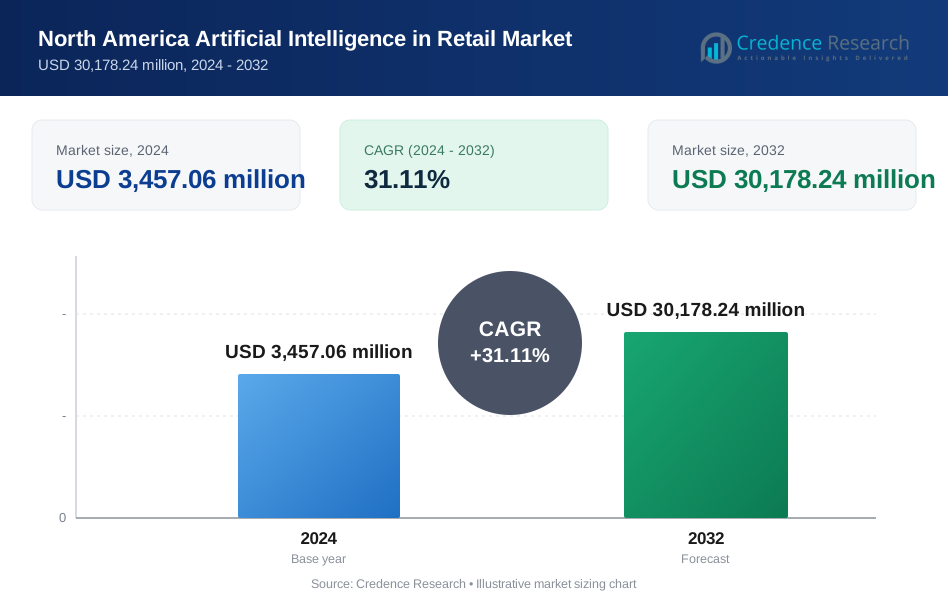
The North America Artificial Intelligence in Retail market is expected to grow significantly, increasing from USD 3,457.06 million in 2024 to USD 30,178.24 million by 2032, at a CAGR of 31.11%.
The North America Artificial Intelligence in Retail market is driven by the growing adoption of AI technologies to enhance customer experiences, improve operational efficiency, and drive personalized marketing strategies. Retailers are increasingly leveraging AI for demand forecasting, inventory management, and personalized recommendations, leading to higher customer satisfaction and retention. Additionally, the rise of e-commerce and the need for advanced data analytics to understand consumer behavior are fueling market growth. Key trends include the integration of AI-powered chatbots for customer support, AI-driven predictive analytics for targeted promotions, and the use of computer vision for checkout-free shopping experiences. As retailers continue to invest in AI solutions to streamline operations and stay competitive, the market is expected to witness substantial growth, driven by technological advancements and a shift toward data-driven decision-making.
The North America Artificial Intelligence in Retail market is primarily driven by the U.S., which leads the region in terms of AI adoption across various retail sectors. Canada is also witnessing steady growth, with major cities like Toronto embracing AI to enhance customer experiences and optimize operations. Mexico, though at an early stage, is experiencing a rapid increase in AI adoption, particularly in e-commerce and retail technology. Key players in the market include global technology giants such as Amazon, Google LLC, Microsoft Corporation, and IBM Corporation, which provide AI-driven solutions for inventory management, personalized marketing, and customer service. Additionally, specialized AI companies like Vue.AI, Cresta, and C3.AI offer tailored AI tools for retailers, contributing to operational efficiencies and improved customer engagement. These key players are continuously innovating to meet the demands of the retail industry and support the growing trend of AI integration in North America’s retail market.
Market Insights
- The North America Artificial Intelligence in Retail market is valued at USD 3,457.06 million in 2024 and is projected to reach USD 30,178.24 million by 2032, growing at a CAGR of 31.11%.
- The increasing demand for personalized customer experiences drives the adoption of AI technologies in retail, enabling better customer engagement and higher sales conversion rates.
- AI technologies such as machine learning, computer vision, and NLP are transforming retail operations, enhancing inventory management, and streamlining supply chains.
- Key market players include Amazon, Google, Microsoft, IBM, and emerging companies like Vue.AI and C3.AI, who lead AI innovation in the retail sector.
- Data privacy concerns and high implementation costs remain significant market restraints for widespread AI adoption in the retail industry.
- North America, especially the U.S., leads in AI integration, with Canada and Mexico showing significant potential for growth in AI-driven retail applications.
- The competitive landscape is evolving as both established tech giants and niche AI providers focus on providing tailored solutions to retailers across various regions.
Market Drivers
Enhanced Customer Experience
The primary driver of the North America Artificial Intelligence in Retail market is the growing emphasis on enhancing customer experience. For instance, Sephora uses AI-driven tools like Colour IQ and Lip IQ to scan a customer's face and offer tailored makeup recommendations. AI technologies, such as chatbots, recommendation engines, and virtual assistants, enable retailers to provide personalized services and tailored shopping experiences. By analyzing vast amounts of consumer data, AI tools help retailers understand individual preferences and behavior, enabling the delivery of more relevant product suggestions, promotions, and targeted marketing campaigns. This level of personalization not only improves customer satisfaction but also drives higher conversion rates and customer loyalty.
Operational Efficiency and Cost Reduction
AI in retail is also widely adopted to optimize operational efficiency and reduce costs. For example, Walmart uses AI-driven demand forecasting to ensure better inventory management and minimize stockouts. AI-driven solutions such as demand forecasting, inventory management, and automated checkout systems enable retailers to streamline their operations. By accurately predicting consumer demand, retailers can ensure better inventory management, minimizing stockouts and overstock situations. Additionally, AI tools can automate mundane tasks such as pricing adjustments and replenishment, reducing human intervention and operational costs. This increased efficiency leads to better resource allocation and higher profit margins.
Growth of E-Commerce and Online Shopping
The continued growth of e-commerce and online shopping is a significant driver of AI adoption in the retail sector. With more consumers shifting to online shopping platforms, retailers are increasingly leveraging AI to enhance their digital presence and optimize their online operations. AI applications, such as AI-powered search engines, personalized recommendations, and smart logistics solutions, help e-commerce businesses provide a seamless and engaging online shopping experience. Retailers are using AI to process large volumes of data in real-time, improving their ability to understand customer preferences and make data-driven decisions.
Technological Advancements and Innovation
Technological advancements in AI, machine learning, and data analytics are fueling the growth of AI in retail. For example, Microsoft has developed AI solutions that integrate computer vision and natural language processing to enable innovations like automated checkout and virtual try-ons. With continuous innovations in AI algorithms and processing power, retailers have access to more powerful tools that can analyze vast amounts of data and extract actionable insights. The integration of computer vision and natural language processing technologies has enabled innovations such as automated checkout, virtual try-ons, and in-store AI assistants, further enhancing customer engagement. As AI technology continues to evolve, its potential to transform the retail sector will drive sustained market growth in North America.
Market Trends
Personalization and Customer-Centric Strategies
A major trend in the North American Artificial Intelligence in Retail market is the increasing focus on personalized customer experiences. For instance, Nike uses AI-driven tools to offer personalized product recommendations through its NikePlus loyalty program, which analyzes customer data to suggest relevant products. Retailers are adopting AI-driven solutions to deliver tailored recommendations, targeted promotions, and customized shopping journeys. By leveraging data analytics and machine learning algorithms, retailers can predict consumer preferences and purchasing behavior, offering more relevant products and services. Personalized shopping experiences not only increase customer satisfaction but also drive repeat purchases and foster long-term brand loyalty, making personalization a central strategy in the retail industry.
AI-Powered Inventory and Supply Chain Management
AI is transforming inventory and supply chain management in retail by enhancing accuracy and efficiency. Retailers are utilizing AI tools for demand forecasting, inventory optimization, and logistics management. AI-driven predictive analytics help businesses anticipate customer demand, ensuring that stock levels align with actual sales trends and seasonal fluctuations. Additionally, AI-powered solutions enable more efficient route planning for delivery and optimized warehouse operations, reducing costs and improving service delivery. This trend is particularly prominent among e-commerce businesses seeking to streamline their supply chains and improve operational performance.
AI-Driven Visual and Voice Search Technologies
The integration of AI-driven visual and voice search technologies is another significant trend in the North American retail market. Retailers are increasingly using computer vision and natural language processing to improve product search and enhance the shopping experience. AI-powered visual search allows customers to upload images of products they are interested in, instantly finding similar items available for purchase. Voice search, facilitated by virtual assistants such as Amazon Alexa and Google Assistant, enables customers to shop hands-free and efficiently. These technologies are reshaping how consumers interact with online platforms, making shopping more intuitive and accessible.
Increased Use of Autonomous Retail Solutions
The trend towards autonomous retail solutions, including cashier-less stores and automated checkout systems, is gaining momentum in North America. For example, Amazon Go stores use AI-powered Just Walk Out technology, which allows customers to shop without traditional checkouts. Retailers like Amazon Go and other brick-and-mortar stores are implementing AI-powered technologies that enable customers to shop without traditional checkouts. These systems rely on a combination of computer vision, sensor technologies, and AI algorithms to track customer purchases and automate payment processes. This trend not only reduces operational costs but also enhances the customer experience by providing faster and more convenient shopping options. As technology improves, the adoption of autonomous retail solutions is expected to grow significantly in the coming years.
Market Challenges Analysis
Data Privacy and Security Concerns
One of the primary challenges facing the North American Artificial Intelligence in Retail market is data privacy and security concerns. For instance, a survey by Gulf Business Machines found that 31% of organizations in the region prioritize data privacy as their top concern amid AI adoption. As retailers increasingly adopt AI technologies to collect and analyze vast amounts of consumer data, they must ensure that sensitive customer information is protected from cyber threats and breaches. The reliance on AI-driven solutions to personalize customer experiences requires the gathering of personal data, such as browsing history, purchase behavior, and preferences, which raises concerns about the misuse or unauthorized access to this data. Stringent data protection regulations, such as the GDPR in Europe and CCPA in California, impose compliance obligations on retailers, making data security a critical issue. Retailers must invest in robust cybersecurity measures and transparent data handling practices to build consumer trust and comply with evolving regulations, adding complexity and cost to AI adoption.
High Implementation Costs and Technical Limitations
Another significant challenge in the AI adoption process is the high implementation costs and technical limitations associated with integrating AI solutions into existing retail systems. Implementing AI technologies requires significant upfront investment in infrastructure, software, and talent, making it a costly endeavor for many retailers, particularly small and mid-sized businesses. Moreover, AI systems require continuous training, monitoring, and updates to ensure optimal performance, further increasing operational costs. Additionally, technical limitations such as insufficient data quality, integration challenges with legacy systems, and the need for specialized expertise can hinder the effective deployment of AI in retail. As a result, some retailers may face difficulties in scaling AI solutions or achieving the desired outcomes, slowing down market adoption.
Market Opportunities
The North America Artificial Intelligence in Retail market presents several significant opportunities for growth and innovation. As AI technologies continue to evolve, retailers can capitalize on the increasing demand for personalized shopping experiences. The ability to leverage AI for data-driven insights enables retailers to better understand customer preferences and behavior, which opens up new avenues for targeted marketing, personalized recommendations, and dynamic pricing strategies. AI-powered tools like chatbots, virtual assistants, and recommendation engines can further enhance customer engagement, leading to improved satisfaction and loyalty. Retailers can also use AI to enhance customer service operations, automating routine inquiries and support tasks, thereby reducing operational costs and freeing up resources for more complex customer needs.
Another key opportunity lies in the optimization of supply chain and inventory management through AI. Retailers can use predictive analytics to forecast demand more accurately, ensuring they stock the right products at the right time, reducing excess inventory and minimizing stockouts. AI can also improve warehouse management, logistics, and delivery processes, creating efficiencies across the entire supply chain. As e-commerce continues to grow, AI’s role in automating operations and providing real-time insights will become even more critical. Additionally, the rise of autonomous retail solutions, such as cashier-less stores and automated checkout, offers a promising opportunity for retailers to reduce operational costs and enhance the in-store shopping experience. These opportunities, driven by technological advancements and evolving consumer expectations, provide significant growth potential for AI adoption in the North American retail market.
Market Segmentation Analysis:
By Component:
The North America Artificial Intelligence in Retail market is segmented by component into solutions and services. Solutions are the dominant segment, as AI technologies like machine learning, natural language processing, and computer vision are implemented to address specific retail challenges. These solutions are integral to enhancing customer experience, automating operations, and optimizing inventory management. Services, on the other hand, play a crucial role in ensuring the successful deployment and maintenance of AI systems. Services include consulting, system integration, and managed services, helping retailers seamlessly integrate AI solutions into their existing infrastructure. As AI adoption grows, the demand for both advanced solutions and professional services will rise, driving further market expansion.
By Business Function:
AI in retail is also segmented by business function, including marketing & sales, human resources, finance & accounting, operations, and cybersecurity. In marketing & sales, AI technologies enable personalized customer engagement, dynamic pricing, and targeted promotions. Human resources benefit from AI tools for talent acquisition, workforce optimization, and performance management. AI in finance & accounting streamlines tasks like fraud detection, auditing, and financial forecasting. Operations management is enhanced through AI-powered solutions for inventory tracking, demand forecasting, and supply chain optimization. Lastly, cybersecurity is increasingly reliant on AI to detect and mitigate potential threats, ensuring the safety of customer data and systems. Each of these business functions leverages AI to increase efficiency, reduce costs, and improve decision-making, positioning AI as a transformative force across the retail sector.
Segments:
Based on Component:
- Solution
- Services
Based on Business Function:
- Marketing & Sales
- Human Resources
- Finance & Accounting
- Operations
- Cybersecurity
Based on Technology:
- Machine Learning
- Natural Language Processing
- Chatbots
- Image and Video Analytics
- Swarm Intelligence
Based on Sales Channel:
- Omnichannel
- Brick and Mortar
Based on the Geography:
- S.
- Canada
- Mexico
Regional Analysis
U.S.
The United States dominates the North America Artificial Intelligence in Retail market, holding the largest market share in the region. As of 2024, the U.S. accounts for nearly 70% of the market, driven by the rapid adoption of AI technologies across major retail sectors. U.S. retailers, particularly e-commerce giants and large brick-and-mortar stores, are leading the way in AI adoption, utilizing advanced machine learning, computer vision, and natural language processing to enhance customer experiences and streamline operations. The increasing demand for personalized shopping experiences, coupled with the growth of data-driven decision-making, has propelled the market forward. Moreover, significant investments in AI research and development by both established retail players and startups further fuel the U.S. market’s expansion. The country’s robust technological infrastructure, coupled with its focus on innovation, continues to drive the widespread use of AI in various retail applications such as inventory management, demand forecasting, and customer service.
Canada
Canada represents a significant segment of the North America Artificial Intelligence in Retail market, holding a market share of approximately 15%. Although smaller than the U.S., Canada has seen steady growth in AI adoption, particularly in major cities like Toronto and Vancouver, where tech-driven retail solutions are being implemented. Canadian retailers are leveraging AI to enhance their operations and customer experiences, particularly in e-commerce, personalized marketing, and supply chain management. The government’s support for AI innovation through various grants and initiatives is also contributing to the growth of AI in the retail sector. Furthermore, Canadian retailers are increasingly adopting AI-powered chatbots, predictive analytics, and automation tools to improve customer engagement and optimize inventory management. As AI technology continues to advance, Canada’s retail market is expected to experience accelerated adoption of AI-driven solutions, improving both operational efficiency and customer satisfaction.
Mexico
Mexico’s Artificial Intelligence in Retail market is still in the early stages of development but is projected to grow rapidly over the next several years. Holding a market share of around 10%, Mexico presents significant opportunities for AI adoption as the retail sector continues to evolve. With an expanding e-commerce market and growing consumer demand for personalized experiences, Mexican retailers are starting to explore AI technologies to enhance their operations and meet customer expectations. Retailers in Mexico are increasingly leveraging AI for demand forecasting, supply chain optimization, and customer engagement, though the level of adoption is not as high as in the U.S. or Canada. Mexico’s retail market is expected to experience strong growth in AI as technological advancements and investment in AI solutions continue to make their way into the country. Local government initiatives and partnerships with global tech companies are expected to play a key role in the market’s expansion.
Key Player Analysis
- Amazon
- Google LLC
- Microsoft Corporation
- Oracle Corporation
- IBM Corporation
- AI
- Cresta
- Mason
- AMD
- AI
- Symphony AI
- Bloomreach
- Talkdesk
- Daisy Intelligence
- Others
Competitive Analysis
The competitive landscape of the North America Artificial Intelligence in Retail market is highly dynamic, driven by a combination of established technology giants and innovative specialized AI companies. Leading players such as Amazon, Google LLC, Microsoft Corporation, Oracle Corporation, and IBM Corporation are at the forefront, leveraging their vast resources and expertise to provide AI-powered solutions for inventory management, customer engagement, and personalized marketing. For instance, Amazon uses AI to optimize its supply chain and personalize customer experiences through its recommendation engine. These companies have the advantage of their strong brand presence, global reach, and extensive product portfolios, making them key players in shaping the market's direction. These players benefit from extensive research and development capabilities, allowing them to lead in AI technology adoption. On the other hand, smaller, specialized AI firms are making significant strides by focusing on niche applications within the retail sector. They provide tailored AI solutions such as predictive analytics, customer service automation, and real-time decision-making tools. By addressing specific retail challenges, these companies carve out unique positions in the market, offering high-value solutions that complement the broader market trends. The competitive pressure is intensifying as both large and small firms continue to innovate, refine their AI technologies, and establish strategic partnerships to maintain their positions in the market. With rapid advancements in machine learning, computer vision, and natural language processing, competition is likely to increase, fostering a dynamic environment that promotes continuous innovation and market growth.
Recent Developments
- In January 2025, NVIDIA announced the NVIDIA AI Blueprint for retail shopping assistants, designed to transform shopping experiences both online and in stores. This blueprint helps developers create AI-powered digital assistants that can deliver personalized shopping experiences, drive higher conversion rates, and lower product return rates.
- In April 2024, Oracle introduced new AI capabilities within Oracle Fusion Cloud Customer Experience (CX) to help marketers, sellers, and service agents accelerate deal cycles. These capabilities automate time-consuming tasks and enable more precise targeting, engagement, and service of buyers.
- In January 2024, Microsoft unveiled new generative AI and data solutions at NRF 2024 to transform shopping experiences. These solutions span the retail shopper journey, from personalized shopping experiences to empowering store associates and unifying retail data.
- In January 2024, Salesforce announced new data and AI-powered tools at NRF 2024 to transform shopping experiences. These tools, powered by the Einstein 1 Platform, include AI content creation, digital storefronts, and shopper insights to enhance customer interactions, increase loyalty, and drive revenue.
- In January 2024, IBM reported at NRF 2024 that generative AI can bridge the consumer expectation gap by creating unified, integrated shopping experiences. The study showed dissatisfaction with current retail experiences and emphasized the role of AI in meeting consumer demands.
Market Concentration & Characteristics
The North America Artificial Intelligence in Retail market exhibits moderate to high market concentration, with a few dominant players holding a significant share while a number of specialized firms contribute to the market’s overall growth. Large technology companies, which have the resources to invest in extensive research and development, play a key role in shaping the direction of the market. These companies focus on delivering AI-driven solutions that address a wide array of retail challenges, including inventory management, personalized marketing, and customer engagement. However, there is also a growing presence of smaller, specialized firms that offer targeted AI solutions for specific retail applications, such as predictive analytics, computer vision, and natural language processing. These smaller firms differentiate themselves by providing highly customizable and specialized solutions, catering to the evolving needs of retailers seeking innovative, cost-effective technologies. As the demand for AI solutions in retail increases, market characteristics are shifting towards a combination of large-scale, enterprise-level solutions and niche, specialized offerings. The market is marked by rapid innovation, with continuous advancements in AI technologies like machine learning, robotics, and automated customer service tools. This competitive environment encourages continuous improvement, fosters new product developments, and drives market growth across the region.
Report Coverage
The research report offers an in-depth analysis based on Component, Business Function, Technology, Sales Channel and Geography. It details leading market players, providing an overview of their business, product offerings, investments, revenue streams, and key applications. Additionally, the report includes insights into the competitive environment, SWOT analysis, current market trends, as well as the primary drivers and constraints. Furthermore, it discusses various factors that have driven market expansion in recent years. The report also explores market dynamics, regulatory scenarios, and technological advancements that are shaping the industry. It assesses the impact of external factors and global economic changes on market growth. Lastly, it provides strategic recommendations for new entrants and established companies to navigate the complexities of the market.
Future Outlook
- The North America Artificial Intelligence in Retail market is expected to continue its rapid growth, driven by increasing demand for personalized customer experiences.
- AI technologies will further optimize supply chains, improving inventory management, demand forecasting, and logistics.
- E-commerce will play a pivotal role in AI adoption, with retailers leveraging AI to enhance online shopping experiences and automate customer service.
- Advancements in machine learning and natural language processing will enable more accurate product recommendations and targeted marketing strategies.
- As AI solutions become more accessible, small and medium-sized retailers will increasingly adopt these technologies to remain competitive.
- Retailers will integrate AI with other technologies such as the Internet of Things (IoT) and robotics to enhance automation and efficiency in stores.
- AI-driven tools for fraud detection and cybersecurity will become more advanced, addressing growing concerns over data security in the retail sector.
- The demand for AI-powered chatbots and virtual assistants will rise, improving customer support and engagement across digital platforms.
- Retailers will prioritize AI solutions that provide real-time analytics and actionable insights to drive business decisions and customer satisfaction.
- Collaborations between tech companies and retailers will increase, leading to the development of more innovative, tailor-made AI solutions for the retail market.
Request a Free Sample
Fill in your details and we'll send you a free sample report.
- Sample data tables & charts
- Research methodology
Need a Custom Version of This Report?
Tailor the scope, geography, or segments to your exact requirements.
- Custom geography or segment scope
- Direct access to our analyst team
Frequently Asked Questions
What is the current size of the North America Artificial Intelligence in Retail market?
What factors are driving the growth of the North America Artificial Intelligence in Retail market?
What are the key segments within the North America Artificial Intelligence in Retail market?
What are some challenges faced by the North America Artificial Intelligence in Retail market?
Who are the major players in the North America Artificial Intelligence in Retail market?
Table of Content
Chapter 1. Report Introduction
- 1.1 Report Description & Purpose
- 1.1.1 Report Title & Market Definition
- 1.1.2 Unique Selling Propositions (USP) & Key Differentiators
- 1.1.3 Value Proposition for Stakeholders
- 1.2 Research Objectives
- 1.2.1 Market Sizing Objectives (Volume & Revenue)
- 1.2.2 Segmentation Objectives
- 1.2.3 Competitive Intelligence Objectives
- 1.2.4 Forecast & Scenario Objectives
- 1.3 Report Scope
- 1.3.1 North America Artificial Intelligence in Retail Scope – Types & Subtypes Covered
- 1.3.2 Geographic Scope – Regions & Countries Covered
- 1.3.3 Historical Period, Base Year & Forecast Period (2024; forecast to 2032)
- 1.3.4 Inclusions & Exclusions
- 1.4 HS Code & Classification Framework
- 1.5 Currency, Units & Pricing Basis
- 1.6 Target Stakeholders
- 1.7 Limitations & Assumptions
Chapter 2. Executive Summary
- 2.1 Global North America Artificial Intelligence in Retail Market Snapshot
- 2.1.1 Market Size – Historical (2024) & Forecast (2024-2032) (2024: USD 3,457.06 million → 2032: USD 30,178.24 million)
- 2.1.2 Volume & Revenue – Global Totals
- 2.1.3 Key Market Highlights – Top Five Facts
- 2.2 North America Artificial Intelligence in Retail Market Segmentation Snapshot
- 2.2.1 Market Split by Region – 2024 vs. 2032
- 2.3 Competitive Snapshot
- 2.3.1 Top 10 Players by Revenue Share – 2024
- 2.3.2 Top 10 Players by Volume Share – 2024
- 2.3.3 Recent Strategic Developments (18-Month Summary)
- 2.4 Key Investment Highlights & Strategic Conclusions
Chapter 3. North America Artificial Intelligence in Retail Market Dynamics & Industry Analysis
- 3.1 Market Overview & Context
- 3.1.1 North America Artificial Intelligence in Retail Market Position in the Broader Automotive Value Chain
- 3.1.2 OEM vs. Replacement Market Dynamics
- 3.1.3 Market Maturity & Development Stage by Region
- 3.2 North America Artificial Intelligence in Retail Market Drivers
- 3.3 North America Artificial Intelligence in Retail Market Restraints & Challenges
- 3.4 North America Artificial Intelligence in Retail Market Opportunities
- 3.5 Porter's Five Forces Analysis
- 3.5.1 Threat of New Entrants
- 3.5.2 Bargaining Power of Suppliers
- 3.5.3 Bargaining Power of Buyers
- 3.5.4 Threat of Substitutes
- 3.5.5 Competitive Rivalry – Intensity Assessment
- 3.6 North America Artificial Intelligence in Retail Value Chain Analysis
- 3.6.1 Upstream – Raw Material/Input Suppliers
- 3.6.1.1 Raw Material/Input 1
- 3.6.1.2 Raw Material/Input 2
- 3.6.1.3 Raw Material/Input 3
- 3.6.2 Midstream – Production/Manufacturing/Service Delivery
- 3.6.2.1 Production/Process Overview
- 3.6.2.2 Key Facility Locations & Capacity by Manufacturer
- 3.6.3 Downstream – Distribution & End Consumer
- 3.6.3.1 Primary Channel – B2B/OEM
- 3.6.3.2 Secondary Channels – Dealer, Retail, Online, Direct
- 3.6.4 Value Chain Profitability Analysis
- 3.6.1 Upstream – Raw Material/Input Suppliers
- 3.7 PESTEL Analysis
- 3.7.1 Political Factors
- 3.7.2 Economic Factors
- 3.7.3 Social Factors
- 3.7.4 Technological Factors
- 3.7.5 Environmental Factors
- 3.7.6 Legal Factors
- 3.8 North America Artificial Intelligence in Retail Supply Chain Analysis
- 3.8.1 Raw Material/Input Supply Risk Assessment
- 3.8.2 Manufacturing Concentration Risk (Geographic Exposure)
- 3.8.3 Trade Disruption Impact Analysis
- 3.9 Regulatory & Policy Landscape
Note: The regulatory and policy landscape section covers regulations based on their applicability to the market, North America Artificial Intelligence in Retail category, geography, and scope of the study. Only regulatory frameworks with a material impact on operations, compliance, trade, sustainability, or market access are analyzed in detail.
Chapter 4. Key Investment Pockets & Opportunity Analysis
- 4.1 North America Artificial Intelligence in Retail Market Attractiveness Analysis
- 4.1.1 By Region – Investment Attractiveness Matrix (Volume × CAGR)
- 4.2 Absolute Revenue Growth Opportunity
- 4.2.1 By Region – Absolute USD Growth Through 2032
- 4.3 Incremental Volume Opportunity
- 4.3.1 By Region – Incremental Volume Through 2032
- 4.3.2 Segment – Incremental Volume
- 4.4 Emerging Submarket Opportunity Deep Dive (Subject to Applicability)
- 4.5 Emerging Market Opportunity Scorecards
- 4.5.1 United States
- 4.5.2 Europe
- 4.5.3 Asia
- 4.5.4 Middle East & Africa
Note: Emerging Market Opportunity Scorecards will be included based on relevance and strategic importance. Regions listed are indicative and may vary depending on data availability and market dynamics.
Chapter 5. North America Artificial Intelligence in Retail Import-Export Analysis & Trade Flows
- 5.1 Global Trade Overview
- 5.1.1 Global Export Value by Country (2024)
- 5.1.2 Global Export Volume by Country (2024)
- 5.1.3 Global Import Value by Country (2024)
- 5.1.4 Global Import Volume by Country (2024)
- 5.1.5 Net Trade Balance by Country (2024)
- 5.2 Export Analysis – Segment
- 5.2.1 Type 1 (HS Code)
- 5.2.2 Type 2 (HS Code)
- 5.2.3 Type 3 (HS Code)
- 5.2.4 Type 4 (HS Code)
- 5.2.5 Type 5 (HS Code)
- 5.3 Import Analysis – Segment
- 5.3.1 Type 1 (HS Code)
- 5.3.2 Type 2 (HS Code)
- 5.3.3 Type 3 (HS Code)
- 5.3.4 Type 4 (HS Code)
- 5.3.5 Type 5 (HS Code)
- 5.4 Average Unit Trade Prices
- 5.4.1 Average Export Price – Segment & Country
- 5.4.2 Average Import Price – Segment & Source Country
- 5.4.3 Price Trends (2024)
- 5.5 Key Trade Route Analysis
- 5.5.1 Trade Route 1
- 5.5.2 Trade Route 2
- 5.5.3 Trade Route 3
- 5.5.4 Trade Route 4
- 5.5.5 Trade Route 5
- 5.6 Trade Policy Impact Assessment
- 5.6.1 US Anti-Dumping & Section 301 Tariffs
- 5.6.2 EU Customs Union Impact
- 5.6.3 Major Free Trade Agreements
- 5.6.4 USMCA Rules of Origin
Note: Trade policy analysis will be included only where relevant to the North America Artificial Intelligence in Retail market.
Chapter 6. Competitive Landscape & Company Benchmarking
- 6.1 North America Artificial Intelligence in Retail Market Concentration & Structure
- 6.1.1 Herfindahl-Hirschman Index (HHI) – vs. 2024
- 6.1.2 Tier 1, Tier 2 & Tier 3 Market Structure
- 6.1.3 Global, Regional & Local Player Dynamics
- 6.2 North America Artificial Intelligence in Retail Market Share Analysis – 2024
- 6.2.1 Global Revenue Share by Company
- 6.2.2 Global Volume Share by Company
- 6.2.3 Regional Revenue Share
- 6.2.4 Market Share Evolution ( vs. 2024)
- 6.2.5 OEM Segment Share by Company
- 6.2.6 Replacement Segment Share by Company
- 6.3 Production/Delivery Capacity & Facility Analysis
- 6.3.1 Global Installed Capacity
- 6.3.2 Capacity Utilization Rates
- 6.3.3 Production/Output Volume
- 6.3.4 Facility Locations & Capacity Map
- 6.3.5 Planned Capacity Additions
- 6.4 North America Artificial Intelligence in Retail Competitive Benchmarking Matrix
- 6.4.1 Revenue, Volume, CAGR & Profitability Comparison
- 6.4.2 Channel Revenue Mix
- 6.4.3 Geographic Revenue Exposure
- 6.4.4 R&D Intensity
- 6.4.5 Sustainability Maturity
- 6.5 Strategic Developments in North America Artificial Intelligence in Retail (Last 24 Months)
- 6.5.1 Mergers, Acquisitions & Divestments
- 6.5.2 New North America Artificial Intelligence in Retail Launches
- 6.5.3 Facility Expansions
- 6.5.4 Strategic Alliances, Joint Ventures & Partnerships
- 6.5.5 Distribution Expansion & Market Entry
- 6.5.6 Sustainability & ESG Initiatives
- 6.6 Competitive Strategy Mapping
- 6.6.1 Leader, Challenger, Follower & Niche Classification
- 6.6.2 Pricing Strategy Comparison
- 6.6.3 Channel Strategy Matrix
Note: Strategic developments are included based on their materiality and the availability of reliable information.
Chapter 7. Global North America Artificial Intelligence in Retail Market – By Distribution Channel
- 7.1 Segment Overview
- 7.1.1 Volume & Revenue Split by Channel (2024 & 2032)
- 7.1.2 Channel Mix Evolution (2024-2032)
Chapter 8. Regional Market Analysis – Global Overview
- 8.1 Global Regional Overview
- 8.1.1 Regional Volume Share
- 8.1.2 Regional Revenue Share
- 8.1.3 Regional Volume by Region
- 8.1.4 Regional Revenue by Region
- 8.1.5 Regional Forecast Through 2032
- 8.2 Cross-Regional Segment Analysis
- 8.2.1 By Distribution Channel
- 8.2.2 By Brand/Price Tier
Chapter 9. North America North America Artificial Intelligence in Retail Market
- 9.1 United States
- 9.2 Canada
- 9.3 Mexico
Chapter 10. Europe North America Artificial Intelligence in Retail Market
- 10.1 Germany
- 10.2 France
- 10.3 Italy
- 10.4 United Kingdom
- 10.5 Spain
- 10.6 Poland
- 10.7 Russia
- 10.8 Netherlands
- 10.9 Belgium
- 10.10 Sweden
- 10.11 Denmark
- 10.12 Norway
- 10.13 Rest of Europe
Chapter 11. Asia Pacific North America Artificial Intelligence in Retail Market
- 11.1 China
- 11.2 India
- 11.3 Japan
- 11.4 South Korea
- 11.5 Thailand
- 11.6 Indonesia
- 11.7 Vietnam
- 11.8 Malaysia
- 11.9 Australia
- 11.10 Rest of Asia Pacific
Chapter 12. Latin America North America Artificial Intelligence in Retail Market
- 12.1 Brazil
- 12.2 Argentina
- 12.3 Colombia
- 12.4 Chile
- 12.5 Rest of Latin America
Chapter 13. Middle East North America Artificial Intelligence in Retail Market
- 13.1 Saudi Arabia
- 13.2 United Arab Emirates
- 13.3 Turkey
- 13.4 Israel
- 13.5 Iran
- 13.6 Rest of the Middle East
Chapter 14. Africa North America Artificial Intelligence in Retail Market
- 14.1 South Africa
- 14.2 Egypt
- 14.3 Nigeria
- 14.4 Morocco
- 14.5 Rest of Africa
Chapter 15. North America Artificial Intelligence in Retail Company Profiles
- 15.1 [Company 01]
- 15.1.1 Company Overview
- 15.1.2 Key Management Personnel
- 15.1.3 Products & Services Portfolio
- 15.1.4 Financial Performance
- 15.1.5 Key Market Focus & Geographic Presence
- 15.1.6 Recent Developments & Strategic Initiatives
Note: The company profile list is preliminary and may change based on research findings, market developments, data availability, and client requirements.
Chapter 16. Appendices
- Appendix A – List of Abbreviations & Acronyms
- Appendix B – Industry Classification Code Reference – Full Series
- Appendix C – Production & Capacity Data Tables
- Appendix D – End-Use & Demand Base Tables
- Appendix E – Consumption & Replacement Rate Assumptions
- Appendix F – ASP Reference Tables
- Appendix G – Manufacturing & Facility Database
- Appendix H – Import-Export Data Tables
- Appendix I – Regulatory Summary Tables
- Appendix J – Primary Research Participant List (Anonymized)
- Appendix K – Primary Research Questionnaire Framework
- Appendix L – Data Sources & Bibliography
- Appendix M – Market Size Divergence & Source Comparison
Chapter 17. Research Methodology
- 17.1 Research Framework & Philosophy
- 17.2 Secondary Research – Sources, Hierarchy & Data Extraction
- 17.3 Data Modeling – Bottom-Up & Top-Down Market Sizing
- 17.4 Primary Research – Stakeholder Framework, LOI & Sample Sizes
- 17.5 Forecast Methodology – Regression, Scenario & Sensitivity Analysis
- 17.6 Quality Control – Four-Layer Validation Framework
- 17.7 Limitations & Standard Assumptions
- 17.8 Disclaimer
