
| REPORT ATTRIBUTE | DETAILS |
|---|---|
| Historical Period | 2020-2023 |
| Base Year | 2024 |
| Forecast Period | 2025-2032 |
| NTM Diagnostic Market 2023 | USD 1,814.8 million |
| NTM Diagnostic Market, CAGR | 6.64% |
| NTM Diagnostic Market2032 | USD 3,261.1 million |
Market Overview
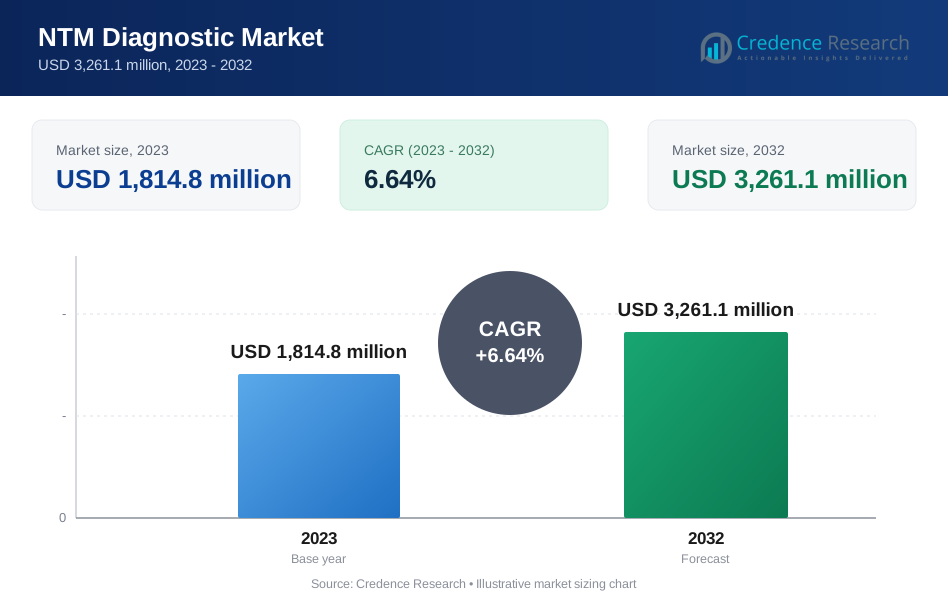
Global NTM Diagnostic Market size was valued at USD 1,814.8 million in 2023 and is anticipated to reach USD 3,261.1 million by 2032, at a CAGR of 6.64% during the forecast period.
The Global NTM Diagnostic Market is driven by the rising prevalence of non-tuberculous mycobacterial (NTM) infections, increased awareness among healthcare professionals, and advancements in molecular diagnostic technologies. Growing adoption of rapid and accurate diagnostic methods supports early detection and improved patient management. Trends include the integration of automated systems, expansion of point-of-care testing, and investment in research to develop more sensitive and specific assays. The aging population and rising incidence of chronic lung diseases further contribute to market demand. Government initiatives and funding for infectious disease control, along with the expanding use of multiplex PCR and next-generation sequencing, accelerate diagnostic capabilities.
The Global NTM Diagnostic Market demonstrates robust growth across diverse geographies, with North America and Europe leading in the adoption of advanced molecular diagnostic technologies due to strong healthcare infrastructure and high awareness of NTM infections. Asia Pacific is rapidly expanding, supported by increasing healthcare investments, rising respiratory disease burden, and a growing focus on modernizing laboratory capabilities. Latin America and the Middle East & Africa regions are gradually integrating automated diagnostic platforms and point-of-care solutions to improve access and early detection.
Market Insights
- The Global NTM Diagnostic Market was valued at USD 1,814.8 million in 2023 and is projected to reach USD 3,261.1 million by 2032, registering a CAGR of 6.64% during the forecast period.
- Rising prevalence of non-tuberculous mycobacterial infections and increased awareness among healthcare professionals are driving demand for advanced diagnostic solutions.
- Advancements in molecular diagnostics, automation, and integration of point-of-care technologies are shaping market trends and improving early detection rates.
- The market features strong competition with key players such as Thermo Fisher Scientific Inc, F. Hoffmann-La Roche Ltd, Becton, Dickinson and Company (BD), and bioMérieux SA focusing on innovation and strategic partnerships.
- High diagnostic costs, limited access in low-resource regions, and lack of standardized testing protocols remain major restraints for market growth.
- North America and Europe lead the market due to well-established healthcare infrastructure, while Asia Pacific is witnessing rapid growth supported by healthcare modernization and increasing investment in diagnostics.
- Industry players are expanding their presence in emerging markets by offering affordable and user-friendly diagnostic platforms, strengthening the market’s global reach and accessibility.
Report Scope:
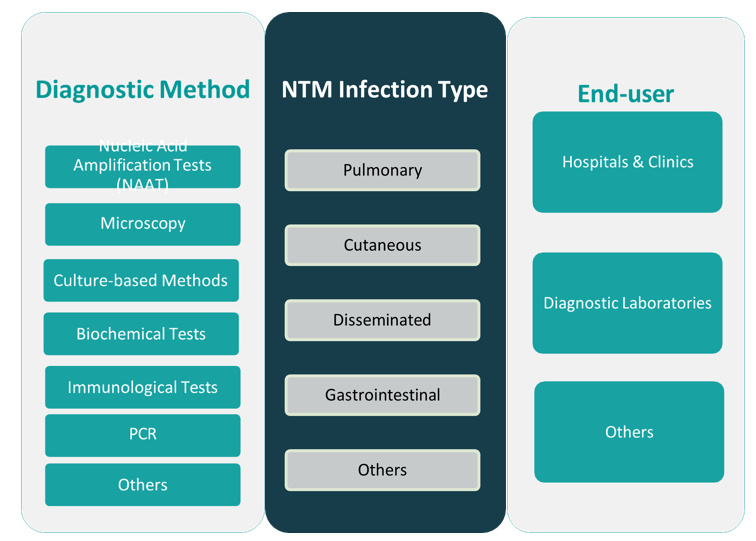
This report segments the Global NTM Diagnostic Market as follows:
Market Drivers
Increasing Prevalence of NTM Infections and Rising Chronic Lung Diseases Fuel Diagnostic Demand
A significant driver for the Global NTM Diagnostic Market is the rising incidence of non-tuberculous mycobacterial (NTM) infections worldwide. It has seen a marked increase in both immunocompetent and immunocompromised populations, largely due to the expanding burden of chronic lung diseases such as chronic obstructive pulmonary disease (COPD), cystic fibrosis, and bronchiectasis. The growing number of patients with compromised respiratory systems requires timely and accurate diagnostic solutions to ensure effective treatment outcomes. This trend has prompted healthcare providers to prioritize the early and precise identification of NTM infections, thereby expanding the adoption of advanced diagnostic tests. Increasing awareness of the clinical importance of NTM detection among healthcare professionals further supports market growth. Healthcare systems in both developed and developing regions recognize the need to address the diagnostic challenges posed by these infections.
- For instance, BioMérieux’s BioFire® FilmArray® system has been adopted by over 3,000 clinical laboratories worldwide, demonstrating a significant rise in molecular diagnostic usage for respiratory pathogens, including NTM.
Advancements in Molecular Diagnostic Technologies Support Early and Accurate Detection
Continuous advancements in molecular diagnostic technologies significantly propel the Global NTM Diagnostic Market. It benefits from innovations such as polymerase chain reaction (PCR), next-generation sequencing (NGS), and multiplex assays that deliver high sensitivity and specificity in detecting NTM species. The growing preference for rapid, automated, and user-friendly platforms allows laboratories and clinics to enhance diagnostic efficiency and accuracy. Molecular methods now outperform traditional culture-based diagnostics in speed and reliability, making them a preferred choice for clinicians. The ongoing investment in research and development from industry leaders leads to the creation of new and improved testing solutions, further broadening the range of available diagnostic options. These technological improvements directly contribute to better clinical outcomes and patient management.
- For instance, Qiagen’s QIAstat-Dx platform can deliver comprehensive results for respiratory pathogens, including NTM, in less than 70 minutes with a sensitivity exceeding 95%, according to peer-reviewed studies.
Government Initiatives, Public Health Funding, and Supportive Regulatory Landscape Boost Market Growth
Public health initiatives and government funding play a critical role in expanding the Global NTM Diagnostic Market. It receives support from programs designed to control infectious diseases and enhance laboratory infrastructure, particularly in emerging economies. Regulatory agencies facilitate the introduction of advanced diagnostic products through streamlined approval processes and updated clinical guidelines. The involvement of international health organizations encourages collaboration between public and private stakeholders, driving the dissemination of best practices and new technologies. Strategic partnerships between diagnostic companies and research institutes accelerate the development of high-quality NTM tests. Such supportive measures create a favorable environment for market growth and encourage further innovation in NTM diagnostics.
Expanding Access, Patient Awareness, and Integration of Point-of-Care Solutions Strengthen Market Potential
Efforts to improve access to diagnostics in underserved regions have a positive impact on the Global NTM Diagnostic Market. It benefits from the increasing deployment of point-of-care and decentralized testing solutions, which bring advanced diagnostics closer to patients. Growing awareness campaigns targeting both healthcare professionals and patients facilitate earlier diagnosis and treatment initiation. The integration of digital health technologies, such as telemedicine and electronic health records, enhances data sharing and improves clinical decision-making. Industry players invest in education and training initiatives to boost the adoption of NTM diagnostic tools at primary care levels. These combined factors continue to strengthen the market’s potential by making high-quality diagnostic services more accessible and efficient worldwide.
Market Trends
Integration of Advanced Molecular Diagnostics and Automation Shapes the Future of NTM Testing
Adoption of advanced molecular diagnostics and automation stands out as a prominent trend in the Global NTM Diagnostic Market. It is experiencing a shift from conventional culture-based methods to PCR, next-generation sequencing, and multiplex molecular assays, which deliver higher sensitivity, specificity, and speed. Automated platforms enable laboratories to streamline workflows, reduce turnaround times, and minimize human error. This shift addresses the growing need for timely diagnosis and supports better clinical outcomes for patients with NTM infections. Industry players focus on developing integrated systems that combine multiple diagnostic modalities within a single platform. This evolution increases efficiency and positions molecular diagnostics as a cornerstone in the identification and characterization of NTM pathogens.
- For instance, the Centers for Disease Control and Prevention note that nearly 2,000 public health laboratories have automated their NTM diagnostic workflows since 2020. Industry reports show more than 400 hospitals in South Korea now use fully integrated systems capable of simultaneously running up to ten different assays.
Point-of-Care Testing and Decentralized Diagnostics Drive Accessibility and Early Detection
Expansion of point-of-care (POC) testing represents a key trend shaping the Global NTM Diagnostic Market. It is marked by the increasing availability of portable, user-friendly diagnostic devices that deliver rapid results outside traditional laboratory settings. Decentralized diagnostic approaches support early detection and timely treatment, particularly in resource-limited or remote environments. Healthcare providers are adopting POC solutions to bring advanced testing capabilities closer to patients, reducing diagnostic delays and improving disease management. The emphasis on accessibility aligns with global efforts to close healthcare gaps and support early intervention strategies. Ongoing technological advancements further strengthen the reliability and adoption of POC solutions in clinical practice.
- For instance, Roche’s cobas® 6800/8800 Systems process up to 960 tests in an eight-hour shift, enabling large-scale, high-throughput molecular screening for mycobacterial infections.
Rising Collaborations and Strategic Partnerships Fuel Innovation and Market Expansion
Industry collaboration and strategic partnerships represent another defining trend in the Global NTM Diagnostic Market. It sees diagnostic manufacturers, academic institutions, and public health organizations joining forces to accelerate product development and address complex diagnostic challenges. Partnerships facilitate knowledge sharing, leverage diverse expertise, and support the creation of novel assays tailored to emerging clinical needs. Joint initiatives target innovation in sample preparation, detection platforms, and data analytics, fueling the introduction of next-generation diagnostic products. These collaborations enhance the market’s competitive landscape and contribute to more rapid adoption of new technologies on a global scale. The trend towards open innovation drives value for both industry stakeholders and end users.
Emphasis on Digital Health Integration and Data-Driven Decision Making Advances Clinical Practice
Digital health integration is reshaping clinical practice in the Global NTM Diagnostic Market. It benefits from the adoption of electronic health records, cloud-based data management, and telemedicine platforms, all of which streamline diagnostic workflows and facilitate data sharing. Healthcare providers leverage digital tools to support remote consultations, monitor patient outcomes, and enable real-time decision making. Advanced analytics and artificial intelligence enhance the interpretation of complex diagnostic results, guiding clinicians toward more personalized treatment strategies. Digital health trends are expected to continue driving efficiency, accuracy, and patient-centric care within the NTM diagnostic landscape, supporting market evolution and expansion.
Market Challenges Analysis
High Diagnostic Costs and Limited Access Restrict Market Growth Across Emerging Regions
High costs associated with advanced diagnostic technologies remain a primary challenge for the Global NTM Diagnostic Market. It faces hurdles as many healthcare systems in low- and middle-income countries lack the resources to procure and maintain cutting-edge molecular diagnostic equipment. Limited access to specialized laboratories and skilled personnel further restricts the adoption of NTM diagnostics in these regions. Many patients continue to rely on slow, less accurate traditional methods, delaying effective treatment. Reimbursement policies for NTM diagnostic tests are often inadequate, deterring healthcare providers from adopting innovative solutions. The challenge of affordability and accessibility persists, particularly in geographically remote or underserved areas, where disease burden is often highest.
Complexity of NTM Detection and Lack of Standardized Testing Hinder Accurate Diagnosis
The complexity of non-tuberculous mycobacteria detection poses another major obstacle for the Global NTM Diagnostic Market. It struggles with the absence of universally accepted guidelines and standardized protocols for NTM identification, leading to variability in diagnostic outcomes across laboratories. Diverse NTM species present with overlapping clinical symptoms, complicating differentiation from other respiratory infections. False negatives and delayed diagnoses can impact patient management and increase disease transmission risks. Diagnostic sensitivity and specificity often vary between testing platforms, creating uncertainty for clinicians. The market continues to face the pressing need for consensus standards and validated protocols to improve diagnostic accuracy and patient care outcomes.
Market Opportunities
Expansion of Rapid Molecular and Point-of-Care Diagnostics Creates New Growth Avenues
Rapid advancements in molecular diagnostics and the increasing availability of point-of-care solutions present significant opportunities for the Global NTM Diagnostic Market. It can expand by introducing innovative technologies that reduce diagnostic turnaround time and improve accuracy, enabling faster clinical decision-making. Industry players have the potential to address unmet needs in both hospital and decentralized care settings by developing portable and user-friendly diagnostic platforms. Investment in research focused on multiplex assays and integrated sample-to-answer systems opens doors for broadening diagnostic capabilities. The move toward miniaturization and automation supports higher adoption rates among healthcare providers seeking efficient, reliable, and scalable diagnostic options. These advancements will accelerate market penetration, especially in regions seeking to modernize healthcare delivery.
Growth in Emerging Markets and Strategic Collaborations Foster Wider Adoption
Emerging markets offer promising opportunities for the Global NTM Diagnostic Market, driven by rising healthcare expenditure, government initiatives, and improvements in laboratory infrastructure. It benefits when industry stakeholders collaborate with local health authorities, research institutions, and non-governmental organizations to strengthen distribution networks and training programs. Strategic partnerships enable companies to leverage regional expertise and expand access to advanced diagnostics in underserved populations. Expansion efforts supported by public health campaigns and awareness programs help increase early detection rates and drive demand for NTM testing. Companies that focus on localized solutions and affordable pricing models can establish a strong foothold in fast-growing economies, paving the way for long-term market growth.
Market Segmentation Analysis:
By Diagnostic Method:
Nucleic Acid Amplification Tests (NAAT) command significant attention due to their rapid turnaround time, high sensitivity, and ability to differentiate NTM species. PCR methods further enhance accuracy in detecting complex infections, while immunological tests gain traction for their utility in screening and early identification. Culture-based methods and microscopy remain relevant in resource-limited settings, supporting traditional workflows where advanced infrastructure is less accessible. Biochemical tests and other emerging technologies supplement standard practices, offering incremental value for laboratories looking to expand their test menus.
- For instance, Cepheid’s GeneXpert® platform, with over 40,000 instruments installed in more than 180 countries, has dramatically expanded access to rapid NTM and TB diagnostics at the point of care.
By Infection Type:
Pulmonary NTM infections account for the largest share, given the high prevalence of respiratory conditions and chronic lung disease populations susceptible to mycobacterial infection. The market also addresses cutaneous, disseminated, and gastrointestinal infections, each requiring specialized diagnostic strategies due to differing clinical presentations and disease burdens. It continues to expand its diagnostic portfolios to capture rare and atypical infection types, helping clinicians improve patient management and outcomes across a wide clinical spectrum.
- For instance, Thermo Fisher Scientific’s Ion Torrent™ NGS technology has been used to subtype and identify more than 100 NTM species from pulmonary and extrapulmonary samples in clinical research studies, enhancing the precision of infection characterization.
By End-User:
End-user segmentation highlights the dominance of hospitals and clinics, which maintain comprehensive diagnostic capabilities and manage a high volume of suspected NTM cases. Diagnostic laboratories serve a critical role in confirmatory testing and advanced molecular analyses, often supporting reference centers or specialized research projects. The “Others” segment, which may include ambulatory care centers and community health facilities, reflects ongoing efforts to decentralize diagnostics and improve access in underserved or rural settings. It benefits from portable, user-friendly platforms that bridge gaps in diagnostic availability, expanding market reach and supporting early intervention. The Global NTM Diagnostic Market’s segment diversity ensures it remains responsive to emerging clinical needs, technological advancements, and regional healthcare infrastructure developments, positioning it for sustained growth and innovation.
Segments:
Based on Diagnostic Method:
- Nucleic Acid Amplification Tests (NAAT)
- Microscopy
- Culture-based Methods
- Biochemical Tests
- Immunological Tests
- PCR
- Others
Based on Infection Type:
- Pulmonary
- Cutaneous
- Disseminated
- Gastrointestinal
- Others
Based on End-User:
- Hospitals & Clinics
- Diagnostic Laboratories
- Others
Based on the Geography:
- North America
- US
- Canada
- Mexico
- Europe
- UK
- France
- Germany
- Italy
- Spain
- Russia
- Belgium
- Netherlands
- Austria
- Sweden
- Poland
- Denmark
- Switzerland
- Rest of Europe
- Asia Pacific
- China
- Japan
- South Korea
- India
- Australia
- Thailand
- Indonesia
- Vietnam
- Malaysia
- Philippines
- Taiwan
- Rest of Asia Pacific
- Latin America
- Brazil
- Argentina
- Peru
- Chile
- Colombia
- Rest of Latin America
- Middle East
- UAE
- KSA
- Israel
- Turkey
- Iran
- Rest of Middle East
- Africa
- Egypt
- Nigeria
- Algeria
- Morocco
- Rest of Africa
Regional Analysis
North America
North America holds the largest market share in the Global NTM Diagnostic Market, accounting for approximately 39% of the global revenue in 2023. The region benefits from advanced healthcare infrastructure, widespread adoption of molecular diagnostic technologies, and robust research activities centered on infectious diseases. Major market participants are based in the United States and Canada, leveraging their technical expertise and financial resources to drive product innovation and clinical adoption. The high prevalence of chronic lung diseases, such as COPD and cystic fibrosis, contributes to sustained demand for accurate and rapid NTM diagnostic solutions. Favorable reimbursement policies and strong collaboration between public health agencies and diagnostic companies enhance accessibility to new testing platforms. North America’s market leadership is further solidified by ongoing investments in laboratory modernization and a focus on precision medicine, which support continued growth and advancement in the NTM diagnostic sector.
Europe
Europe represents the second-largest regional market, capturing nearly 27% of the global market share in 2023. The region exhibits steady growth driven by increasing awareness of NTM infections, an aging population, and rising healthcare expenditure. Countries such as Germany, the United Kingdom, and France play a pivotal role in technology adoption and research funding, fostering a supportive environment for the deployment of advanced diagnostic methods. National health authorities and international organizations collaborate to implement standardized clinical guidelines and enhance disease surveillance, supporting improved detection rates and early intervention. The European market benefits from a highly skilled workforce and a strong network of reference laboratories, enabling rapid integration of novel diagnostic tools. Regulatory alignment across the European Union streamlines market entry and promotes the adoption of best practices throughout the region.
Asia Pacific
The Asia Pacific region holds a significant share in the Global NTM Diagnostic Market, accounting for approximately 23% of the total market in 2023. Rapidly expanding healthcare infrastructure and growing investment in diagnostic technologies drive market growth across key countries such as China, Japan, South Korea, and India. The increasing burden of respiratory diseases, large patient populations, and government initiatives aimed at improving infectious disease control propel the adoption of advanced diagnostic methods. The region also experiences rising demand for point-of-care and decentralized testing solutions that improve diagnostic accessibility in rural and underserved areas. Strategic partnerships between local and global diagnostic firms foster technology transfer and knowledge sharing, accelerating market penetration. Asia Pacific’s dynamic growth trajectory is further supported by favorable regulatory reforms and heightened focus on healthcare modernization.
Latin America
Latin America holds a modest market share, estimated at 6% of the global total in 2023, yet it demonstrates considerable growth potential. Regional demand is driven by increasing awareness of NTM infections, expanding private healthcare sectors, and targeted public health initiatives. Countries such as Brazil, Mexico, and Argentina are making significant investments in laboratory infrastructure and workforce development. Despite challenges related to healthcare disparities and limited resources in remote areas, Latin America is gradually adopting molecular and automated diagnostic platforms. Efforts to improve healthcare coverage, regulatory support, and international collaborations are gradually strengthening the region’s diagnostic capacity and driving market expansion.
Middle East and Africa
The Middle East and Africa region holds the smallest share in the Global NTM Diagnostic Market, with an estimated 5% market share in 2023. The market is characterized by underdiagnosis of NTM infections due to limited access to advanced diagnostics, infrastructural constraints, and workforce shortages. However, ongoing investments in healthcare infrastructure and increasing public awareness are creating opportunities for market growth. Countries in the Gulf Cooperation Council (GCC) and South Africa are leading regional efforts to improve infectious disease management and diagnostic capacity. Partnerships with international organizations and private companies are driving the introduction of automated platforms and point-of-care diagnostics. Over time, sustained investment and capacity-building initiatives are expected to enhance market penetration and support early detection of NTM infections across the Middle East and Africa.
Key Player Analysis
- Thermo Fisher Scientific Inc
- Hoffmann-La Roche Ltd
- Becton, Dickinson and Company (BD)
- bioMérieux SA
- Bruker Corporation
- SD Biosensor
- Bioneer
- Seegene Inc.
Competitive Analysis
The competitive landscape of the Global NTM Diagnostic Market is characterized by the presence of leading players such as Thermo Fisher Scientific Inc, F. Hoffmann-La Roche Ltd, Becton, Dickinson and Company (BD), and bioMérieux SA. These companies maintain a strong foothold through their broad portfolios of molecular and immunological diagnostic solutions, catering to both centralized laboratories and decentralized testing environments. They invest heavily in research and development to introduce advanced assays, automated platforms, and integrated systems that enhance diagnostic speed, accuracy, and workflow efficiency. Strategic partnerships, collaborations with research institutions, and mergers and acquisitions are common approaches to accelerate innovation and expand geographic presence. Key players also focus on regulatory compliance and obtaining international certifications, enabling seamless market entry across regions. Their ability to address evolving clinical needs, support public health initiatives, and offer training and technical support further strengthens their market leadership. The emphasis on affordability, scalability, and digital integration allows these companies to stay competitive while adapting to shifting healthcare demands and regulatory landscapes worldwide.
Recent Developments
- In January 2022, Spero Therapeutics stated that the FDA had withdrawn the clinical stay imposed on its Phase IIa SPR720 study by the agency. Patients with nontuberculous mycobacterial pulmonary illness are being examined with medication, an oral antibacterial agent (NTM-PD).
- In January 2022, Gaelan Medical Trade LLC and RedHill Biopharma Ltd., a specialist biopharmaceutical business, have partnered to sell the medication Talicia (omeprazole magnesium, amoxicillin, and rifabutin) in the United Arab Emirates (UAE).
- In June 2022, for treating pulmonary nontuberculous mycobacterial disorders brought on by Mycobacterium avium complex (MAC) and Mycobacterium abscessus, the FDA granted NUZYRA® from Paratek Pharmaceuticals Fast Track Designation (MAB).
Market Concentration & Characteristics
The Global NTM Diagnostic Market exhibits a moderate to high level of market concentration, with a few multinational corporations accounting for a significant share of total revenue. It features a mix of global leaders and specialized regional players, each contributing to innovation and product development. Leading companies leverage advanced research capabilities, strong distribution networks, and established brand recognition to secure their market positions. The market is characterized by continuous technological advancement, a focus on molecular diagnostics, and a growing shift toward automated and point-of-care testing solutions. It responds to evolving clinical needs by offering assays with improved sensitivity and specificity while navigating regulatory requirements in diverse regions. Product differentiation, customer support services, and integration with digital health platforms distinguish the offerings of top players. The market continues to expand into emerging economies, supported by efforts to address unmet diagnostic needs and promote accessibility to high-quality testing solutions worldwide.
Report Coverage
The research report offers an in-depth analysis based on Diagnostic Method, Infection Type, End-User and Geography. It details leading market players, providing an overview of their business, product offerings, investments, revenue streams, and key applications. Additionally, the report includes insights into the competitive environment, SWOT analysis, current market trends, as well as the primary drivers and constraints. Furthermore, it discusses various factors that have driven market expansion in recent years. The report also explores market dynamics, regulatory scenarios, and technological advancements that are shaping the industry. It assesses the impact of external factors and global economic changes on market growth. Lastly, it provides strategic recommendations for new entrants and established companies to navigate the complexities of the market.
Future Outlook
- The Global NTM Diagnostic Market is projected to experience steady growth through 2032, driven by increasing awareness and the need for early detection of non-tuberculous mycobacterial infections.
- Advancements in molecular diagnostic technologies, such as PCR and next-generation sequencing, are enhancing the accuracy and speed of NTM detection, facilitating timely treatment decisions.
- The integration of automated and point-of-care diagnostic solutions is expanding, improving accessibility in both developed and resource-limited settings.
- Key industry players are focusing on strategic collaborations and research investments to develop innovative diagnostic tools and expand their global footprint.
- The rising prevalence of chronic respiratory diseases, including COPD and bronchiectasis, is contributing to increased demand for NTM diagnostic services.
- Emerging markets in Asia-Pacific and Latin America are witnessing growth opportunities due to healthcare infrastructure development and increased investment in diagnostic capabilities.
- Regulatory support and government initiatives aimed at controlling infectious diseases are encouraging the adoption of advanced diagnostic methods.
- Challenges such as high costs of advanced diagnostics and limited access in certain regions may hinder market growth, necessitating affordable and scalable solutions.
- The market is expected to benefit from the growing trend of personalized medicine, with diagnostics playing a crucial role in tailoring treatments for NTM infections.
- Continuous innovation and technological advancements are anticipated to shape the future landscape of the Global NTM Diagnostic Market, enhancing diagnostic accuracy and patient outcomes.
Request a Free Sample
Fill in your details and we'll send you a free sample report.
- Sample data tables & charts
- Research methodology
Market Dynamics
Increasing Prevalence of NTM Infections and Chronic Lung Diseases
The rising incidence of non-tuberculous mycobacterial infections, particularly among populations with chronic lung diseases such as COPD and cystic fibrosis, is driving demand for timely and accurate diagnostic solutions. This trend is prompting healthcare providers to prioritize early and precise identification of NTM infections, expanding the adoption of advanced diagnostic tests.
Advancements in Molecular Diagnostic Technologies
Continuous innovation in molecular diagnostics, including PCR, next-generation sequencing, and multiplex assays, is enhancing the sensitivity, specificity, and speed of NTM detection. These technologies outperform traditional methods, enabling rapid and reliable diagnosis that supports better patient management and clinical outcomes.
Government Initiatives and Public Health Funding
Supportive government policies, public health initiatives, and increased funding for infectious disease control are facilitating the adoption of advanced NTM diagnostic technologies. Regulatory agencies and international organizations are streamlining approval processes and promoting best practices, accelerating market growth.
Expansion of Point-of-Care and Decentralized Testing
The growing deployment of point-of-care and decentralized diagnostic solutions is improving access to NTM testing, especially in underserved and remote regions. These portable and user-friendly platforms enable earlier diagnosis and treatment, supporting global efforts to close healthcare gaps.
Strategic Collaborations and Industry Partnerships
Collaborations between diagnostic manufacturers, research institutions, and public health organizations are accelerating the development and dissemination of innovative NTM diagnostic tools. These partnerships foster knowledge sharing, drive product innovation, and expand access to advanced diagnostics in both developed and emerging markets.
Need a Custom Version of This Report?
Tailor the scope, geography, or segments to your exact requirements.
- Custom geography or segment scope
- Direct access to our analyst team
Frequently Asked Questions
What is the current size of the Global NTM Diagnostic Market?
What factors are driving the growth of the Global NTM Diagnostic Market?
What are the key segments within the Global NTM Diagnostic Market?
What are some challenges faced by the Global NTM Diagnostic Market?
Who are the major players in the Global NTM Diagnostic Market?
Table of Content
Chapter 1 Market Segmentation
- 1.1 Segmentation Framework
- 1.1.1 Product and Service Classification
- 1.1.2 Application and End-Use Classification
- 1.1.3 Technology and Solution Classification
- 1.1.4 Customer and Distribution Channel Classification
- 1.1.5 Geographic Segmentation
- 1.1.6 Market Segment Definitions and Boundaries
- 1.2 By End-User
- 1.2.1 Hospitals & Clinics
- 1.2.2 Diagnostic Laboratories
- 1.2.3 Others
- 1.3 By Infection Type
- 1.3.1 Pulmonary
- 1.3.2 Cutaneous
- 1.3.3 Disseminated
- 1.3.4 Gastrointestinal
- 1.3.5 Others
- 1.4 By Diagnostic Method
- 1.4.1 Nucleic Acid Amplification Tests (NAAT)
- 1.4.2 Microscopy
- 1.4.3 Culture-based Methods
- 1.4.4 Biochemical Tests
- 1.4.5 Immunological Tests
- 1.4.6 PCR
- 1.4.7 Others
Chapter 2 Introduction
- 2.1 Report Objectives and Scope
- 2.2 Product Definition and Industry Terminology
- 2.3 Market Inclusions and Exclusions
- 2.4 Research Process
- 2.4.1 Primary Research and Expert Interviews
- 2.4.2 Secondary Research and Source Review
- 2.4.3 Top-Down and Bottom-Up Estimation
- 2.4.4 Data Triangulation and Verification
- 2.5 Market Size Measurement Basis
- 2.5.1 2023: USD 1,814.8 million → 2032: USD 3,261.1 million
- 2.6 Historical and Forecast Reference Periods
- 2.6.1 Base Year: 2023
- 2.6.2 Forecast Period: 2023-2032
- 2.7 Research Assumptions and Limitations
Chapter 3 Executive Summary
- 3.1 Market Snapshot and Key Findings
- 3.2 Base-Year Market Size, 2023
- 3.3 Forecast Market Size, 2032
- 3.4 Revenue and Volume Growth Outlook
- 3.5 Key Demand and Supply Indicators
- 3.6 Leading Market Segments
- 3.7 Fastest-Growing Market Opportunities
- 3.8 Regional Performance Highlights
- 3.9 Technology and Industry Transformation
- 3.10 Competitive Landscape Summary
- 3.11 Analyst View and Strategic Implications
Chapter 4 Global NTM Diagnostic Market Trends and Developments
- 4.1 Historical Industry Development
- 4.2 Recent Market Trends and Developments
- 4.3 Demand and Customer Behavior Trends
- 4.4 Technology and Product Innovation
- 4.5 Artificial Intelligence, Automation and Digitalization
- 4.6 Local Manufacturing and Supply Chain Realignment
- 4.7 Industry Partnerships, Mergers and Acquisitions
- 4.8 Sustainability and Circular Economy Developments
- 4.9 Government and Private Sector Investment Trends
- 4.10 Emerging Business Models and Commercialization
- 4.11 Industry Developments and Announcements
Chapter 5 Global NTM Diagnostic Market Production, Supply and Demand Analysis
- 5.1 Demand Trend and Consumption Analysis
- 5.2 Demand Forecast, 2023-2032
- 5.3 Production and Output Trend
- 5.4 Production and Output Forecast, 2023-2032
- 5.5 Installed Capacity and Capacity Utilization
- 5.6 Company-Wise Production Plants and Statistics
- 5.6.1 Installed Production Capacity
- 5.6.2 Actual Production
- 5.6.3 Planned Capacity and Expansion Targets
- 5.7 Supply Chain Structure and Procurement Trends
- 5.8 Supply-Demand Gap and Bottlenecks
- 5.9 Import Dependence and Sourcing Structure
- 5.10 Contract Manufacturing and Outsourcing
- 5.11 Regional Supply and Demand Concentration
Chapter 6 Global NTM Diagnostic Market Pricing Analysis
- 6.1 Pricing Structure and Measurement
- 6.2 Historical Pricing Trends
- 6.3 Pricing Outlook, 2023-2032
- 6.4 Average Selling Price and Unit Economics
- 6.5 Pricing by Product and Market Segment
- 6.6 Geographic Pricing Differences
- 6.7 Key Input, Energy, Labor and Logistics Costs
- 6.8 Contract Pricing and Purchasing Models
- 6.9 Pricing Sensitivity and Competitive Positioning
- 6.10 Price, Margin and Profitability Implications
Chapter 7 Global NTM Diagnostic Market Dynamics
- 7.1 Market Growth Drivers
- 7.1.1 Demand-Side Drivers
- 7.1.2 Technology and Innovation Drivers
- 7.1.3 Infrastructure and Investment Drivers
- 7.1.4 Regulatory and Policy Drivers
- 7.2 Market Restraints
- 7.2.1 Cost and Affordability Constraints
- 7.2.2 Technology and Adoption Barriers
- 7.2.3 Supply Chain and Operational Constraints
- 7.3 Market Challenges
- 7.3.1 Competitive Pressure and Margin Erosion
- 7.3.2 Skills, Infrastructure and Implementation Gaps
- 7.4 Emerging Market Opportunities
- 7.5 Market Dynamics Impact and Time-Horizon Assessment
Chapter 8 Global NTM Diagnostic Value Chain Analysis
- 8.1 Industry Value Chain Overview
- 8.2 Upstream Suppliers and Critical Inputs
- 8.3 Technology and Component Providers
- 8.4 Manufacturing or Service Delivery
- 8.5 Distribution, Channel Partners and Integrators
- 8.6 Downstream Applications and End Users
- 8.7 Value Addition and Profit Pools
- 8.8 Vertical Integration and Outsourcing
- 8.9 Supplier Concentration and Risk
- 8.10 Supply Chain Localization and Resilience
Chapter 9 Global NTM Diagnostic Market Regulations and Policies
- 9.1 Relevant Laws, Standards and Compliance Frameworks
- 9.2 Product, Service, Safety and Quality Requirements
- 9.3 Government Policies, Incentives and Subsidies
- 9.4 Imports, Exports and Trade Barriers
- 9.5 Public Procurement and Local Content Requirements
- 9.6 Environmental and Sustainability Compliance
- 9.7 Upcoming Policy Changes and Market Implications
Chapter 10 Global NTM Diagnostic Market Hotspots and Opportunities
- 10.1 Market Opportunity Mapping and Growth Hotspots
- 10.2 High-Growth Applications and Customer Groups
- 10.3 Underserved Markets and White-Space Opportunities
- 10.4 Emerging Technology and Product Opportunities
- 10.5 New Capacity and Investment Hotspots
- 10.6 Market Entry and Expansion Opportunities
- 10.7 Distribution and Partnership Opportunities
- 10.8 Near-Term and Long-Term Commercial Potential
- 10.9 Opportunity Attractiveness and Execution Risks
Chapter 11 Global NTM Diagnostic Market Outlook, 2023-2032
- 11.1 Market Size and Analysis
- 11.1.1 Revenue (Market Measurement: 2023: USD 1,814.8 million → 2032: USD 3,261.1 million)
- 11.1.2 Market Volume and Quantity Sold
- 11.1.3 Historical Market Size
- 11.1.4 Base-Year Market Size, 2023
- 11.2 Market Forecast, 2023-2032
- 11.2.1 Revenue Forecast to 2032
- 11.2.2 Volume Forecast to 2032
- 11.2.3 CAGR and Year-on-Year Growth
- 11.2.4 Incremental Revenue Opportunity
- 11.3 Forecast Assumptions and Scenario Analysis
- 11.3.1 Base-Case Forecast
- 11.3.2 Optimistic and Conservative Scenarios
- 11.3.3 Technology, Pricing and Policy Sensitivities
- 11.4 Market Attractiveness and Growth Outlook
Chapter 12 Global NTM Diagnostic Market Segmentation and Outlook
- 12.1 Segmentation Summary and Market Shares, 2023
- 12.2 Largest and Fastest-Growing Segments
- 12.3 By End-User - Market Size and Forecast, 2023-2032
- 12.3.1 Segment Definition and Scope
- 12.3.2 Historical Market Size
- 12.3.3 Revenue Forecast, 2023-2032
- 12.3.4 Volume Forecast, 2023-2032
- 12.3.5 Base-Year Market Share, 2023
- 12.3.6 Segment CAGR and Growth Drivers
- 12.3.7 Subsegment Market Size and Forecast
- 12.3.7.1 Hospitals & Clinics
- 12.3.7.2 Diagnostic Laboratories
- 12.3.7.3 Others
- 12.3.8 Subsegment Pricing and Adoption Trends
- 12.3.9 Leading Suppliers and Competition
- 12.3.10 Regional Demand and Opportunities
- 12.4 By Infection Type - Market Size and Forecast, 2023-2032
- 12.4.1 Segment Definition and Scope
- 12.4.2 Historical Market Size
- 12.4.3 Revenue Forecast, 2023-2032
- 12.4.4 Volume Forecast, 2023-2032
- 12.4.5 Base-Year Market Share, 2023
- 12.4.6 Segment CAGR and Growth Drivers
- 12.4.7 Subsegment Market Size and Forecast
- 12.4.7.1 Pulmonary
- 12.4.7.2 Cutaneous
- 12.4.7.3 Disseminated
- 12.4.7.4 Gastrointestinal
- 12.4.7.5 Others
- 12.4.8 Subsegment Pricing and Adoption Trends
- 12.4.9 Leading Suppliers and Competition
- 12.4.10 Regional Demand and Opportunities
- 12.5 By Diagnostic Method - Market Size and Forecast, 2023-2032
- 12.5.1 Segment Definition and Scope
- 12.5.2 Historical Market Size
- 12.5.3 Revenue Forecast, 2023-2032
- 12.5.4 Volume Forecast, 2023-2032
- 12.5.5 Base-Year Market Share, 2023
- 12.5.6 Segment CAGR and Growth Drivers
- 12.5.7 Subsegment Market Size and Forecast
- 12.5.7.1 Nucleic Acid Amplification Tests (NAAT)
- 12.5.7.2 Microscopy
- 12.5.7.3 Culture-based Methods
- 12.5.7.4 Biochemical Tests
- 12.5.7.5 Immunological Tests
- 12.5.7.6 PCR
- 12.5.7.7 Others
- 12.5.8 Subsegment Pricing and Adoption Trends
- 12.5.9 Leading Suppliers and Competition
- 12.5.10 Regional Demand and Opportunities
- 12.6 Segment Growth Comparison
- 12.7 Segment Attractiveness and Priority Matrix
Chapter 13 Global NTM Diagnostic End-Use and Application Market Outlook
- 13.1 End-Use Industry and Customer Demand Structure
- 13.2 Leading Applications and Customer Groups
- 13.3 End-Use Market Size, Share and Forecast
- 13.4 Major End-Use Industry Deep Dives
- 13.4.1 Customer Requirements and Use Cases
- 13.4.2 Demand and Replacement Cycles
- 13.4.3 Technical and Regulatory Considerations
- 13.4.4 Purchasing and Procurement Models
- 13.4.5 Leading Vendors and Distribution Channels
- 13.4.6 Forecast and Commercial Opportunities
- 13.5 Emerging Applications and Cross-Segment Demand
- 13.6 End-Use Industry Investment Priorities
Chapter 14 Global NTM Diagnostic Geographic Market Outlook, 2023-2032
- 14.1 Regional Market Size and Share, 2023
- 14.2 Regional Market Forecast, 2023-2032
- 14.3 Regional Pricing, Production and Demand Differences
- 14.4 North America
- 14.4.1 United States
- 14.4.2 Canada
- 14.4.3 Mexico
- 14.5 Europe
- 14.5.1 Germany
- 14.5.2 France
- 14.5.3 Italy
- 14.5.4 United Kingdom
- 14.5.5 Spain
- 14.5.6 Poland
- 14.5.7 Russia
- 14.5.8 Netherlands
- 14.5.9 Belgium
- 14.5.10 Sweden
- 14.5.11 Denmark
- 14.5.12 Norway
- 14.5.13 Rest of Europe
- 14.6 Asia Pacific
- 14.6.1 China
- 14.6.2 India
- 14.6.3 Japan
- 14.6.4 South Korea
- 14.6.5 Thailand
- 14.6.6 Indonesia
- 14.6.7 Vietnam
- 14.6.8 Malaysia
- 14.6.9 Australia
- 14.6.10 Rest of Asia Pacific
- 14.7 Latin America
- 14.7.1 Brazil
- 14.7.2 Argentina
- 14.7.3 Colombia
- 14.7.4 Chile
- 14.7.5 Rest of Latin America
- 14.8 Middle East
- 14.8.1 Saudi Arabia
- 14.8.2 United Arab Emirates
- 14.8.3 Turkey
- 14.8.4 Israel
- 14.8.5 Iran
- 14.8.6 Rest of the Middle East
- 14.9 Africa
- 14.9.1 South Africa
- 14.9.2 Egypt
- 14.9.3 Nigeria
- 14.9.4 Morocco
- 14.9.5 Rest of Africa
- 14.10 Regional Investment, Policy and Supply Chain Differences
- 14.11 Regional Competitive Landscape
- 14.12 Geographic Growth Hotspots
Chapter 15 Global NTM Diagnostic Technology, Innovation and Sustainability Outlook
- 15.1 Technology Landscape and Maturity
- 15.2 Product, Process and Service Innovation
- 15.3 AI, Automation and Digital Tools in the Industry
- 15.4 Technology Adoption and Performance Benchmarking
- 15.5 Innovation Pipeline and R&D Investment
- 15.6 Patent and Intellectual Property Trends
- 15.7 Energy Efficiency and Resource Management
- 15.8 Sustainability, Recycling and Circularity
- 15.9 Technology Roadmap, 2023-2032
- 15.10 Risks of Obsolescence and Technology Substitution
Chapter 16 Global NTM Diagnostic Market Key Strategic Imperatives
- 16.1 Growth and Market Entry Priorities
- 16.2 High-Return Products and Segments
- 16.3 Pricing, Profitability and Cost Optimization
- 16.4 Technology Investment and Product Differentiation
- 16.5 Supply Chain Localization and Resilience
- 16.6 Distribution and Customer Acquisition
- 16.7 Partnership, Acquisition and Capacity Strategy
- 16.8 Regional Expansion Priorities
- 16.9 Short-, Medium- and Long-Term Actions
Chapter 17 Competition Outlook
- 17.1 Industry Competition Characteristics
- 17.2 Market Structure and Concentration
- 17.3 Market Share and Competitive Positioning, 2023
- 17.4 Company-Wise Revenue and Product Benchmarking
- 17.5 Production and Service Capacity Benchmarking
- 17.6 Technology, Pricing and Differentiation
- 17.7 Regional Footprint and Distribution Strength
- 17.8 Mergers, Acquisitions and Strategic Alliances
- 17.9 New Entrants and Competitive Threats
- 17.10 Porter's Five Forces and Industry Attractiveness
- 17.11 Competitive Outlook, 2023-2032
Chapter 18 Company Profiles
- 18.1 Company Coverage and Selection Criteria
- 18.2 Thermo Fisher Scientific Inc
- 18.2.1 Business Description
- 18.2.2 Company Ownership and Geographic Presence
- 18.2.3 Product and Service Portfolio
- 18.2.4 Manufacturing and Operating Footprint
- 18.2.5 Production Capacity and Expansion Plans
- 18.2.6 Financial Performance and Investment
- 18.2.7 Market Share and Competitive Position
- 18.2.8 Technology and Innovation Capabilities
- 18.2.9 Strategic Alliances or Partnerships
- 18.2.10 Recent Developments
- 18.2.11 Growth Strategy and Outlook
- 18.3 F. Hoffmann-La Roche Ltd
- 18.4 Becton, Dickinson and Company (BD)
- 18.5 bioMérieux SA
- 18.6 Bruker Corporation
- 18.7 SD Biosensor
- 18.8 Bioneer
- 18.9 Seegene Inc.
- 18.10 Qiagen
- 18.11 Cepheid
- 18.12 Other Relevant Market Participants
Note: Every listed company is profiled on the structure shown under the first company. The company list is preliminary and may change based on research findings, market developments, data availability and client requirements.
Chapter 19 Disclaimer
- 19.1 Research and Forecast Disclaimer
- 19.2 Data Source and Estimation Limitations
Note: The depth of individual sections depends on data availability for this market. Volume, capacity, trade and other unit-based metrics are included where applicable.
