Executive Summary & Core Metrics
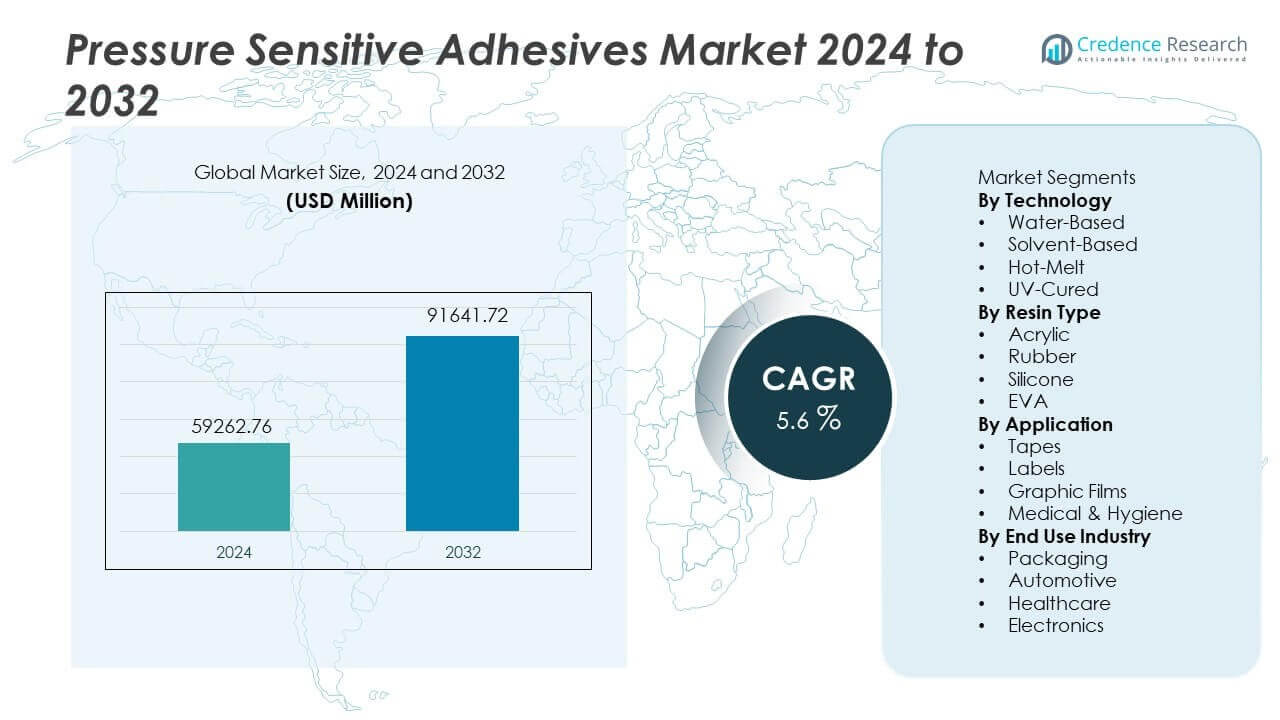
The global pressure sensitive adhesives market was valued at USD 59,262.76 million in 2024 and is projected to reach USD 91,641.72 million by 2032, expanding at a compound annual growth rate (CAGR) of 5.6% during the forecast period, according to Credence Research. This growth reflects rising demand for tapes, labels, graphic films and medical adhesives across packaging, automotive, healthcare, electronics and industrial manufacturing applications.
| REPORT ATTRIBUTE | DETAILS |
|---|---|
| Historical Period | 2020-2023 |
| Base Year | 2024 |
| Forecast Period | 2025-2032 |
| Pressure Sensitive Adhesives Market Size 2024 | USD 59,262.76 million |
| Pressure Sensitive Adhesives Market, CAGR | 5.6% |
| Pressure Sensitive Adhesives Market Size 2032 | USD 91,641.72 million |
The global pressure sensitive adhesives market is characterized by the presence of major adhesive manufacturers, specialty chemical suppliers and material technology companies competing on bonding strength, sustainability, resin performance, substrate compatibility and production efficiency. Leading players focus on acrylic, rubber, silicone and EVA-based systems across water-based, solvent-based, hot-melt and UV-cured technologies. Strategic priorities across the sector include low-VOC formulations, recyclable labels, UV-curable systems, hot-melt products, biobased adhesive development, medical-grade adhesives and high-performance bonding for automotive and electronics applications.
Strategic Market Insights
- Market growth is primarily driven by rising packaging demand as e-commerce, logistics, food delivery and retail distribution increase consumption of tapes, labels and protective adhesive films.
- Dominant industry trends highlight sustainability, advanced bonding performance, UV-curing, recyclable labels, hot-melt systems and adhesive formulations designed for fast production cycles and automated packaging lines.
- The competitive landscape includes global companies expanding acrylic, rubber and silicone solutions, while regional suppliers compete through cost-efficient adhesive formulations for packaging, automotive and healthcare applications.
- According to Credence Research regional mapping, Asia Pacific represents the largest market, accounting for a definitive 38% share due to strong packaging demand, electronics production, automotive manufacturing and large-scale industrial output.
Pressure Sensitive Adhesives Market Segmentation Analysis
By Technology
- Water-Based
- Solvent-Based
- Hot-Melt
- UV-Cured
Water-based technology leads the pressure sensitive adhesives market with a 42% share. This leadership is supported by strong adoption in packaging and labels due to low VOC content, environmental compliance and compatibility with sustainability goals. Water-based adhesives are widely used in consumer packaging, logistics labels and flexible packaging where regulatory acceptance and safer processing are important.
Solvent-based adhesives hold 24% share, supported by applications requiring high bond strength, chemical resistance and durability across industrial uses. Hot-melt technology accounts for 22% share, driven by fast-setting requirements in tapes, packaging lines and graphic films. UV-cured systems represent 12% share and are gaining momentum in specialty electronics and high-performance industrial bonding where instant curing and precision are required.
Henkel AG & Co. KGaA endorses water-based laminating adhesives for flexible packaging applications serving food and non-food markets worldwide.
By Resin Type
- Acrylic
- Rubber
- Silicone
- EVA
Acrylic resin dominates the resin type segment with an estimated 48% market share. Acrylic adhesives offer strong adhesion, weather resistance, aging stability and durability across packaging, automotive, graphic film and industrial applications. Their compatibility with water-based systems supports eco-friendly manufacturing and low-VOC product development. Acrylic systems are also widely used in labels, tapes and automotive bonding where long-term performance is required.
Rubber-based adhesives hold 28% share, supported by high tack and strong bonding performance in tapes and industrial packaging. Silicone adhesives account for 14% share, driven by high-temperature resistance and biocompatibility requirements across electronics and medical applications. EVA resin represents 10% share and is used mainly in flexible and low-temperature applications.
Avery Dennison Medical manufactures silicone adhesives certified under CE-marking and FDA approvals for biocompatible medical device assembly and wound-care products.
By Application
- Tapes
- Labels
- Graphic Films
- Medical & Hygiene
Tapes lead the application segment with a 41% share, supported by packaging, construction, industrial assembly and logistics applications requiring strong bonding and fast application. Packaging tapes, carton sealing tapes and specialty industrial tapes continue to see strong demand as e-commerce and manufacturing activity expand. Tapes are also increasingly used as lightweight alternatives to mechanical fastening in automotive and electronics applications.
Labels hold 26% share, driven by retail, food, logistics and healthcare needs that require strong adhesion, print compatibility and product identification. Graphic films account for 19% share, supported by signage, vehicle wrapping and branding applications. Medical and hygiene applications represent 14% share, benefiting from skin-friendly adhesive development, wound care products, wearable devices and single-use hygiene products.
Key Market Dynamics
Primary Market Drivers
Rising Packaging Demand
Growing e-commerce shipments increase pressure sensitive adhesive consumption across carton sealing, shipping labels and protective tapes. Packaging manufacturers adopt water-based and acrylic adhesive systems to meet bonding strength, sustainability and fast application needs. Food and beverage brands use regulated label adhesives for product tracking and retail presentation. Rising demand for medical and hygiene packaging further expands long-term consumption. Intercol Adhesives produces pressure sensitive adhesives for corrugated-board carton sealing and shipping label tapes used in e-commerce dispatches.
Expansion of Electronics and Automotive Applications
Electronics manufacturers adopt pressure sensitive adhesives for display bonding, thermal management films and component protection. Automotive OEMs replace bolts and mechanical fasteners with acrylic adhesive films to reduce part weight and improve fuel efficiency. EV adoption increases bonding requirements for battery insulation, interior trims and wiring harness protection. PSA tapes engineered for automotive applications are specified to withstand temperature shifts, moisture and vibration, enabling door-panel and glass bonding without mechanical fasteners.
Growing Preference for Sustainable Adhesive Technologies
Environmental standards are encouraging the use of low-VOC, water-based and solvent-free adhesive systems. Packaging brands are shifting toward recyclable label adhesives designed to support circular packaging streams. Regulatory pressure reduces solvent-based adhesive usage across consumer goods and industrial products. Sustainable material development also encourages biobased acrylic and natural rubber formulations. Credence Research identifies sustainability compliance as a central driver for adhesive technology innovation.
Key Trends & Structural Opportunities
Adoption of UV-Cured and High-Performance Adhesive System
Manufacturers are investing in UV-cured PSA solutions for instant bonding, precision performance and high chemical resistance. UV adhesives enable faster production cycles with reduced energy use. Demand is rising across automotive, aerospace, electronics and specialty packaging. Dymax states that its LED-curable adhesive systems can achieve full cure in nearly 1 to 5 seconds under 385-nm or 405-nm lamps and reports more than 300 active curing formulations used in electronics and automotive assemblies worldwide.
Medical and Hygiene Adhesive Innovation
Medical device manufacturers are developing skin-friendly adhesives for wound care, wearable monitoring devices and surgical applications. Single-use hygiene products require gentle adhesion without irritation. Healthcare expansion in emerging markets increases pressure sensitive adhesive consumption in surgical tapes, dressings and medical disposables. 3M Medical Materials and Technologies notes that its silicone-based PSAs pass ISO 10993 biocompatibility testing and are integrated in more than 2,500 medical products used in wound dressings and long-wear sensor patches.
Growth of Recyclable Labels and Circular Packaging Solutions
Recyclable labels and removable adhesive technologies are creating new opportunities as packaging companies work to improve recovery of paper, plastic and flexible substrates. Adhesives that support clean separation, washability and substrate compatibility are gaining demand from brands seeking circular packaging compliance. This trend benefits suppliers that can combine strong bonding performance with recyclability and regulatory alignment.
Industry Challenges
Volatility in Raw Material Prices
Acrylics, rubber polymers, silicone materials and other adhesive feedstocks face price fluctuations linked with petrochemical supply instability. These variations pressure production costs and reduce margin stability for adhesive suppliers. Manufacturers must use reformulation, alternative sourcing and procurement strategies to manage cost volatility while maintaining consistent product performance.
Complex Regulatory and Recycling Requirements
sustainability regulations require adhesives that support recyclability across flexible packaging, labels and graphic films. Some label adhesives can hinder paper and plastic recovery, creating compliance challenges for converters and brand owners. Manufacturers are developing washable, removable and recyclable PSA systems, but this increases development time, testing requirements and cost.
Detailed Regional Analysis
| Region | Market Share (%) | Strategic Regional Catalysts & Insights |
| Asia Pacific | 38.0% | Global leader. Driven by packaging, electronics, automotive production, e-commerce logistics and industrial manufacturing across China, Japan, South Korea, India and Southeast Asia. |
| Europe | 27.0% | Mature regional market. Supported by environmental regulations, automotive manufacturing, sustainable packaging and low-VOC adhesive adoption. |
| North America | 22.0% | Strong demand market. Driven by e-commerce packaging, healthcare adhesives, electronics assembly, automotive components and solvent-free adhesive development. |
| Middle East & Africa | 7.0% | Emerging territory. Supported by industrialization, food packaging, healthcare expansion and growing demand for labels and graphic films. |
| Latin America | 6.0% | Developing regional market. Driven by packaging, agriculture logistics, automotive manufacturing and healthcare adhesive demand. |
Asia Pacific leads the global pressure sensitive adhesives market with a 38% share, according to Credence Research. The region benefits from strong packaging, electronics and automotive production across China, Japan and South Korea. E-commerce logistics increases demand for shipping labels and carton sealing tapes, while industrial development in India and Southeast Asia expands consumption of tapes and protective films. Growing EV production further accelerates demand for high-performance bonding and thermal adhesive systems.
Europe holds 27% share, supported by advanced packaging regulations, strong automotive manufacturing and sustainable adhesive development. Strict environmental laws encourage rapid adoption of water-based and low-VOC resin systems. Growing EV production across Germany and France increases demand for lightweight bonding solutions. Packaging circularity initiatives also support recyclable adhesive development.
North America accounts for 22% share, driven by strong packaging consumption across e-commerce, retail and logistics. U.S. manufacturers adopt advanced adhesive systems for electronics assembly, automotive components and industrial bonding. Healthcare expansion increases demand for medical PSA films used in wound care, tapes and wearable devices. Sustainability goals encourage solvent-free and recyclable adhesive development.
The Middle East & Africa represent 7% share, supported by growing industrialization and packaging needs in food and consumer products. Infrastructure development increases adhesive demand for construction and industrial bonding. Expanding healthcare services across Gulf Cooperation Council countries strengthens medical adhesive consumption, while retail growth supports labeling and graphic film demand.
Latin America holds 6% share, driven by packaging and labeling demand across food, agriculture and industrial logistics. Brazil and Mexico support adhesive consumption through automotive and consumer product manufacturing. Rising e-commerce penetration increases industrial tape usage, while sustainability efforts encourage water-based and solvent-controlled adhesive technologies.
Competitive Landscape & Recent Developments
The pressure sensitive adhesives market includes major companies such as 3M, Henkel AG, Avery Dennison, H.B. Fuller, Sika AG, Arkema, Dow Inc., Ashland Global, Scapa Group and Lohmann GmbH. These companies lead global supply, innovation and technical development across packaging, automotive, electronics and healthcare industries.
Market leaders invest in acrylic, rubber and silicone formulations that deliver high adhesion strength, chemical resistance and compatibility with sustainable substrates. Many suppliers develop water-based, hot-melt and UV-curable products to meet eco-friendly standards and improve processing efficiency. Strategic expansions include acquisitions, product upgrades and capacity additions in Asia and North America. Competitive focus continues to shift toward sustainable solutions, global brand partnerships and specialty performance products for advanced industrial bonding.
Recent Industry Developments (2024–2025)
- In October 2025, Henkel AG & Co. KGaA and Dow Inc. expanded their strategic partnership to reduce emissions across their adhesive portfolio, including pressure sensitive adhesive products.
- In September 2025, Henkel AG & Co. KGaA showcased new recyclable and CO₂-reducing pressure sensitive adhesives at Labelexpo Europe 2025.
- In April 2024, Arkema, through its subsidiary Bostik, increased its UV-acrylic hot-melt PSA production capacity at North American facilities to offer enhanced performance adhesives.

Request a Free Sample
Fill in your details and we'll send you a free sample report.
- Sample data tables & charts
- Research methodology
Need a Custom Version of This Report?
Tailor the scope, geography, or segments to your exact requirements.
- Custom geography or segment scope
- Direct access to our analyst team
Frequently Asked Questions
What is the current and projected size of the global pressure sensitive adhesives market?
What is the projected growth rate of the pressure sensitive adhesives industry over the forecast period?
Which technology segment holds the maximum market share within the pressure sensitive adhesives industry?
Which resin type dominates the pressure sensitive adhesives market?
Which application segment leads the pressure sensitive adhesives market?
Which region commands the highest market share in the global pressure sensitive adhesives space?
Table of Content
Chapter 1 Market Segmentation
- 1.1 Segmentation Framework
- 1.1.1 Product and Service Classification
- 1.1.2 Application and End-Use Classification
- 1.1.3 Technology and Solution Classification
- 1.1.4 Customer and Distribution Channel Classification
- 1.1.5 Geographic Segmentation
- 1.1.6 Market Segment Definitions and Boundaries
Chapter 2 Introduction
- 2.1 Report Objectives and Scope
- 2.2 Product Definition and Industry Terminology
- 2.3 Market Inclusions and Exclusions
- 2.4 Research Process
- 2.4.1 Primary Research and Expert Interviews
- 2.4.2 Secondary Research and Source Review
- 2.4.3 Top-Down and Bottom-Up Estimation
- 2.4.4 Data Triangulation and Verification
- 2.5 Market Size Measurement Basis
- 2.5.1 2024: USD 59,262.76 million → 2032: USD 91,641.72 million
- 2.6 Historical and Forecast Reference Periods
- 2.6.1 Base Year: 2024
- 2.6.2 Forecast Period: 2024-2032
- 2.7 Research Assumptions and Limitations
Chapter 3 Executive Summary
- 3.1 Market Snapshot and Key Findings
- 3.2 Base-Year Market Size, 2024
- 3.3 Forecast Market Size, 2032
- 3.4 Revenue and Volume Growth Outlook
- 3.5 Key Demand and Supply Indicators
- 3.6 Leading Market Segments
- 3.7 Fastest-Growing Market Opportunities
- 3.8 Regional Performance Highlights
- 3.9 Technology and Industry Transformation
- 3.10 Competitive Landscape Summary
- 3.11 Analyst View and Strategic Implications
Chapter 4 Global Pressure Sensitive Adhesives Market Trends and Developments
- 4.1 Historical Industry Development
- 4.2 Recent Market Trends and Developments
- 4.3 Demand and Customer Behavior Trends
- 4.4 Technology and Product Innovation
- 4.5 Artificial Intelligence, Automation and Digitalization
- 4.6 Local Manufacturing and Supply Chain Realignment
- 4.7 Industry Partnerships, Mergers and Acquisitions
- 4.8 Sustainability and Circular Economy Developments
- 4.9 Government and Private Sector Investment Trends
- 4.10 Emerging Business Models and Commercialization
- 4.11 Industry Developments and Announcements
Chapter 5 Global Pressure Sensitive Adhesives Market Production, Supply and Demand Analysis
- 5.1 Demand Trend and Consumption Analysis
- 5.2 Demand Forecast, 2024-2032
- 5.3 Production and Output Trend
- 5.4 Production and Output Forecast, 2024-2032
- 5.5 Installed Capacity and Capacity Utilization
- 5.6 Company-Wise Production Plants and Statistics
- 5.6.1 Installed Production Capacity
- 5.6.2 Actual Production
- 5.6.3 Planned Capacity and Expansion Targets
- 5.7 Supply Chain Structure and Procurement Trends
- 5.8 Supply-Demand Gap and Bottlenecks
- 5.9 Import Dependence and Sourcing Structure
- 5.10 Contract Manufacturing and Outsourcing
- 5.11 Regional Supply and Demand Concentration
Chapter 6 Global Pressure Sensitive Adhesives Market Pricing Analysis
- 6.1 Pricing Structure and Measurement
- 6.2 Historical Pricing Trends
- 6.3 Pricing Outlook, 2024-2032
- 6.4 Average Selling Price and Unit Economics
- 6.5 Pricing by Product and Market Segment
- 6.6 Geographic Pricing Differences
- 6.7 Key Input, Energy, Labor and Logistics Costs
- 6.8 Contract Pricing and Purchasing Models
- 6.9 Pricing Sensitivity and Competitive Positioning
- 6.10 Price, Margin and Profitability Implications
Chapter 7 Global Pressure Sensitive Adhesives Market Dynamics
- 7.1 Market Growth Drivers
- 7.1.1 Demand-Side Drivers
- 7.1.2 Technology and Innovation Drivers
- 7.1.3 Infrastructure and Investment Drivers
- 7.1.4 Regulatory and Policy Drivers
- 7.2 Market Restraints
- 7.2.1 Cost and Affordability Constraints
- 7.2.2 Technology and Adoption Barriers
- 7.2.3 Supply Chain and Operational Constraints
- 7.3 Market Challenges
- 7.3.1 Competitive Pressure and Margin Erosion
- 7.3.2 Skills, Infrastructure and Implementation Gaps
- 7.4 Emerging Market Opportunities
- 7.5 Market Dynamics Impact and Time-Horizon Assessment
Chapter 8 Global Pressure Sensitive Adhesives Value Chain Analysis
- 8.1 Industry Value Chain Overview
- 8.2 Upstream Suppliers and Critical Inputs
- 8.3 Technology and Component Providers
- 8.4 Manufacturing or Service Delivery
- 8.5 Distribution, Channel Partners and Integrators
- 8.6 Downstream Applications and End Users
- 8.7 Value Addition and Profit Pools
- 8.8 Vertical Integration and Outsourcing
- 8.9 Supplier Concentration and Risk
- 8.10 Supply Chain Localization and Resilience
Chapter 9 Global Pressure Sensitive Adhesives Market Regulations and Policies
- 9.1 Relevant Laws, Standards and Compliance Frameworks
- 9.2 Product, Service, Safety and Quality Requirements
- 9.3 Government Policies, Incentives and Subsidies
- 9.4 Imports, Exports and Trade Barriers
- 9.5 Public Procurement and Local Content Requirements
- 9.6 Environmental and Sustainability Compliance
- 9.7 Upcoming Policy Changes and Market Implications
Chapter 10 Global Pressure Sensitive Adhesives Market Hotspots and Opportunities
- 10.1 Market Opportunity Mapping and Growth Hotspots
- 10.2 High-Growth Applications and Customer Groups
- 10.3 Underserved Markets and White-Space Opportunities
- 10.4 Emerging Technology and Product Opportunities
- 10.5 New Capacity and Investment Hotspots
- 10.6 Market Entry and Expansion Opportunities
- 10.7 Distribution and Partnership Opportunities
- 10.8 Near-Term and Long-Term Commercial Potential
- 10.9 Opportunity Attractiveness and Execution Risks
Chapter 11 Global Pressure Sensitive Adhesives Market Outlook, 2024-2032
- 11.1 Market Size and Analysis
- 11.1.1 Revenue (Market Measurement: 2024: USD 59,262.76 million → 2032: USD 91,641.72 million)
- 11.1.2 Market Volume and Quantity Sold
- 11.1.3 Historical Market Size
- 11.1.4 Base-Year Market Size, 2024
- 11.2 Market Forecast, 2024-2032
- 11.2.1 Revenue Forecast to 2032
- 11.2.2 Volume Forecast to 2032
- 11.2.3 CAGR and Year-on-Year Growth
- 11.2.4 Incremental Revenue Opportunity
- 11.3 Forecast Assumptions and Scenario Analysis
- 11.3.1 Base-Case Forecast
- 11.3.2 Optimistic and Conservative Scenarios
- 11.3.3 Technology, Pricing and Policy Sensitivities
- 11.4 Market Attractiveness and Growth Outlook
Chapter 12 Global Pressure Sensitive Adhesives Market Segmentation and Outlook
- 12.1 Segmentation Summary and Market Shares, 2024
- 12.2 Largest and Fastest-Growing Segments
- 12.3 Segment Growth Comparison
- 12.4 Segment Attractiveness and Priority Matrix
Chapter 13 Global Pressure Sensitive Adhesives Geographic Market Outlook, 2024-2032
- 13.1 Regional Market Size and Share, 2024
- 13.2 Regional Market Forecast, 2024-2032
- 13.3 Regional Pricing, Production and Demand Differences
- 13.4 North America
- 13.4.1 United States
- 13.4.2 Canada
- 13.4.3 Mexico
- 13.5 Europe
- 13.5.1 Germany
- 13.5.2 France
- 13.5.3 Italy
- 13.5.4 United Kingdom
- 13.5.5 Spain
- 13.5.6 Poland
- 13.5.7 Russia
- 13.5.8 Netherlands
- 13.5.9 Belgium
- 13.5.10 Sweden
- 13.5.11 Denmark
- 13.5.12 Norway
- 13.5.13 Rest of Europe
- 13.6 Asia Pacific
- 13.6.1 China
- 13.6.2 India
- 13.6.3 Japan
- 13.6.4 South Korea
- 13.6.5 Thailand
- 13.6.6 Indonesia
- 13.6.7 Vietnam
- 13.6.8 Malaysia
- 13.6.9 Australia
- 13.6.10 Rest of Asia Pacific
- 13.7 Latin America
- 13.7.1 Brazil
- 13.7.2 Argentina
- 13.7.3 Colombia
- 13.7.4 Chile
- 13.7.5 Rest of Latin America
- 13.8 Middle East
- 13.8.1 Saudi Arabia
- 13.8.2 United Arab Emirates
- 13.8.3 Turkey
- 13.8.4 Israel
- 13.8.5 Iran
- 13.8.6 Rest of the Middle East
- 13.9 Africa
- 13.9.1 South Africa
- 13.9.2 Egypt
- 13.9.3 Nigeria
- 13.9.4 Morocco
- 13.9.5 Rest of Africa
- 13.10 Regional Investment, Policy and Supply Chain Differences
- 13.11 Regional Competitive Landscape
- 13.12 Geographic Growth Hotspots
Chapter 14 Global Pressure Sensitive Adhesives Technology, Innovation and Sustainability Outlook
- 14.1 Technology Landscape and Maturity
- 14.2 Product, Process and Service Innovation
- 14.3 AI, Automation and Digital Tools in the Industry
- 14.4 Technology Adoption and Performance Benchmarking
- 14.5 Innovation Pipeline and R&D Investment
- 14.6 Patent and Intellectual Property Trends
- 14.7 Energy Efficiency and Resource Management
- 14.8 Sustainability, Recycling and Circularity
- 14.9 Technology Roadmap, 2024-2032
- 14.10 Risks of Obsolescence and Technology Substitution
Chapter 15 Global Pressure Sensitive Adhesives Market Key Strategic Imperatives
- 15.1 Growth and Market Entry Priorities
- 15.2 High-Return Products and Segments
- 15.3 Pricing, Profitability and Cost Optimization
- 15.4 Technology Investment and Product Differentiation
- 15.5 Supply Chain Localization and Resilience
- 15.6 Distribution and Customer Acquisition
- 15.7 Partnership, Acquisition and Capacity Strategy
- 15.8 Regional Expansion Priorities
- 15.9 Short-, Medium- and Long-Term Actions
Chapter 16 Competition Outlook
- 16.1 Industry Competition Characteristics
- 16.2 Market Structure and Concentration
- 16.3 Market Share and Competitive Positioning, 2024
- 16.4 Company-Wise Revenue and Product Benchmarking
- 16.5 Production and Service Capacity Benchmarking
- 16.6 Technology, Pricing and Differentiation
- 16.7 Regional Footprint and Distribution Strength
- 16.8 Mergers, Acquisitions and Strategic Alliances
- 16.9 New Entrants and Competitive Threats
- 16.10 Porter's Five Forces and Industry Attractiveness
- 16.11 Competitive Outlook, 2024-2032
Chapter 17 Company Profiles
- 17.1 Company Coverage and Selection Criteria
- 17.2 Leading Market Participants – Standard Profile Structure
- 17.2.1 Business Description
- 17.2.2 Company Ownership and Geographic Presence
- 17.2.3 Product and Service Portfolio
- 17.2.4 Manufacturing and Operating Footprint
- 17.2.5 Production Capacity and Expansion Plans
- 17.2.6 Financial Performance and Investment
- 17.2.7 Market Share and Competitive Position
- 17.2.8 Technology and Innovation Capabilities
- 17.2.9 Strategic Alliances or Partnerships
- 17.2.10 Recent Developments
- 17.2.11 Growth Strategy and Outlook
- 17.3 Other Relevant Market Participants
Note: Every listed company is profiled on the structure shown under the first company. The company list is preliminary and may change based on research findings, market developments, data availability and client requirements.
Chapter 18 Disclaimer
- 18.1 Research and Forecast Disclaimer
- 18.2 Data Source and Estimation Limitations
Note: The depth of individual sections depends on data availability for this market. Volume, capacity, trade and other unit-based metrics are included where applicable.