
| REPORT ATTRIBUTE | DETAILS |
|---|---|
| Historical Period | 2019-2022 |
| Base Year | 2023 |
| Forecast Period | 2024-2032 |
| Printing Machines Market Size 2023 | USD 22,815 Million |
| Printing Machines Market, CAGR | 4.6% |
| Printing Machines Market Size 2032 | USD 21,140.6 Million |
Market Overview
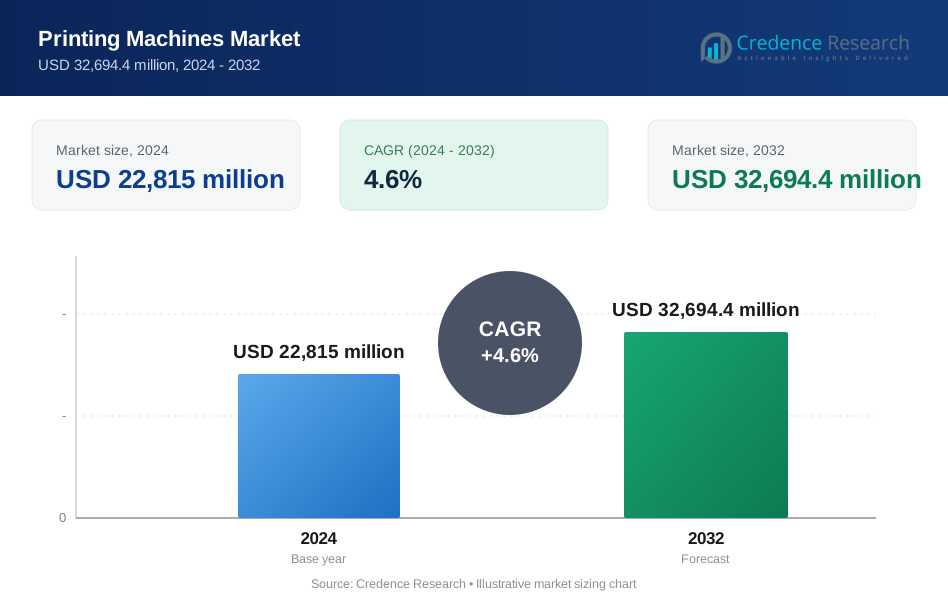
The global Printing Machines Market is projected to grow from USD 22,815 million in 2024 to USD 32,694.4 million by 2032, registering a CAGR of 4.6%.
The printing machines market is driven by increasing demand for high-quality, cost-effective printing solutions across industries such as packaging, publishing, and textiles. Technological advancements in digital printing, automation, and inkjet technology are improving efficiency, reducing waste, and enabling faster production. The rise of e-commerce and the need for personalized products further fuel market growth. Additionally, the growing focus on sustainable practices, such as eco-friendly inks and energy-efficient machines, is shaping industry trends. The integration of AI and IoT technologies in printing processes enhances precision, product quality, and operational efficiency, further propelling market expansion.
The printing machines market is experiencing strong growth across various regions, driven by technological advancements and evolving consumer demands. Key players in the market, such as Bobst Group SA, Heidelberger Druckmaschinen AG, HP Inc., and Fujifilm Holdings Corporation, are focusing on innovations in digital printing, sustainability, and automation to meet industry needs. In regions like North America and Asia-Pacific, the demand for high-quality printing solutions is increasing across packaging, commercial printing, and industrial sectors. The competitive landscape is shaped by both established players and emerging companies offering advanced and cost-effective printing technologies.
Market Drivers
Sector-Specific Growth Drivers
Certain industries are further accelerating the need for advanced printing solutions. The food and beverage sector, for example, demands detailed product information and visually appealing packaging to attract consumers. For instance, report by the Food and Drug Administration (FDA) emphasizes the importance of clear and accurate labeling in maintaining consumer trust and compliance with regulations. Similarly, the healthcare and pharmaceutical industries require precise labeling and packaging to ensure accuracy and regulatory compliance. These requirements are fueling the demand for reliable, high-quality printing machinery across various sectors.
Changing Consumer Preferences
Consumer preferences are rapidly evolving, influencing the demand for innovative printing technologies. Increasingly, consumers are seeking personalized products and packaging, pushing businesses to adopt digital printing for mass customization. This trend allows companies to offer unique, tailored products that meet individual preferences. For instance, a study by Deloitte indicates that consumers are willing to pay a premium for personalized products, driving businesses to invest in digital printing technologies. Sustainability is another key driver, with eco-conscious consumers pushing for environmentally friendly printing solutions. The use of water-based inks and recycled materials is becoming more common as businesses strive to reduce their environmental footprint. In addition, there is a growing emphasis on high-quality printing, particularly in packaging and advertising, as consumers expect visually appealing and durable printed materials.
Technological Advancements in Printing
Advancements in printing technologies are significantly shaping the industry. Digital printing, known for its high-quality, on-demand results, reduces setup costs and lead times, making it ideal for short-run and personalized printing jobs. This is particularly beneficial for businesses looking to meet the growing demand for customized products. Additionally, the rise of 3D printing presents new possibilities for manufacturing and customization, especially in packaging and prototyping. Though still in its early stages, 3D printing is poised to revolutionize the sector by offering more flexible and cost-effective solutions. Moreover, automation and AI-powered systems are enhancing operational efficiency. Automation tools, such as robotic arms, streamline production processes, while AI solutions optimize workflow and improve precision.
E-commerce and Packaging Demand
The rise of e-commerce has led to an increased demand for packaging and labeling solutions, creating a surge in the printing machinery market. As online shopping continues to grow, businesses require efficient and attractive packaging to ensure products are delivered in optimal condition. This trend has driven the adoption of advanced printing technologies to meet the evolving needs of the e-commerce sector, particularly for branding and product information.
Market Trends
Dominance of Digital Printing and Automation Integration
Digital printing continues to dominate the industry, driven by its ability to handle versatile, short-run, and personalized jobs with faster turnaround times. This trend is gaining momentum as businesses seek more cost-effective and efficient printing solutions for customized products. For instance, a report by the Printing Industries of America highlights that digital printing has enabled companies to offer personalized marketing materials with quicker turnaround times. The integration of advanced technologies such as AI and IoT in digital printing machines further boosts their efficiency, precision, and quality control. This technology enables real-time monitoring and predictive maintenance, optimizing machine performance and reducing downtime. Additionally, the automation wave is sweeping across the printing sector, with the adoption of smart factories and robotics enhancing productivity while cutting labor costs. Data-driven insights, powered by automation and real-time analysis, are playing a critical role in improving operational efficiency across production lines.
Sustainability, Packaging Innovation, and Regional Growth
As environmental concerns intensify, sustainability is becoming a key focus for the printing industry. Manufacturers are increasingly incorporating eco-friendly solutions, such as water-based inks, recyclable materials, and energy-efficient machines, to reduce their environmental footprint. Sustainable practices are not only essential for compliance but also align with growing consumer demand for green products. This shift towards sustainability is especially evident in the packaging and labeling sectors, where there is a rising need for innovative and high-quality solutions. The packaging industry is pushing for advanced printing technologies to create functional and aesthetically appealing packaging, while the demand for accurate and durable labels continues to fuel growth in label printing. Meanwhile, the global market is seeing significant growth in emerging regions, particularly in Asia-Pacific, where urbanization and rising consumer spending in countries like China and India are accelerating demand. Additionally, developing markets in Africa, Latin America, and the Middle East are presenting substantial growth opportunities, expanding the reach and influence of the printing industry globally.
Market Challenges Analysis
Technological, Environmental, and Supply Chain Challenges
Keeping pace with rapid technological advancements presents a significant challenge for many printing businesses. The constant evolution of technology, while offering the potential for increased efficiency and improved quality, also demands substantial investment. Smaller companies, in particular, may struggle to upgrade their machinery regularly, leading to concerns about obsolescence. Furthermore, stricter environmental regulations are increasing the cost of compliance, as businesses are required to adopt sustainable practices to meet both legal standards and consumer demand for eco-friendly solutions. For instance, the Environmental Protection Agency (EPA) outlines several federal laws that apply to the commercial printing industry, including the Clean Air Act and the Resource Conservation and Recovery Act. This shift toward sustainability is not only costly to implement but also puts additional pressure on businesses to innovate. Supply chain disruptions also remain a key challenge, with global delays in the delivery of raw materials and components affecting production timelines. Logistics challenges, including high transportation costs, further complicate the situation. Finally, the labor shortage in specialized areas such as print finishing and pre-press is another growing concern. The ongoing skill gap and rising labor costs are pushing up operational expenses, making it harder for businesses to maintain profitability while meeting evolving consumer preferences for both digital and print media.
Rising Operational Costs and Competitive Pressures
The printing industry is grappling with rising costs in raw materials and energy. Fluctuations in the prices of key raw materials like paper, ink, and other consumables directly affect production costs, creating uncertainty for manufacturers. The energy-intensive nature of printing operations further amplifies these challenges, as rising energy prices increase operational expenses. Additionally, the industry faces intensified competition from manufacturers in regions with lower labor costs, leading to price pressure. As global competition escalates, companies are forced to lower their prices to remain competitive, which often results in reduced profit margins. The cost pressures are compounded by the need for continuous technological investment to stay ahead of the curve, with older machines quickly becoming obsolete and requiring costly upgrades to newer, more efficient models.
Market Segmentation Analysis:
By Product Type:
The printing machines market is segmented by product type, with each type catering to specific printing needs across various industries. Offset lithography is the most widely used technology due to its efficiency in high-volume print runs and ability to deliver high-quality results, especially in commercial printing. Flexography is another key segment, known for its versatility in packaging, as it can print on a wide range of materials, including flexible substrates. Screen printing, primarily used for textiles and promotional items, remains popular due to its ability to produce vivid colors on various surfaces. Gravure printing, known for its high-quality output, is commonly used in packaging, especially for long-run, high-volume applications. Letterpress, while more traditional, is still used in niche applications like premium and luxury printing. The growing demand for digital printing is also notable, driven by its ability to produce high-quality prints on demand, making it ideal for short runs, personalization, and rapid turnaround times. Other specialized printing technologies also contribute to the market by serving niche applications.
By Substrate Type:
The printing machines market is also segmented by substrate type, with various industries demanding specific materials for printing. Paper and paperboard remain the dominant substrates, widely used in packaging, publishing, and advertising. The demand for printed materials on paper is driven by the continued need for books, newspapers, and commercial packaging. Plastics, however, are gaining traction, particularly in the packaging industry, where flexographic and gravure printing technologies are employed to print on flexible packaging materials. Metal substrates are predominantly used in industrial applications, such as printing on cans, containers, and promotional materials, leveraging technologies like offset lithography and screen printing. Other substrates, such as wood, glass, and fabric, cater to specific market needs, including decorative and promotional printing, as well as niche packaging solutions. The growing demand for eco-friendly materials is also influencing the market, with innovations in sustainable substrates and printing technologies emerging to meet consumer preferences for environmentally responsible solutions. Each substrate type plays a crucial role in the continued evolution and diversification of the printing machines market.
Segments:
Based on Product Type:
- Offset Lithography
- Flexography
- Screen
- Gravure
- Letterpress
- Digital
- Others
Based on Substrate Type:
- Plastic
- Paper & Paperboard
- Metal
- Other Substrates (Wood, Glass, Fabric)
Based on Application:
- Packaging & Labels
- Books
- Newspaper & Magazines
- Commercial Printing & Others
- Advertising
- Office Stationaries
Based on End Use:
- Commercial
- Publication
- Packaging
Based on the Geography:
- North America
- U.S.
- Canada
- Mexico
- Europe
- Germany
- France
- U.K.
- Italy
- Spain
- Rest of Europe
- Asia Pacific
- China
- Japan
- India
- South Korea
- South-east Asia
- Rest of Asia Pacific
- Latin America
- Brazil
- Argentina
- Rest of Latin America
- Middle East & Africa
- GCC Countries
- South Africa
- Rest of the Middle East and Africa
Regional Analysis
North America
The North American printing machines market holds a significant share, accounting for approximately 30% of the global market. The region's dominance is attributed to the high demand for advanced printing technologies across various industries, including packaging, publishing, and advertising. The United States, in particular, leads the market, driven by its robust manufacturing infrastructure, technological advancements, and strong demand for high-quality commercial and industrial printing solutions. The presence of key players in the printing machinery industry, coupled with the growing demand for eco-friendly printing practices, has further fueled market growth. Additionally, the increasing adoption of digital printing technologies, due to their ability to provide on-demand, customizable prints, has enhanced the appeal of the region’s printing market. With a mature market for traditional printing methods such as offset lithography, North America continues to lead in the production of high-end, industrial printing machines. Furthermore, the demand for sustainable packaging and labeling solutions is expected to drive continued growth in the region, particularly within the food and beverage and healthcare industries.
Asia-Pacific
The Asia-Pacific region is the fastest-growing market for printing machines, accounting for nearly 40% of the global market share. This significant growth is primarily driven by emerging economies such as China and India, where rapid industrialization, urbanization, and increasing consumer demand are creating a surge in printing machine requirements. The region’s expansion is also attributed to the growing e-commerce sector, which drives demand for packaging and labeling solutions. In addition, the Asia-Pacific region has seen a rapid shift towards more cost-effective and advanced printing technologies, such as digital printing, flexography, and screen printing, to meet the diverse needs of industries like packaging, textiles, and electronics. Furthermore, the availability of labor at competitive costs in countries like China and India has attracted significant investments in the printing machinery sector, fostering local manufacturing capabilities. As the demand for high-quality, customized, and eco-friendly printing solutions increases, Asia-Pacific is poised to become the largest market for printing machines, supported by a strong manufacturing base and growing consumer industries.
Key Player Analysis
- Bobst Group SA
- Apex Machine Company Inc.
- Komori Corporation
- Fujifilm Holdings Corporation
- Officine Meccaniche Giovanni Cerutti S.p.A.
- Agfa-Gevaert NV
- HP Inc.
- Koening & Bauer AG
- Heidelberger Druckmaschinen AG
- Oce NV
Competitive Analysis
The printing machines market is highly competitive, with leading players such as Bobst Group SA, Heidelberger Druckmaschinen AG, HP Inc., Fujifilm Holdings Corporation, Agfa-Gevaert NV, Koenig & Bauer AG, Komori Corporation, Apex Machine Company Inc., Oce NV, and Officine Meccaniche Giovanni Cerutti S.p.A. These companies are at the forefront of technological innovation, focusing on enhancing digital printing capabilities, sustainability, and automation. Leading companies are focusing on enhancing their product offerings by integrating digital printing, automation, and sustainable practices. Digital printing technologies are gaining momentum due to their ability to deliver high-quality, on-demand prints with shorter turnaround times. Companies are also investing heavily in automation solutions, which improve efficiency and reduce labor costs. Additionally, the growing demand for eco-friendly printing methods has pushed manufacturers to develop sustainable solutions, such as water-based inks and recyclable materials. As a result, market players are constantly innovating to stay ahead in this competitive landscape, aiming to meet the diverse needs of packaging, commercial printing, and industrial sectors.
Recent Developments
- In December 2023, ColdsetInnovation Fulda, a printing company, extended its service partnership with Koenig & Bauer for a further ten years, describing the step as confirmation of its long-term commitment to newspaper printing. The extension of the service contract beyond the initial expiry date in 2025 exemplified the company's forward-thinking mindset and solidified its position as a dependable partner in the newspaper printing industry.
- In October 2023, Koenig & Bauer Banknote Solutions showed its commitment to serving customers comprehensively in the banknote and high-security printing domain by entering a strategic partnership with BIRKAN GmbH. This collaboration aims to broaden the range of consumables offered and enhance the development of a distinctive printing ecosystem tailored to the specific requirements of high-security printers.
- In October 2023, Koenig & Bauer introduced its XD Pro CI Flexo press, representing high-performance printing technology. This press elevates performance reliability, process consistency, and efficiency to unprecedented productivity levels. The XD Pro is designed to meet the growing demand for short-run production in the flexible packaging market, delivering solutions while prioritizing sustainability.
Market Concentration & Characteristics
The printing machines market is moderately concentrated, with a few dominant players holding significant market shares, while a variety of smaller companies cater to niche segments. The industry is characterized by continuous innovation and technological advancements, driven by the demand for faster, more efficient, and customizable printing solutions. Companies are increasingly focusing on automation, digital printing, and sustainability to meet the evolving needs of industries like packaging, publishing, and textiles. Market characteristics include a strong emphasis on high-quality output, cost-effectiveness, and the ability to handle diverse substrates. The shift toward eco-friendly materials and energy-efficient technologies is also becoming more prominent, as companies strive to align with consumer demand for sustainability. The competitive landscape is further shaped by regional growth, particularly in emerging markets, where demand for printing machines is growing due to industrialization and expanding consumer markets.
Report Coverage
The research report offers an in-depth analysis based on Product Type, Substrate Type, Application, End Use and Geography. It details leading market players, providing an overview of their business, product offerings, investments, revenue streams, and key applications. Additionally, the report includes insights into the competitive environment, SWOT analysis, current market trends, as well as the primary drivers and constraints. Furthermore, it discusses various factors that have driven market expansion in recent years. The report also explores market dynamics, regulatory scenarios, and technological advancements that are shaping the industry. It assesses the impact of external factors and global economic changes on market growth. Lastly, it provides strategic recommendations for new entrants and established companies to navigate the complexities of the market.
Future Outlook
- Digital printing will continue to grow due to its flexibility, faster turnaround times, and demand for short-run jobs.
- Automation and AI integration will enhance production efficiency, reducing labor costs and downtime.
- Sustainable printing solutions, including eco-friendly inks and recyclable materials, will become increasingly important.
- The demand for packaging and labeling solutions will rise, driven by e-commerce and consumer preferences for personalized products.
- 3D printing technologies will expand, offering new opportunities for customized manufacturing and prototyping.
- The rise in demand for high-quality prints across industries like healthcare, food, and beverage will drive innovations in printing machines.
- Emerging markets, particularly in Asia-Pacific, will see significant growth due to industrialization and increased consumer spending.
- Companies will focus on offering integrated, multi-functional printing machines to meet the diverse needs of different industries.
- Increased focus on energy-efficient machines will reduce operational costs and address environmental concerns.
- The shift towards digital media may impact the traditional print market, but demand for printed materials will remain strong in specific sectors.
Request a Free Sample
Fill in your details and we'll send you a free sample report.
- Sample data tables & charts
- Research methodology
Need a Custom Version of This Report?
Tailor the scope, geography, or segments to your exact requirements.
- Custom geography or segment scope
- Direct access to our analyst team
Frequently Asked Questions
What is the current size of the Printing Machines Market?
What factors are driving the growth of the Printing Machines Market?
What are the key segments within the Printing Machines Market?
What are some challenges faced by the Printing Machines Market?
Who are the major players in the Printing Machines Market?
Table of Content
Chapter 1. Report Introduction
- 1.1 Report Description & Purpose
- 1.1.1 Report Title & Market Definition
- 1.1.2 Unique Selling Propositions (USP) & Key Differentiators
- 1.1.3 Value Proposition for Stakeholders
- 1.2 Research Objectives
- 1.2.1 Market Sizing Objectives (Volume & Revenue) (Volume Where Applicable)
- 1.2.2 Segmentation Objectives
- 1.2.3 Competitive Intelligence Objectives
- 1.2.4 Forecast & Scenario Objectives
- 1.3 Report Scope
- 1.3.1 Printing Machines Scope – Segments & Subsegments Covered
- 1.3.2 Geographic Scope – Regions & Countries Covered
- 1.3.3 Historical Period, Base Year & Forecast Period (2024; forecast to 2032)
- 1.3.4 Inclusions & Exclusions
- 1.4 Industry Classification & Applicable Codes
- 1.5 Currency, Measurement Units & Valuation Basis
- 1.6 Target Stakeholders
- 1.7 Limitations & Assumptions
Chapter 2. Executive Summary
- 2.1 Global Printing Machines Market Snapshot
- 2.1.1 Market Size – Historical (2024) & Forecast (2024-2032) (2024: USD 22,815 million → 2032: USD 32,694.4 million)
- 2.1.2 Volume & Revenue – Global Totals (Volume Where Applicable)
- 2.1.3 Key Market Highlights – Top Five Facts
- 2.2 Printing Machines Market Segmentation Snapshot
- 2.2.1 Market Split by Region – 2024 vs. 2032
- 2.3 Competitive Snapshot
- 2.3.1 Top 10 Players by Revenue Share – 2024
- 2.3.2 Top 10 Players by Volume Share – 2024 (Volume Where Applicable)
- 2.3.3 Recent Strategic Developments (18-Month Summary)
- 2.4 Key Investment Highlights & Strategic Conclusions
Chapter 3. Printing Machines Market Dynamics & Industry Analysis
- 3.1 Market Overview & Context
- 3.1.1 Printing Machines Market Position in the Broader Industry Value Chain
- 3.1.2 Demand Structure & Purchasing Dynamics
- 3.1.3 Market Maturity & Development Stage by Region
- 3.2 Printing Machines Market Drivers
- 3.3 Printing Machines Market Restraints & Challenges
- 3.4 Printing Machines Market Opportunities
- 3.5 Porter's Five Forces Analysis
- 3.5.1 Threat of New Entrants
- 3.5.2 Bargaining Power of Suppliers
- 3.5.3 Bargaining Power of Buyers
- 3.5.4 Threat of Substitutes
- 3.5.5 Competitive Rivalry – Intensity Assessment
- 3.6 Printing Machines Value Chain Analysis
- 3.6.1 Upstream – Key Inputs, Resources & Suppliers
- 3.6.1.1 Key Input/Resource 1
- 3.6.1.2 Key Input/Resource 2
- 3.6.1.3 Key Input/Resource 3
- 3.6.2 Midstream – Core Operations & Value Creation
- 3.6.2.1 Operating Model & Process Overview
- 3.6.2.2 Key Operating Locations & Capabilities by Company
- 3.6.3 Downstream – Market Channels & End Users
- 3.6.3.1 Direct Sales & Customer Engagement Channels
- 3.6.3.2 Indirect Sales, Intermediaries & Partner Channels
- 3.6.4 Value Chain Profitability Analysis
- 3.6.1 Upstream – Key Inputs, Resources & Suppliers
- 3.7 PESTEL Analysis
- 3.7.1 Political Factors
- 3.7.2 Economic Factors
- 3.7.3 Social Factors
- 3.7.4 Technological Factors
- 3.7.5 Environmental Factors
- 3.7.6 Legal Factors
- 3.8 Printing Machines Supply Chain Analysis
- 3.8.1 Critical Input & Resource Availability Risk Assessment
- 3.8.2 Supplier & Operational Concentration Risk (Geographic Exposure)
- 3.8.3 Supply & Service Disruption Impact Analysis
- 3.9 Regulatory & Policy Landscape
Note: The regulatory and policy landscape section covers regulations based on their applicability to the market, Printing Machines category, geography, and scope of the study. Only regulatory frameworks with a material impact on operations, compliance, trade, sustainability, or market access are analyzed in detail.
Chapter 4. Key Investment Pockets & Opportunity Analysis
- 4.1 Printing Machines Market Attractiveness Analysis
- 4.1.1 By Region – Investment Attractiveness Matrix (Market Size × CAGR)
- 4.2 Absolute Revenue Growth Opportunity
- 4.2.1 By Region – Absolute Revenue Growth Through 2032
- 4.3 Incremental Demand Opportunity
- 4.3.1 By Region – Incremental Demand Through 2032
- 4.3.2 Segment – Incremental Demand
- 4.4 Emerging Submarket Opportunity Deep Dive (Subject to Applicability)
- 4.5 Priority Market Opportunity Scorecards
- 4.5.1 United States
- 4.5.2 Europe
- 4.5.3 Asia
- 4.5.4 Middle East & Africa
Note: Priority market opportunity scorecards reflect the geographic scope and strategic relevance of the study. Listed markets are indicative and may be adapted to the industry.
Chapter 5. Printing Machines Cross-Border Trade & Market Access Analysis
- 5.1 International Trade & Cross-Border Activity Overview
- 5.1.1 Global Export Value by Country (2024)
- 5.1.2 Global Export Volume by Country (2024) (Volume Where Applicable)
- 5.1.3 Global Import Value by Country (2024)
- 5.1.4 Global Import Volume by Country (2024) (Volume Where Applicable)
- 5.1.5 Net Trade Balance by Country (2024)
- 5.2 Export Analysis – Segment
- 5.2.1 Category 1 (Applicable Classification Code)
- 5.2.2 Category 2 (Applicable Classification Code)
- 5.2.3 Category 3 (Applicable Classification Code)
- 5.2.4 Category 4 (Applicable Classification Code)
- 5.2.5 Category 5 (Applicable Classification Code)
- 5.3 Import Analysis – Segment
- 5.3.1 Category 1 (Applicable Classification Code)
- 5.3.2 Category 2 (Applicable Classification Code)
- 5.3.3 Category 3 (Applicable Classification Code)
- 5.3.4 Category 4 (Applicable Classification Code)
- 5.3.5 Category 5 (Applicable Classification Code)
- 5.4 Cross-Border Pricing & Transaction Benchmarks
- 5.4.1 Export Pricing – Segment & Country
- 5.4.2 Import Pricing – Segment & Source Country
- 5.4.3 Price Trends (2024)
- 5.5 Key Cross-Border Trade & Delivery Routes
- 5.5.1 Cross-Border Trade/Delivery Route 1
- 5.5.2 Cross-Border Trade/Delivery Route 2
- 5.5.3 Cross-Border Trade/Delivery Route 3
- 5.5.4 Cross-Border Trade/Delivery Route 4
- 5.5.5 Cross-Border Trade/Delivery Route 5
- 5.6 Trade Policy & Market Access Impact Assessment
- 5.6.1 Tariff & Non-Tariff Barriers
- 5.6.2 Regional Trade & Economic Integration Frameworks
- 5.6.3 Bilateral & Multilateral Trade Agreements
- 5.6.4 Cross-Border Operating, Licensing & Localization Requirements
Note: This chapter applies where cross-border trade or delivery is relevant to Printing Machines. Goods, services, and digital offerings are assessed using applicable classifications and transaction measures. Import-export volumes, trade balances, and route analyses are included only where meaningful to the market.
Chapter 6. Competitive Landscape & Company Benchmarking
- 6.1 Printing Machines Market Concentration & Structure
- 6.1.1 Herfindahl-Hirschman Index (HHI) – vs. 2024
- 6.1.2 Leading, Mid-Sized & Emerging Player Structure
- 6.1.3 Global, Regional & Local Player Dynamics
- 6.2 Printing Machines Market Share Analysis – 2024
- 6.2.1 Global Revenue Share by Company
- 6.2.2 Global Volume Share by Company (Volume Where Applicable)
- 6.2.3 Regional Revenue Share
- 6.2.4 Market Share Evolution ( vs. 2024)
- 6.2.5 Company Market Share by Key Segment
- 6.2.6 Company Market Share by Customer Group
- 6.3 Operating Scale, Capacity & Infrastructure Analysis
- 6.3.1 Global Operating Scale & Supply Capacity
- 6.3.2 Resource Utilization & Operating Efficiency
- 6.3.3 Output, Service Delivery & Activity Metrics
- 6.3.4 Operating Footprint & Infrastructure Map
- 6.3.5 Planned Operational & Capacity Expansion
- 6.4 Printing Machines Competitive Benchmarking Matrix
- 6.4.1 Revenue, Growth, Profitability & Operating Metric Comparison
- 6.4.2 Channel Revenue Mix
- 6.4.3 Geographic Revenue Exposure
- 6.4.4 R&D Intensity
- 6.4.5 Sustainability Maturity
- 6.5 Strategic Developments in Printing Machines (Last 24 Months)
- 6.5.1 Mergers, Acquisitions & Divestments
- 6.5.2 New Products, Services & Solutions in Printing Machines
- 6.5.3 Operational & Infrastructure Expansions
- 6.5.4 Strategic Alliances, Joint Ventures & Partnerships
- 6.5.5 Distribution Expansion & Market Entry
- 6.5.6 Sustainability & ESG Initiatives
- 6.6 Competitive Strategy Mapping
- 6.6.1 Leader, Challenger, Follower & Niche Classification
- 6.6.2 Pricing Strategy Comparison
- 6.6.3 Channel Strategy Matrix
Note: Strategic developments are included based on their materiality and the availability of reliable information.
Chapter 7. Global Printing Machines Market – By Sales & Delivery Channel
- 7.1 Segment Overview
- 7.1.1 Volume & Revenue Split by Channel (2024 & 2032) (Volume Where Applicable)
- 7.1.2 Channel Mix Evolution (2024-2032)
Chapter 8. Regional Market Analysis – Global Overview
- 8.1 Global Regional Overview
- 8.1.1 Regional Volume Share (Volume Where Applicable)
- 8.1.2 Regional Revenue Share
- 8.1.3 Regional Volume by Region (Volume Where Applicable)
- 8.1.4 Regional Revenue by Region
- 8.1.5 Regional Forecast Through 2032
- 8.2 Cross-Regional Segment Analysis
- 8.2.1 By Sales & Delivery Channel
- 8.2.2 By Competitive Positioning & Price Tier
Chapter 9. North America Printing Machines Market
- 9.1 United States
- 9.2 Canada
- 9.3 Mexico
Chapter 10. Europe Printing Machines Market
- 10.1 Germany
- 10.2 France
- 10.3 Italy
- 10.4 United Kingdom
- 10.5 Spain
- 10.6 Poland
- 10.7 Russia
- 10.8 Netherlands
- 10.9 Belgium
- 10.10 Sweden
- 10.11 Denmark
- 10.12 Norway
- 10.13 Rest of Europe
Chapter 11. Asia Pacific Printing Machines Market
- 11.1 China
- 11.2 India
- 11.3 Japan
- 11.4 South Korea
- 11.5 Thailand
- 11.6 Indonesia
- 11.7 Vietnam
- 11.8 Malaysia
- 11.9 Australia
- 11.10 Rest of Asia Pacific
Chapter 12. Latin America Printing Machines Market
- 12.1 Brazil
- 12.2 Argentina
- 12.3 Colombia
- 12.4 Chile
- 12.5 Rest of Latin America
Chapter 13. Middle East Printing Machines Market
- 13.1 Saudi Arabia
- 13.2 United Arab Emirates
- 13.3 Turkey
- 13.4 Israel
- 13.5 Iran
- 13.6 Rest of the Middle East
Chapter 14. Africa Printing Machines Market
- 14.1 South Africa
- 14.2 Egypt
- 14.3 Nigeria
- 14.4 Morocco
- 14.5 Rest of Africa
Chapter 15. Printing Machines Company Profiles
- 15.1 [Company 01]
- 15.1.1 Company Overview
- 15.1.2 Key Management Personnel
- 15.1.3 Products & Services Portfolio
- 15.1.4 Financial Performance
- 15.1.5 Key Market Focus & Geographic Presence
- 15.1.6 Recent Developments & Strategic Initiatives
Note: The company profile list is preliminary and may change based on research findings, market developments, data availability, and client requirements.
Chapter 16. Appendices
- Appendix A – List of Abbreviations & Acronyms
- Appendix B – Industry Classification Code Reference – Full Series
- Appendix C – Supply, Output & Operating Capacity Data Tables
- Appendix D – End-Use & Demand Base Tables
- Appendix E – Demand, Adoption & Usage Assumptions
- Appendix F – Pricing & Revenue Metric Reference Tables
- Appendix G – Company Operations & Infrastructure Database
- Appendix H – Cross-Border Trade & Activity Data Tables (Where Applicable)
- Appendix I – Regulatory Summary Tables
- Appendix J – Primary Research Participant List (Anonymized)
- Appendix K – Primary Research Questionnaire Framework
- Appendix L – Data Sources & Bibliography
- Appendix M – Market Size Divergence & Source Comparison
Chapter 17. Research Methodology
- 17.1 Research Framework & Philosophy
- 17.2 Secondary Research – Sources, Hierarchy & Data Extraction
- 17.3 Data Modeling – Bottom-Up & Top-Down Market Sizing
- 17.4 Primary Research – Stakeholder Framework, LOI & Sample Sizes
- 17.5 Forecast Methodology – Regression, Scenario & Sensitivity Analysis
- 17.6 Quality Control – Four-Layer Validation Framework
- 17.7 Limitations & Standard Assumptions
- 17.8 Disclaimer
