
Executive Summary & Core Metrics
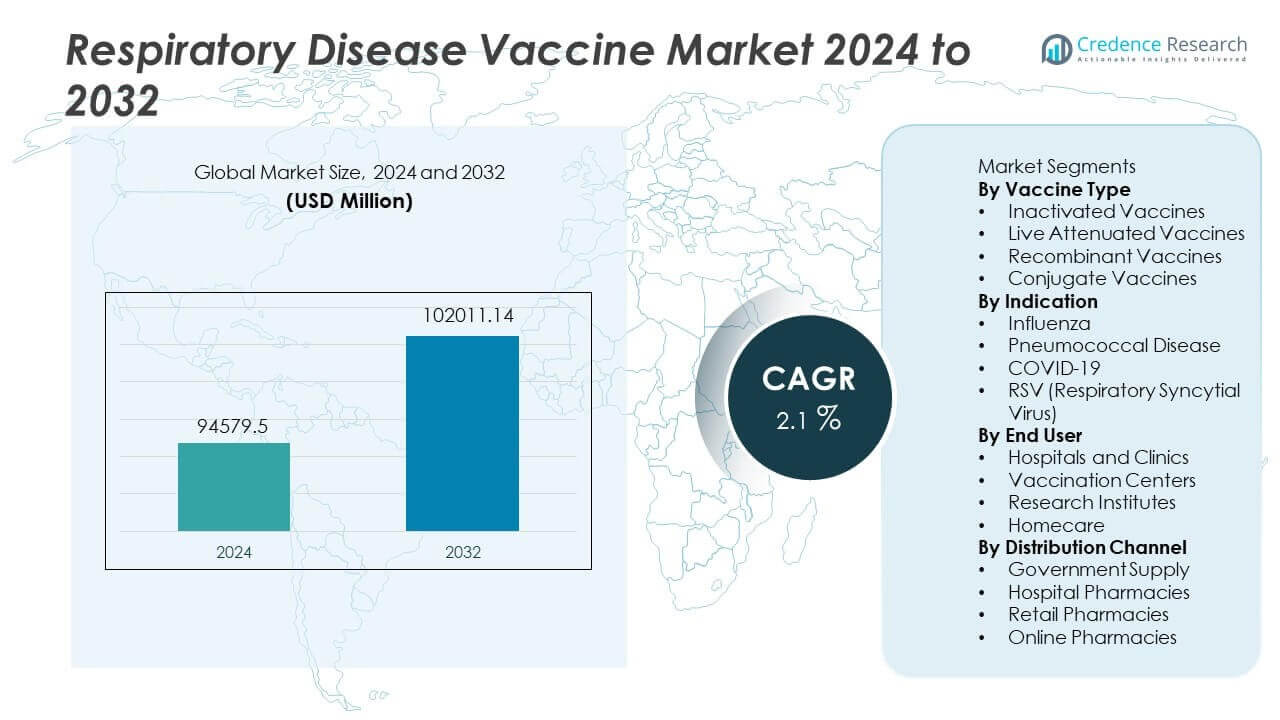
The global respiratory disease vaccine market was valued at USD 94,579.5 million in 2024 and is projected to reach USD 102,011.14 million by 2032, expanding at a compound annual growth rate (CAGR) of 2.1% during the forecast period, according to Credence Research. This growth reflects continued demand for seasonal immunization programs, rising respiratory disease prevalence, COVID-19 booster adoption, pneumococcal vaccination expansion and new RSV vaccine uptake across adult, pediatric and high-risk populations.
| REPORT ATTRIBUTE | DETAILS |
|---|---|
| Historical Period | 2020-2023 |
| Base Year | 2024 |
| Forecast Period | 2025-2032 |
| Respiratory Disease Vaccine Market Size 2024 | USD 94,579.5 million |
| Respiratory Disease Vaccine Market, CAGR | 2.1% |
| Respiratory Disease Vaccine Market Size 2032 | USD 102,011.14 million |
The global respiratory disease vaccine market is characterized by the presence of major pharmaceutical companies and vaccine manufacturers competing on platform innovation, strain targeting, safety profile, public procurement scale and age-group coverage. Leading players focus on inactivated vaccines, live attenuated vaccines, recombinant vaccines, conjugate vaccines and mRNA-based respiratory formulations across influenza, pneumococcal disease, COVID-19 and RSV. Strategic priorities include government procurement partnerships, updated booster formulations, RSV vaccine launches, universal influenza research, adult immunization expansion, pediatric protection and manufacturing capacity growth.
Strategic Market Insights
- Market growth is primarily driven by rising influenza and pneumococcal vaccination coverage, COVID-19 booster programs, growing respiratory disease prevalence and expanding adult immunization initiatives.
- Dominant industry trends highlight rapid development of RSV vaccines for adults and infants, increasing adoption of recombinant platforms and ongoing research into universal influenza vaccines that reduce seasonal mismatch risks.
- The competitive landscape is defined by pharmaceutical companies expanding mRNA, recombinant and conjugate vaccine portfolios while forming public procurement partnerships with national healthcare systems.
- According to Credence Research regional mapping, North America represents the largest market, accounting for a definitive 32% share due to high vaccination rates, strong government funding and established seasonal immunization systems.
Market Segmentation Analysis
By Vaccine Type
- Inactivated Vaccines
- Live Attenuated Vaccines
- Recombinant Vaccines
- Conjugate Vaccines
Inactivated vaccines lead the respiratory disease vaccine market with near 43% share. Their leadership is supported by wide adoption across influenza, pneumococcal and COVID-19 immunization programs. These vaccines offer a strong safety profile and are used across pediatric, elderly and immunocompromised populations, supporting broad acceptance across developed healthcare systems. Government-led procurement and seasonal immunization schedules further strengthen their demand.
Live attenuated vaccines hold near 27% share, especially in seasonal influenza programs among younger populations. Recombinant vaccines account for near 18% share, supported by stronger uptake in COVID-19 and viral mutation protection. Conjugate vaccines hold near 12% share due to high use in pneumococcal immunization. Growth across all vaccine types is supported by respiratory disease surveillance, government funding and continuous efforts to improve mass vaccination coverage.
Simultaneous administration of an inactivated influenza vaccine with an mRNA COVID-19 vaccine showed no increase in moderate or severe adverse reactions in a 335-person randomized trial.
By Indication
- Influenza
- Pneumococcal Disease
- COVID-19
- RSV (Respiratory Syncytial Virus)
Influenza dominates the indication segment with near 46% share. This leadership is driven by annual vaccination schedules, strong government procurement and higher prioritization among elderly populations and patients with chronic conditions. Seasonal flu vaccination remains a central component of public health planning across developed and emerging markets.
Pneumococcal disease follows with near 25% share, supported by pediatric immunization and adult vaccination policies for high-risk groups. COVID-19 holds near 21% share due to continuing booster programs and evolving viral strains that require updated formulations. RSV vaccines represent near 8% share, supported by recent launches targeting older adults, infants and high-risk populations. Disease surveillance systems and national immunization guidelines continue to support long-term demand across all respiratory indications.
Seasonal influenza vaccines remain among the highest-volume vaccine categories globally, alongside routine childhood immunizations such as polio vaccines and diphtheria-tetanus-pertussis-containing vaccines.
By End User
- Hospitals and Clinics
- Vaccination Centers
- Research Institutes
- Homecare
Hospitals and clinics lead the end-user segment with near 52% share. Their dominance is supported by large-scale public vaccination programs, government procurement channels and clinical management of high-risk patients. Hospitals and clinics remain central to adult immunization, elderly vaccination, pediatric vaccination and booster administration programs.
Vaccination centers hold near 28% share, supported by seasonal influenza campaigns and dedicated public immunization programs. Research institutes capture near 12% share due to clinical trials and continuous vaccine development for emerging respiratory strains. Homecare represents near 8% share, supported by mobile immunization services and remote health programs for elderly patients. Public awareness campaigns, vaccine funding and expanded respiratory immunization coverage continue to strengthen adoption across these end-user groups.
Key Market Dynamics
Primary Market Drivers
- Increasing Global Respiratory Infection Burden: The growing prevalence of influenza, pneumococcal disease, RSV and evolving COVID-19 variants increases demand for respiratory vaccines across all age groups. Elderly patients and individuals with chronic lung disease remain highly vulnerable, supporting continuous immunization programs. Government vaccination schedules and national public health strategies expand access to respiratory vaccines. Pharmaceutical companies also increase production capacity and invest in updated formulations. Sanofi increased influenza vaccine output to nearly 250 million doses in 2023 to support global seasonal demand.
- Supportive Immunization Policies and Funding: Many governments fund influenza, pneumococcal and COVID-19 vaccination programs for adults, children and high-risk populations. Public vaccination policies support consistent seasonal demand, while procurement agreements ensure large-scale supply for national immunization schedules. Multilateral organizations also support vaccine access across developing regions. These initiatives improve coverage among underserved populations and strengthen long-term market demand. Pfizer announced delivery of its one-billionth pneumococcal conjugate vaccine dose through collaborations with global vaccination programs.
- Rapid R&D and New Vaccine Platforms: Pharmaceutical companies are investing in recombinant, mRNA and other advanced vaccine platforms that support faster development against evolving respiratory viruses. New formulations help target emerging variants and improve immune response in older adults. Ongoing clinical trials expand RSV and pneumococcal vaccine indications across pediatric and adult populations. These innovations improve efficacy, safety and durability of immune protection, supporting long-term vaccination growth.
Key Trends & Structural Opportunities
- Development of Universal and Variant-Targeted Vaccines: Researchers are developing universal influenza vaccines that target broader viral families and reduce the need for seasonal reformulation. Variant-specific formulations continue emerging for COVID-19 and RSV as viral mutations increase disease risk among vulnerable populations. Opportunities are expanding for companies developing multi-strain vaccines and booster programs. Growing focus on mRNA and recombinant technologies supports faster production and outbreak response. Moderna reported that its mRNA-based influenza candidate mRNA-1010 reached Phase 3 enrollment of more than 6,000 adults in a global trial.
- Expansion of Adult and Elderly Immunization Programs: Respiratory vaccines are expanding beyond pediatric programs as aging populations drive higher disease risk worldwide. Public health agencies encourage elderly immunization for influenza, pneumococcal disease and RSV. Adult vaccination is becoming a routine health measure across many developed markets. Pharmaceutical companies are expanding education and marketing campaigns focused on chronic disease patients, older adults and primary care providers. GSK reported approval of its RSV older-adult vaccine Arexvy, supported by clinical trials involving more than 24,000 participants.
- Rising Use of mRNA and Recombinant Platforms: mRNA and recombinant platforms are gaining stronger attention because they support faster strain targeting, scalable development and rapid response to emerging respiratory threats. These technologies are especially important for variant-specific COVID-19 boosters, RSV pipeline development and future influenza vaccine improvements. Companies with flexible manufacturing platforms are positioned to respond faster to viral evolution and public procurement requirements. Credence Research identifies advanced vaccine platforms as a key opportunity for long-term portfolio differentiation.
Industry Challenges
- Viral Mutation and Vaccine Effectiveness Variability: Respiratory viruses such as influenza and SARS-CoV-2 mutate frequently, which can reduce vaccine effectiveness over time. Manufacturers must continuously update formulations, increasing research, development and production costs. Seasonal mismatches between vaccine strains and circulating viruses can limit protection in certain populations. These challenges increase the need for strong surveillance systems, booster strategies, multi-strain formulations and universal vaccine technologies.
- Uneven Vaccination Access in Developing Countries: Limited healthcare infrastructure, lower vaccination funding and cold chain constraints restrict access to respiratory vaccines in many developing regions. Supply limitations during seasonal peaks can slow vaccination rollout. Awareness gaps also reduce uptake among high-risk adults and elderly populations. These barriers delay broad immunization coverage and restrict market growth across low-income regions, even where respiratory disease burden remains high.
Detailed Regional Analysis
| Region | Market Share (%) | Strategic Regional Catalysts & Insights |
| North America | 32.0% | Global leader. Supported by high vaccination coverage, government funding, COVID-19 booster uptake, RSV vaccine adoption and strong surveillance systems. |
| Europe | 28.0% | Mature regional market. Driven by national immunization programs, public healthcare systems, aging populations and strong respiratory vaccine reimbursement frameworks. |
| Asia Pacific | 26.0% | High-growth regional market. Supported by large populations, growing respiratory infection burden, expanding vaccine coverage and rising healthcare expenditure. |
| Latin America | 8.0% | Developing regional market. Driven by influenza and pneumococcal vaccination programs, public healthcare procurement and respiratory disease surveillance. |
| Middle East & Africa | 6.0% | Emerging territory. Supported by influenza and COVID-19 procurement in Gulf countries and pneumococcal programs across parts of Africa. |
North America leads the global respiratory disease vaccine market with a 32% share, according to Credence Research. The region benefits from high vaccination coverage, strong government funding and continuous influenza and pneumococcal immunization programs. The United States leads adoption of COVID-19 boosters and RSV vaccines due to its large elderly population and strong reimbursement frameworks. Hospitals and public health systems conduct seasonal campaigns that improve uptake among high-risk groups. Early approval pathways and advanced surveillance systems further support regional leadership.
Europe accounts for 28% of the global market, supported by national immunization programs, high public awareness and strong regulatory support for influenza and pneumococcal vaccines. Germany, France and the United Kingdom show steady vaccine uptake due to aging populations and chronic disease prevalence. COVID-19 vaccination schedules continue across adult and elderly groups, while RSV vaccine access expands through public healthcare networks. Government reimbursement frameworks and seasonal campaigns create consistent demand.
Asia Pacific holds 26% share, supported by large populations, rising respiratory infection burden and expanding immunization coverage across China, India and Japan. National vaccination programs are expanding influenza and pneumococcal access, while COVID-19 boosters remain an active market segment. Japan leads RSV introduction due to strong elderly healthcare systems. Rural access challenges remain, but public awareness programs and healthcare expenditure growth support future adoption.
Latin America holds 8% share, driven by influenza and pneumococcal programs supported by public healthcare institutions. Brazil and Mexico lead vaccine adoption through government procurement and wider respiratory disease surveillance. COVID-19 vaccination continues across adult populations, supporting broader market expansion. Uneven access and funding gaps limit penetration in several countries, but public awareness improves seasonal uptake.
The Middle East & Africa represent 6% share, influenced by early-stage RSV access and limited immunization funding in several low-income countries. Gulf countries increase procurement of influenza and COVID-19 vaccines through government healthcare systems and mandatory immunization policies for high-risk groups. Africa continues expanding pneumococcal programs for children with support from public health organizations. Limited infrastructure restricts broad adoption, but infection burden and chronic disease prevalence create long-term demand potential.
Competitive Landscape & Recent Developments
The respiratory disease vaccine market includes major companies such as Pfizer Inc., AstraZeneca plc, GlaxoSmithKline plc, Moderna Inc., Sanofi S.A., Merck & Co. Inc., Novavax Inc., Johnson & Johnson, Seqirus and Bavarian Nordic A/S. These companies compete through seasonal influenza, pneumococcal, COVID-19 and RSV vaccine portfolios, along with mRNA, recombinant and conjugate vaccine platforms.
Leading companies invest in booster development, variant-specific formulations and broader respiratory vaccine coverage across older adult populations. Partnerships with governments and global health programs support large-scale procurement for national immunization plans. Companies also strengthen clinical research for universal influenza and multivalent respiratory vaccines that reduce annual reformulation needs. Strong competition encourages technology advancement, broader age-group coverage, manufacturing capacity expansion and long-term supply agreements with public healthcare systems.
Recent Industry Developments (2024–2025)
- In April 2025, Pfizer Inc. announced that the U.S. Centers for Disease Control and Prevention’s Advisory Committee on Immunization Practices voted to broaden its recommendation for RSV vaccines to include adults aged 50–59 who are at increased risk of RSV-related lower respiratory tract disease.
- In March 2025, the World Health Organization prequalified Pfizer’s maternal respiratory syncytial virus vaccine, Abrysvo, marking the first-ever prequalification of a maternal RSV vaccine.
- In September 2024, AstraZeneca plc gained FDA approval for at-home FluMist administration, making FluMist the first self- or caregiver-administered flu vaccine in the U.S.
Request a Free Sample
Fill in your details and we'll send you a free sample report.
- Sample data tables & charts
- Research methodology
Need a Custom Version of This Report?
Tailor the scope, geography, or segments to your exact requirements.
- Custom geography or segment scope
- Direct access to our analyst team
Frequently Asked Questions
What is the current and projected size of the global sonar absorbing rubber composites market?
What is the projected growth rate of the sonar absorbing rubber composites industry over the forecast period?
Which type segment holds the maximum market share within the sonar absorbing rubber composites industry?
Which application segment dominates the sonar absorbing rubber composites market?
Which end-use segment leads the sonar absorbing rubber composites market?
Which region commands the highest market share in the global sonar absorbing rubber composites space?
Table of Content
Chapter 1. Report Introduction
- 1.1 Report Description & Purpose
- 1.1.1 Report Title & Market Definition
- 1.1.2 Unique Selling Propositions (USP) & Key Differentiators
- 1.1.3 Value Proposition for Stakeholders
- 1.2 Research Objectives
- 1.2.1 Market Sizing Objectives (Volume & Revenue)
- 1.2.2 Segmentation Objectives
- 1.2.3 Competitive Intelligence Objectives
- 1.2.4 Forecast & Scenario Objectives
- 1.3 Report Scope
- 1.3.1 Respiratory Disease Vaccine Scope – Types & Subtypes Covered
- 1.3.2 Geographic Scope – Regions & Countries Covered
- 1.3.3 Historical Period, Base Year & Forecast Period (2024; forecast to 2032)
- 1.3.4 Inclusions & Exclusions
- 1.4 HS Code & Classification Framework
- 1.5 Currency, Units & Pricing Basis
- 1.6 Target Stakeholders
- 1.7 Limitations & Assumptions
Chapter 2. Executive Summary
- 2.1 Global Respiratory Disease Vaccine Market Snapshot
- 2.1.1 Market Size – Historical (2024) & Forecast (2024-2032) (2024: USD 214.9 million → 2032: USD 280.8 million)
- 2.1.2 Volume & Revenue – Global Totals
- 2.1.3 Key Market Highlights – Top Five Facts
- 2.2 Respiratory Disease Vaccine Market Segmentation Snapshot
- 2.2.1 Market Split by Region – 2024 vs. 2032
- 2.3 Competitive Snapshot
- 2.3.1 Top 10 Players by Revenue Share – 2024
- 2.3.2 Top 10 Players by Volume Share – 2024
- 2.3.3 Recent Strategic Developments (18-Month Summary)
- 2.4 Key Investment Highlights & Strategic Conclusions
Chapter 3. Respiratory Disease Vaccine Market Dynamics & Industry Analysis
- 3.1 Market Overview & Context
- 3.1.1 Respiratory Disease Vaccine Market Position in the Broader Automotive Value Chain
- 3.1.2 OEM vs. Replacement Market Dynamics
- 3.1.3 Market Maturity & Development Stage by Region
- 3.2 Respiratory Disease Vaccine Market Drivers
- 3.3 Respiratory Disease Vaccine Market Restraints & Challenges
- 3.4 Respiratory Disease Vaccine Market Opportunities
- 3.5 Porter's Five Forces Analysis
- 3.5.1 Threat of New Entrants
- 3.5.2 Bargaining Power of Suppliers
- 3.5.3 Bargaining Power of Buyers
- 3.5.4 Threat of Substitutes
- 3.5.5 Competitive Rivalry – Intensity Assessment
- 3.6 Respiratory Disease Vaccine Value Chain Analysis
- 3.6.1 Upstream – Raw Material/Input Suppliers
- 3.6.1.1 Raw Material/Input 1
- 3.6.1.2 Raw Material/Input 2
- 3.6.1.3 Raw Material/Input 3
- 3.6.2 Midstream – Production/Manufacturing/Service Delivery
- 3.6.2.1 Production/Process Overview
- 3.6.2.2 Key Facility Locations & Capacity by Manufacturer
- 3.6.3 Downstream – Distribution & End Consumer
- 3.6.3.1 Primary Channel – B2B/OEM
- 3.6.3.2 Secondary Channels – Dealer, Retail, Online, Direct
- 3.6.4 Value Chain Profitability Analysis
- 3.6.1 Upstream – Raw Material/Input Suppliers
- 3.7 PESTEL Analysis
- 3.7.1 Political Factors
- 3.7.2 Economic Factors
- 3.7.3 Social Factors
- 3.7.4 Technological Factors
- 3.7.5 Environmental Factors
- 3.7.6 Legal Factors
- 3.8 Respiratory Disease Vaccine Supply Chain Analysis
- 3.8.1 Raw Material/Input Supply Risk Assessment
- 3.8.2 Manufacturing Concentration Risk (Geographic Exposure)
- 3.8.3 Trade Disruption Impact Analysis
- 3.9 Regulatory & Policy Landscape
Note: The regulatory and policy landscape section covers regulations based on their applicability to the market, Respiratory Disease Vaccine category, geography, and scope of the study. Only regulatory frameworks with a material impact on operations, compliance, trade, sustainability, or market access are analyzed in detail.
Chapter 4. Key Investment Pockets & Opportunity Analysis
- 4.1 Respiratory Disease Vaccine Market Attractiveness Analysis
- 4.1.1 By Region – Investment Attractiveness Matrix (Volume × CAGR)
- 4.2 Absolute Revenue Growth Opportunity
- 4.2.1 By Region – Absolute USD Growth Through 2032
- 4.3 Incremental Volume Opportunity
- 4.3.1 By Region – Incremental Volume Through 2032
- 4.3.2 Segment – Incremental Volume
- 4.4 Emerging Submarket Opportunity Deep Dive (Subject to Applicability)
- 4.5 Emerging Market Opportunity Scorecards
- 4.5.1 United States
- 4.5.2 Europe
- 4.5.3 Asia
- 4.5.4 Middle East & Africa
Note: Emerging Market Opportunity Scorecards will be included based on relevance and strategic importance. Regions listed are indicative and may vary depending on data availability and market dynamics.
Chapter 5. Respiratory Disease Vaccine Import-Export Analysis & Trade Flows
- 5.1 Global Trade Overview
- 5.1.1 Global Export Value by Country (2024)
- 5.1.2 Global Export Volume by Country (2024)
- 5.1.3 Global Import Value by Country (2024)
- 5.1.4 Global Import Volume by Country (2024)
- 5.1.5 Net Trade Balance by Country (2024)
- 5.2 Export Analysis – Segment
- 5.2.1 Type 1 (HS Code)
- 5.2.2 Type 2 (HS Code)
- 5.2.3 Type 3 (HS Code)
- 5.2.4 Type 4 (HS Code)
- 5.2.5 Type 5 (HS Code)
- 5.3 Import Analysis – Segment
- 5.3.1 Type 1 (HS Code)
- 5.3.2 Type 2 (HS Code)
- 5.3.3 Type 3 (HS Code)
- 5.3.4 Type 4 (HS Code)
- 5.3.5 Type 5 (HS Code)
- 5.4 Average Unit Trade Prices
- 5.4.1 Average Export Price – Segment & Country
- 5.4.2 Average Import Price – Segment & Source Country
- 5.4.3 Price Trends (2024)
- 5.5 Key Trade Route Analysis
- 5.5.1 Trade Route 1
- 5.5.2 Trade Route 2
- 5.5.3 Trade Route 3
- 5.5.4 Trade Route 4
- 5.5.5 Trade Route 5
- 5.6 Trade Policy Impact Assessment
- 5.6.1 US Anti-Dumping & Section 301 Tariffs
- 5.6.2 EU Customs Union Impact
- 5.6.3 Major Free Trade Agreements
- 5.6.4 USMCA Rules of Origin
Note: Trade policy analysis will be included only where relevant to the Respiratory Disease Vaccine market.
Chapter 6. Competitive Landscape & Company Benchmarking
- 6.1 Respiratory Disease Vaccine Market Concentration & Structure
- 6.1.1 Herfindahl-Hirschman Index (HHI) – vs. 2024
- 6.1.2 Tier 1, Tier 2 & Tier 3 Market Structure
- 6.1.3 Global, Regional & Local Player Dynamics
- 6.2 Respiratory Disease Vaccine Market Share Analysis – 2024
- 6.2.1 Global Revenue Share by Company
- 6.2.2 Global Volume Share by Company
- 6.2.3 Regional Revenue Share
- 6.2.4 Market Share Evolution ( vs. 2024)
- 6.2.5 OEM Segment Share by Company
- 6.2.6 Replacement Segment Share by Company
- 6.3 Production/Delivery Capacity & Facility Analysis
- 6.3.1 Global Installed Capacity
- 6.3.2 Capacity Utilization Rates
- 6.3.3 Production/Output Volume
- 6.3.4 Facility Locations & Capacity Map
- 6.3.5 Planned Capacity Additions
- 6.4 Respiratory Disease Vaccine Competitive Benchmarking Matrix
- 6.4.1 Revenue, Volume, CAGR & Profitability Comparison
- 6.4.2 Channel Revenue Mix
- 6.4.3 Geographic Revenue Exposure
- 6.4.4 R&D Intensity
- 6.4.5 Sustainability Maturity
- 6.5 Strategic Developments in Respiratory Disease Vaccine (Last 24 Months)
- 6.5.1 Mergers, Acquisitions & Divestments
- 6.5.2 New Respiratory Disease Vaccine Launches
- 6.5.3 Facility Expansions
- 6.5.4 Strategic Alliances, Joint Ventures & Partnerships
- 6.5.5 Distribution Expansion & Market Entry
- 6.5.6 Sustainability & ESG Initiatives
- 6.6 Competitive Strategy Mapping
- 6.6.1 Leader, Challenger, Follower & Niche Classification
- 6.6.2 Pricing Strategy Comparison
- 6.6.3 Channel Strategy Matrix
Note: Strategic developments are included based on their materiality and the availability of reliable information.
Chapter 7. Global Respiratory Disease Vaccine Market – By Distribution Channel
- 7.1 Segment Overview
- 7.1.1 Volume & Revenue Split by Channel (2024 & 2032)
- 7.1.2 Channel Mix Evolution (2024-2032)
Chapter 8. Regional Market Analysis – Global Overview
- 8.1 Global Regional Overview
- 8.1.1 Regional Volume Share
- 8.1.2 Regional Revenue Share
- 8.1.3 Regional Volume by Region
- 8.1.4 Regional Revenue by Region
- 8.1.5 Regional Forecast Through 2032
- 8.2 Cross-Regional Segment Analysis
- 8.2.1 By Distribution Channel
- 8.2.2 By Brand/Price Tier
Chapter 9. North America Respiratory Disease Vaccine Market
- 9.1 United States
- 9.2 Canada
- 9.3 Mexico
Chapter 10. Europe Respiratory Disease Vaccine Market
- 10.1 Germany
- 10.2 France
- 10.3 Italy
- 10.4 United Kingdom
- 10.5 Spain
- 10.6 Poland
- 10.7 Russia
- 10.8 Netherlands
- 10.9 Belgium
- 10.10 Sweden
- 10.11 Denmark
- 10.12 Norway
- 10.13 Rest of Europe
Chapter 11. Asia Pacific Respiratory Disease Vaccine Market
- 11.1 China
- 11.2 India
- 11.3 Japan
- 11.4 South Korea
- 11.5 Thailand
- 11.6 Indonesia
- 11.7 Vietnam
- 11.8 Malaysia
- 11.9 Australia
- 11.10 Rest of Asia Pacific
Chapter 12. Latin America Respiratory Disease Vaccine Market
- 12.1 Brazil
- 12.2 Argentina
- 12.3 Colombia
- 12.4 Chile
- 12.5 Rest of Latin America
Chapter 13. Middle East Respiratory Disease Vaccine Market
- 13.1 Saudi Arabia
- 13.2 United Arab Emirates
- 13.3 Turkey
- 13.4 Israel
- 13.5 Iran
- 13.6 Rest of the Middle East
Chapter 14. Africa Respiratory Disease Vaccine Market
- 14.1 South Africa
- 14.2 Egypt
- 14.3 Nigeria
- 14.4 Morocco
- 14.5 Rest of Africa
Chapter 15. Respiratory Disease Vaccine Company Profiles
- 15.1 [Company 01]
- 15.1.1 Company Overview
- 15.1.2 Key Management Personnel
- 15.1.3 Products & Services Portfolio
- 15.1.4 Financial Performance
- 15.1.5 Key Market Focus & Geographic Presence
- 15.1.6 Recent Developments & Strategic Initiatives
Note: The company profile list is preliminary and may change based on research findings, market developments, data availability, and client requirements.
Chapter 16. Appendices
- Appendix A – List of Abbreviations & Acronyms
- Appendix B – Industry Classification Code Reference – Full Series
- Appendix C – Production & Capacity Data Tables
- Appendix D – End-Use & Demand Base Tables
- Appendix E – Consumption & Replacement Rate Assumptions
- Appendix F – ASP Reference Tables
- Appendix G – Manufacturing & Facility Database
- Appendix H – Import-Export Data Tables
- Appendix I – Regulatory Summary Tables
- Appendix J – Primary Research Participant List (Anonymized)
- Appendix K – Primary Research Questionnaire Framework
- Appendix L – Data Sources & Bibliography
- Appendix M – Market Size Divergence & Source Comparison
Chapter 17. Research Methodology
- 17.1 Research Framework & Philosophy
- 17.2 Secondary Research – Sources, Hierarchy & Data Extraction
- 17.3 Data Modeling – Bottom-Up & Top-Down Market Sizing
- 17.4 Primary Research – Stakeholder Framework, LOI & Sample Sizes
- 17.5 Forecast Methodology – Regression, Scenario & Sensitivity Analysis
- 17.6 Quality Control – Four-Layer Validation Framework
- 17.7 Limitations & Standard Assumptions
- 17.8 Disclaimer
