Executive Summary & Core Metrics
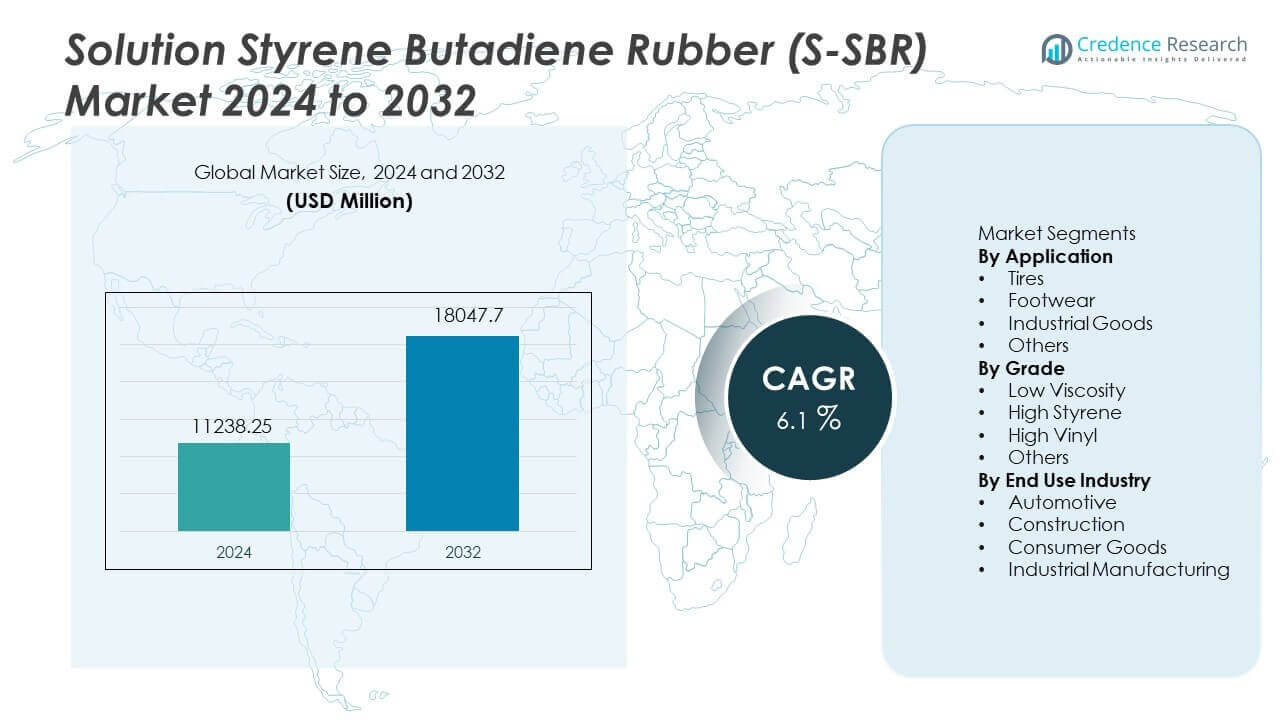
The global solution styrene butadiene rubber (S-SBR) market was valued at USD 11,238.25 million in 2024 and is projected to reach USD 18,047.7 million by 2032, expanding at a compound annual growth rate (CAGR) of 6.1% during the forecast period, according to Credence Research. This growth reflects rising demand for high-performance synthetic rubber across fuel-efficient tires, electric vehicle tires, footwear, industrial goods and specialty elastomer applications.
| REPORT ATTRIBUTE | DETAILS |
|---|---|
| Historical Period | 2020-2023 |
| Base Year | 2024 |
| Forecast Period | 2025-2032 |
| Solution Styrene Butadiene Rubber (S-SBR) Market Size 2024 | USD 11,238.25 million |
| Solution Styrene Butadiene Rubber (S-SBR) Market, CAGR | 6.1% |
| Solution Styrene Butadiene Rubber (S-SBR) Market Size 2032 | USD 18,047.7 million |
The global S-SBR market is characterized by the presence of major synthetic rubber manufacturers, tire material suppliers and advanced polymer producers competing on rolling resistance performance, wet grip, abrasion resistance, polymer functionality and sustainability. Leading players focus on high-vinyl grades, low-viscosity grades, high-styrene grades and functionalized S-SBR compounds designed for premium tire formulations and advanced industrial uses. Strategic priorities across the sector include advanced polymerization, green-tire technologies, sustainable feedstocks, long-term tire company supply agreements, EV tire innovation and capacity expansion across Asia Pacific and Europe.
Strategic Market Insights
- Market growth is primarily driven by rising demand for fuel-efficient tires, increasing electric vehicle production and stricter regulatory focus on tire labeling, rolling resistance, fuel economy and vehicle emission reduction.
- Dominant industry trends highlight the adoption of high-vinyl and low-viscosity grades, development of sustainable rubber solutions and rising investment in green-tire technologies aligned with global mobility decarbonization targets.
- The competitive landscape is defined by manufacturers investing in advanced polymerization, functionalized rubber, bio-based feedstocks and long-term supply agreements with global tire producers.
- According to Credence Research regional mapping, Asia Pacific represents the largest market, accounting for a definitive 42.7% share due to strong tire manufacturing, automotive production and rubber compounding capacity across China, Japan, India and South Korea.
Market Segmentation Analysis
By Application
- Tires
- Footwear
- Industrial Goods
- Others
Data compiled by Credence Research confirms that tires constitute the dominant application segment, holding near 72% market share in 2024. Tire manufacturers use S-SBR because it improves low rolling resistance, wet grip, abrasion resistance and durability in passenger and commercial vehicle tires. These performance benefits are especially important in premium tires, green tires and electric vehicle tire formulations where efficiency, road safety and tread life are critical.
Footwear accounts for near 12% of the market, supported by demand for elastic, lightweight and durable materials in soles and performance footwear. Industrial goods and other applications represent the remaining near 16% share, driven by use in sealing products, conveyor belts, hoses, rubber parts and specialty elastomer applications. However, tires remain the central demand base because automotive manufacturers and tire producers increasingly rely on S-SBR to meet fuel economy, safety and emission-related performance standards.
Bridgestone increased the use of advanced S-SBR compounds in its ECOPIA tire line to support wear life improvement, while internal mixing systems enhanced compound uniformity and performance consistency.
By Grade
- Low Viscosity
- High Styrene
- High Vinyl
- Others
Credence Research identifies high vinyl grade as the leading grade segment, accounting for near 48% of global market share in 2024. High vinyl S-SBR is widely used in advanced tire formulations because it provides superior abrasion resistance, improved wet grip and enhanced performance in low rolling resistance tire manufacturing. These characteristics make it valuable for premium passenger tires, EV tires and eco-performance tire lines.
Low viscosity grades account for near 32% share due to easier processing and strong compatibility with advanced tire compounding systems. These grades support faster mixing, improved production efficiency and better dispersion with silica-based compounds. High styrene grades hold near 14% share, driven by niche use in adhesives, impact-resistant products and specialty rubber applications. Other grades represent near 6% share across customized formulations for technical rubber goods, automotive sealing and engineering plastics.
Asahi Kasei’s S-SBR supports high-performance and fuel-efficient tires by using polymer modification technology that helps bond with silica, improving the balance of fuel efficiency and wet grip performance.
By End-Use Industry
- Low Viscosity
- High Styrene
- High Vinyl
- Others
The automotive industry dominates the S-SBR market with near 69% share in 2024. This leadership is driven by rising demand for fuel-efficient vehicles, electric vehicles and high-performance tires that meet safety and emission standards. Automakers and tire manufacturers adopt S-SBR-based compounds to improve rolling efficiency, road grip, tread durability and carbon reduction performance. OEM adoption continues to strengthen as tire performance becomes a more important part of vehicle efficiency.
Consumer goods hold near 13% share, supported by footwear and lifestyle products using elastic and durable polymer compounds. Construction accounts for near 11% share through adhesives, industrial flooring and specialty sealants. Industrial manufacturing represents near 7% share, supported by demand for conveyor belts, hoses, sealing materials and technical rubber products. Across end-use industries, automotive remains the strongest growth engine due to EV adoption, green-tire regulations and premium tire replacement demand.
Key Market Dynamics
Primary Market Drivers
Rising Demand for High-Performance and Fuel-Efficient Tires
Growing adoption of low-rolling-resistance tires strongly drives the S-SBR market as automotive manufacturers comply with strict fuel economy and emission regulations. Tire producers use S-SBR to improve wet grip, road safety, abrasion resistance and durability while reducing rolling resistance. Rising vehicle production, premium tire replacement and green-tire adoption support stronger integration of S-SBR in advanced tread compounds. Fuel-efficient mobility requirements and sustainability standards further accelerate demand for high-performance synthetic rubber. Credence Research identifies tire efficiency regulations as a central growth driver for the market. Goodyear deployed an S-SBR and silica blend in its Assurance Fuel Max design to reduce rolling resistance and improve tread life after compound optimization.
Expanding Electric Vehicle Tire Requirements
Electric vehicles require advanced tire compounds that manage higher torque, reduce heat generation, improve tread life and support quieter operation. These requirements increase reliance on S-SBR because the material supports grip, abrasion resistance and energy efficiency in premium tire lines. EV makers increasingly work with tire suppliers to develop specialized tread compounds that handle heavier battery loads and instant torque. Growing EV penetration, charging infrastructure expansion and government clean mobility programs strengthen long-term S-SBR demand. Continental engineered a specialized tread formulation for electric vehicle tires to manage heat buildup during high-load conditions and improve acoustic performance in road trials.
Increasing Adoption Across Non-Tire Industrial Applications
S-SBR adoption is expanding across industrial goods, adhesives, construction materials and consumer products due to its flexibility, strength and material performance. The material supports footwear manufacturing, construction chemicals, impact-resistant components and advanced polymer modification. Growth in manufacturing output and industrial automation increases demand for high-strength elastomers in belts, hoses and sealing products. Infrastructure development across Asia also supports demand from construction and engineering applications. Credence Research indicates that non-tire applications will provide steady secondary growth, although tires will remain the dominant demand segment.
Key Trends & Structural Opportunities
Shift Toward Eco-Friendly and Sustainable Rubber Formulations
Manufacturers are focusing on green tires and sustainable rubber blends that reduce environmental impact and support carbon reduction targets. Regulatory pressure on emissions and fuel efficiency encourages the development of S-SBR formulations using renewable feedstocks and improved catalyst systems. Tire companies increasingly introduce eco-performance portfolios that expand S-SBR integration into low-rolling-resistance and long-life tire categories. This trend creates opportunities for producers investing in bio-styrene, circular materials and lower-emission polymerization technologies. Michelin integrated a bio-sourced elastomer blend in its sustainable tire program, supporting tread wear improvement during field testing and contributing to longer tire life.
Increasing R&D for Performance Enhancement in EV and Autonomous Mobility
Research activity is increasing around advanced polymer design, nano-reinforcement and modified S-SBR grades that meet the needs of EVs, connected vehicles and autonomous mobility platforms. Tire producers are developing specialized tread compounds that improve energy efficiency, braking performance, heat dissipation and road safety. These innovations support premium tire applications where durability, low noise and reliable grip are essential. Hankook is developing an environmentally friendly S-SBR polymer using recycled styrene monomer to improve wear resistance and fuel efficiency in tire prototypes.
Growth of Functionalized S-SBR and Silica-Based Tire Compounds
Functionalized S-SBR grades are gaining stronger market traction as tire manufacturers seek better interaction between rubber polymers and silica fillers. Improved polymer-filler bonding supports lower rolling resistance, better wet grip and improved tire durability. This trend creates opportunities for suppliers with advanced polymerization technology and customized grades for specific tire performance targets. Credence Research identifies functionalized S-SBR as a key product development pathway as OEMs and tire brands pursue higher fuel efficiency and stronger safety performance.
Industry Challenges
High Raw Material Cost and Pricing Volatility
Feedstock price fluctuation remains a major challenge for S-SBR producers. The market depends on petroleum-based inputs, and volatility in butadiene and styrene supply affects production planning, pricing and profitability. Tight raw material availability can increase cost pressure and force manufacturers to adopt flexible procurement strategies. Price instability also affects adoption in cost-sensitive industrial and regional tire markets. Producers must manage supply risk while maintaining consistent product quality and competitive pricing.
Increasing Competition from Alternative Elastomers and Regional Substitutes
S-SBR faces competition from natural rubber, polybutadiene rubber and other synthetic elastomers used in tire and industrial applications. Regional producers may also offer cost-competitive substitutes that limit S-SBR penetration in emerging markets. Performance differences, processing requirements and price sensitivity influence material selection in non-tire uses. Smaller S-SBR suppliers face competitive pressure from larger integrated producers with stronger feedstock access and long-term customer contracts. Suppliers must differentiate through performance, sustainability and technical support to maintain market share.
Detailed Regional Analysis
| Region | Market Share (%) | Strategic Regional Catalysts & Insights |
| Asia Pacific | 42.7% | Global leader. Driven by strong vehicle production, tire manufacturing, export activity and expanding rubber capacity across China, Japan, India and South Korea. |
| Europe | 26.5% | Mature regional market. Supported by tire labeling rules, fuel efficiency standards, CO₂ reduction targets, premium tire brands and electric mobility growth. |
| North America | 19.2% | Strong demand market. Driven by replacement tire demand, fuel economy standards, EV adoption and advanced tire R&D across the United States. |
| Latin America | 6.8% | Developing regional market. Supported by vehicle ownership growth, tire distribution expansion and demand from Brazil, Mexico and Argentina. |
| Middle East & Africa | 4.8% | Emerging territory. Driven by replacement tire demand, road transport expansion, tire imports and industrial rubber applications. |
Asia Pacific leads the global S-SBR market with a 42.7% share, according to Credence Research. The region benefits from strong vehicle production, tire manufacturing and export activity across China, Japan, India and South Korea. Expanding automotive output and rising replacement tire demand support S-SBR consumption across OEM and aftermarket channels. Government fuel-efficiency standards are accelerating adoption of low-rolling-resistance tire compounds in passenger vehicles. Growing EV programs and mobility expansion further strengthen demand for performance polymer compounds. Tire manufacturers continue expanding capacity across China and Southeast Asia, reinforcing regional leadership.
Europe accounts for 26.5% of the global S-SBR market, supported by strict tire labeling rules, fuel efficiency regulations and CO₂ emission reduction targets. Tire manufacturers across Germany, France and Italy prioritize high-performance and eco-tire formulations that use S-SBR for improved braking, wet grip and rolling efficiency. Premium tire brands and electric mobility growth further strengthen demand. Regional sustainability policies and advanced polymer research support wider use of performance elastomers. Increasing adoption of winter tires also contributes to modified S-SBR demand designed for cold-weather performance.
North America holds 19.2% of the global market, driven by replacement tire demand, fuel economy standards and adoption of high-performance tire compounds. The United States leads regional demand due to its large automotive fleet and growing shift toward fuel-efficient premium tires. Manufacturers integrate S-SBR to enhance wet grip, winter performance and tread life across passenger and commercial vehicles. Growing EV production and advanced tire research also support market expansion. Regulatory focus on sustainable materials and low-rolling-resistance solutions continues to strengthen regional adoption.
Latin America holds 6.8% of the global S-SBR market, supported by increasing vehicle ownership, expanding tire distribution networks and rising demand for efficient tires in Brazil, Mexico and Argentina. Passenger vehicle sales and industrial activity contribute to tire replacement growth. Local manufacturing investment and imports of premium tires support use of S-SBR-based compounds. However, economic instability and price sensitivity limit faster penetration of performance elastomers across mainstream vehicle categories. Long-term automotive expansion is expected to sustain gradual regional growth.
The Middle East & Africa account for 4.8% of the global market. Demand is supported by rising automotive service activity, infrastructure development and tire import growth across the Gulf Cooperation Council, South Africa and North Africa. Replacement tire demand increases due to expanding road transport and extreme climate conditions that affect tire wear rates. Industrial applications such as hoses, belts and construction materials also contribute to regional adoption. Limited regional manufacturing and higher cost sensitivity slow premium S-SBR adoption, but growing passenger vehicle ownership supports incremental market growth.
Competitive Landscape & Recent Developments
The S-SBR market is competitive, with leading synthetic rubber producers and tire companies investing in high-performance elastomer technologies. Key players include Asahi Kasei Corporation, JSR Corporation, Lanxess AG, Synthos SA, Zeon Corporation, Kumho Petrochemical, LG Chem, Trinseo PLC, Goodyear Chemical and Bridgestone Corporation. These companies compete through advanced polymerization, high-vinyl and high-styrene grades, functionalized rubber, sustainable feedstocks and long-term tire manufacturer relationships.
Market leaders focus on developing S-SBR grades that improve rolling resistance, wet grip and tire durability for fuel-efficient and electric vehicle tires. Producers are expanding green-tire technologies and sustainable rubber solutions to meet OEM specifications and environmental regulations. Many companies strengthen supply agreements with tire manufacturers and expand production capacity across Asia and Europe. R&D programs, advanced catalysts, polymer modification and silica-compatible formulations remain central to competitive positioning. Growing emphasis on low-emission mobility and EV adoption continues to shape innovation across the global S-SBR supply chain.
Recent Industry Developments (2024)
- In October 2024, Synthos SA was recognized as a joint winner in the Sustainable Materials category of the European Rubber Journal Future Tire & Rubber Awards for SPRINTAN 918S, a multifunctional SSBR designed to balance low rolling resistance, high wet grip and high abrasion resistance in silica-filled passenger-car treads.
- In June 2024, Asahi Kasei Corporation showcased a newly developed hydrogenated solution styrene-butadiene rubber at DKT 2024, positioned as an advanced S-SBR for tires with improved heat, aging and chemical resistance while maintaining the processability and grip of conventional S-SBR.

Request a Free Sample
Fill in your details and we'll send you a free sample report.
- Sample data tables & charts
- Research methodology
Need a Custom Version of This Report?
Tailor the scope, geography, or segments to your exact requirements.
- Custom geography or segment scope
- Direct access to our analyst team
Frequently Asked Questions
What is the current and projected size of the global solution styrene butadiene rubber market?
What is the projected growth rate of the solution styrene butadiene rubber industry over the forecast period?
Which application segment holds the maximum market share within the S-SBR industry?
Which grade segment dominates the S-SBR market?
Which end-use industry leads the S-SBR market?
Which region commands the highest market share in the global S-SBR space?
Table of Content
Chapter 1 Market Segmentation
- 1.1 Segmentation Framework
- 1.1.1 Product and Service Classification
- 1.1.2 Application and End-Use Classification
- 1.1.3 Technology and Solution Classification
- 1.1.4 Customer and Distribution Channel Classification
- 1.1.5 Geographic Segmentation
- 1.1.6 Market Segment Definitions and Boundaries
Chapter 2 Introduction
- 2.1 Report Objectives and Scope
- 2.2 Product Definition and Industry Terminology
- 2.3 Market Inclusions and Exclusions
- 2.4 Research Process
- 2.4.1 Primary Research and Expert Interviews
- 2.4.2 Secondary Research and Source Review
- 2.4.3 Top-Down and Bottom-Up Estimation
- 2.4.4 Data Triangulation and Verification
- 2.5 Market Size Measurement Basis
- 2.5.1 2024: USD 11,238.25 million → 2032: USD 18,047.7 million
- 2.6 Historical and Forecast Reference Periods
- 2.6.1 Base Year: 2024
- 2.6.2 Forecast Period: 2024-2032
- 2.7 Research Assumptions and Limitations
Chapter 3 Executive Summary
- 3.1 Market Snapshot and Key Findings
- 3.2 Base-Year Market Size, 2024
- 3.3 Forecast Market Size, 2032
- 3.4 Revenue and Volume Growth Outlook
- 3.5 Key Demand and Supply Indicators
- 3.6 Leading Market Segments
- 3.7 Fastest-Growing Market Opportunities
- 3.8 Regional Performance Highlights
- 3.9 Technology and Industry Transformation
- 3.10 Competitive Landscape Summary
- 3.11 Analyst View and Strategic Implications
Chapter 4 Global Solution Styrene Butadiene Rubber (S-SBR) Market Trends and Developments
- 4.1 Historical Industry Development
- 4.2 Recent Market Trends and Developments
- 4.3 Demand and Customer Behavior Trends
- 4.4 Technology and Product Innovation
- 4.5 Artificial Intelligence, Automation and Digitalization
- 4.6 Local Manufacturing and Supply Chain Realignment
- 4.7 Industry Partnerships, Mergers and Acquisitions
- 4.8 Sustainability and Circular Economy Developments
- 4.9 Government and Private Sector Investment Trends
- 4.10 Emerging Business Models and Commercialization
- 4.11 Industry Developments and Announcements
Chapter 5 Global Solution Styrene Butadiene Rubber (S-SBR) Market Production, Supply and Demand Analysis
- 5.1 Demand Trend and Consumption Analysis
- 5.2 Demand Forecast, 2024-2032
- 5.3 Production and Output Trend
- 5.4 Production and Output Forecast, 2024-2032
- 5.5 Installed Capacity and Capacity Utilization
- 5.6 Company-Wise Production Plants and Statistics
- 5.6.1 Installed Production Capacity
- 5.6.2 Actual Production
- 5.6.3 Planned Capacity and Expansion Targets
- 5.7 Supply Chain Structure and Procurement Trends
- 5.8 Supply-Demand Gap and Bottlenecks
- 5.9 Import Dependence and Sourcing Structure
- 5.10 Contract Manufacturing and Outsourcing
- 5.11 Regional Supply and Demand Concentration
Chapter 6 Global Solution Styrene Butadiene Rubber (S-SBR) Market Pricing Analysis
- 6.1 Pricing Structure and Measurement
- 6.2 Historical Pricing Trends
- 6.3 Pricing Outlook, 2024-2032
- 6.4 Average Selling Price and Unit Economics
- 6.5 Pricing by Product and Market Segment
- 6.6 Geographic Pricing Differences
- 6.7 Key Input, Energy, Labor and Logistics Costs
- 6.8 Contract Pricing and Purchasing Models
- 6.9 Pricing Sensitivity and Competitive Positioning
- 6.10 Price, Margin and Profitability Implications
Chapter 7 Global Solution Styrene Butadiene Rubber (S-SBR) Market Dynamics
- 7.1 Market Growth Drivers
- 7.1.1 Demand-Side Drivers
- 7.1.2 Technology and Innovation Drivers
- 7.1.3 Infrastructure and Investment Drivers
- 7.1.4 Regulatory and Policy Drivers
- 7.2 Market Restraints
- 7.2.1 Cost and Affordability Constraints
- 7.2.2 Technology and Adoption Barriers
- 7.2.3 Supply Chain and Operational Constraints
- 7.3 Market Challenges
- 7.3.1 Competitive Pressure and Margin Erosion
- 7.3.2 Skills, Infrastructure and Implementation Gaps
- 7.4 Emerging Market Opportunities
- 7.5 Market Dynamics Impact and Time-Horizon Assessment
Chapter 8 Global Solution Styrene Butadiene Rubber (S-SBR) Value Chain Analysis
- 8.1 Industry Value Chain Overview
- 8.2 Upstream Suppliers and Critical Inputs
- 8.3 Technology and Component Providers
- 8.4 Manufacturing or Service Delivery
- 8.5 Distribution, Channel Partners and Integrators
- 8.6 Downstream Applications and End Users
- 8.7 Value Addition and Profit Pools
- 8.8 Vertical Integration and Outsourcing
- 8.9 Supplier Concentration and Risk
- 8.10 Supply Chain Localization and Resilience
Chapter 9 Global Solution Styrene Butadiene Rubber (S-SBR) Market Regulations and Policies
- 9.1 Relevant Laws, Standards and Compliance Frameworks
- 9.2 Product, Service, Safety and Quality Requirements
- 9.3 Government Policies, Incentives and Subsidies
- 9.4 Imports, Exports and Trade Barriers
- 9.5 Public Procurement and Local Content Requirements
- 9.6 Environmental and Sustainability Compliance
- 9.7 Upcoming Policy Changes and Market Implications
Chapter 10 Global Solution Styrene Butadiene Rubber (S-SBR) Market Hotspots and Opportunities
- 10.1 Market Opportunity Mapping and Growth Hotspots
- 10.2 High-Growth Applications and Customer Groups
- 10.3 Underserved Markets and White-Space Opportunities
- 10.4 Emerging Technology and Product Opportunities
- 10.5 New Capacity and Investment Hotspots
- 10.6 Market Entry and Expansion Opportunities
- 10.7 Distribution and Partnership Opportunities
- 10.8 Near-Term and Long-Term Commercial Potential
- 10.9 Opportunity Attractiveness and Execution Risks
Chapter 11 Global Solution Styrene Butadiene Rubber (S-SBR) Market Outlook, 2024-2032
- 11.1 Market Size and Analysis
- 11.1.1 Revenue (Market Measurement: 2024: USD 11,238.25 million → 2032: USD 18,047.7 million)
- 11.1.2 Market Volume and Quantity Sold
- 11.1.3 Historical Market Size
- 11.1.4 Base-Year Market Size, 2024
- 11.2 Market Forecast, 2024-2032
- 11.2.1 Revenue Forecast to 2032
- 11.2.2 Volume Forecast to 2032
- 11.2.3 CAGR and Year-on-Year Growth
- 11.2.4 Incremental Revenue Opportunity
- 11.3 Forecast Assumptions and Scenario Analysis
- 11.3.1 Base-Case Forecast
- 11.3.2 Optimistic and Conservative Scenarios
- 11.3.3 Technology, Pricing and Policy Sensitivities
- 11.4 Market Attractiveness and Growth Outlook
Chapter 12 Global Solution Styrene Butadiene Rubber (S-SBR) Market Segmentation and Outlook
- 12.1 Segmentation Summary and Market Shares, 2024
- 12.2 Largest and Fastest-Growing Segments
- 12.3 Segment Growth Comparison
- 12.4 Segment Attractiveness and Priority Matrix
Chapter 13 Global Solution Styrene Butadiene Rubber (S-SBR) Geographic Market Outlook, 2024-2032
- 13.1 Regional Market Size and Share, 2024
- 13.2 Regional Market Forecast, 2024-2032
- 13.3 Regional Pricing, Production and Demand Differences
- 13.4 North America
- 13.4.1 United States
- 13.4.2 Canada
- 13.4.3 Mexico
- 13.5 Europe
- 13.5.1 Germany
- 13.5.2 France
- 13.5.3 Italy
- 13.5.4 United Kingdom
- 13.5.5 Spain
- 13.5.6 Poland
- 13.5.7 Russia
- 13.5.8 Netherlands
- 13.5.9 Belgium
- 13.5.10 Sweden
- 13.5.11 Denmark
- 13.5.12 Norway
- 13.5.13 Rest of Europe
- 13.6 Asia Pacific
- 13.6.1 China
- 13.6.2 India
- 13.6.3 Japan
- 13.6.4 South Korea
- 13.6.5 Thailand
- 13.6.6 Indonesia
- 13.6.7 Vietnam
- 13.6.8 Malaysia
- 13.6.9 Australia
- 13.6.10 Rest of Asia Pacific
- 13.7 Latin America
- 13.7.1 Brazil
- 13.7.2 Argentina
- 13.7.3 Colombia
- 13.7.4 Chile
- 13.7.5 Rest of Latin America
- 13.8 Middle East
- 13.8.1 Saudi Arabia
- 13.8.2 United Arab Emirates
- 13.8.3 Turkey
- 13.8.4 Israel
- 13.8.5 Iran
- 13.8.6 Rest of the Middle East
- 13.9 Africa
- 13.9.1 South Africa
- 13.9.2 Egypt
- 13.9.3 Nigeria
- 13.9.4 Morocco
- 13.9.5 Rest of Africa
- 13.10 Regional Investment, Policy and Supply Chain Differences
- 13.11 Regional Competitive Landscape
- 13.12 Geographic Growth Hotspots
Chapter 14 Global Solution Styrene Butadiene Rubber (S-SBR) Technology, Innovation and Sustainability Outlook
- 14.1 Technology Landscape and Maturity
- 14.2 Product, Process and Service Innovation
- 14.3 AI, Automation and Digital Tools in the Industry
- 14.4 Technology Adoption and Performance Benchmarking
- 14.5 Innovation Pipeline and R&D Investment
- 14.6 Patent and Intellectual Property Trends
- 14.7 Energy Efficiency and Resource Management
- 14.8 Sustainability, Recycling and Circularity
- 14.9 Technology Roadmap, 2024-2032
- 14.10 Risks of Obsolescence and Technology Substitution
Chapter 15 Global Solution Styrene Butadiene Rubber (S-SBR) Market Key Strategic Imperatives
- 15.1 Growth and Market Entry Priorities
- 15.2 High-Return Products and Segments
- 15.3 Pricing, Profitability and Cost Optimization
- 15.4 Technology Investment and Product Differentiation
- 15.5 Supply Chain Localization and Resilience
- 15.6 Distribution and Customer Acquisition
- 15.7 Partnership, Acquisition and Capacity Strategy
- 15.8 Regional Expansion Priorities
- 15.9 Short-, Medium- and Long-Term Actions
Chapter 16 Competition Outlook
- 16.1 Industry Competition Characteristics
- 16.2 Market Structure and Concentration
- 16.3 Market Share and Competitive Positioning, 2024
- 16.4 Company-Wise Revenue and Product Benchmarking
- 16.5 Production and Service Capacity Benchmarking
- 16.6 Technology, Pricing and Differentiation
- 16.7 Regional Footprint and Distribution Strength
- 16.8 Mergers, Acquisitions and Strategic Alliances
- 16.9 New Entrants and Competitive Threats
- 16.10 Porter's Five Forces and Industry Attractiveness
- 16.11 Competitive Outlook, 2024-2032
Chapter 17 Company Profiles
- 17.1 Company Coverage and Selection Criteria
- 17.2 Leading Market Participants – Standard Profile Structure
- 17.2.1 Business Description
- 17.2.2 Company Ownership and Geographic Presence
- 17.2.3 Product and Service Portfolio
- 17.2.4 Manufacturing and Operating Footprint
- 17.2.5 Production Capacity and Expansion Plans
- 17.2.6 Financial Performance and Investment
- 17.2.7 Market Share and Competitive Position
- 17.2.8 Technology and Innovation Capabilities
- 17.2.9 Strategic Alliances or Partnerships
- 17.2.10 Recent Developments
- 17.2.11 Growth Strategy and Outlook
- 17.3 Other Relevant Market Participants
Note: Every listed company is profiled on the structure shown under the first company. The company list is preliminary and may change based on research findings, market developments, data availability and client requirements.
Chapter 18 Disclaimer
- 18.1 Research and Forecast Disclaimer
- 18.2 Data Source and Estimation Limitations
Note: The depth of individual sections depends on data availability for this market. Volume, capacity, trade and other unit-based metrics are included where applicable.