
Market Overview
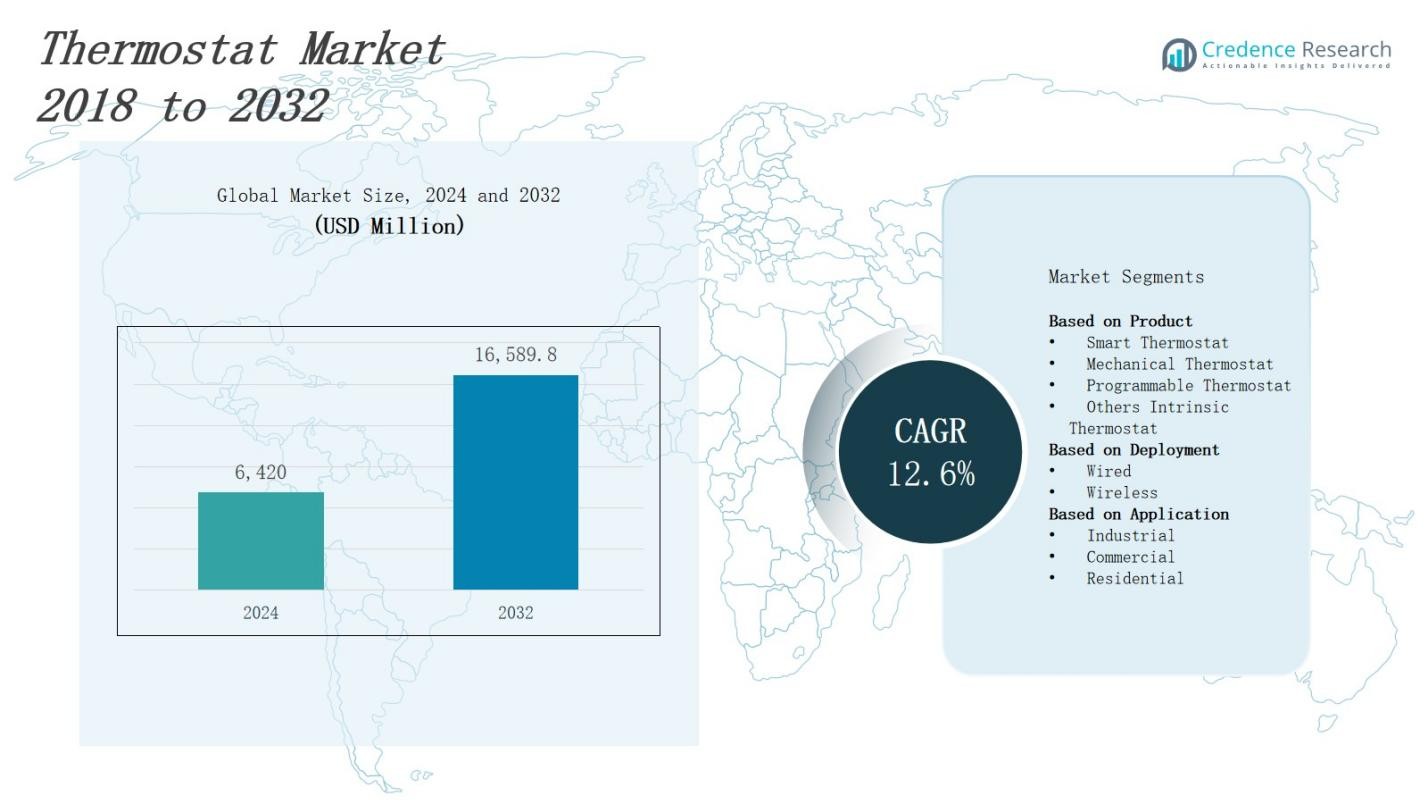
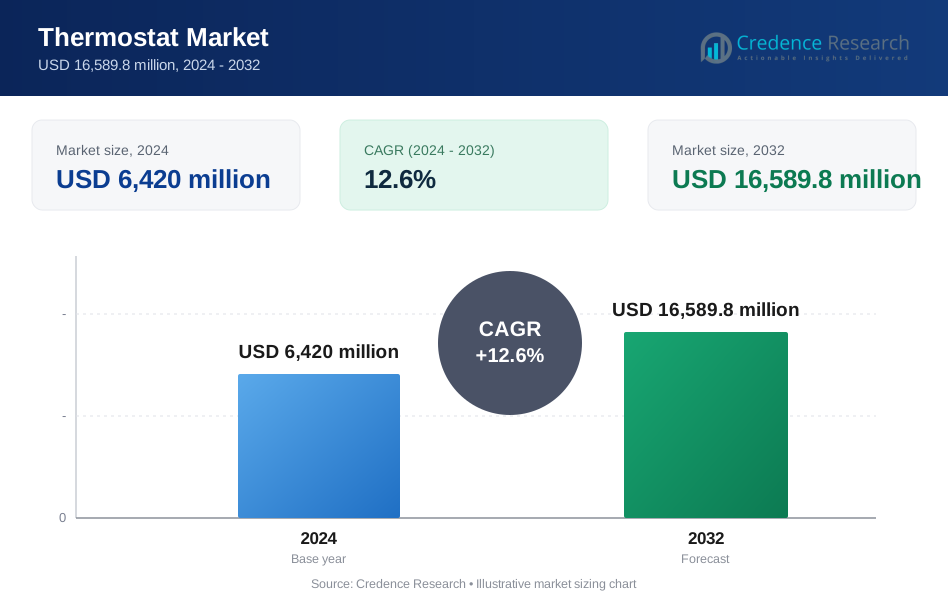
The Thermostat Market is projected to grow from USD 6,420 million in 2024 to USD 16,589.8 million by 2032, expanding at a CAGR of 12.6%.
| REPORT ATTRIBUTE | DETAILS |
|---|---|
| Historical Period | 2020-2024 |
| Base Year | 2024 |
| Forecast Period | 2025-2032 |
| Thermostat Market Size 2024 | USD 6,420 Million |
| Thermostat Market, CAGR | 12.6% |
| Thermostat Market Size 2032 | USD 16,589.8 Million |
The thermostat market grows driven by increasing demand for energy-efficient climate control solutions across residential, commercial, and industrial sectors. Rising adoption of smart thermostats, enabled by advancements in IoT and home automation, enhances user convenience and energy savings. Regulatory mandates on energy consumption and environmental sustainability further stimulate market expansion. Additionally, growing awareness of cost savings through optimized heating and cooling systems encourages widespread thermostat integration. Trends include the integration of AI for predictive temperature management, voice-controlled interfaces, and compatibility with renewable energy systems. These factors collectively accelerate innovation and adoption, positioning the thermostat market for sustained growth.
The thermostat market spans North America, Europe, Asia-Pacific, and the Rest of the World, with North America leading at 35% market share, followed by Europe at 28%, Asia-Pacific at 25%, and the Rest of the World at 12%. Key players like Honeywell, Nest (Google), Ecobee, Johnson Controls, and Schneider Electric dominate the market through innovation and strong regional presence. These companies tailor products to regional demands, regulatory standards, and consumer preferences, driving growth across diverse applications in residential, commercial, and industrial sectors worldwide.
Market Insights
- The thermostat market will grow from USD 6,420 million in 2024 to USD 16,589.8 million by 2032, at a CAGR of 12.6%.
- Increasing demand for energy-efficient climate control solutions across residential, commercial, and industrial sectors drives market growth.
- Smart thermostats gain popularity due to IoT advancements, offering enhanced convenience and energy savings.
- Regulatory mandates on energy consumption and environmental sustainability encourage widespread adoption.
- AI integration, voice control, and renewable energy compatibility emerge as key technology trends.
- North America leads with 35% market share, followed by Europe (28%), Asia-Pacific (25%), and the Rest of the World (12%).
- Key players such as Honeywell, Nest (Google), Ecobee, Johnson Controls, and Schneider Electric dominate through innovation and regional adaptation.
Market Drivers
Rising Demand for Energy Efficiency and Cost Savings
Increasing energy costs and environmental concerns drive widespread adoption of thermostats that optimize heating and cooling systems. It helps users reduce energy consumption by maintaining precise temperature control, lowering utility bills significantly. Governments enforce stricter energy regulations, prompting industries and households to invest in energy-saving devices. The thermostat market benefits from this demand, encouraging manufacturers to develop more efficient and reliable products. Consumers prioritize solutions that balance comfort with sustainability, fueling market expansion.
- For instance, Google Nest Learning Thermostat Gen 4, which uses AI to create customized heating and cooling schedules, achieving balanced comfort and significant energy savings through remote room sensors and smart automation.
Advancements in Smart and Connected Technologies
The thermostat market experiences rapid growth due to integration with smart home ecosystems and IoT technologies. It offers remote monitoring, programmable schedules, and real-time energy usage feedback, enhancing user convenience and control. Voice-activated and AI-driven thermostats improve interaction and automate temperature adjustments based on occupancy patterns. Technology companies invest heavily in innovation, driving new product launches with enhanced connectivity and functionality. This trend accelerates adoption across residential and commercial sectors.
- For instance, Ecobee's Smart Thermostat Premium integrates voice assistant functions with air quality monitoring, providing users with enhanced control and environmental feedback.
Regulatory Support and Environmental Awareness
Governments worldwide implement policies encouraging energy-efficient building systems, creating favorable conditions for thermostat adoption. It plays a crucial role in meeting energy codes and green building certifications by optimizing HVAC performance. Growing public awareness of climate change emphasizes reducing carbon footprints through smarter energy use. These factors increase demand in both new constructions and retrofitting projects. The market responds by offering compliant, eco-friendly solutions that support sustainability goals.
Expanding Applications in Commercial and Industrial Sectors
Industries increasingly deploy thermostats to maintain controlled environments, ensuring operational efficiency and equipment longevity. It helps monitor temperature-sensitive processes, enhancing product quality and reducing downtime. Commercial buildings adopt advanced thermostats to optimize energy management and comply with workplace comfort standards. Growing industrial automation and digitization further boost market demand. Manufacturers focus on customizable solutions to address specific sector requirements, broadening the thermostat market’s reach.
Market Trends
Integration of Artificial Intelligence and Predictive Analytics
The thermostat market increasingly incorporates artificial intelligence to enhance temperature regulation and energy efficiency. It uses predictive analytics to learn user behavior and adjust settings proactively, improving comfort while reducing waste. AI-driven systems detect occupancy patterns and weather changes, optimizing HVAC operation without manual input. Companies invest in developing smarter thermostats that provide personalized climate control. This technology trend transforms user experience and drives demand for intelligent home automation solutions.
Growth of Voice-Controlled and Mobile-Enabled Thermostats
Voice assistants and mobile applications redefine thermostat usability by enabling remote and hands-free control. It allows users to adjust temperature settings through smartphones or smart speakers, enhancing convenience and accessibility. Integration with popular platforms like Amazon Alexa, Google Assistant, and Apple HomeKit accelerates adoption across residential and commercial sectors. Manufacturers focus on seamless connectivity and intuitive interfaces to attract tech-savvy consumers. This trend expands market potential by combining smart technology with user-friendly control methods.
Emphasis on Sustainability and Eco-Friendly Solutions
The thermostat market reflects growing global demand for environmentally responsible products that reduce energy consumption. It supports sustainability goals by optimizing heating and cooling processes and minimizing carbon emissions. Thermostats with eco-modes and adaptive scheduling help users lower their ecological footprint while managing costs. Companies develop devices using recyclable materials and energy-efficient components to meet green certifications. This trend aligns with consumer preference shifts toward sustainable living and regulatory pressures.
- For instance, Ecobee’s Smart Thermostat Essential, launched in January 2025, delivers up to 23% energy savings through adaptive scheduling and occupancy sensing, which helps reduce unnecessary heating and cooling.
Expansion of Commercial and Industrial Smart Thermostat Applications
Commercial and industrial sectors adopt smart thermostats to improve operational efficiency and energy management. It enables real-time monitoring and remote control of multiple zones within complex facilities. Integration with building management systems facilitates data-driven decisions that reduce energy costs and enhance occupant comfort. The rise of IoT and automation in these sectors boosts demand for sophisticated thermostat solutions. Manufacturers tailor products to meet the unique requirements of large-scale and specialized environments, driving market growth.
- For instance, Johnson Controls' Metasys system integrates smart thermostats with HVAC controls to optimize energy use in large commercial buildings.
Market Challenges Analysis
High Initial Costs and Complex Installation Processes
The thermostat market faces challenges due to the high upfront costs associated with advanced smart thermostats. It limits adoption among cost-sensitive consumers and small businesses despite long-term energy savings. Installation of sophisticated systems often requires professional assistance, increasing total expenses and complicating the buying decision. Compatibility issues with existing HVAC infrastructure create additional barriers, especially in older buildings. Manufacturers must balance innovation with affordability to broaden market penetration. Educating consumers on return on investment remains critical to overcoming cost-related resistance.
Data Privacy Concerns and Technical Limitations
Privacy and security concerns hinder consumer confidence in connected thermostats that collect personal usage data. It requires stringent cybersecurity measures to protect sensitive information and prevent unauthorized access. Technical limitations, such as connectivity disruptions and interoperability challenges between devices, impact user experience. These issues create hesitancy in adopting smart thermostat solutions despite their benefits. Companies need to enhance device reliability and strengthen data protection protocols to build trust. Addressing these challenges is essential to sustaining growth in the thermostat market.
Market Opportunities
Expansion into Emerging Markets with Growing Urbanization
The thermostat market presents significant opportunities in emerging economies experiencing rapid urbanization and infrastructure development. It can capture demand from expanding residential and commercial construction projects that require efficient climate control systems. Increasing disposable incomes and rising awareness of energy conservation further support market growth in these regions. Companies that customize products to local climate conditions and regulatory requirements gain competitive advantages. Partnering with regional distributors and leveraging government incentives can accelerate market entry. This expansion offers considerable potential to diversify revenue streams and increase global market share.
Innovation in Integration with Renewable Energy Systems
The growing adoption of renewable energy sources creates opportunities for the thermostat market to develop compatible and intelligent control systems. It can optimize energy use by coordinating with solar panels, heat pumps, and battery storage solutions. Such integration enhances overall energy efficiency and reduces dependence on traditional power grids. Manufacturers that invest in smart thermostats supporting renewable energy technologies position themselves to meet evolving consumer preferences. This focus opens new avenues for product differentiation and long-term sustainability. Capitalizing on this trend will drive innovation and expand application scope across residential and commercial sectors.
Market Segmentation Analysis:
By Product Type
The thermostat market segments by product into smart, mechanical, programmable, and other intrinsic thermostats. It favors smart thermostats due to their advanced features like remote access, AI integration, and energy-saving capabilities. Mechanical thermostats maintain a steady demand for their simplicity and cost-effectiveness in basic applications. Programmable thermostats offer users scheduled temperature control, balancing convenience and efficiency. Other intrinsic thermostats serve niche industrial and specialized uses. Product innovation drives differentiation and expands options for diverse consumer needs.
By Deployment Type
The thermostat market divides deployment into wired and wireless systems. It witnesses growing adoption of wireless thermostats for their installation flexibility and compatibility with smart home ecosystems. Wired thermostats retain importance in commercial and industrial sectors where stable, uninterrupted connections are critical. Wireless solutions enhance user convenience through remote control and integration with IoT devices. Deployment choice depends on application requirements, infrastructure, and user preferences, influencing overall market dynamics.
- For instance, Google Nest Thermostat offers wireless installation and can be controlled remotely via the Google Home app, enhancing user convenience.
By Application Sector
The thermostat market categorizes application into industrial, commercial, and residential sectors. It experiences strong growth in residential segments driven by smart home automation trends and energy efficiency demands. Commercial applications prioritize scalable systems that manage multiple zones and comply with building codes. Industrial users require thermostats that withstand harsh environments and support process control. Tailoring products to sector-specific needs supports wider adoption and strengthens market penetration across diverse end uses.
- For instance, Honeywell International offers thermostats engineered for industrial environments that endure extreme temperatures and support precise process control.
Segments:
Based on Product
- Smart Thermostat
- Mechanical Thermostat
- Programmable Thermostat
- Others Intrinsic Thermostat
Based on Deployment
- Wired
- Wireless
Based on Application
- Industrial
- Commercial
- Residential
Based on the Geography:
- North America
- U.S.
- Canada
- Mexico
- Europe
- Germany
- France
- U.K.
- Italy
- Spain
- Rest of Europe
- Asia Pacific
- China
- Japan
- India
- South Korea
- South-east Asia
- Rest of Asia Pacific
- Latin America
- Brazil
- Argentina
- Rest of Latin America
- Middle East & Africa
- GCC Countries
- South Africa
- Rest of the Middle East and Africa
Regional Analysis
North America
North America holds the largest share of the thermostat market with 35%. It benefits from advanced infrastructure, high adoption of smart home technologies, and strong regulatory support for energy efficiency. Consumers increasingly prefer smart and programmable thermostats that integrate with IoT platforms. The presence of key manufacturers and ongoing innovation drive market growth. Commercial and residential sectors actively invest in modern climate control systems to reduce energy costs. High disposable incomes and awareness about sustainability further boost demand. The region leads in technology adoption and product development.
Europe
Europe accounts for 28% of the thermostat market, supported by stringent energy regulations and government incentives promoting green buildings. It shows strong demand for energy-efficient thermostats in residential, commercial, and industrial applications. Rising focus on reducing carbon footprints accelerates the deployment of smart and wireless thermostat solutions. Countries like Germany, the UK, and France invest heavily in sustainable infrastructure. Market players target customization to meet regional standards and consumer preferences. Europe’s emphasis on environmental policies sustains steady growth.
Asia-Pacific
Asia-Pacific holds 25% of the thermostat market, driven by rapid urbanization, expanding construction activities, and increasing disposable income in emerging economies. It experiences rising adoption of smart thermostats in countries such as China, India, Japan, and South Korea. Industrial and commercial sectors also contribute significantly due to growing automation and energy management initiatives. The market benefits from government efforts to improve energy efficiency and support smart city projects. Increasing awareness of sustainable living promotes wider thermostat usage. Regional manufacturers focus on cost-effective solutions to penetrate the diverse market.
Rest of the World
The Rest of the World accounts for 12% of the thermostat market. It includes Latin America, the Middle East, and Africa, where infrastructure development and urbanization create growth opportunities. Adoption rates vary due to differing economic conditions and regulatory frameworks. Demand in commercial and residential sectors increases with rising energy costs and awareness. Market expansion depends on improved distribution networks and tailored products addressing local needs. Companies explore partnerships and government projects to strengthen their presence in these emerging regions.
Key Player Analysis
- Ecobee
- Siemens AG
- Nest (owned by Google)
- Johnson Controls
- Honeywell
- Schneider Electric
- Trane Technologies
- Carrier Corporation
- Tado
- Danfoss
- Emerson Electric Co.
- Lux Products
- Sensi
Competitive Analysis
The thermostat market features intense competition among leading global players focused on innovation, product differentiation, and geographic expansion. Companies invest heavily in developing smart and connected thermostats with advanced features such as AI integration, voice control, and energy management. It drives continuous improvements in user experience and device interoperability. Key players compete through strategic partnerships, acquisitions, and expanding distribution networks to strengthen market presence. Pricing strategies and customization options cater to diverse consumer needs across residential, commercial, and industrial segments. Emphasis on sustainability and compliance with energy regulations influences product development. The competitive landscape rewards companies that balance technology, affordability, and reliability, positioning them for long-term growth in the rapidly evolving thermostat market.
Recent Developments
- In January 2025, Resideo introduced the Honeywell Home X2S Smart Thermostat at CES, offering compatibility with Matter, Alexa, Google Assistant, and Apple HomeKit, and planned release in spring 2025 in the U.S. and Canada.
- In August 2024, Copeland introduced the Verdant VX4 with demand response capabilities and fingerprint-resistant glass for hospitality and multifamily properties.
- In October 2024, Building36 launched a smart thermostat with cellular connectivity to simplify installation and improve reliability.
- In August 2024, Copeland unveiled the Verdant VX4 smart thermostat, designed with demand response capabilities and fingerprint-resistant glass, targeting the hospitality and multifamily housing sectors.
Market Concentration & Characteristics
The thermostat market exhibits a moderately concentrated structure, dominated by several key global players that hold significant market shares. It features strong competition among established companies such as Honeywell, Nest (Google), Ecobee, Johnson Controls, and Schneider Electric, which drive innovation through advanced technologies like AI integration, IoT connectivity, and voice control. The market characteristics include rapid adoption of smart thermostats, growing demand for energy-efficient solutions, and increasing focus on sustainability. It also shows segmentation across residential, commercial, and industrial applications, requiring diverse product offerings tailored to each sector. Companies invest heavily in research and development to enhance device compatibility, user experience, and data security. The Thermostat market rewards those that balance technological sophistication with affordability and reliability, fostering steady growth while addressing evolving consumer and regulatory demands worldwide.
Report Coverage
The research report offers an in-depth analysis based on Product, Deployment, Application and Geography. It details leading market players, providing an overview of their business, product offerings, investments, revenue streams, and key applications. Additionally, the report includes insights into the competitive environment, SWOT analysis, current market trends, as well as the primary drivers and constraints. Furthermore, it discusses various factors that have driven market expansion in recent years. The report also explores market dynamics, regulatory scenarios, and technological advancements that are shaping the industry. It assesses the impact of external factors and global economic changes on market growth. Lastly, it provides strategic recommendations for new entrants and established companies to navigate the complexities of the market.
Future Outlook
- The thermostat market will expand due to rising demand for energy-efficient climate control solutions.
- Smart thermostats will gain wider adoption through enhanced connectivity and AI capabilities.
- Integration with renewable energy systems will drive product innovation and market growth.
- Voice-controlled and mobile-enabled thermostats will improve user convenience and accessibility.
- Regulatory support for energy conservation will continue to boost market demand globally.
- Emerging markets will present significant growth opportunities fueled by urbanization and infrastructure development.
- Commercial and industrial sectors will increasingly adopt advanced thermostats for optimized energy management.
- Manufacturers will focus on improving data security and device interoperability to build consumer trust.
- Customization of thermostat solutions will rise to meet diverse regional and application-specific needs.
- Continuous technological advancements will sustain competition and expand application scope across sectors.
Request a Free Sample
Fill in your details and we'll send you a free sample report.
- Sample data tables & charts
- Research methodology
Need a Custom Version of This Report?
Tailor the scope, geography, or segments to your exact requirements.
- Custom geography or segment scope
- Direct access to our analyst team
Frequently Asked Questions
What is the current market size for Thermostat market, and what is its projected size in 2032?
At what Compound Annual Growth Rate is the Thermostat market projected to grow between 2025 and 2032?
Which Thermostat market segment held the largest share in 2024?
What are the primary factors fueling the growth of the Thermostat market?
Who are the leading companies in the Thermostat market?
Which region commanded the largest share of the Thermostat market in 2024?
Table of Content
Chapter 1. Report Introduction
- 1.1 Report Description & Purpose
- 1.1.1 Report Title & Market Definition
- 1.1.2 Unique Selling Propositions (USP) & Key Differentiators
- 1.1.3 Value Proposition for Stakeholders
- 1.2 Research Objectives
- 1.2.1 Market Sizing Objectives (Volume & Revenue)
- 1.2.2 Segmentation Objectives
- 1.2.3 Competitive Intelligence Objectives
- 1.2.4 Forecast & Scenario Objectives
- 1.3 Report Scope
- 1.3.1 Thermostat Scope – Types & Subtypes Covered
- 1.3.2 Geographic Scope – Regions & Countries Covered
- 1.3.3 Historical Period, Base Year & Forecast Period (2024; forecast to 2032)
- 1.3.4 Inclusions & Exclusions
- 1.4 HS Code & Classification Framework
- 1.5 Currency, Units & Pricing Basis
- 1.6 Target Stakeholders
- 1.7 Limitations & Assumptions
Chapter 2. Executive Summary
- 2.1 Global Thermostat Market Snapshot
- 2.1.1 Market Size – Historical (2024) & Forecast (2024-2032) (2024: USD 6,420 million → 2032: USD 16,589.8 million)
- 2.1.2 Volume & Revenue – Global Totals
- 2.1.3 Key Market Highlights – Top Five Facts
- 2.2 Thermostat Market Segmentation Snapshot
- 2.2.1 Market Split by Region – 2024 vs. 2032
- 2.3 Competitive Snapshot
- 2.3.1 Top 10 Players by Revenue Share – 2024
- 2.3.2 Top 10 Players by Volume Share – 2024
- 2.3.3 Recent Strategic Developments (18-Month Summary)
- 2.4 Key Investment Highlights & Strategic Conclusions
Chapter 3. Thermostat Market Dynamics & Industry Analysis
- 3.1 Market Overview & Context
- 3.1.1 Thermostat Market Position in the Broader Automotive Value Chain
- 3.1.2 OEM vs. Replacement Market Dynamics
- 3.1.3 Market Maturity & Development Stage by Region
- 3.2 Thermostat Market Drivers
- 3.3 Thermostat Market Restraints & Challenges
- 3.4 Thermostat Market Opportunities
- 3.5 Porter's Five Forces Analysis
- 3.5.1 Threat of New Entrants
- 3.5.2 Bargaining Power of Suppliers
- 3.5.3 Bargaining Power of Buyers
- 3.5.4 Threat of Substitutes
- 3.5.5 Competitive Rivalry – Intensity Assessment
- 3.6 Thermostat Value Chain Analysis
- 3.6.1 Upstream – Raw Material/Input Suppliers
- 3.6.1.1 Raw Material/Input 1
- 3.6.1.2 Raw Material/Input 2
- 3.6.1.3 Raw Material/Input 3
- 3.6.2 Midstream – Production/Manufacturing/Service Delivery
- 3.6.2.1 Production/Process Overview
- 3.6.2.2 Key Facility Locations & Capacity by Manufacturer
- 3.6.3 Downstream – Distribution & End Consumer
- 3.6.3.1 Primary Channel – B2B/OEM
- 3.6.3.2 Secondary Channels – Dealer, Retail, Online, Direct
- 3.6.4 Value Chain Profitability Analysis
- 3.6.1 Upstream – Raw Material/Input Suppliers
- 3.7 PESTEL Analysis
- 3.7.1 Political Factors
- 3.7.2 Economic Factors
- 3.7.3 Social Factors
- 3.7.4 Technological Factors
- 3.7.5 Environmental Factors
- 3.7.6 Legal Factors
- 3.8 Thermostat Supply Chain Analysis
- 3.8.1 Raw Material/Input Supply Risk Assessment
- 3.8.2 Manufacturing Concentration Risk (Geographic Exposure)
- 3.8.3 Trade Disruption Impact Analysis
- 3.9 Regulatory & Policy Landscape
Note: The regulatory and policy landscape section covers regulations based on their applicability to the market, Thermostat category, geography, and scope of the study. Only regulatory frameworks with a material impact on operations, compliance, trade, sustainability, or market access are analyzed in detail.
Chapter 4. Key Investment Pockets & Opportunity Analysis
- 4.1 Thermostat Market Attractiveness Analysis
- 4.1.1 By Region – Investment Attractiveness Matrix (Volume × CAGR)
- 4.2 Absolute Revenue Growth Opportunity
- 4.2.1 By Region – Absolute USD Growth Through 2032
- 4.3 Incremental Volume Opportunity
- 4.3.1 By Region – Incremental Volume Through 2032
- 4.3.2 Segment – Incremental Volume
- 4.4 Emerging Submarket Opportunity Deep Dive (Subject to Applicability)
- 4.5 Emerging Market Opportunity Scorecards
- 4.5.1 United States
- 4.5.2 Europe
- 4.5.3 Asia
- 4.5.4 Middle East & Africa
Note: Emerging Market Opportunity Scorecards will be included based on relevance and strategic importance. Regions listed are indicative and may vary depending on data availability and market dynamics.
Chapter 5. Thermostat Import-Export Analysis & Trade Flows
- 5.1 Global Trade Overview
- 5.1.1 Global Export Value by Country (2024)
- 5.1.2 Global Export Volume by Country (2024)
- 5.1.3 Global Import Value by Country (2024)
- 5.1.4 Global Import Volume by Country (2024)
- 5.1.5 Net Trade Balance by Country (2024)
- 5.2 Export Analysis – Segment
- 5.2.1 Type 1 (HS Code)
- 5.2.2 Type 2 (HS Code)
- 5.2.3 Type 3 (HS Code)
- 5.2.4 Type 4 (HS Code)
- 5.2.5 Type 5 (HS Code)
- 5.3 Import Analysis – Segment
- 5.3.1 Type 1 (HS Code)
- 5.3.2 Type 2 (HS Code)
- 5.3.3 Type 3 (HS Code)
- 5.3.4 Type 4 (HS Code)
- 5.3.5 Type 5 (HS Code)
- 5.4 Average Unit Trade Prices
- 5.4.1 Average Export Price – Segment & Country
- 5.4.2 Average Import Price – Segment & Source Country
- 5.4.3 Price Trends (2024)
- 5.5 Key Trade Route Analysis
- 5.5.1 Trade Route 1
- 5.5.2 Trade Route 2
- 5.5.3 Trade Route 3
- 5.5.4 Trade Route 4
- 5.5.5 Trade Route 5
- 5.6 Trade Policy Impact Assessment
- 5.6.1 US Anti-Dumping & Section 301 Tariffs
- 5.6.2 EU Customs Union Impact
- 5.6.3 Major Free Trade Agreements
- 5.6.4 USMCA Rules of Origin
Note: Trade policy analysis will be included only where relevant to the Thermostat market.
Chapter 6. Competitive Landscape & Company Benchmarking
- 6.1 Thermostat Market Concentration & Structure
- 6.1.1 Herfindahl-Hirschman Index (HHI) – vs. 2024
- 6.1.2 Tier 1, Tier 2 & Tier 3 Market Structure
- 6.1.3 Global, Regional & Local Player Dynamics
- 6.2 Thermostat Market Share Analysis – 2024
- 6.2.1 Global Revenue Share by Company
- 6.2.2 Global Volume Share by Company
- 6.2.3 Regional Revenue Share
- 6.2.4 Market Share Evolution ( vs. 2024)
- 6.2.5 OEM Segment Share by Company
- 6.2.6 Replacement Segment Share by Company
- 6.3 Production/Delivery Capacity & Facility Analysis
- 6.3.1 Global Installed Capacity
- 6.3.2 Capacity Utilization Rates
- 6.3.3 Production/Output Volume
- 6.3.4 Facility Locations & Capacity Map
- 6.3.5 Planned Capacity Additions
- 6.4 Thermostat Competitive Benchmarking Matrix
- 6.4.1 Revenue, Volume, CAGR & Profitability Comparison
- 6.4.2 Channel Revenue Mix
- 6.4.3 Geographic Revenue Exposure
- 6.4.4 R&D Intensity
- 6.4.5 Sustainability Maturity
- 6.5 Strategic Developments in Thermostat (Last 24 Months)
- 6.5.1 Mergers, Acquisitions & Divestments
- 6.5.2 New Thermostat Launches
- 6.5.3 Facility Expansions
- 6.5.4 Strategic Alliances, Joint Ventures & Partnerships
- 6.5.5 Distribution Expansion & Market Entry
- 6.5.6 Sustainability & ESG Initiatives
- 6.6 Competitive Strategy Mapping
- 6.6.1 Leader, Challenger, Follower & Niche Classification
- 6.6.2 Pricing Strategy Comparison
- 6.6.3 Channel Strategy Matrix
Note: Strategic developments are included based on their materiality and the availability of reliable information.
Chapter 7. Global Thermostat Market – By Distribution Channel
- 7.1 Segment Overview
- 7.1.1 Volume & Revenue Split by Channel (2024 & 2032)
- 7.1.2 Channel Mix Evolution (2024-2032)
Chapter 8. Regional Market Analysis – Global Overview
- 8.1 Global Regional Overview
- 8.1.1 Regional Volume Share
- 8.1.2 Regional Revenue Share
- 8.1.3 Regional Volume by Region
- 8.1.4 Regional Revenue by Region
- 8.1.5 Regional Forecast Through 2032
- 8.2 Cross-Regional Segment Analysis
- 8.2.1 By Distribution Channel
- 8.2.2 By Brand/Price Tier
Chapter 9. North America Thermostat Market
- 9.1 United States
- 9.2 Canada
- 9.3 Mexico
Chapter 10. Europe Thermostat Market
- 10.1 Germany
- 10.2 France
- 10.3 Italy
- 10.4 United Kingdom
- 10.5 Spain
- 10.6 Poland
- 10.7 Russia
- 10.8 Netherlands
- 10.9 Belgium
- 10.10 Sweden
- 10.11 Denmark
- 10.12 Norway
- 10.13 Rest of Europe
Chapter 11. Asia Pacific Thermostat Market
- 11.1 China
- 11.2 India
- 11.3 Japan
- 11.4 South Korea
- 11.5 Thailand
- 11.6 Indonesia
- 11.7 Vietnam
- 11.8 Malaysia
- 11.9 Australia
- 11.10 Rest of Asia Pacific
Chapter 12. Latin America Thermostat Market
- 12.1 Brazil
- 12.2 Argentina
- 12.3 Colombia
- 12.4 Chile
- 12.5 Rest of Latin America
Chapter 13. Middle East Thermostat Market
- 13.1 Saudi Arabia
- 13.2 United Arab Emirates
- 13.3 Turkey
- 13.4 Israel
- 13.5 Iran
- 13.6 Rest of the Middle East
Chapter 14. Africa Thermostat Market
- 14.1 South Africa
- 14.2 Egypt
- 14.3 Nigeria
- 14.4 Morocco
- 14.5 Rest of Africa
Chapter 15. Thermostat Company Profiles
- 15.1 [Company 01]
- 15.1.1 Company Overview
- 15.1.2 Key Management Personnel
- 15.1.3 Products & Services Portfolio
- 15.1.4 Financial Performance
- 15.1.5 Key Market Focus & Geographic Presence
- 15.1.6 Recent Developments & Strategic Initiatives
Note: The company profile list is preliminary and may change based on research findings, market developments, data availability, and client requirements.
Chapter 16. Appendices
- Appendix A – List of Abbreviations & Acronyms
- Appendix B – Industry Classification Code Reference – Full Series
- Appendix C – Production & Capacity Data Tables
- Appendix D – End-Use & Demand Base Tables
- Appendix E – Consumption & Replacement Rate Assumptions
- Appendix F – ASP Reference Tables
- Appendix G – Manufacturing & Facility Database
- Appendix H – Import-Export Data Tables
- Appendix I – Regulatory Summary Tables
- Appendix J – Primary Research Participant List (Anonymized)
- Appendix K – Primary Research Questionnaire Framework
- Appendix L – Data Sources & Bibliography
- Appendix M – Market Size Divergence & Source Comparison
Chapter 17. Research Methodology
- 17.1 Research Framework & Philosophy
- 17.2 Secondary Research – Sources, Hierarchy & Data Extraction
- 17.3 Data Modeling – Bottom-Up & Top-Down Market Sizing
- 17.4 Primary Research – Stakeholder Framework, LOI & Sample Sizes
- 17.5 Forecast Methodology – Regression, Scenario & Sensitivity Analysis
- 17.6 Quality Control – Four-Layer Validation Framework
- 17.7 Limitations & Standard Assumptions
- 17.8 Disclaimer
