
Market Overview
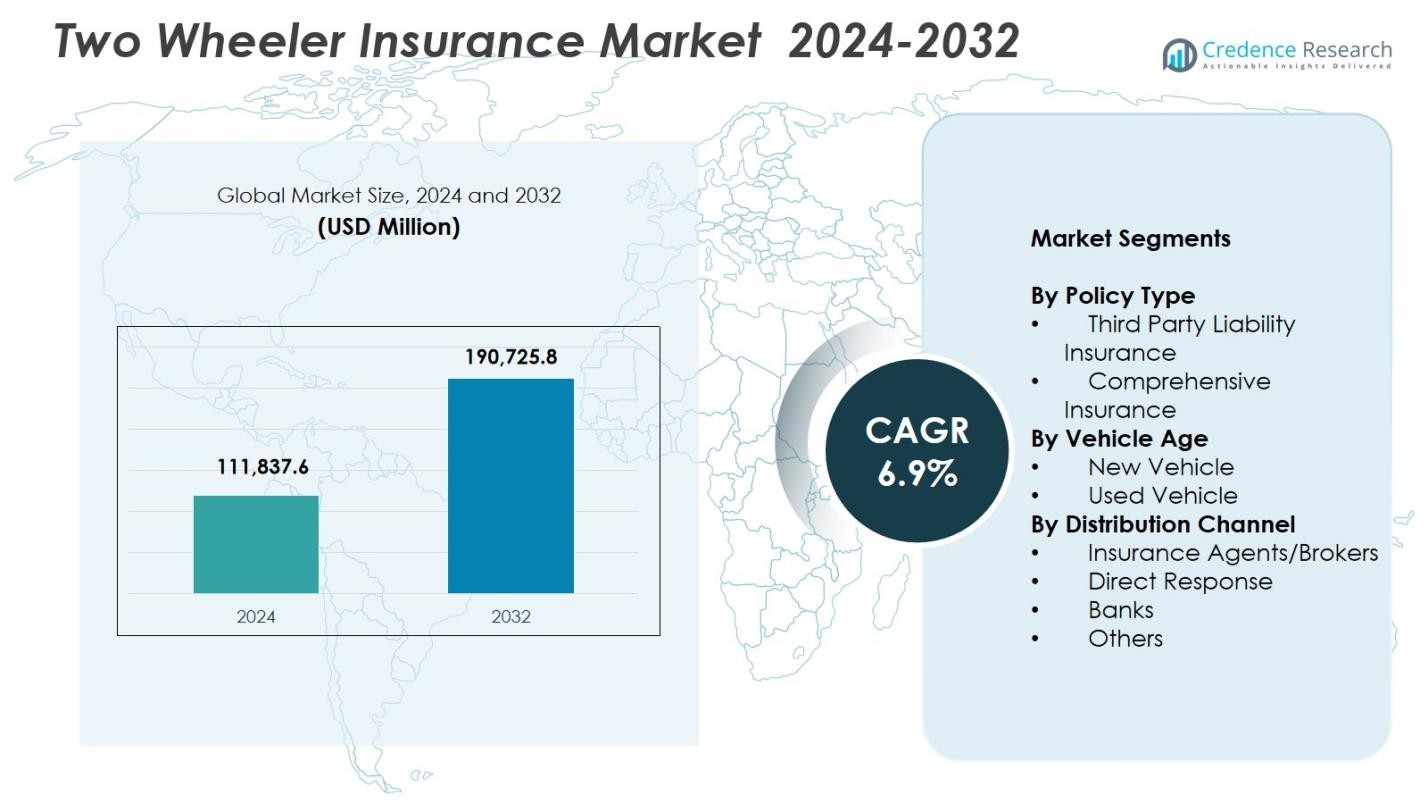
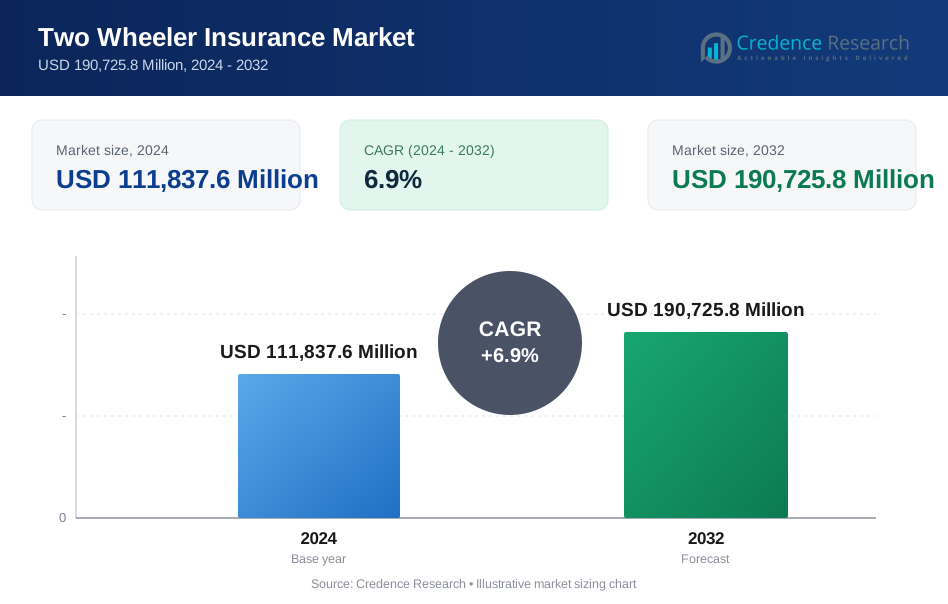
Two Wheeler Insurance Market size was valued at USD 111,837.6 Million in 2024 and is anticipated to reach USD 190,725.8 Million by 2032, at a CAGR of 6.9% during the forecast period.
| REPORT ATTRIBUTE | DETAILS |
|---|---|
| Historical Period | 2020-2023 |
| Base Year | 2024 |
| Forecast Period | 2025-2032 |
| Two Wheeler Insurance Market Size 2024 | USD 111,837.6 Million |
| Two Wheeler Insurance Market, CAGR | 6.9% |
| Two Wheeler Insurance Market Size 2032 | USD 190,725.8 Million |
Two Wheeler Insurance Market is shaped by leading insurers such as State Farm Mutual Automobile Insurance, GEICO, Allstate Insurance Company, Bajaj Allianz General Insurance, Farmers, Dairyland, Liberty General Insurance Ltd., ACKO General Insurance Limited, Progressive Casualty Insurance Company, and USAA, each strengthening their presence through product innovation, digital servicing, and expanded distribution networks. Asia-Pacific remained the dominant region in 2024 with a 71.6% share, driven by high two-wheeler density, strong regulatory enforcement, and growing adoption of comprehensive policies. Europe and North America followed, supported by rising motorcycle usage and strong insurer–OEM collaborations, reinforcing regional market expansion.
Market Insights
- Two Wheeler Insurance Market size reached USD 111,837.6 Million in 2024 and will grow USD 190,725.8 at a CAGR of 6.9% through 2032.
- Rising two-wheeler ownership and mandatory insurance regulations strongly drive market expansion, with Comprehensive Insurance holding a 62.4% share in 2024 due to higher protection demand.
- Digital adoption, telematics-based pricing, and customizable add-on covers represent key trends reshaping product innovation and improving customer engagement.
- Leading insurers enhance their presence through AI-based underwriting, faster claims processing, and strong OEM partnerships, improving policy penetration across new and used vehicle segments.
- Asia-Pacific dominated with a 71.6% regional share, followed by Europe at 9.8% and North America at 7.9%, reflecting strong mobility patterns and varying insurance maturity across global markets.
 Market Segmentation Analysis:
By Policy Type
The Two Wheeler Insurance Market is led by Comprehensive Insurance, holding a 62.4% share in 2024, driven by rising accident rates, increasing consumer awareness of full financial protection, and growth in high-value motorcycles requiring broader coverage. Comprehensive policies attract customers with add-ons such as zero depreciation, roadside assistance, and engine protection, strengthening adoption across both urban and semi-urban markets. Third Party Liability Insurance, while mandatory, accounts for the remaining market share as budget-conscious riders prefer basic legal compliance; however, insurers continue to push comprehensive plans through bundled features and digital promotions.
- For instance, Tata AIG offers its Auto Secure Two Wheeler Package Policy, which bundles own-damage coverage with third-party liability and includes ₹15 lakhs personal accident cover for the owner-driver.
By Vehicle Age
New Vehicles dominated the vehicle age segment with a 58.7% share in 2024, supported by regulatory requirements mandating multi-year policies for new two-wheelers and increased preference for comprehensive coverage during vehicle purchase. OEM-insurance partnerships and dealership-level bundling strongly influence buyer decisions, ensuring higher penetration in the new vehicle category. The Used Vehicle segment, holding the balance of the share, grows steadily as digital verification tools, telematics-based risk assessment, and simplified renewal processes improve trust and affordability for previously owned two-wheelers.
- For instance, Roadzen partnered with a top global two-wheeler OEM serving over 60 million two-wheelers in India to launch AI-powered connected roadside assistance for new electric vehicles, accessible via dashboard or app for seamless support.
By Distribution Channel
Insurance Agents/Brokers held the dominant position with a 46.3% share in 2024, driven by strong offline networks, personalized policy guidance, and higher conversion rates among first-time buyers. Their influence remains strong in rural and semi-urban regions where in-person assistance is preferred. Direct Response channels follow closely, supported by rapid expansion of digital platforms, instant policy issuance, and competitive pricing. Banks and Others contribute the remaining segment share as bancassurance partnerships grow and e-commerce, fintech platforms, and OEM-integrated insurance solutions attract younger, digitally active customers.
Key Growth Drivers
Rising Two-Wheeler Ownership Across Urban and Semi-Urban Regions
Rapid growth in two-wheeler sales, particularly in densely populated urban and expanding semi-urban regions, drives the Two Wheeler Insurance Market significantly. Increasing affordability, convenient financing, and congestion-friendly mobility solutions boost motorcycle and scooter adoption. Mandatory insurance regulations further support policy uptake as new vehicle owners prioritize immediate coverage. The surge in delivery and gig-economy riders also amplifies demand for broader protection plans. Together, these dynamics strengthen overall market expansion and encourage insurers to develop tailored offerings for diverse rider profiles.
- For instance, Honda Activa crossed 35 million cumulative sales in India by 2025, revolutionizing urban scooter mobility since 2001 with milestones of 10 million by 2015 and 20 million by 2018. It contributes over 50% to Honda's two-wheeler sales.
Mandatory Motor Insurance Regulations Strengthening Market Penetration
Government regulations mandating third-party insurance and promoting long-term coverage for new vehicles remain a major growth catalyst. Enforcement measures, digital verification systems, and penalties for uninsured vehicles have increased adherence across regions. Regulatory pushes toward multi-year policies enhance renewal stability and reduce coverage lapses. Additionally, authorities encourage digital policy issuance, improving accessibility and compliance. As regulatory frameworks evolve to address road safety and accident risk, insurers witness sustained demand, creating a resilient foundation for growth in both basic and comprehensive policies.
- For instance, under the Motor Vehicles (Amendment) Act 2019, first-time offenders driving without valid insurance face a fine of ₹2,000 and/or up to three months imprisonment, with repeat offences escalating to ₹4,000 and/or the same jail term.
Digital Distribution Expansion and Insurtech Innovation
The rapid adoption of digital channels, AI-based underwriting, and seamless online policy issuance drives substantial growth in the Two Wheeler Insurance Market. Insurtech platforms simplify comparison, customization, and instant claim filing, appealing to tech-savvy consumers. Data analytics, telematics, and automated risk assessment improve pricing accuracy and enhance customer satisfaction. Subscription-based renewals, mobile-first experiences, and digital KYC processes further accelerate market penetration. This transformation enhances operational efficiency for insurers while enabling customers to access more transparent, affordable, and personalized coverage.
Key Trends & Opportunities
Rising Demand for Add-On Covers and Customizable Insurance Products
A growing shift toward personalized insurance solutions presents a major opportunity for market players. Riders increasingly opt for add-ons such as zero-depreciation, roadside assistance, personal accident cover, and engine protection to enhance financial security. Premium two-wheeler owners, delivery riders, and frequent commuters drive demand for advanced riders. Insurers respond by offering modular, customizable plans tailored to riding habits and vehicle types. This trend supports market premiumization and encourages insurers to innovate through flexible, value-added features and subscription-based add-on models.
- For instance, HDFC ERGO includes optional personal accident cover up to ₹15 lakhs and zero depreciation add-ons in its comprehensive plans, with emergency roadside assistance available for repairs anywhere.
Telematics Adoption Enabling Usage-Based and Behavior-Based Insurance Models
The integration of telematics devices and smartphone-based monitoring opens significant opportunities for usage-based and behavior-based insurance models. Real-time driving data helps insurers reward safe riders with lower premiums while reducing risk-related losses. Delivery fleets and commercial two-wheeler operators increasingly adopt telematics-driven policies to optimize cost and safety. As connected mobility grows, insurers can implement dynamic pricing, automated claim validation, and proactive risk alerts. This evolution positions telematics as a transformative trend shaping the future of two-wheeler insurance offerings.
- For instance, Zurich Kotak General Insurance leverages telematics devices in its bike insurance policies to track real-time data such as distance traveled, speed, braking patterns, and driving times. The data supports personalized premiums and incentivizes safer riding habits among policyholders.
Key Challenges
High Claim Fraud Incidences and Limited Risk Transparency
The Two Wheeler Insurance Market faces persistent challenges from fraudulent claims, staged accidents, and manipulated repair costs, which elevate insurer losses. Limited access to verified customer and vehicle data further complicates accurate risk assessment. Small workshops and unorganized repair networks amplify inconsistencies in claim estimates. Although digital tools and AI-driven fraud detection systems help mitigate risks, enforcement gaps remain. These challenges increase operational burdens for insurers and contribute to higher premiums for genuine policyholders.
Low Insurance Penetration in Rural Markets and Renewal Lapses
Despite regulatory requirements, insurance penetration remains low in rural regions due to limited awareness, affordability concerns, and reliance on informal transport practices. Many riders allow policies to lapse after the first year, reducing long-term market stability. Lack of digital literacy and limited distribution channels further hinder rural adoption. Insurers struggle to maintain renewal rates without targeted outreach. Expanding micro-insurance products, simplified digital processes, and rural agent networks is essential to overcome this barrier and unlock untapped growth potential.
Regional Analysis
Asia-Pacific
Asia-Pacific led the Two Wheeler Insurance Market with a 71.6% share in 2024, driven by high two-wheeler ownership, expanding urban mobility, and strong regulatory enforcement in countries such as India, China, Indonesia, and Vietnam. The surge in delivery services and rising disposable incomes further boosts demand for comprehensive insurance plans. Government initiatives promoting digital insurance adoption and multi-year policies strengthen market penetration. Increasing OEM–insurer partnerships at the dealership level continue to shape customer preferences. The region’s rapid economic growth and large commuter base position Asia-Pacific as the core revenue generator throughout the forecast period.
Europe
Europe accounted for a 9.8% share in 2024, supported by rising adoption of motorcycles for leisure and urban commuting, especially in Italy, Spain, Germany, and France. Strong road safety regulations, higher vehicle maintenance standards, and well-established insurance frameworks contribute to steady market expansion. The region shows increasing demand for premium comprehensive policies, reflecting the popularity of high-end motorcycles. Digitalization of insurance services and the emergence of telematics-based pricing models enhance consumer engagement. Growth is further encouraged by insurer initiatives promoting personalized products tailored to commuter behavior and evolving mobility trends.
North America
North America held a 7.9% share in 2024, driven by a stable market for motorcycles used for leisure, sports, and adventure touring. The United States dominates the regional landscape due to strong penetration of comprehensive insurance products and a mature regulatory structure. Consumer preference for high-value bikes supports higher premium generation. Additionally, digital insurance adoption, improved risk assessment tools, and rising interest in add-on protection features enhance policy uptake. Market growth continues as insurers expand telematics-based offerings and strengthen partnerships with motorcycle manufacturers and dealerships to streamline purchase-linked insurance.
Latin America
Latin America captured a 6.3% share in 2024, with countries such as Brazil, Argentina, Colombia, and Mexico contributing significantly to demand. Growing urban congestion drives motorcycle adoption as a cost-effective mobility solution, directly boosting insurance requirements. Regulatory authorities increasingly enforce mandatory third-party policies, improving market penetration. Economic fluctuations influence premium affordability, yet digital channels and micro-insurance offerings are expanding access. The region also benefits from rising delivery service usage and improving financial inclusion. Enhanced insurer focus on localized distribution strategies continues to strengthen market presence across Latin America.
Middle East & Africa
The Middle East & Africa region held a 4.4% share in 2024, driven by rising motorcycle usage in Africa for essential mobility and increasing adoption in Middle Eastern urban centers. Gradual improvements in insurance regulations and road safety awareness support moderate market expansion. Affordability challenges and low awareness remain constraints, particularly in rural areas. However, digital distribution, mobile-based policy renewal, and government-led compliance measures are improving accessibility. Growth is supported by expanding gig-economy transportation and efforts by insurers to introduce low-cost, simplified plans tailored to income-sensitive riders across the region.
Market Segmentations:
By Policy Type
- Third Party Liability Insurance
- Comprehensive Insurance
By Vehicle Age
- New Vehicle
- Used Vehicle
By Distribution Channel
- Insurance Agents/Brokers
- Direct Response
- Banks
- Others
By Geography
- North America
- U.S.
- Canada
- Mexico
- Europe
- Germany
- France
- U.K.
- Italy
- Spain
- Rest of Europe
- Asia Pacific
- China
- Japan
- India
- South Korea
- South-east Asia
- Rest of Asia Pacific
- Latin America
- Brazil
- Argentina
- Rest of Latin America
- Middle East & Africa
- GCC Countries
- South Africa
- Rest of the Middle East and Africa
Competitive Landscape
The competitive landscape of the Two Wheeler Insurance Market is shaped by leading insurers such as STATE FARM MUTUAL AUTOMOBILE INSURANCE, GEICO, ALLSTATE INSURANCE COMPANY, Bajaj Allianz General Insurance, Farmers, Dairyland, Liberty General Insurance Ltd., ACKO General Insurance Limited, Progressive Casualty Insurance Company, and USAA. Market players focus on product differentiation through customized add-on covers, digital-first policy issuance, and telematics-driven premium models to strengthen customer retention. Insurers increasingly invest in AI-based underwriting, automated claims processing, and fraud detection to enhance operational efficiency and service accuracy. Strategic partnerships with OEMs, fintech platforms, and dealership networks significantly expand customer reach, particularly across emerging markets with rising two-wheeler ownership. Companies also intensify efforts to improve renewal rates through subscription-based models, reward programs for safe riding, and mobile-based engagement tools. As competition heightens, insurers prioritize customer experience, competitive pricing strategies, and innovation to capture market share in a rapidly evolving mobility landscape.
Key Player Analysis
- Liberty General Insurance Ltd.
- GEICO
- Progressive Casualty Insurance Company
- Bajaj Allianz General Insurance
- Farmers
- USAA
- ALLSTATE INSURANCE COMPANY
- Dairyland
- ACKO General Insurance Limited
- STATE FARM MUTUAL AUTOMOBILE INSURANCE
Recent Developments
- In March 2025, PhonePe launched a new vehicle insurance offering specifically for two-wheelers and four-wheelers, enabling users to compare policies digitally and save up to ₹4,000 compared to dealership prices.
- In January 2025, Sentry Insurance acquired The General for USD 1.7 billion, bolstering its non-standard motor insurance segment that includes two-wheeler coverage for higher-risk riders.
Report Coverage
The research report offers an in-depth analysis based on Policy Type, Vehicle Age, Distribution Channel and Geography. It details leading market players, providing an overview of their business, product offerings, investments, revenue streams, and key applications. Additionally, the report includes insights into the competitive environment, SWOT analysis, current market trends, as well as the primary drivers and constraints. Furthermore, it discusses various factors that have driven market expansion in recent years. The report also explores market dynamics, regulatory scenarios, and technological advancements that are shaping the industry. It assesses the impact of external factors and global economic changes on market growth. Lastly, it provides strategic recommendations for new entrants and established companies to navigate the complexities of the market.
Future Outlook
- The market will experience steady growth as rising two-wheeler ownership strengthens long-term insurance demand.
- Digital insurance adoption will expand rapidly, driven by mobile-first policy issuance and automated claim processing.
- Telematics-enabled, behavior-based premium models will gain wider acceptance among insurers and customers.
- Customized add-on covers will become essential as consumers seek more personalized protection solutions.
- OEM–insurer partnerships will intensify, making bundled insurance a standard part of new vehicle purchases.
- AI-driven underwriting and fraud detection will significantly improve risk assessment accuracy.
- Rural and semi-urban penetration will increase as insurers introduce low-cost micro-insurance products.
- Renewal rates will improve with subscription-based models and digital reminders enhancing customer retention.
- Insurtech platforms will shape future competition by offering seamless comparison and customized policy options.
- Sustainability initiatives will drive insurers to develop eco-friendly products aligned with electric two-wheeler adoption.
Request a Free Sample
Fill in your details and we'll send you a free sample report.
- Sample data tables & charts
- Research methodology
Need a Custom Version of This Report?
Tailor the scope, geography, or segments to your exact requirements.
- Custom geography or segment scope
- Direct access to our analyst team
Frequently Asked Questions
What is the current market size for Two Wheeler Insurance Market, and what is its projected size in 2032?
At what Compound Annual Growth Rate is the Two Wheeler Insurance Market projected to grow between 2025 and 2032?
Which Two Wheeler Insurance Market segment held the largest share in 2024?
What are the primary factors fueling the growth of the Two Wheeler Insurance Market?
Who are the leading companies in the Two Wheeler Insurance Market?
Which region commanded the largest share of the Two Wheeler Insurance Market in 2024?
Table of Content
Chapter 1. Report Introduction
- 1.1 Report Description & Purpose
- 1.1.1 Report Title & Market Definition
- 1.1.2 Unique Selling Propositions (USP) & Key Differentiators
- 1.1.3 Value Proposition for Stakeholders
- 1.2 Research Objectives
- 1.2.1 Market Sizing Objectives (Volume & Revenue)
- 1.2.2 Segmentation Objectives
- 1.2.3 Competitive Intelligence Objectives
- 1.2.4 Forecast & Scenario Objectives
- 1.3 Report Scope
- 1.3.1 Two Wheeler Insurance Scope – Types & Subtypes Covered
- 1.3.2 Geographic Scope – Regions & Countries Covered
- 1.3.3 Historical Period, Base Year & Forecast Period (2024; forecast to 2032)
- 1.3.4 Inclusions & Exclusions
- 1.4 HS Code & Classification Framework
- 1.5 Currency, Units & Pricing Basis
- 1.6 Target Stakeholders
- 1.7 Limitations & Assumptions
Chapter 2. Executive Summary
- 2.1 Global Two Wheeler Insurance Market Snapshot
- 2.1.1 Market Size – Historical (2024) & Forecast (2024-2032) (2024: USD 111,837.6 Million → 2032: USD 190,725.8 Million)
- 2.1.2 Volume & Revenue – Global Totals
- 2.1.3 Key Market Highlights – Top Five Facts
- 2.2 Two Wheeler Insurance Market Segmentation Snapshot
- 2.2.1 Market Split by Region – 2024 vs. 2032
- 2.3 Competitive Snapshot
- 2.3.1 Top 10 Players by Revenue Share – 2024
- 2.3.2 Top 10 Players by Volume Share – 2024
- 2.3.3 Recent Strategic Developments (18-Month Summary)
- 2.4 Key Investment Highlights & Strategic Conclusions
Chapter 3. Two Wheeler Insurance Market Dynamics & Industry Analysis
- 3.1 Market Overview & Context
- 3.1.1 Two Wheeler Insurance Market Position in the Broader Automotive Value Chain
- 3.1.2 OEM vs. Replacement Market Dynamics
- 3.1.3 Market Maturity & Development Stage by Region
- 3.2 Two Wheeler Insurance Market Drivers
- 3.3 Two Wheeler Insurance Market Restraints & Challenges
- 3.4 Two Wheeler Insurance Market Opportunities
- 3.5 Porter's Five Forces Analysis
- 3.5.1 Threat of New Entrants
- 3.5.2 Bargaining Power of Suppliers
- 3.5.3 Bargaining Power of Buyers
- 3.5.4 Threat of Substitutes
- 3.5.5 Competitive Rivalry – Intensity Assessment
- 3.6 Two Wheeler Insurance Value Chain Analysis
- 3.6.1 Upstream – Raw Material/Input Suppliers
- 3.6.1.1 Raw Material/Input 1
- 3.6.1.2 Raw Material/Input 2
- 3.6.1.3 Raw Material/Input 3
- 3.6.2 Midstream – Production/Manufacturing/Service Delivery
- 3.6.2.1 Production/Process Overview
- 3.6.2.2 Key Facility Locations & Capacity by Manufacturer
- 3.6.3 Downstream – Distribution & End Consumer
- 3.6.3.1 Primary Channel – B2B/OEM
- 3.6.3.2 Secondary Channels – Dealer, Retail, Online, Direct
- 3.6.4 Value Chain Profitability Analysis
- 3.6.1 Upstream – Raw Material/Input Suppliers
- 3.7 PESTEL Analysis
- 3.7.1 Political Factors
- 3.7.2 Economic Factors
- 3.7.3 Social Factors
- 3.7.4 Technological Factors
- 3.7.5 Environmental Factors
- 3.7.6 Legal Factors
- 3.8 Two Wheeler Insurance Supply Chain Analysis
- 3.8.1 Raw Material/Input Supply Risk Assessment
- 3.8.2 Manufacturing Concentration Risk (Geographic Exposure)
- 3.8.3 Trade Disruption Impact Analysis
- 3.9 Regulatory & Policy Landscape
Note: The regulatory and policy landscape section covers regulations based on their applicability to the market, Two Wheeler Insurance category, geography, and scope of the study. Only regulatory frameworks with a material impact on operations, compliance, trade, sustainability, or market access are analyzed in detail.
Chapter 4. Key Investment Pockets & Opportunity Analysis
- 4.1 Two Wheeler Insurance Market Attractiveness Analysis
- 4.1.1 By Region – Investment Attractiveness Matrix (Volume × CAGR)
- 4.2 Absolute Revenue Growth Opportunity
- 4.2.1 By Region – Absolute USD Growth Through 2032
- 4.3 Incremental Volume Opportunity
- 4.3.1 By Region – Incremental Volume Through 2032
- 4.3.2 Segment – Incremental Volume
- 4.4 Emerging Submarket Opportunity Deep Dive (Subject to Applicability)
- 4.5 Emerging Market Opportunity Scorecards
- 4.5.1 United States
- 4.5.2 Europe
- 4.5.3 Asia
- 4.5.4 Middle East & Africa
Note: Emerging Market Opportunity Scorecards will be included based on relevance and strategic importance. Regions listed are indicative and may vary depending on data availability and market dynamics.
Chapter 5. Two Wheeler Insurance Import-Export Analysis & Trade Flows
- 5.1 Global Trade Overview
- 5.1.1 Global Export Value by Country (2024)
- 5.1.2 Global Export Volume by Country (2024)
- 5.1.3 Global Import Value by Country (2024)
- 5.1.4 Global Import Volume by Country (2024)
- 5.1.5 Net Trade Balance by Country (2024)
- 5.2 Export Analysis – Segment
- 5.2.1 Type 1 (HS Code)
- 5.2.2 Type 2 (HS Code)
- 5.2.3 Type 3 (HS Code)
- 5.2.4 Type 4 (HS Code)
- 5.2.5 Type 5 (HS Code)
- 5.3 Import Analysis – Segment
- 5.3.1 Type 1 (HS Code)
- 5.3.2 Type 2 (HS Code)
- 5.3.3 Type 3 (HS Code)
- 5.3.4 Type 4 (HS Code)
- 5.3.5 Type 5 (HS Code)
- 5.4 Average Unit Trade Prices
- 5.4.1 Average Export Price – Segment & Country
- 5.4.2 Average Import Price – Segment & Source Country
- 5.4.3 Price Trends (2024)
- 5.5 Key Trade Route Analysis
- 5.5.1 Trade Route 1
- 5.5.2 Trade Route 2
- 5.5.3 Trade Route 3
- 5.5.4 Trade Route 4
- 5.5.5 Trade Route 5
- 5.6 Trade Policy Impact Assessment
- 5.6.1 US Anti-Dumping & Section 301 Tariffs
- 5.6.2 EU Customs Union Impact
- 5.6.3 Major Free Trade Agreements
- 5.6.4 USMCA Rules of Origin
Note: Trade policy analysis will be included only where relevant to the Two Wheeler Insurance market.
Chapter 6. Competitive Landscape & Company Benchmarking
- 6.1 Two Wheeler Insurance Market Concentration & Structure
- 6.1.1 Herfindahl-Hirschman Index (HHI) – vs. 2024
- 6.1.2 Tier 1, Tier 2 & Tier 3 Market Structure
- 6.1.3 Global, Regional & Local Player Dynamics
- 6.2 Two Wheeler Insurance Market Share Analysis – 2024
- 6.2.1 Global Revenue Share by Company
- 6.2.2 Global Volume Share by Company
- 6.2.3 Regional Revenue Share
- 6.2.4 Market Share Evolution ( vs. 2024)
- 6.2.5 OEM Segment Share by Company
- 6.2.6 Replacement Segment Share by Company
- 6.3 Production/Delivery Capacity & Facility Analysis
- 6.3.1 Global Installed Capacity
- 6.3.2 Capacity Utilization Rates
- 6.3.3 Production/Output Volume
- 6.3.4 Facility Locations & Capacity Map
- 6.3.5 Planned Capacity Additions
- 6.4 Two Wheeler Insurance Competitive Benchmarking Matrix
- 6.4.1 Revenue, Volume, CAGR & Profitability Comparison
- 6.4.2 Channel Revenue Mix
- 6.4.3 Geographic Revenue Exposure
- 6.4.4 R&D Intensity
- 6.4.5 Sustainability Maturity
- 6.5 Strategic Developments in Two Wheeler Insurance (Last 24 Months)
- 6.5.1 Mergers, Acquisitions & Divestments
- 6.5.2 New Two Wheeler Insurance Launches
- 6.5.3 Facility Expansions
- 6.5.4 Strategic Alliances, Joint Ventures & Partnerships
- 6.5.5 Distribution Expansion & Market Entry
- 6.5.6 Sustainability & ESG Initiatives
- 6.6 Competitive Strategy Mapping
- 6.6.1 Leader, Challenger, Follower & Niche Classification
- 6.6.2 Pricing Strategy Comparison
- 6.6.3 Channel Strategy Matrix
Note: Strategic developments are included based on their materiality and the availability of reliable information.
Chapter 7. Global Two Wheeler Insurance Market – By Distribution Channel
- 7.1 Segment Overview
- 7.1.1 Volume & Revenue Split by Channel (2024 & 2032)
- 7.1.2 Channel Mix Evolution (2024-2032)
Chapter 8. Regional Market Analysis – Global Overview
- 8.1 Global Regional Overview
- 8.1.1 Regional Volume Share
- 8.1.2 Regional Revenue Share
- 8.1.3 Regional Volume by Region
- 8.1.4 Regional Revenue by Region
- 8.1.5 Regional Forecast Through 2032
- 8.2 Cross-Regional Segment Analysis
- 8.2.1 By Distribution Channel
- 8.2.2 By Brand/Price Tier
Chapter 9. North America Two Wheeler Insurance Market
- 9.1 United States
- 9.2 Canada
- 9.3 Mexico
Chapter 10. Europe Two Wheeler Insurance Market
- 10.1 Germany
- 10.2 France
- 10.3 Italy
- 10.4 United Kingdom
- 10.5 Spain
- 10.6 Poland
- 10.7 Russia
- 10.8 Netherlands
- 10.9 Belgium
- 10.10 Sweden
- 10.11 Denmark
- 10.12 Norway
- 10.13 Rest of Europe
Chapter 11. Asia Pacific Two Wheeler Insurance Market
- 11.1 China
- 11.2 India
- 11.3 Japan
- 11.4 South Korea
- 11.5 Thailand
- 11.6 Indonesia
- 11.7 Vietnam
- 11.8 Malaysia
- 11.9 Australia
- 11.10 Rest of Asia Pacific
Chapter 12. Latin America Two Wheeler Insurance Market
- 12.1 Brazil
- 12.2 Argentina
- 12.3 Colombia
- 12.4 Chile
- 12.5 Rest of Latin America
Chapter 13. Middle East Two Wheeler Insurance Market
- 13.1 Saudi Arabia
- 13.2 United Arab Emirates
- 13.3 Turkey
- 13.4 Israel
- 13.5 Iran
- 13.6 Rest of the Middle East
Chapter 14. Africa Two Wheeler Insurance Market
- 14.1 South Africa
- 14.2 Egypt
- 14.3 Nigeria
- 14.4 Morocco
- 14.5 Rest of Africa
Chapter 15. Two Wheeler Insurance Company Profiles
- 15.1 [Company 01]
- 15.1.1 Company Overview
- 15.1.2 Key Management Personnel
- 15.1.3 Products & Services Portfolio
- 15.1.4 Financial Performance
- 15.1.5 Key Market Focus & Geographic Presence
- 15.1.6 Recent Developments & Strategic Initiatives
Note: The company profile list is preliminary and may change based on research findings, market developments, data availability, and client requirements.
Chapter 16. Appendices
- Appendix A – List of Abbreviations & Acronyms
- Appendix B – Industry Classification Code Reference – Full Series
- Appendix C – Production & Capacity Data Tables
- Appendix D – End-Use & Demand Base Tables
- Appendix E – Consumption & Replacement Rate Assumptions
- Appendix F – ASP Reference Tables
- Appendix G – Manufacturing & Facility Database
- Appendix H – Import-Export Data Tables
- Appendix I – Regulatory Summary Tables
- Appendix J – Primary Research Participant List (Anonymized)
- Appendix K – Primary Research Questionnaire Framework
- Appendix L – Data Sources & Bibliography
- Appendix M – Market Size Divergence & Source Comparison
Chapter 17. Research Methodology
- 17.1 Research Framework & Philosophy
- 17.2 Secondary Research – Sources, Hierarchy & Data Extraction
- 17.3 Data Modeling – Bottom-Up & Top-Down Market Sizing
- 17.4 Primary Research – Stakeholder Framework, LOI & Sample Sizes
- 17.5 Forecast Methodology – Regression, Scenario & Sensitivity Analysis
- 17.6 Quality Control – Four-Layer Validation Framework
- 17.7 Limitations & Standard Assumptions
- 17.8 Disclaimer
