
Market Overview:
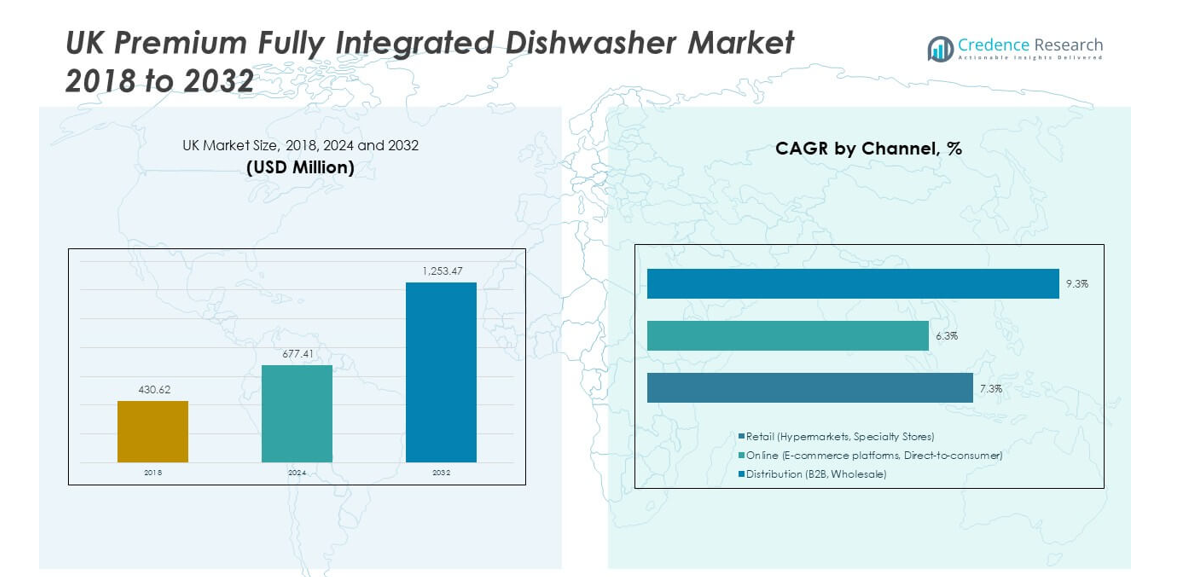
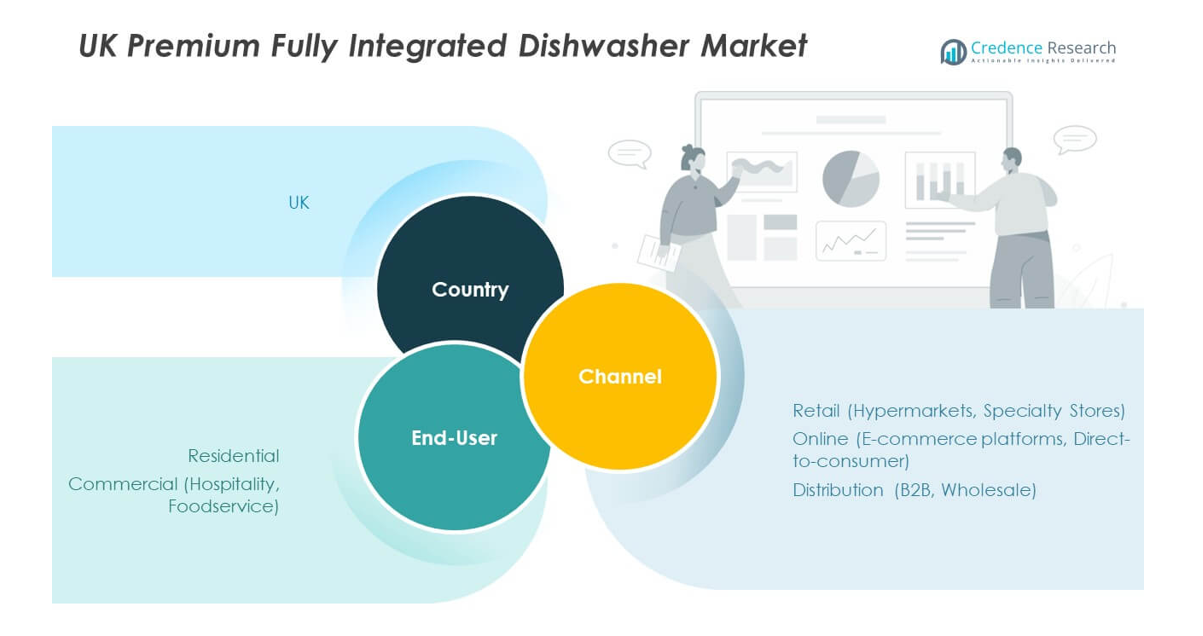
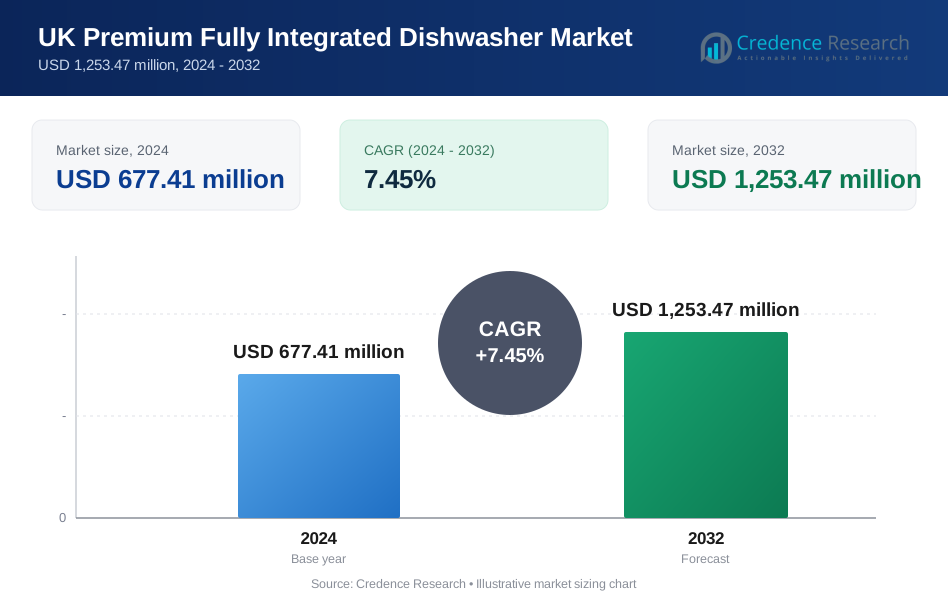
The UK Premium Fully Integrated Dishwasher Market size was valued at USD 430.62 million in 2018 to USD 677.41 million in 2024 and is anticipated to reach USD 1,253.47 million by 2032, at a CAGR of 7.45% during the forecast period.
| REPORT ATTRIBUTE | DETAILS |
|---|---|
| Historical Period | 2020-2023 |
| Base Year | 2024 |
| Forecast Period | 2025-2032 |
| UK Premium Fully Integrated Dishwasher Market Size 2024 | USD 677.41 million |
| UK Premium Fully Integrated Dishwasher Market, CAGR | 7.45% |
| UK Premium Fully Integrated Dishwasher Market Size 2032 | USD 1,253.47 million |
The UK Premium Fully Integrated Dishwasher Market grows due to strong demand for built-in kitchens. Homeowners prefer seamless appliances that match modern cabinet designs. Rising urban housing supports compact and premium kitchen layouts. Consumers show higher spending on durable home appliances. Energy efficiency standards push buyers toward advanced dishwasher models. Quiet operation attracts buyers in apartments and shared housing. Smart features improve user control and cleaning performance. Brand focus on design strengthens premium category appeal. Retailers promote bundled kitchen solutions with integrated appliances.
The UK Premium Fully Integrated Dishwasher Market is led by England, driven by urban households. London and the South East dominate due to higher income levels. These areas favor premium kitchen renovations and new housing projects. The Midlands show steady demand from suburban developments. Northern England gains traction with modern housing upgrades. Scotland emerges through urban apartment growth in major cities. Wales and Northern Ireland remain smaller but stable markets. Regional retail networks influence brand visibility and adoption rates. Local building trends shape regional demand patterns.
Market Insights:
- The UK Premium Fully Integrated Dishwasher Market grew from USD 430.62 million in 2018 to USD 677.41 million in 2024 and is projected to reach USD 1,253.47 million by 2032, registering a CAGR of 7.45% during the forecast period.
- England holds the largest regional share at about 72%, driven by London and South East England. Scotland follows with around 14% due to urban demand. Wales accounts for nearly 8%, supported by housing upgrades.
- Scotland stands as the fastest-growing region with about 14% share, supported by apartment living, premium renovations, and demand for quiet integrated appliances in urban centers.
- By channel, retail dominates with nearly 48% share, led by specialty appliance stores and hypermarkets that influence premium purchase decisions and bundled kitchen sales.
- Online channels hold around 32% share, supported by e-commerce platforms and direct-to-consumer models, while distribution accounts for about 20%, driven by B2B and wholesale procurement.
Market Drivers:
Rising Demand For Seamless Built-In Kitchen Appliances
The UK Premium Fully Integrated Dishwasher Market benefits from modern kitchen preferences focused on clean layouts. Homeowners prefer appliances hidden behind matching cabinet panels. Integrated designs support minimal interior styles in premium homes. New housing projects increasingly adopt fully concealed kitchen equipment. Developers include integrated dishwashers in upscale apartments and condominiums. Renovation-focused households also replace freestanding units with integrated models. This shift sustains steady demand across urban and suburban areas.
- For instance, Miele’s fully integrated dishwashers support panel-ready installation, typically requiring a door panel thickness of at least 3/4" (18 mm) where the mounting brackets are attached, and must not exceed a specific maximum weight (e.g., 21 lbs or 9.5 kg for many G 800 series models) to ensure proper door function. These requirements enable a flush and seamless alignment within bespoke cabinetry designs.
Higher Consumer Spending On Premium Home Appliances
Rising disposable income supports demand for premium kitchen appliances. Consumers prioritize durability, performance, and brand value. Premium dishwashers reflect lifestyle upgrades and modern living standards. Buyers favor advanced wash programs and quiet operation. Brand reputation plays a strong role in final selection. Retail financing options reduce price barriers for premium models. This spending pattern strengthens long-term market growth.
- For instance, while Miele explicitly states that all of its dishwashers are tested for the equivalent of 20 years of usage (approximately 10,000 operating hours or 5 washes a week), Bosch does not provide a specific operating-hour rating. Instead, the typical lifespan for a Bosch dishwasher is estimated by experts and retailers to be between 10 to 15 years with proper maintenance, which is still above the industry average.
Energy Efficiency Regulations And Water Conservation Focus
Energy efficiency standards influence dishwasher purchase decisions. Households prefer models with lower power and water usage. Environmental awareness supports adoption of eco-friendly appliances. Manufacturers align premium designs with UK efficiency regulations. Product labeling highlights reduced resource consumption. Replacement demand rises as older models fail to meet standards. Policy alignment reinforces demand for premium integrated units.
Urban Living And Space-Optimized Housing Growth
Urban housing trends favor compact and functional kitchen layouts. Integrated dishwashers help optimize limited kitchen space. Apartment residents value quiet and vibration-free appliances. Developers select premium integrated units for noise control benefits. Smart layouts improve appliance acceptance in city homes. Demand remains strong across dense residential developments. Housing density supports consistent market stability.
Market Trends:
Integration Of Smart Controls And Connected Appliance Features
Smart technology adoption shapes premium dishwasher demand. Consumers prefer app-based control and real-time monitoring. Connected dishwashers integrate with wider smart home systems. Remote diagnostics improve maintenance planning and user convenience. Brands promote digital features to justify premium pricing. Intuitive interfaces enhance daily usage experience. Technology-led differentiation defines product positioning.
- For instance, Siemens Home Connect enables remote start, cycle status alerts, and fault diagnostics via smartphone, supporting connected kitchen ecosystems.
Focus On Ultra-Quiet Operation And Acoustic Performance
Noise reduction remains a key trend in premium dishwashers. Open-plan homes require silent kitchen appliances. Manufacturers emphasize low decibel performance in product design. Improved insulation enhances acoustic comfort during operation. Advanced motors reduce vibration and sound levels. Quiet cycles support night-time usage in apartments. Acoustic performance strengthens premium market appeal.
- For instance, Gaggenau premium integrated dishwashers operate at sound levels as low as 42 dB, supporting uninterrupted use in open living spaces.
Growth Of Design-Led Appliance Customization Options
Design flexibility gains importance among premium buyers. Consumers seek appliances that match cabinetry finishes. Panel-ready designs support seamless kitchen aesthetics. Interior designers influence demand for concealed appliances. Premium brands offer customization-friendly integration formats. Visual consistency affects final purchase decisions. Design-led demand continues to expand.
Expansion Of Online And Specialist Appliance Retail Channels
Digital platforms shape premium appliance research behavior. Consumers compare features through brand and retailer websites. Specialist retailers provide guided consultations and demos. Online reviews influence brand trust and selection. Virtual tools support informed purchase decisions. Retailers clearly communicate premium benefits online. Omnichannel strategies improve market penetration.
Market Challenges Analysis:
High Product Cost And Price Sensitivity Among Buyers
Premium fully integrated dishwashers carry high upfront costs. Price sensitivity limits adoption among mid-income households. Economic uncertainty affects discretionary appliance spending. Buyers compare premium models with mid-range alternatives. Limited discounting restricts volume growth potential. Retail margins constrain aggressive pricing strategies. Clear value communication remains critical for adoption.
Complex Installation And Limited Retrofit Compatibility
Integrated dishwashers require precise cabinet measurements. Older homes face retrofit and layout constraints. Installation complexity affects buyer confidence. Skilled labor availability influences project timelines. Consumers anticipate additional installation expenses. Retailers coordinate closely with kitchen installers. Installation challenges delay purchase decisions.
Market Opportunities:
Rising Kitchen Renovation And Home Upgrade Activities
Kitchen renovation activity continues across the UK. Homeowners invest in premium built-in appliances. Integrated dishwashers fit full kitchen remodel projects. Design-focused renovations favor concealed appliance formats. Retailers bundle appliances with cabinetry solutions. Replacement cycles support steady demand growth. Renovation-driven sales create repeat opportunities.
Innovation In Sustainable And Smart Premium Models
Sustainability opens new product differentiation paths. Manufacturers develop advanced water-saving technologies. Smart load detection improves wash efficiency. Energy-efficient motors lower long-term operating costs. Premium positioning supports innovation-led pricing. Eco-focused messaging resonates with modern buyers. Innovation strengthens long-term market potential.
Market Segmentation Analysis:
By Channel Segment
Retail channels play a strong role through hypermarkets and specialty appliance stores. Hypermarkets offer brand visibility and bundled promotions for premium buyers. Specialty appliance stores attract design-focused consumers seeking expert advice. Online channels grow through e-commerce platforms and direct-to-consumer models. Digital channels support feature comparison and price transparency. Distribution channels serve B2B sales and wholesale networks. These routes support bulk procurement for projects and developers.
- For instance, AEG partners with certified kitchen studios to deliver installation-ready integrated appliances, supporting project-based procurement.
By End-User Segment
Residential users dominate demand across urban households and premium housing projects. Urban households prefer integrated designs that save space and reduce noise. Premium housing projects specify built-in dishwashers as standard fixtures. Commercial demand comes from hospitality and foodservice establishments. Hotels value quiet operation and reliable performance. Foodservice outlets adopt premium models for hygiene and efficiency. End-user needs shape product positioning and channel focus.
- For instance, Electrolux Professional dishwashers support wash temperatures up to 90 °C, meeting commercial hygiene requirements while retaining integrated design appeal.
By Country Segment
England leads demand, driven by London, South East England, and the Midlands. London shows strong uptake due to high-income households and renovations. South East England benefits from new residential developments. The Midlands supports steady replacement demand. Scotland sees growth in urban residential markets. Wales records moderate demand from housing upgrades. Northern Ireland remains niche with small-scale premium adoption.
By Product Category
Fully integrated dishwashers dominate through panel-ready and smart integrated models. Panel-ready units support seamless kitchen aesthetics. Smart models improve control and efficiency. Premium built-in variants focus on silent operation and energy efficiency. Low-noise designs suit apartments and open layouts. Energy-efficient models appeal to sustainability-focused buyers. The UK Premium Fully Integrated Dishwasher Market reflects strong alignment between product design and user preferences.
Segmentation:
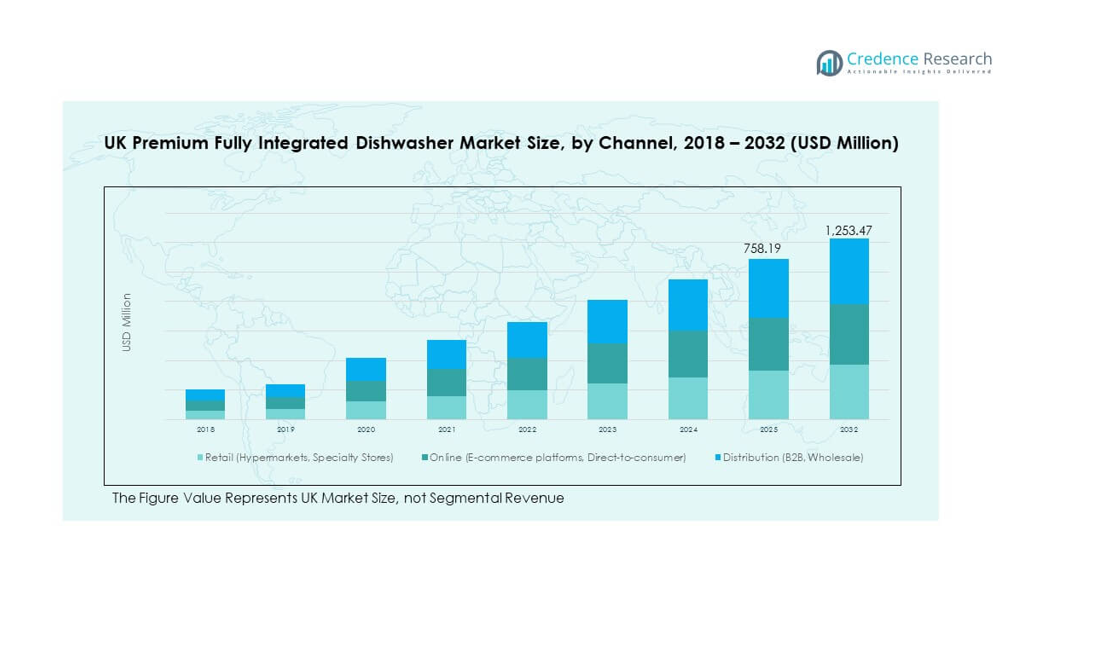
- By Channel Segment
- Retail
- Hypermarkets
- Specialty Appliance Stores
- Online
- E-commerce Platforms
- Direct-to-Consumer Channels
- Distribution
- B2B Sales
- Wholesale Networks
- By End-User Segment
- Residential
- Urban Households
- Premium Housing Projects
- Commercial
- Hospitality Sector
- Foodservice Establishments
- By Country Segment
- England
- London
- South East England
- Midlands
- Scotland
- Urban Residential Markets
- Wales
- Residential Housing Developments
- Northern Ireland
- Small-scale Premium Demand
- By Product Category
- Fully Integrated Dishwashers
- Panel-Ready Models
- Smart Integrated Models
- Premium Built-In Variants
- Silent Operation Models
- Energy-Efficient Models
Regional Analysis:
England
England dominates the regional landscape with an estimated market share of about 72%. London and South East England lead demand due to high-income households. Strong renovation activity supports premium appliance adoption. Open-plan living spaces increase preference for quiet integrated dishwashers. Developers specify premium models in new residential projects. Specialty appliance retailers have dense coverage across major cities. The UK Premium Fully Integrated Dishwasher Market benefits strongly from England’s mature housing and retail ecosystem.
Scotland
Scotland accounts for nearly 14% of the overall market share. Urban residential markets in cities like Edinburgh and Glasgow drive demand. Apartment living supports preference for space-efficient integrated appliances. Consumers value silent operation and energy efficiency. Premium kitchen upgrades gain traction among urban homeowners. Retail availability improves through regional appliance specialists. Stable housing demand supports consistent regional performance.
Wales and Northern Ireland
Wales holds around 8% market share, supported by residential housing developments. Home upgrades in suburban areas drive premium dishwasher adoption. Buyers focus on durability and long-term value. Northern Ireland contributes close to 6% of total demand. The region shows smaller but steady premium adoption. Limited urban density moderates volume growth. Select retailers and builders influence regional penetration.
Key Player Analysis:
Competitive Analysis:
The UK Premium Fully Integrated Dishwasher Market shows strong competition among global appliance brands. Players compete on design integration, quiet performance, and energy efficiency. Premium positioning depends on brand reputation and after-sales support. Companies invest in product refinement and smart features. Retail presence across specialty stores strengthens brand visibility. Strategic pricing supports premium margins without mass discounting. Innovation cycles remain steady across top brands. It reflects a balanced competitive structure with clear brand leaders.
Recent Developments:
- In September 2025, Gaggenau reinforced its luxury built‑in kitchen presence with the expansion of its Vario Expressive series, a modular premium cooling and storage line designed to integrate seamlessly into architect‑designed kitchens. While the announcement focused on refrigerators, freezers, fridge‑freezer combinations and wine cabinets, the launch underlines Gaggenau’s broader strategy in fully integrated, handleless, panel‑ready appliances that complement its existing high‑end dishwashers in bespoke UK kitchen projects.
- In May 2025, Siemens upgraded its UK high‑end fully integrated line‑up with the iQ700 SX87Y801BE fully integrated dishwasher, highlighted by UK retailer London Appliances. The model delivers a B energy efficiency class, 13 place settings, eight advanced programmes including Eco, Auto, Intelligent and Silence options, plus five special functions such as Remote Start, Shine & Dry, IntensiveZone, HygienePlus and varioSpeed Plus. With Home Connect capability, Zeolith drying, autoOpen dry and DoorOpen Assist for handleless kitchens, it is clearly targeted at the premium, fully integrated segment of the UK market.
Report Coverage:
The research report offers an in-depth analysis based on channel, end-user, country, and product segments. It details leading market players, providing an overview of their business, product offerings, investments, revenue streams, and key applications. Additionally, the report includes insights into the competitive environment, SWOT analysis, current market trends, as well as the primary drivers and constraints. Furthermore, it discusses various factors that have driven market expansion in recent years. The report also explores market dynamics, regulatory scenarios, and technological advancements that are shaping the industry. It assesses the impact of external factors and global economic changes on market growth. Lastly, it provides strategic recommendations for new entrants and established companies to navigate the complexities of the market.
Future Outlook:
- Premium kitchen renovations will remain a core demand driver.
- Integrated appliance adoption will rise in urban housing projects.
- Smart features will gain wider acceptance among premium buyers.
- Energy efficiency expectations will shape product development.
- Quiet operation will stay a critical purchase criterion.
- Online research will influence final buying decisions.
- Specialty retail channels will retain advisory importance.
- Brand-led differentiation will strengthen competitive positions.
- Sustainable materials will gain design relevance.
- Long-term replacement demand will support market stability.
Request a Free Sample
Fill in your details and we'll send you a free sample report.
- Sample data tables & charts
- Research methodology
Need a Custom Version of This Report?
Tailor the scope, geography, or segments to your exact requirements.
- Custom geography or segment scope
- Direct access to our analyst team
Frequently Asked Questions
What is the current market size for the UK Premium Fully Integrated Dishwasher Market, and what is its projected size in 2032?
At what Compound Annual Growth Rate is the UK Premium Fully Integrated Dishwasher Market projected to grow between 2024 and 2032?
Which UK Premium Fully Integrated Dishwasher Market segment held the largest share in 2024?
What are the primary factors fueling the growth of the UK Premium Fully Integrated Dishwasher Market?
Who are the leading companies in the UK Premium Fully Integrated Dishwasher Market?
Table of Content
Chapter 1. Report Introduction
- 1.1 Report Description & Purpose
- 1.1.1 Report Title & Market Definition
- 1.1.2 Unique Selling Propositions (USP) & Key Differentiators
- 1.1.3 Value Proposition for Stakeholders
- 1.2 Research Objectives
- 1.2.1 Market Sizing Objectives (Volume & Revenue)
- 1.2.2 Segmentation Objectives
- 1.2.3 Competitive Intelligence Objectives
- 1.2.4 Forecast & Scenario Objectives
- 1.3 Report Scope
- 1.3.1 UK Premium Fully Integrated Dishwasher Scope – Types & Subtypes Covered
- 1.3.2 Geographic Scope – Regions & Countries Covered
- 1.3.3 Historical Period, Base Year & Forecast Period (2024; forecast to 2032)
- 1.3.4 Inclusions & Exclusions
- 1.4 HS Code & Classification Framework
- 1.5 Currency, Units & Pricing Basis
- 1.6 Target Stakeholders
- 1.7 Limitations & Assumptions
Chapter 2. Executive Summary
- 2.1 Global UK Premium Fully Integrated Dishwasher Market Snapshot
- 2.1.1 Market Size – Historical (2024) & Forecast (2024-2032) (2024: USD 677.41 million → 2032: USD 1,253.47 million)
- 2.1.2 Volume & Revenue – Global Totals
- 2.1.3 Key Market Highlights – Top Five Facts
- 2.2 UK Premium Fully Integrated Dishwasher Market Segmentation Snapshot
- 2.2.1 Market Split by Region – 2024 vs. 2032
- 2.3 Competitive Snapshot
- 2.3.1 Top 10 Players by Revenue Share – 2024
- 2.3.2 Top 10 Players by Volume Share – 2024
- 2.3.3 Recent Strategic Developments (18-Month Summary)
- 2.4 Key Investment Highlights & Strategic Conclusions
Chapter 3. UK Premium Fully Integrated Dishwasher Market Dynamics & Industry Analysis
- 3.1 Market Overview & Context
- 3.1.1 UK Premium Fully Integrated Dishwasher Market Position in the Broader Automotive Value Chain
- 3.1.2 OEM vs. Replacement Market Dynamics
- 3.1.3 Market Maturity & Development Stage by Region
- 3.2 UK Premium Fully Integrated Dishwasher Market Drivers
- 3.3 UK Premium Fully Integrated Dishwasher Market Restraints & Challenges
- 3.4 UK Premium Fully Integrated Dishwasher Market Opportunities
- 3.5 Porter's Five Forces Analysis
- 3.5.1 Threat of New Entrants
- 3.5.2 Bargaining Power of Suppliers
- 3.5.3 Bargaining Power of Buyers
- 3.5.4 Threat of Substitutes
- 3.5.5 Competitive Rivalry – Intensity Assessment
- 3.6 UK Premium Fully Integrated Dishwasher Value Chain Analysis
- 3.6.1 Upstream – Raw Material/Input Suppliers
- 3.6.1.1 Raw Material/Input 1
- 3.6.1.2 Raw Material/Input 2
- 3.6.1.3 Raw Material/Input 3
- 3.6.2 Midstream – Production/Manufacturing/Service Delivery
- 3.6.2.1 Production/Process Overview
- 3.6.2.2 Key Facility Locations & Capacity by Manufacturer
- 3.6.3 Downstream – Distribution & End Consumer
- 3.6.3.1 Primary Channel – B2B/OEM
- 3.6.3.2 Secondary Channels – Dealer, Retail, Online, Direct
- 3.6.4 Value Chain Profitability Analysis
- 3.6.1 Upstream – Raw Material/Input Suppliers
- 3.7 PESTEL Analysis
- 3.7.1 Political Factors
- 3.7.2 Economic Factors
- 3.7.3 Social Factors
- 3.7.4 Technological Factors
- 3.7.5 Environmental Factors
- 3.7.6 Legal Factors
- 3.8 UK Premium Fully Integrated Dishwasher Supply Chain Analysis
- 3.8.1 Raw Material/Input Supply Risk Assessment
- 3.8.2 Manufacturing Concentration Risk (Geographic Exposure)
- 3.8.3 Trade Disruption Impact Analysis
- 3.9 Regulatory & Policy Landscape
Note: The regulatory and policy landscape section covers regulations based on their applicability to the market, UK Premium Fully Integrated Dishwasher category, geography, and scope of the study. Only regulatory frameworks with a material impact on operations, compliance, trade, sustainability, or market access are analyzed in detail.
Chapter 4. Key Investment Pockets & Opportunity Analysis
- 4.1 UK Premium Fully Integrated Dishwasher Market Attractiveness Analysis
- 4.1.1 By Region – Investment Attractiveness Matrix (Volume × CAGR)
- 4.2 Absolute Revenue Growth Opportunity
- 4.2.1 By Region – Absolute USD Growth Through 2032
- 4.3 Incremental Volume Opportunity
- 4.3.1 By Region – Incremental Volume Through 2032
- 4.3.2 Segment – Incremental Volume
- 4.4 Emerging Submarket Opportunity Deep Dive (Subject to Applicability)
- 4.5 Emerging Market Opportunity Scorecards
- 4.5.1 United States
- 4.5.2 Europe
- 4.5.3 Asia
- 4.5.4 Middle East & Africa
Note: Emerging Market Opportunity Scorecards will be included based on relevance and strategic importance. Regions listed are indicative and may vary depending on data availability and market dynamics.
Chapter 5. UK Premium Fully Integrated Dishwasher Import-Export Analysis & Trade Flows
- 5.1 Global Trade Overview
- 5.1.1 Global Export Value by Country (2024)
- 5.1.2 Global Export Volume by Country (2024)
- 5.1.3 Global Import Value by Country (2024)
- 5.1.4 Global Import Volume by Country (2024)
- 5.1.5 Net Trade Balance by Country (2024)
- 5.2 Export Analysis – Segment
- 5.2.1 Type 1 (HS Code)
- 5.2.2 Type 2 (HS Code)
- 5.2.3 Type 3 (HS Code)
- 5.2.4 Type 4 (HS Code)
- 5.2.5 Type 5 (HS Code)
- 5.3 Import Analysis – Segment
- 5.3.1 Type 1 (HS Code)
- 5.3.2 Type 2 (HS Code)
- 5.3.3 Type 3 (HS Code)
- 5.3.4 Type 4 (HS Code)
- 5.3.5 Type 5 (HS Code)
- 5.4 Average Unit Trade Prices
- 5.4.1 Average Export Price – Segment & Country
- 5.4.2 Average Import Price – Segment & Source Country
- 5.4.3 Price Trends (2024)
- 5.5 Key Trade Route Analysis
- 5.5.1 Trade Route 1
- 5.5.2 Trade Route 2
- 5.5.3 Trade Route 3
- 5.5.4 Trade Route 4
- 5.5.5 Trade Route 5
- 5.6 Trade Policy Impact Assessment
- 5.6.1 US Anti-Dumping & Section 301 Tariffs
- 5.6.2 EU Customs Union Impact
- 5.6.3 Major Free Trade Agreements
- 5.6.4 USMCA Rules of Origin
Note: Trade policy analysis will be included only where relevant to the UK Premium Fully Integrated Dishwasher market.
Chapter 6. Competitive Landscape & Company Benchmarking
- 6.1 UK Premium Fully Integrated Dishwasher Market Concentration & Structure
- 6.1.1 Herfindahl-Hirschman Index (HHI) – vs. 2024
- 6.1.2 Tier 1, Tier 2 & Tier 3 Market Structure
- 6.1.3 Global, Regional & Local Player Dynamics
- 6.2 UK Premium Fully Integrated Dishwasher Market Share Analysis – 2024
- 6.2.1 Global Revenue Share by Company
- 6.2.2 Global Volume Share by Company
- 6.2.3 Regional Revenue Share
- 6.2.4 Market Share Evolution ( vs. 2024)
- 6.2.5 OEM Segment Share by Company
- 6.2.6 Replacement Segment Share by Company
- 6.3 Production/Delivery Capacity & Facility Analysis
- 6.3.1 Global Installed Capacity
- 6.3.2 Capacity Utilization Rates
- 6.3.3 Production/Output Volume
- 6.3.4 Facility Locations & Capacity Map
- 6.3.5 Planned Capacity Additions
- 6.4 UK Premium Fully Integrated Dishwasher Competitive Benchmarking Matrix
- 6.4.1 Revenue, Volume, CAGR & Profitability Comparison
- 6.4.2 Channel Revenue Mix
- 6.4.3 Geographic Revenue Exposure
- 6.4.4 R&D Intensity
- 6.4.5 Sustainability Maturity
- 6.5 Strategic Developments in UK Premium Fully Integrated Dishwasher (Last 24 Months)
- 6.5.1 Mergers, Acquisitions & Divestments
- 6.5.2 New UK Premium Fully Integrated Dishwasher Launches
- 6.5.3 Facility Expansions
- 6.5.4 Strategic Alliances, Joint Ventures & Partnerships
- 6.5.5 Distribution Expansion & Market Entry
- 6.5.6 Sustainability & ESG Initiatives
- 6.6 Competitive Strategy Mapping
- 6.6.1 Leader, Challenger, Follower & Niche Classification
- 6.6.2 Pricing Strategy Comparison
- 6.6.3 Channel Strategy Matrix
Note: Strategic developments are included based on their materiality and the availability of reliable information.
Chapter 7. Global UK Premium Fully Integrated Dishwasher Market – By Distribution Channel
- 7.1 Segment Overview
- 7.1.1 Volume & Revenue Split by Channel (2024 & 2032)
- 7.1.2 Channel Mix Evolution (2024-2032)
Chapter 8. Regional Market Analysis – Global Overview
- 8.1 Global Regional Overview
- 8.1.1 Regional Volume Share
- 8.1.2 Regional Revenue Share
- 8.1.3 Regional Volume by Region
- 8.1.4 Regional Revenue by Region
- 8.1.5 Regional Forecast Through 2032
- 8.2 Cross-Regional Segment Analysis
- 8.2.1 By Distribution Channel
- 8.2.2 By Brand/Price Tier
Chapter 9. North America UK Premium Fully Integrated Dishwasher Market
- 9.1 United States
- 9.2 Canada
- 9.3 Mexico
Chapter 10. Europe UK Premium Fully Integrated Dishwasher Market
- 10.1 Germany
- 10.2 France
- 10.3 Italy
- 10.4 United Kingdom
- 10.5 Spain
- 10.6 Poland
- 10.7 Russia
- 10.8 Netherlands
- 10.9 Belgium
- 10.10 Sweden
- 10.11 Denmark
- 10.12 Norway
- 10.13 Rest of Europe
Chapter 11. Asia Pacific UK Premium Fully Integrated Dishwasher Market
- 11.1 China
- 11.2 India
- 11.3 Japan
- 11.4 South Korea
- 11.5 Thailand
- 11.6 Indonesia
- 11.7 Vietnam
- 11.8 Malaysia
- 11.9 Australia
- 11.10 Rest of Asia Pacific
Chapter 12. Latin America UK Premium Fully Integrated Dishwasher Market
- 12.1 Brazil
- 12.2 Argentina
- 12.3 Colombia
- 12.4 Chile
- 12.5 Rest of Latin America
Chapter 13. Middle East UK Premium Fully Integrated Dishwasher Market
- 13.1 Saudi Arabia
- 13.2 United Arab Emirates
- 13.3 Turkey
- 13.4 Israel
- 13.5 Iran
- 13.6 Rest of the Middle East
Chapter 14. Africa UK Premium Fully Integrated Dishwasher Market
- 14.1 South Africa
- 14.2 Egypt
- 14.3 Nigeria
- 14.4 Morocco
- 14.5 Rest of Africa
Chapter 15. UK Premium Fully Integrated Dishwasher Company Profiles
- 15.1 [Company 01]
- 15.1.1 Company Overview
- 15.1.2 Key Management Personnel
- 15.1.3 Products & Services Portfolio
- 15.1.4 Financial Performance
- 15.1.5 Key Market Focus & Geographic Presence
- 15.1.6 Recent Developments & Strategic Initiatives
Note: The company profile list is preliminary and may change based on research findings, market developments, data availability, and client requirements.
Chapter 16. Appendices
- Appendix A – List of Abbreviations & Acronyms
- Appendix B – Industry Classification Code Reference – Full Series
- Appendix C – Production & Capacity Data Tables
- Appendix D – End-Use & Demand Base Tables
- Appendix E – Consumption & Replacement Rate Assumptions
- Appendix F – ASP Reference Tables
- Appendix G – Manufacturing & Facility Database
- Appendix H – Import-Export Data Tables
- Appendix I – Regulatory Summary Tables
- Appendix J – Primary Research Participant List (Anonymized)
- Appendix K – Primary Research Questionnaire Framework
- Appendix L – Data Sources & Bibliography
- Appendix M – Market Size Divergence & Source Comparison
Chapter 17. Research Methodology
- 17.1 Research Framework & Philosophy
- 17.2 Secondary Research – Sources, Hierarchy & Data Extraction
- 17.3 Data Modeling – Bottom-Up & Top-Down Market Sizing
- 17.4 Primary Research – Stakeholder Framework, LOI & Sample Sizes
- 17.5 Forecast Methodology – Regression, Scenario & Sensitivity Analysis
- 17.6 Quality Control – Four-Layer Validation Framework
- 17.7 Limitations & Standard Assumptions
- 17.8 Disclaimer
