
Market Overview:
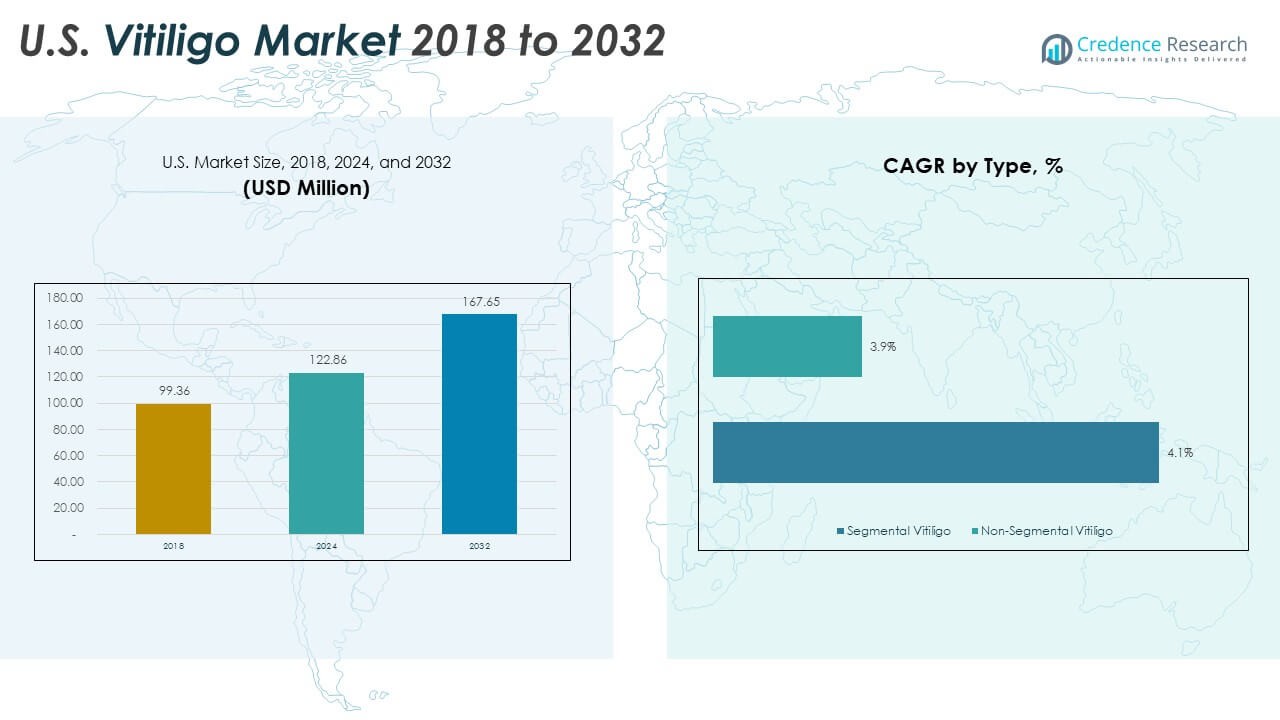
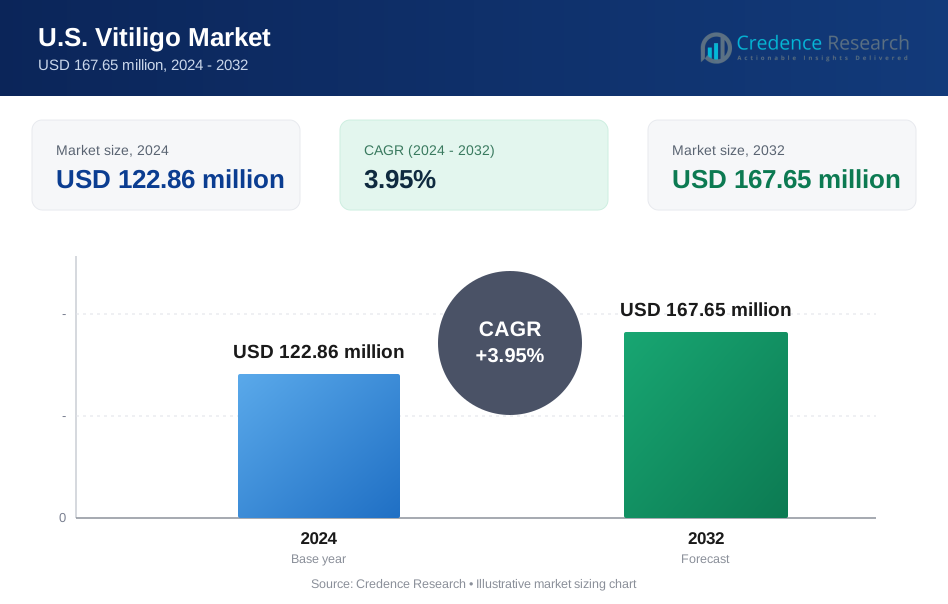
The U.S. Vitiligo Market size was valued at USD 99.36 million in 2018 to USD 122.86 million in 2024 and is anticipated to reach USD 167.65 million by 2032, at a CAGR of 3.95% during the forecast period.
| REPORT ATTRIBUTE | DETAILS |
|---|---|
| Historical Period | 2020-2023 |
| Base Year | 2024 |
| Forecast Period | 2025-2032 |
| U.S. Vitiligo Market Size 2024 | USD122.86 Million |
| U.S. Vitiligo Market, CAGR | 3.95% |
| U.S. Vitiligo Market Size 2032 | USD 167.65 Million |
The market is driven by growing awareness of vitiligo, rising consultations with dermatologists, and expanding adoption of innovative therapies. Increased research investments are supporting the introduction of biologics and advanced topical formulations. Patient advocacy groups and healthcare campaigns are encouraging early diagnosis and treatment adoption. Favorable reimbursement frameworks are reducing financial barriers, making advanced therapies more accessible. Strategic collaborations between pharmaceutical companies and research institutions are strengthening the therapeutic pipeline. Hospitals and specialty clinics are integrating new protocols, improving treatment outcomes and patient satisfaction.
Regionally, the Northeast leads the U.S. Vitiligo Market due to strong healthcare infrastructure, advanced research centers, and widespread patient awareness. The Midwest and South are emerging as important contributors, supported by expanding dermatology services, teledermatology adoption, and rising awareness in semi-urban areas. The Western region holds strategic importance with its concentration of biotechnology firms and clinical research hubs, driving access to innovative therapies. High patient interest in combined medical and cosmetic approaches also supports demand in the West. Overall, the geographic landscape reflects a balance between established dominance and emerging growth opportunities across regions.
Market Insights
- The U.S. Vitiligo Market was valued at USD 99.36 million in 2018, reached USD 122.86 million in 2024, and is projected to hit USD 167.65 million by 2032, growing at a CAGR of 3.95%.
- The Northeast accounted for 32% share in 2024, driven by advanced healthcare infrastructure; the Midwest held 28% with strong medical universities, while the South secured 25% supported by expanding dermatology services.
- The West, with a 15% share, is the fastest-growing region, fueled by biotechnology innovation, clinical research hubs, and rising patient preference for integrated medical and cosmetic treatments.
- Non-segmental vitiligo dominated the market in 2024, accounting for 62% of total share, reflecting its higher prevalence and greater treatment demand.
- Segmental vitiligo contributed 38% share, supported by growing diagnosis awareness and improved access to specialty care in emerging regions.
Market Drivers
Rising Patient Awareness and Growing Dermatological Consultations Across the United States
Public awareness of vitiligo is increasing due to educational campaigns and dermatology outreach programs. Patients are more willing to seek consultations, leading to higher diagnosis rates and early treatment adoption. Strong advocacy from patient groups has brought more visibility to the condition. The U.S. Vitiligo Market benefits from this environment by expanding access to specialized therapies. Rising social media discussions about skin health also drive acceptance of medical intervention. Greater transparency about available treatments builds patient trust. Medical societies are highlighting vitiligo’s psychological impact to encourage timely care. This awareness strengthens long-term demand for innovative therapies.
- For instance, a large global study involving 3,541 vitiligo patients reported profound psychosocial burden and impact on daily life, with over 55% altering clothing choices due to vitiligo and 59% often concealing lesions. This underscores rising patient engagement and awareness driving demand for care in the U.S. and worldwide.
Innovation in Therapeutic Approaches and Adoption of Advanced Clinical Protocols
The introduction of novel treatments is changing the therapeutic landscape. Biologic therapies are offering targeted solutions for patients who previously had limited options. Advanced light-based treatments are showing promising results in clinical settings. The U.S. Vitiligo Market gains from continued innovation supported by strong research funding. It is seeing robust clinical trial activity that highlights industry commitment. Hospitals and specialty clinics are adopting combination therapies to maximize patient outcomes. Integration of patient-centric protocols creates better adherence rates. This innovation-driven environment ensures sustained growth.
- For instance, Incyte Corporation’s ruxolitinib cream 1.5% (Opzelura) is FDA-approved for non-segmental vitiligo in patients 12 years and older, with Phase 3 TRuE-V trials demonstrating significant skin repigmentation and favorable safety outcomes, supporting rapid adoption in specialty clinics.
Supportive Reimbursement Policies and Strengthening Healthcare Coverage for Skin Disorders
Coverage policies from private insurers and public health programs are supporting treatment access. Favorable reimbursement for topical and systemic therapies reduces financial barriers for patients. The U.S. Vitiligo Market leverages this supportive framework to expand treatment uptake. Strong advocacy has encouraged payers to prioritize dermatological conditions. Access to advanced therapies is becoming more equitable across patient groups. It is strengthening patient adherence by making treatment more affordable. Hospitals are expanding dermatology departments to accommodate the rising demand. This favorable policy landscape plays a key role in market expansion.
Rising Research Investments and Strong Pipeline of Potentially Transformative Drugs
Pharmaceutical companies are allocating resources to develop breakthrough treatments. Research collaborations between biotech firms and academic institutions are accelerating innovation. The U.S. Vitiligo Market benefits from a strong pipeline with drugs in advanced trial stages. Regulatory agencies are providing accelerated pathways for dermatological drug approvals. It is fueling investor confidence in the sector. Dermatology research centers are advancing targeted biologics for improved outcomes. Clinical trials are evaluating long-term effectiveness and safety of new molecules. These investments ensure a sustainable pipeline for future growth.
Market Trends
Growing Integration of Digital Tools and Teledermatology in Patient Care
Digital health is shaping new approaches to dermatology care. Teledermatology allows patients to access specialists without geographical barriers. Remote consultations increase diagnosis rates in underserved regions. The U.S. Vitiligo Market benefits from integration of virtual platforms into care models. It is improving patient compliance by offering consistent follow-ups through apps. Digital imaging tools are enhancing treatment monitoring and precision. Hospitals are adopting AI-based diagnostic support systems for dermatologists. This digital trend continues to influence patient care pathways.
Rising Influence of Personalized Medicine and Tailored Treatment Protocols
Healthcare providers are adopting personalized approaches for vitiligo patients. Genetic markers and skin type variations guide treatment choices. The U.S. Vitiligo Market gains momentum from research supporting individualized care. It is advancing protocols that match patients with optimal therapies. Clinicians are using biomarker-driven insights to refine treatment efficacy. Combination therapies are increasingly tailored to minimize side effects. Patients show stronger satisfaction when treatments align with their profiles. This trend reinforces the value of precision medicine.
- For instance, in 2025 a Phase 2b extension study led by Mount Sinai in 230 nonsegmental vitiligo patients found that combining oral ritlecitinib with narrow-band UVB phototherapy produced a 69.6% mean facial repigmentation, versus 55.1% with ritlecitinib alone, illustrating stronger outcomes from combination therapies.
Increasing Role of Cosmetic Dermatology and Acceptance of Combination Aesthetic Therapies
Cosmetic dermatology is playing an important role in patient management. Advanced procedures are complementing medical therapies for improved appearance. The U.S. Vitiligo Market is seeing rising demand for cosmetic-aesthetic combinations. It is driven by patient preference for holistic results. Clinics are integrating light therapy with aesthetic approaches. Medical spas and dermatology practices are expanding cosmetic offerings. Consumer acceptance of such procedures supports wider adoption. This trend strengthens the connection between healthcare and aesthetic industries.
Collaborations Between Pharmaceutical Firms and Dermatology Specialists for Pipeline Expansion
Pharmaceutical companies are forming strategic alliances with dermatology experts. Partnerships accelerate clinical testing and regulatory submissions. The U.S. Vitiligo Market grows through these collaborations that align expertise. It is seeing faster approval timelines supported by shared research. Companies are co-developing biologics and topical solutions for broader patient coverage. Hospitals are involved in multi-site clinical trials. Such collaborations ensure effective translation of research into therapies. This trend drives both innovation and market competitiveness.
- For instance, in 2025 Almirall expanded its AI-drug discovery collaboration with Absci, successfully delivering AI-designed functional antibody leads for a difficult-to-drug dermatology target and selecting a second target, strengthening its biologic pipeline in skin disease R&D.
Market Challenges Analysis
Limited Long-Term Treatment Effectiveness and Patient Adherence Issues in Therapy
Current therapies face challenges in delivering consistent long-term outcomes. Many patients discontinue treatment due to side effects or slow results. The U.S. Vitiligo Market struggles with adherence as some patients lose confidence in therapies. It is difficult to maintain regular treatment schedules over extended periods. Clinicians face obstacles in addressing relapse cases after initial progress. Limited durability of response creates uncertainty for patients. Adherence issues reduce overall therapeutic effectiveness. These gaps highlight the need for continuous innovation.
High Cost of Advanced Treatments and Unequal Access Across Patient Populations
Advanced biologic therapies and light-based treatments often involve significant costs. The U.S. Vitiligo Market faces inequities where certain patients lack access due to affordability issues. It is compounded by regional differences in specialist availability. Patients in rural areas face delays in diagnosis and treatment. High treatment costs place a burden on uninsured individuals. Healthcare providers also face challenges in balancing costs with treatment recommendations. Unequal access weakens overall adoption of newer therapies. This cost-related challenge slows market penetration.
Market Opportunities
Emerging Adoption of Biologics and Development of Targeted Therapy Pipelines
Biologic therapies represent a transformative opportunity for patients with resistant cases. The U.S. Vitiligo Market is well positioned to lead in biologic adoption. It is supported by ongoing clinical trials that explore new targeted mechanisms. Companies are investing in developing next-generation molecules. Hospitals are preparing infrastructure to deliver complex therapies. The opportunity to establish leadership in biologics drives industry investment. Research partnerships accelerate the pace of discovery. This strengthens long-term market prospects.
Expansion of Dermatology Infrastructure and Growth of Patient Support Programs
Hospitals and clinics are expanding dermatology infrastructure across the United States. The U.S. Vitiligo Market benefits from the establishment of specialized centers. It is supported by rising numbers of patient support and counseling programs. Awareness campaigns build community trust and encourage treatment adoption. Employers are introducing wellness programs that include skin health. Technology-enabled care platforms enhance reach across regions. Patient-focused initiatives create stronger treatment adherence. These efforts generate opportunities for sustained growth.
Market Segmentation Analysis
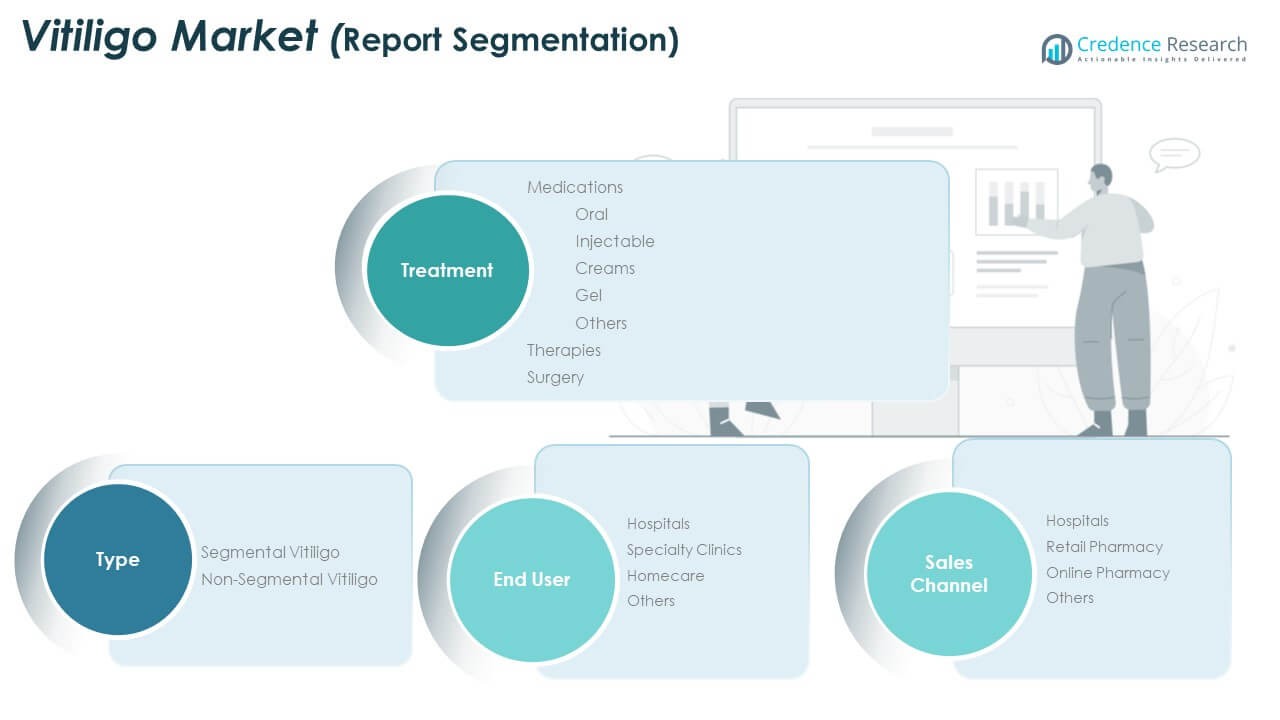
The U.S. Vitiligo Market is segmented
By type
Into segmental vitiligo and non-segmental vitiligo. Non-segmental vitiligo holds the dominant share due to its higher prevalence and demand for long-term treatment solutions. Segmental vitiligo remains a smaller segment but shows growth with rising awareness and improved diagnostic clarity. It highlights a steady balance between established demand and niche expansion.
- For instance, Incyte’s Opzelura (ruxolitinib 1.5% cream) is FDA-approved for non-segmental vitiligo and demonstrated in its Phase 3 TRuE-V clinical trial that 30.4% of patients achieved at least 75% facial repigmentation by week 24, and improvements sustained through week 52, supporting its role in managing the dominant disease subtype.
By treatment
The market is divided into medications, therapies, and surgery. Medications, including oral, injectable, creams, gel, and others, dominate the treatment landscape due to widespread adoption in first-line management. Therapies such as phototherapy are expanding with technological innovation in light-based devices. Surgery caters to limited cases but supports comprehensive treatment portfolios. It shows diverse pathways for patient care supported by research and clinical practices.
- For instance, FDA-cleared home-use narrowband UVB devices such as Daavlin’s Clear Series offer controlled dosing, digital monitoring, and patient-friendly designs, supporting safe self-administration and improved adherence in vitiligo management, marking a significant advance in phototherapy innovation.
By end user
Hospitals lead due to advanced infrastructure and access to dermatology specialists. Specialty clinics follow closely, offering targeted expertise and high patient engagement. Homecare and other providers contribute to market depth through convenience-driven options. It demonstrates the evolving structure of care delivery in the United States.
By sales channel
Hospitals remain significant for advanced therapies and procedures. Retail pharmacies capture strong demand for medications, while online pharmacies are expanding with digital accessibility and patient convenience. Others maintain a smaller role, balancing traditional and modern distribution models. It reflects the growing importance of multi-channel availability to improve patient adherence.
Segmentation
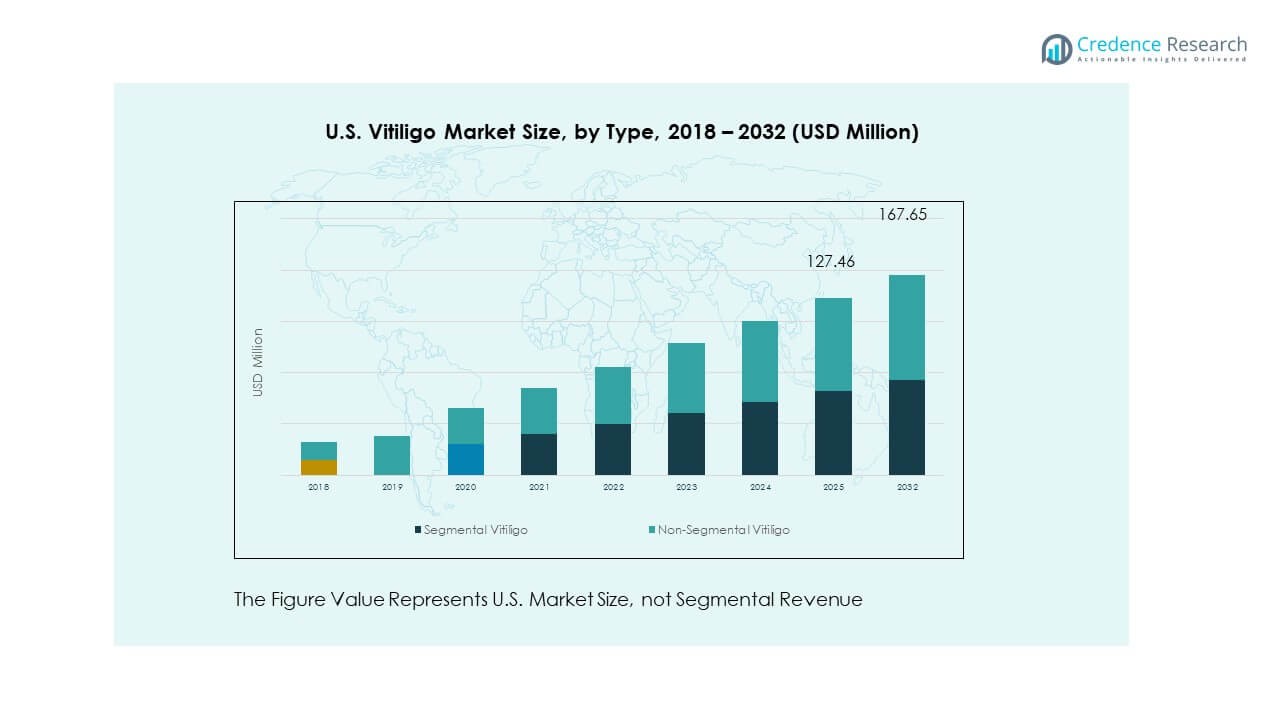
By Type
- Segmental Vitiligo
- Non-Segmental Vitiligo
By Treatment
- Medications
- Oral
- Injectable
- Creams
- Gel
- Others
- Therapies
- Surgery
By End User
- Hospitals
- Specialty Clinics
- Homecare
- Others
By Sales Channel
- Hospitals
- Retail Pharmacy
- Online Pharmacy
- Others
Regional Analysis
Northeast United States
The Northeast holds a 32% share of the U.S. Vitiligo Market, supported by advanced healthcare infrastructure and strong concentration of dermatology specialists. Major academic hospitals and research centers in states such as New York and Massachusetts drive clinical innovation. High awareness among patients encourages early diagnosis and consistent treatment uptake. Insurance coverage in this region is also favorable, creating strong access to biologics and advanced light-based therapies. The presence of established pharmaceutical headquarters further supports the market. It demonstrates steady growth backed by strong collaboration between healthcare institutions and industry players.
Midwest and Southern United States
The Midwest accounts for 28% share, while the Southern region represents 25% of the U.S. Vitiligo Market. Both subregions are witnessing growth due to expanding dermatology services and rising patient consultations. The Midwest benefits from strong medical universities and a growing base of specialty clinics. Southern states are improving access through teledermatology platforms that reach rural populations. These areas also show rising adoption of topical therapies due to affordability. It maintains potential for higher treatment penetration through ongoing policy reforms and regional investments.
Western United States
The Western region contributes 15% share to the U.S. Vitiligo Market, supported by innovation hubs and a strong biotechnology presence in California. Access to experimental therapies and advanced clinical trials attracts patients seeking new options. High patient awareness is driving adoption of both medical and cosmetic dermatology treatments. The strong startup ecosystem enables partnerships with hospitals and research groups. Demand in this region is influenced by lifestyle trends emphasizing skin health. It positions the West as a strategic center for clinical innovation and technology-driven therapies.
Key Player Analysis
- Incyte Corporation
- Pfizer Inc.
- AbbVie Inc.
- Astellas Pharma Inc.
- Bristol-Myers Squibb
- Strata Skin Sciences
- Viatris Inc.
- Other Key Players
Competitive Analysis
The U.S. Vitiligo Market is shaped by the presence of multinational pharmaceutical companies, biotechnology innovators, and dermatology-focused firms. Leading players such as Incyte, Pfizer, AbbVie, and Bristol-Myers Squibb drive the market with strong portfolios in biologics, topical therapies, and ongoing research pipelines. It benefits from competitive strategies that focus on mergers, acquisitions, and clinical collaborations to accelerate product development. Strata Skin Sciences strengthens its position through advanced light therapy solutions, while Astellas Pharma and Viatris expand access with diversified treatment options. Companies invest heavily in research partnerships with academic centers, ensuring a steady flow of innovative therapies. Competitive intensity remains high due to the race to commercialize first-in-class biologics and combination therapies. The landscape reflects a mix of established pharmaceutical leadership and rising biotech firms focusing on niche treatment opportunities.
Recent Developments
- In May 2025, Clinuvel Pharmaceuticals achieved a key milestone by completing Phase III enrollment for their systemic repigmentation therapy afamelanotide (CUV105), advancing potential new treatment options for vitiligo patients.
Report Coverage
The research report offers an in-depth analysis based on Type, Treatment, End User and Sales Channel. It details leading market players, providing an overview of their business, product offerings, investments, revenue streams, and key applications. Additionally, the report includes insights into the competitive environment, SWOT analysis, current market trends, as well as the primary drivers and constraints. Furthermore, it discusses various factors that have driven market expansion in recent years. The report also explores market dynamics, regulatory scenarios, and technological advancements that are shaping the industry. It assesses the impact of external factors and global economic changes on market growth. Lastly, it provides strategic recommendations for new entrants and established companies to navigate the complexities of the market.
Future Outlook
- Biologic therapies are expected to reshape treatment protocols by offering targeted, long-lasting results.
- Topical therapies will maintain steady adoption due to accessibility and patient affordability.
- Light-based treatments are projected to gain wider use with improving dermatology infrastructure.
- Clinical trials for innovative molecules will strengthen the pipeline and expand therapeutic choices.
- Teledermatology adoption will accelerate, enhancing patient reach in underserved areas.
- Personalized treatment protocols guided by biomarkers will gain prominence in clinical settings.
- Patient advocacy and awareness campaigns will continue to drive early diagnosis and treatment demand.
- Cosmetic dermatology integration will expand as patients seek both medical and aesthetic outcomes.
- Strategic collaborations between pharmaceutical companies and academic centers will boost research output.
- Expanding healthcare coverage and supportive reimbursement policies will sustain long-term market growth.
Request a Free Sample
Fill in your details and we'll send you a free sample report.
- Sample data tables & charts
- Research methodology
Need a Custom Version of This Report?
Tailor the scope, geography, or segments to your exact requirements.
- Custom geography or segment scope
- Direct access to our analyst team
Frequently Asked Questions
What is the current market size for U.S. Vitiligo Market, and what is its projected size in 2032?
At what Compound Annual Growth Rate is the U.S. Vitiligo Market projected to grow between 2024 and 2032?
Which U.S. Vitiligo Market segment held the largest share in 2024?
What are the primary factors fueling the growth of the U.S. Vitiligo Market?
Who are the leading companies in the U.S. Vitiligo Market?
Which region commanded the largest share of the U.S. Vitiligo Market in 2024?
Table of Content
Chapter 1. Report Introduction
- 1.1 Report Description & Purpose
- 1.1.1 Report Title & Market Definition
- 1.1.2 Unique Selling Propositions (USP) & Key Differentiators
- 1.1.3 Value Proposition for Stakeholders
- 1.2 Research Objectives
- 1.2.1 Market Sizing Objectives (Volume & Revenue)
- 1.2.2 Segmentation Objectives
- 1.2.3 Competitive Intelligence Objectives
- 1.2.4 Forecast & Scenario Objectives
- 1.3 Report Scope
- 1.3.1 U.S. Vitiligo Scope – Types & Subtypes Covered
- 1.3.2 Geographic Scope – Regions & Countries Covered
- 1.3.3 Historical Period, Base Year & Forecast Period (2024; forecast to 2032)
- 1.3.4 Inclusions & Exclusions
- 1.4 HS Code & Classification Framework
- 1.5 Currency, Units & Pricing Basis
- 1.6 Target Stakeholders
- 1.7 Limitations & Assumptions
Chapter 2. Executive Summary
- 2.1 Global U.S. Vitiligo Market Snapshot
- 2.1.1 Market Size – Historical (2024) & Forecast (2024-2032) (2024: USD 122.86 million → 2032: USD 167.65 million)
- 2.1.2 Volume & Revenue – Global Totals
- 2.1.3 Key Market Highlights – Top Five Facts
- 2.2 U.S. Vitiligo Market Segmentation Snapshot
- 2.2.1 Market Split by Region – 2024 vs. 2032
- 2.3 Competitive Snapshot
- 2.3.1 Top 10 Players by Revenue Share – 2024
- 2.3.2 Top 10 Players by Volume Share – 2024
- 2.3.3 Recent Strategic Developments (18-Month Summary)
- 2.4 Key Investment Highlights & Strategic Conclusions
Chapter 3. U.S. Vitiligo Market Dynamics & Industry Analysis
- 3.1 Market Overview & Context
- 3.1.1 U.S. Vitiligo Market Position in the Broader Automotive Value Chain
- 3.1.2 OEM vs. Replacement Market Dynamics
- 3.1.3 Market Maturity & Development Stage by Region
- 3.2 U.S. Vitiligo Market Drivers
- 3.3 U.S. Vitiligo Market Restraints & Challenges
- 3.4 U.S. Vitiligo Market Opportunities
- 3.5 Porter's Five Forces Analysis
- 3.5.1 Threat of New Entrants
- 3.5.2 Bargaining Power of Suppliers
- 3.5.3 Bargaining Power of Buyers
- 3.5.4 Threat of Substitutes
- 3.5.5 Competitive Rivalry – Intensity Assessment
- 3.6 U.S. Vitiligo Value Chain Analysis
- 3.6.1 Upstream – Raw Material/Input Suppliers
- 3.6.1.1 Raw Material/Input 1
- 3.6.1.2 Raw Material/Input 2
- 3.6.1.3 Raw Material/Input 3
- 3.6.2 Midstream – Production/Manufacturing/Service Delivery
- 3.6.2.1 Production/Process Overview
- 3.6.2.2 Key Facility Locations & Capacity by Manufacturer
- 3.6.3 Downstream – Distribution & End Consumer
- 3.6.3.1 Primary Channel – B2B/OEM
- 3.6.3.2 Secondary Channels – Dealer, Retail, Online, Direct
- 3.6.4 Value Chain Profitability Analysis
- 3.6.1 Upstream – Raw Material/Input Suppliers
- 3.7 PESTEL Analysis
- 3.7.1 Political Factors
- 3.7.2 Economic Factors
- 3.7.3 Social Factors
- 3.7.4 Technological Factors
- 3.7.5 Environmental Factors
- 3.7.6 Legal Factors
- 3.8 U.S. Vitiligo Supply Chain Analysis
- 3.8.1 Raw Material/Input Supply Risk Assessment
- 3.8.2 Manufacturing Concentration Risk (Geographic Exposure)
- 3.8.3 Trade Disruption Impact Analysis
- 3.9 Regulatory & Policy Landscape
Note: The regulatory and policy landscape section covers regulations based on their applicability to the market, U.S. Vitiligo category, geography, and scope of the study. Only regulatory frameworks with a material impact on operations, compliance, trade, sustainability, or market access are analyzed in detail.
Chapter 4. Key Investment Pockets & Opportunity Analysis
- 4.1 U.S. Vitiligo Market Attractiveness Analysis
- 4.1.1 By Region – Investment Attractiveness Matrix (Volume × CAGR)
- 4.2 Absolute Revenue Growth Opportunity
- 4.2.1 By Region – Absolute USD Growth Through 2032
- 4.3 Incremental Volume Opportunity
- 4.3.1 By Region – Incremental Volume Through 2032
- 4.3.2 Segment – Incremental Volume
- 4.4 Emerging Submarket Opportunity Deep Dive (Subject to Applicability)
- 4.5 Emerging Market Opportunity Scorecards
- 4.5.1 United States
- 4.5.2 Europe
- 4.5.3 Asia
- 4.5.4 Middle East & Africa
Note: Emerging Market Opportunity Scorecards will be included based on relevance and strategic importance. Regions listed are indicative and may vary depending on data availability and market dynamics.
Chapter 5. U.S. Vitiligo Import-Export Analysis & Trade Flows
- 5.1 Global Trade Overview
- 5.1.1 Global Export Value by Country (2024)
- 5.1.2 Global Export Volume by Country (2024)
- 5.1.3 Global Import Value by Country (2024)
- 5.1.4 Global Import Volume by Country (2024)
- 5.1.5 Net Trade Balance by Country (2024)
- 5.2 Export Analysis – Segment
- 5.2.1 Type 1 (HS Code)
- 5.2.2 Type 2 (HS Code)
- 5.2.3 Type 3 (HS Code)
- 5.2.4 Type 4 (HS Code)
- 5.2.5 Type 5 (HS Code)
- 5.3 Import Analysis – Segment
- 5.3.1 Type 1 (HS Code)
- 5.3.2 Type 2 (HS Code)
- 5.3.3 Type 3 (HS Code)
- 5.3.4 Type 4 (HS Code)
- 5.3.5 Type 5 (HS Code)
- 5.4 Average Unit Trade Prices
- 5.4.1 Average Export Price – Segment & Country
- 5.4.2 Average Import Price – Segment & Source Country
- 5.4.3 Price Trends (2024)
- 5.5 Key Trade Route Analysis
- 5.5.1 Trade Route 1
- 5.5.2 Trade Route 2
- 5.5.3 Trade Route 3
- 5.5.4 Trade Route 4
- 5.5.5 Trade Route 5
- 5.6 Trade Policy Impact Assessment
- 5.6.1 US Anti-Dumping & Section 301 Tariffs
- 5.6.2 EU Customs Union Impact
- 5.6.3 Major Free Trade Agreements
- 5.6.4 USMCA Rules of Origin
Note: Trade policy analysis will be included only where relevant to the U.S. Vitiligo market.
Chapter 6. Competitive Landscape & Company Benchmarking
- 6.1 U.S. Vitiligo Market Concentration & Structure
- 6.1.1 Herfindahl-Hirschman Index (HHI) – vs. 2024
- 6.1.2 Tier 1, Tier 2 & Tier 3 Market Structure
- 6.1.3 Global, Regional & Local Player Dynamics
- 6.2 U.S. Vitiligo Market Share Analysis – 2024
- 6.2.1 Global Revenue Share by Company
- 6.2.2 Global Volume Share by Company
- 6.2.3 Regional Revenue Share
- 6.2.4 Market Share Evolution ( vs. 2024)
- 6.2.5 OEM Segment Share by Company
- 6.2.6 Replacement Segment Share by Company
- 6.3 Production/Delivery Capacity & Facility Analysis
- 6.3.1 Global Installed Capacity
- 6.3.2 Capacity Utilization Rates
- 6.3.3 Production/Output Volume
- 6.3.4 Facility Locations & Capacity Map
- 6.3.5 Planned Capacity Additions
- 6.4 U.S. Vitiligo Competitive Benchmarking Matrix
- 6.4.1 Revenue, Volume, CAGR & Profitability Comparison
- 6.4.2 Channel Revenue Mix
- 6.4.3 Geographic Revenue Exposure
- 6.4.4 R&D Intensity
- 6.4.5 Sustainability Maturity
- 6.5 Strategic Developments in U.S. Vitiligo (Last 24 Months)
- 6.5.1 Mergers, Acquisitions & Divestments
- 6.5.2 New U.S. Vitiligo Launches
- 6.5.3 Facility Expansions
- 6.5.4 Strategic Alliances, Joint Ventures & Partnerships
- 6.5.5 Distribution Expansion & Market Entry
- 6.5.6 Sustainability & ESG Initiatives
- 6.6 Competitive Strategy Mapping
- 6.6.1 Leader, Challenger, Follower & Niche Classification
- 6.6.2 Pricing Strategy Comparison
- 6.6.3 Channel Strategy Matrix
Note: Strategic developments are included based on their materiality and the availability of reliable information.
Chapter 7. Global U.S. Vitiligo Market – By Distribution Channel
- 7.1 Segment Overview
- 7.1.1 Volume & Revenue Split by Channel (2024 & 2032)
- 7.1.2 Channel Mix Evolution (2024-2032)
Chapter 8. Regional Market Analysis – Global Overview
- 8.1 Global Regional Overview
- 8.1.1 Regional Volume Share
- 8.1.2 Regional Revenue Share
- 8.1.3 Regional Volume by Region
- 8.1.4 Regional Revenue by Region
- 8.1.5 Regional Forecast Through 2032
- 8.2 Cross-Regional Segment Analysis
- 8.2.1 By Distribution Channel
- 8.2.2 By Brand/Price Tier
Chapter 9. North America U.S. Vitiligo Market
- 9.1 United States
- 9.2 Canada
- 9.3 Mexico
Chapter 10. Europe U.S. Vitiligo Market
- 10.1 Germany
- 10.2 France
- 10.3 Italy
- 10.4 United Kingdom
- 10.5 Spain
- 10.6 Poland
- 10.7 Russia
- 10.8 Netherlands
- 10.9 Belgium
- 10.10 Sweden
- 10.11 Denmark
- 10.12 Norway
- 10.13 Rest of Europe
Chapter 11. Asia Pacific U.S. Vitiligo Market
- 11.1 China
- 11.2 India
- 11.3 Japan
- 11.4 South Korea
- 11.5 Thailand
- 11.6 Indonesia
- 11.7 Vietnam
- 11.8 Malaysia
- 11.9 Australia
- 11.10 Rest of Asia Pacific
Chapter 12. Latin America U.S. Vitiligo Market
- 12.1 Brazil
- 12.2 Argentina
- 12.3 Colombia
- 12.4 Chile
- 12.5 Rest of Latin America
Chapter 13. Middle East U.S. Vitiligo Market
- 13.1 Saudi Arabia
- 13.2 United Arab Emirates
- 13.3 Turkey
- 13.4 Israel
- 13.5 Iran
- 13.6 Rest of the Middle East
Chapter 14. Africa U.S. Vitiligo Market
- 14.1 South Africa
- 14.2 Egypt
- 14.3 Nigeria
- 14.4 Morocco
- 14.5 Rest of Africa
Chapter 15. U.S. Vitiligo Company Profiles
- 15.1 [Company 01]
- 15.1.1 Company Overview
- 15.1.2 Key Management Personnel
- 15.1.3 Products & Services Portfolio
- 15.1.4 Financial Performance
- 15.1.5 Key Market Focus & Geographic Presence
- 15.1.6 Recent Developments & Strategic Initiatives
Note: The company profile list is preliminary and may change based on research findings, market developments, data availability, and client requirements.
Chapter 16. Appendices
- Appendix A – List of Abbreviations & Acronyms
- Appendix B – Industry Classification Code Reference – Full Series
- Appendix C – Production & Capacity Data Tables
- Appendix D – End-Use & Demand Base Tables
- Appendix E – Consumption & Replacement Rate Assumptions
- Appendix F – ASP Reference Tables
- Appendix G – Manufacturing & Facility Database
- Appendix H – Import-Export Data Tables
- Appendix I – Regulatory Summary Tables
- Appendix J – Primary Research Participant List (Anonymized)
- Appendix K – Primary Research Questionnaire Framework
- Appendix L – Data Sources & Bibliography
- Appendix M – Market Size Divergence & Source Comparison
Chapter 17. Research Methodology
- 17.1 Research Framework & Philosophy
- 17.2 Secondary Research – Sources, Hierarchy & Data Extraction
- 17.3 Data Modeling – Bottom-Up & Top-Down Market Sizing
- 17.4 Primary Research – Stakeholder Framework, LOI & Sample Sizes
- 17.5 Forecast Methodology – Regression, Scenario & Sensitivity Analysis
- 17.6 Quality Control – Four-Layer Validation Framework
- 17.7 Limitations & Standard Assumptions
- 17.8 Disclaimer
