
International Seaways to Acquire Bruton in $370 Million Deal Adding Four VLCCs
International Seaways Inc., the New York-based tanker owner listed on the NYSE, agreed on Oct. 16, 2026, to acquire Oslo-listed Bruton Limited in a series of transactions that value Bruton at about $370 million. The deal adds four very large crude carriers, including newbuildings, to a fleet of roughly 70 crude and product tankers and will be paid almost entirely in International Seaways stock.
Key developments
- International Seaways signed exchange agreements with holders of about 50.5% of Bruton's shares, who will receive 0.0519 International Seaways shares for each Bruton share. Settlement is expected on or about Oct. 20, 2026.
- A definitive cash-and-stock merger agreement covers the remaining Bruton shares. Bruton plans a special shareholder meeting on or about Oct. 30, 2026, and the shareholders in the first-step exchange have agreed to vote in favor.
- International Seaways expects to issue about 3.12 million shares, representing roughly 96% of the total consideration, with the remainder settled in cash.
- Bruton owns four VLCCs. According to Marine Log and gCaptain, one vessel is already trading and three are under construction at New Times Shipyard in China.
- Alongside the deal, International Seaways released preliminary third-quarter figures, including blended spot earnings of about $68,000 per day and total liquidity of about $965 million at Sept. 30.
Deal background
Bruton is a young company. Its shares began trading on Euronext Growth Oslo in late November 2024, and in a September 2025 strategy update it said it was considering a shift to a pure-play modern VLCC model built around a low-leverage balance sheet and monthly dividends. At that time, the company held two VLCC newbuildings from New Times Shipyard and proposed a combination with Andes Tankers II, which owned two more hulls from the same yard. Bruton also said it was discussing dual-fuel LNG propulsion for the Andes vessels to match its own ships.
gCaptain reported that the delivered ship, Mount Vision, is a 300,000-dwt VLCC that joined the fleet in July and earns $95,000 per day under its current charter. The same report said the next newbuilding, Mount Horizon, has secured a charter at $105,700 per day, and that the three ships still at the yard are scheduled for delivery between November 2026 and October 2027. gCaptain also noted that Bruton earlier spun off eight other newbuildings into OMC Tankers, and those ships are not part of this transaction. International Seaways' own release describes the assets only as four VLCCs, including newbuildings.
Lois K. Zabrocky, president and CEO of International Seaways, said the transaction would let the company expand and modernize its fleet and called it accretive. She said the deal reflects the company's disciplined approach to growth and that it would remain positioned to keep executing its growth strategy after closing.
Industry implications
The acquisition is a fleet renewal move as much as a growth move. Buying ships that are new or still on the slipway gives International Seaways modern tonnage without placing its own shipyard orders and waiting several years for delivery slots. For an owner whose fleet spans both crude and refined product trades, the four VLCCs deepen exposure to the largest crude carrier class, which typically serves long-haul routes from the Middle East, West Africa and the Americas to Asian refiners.
The structure also matters. Paying about 96% of the price in stock lets International Seaways preserve the cash it reported at the end of September, while Bruton's investors move into a larger, more diversified NYSE-listed company instead of holding a four-ship platform. That trade-off is common in shipping consolidation, where scale tends to lower financing costs and gives owners more flexibility to place ships on spot or time charter.
The timing follows a strong earnings run. International Seaways reported preliminary third-quarter blended spot earnings of about $68,000 per day, compared with about $29,000 per day a year earlier, and said it had fixed about 37% of expected fourth-quarter revenue days at roughly $180,000 per day. Owners with healthy balance sheets tend to use periods like this to lock in growth through share-funded deals.
Competitive and supply chain implications
For competitors, the deal is another sign that listed tanker owners prefer buying existing platforms to ordering new ships. Acquiring Bruton gives International Seaways vessels with delivery dates already fixed at a Chinese yard, avoiding the wait for new berth slots at busy shipyards. The approach shifts construction and delivery risk onto the seller while the buyer takes over contracted employment on at least two of the ships, according to gCaptain.
The transaction also underscores how central Chinese shipyards have become to crude tanker supply. All four of Bruton's vessels come from New Times Shipyard, and buyers of these ships inherit exposure to any future U.S. trade measures aimed at Chinese-built tonnage. International Seaways did not address those issues in its announcement. For charterers, including oil majors and trading houses, more modern VLCC capacity under a well-capitalized owner offers lower fuel use per ton-mile and readier compliance with tightening emissions rules.
Regional implications
In Norway, the deal removes another small shipping company from the Oslo market, which has served as a launch pad for single-segment fleets backed by local investors. Bruton's shareholders will instead hold International Seaways stock listed in New York, a pattern that reflects the pull of deeper U.S. capital markets for tanker equity.
In China, New Times Shipyard keeps its delivery schedule, with the remaining hulls now going to a U.S.-listed owner. In the United States, the deal strengthens one of the few NYSE-listed crude and product tanker companies, giving U.S. investors more direct exposure to the VLCC segment as Atlantic Basin crude exports to Asia continue to rely on large carriers for long voyages.
Credence Research analysis
The deal shows a mature owner choosing speed over price discovery. Stock-funded acquisitions of fleets with newbuildings already under contract allow buyers to add modern, fuel-efficient ships when earnings are strong, without adding the debt or the long lead times that come with fresh orders. Because Bruton was built to own a small number of modern VLCCs, it fits neatly into a larger platform, and the fact that holders of a majority of its shares signed exchange agreements before the merger vote reduces the risk that the deal falls apart.
The main risk is cyclical. Tanker earnings move sharply with crude flows, sanctions enforcement and refinery demand, and the elevated fourth-quarter rates International Seaways reported may not last. The heavy use of shares limits balance sheet strain if conditions soften, but it also dilutes existing holders. Investors and charterers will watch whether the new VLCCs are kept on fixed-rate charters or moved into the spot market, and whether the U.S. treatment of Chinese-built ships changes how their earnings hold up over time.
What comes next
- Settlement of the first-step share exchange, expected on or about Oct. 20, 2026.
- International Seaways' Form 8-K filing with additional structural details of the transactions.
- Bruton's special shareholder meeting to vote on the merger, scheduled on or about Oct. 30, 2026, with closing expected shortly after, subject to customary conditions.
- International Seaways' full third-quarter earnings release, scheduled for Nov. 5, 2026.
- Deliveries of the remaining newbuildings from New Times Shipyard, reported for November 2026 through October 2027.
Sources
- International Seaways press release, Form 8-K Exhibit 99.1 (SEC)
- gCaptain: International Seaways adds to VLCC fleet with $370 million Bruton deal
- Marine Log: International Seaways to acquire Bruton
- Bruton Limited strategy update, September 2025
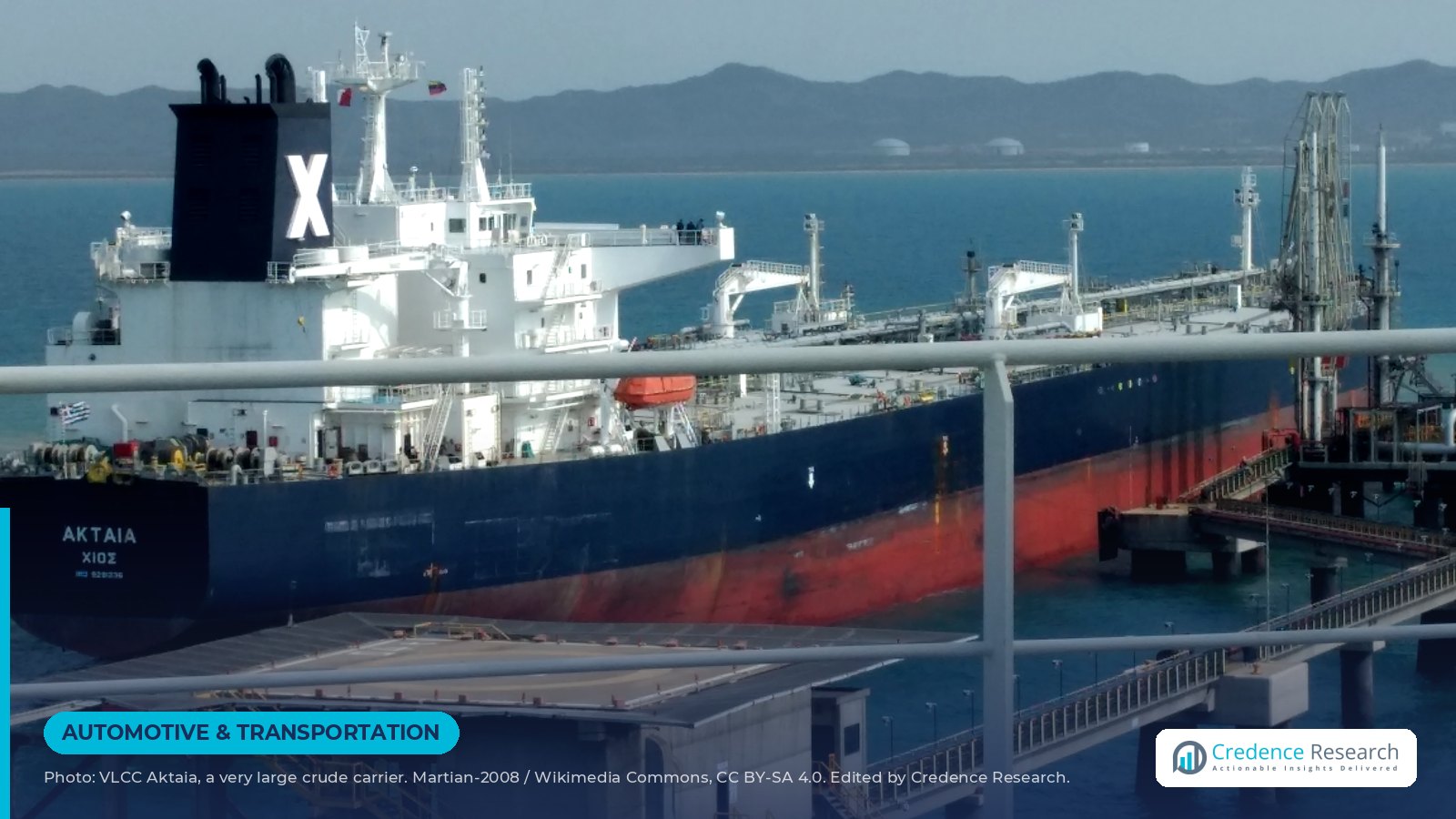
Image: VLCC Aktaia, a very large crude carrier, by Martian-2008 via Wikimedia Commons, CC BY-SA 4.0. Cropped and edited by Credence Research.

About the Author

Senior News Editor at Credence Research Inc