
Venture Global signs GE Vernova, Baker Hughes deals for up to 16 gas power islands for AI
Venture Global, the Arlington, Virginia-based liquefied natural gas exporter, said on Oct. 15, 2026, that it has signed power and grid frame agreements with GE Vernova and Baker Hughes Energy Services covering up to 16 new gas-fired power island units of 720 megawatts each, along with associated power transformer equipment. The company plans to use the units to expand its existing grid-independent power network and to open a path to up to 10 gigawatts of new compute capacity at sites it owns or controls by the end of 2034.
Key developments
- The frame agreements cover up to 16 power island units rated at 720 MW each, plus transformer equipment, supplied through GE Vernova and Baker Hughes Energy Services.
- Venture Global expects to place its first power island purchase order by the end of 2026, with Baker Hughes saying additional orders are anticipated beginning in 2027 and deliveries are scheduled from 2028 through 2034.
- The company already has six power islands ordered, under construction or operating, representing about 4.5 GW of modular, gas-fired generation that serves its LNG facilities behind the meter.
- Venture Global said it would file its first permit applications for the expansion during the week of the announcement.
- Baker Hughes said its scope includes gas turbines, steam turbines, associated equipment and services, and the controls and electrical integration technology, including E-house systems, needed to run each island.
How the island-mode model works
Venture Global builds its LNG export plants with their own on-site power stations rather than drawing electricity from the regional grid. The company calls this arrangement its Island-Mode industrial power network: generation is self-supplied, runs separately from the public system, and is paired with what Chief Executive Officer Mike Sabel described as closed-loop water systems and other on-site infrastructure. The company describes the network as one of the world's largest private industrial electric grids.
The new units follow the configuration the company already uses. Each power island is a combined cycle gas turbine block with related equipment, sized in a standard module so that capacity can be added in steps. Under the frame agreements, Venture Global can enter definitive reservation agreements with agreed pricing and delivery terms to lock in manufacturing slots, then order additional units in stages as commercial arrangements with customers are signed. Baker Hughes described the framework as a replication of the power island architecture it has already deployed with Venture Global.
Venture Global's first three LNG projects, Calcasieu Pass, Plaquemines LNG and CP2 LNG, are located in Louisiana along the Gulf Coast. The company began producing LNG in 2022 and reports more than 100 million tonnes per annum of capacity in production, construction or development.
Industry implications
The announcement shows how quickly gas-fired generation tied to energy infrastructure is being repositioned as a power source for artificial intelligence workloads. Venture Global said the expansion would place no additional demand on the public electric grid or on public water utilities and would add no cost for local consumers. Those are the same pressure points that utilities, regulators and communities have raised as large data center campuses request multi-hundred-megawatt grid connections that can take years to approve and build.
Sabel framed the move as the creation of what he called a vertically integrated AI utility. The company said its LNG business remains its core strategic objective and that any third-party development using Island-Mode power would not affect its LNG sales agreements or other existing commercial commitments. The planned compute buildout is also explicitly conditional: the 10 GW goal depends on customer commitments and market conditions, and the frame agreements do not by themselves commit the company to buy all 16 units.
For power developers, the deal reinforces a shift in how capacity is secured. Rather than ordering turbines project by project, large buyers are reserving manufacturing positions years ahead through framework arrangements that can be converted into firm orders once offtake is in place.
Competitive and supply chain implications
Heavy-duty and industrial gas turbines, steam turbines and large power transformers have become some of the tightest bottlenecks in the energy equipment chain as utilities, independent power producers and data center operators compete for the same factory output. A reservation framework that runs through 2034 gives Venture Global earlier visibility on equipment slots than buyers who wait until projects are fully contracted.
For Baker Hughes, the framework extends an existing customer relationship into a potentially larger, multi-year order stream that blends LNG and data center power, while GE Vernova gains a place in the same long-dated program. Baker Hughes Chairman and CEO Lorenzo Simonelli said behind-the-meter generation has become a critical component of LNG operations and is now supporting the AI economy. The inclusion of transformer equipment alongside turbines is notable, since transformer lead times have been a constraint for both utility grid expansion and private generation projects.
The arrangement also puts Venture Global in a different competitive set. Beyond other LNG developers, it now overlaps with independent power producers, utilities and data center developers pursuing on-site or co-located generation to avoid interconnection queues.
Regional implications
The release does not name specific sites for the new power islands, referring only to locations Venture Global owns or controls and to its LNG facilities. Because the company's existing projects are concentrated in Louisiana, the Gulf Coast is the most likely early host for any adjacent data center development, subject to the permitting process the company has just started.
For Gulf Coast communities, the model offers large industrial investment without new demand on regional transmission, but it also brings additional gas-fired generation, water use questions and air permitting reviews. State and federal regulators will shape how quickly the first units move from reservation to construction.
Credence Research analysis
The significance of the Venture Global agreements lies less in the headline gigawatt figures than in the business model. An LNG exporter with land, gas supply, pipeline access, permitting experience and an operating private grid is positioning those assets as a ready-made platform for compute. If customers sign, this approach could shorten the time to power for large AI campuses compared with grid-connected sites, because the generation, water systems and site control are already part of the developer's core operations.
The execution risks are clear. The compute target is contingent on customer contracts, the frame agreements become binding only as individual orders are placed, and gas-fired capacity on this scale will face permitting scrutiny and questions about emissions. Venture Global has said it is developing carbon capture and sequestration projects at each of its LNG facilities. The first purchase order expected by year-end and the first permit filings will be the earliest tests of whether this strategy moves from framework to steel in the ground.
What comes next
- Filing of the first permit applications for the Island-Mode power expansion, which Venture Global said would begin the week of Oct. 15.
- Placement of the first power island purchase order, expected by the end of 2026.
- Additional power island orders anticipated beginning in 2027, according to Baker Hughes.
- Equipment deliveries scheduled from 2028 through 2034.
- Customer commitments for compute capacity, which will determine how much of the up to 10 GW target is developed by the end of 2034.
Sources
- Venture Global: Venture Global Secures New Agreements to Support Expansion of Existing Grid-Independent Power Network (Oct. 15, 2026)
- Baker Hughes: Baker Hughes and Venture Global Expand Strategic Long-Term Power Generation Partnership (Oct. 15, 2026)
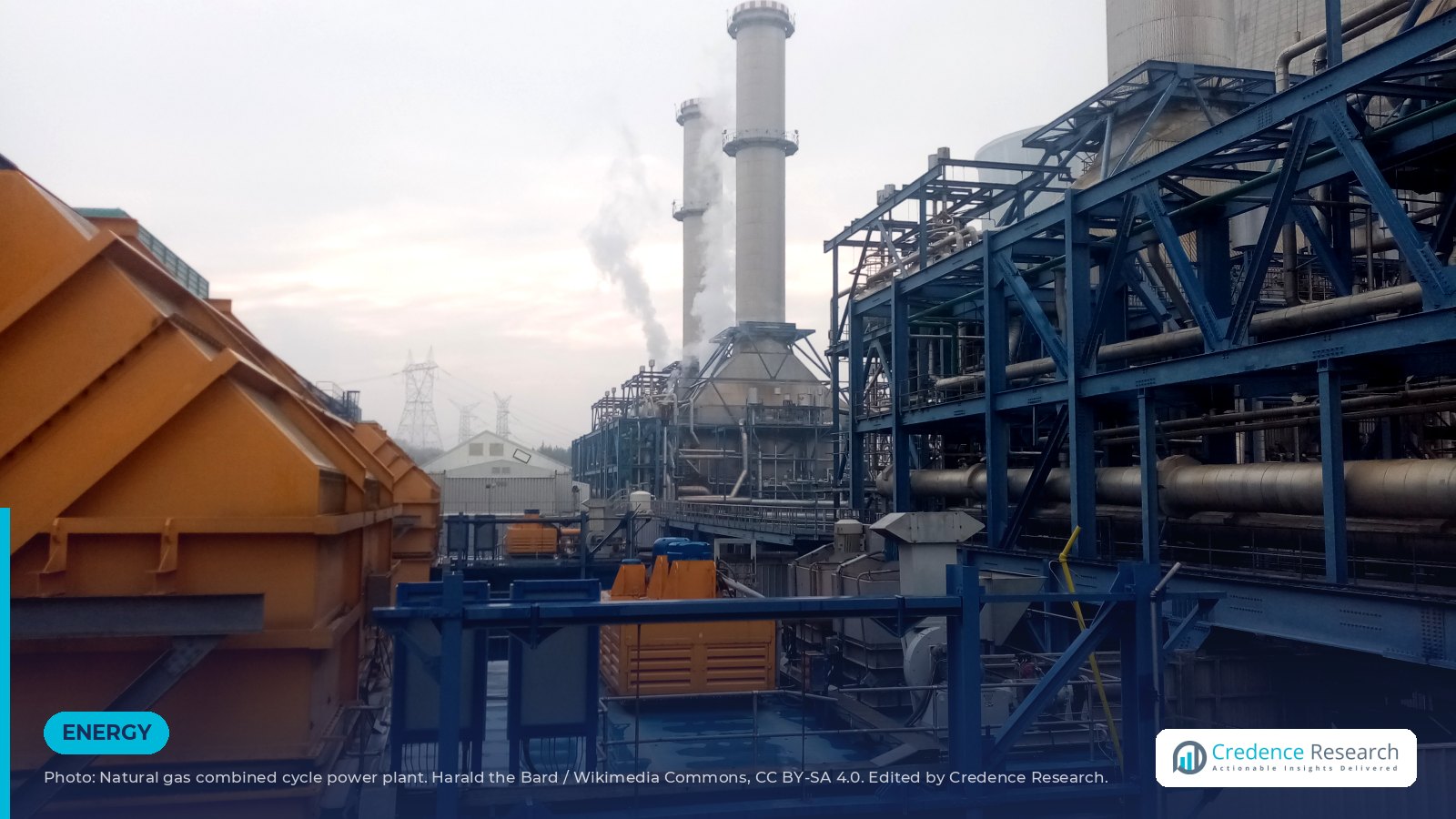
Image: Natural gas combined cycle power plant (representative image, not a Venture Global facility), by Harald the Bard via Wikimedia Commons, CC BY-SA 4.0. Cropped and edited by Credence Research.
About the Author

Senior News Editor at Credence Research Inc