
Wolfspeed adds 200 mm silicon carbide wafers to long-term Infineon supply deal
Wolfspeed Inc. and Infineon Technologies AG have expanded and extended their long-term silicon carbide wafer supply agreement to cover 200 mm substrates, adding the larger wafer format to the 150 mm material Wolfspeed already ships to the German chipmaker. Wolfspeed announced the deal from Durham, North Carolina, on Oct. 15, 2026, about a year after it emerged from a court-supervised financial restructuring, and framed the contract as a vote of confidence in its position as a leading Western supplier of silicon carbide.
Key developments
- The amended agreement adds 200 mm silicon carbide wafers to the existing 150 mm supply, with Wolfspeed positioned to serve Infineon's long-term substrate needs in both sizes.
- Neither company disclosed financial terms, contracted wafer volumes or the length of the extended agreement.
- The two companies trace their commercial relationship back more than 20 years; the current long-term 150 mm wafer contract was first signed in February 2018 and was expanded with a multi-year capacity reservation in January 2024.
- Wolfspeed CEO Robert Feurle said the 200 mm wafers build on the company's materials base as it continues to support Infineon's long-term silicon carbide requirements.
- Infineon described the agreement as a step to further strengthen supply chain resilience.
Why 200 mm silicon carbide matters
Silicon carbide is a wide-bandgap semiconductor used in power devices that switch high voltages with lower losses than conventional silicon. The material allows designers to build smaller, lighter power converters that waste less energy as heat, which is why it has moved into electric vehicle traction inverters and onboard chargers, solar and storage inverters, industrial drives and, more recently, the power supply chains feeding AI data centers. Wolfspeed's release pointed to EV charging, renewable energy, energy storage and AI data centers as the main sources of demand.
The substrate is the hardest part of the chain. Silicon carbide crystals grow slowly at very high temperatures, and defects in the boule carry through to the finished device. Moving from 150 mm to 200 mm wafers gives each wafer substantially more usable area, which lowers substrate cost per chip and lets fabs push more devices through the same tools. Only a handful of suppliers can grow large, low-defect crystals in volume.
Infineon has been working through that shift in its own factories. In February 2025 the company said it would begin releasing its first silicon carbide products made on 200 mm wafers, produced in Villach, Austria, and that the conversion of its Kulim, Malaysia, operations from 150 mm to 200 mm was on track, with a new Module 3 set to ramp high-volume production in line with demand.
Industry implications
For device makers, a secured 200 mm substrate source is a prerequisite for cutting costs on silicon carbide MOSFETs and diodes. Automakers and inverter builders want lower-cost power devices to improve the economics of their programs, and the larger wafer is one of the few structural levers available. A supply commitment from a long-standing materials partner gives Infineon more certainty as it moves capacity at Kulim and Villach onto the larger format.
For Wolfspeed, the agreement is commercial validation of its 200 mm materials program at an important moment. The company completed its financial restructuring in late September 2025, reducing total debt by about 70% and extending maturities to 2030, according to its own announcement. It has since shifted its Durham facilities toward materials production and has described its footprint as a greenfield, vertically integrated 200 mm operation. A multi-year order book from a top-tier power semiconductor maker strengthens the case that its materials business can anchor the company's recovery.
Competitive and supply chain implications
Infineon has long said it follows a multi-source strategy for silicon carbide substrates, and the Wolfspeed extension fits that pattern rather than replacing other suppliers. In early 2024 the company also formalized a supply agreement with SK Siltron CSS, which covers 150 mm wafers and a later move to 200 mm. Buying from several regions limits the risk that one outage or trade restriction stalls output.
The deal also sharpens a broader supply chain theme. Chinese substrate producers have added capacity quickly, adding price pressure on Western suppliers and raising questions among customers about long-term dependence on any one country. Wolfspeed explicitly positioned the agreement as reinforcing its standing as a Western source of silicon carbide, a message aimed at automakers, grid equipment makers and data center operators that increasingly weigh geographic diversity alongside price. Wolfspeed already counts Renesas Electronics among its strategic wafer customers; the Japanese chipmaker signed a 10-year supply agreement in 2023 and received equity in Wolfspeed as part of the court-approved restructuring.
Competing device makers, including STMicroelectronics, onsemi and Rohm, are pursuing their own 200 mm transitions, in several cases with in-house substrate capacity. Infineon's reliance on external substrate partners makes long-term contracts like this one central to its competitive position against vertically integrated rivals.
Regional implications
In the United States, the agreement supports production at Wolfspeed's North Carolina materials operations, including its Durham base and its large substrate complex in Chatham County. Steady demand from a European customer helps sustain domestic crystal growth and wafering capacity, which federal policy has treated as strategically important for power electronics.
In Asia, the 200 mm wafers are aimed at Infineon's long-term manufacturing needs, with Kulim, Malaysia, at the center of the company's silicon carbide expansion. In Europe, Villach produced Infineon's first 200 mm silicon carbide products and shares technologies and processes with Kulim, so the substrate supply also underpins Austrian production and the European automotive and industrial customers that buy those devices.
Credence Research analysis
The agreement matters less for its size, which neither party disclosed, than for what it signals about the 200 mm transition. Infineon is converting its silicon carbide fabs to the larger wafer, and locking in a qualified, long-standing source for 200 mm substrates reduces one of the main execution risks in that plan. The decision to expand an existing contract, rather than shift volume elsewhere, suggests Infineon is satisfied with Wolfspeed's 200 mm material quality, a point Wolfspeed will likely use with other prospective customers.
The deal does not resolve the pricing pressure facing silicon carbide substrate suppliers, and the absence of disclosed volumes makes it difficult to judge the revenue impact on Wolfspeed. Still, the industry is moving toward a structure in which large device makers keep at least one non-Chinese substrate source under long-term contract, and Wolfspeed has now secured 200 mm commitments in that role. Watch for whether demand from AI data center power systems, which favor high-efficiency conversion, offsets slower EV growth as the main driver of 200 mm adoption.
What comes next
- Wolfspeed will report fiscal first-quarter results on Nov. 4, 2026, which may offer more detail on 200 mm materials demand and customer qualification.
- Infineon is expected to update investors on its silicon carbide ramp at Kulim Module 3 and its 200 mm conversion with its fiscal year-end results.
- Watch for additional 200 mm substrate agreements between Infineon and other suppliers under its multi-source strategy.
- Rival device makers are likely to report their own 200 mm progress, which will shape pricing for both substrates and finished power devices.
Sources
- Wolfspeed: Infineon and Wolfspeed expand and extend long-term silicon carbide wafer supply agreement to include 200 mm
- Infineon: Infineon signs 200-millimeter silicon carbide wafer supply agreement with Wolfspeed
- Wolfspeed: Wolfspeed successfully completes financial restructuring
- Infineon: Infineon reaches next milestone on 200 mm silicon carbide roadmap
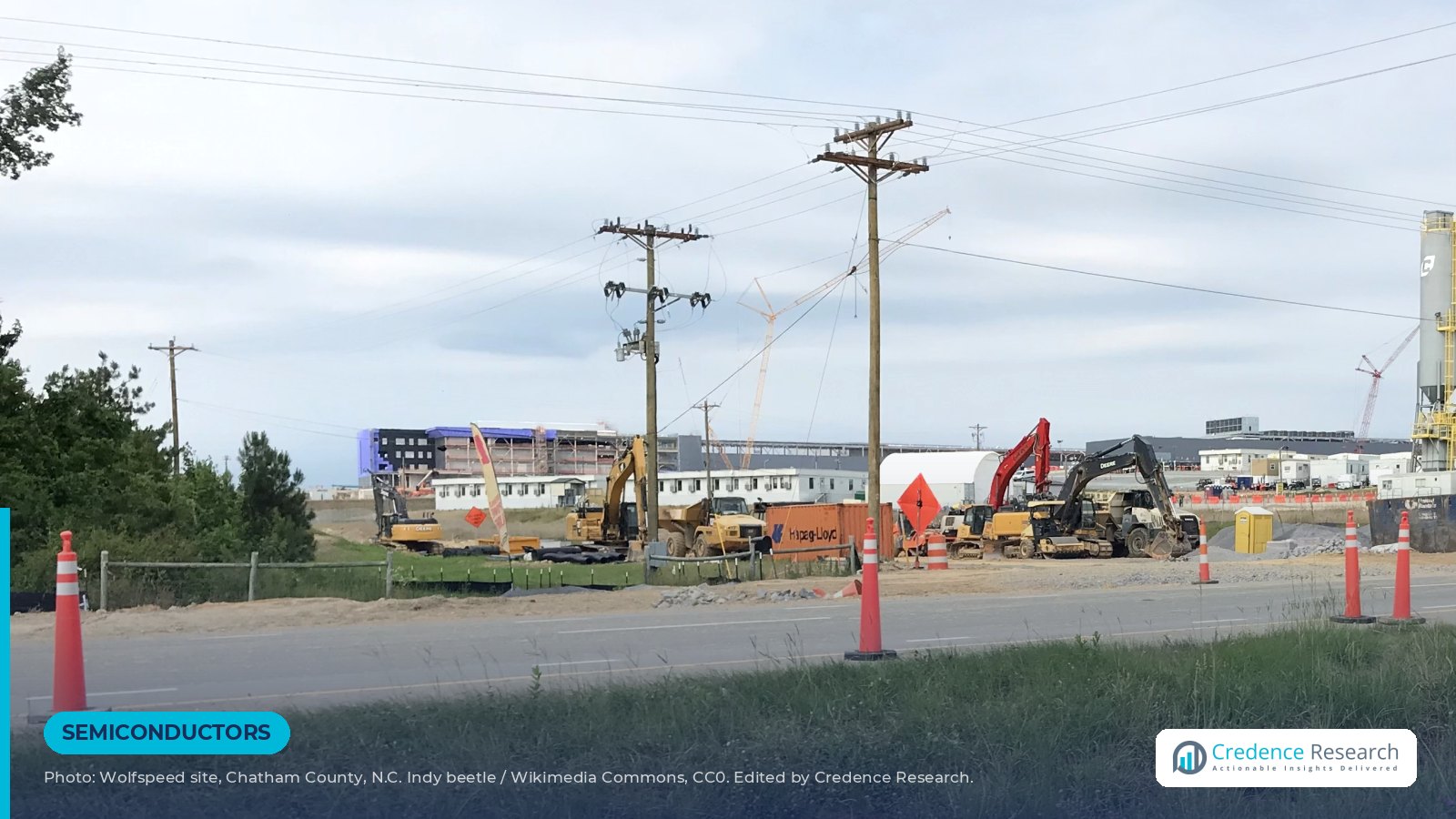
Image: Construction at Wolfspeed's silicon carbide site in Chatham County, North Carolina, by Indy beetle via Wikimedia Commons, CC0 1.0 (public domain dedication). Cropped and edited by Credence Research.

About the Author

Senior News Editor at Credence Research Inc