
Market Overview:
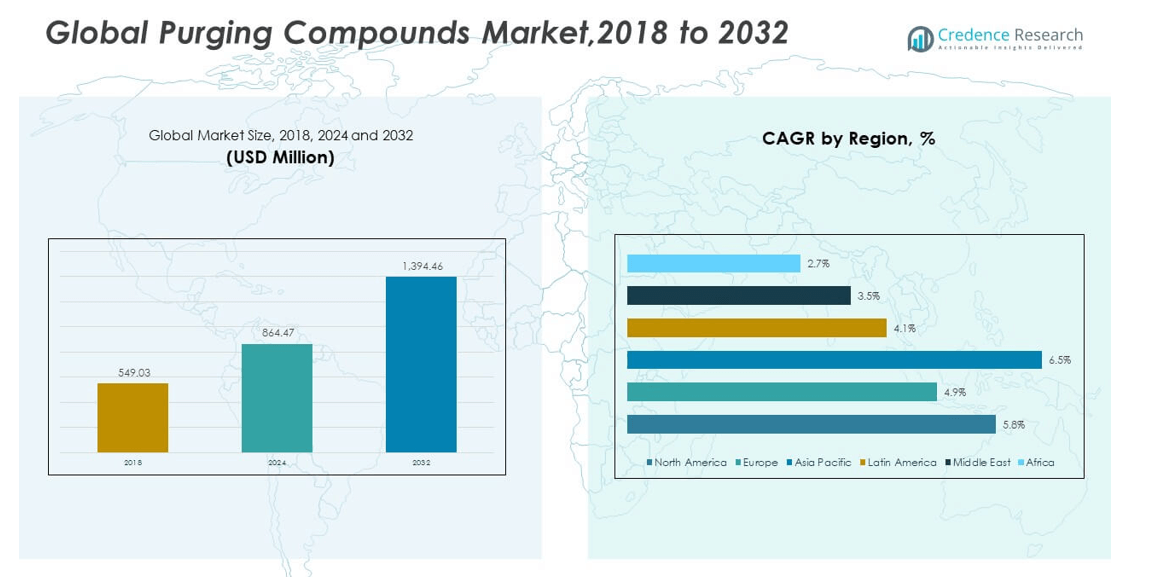
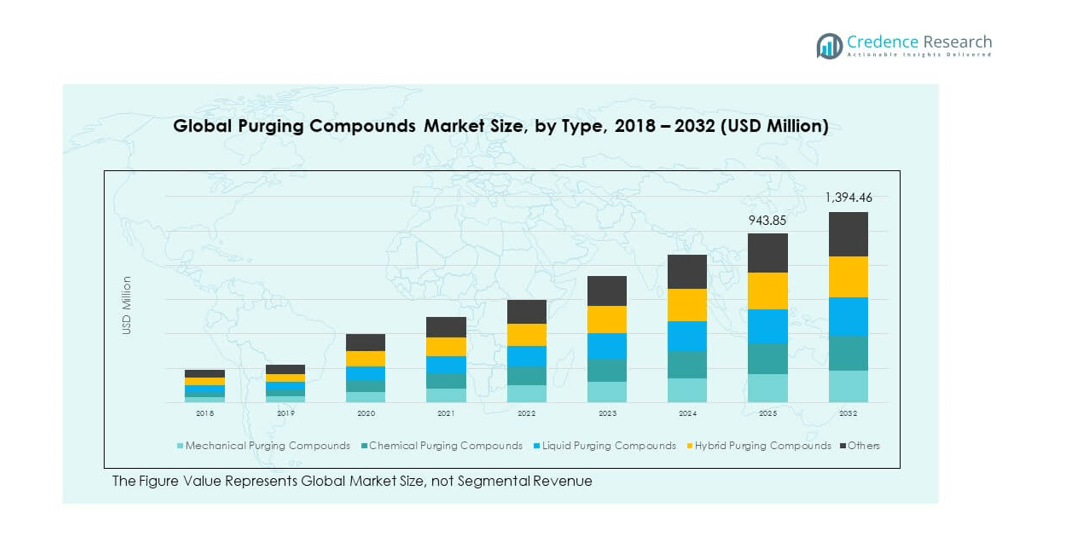
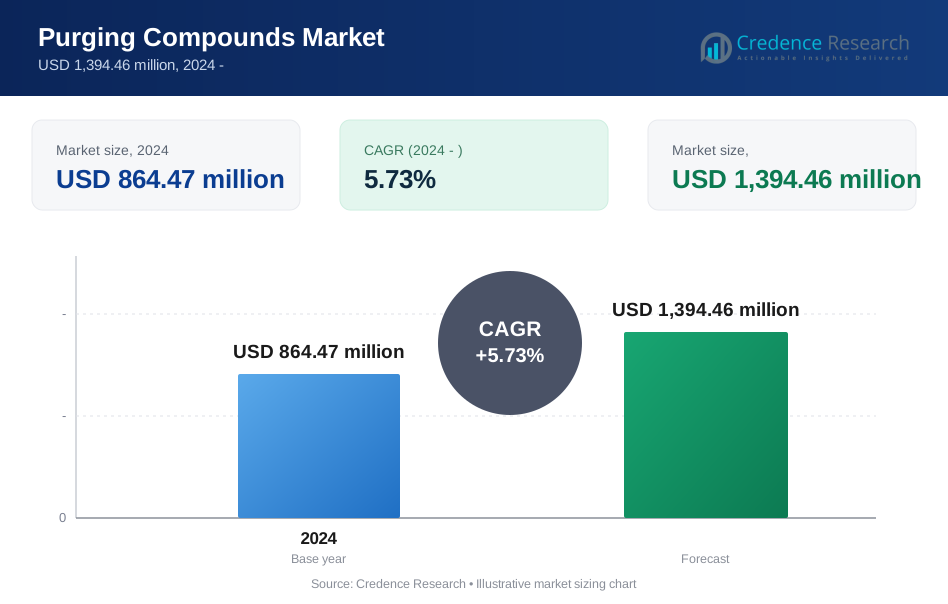
The Global Purging Compounds Market size was valued at USD 549.03 million in 2018 to USD 864.47 million in 2024 and is anticipated to reach USD 1,394.46 million by 2032, at a CAGR of 5.73% during the forecast period.
| REPORT ATTRIBUTE | DETAILS |
|---|---|
| Historical Period | 2020-2023 |
| Base Year | 2024 |
| Forecast Period | 2025-2032 |
| Purging Compounds Market Size 2024 | USD 864.47 million |
| Purging Compounds Market, CAGR | 5.73% |
| Purging Compounds Market Size 2032 | USD 1,394.46 million |
The market grows due to rising demand for efficient plastic processing operations. Manufacturers focus on reducing machine downtime and scrap rates. Purging compounds support faster resin and color changeovers. This benefit improves overall production efficiency. Growing use of engineering plastics increases cleaning complexity. Processors prefer chemical and mechanical purging solutions for consistency. Sustainability goals push firms to cut waste and energy use. Recycled resin processing also raises contamination risks. Purging compounds help maintain quality during frequent material transitions. These factors sustain steady demand across polymer processing industries.
Asia Pacific leads the market due to strong plastics manufacturing growth. China, India, and Southeast Asia expand injection molding and extrusion capacity. Rising packaging, automotive, and consumer goods output supports demand. North America remains a mature market with focus on high-performance purging solutions. The United States drives adoption through advanced polymer processing. Europe shows steady growth supported by strict quality standards. Germany and Italy lead machinery-intensive applications. Latin America and the Middle East emerge gradually. Industrial expansion and local plastics production support future uptake.
Market Insights:
- The market expanded from USD 549.03 million in 2018 to USD 864.47 million in 2024 and is projected to reach USD 1,394.46 million by 2032, reflecting a 5.73% CAGR driven by higher purge frequency in plastics processing.
- Asia Pacific (44%), Europe (26%), and North America (21%) lead regional shares due to large plastics manufacturing bases, strong packaging demand, and strict quality standards that favor efficient changeovers.
- Asia Pacific is the fastest-growing region with a 44% share, supported by rapid capacity expansion in China and India, rising consumer goods output, and frequent resin transitions.
- By type, mechanical purging compounds (~40%) and chemical purging compounds (~30%) dominate usage, as processors balance routine maintenance with deep cleaning needs.
- Liquid purging compounds (~20%) gain traction for faster coverage and shorter cycles, while hybrid and others (~10%) serve complex, multi-resin environments.
Market Drivers:
Rising Need For Faster And Cleaner Polymer Processing Changeovers
The Global Purging Compounds Market benefits from frequent resin and color changes. Manufacturers seek shorter transition cycles between production runs. Purging compounds reduce residual polymer build-up inside machines. This improves product quality across batches. It lowers scrap generation during start-up phases. Equipment uptime improves through effective barrel and screw cleaning. Processors value predictable cleaning outcomes. Demand grows across injection molding and extrusion lines.
- For instance, Asahi Kasei’s Asaclean grades report purge time reductions of up to 50% and faster color changeovers in injection molding applications, supporting higher line availability.
Focus On Cost Control And Waste Reduction In Plastics Manufacturing
The Global Purging Compounds Market gains support from strict cost control goals. Plastic processors aim to reduce raw material losses. Purging compounds limit off-spec production during changeovers. It helps conserve high-cost engineering resins. Lower scrap rates support margin stability. Manufacturers prefer repeatable cleaning performance. Energy use drops due to shorter purge cycles. Operational efficiency drives adoption across facilities.
- For instance, Chem-Trend’s Ultra Purge™ compounds have been cited to cut scrap material by up to 30% during resin transitions, improving cost efficiency across extrusion operations.
Growing Use Of Engineering And Specialty Polymers In Production
The Global Purging Compounds Market advances with complex polymer usage. Engineering plastics leave stubborn residues in processing equipment. Standard purging methods fail to remove deposits fully. Specialized compounds improve cleaning depth and consistency. It protects screw geometry and barrel surfaces. Quality standards rise in automotive and electronics plastics. Processors invest in reliable cleaning solutions. This trend sustains long-term demand growth.
Expansion Of High-Volume Plastic Processing Industries Worldwide
The Global Purging Compounds Market grows with plastics industry expansion. Packaging production scales across food and consumer goods. Automotive molding volumes remain strong in many regions. Medical device manufacturing demands clean processing environments. Purging compounds support frequent material changes. It ensures compliance with quality requirements. High-output lines value minimal downtime. Industrial growth supports steady market demand.
Market Trends:
Shift Toward Ready-To-Use And Customized Purging Formulations
The Global Purging Compounds Market shows preference for ready-to-use solutions. Processors avoid manual blending and preparation steps. Customized grades match specific resin types and temperatures. It simplifies operator training across shifts. Consistent results improve confidence in purge cycles. Suppliers offer application-specific product portfolios. This trend supports premium product positioning. Ease of use influences purchasing decisions.
- For instance, some purging compounds offer resin-specific grades that manufacturers report can reduce purging costs by over 60% and significantly accelerate changeovers, supporting standardized plant operations.
Increasing Preference For Low-Odor And Low-Residue Purging Solutions
The Global Purging Compounds Market reflects demand for cleaner shop floors. Operators favor low-odor compounds for better work conditions. Reduced smoke improves visibility near machines. It supports safety and compliance standards. Low-residue formulas limit secondary cleaning needs. Processors value smooth restart after purging cycles. Production stability improves with cleaner systems. Comfort and safety drive formulation innovation.
Integration Of Purging Solutions Into Preventive Maintenance Practices
The Global Purging Compounds Market aligns with preventive maintenance programs. Manufacturers schedule purging during planned downtime. This approach prevents severe build-up inside barrels. It extends equipment service life. Maintenance teams track purge cycles systematically. Predictive upkeep reduces unexpected breakdowns. Structured cleaning routines gain traction. Purging becomes part of standard operating procedures.
Growing Adoption Of Purging Compounds In Recycled Plastic Processing
The Global Purging Compounds Market adapts to recycled resin usage. Recycled polymers carry higher contamination risks. Frequent cleaning protects product consistency. It supports stable melt flow and color control. Processors handle mixed resin streams more confidently. Purging compounds limit cross-contamination effects. Recycling growth boosts specialized product demand. Circular economy goals influence market evolution.
Market Challenges Analysis:
Limited Awareness And Improper Usage Across Small Processing Units
The Global Purging Compounds Market faces awareness gaps in small plants. Many operators rely on traditional purge methods. Improper usage reduces performance benefits. It leads to inconsistent cleaning results. Training gaps affect purge cycle efficiency. Cost sensitivity limits product trials. Smaller processors delay adoption decisions. Education remains a key market challenge.
Performance Variability Across Different Machine And Resin Combinations
The Global Purging Compounds Market encounters compatibility concerns. One compound rarely suits all processing conditions. Incorrect grade selection affects cleaning depth. It may leave residue inside equipment. Trial costs discourage experimentation. Processors expect predictable outcomes. Suppliers must guide application choices. Technical support demands remain high.
Market Opportunities:
Product Innovation Focused On Sustainable And Low-Waste Processing Needs
The Global Purging Compounds Market holds scope for sustainable solutions. Manufacturers seek reduced purge material consumption. Efficient formulations lower disposal volumes. It aligns with waste reduction targets. Bio-based and recyclable compounds gain attention. Regulatory pressure supports cleaner formulations. Innovation creates differentiation opportunities. Sustainability trends shape future demand.
Growth Potential Across Emerging Manufacturing Regions And Industries
The Global Purging Compounds Market finds opportunity in emerging economies. Industrial expansion boosts plastic processing capacity. Local manufacturers upgrade production quality standards. It raises demand for professional cleaning solutions. Packaging and consumer goods output increases rapidly. Automotive localization supports molding growth. Suppliers expand regional distribution networks. Emerging markets offer long-term growth potential.
Market Segmentation Analysis:
By Type
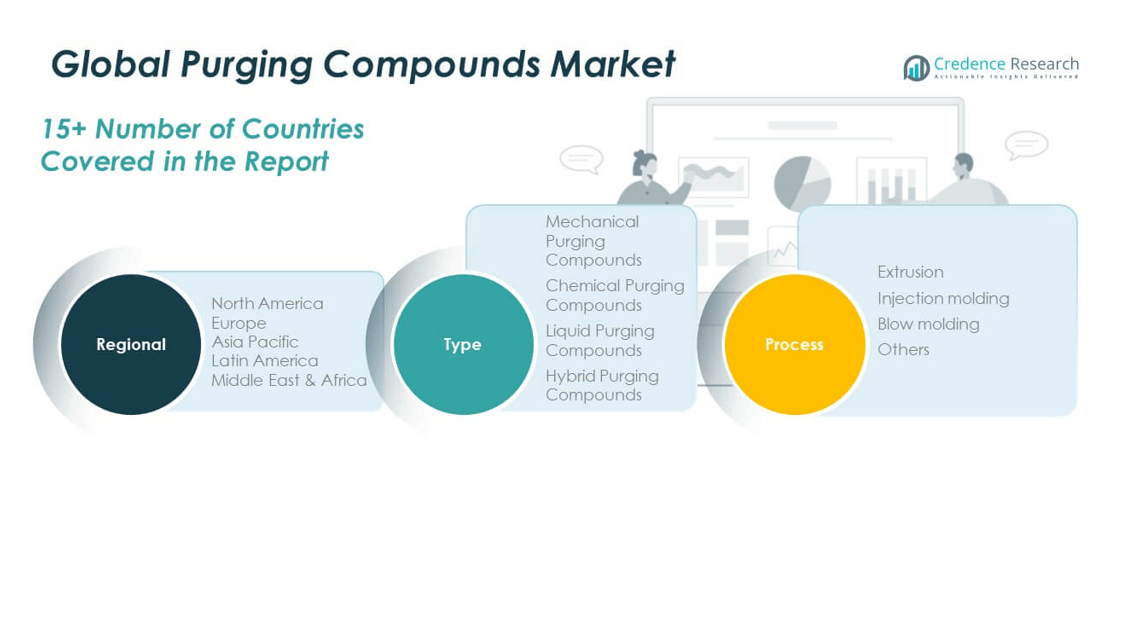
The Global Purging Compounds Market shows clear differentiation across product types. Mechanical purging compounds see wide use due to simple application and low residue risk. It suits routine maintenance in standard polymer runs. Chemical purging compounds support deep cleaning for high-temperature and engineered resins. Liquid purging compounds gain attention for uniform dispersion and faster coverage inside barrels. It supports short purge cycles and reduced material loss. Hybrid purging compounds combine mechanical and chemical action. This segment serves complex processing environments with frequent material changes.
- For instance, Chem-Trend reports hybrid formulations that remove carbonized deposits at processing temperatures above 300°C, serving complex multi-resin environments.
By Process
The Global Purging Compounds Market reflects varied demand across processing methods. Extrusion operations rely on purging to maintain steady melt flow and surface finish. It helps manage color transitions in continuous lines. Injection molding drives strong demand due to frequent tool and resin changes. Blow molding applications value purging for clean parison formation and consistent wall thickness. It supports packaging quality standards. Other processes include compression and transfer molding. These segments adopt purging compounds to protect equipment performance and maintain product consistency.
- For instance, users of Asaclean in extrusion lines report stable output after purging without dismantling screws, helping protect equipment performance and product consistency.
Segmentation:
By Type- Mechanical Purging Compounds
- Chemical Purging Compounds
- Liquid Purging Compounds
- Hybrid Purging Compounds
- Extrusion
- Injection Molding
- Blow Molding
- Others
- North America
- U.S.
- Canada
- Mexico
- Europe
- Germany
- France
- U.K.
- Italy
- Spain
- Rest of Europe
- Asia Pacific
- China
- Japan
- India
- South Korea
- South-east Asia
- Rest of Asia Pacific
- Latin America
- Brazil
- Argentina
- Rest of Latin America
- Middle East & Africa
- GCC Countries
- South Africa
- Rest of the Middle East and Africa
Regional Analysis:
North America
The North America Purging Compounds Market size was valued at USD 119.33 million in 2018 to USD 183.97 million in 2024 and is anticipated to reach USD 298.43 million by 2032, at a CAGR of 5.8 during the forecast period. The Global Purging Compounds Market maintains stable demand across the region due to advanced plastic processing infrastructure. The United States leads with strong injection molding activity. Automotive, packaging, and medical sectors drive consistent usage. It benefits from strict quality control norms and downtime reduction goals. Processors favor chemical and hybrid grades for complex polymers. Equipment modernization supports frequent purge cycles. North America accounts for about 21% market share in 2024.
Europe
The Europe Purging Compounds Market size was valued at USD 146.17 million in 2018 to USD 221.31 million in 2024 and is anticipated to reach USD 334.68 million by 2032, at a CAGR of 4.9 during the forecast period. The Global Purging Compounds Market shows steady performance across Europe. Germany, France, and Italy anchor demand through strong industrial bases. Packaging and automotive molding drive consistent consumption. It supports high standards for surface finish and color accuracy. Sustainability goals influence product preferences. Mechanical and liquid compounds remain widely used. Europe holds nearly 26% market share in 2024.
Asia Pacific
The Asia Pacific Purging Compounds Market size was valued at USD 234.01 million in 2018 to USD 382.42 million in 2024 and is anticipated to reach USD 655.41 million by 2032, at a CAGR of 6.5 during the forecast period. The Global Purging Compounds Market finds its largest regional base here. China, India, and Southeast Asia drive high-volume plastic production. Packaging and consumer goods output expands rapidly. It supports frequent resin and color changes. Cost efficiency shapes buying decisions. Local suppliers compete with global brands. Asia Pacific holds about 44% market share in 2024.
Latin America
The Latin America Purging Compounds Market size was valued at USD 25.45 million in 2018 to USD 39.56 million in 2024 and is anticipated to reach USD 56.33 million by 2032, at a CAGR of 4.1 during the forecast period. The Global Purging Compounds Market grows steadily in this region. Brazil and Mexico lead demand through packaging and household plastics. Quality improvement efforts support adoption. It aligns with gradual equipment upgrades. Cost sensitivity affects product selection. Distributor presence improves access. Latin America represents about 5% market share in 2024.
Middle East
The Middle East Purging Compounds Market size was valued at USD 15.56 million in 2018 to USD 22.42 million in 2024 and is anticipated to reach USD 30.59 million by 2032, at a CAGR of 3.5 during the forecast period. The Global Purging Compounds Market shows moderate growth in the region. UAE and Saudi Arabia lead industrial usage. Packaging and construction plastics support demand. It benefits from diversification initiatives. Import dependence shapes supply trends. Awareness of purge efficiency improves gradually. The Middle East holds nearly 3% market share in 2024.
Africa
The Africa Purging Compounds Market size was valued at USD 8.51 million in 2018 to USD 14.80 million in 2024 and is anticipated to reach USD 19.02 million by 2032, at a CAGR of 2.7 during the forecast period. The Global Purging Compounds Market remains limited across Africa. South Africa and Egypt lead regional activity. Plastic processing capacity stays modest. It supports basic packaging demand. Cost constraints slow adoption. Mechanical compounds dominate usage. Africa accounts for about 2% market share in 2024.
Key Player Analysis:
- Calsak Corporation
- Plastic Solutions, Inc.
- Neutrex, Inc.
- Perfect Colourants & Plastics Pvt. Ltd.
- Asahi Kasei Corporation
- Chem-Trend L.P.
- 3M
Competitive Analysis:
The Global Purging Compounds Market features a mix of global chemical firms and specialized niche suppliers. Competition centers on product performance, ease of use, and application support. Leading players focus on chemical, hybrid, and liquid formulations for complex polymers. It rewards suppliers that offer consistent purge efficiency across machines. Technical service and customer training strengthen long-term contracts. Regional players compete on price and local availability. Innovation targets faster cleaning cycles and low-residue performance. Strategic partnerships with processors enhance market presence. Brand reputation plays a key role in buyer selection.
Recent Developments:
- In September 2025, Asahi Kasei announced the launch of its newest innovation in the purging compounds market by starting European sales activities of the Asaclean™ R-Series. This strategic product launch represents a significant addition to the company's family of purging compounds for plastics processing equipment. The Asaclean™ R-Series consists of three distinct grades designed to optimize different processing requirements: the universal grade RU, the time-optimized RX grade, and the RE grade, which is specifically optimized for quick and efficient material changeover. The new series achieves outstanding cleaning performance while requiring significantly less rinsing material after the purging process, contributing to time-, cost-, and material-optimization in the plastics processing industry. Asahi Kasei presented this innovation at K 2025, the world's No. 1 trade fair for the plastics and rubber industry held in Düsseldorf from October 8-15, 2025.
Report Coverage:
The research report offers an in-depth analysis based on By Type and By Process. It details leading market players, providing an overview of their business, product offerings, investments, revenue streams, and key applications. Additionally, the report includes insights into the competitive environment, SWOT analysis, current market trends, as well as the primary drivers and constraints. Furthermore, it discusses various factors that have driven market expansion in recent years. The report also explores market dynamics, regulatory scenarios, and technological advancements that are shaping the industry. It assesses the impact of external factors and global economic changes on market growth. Lastly, it provides strategic recommendations for new entrants and established companies to navigate the complexities of the market.
Future Outlook:
- Demand will rise with frequent resin and color changeovers.
- Hybrid purging compounds will gain wider industrial acceptance.
- Recycling-driven processing will increase purge frequency.
- Low-residue formulations will attract quality-focused processors.
- Asia Pacific will remain the primary growth engine.
- Preventive maintenance adoption will support steady demand.
- Sustainability goals will shape product development.
- Distributor networks will expand in emerging regions.
- Custom formulations will strengthen supplier differentiation.
- Technical support will influence long-term contracts.
Request a Free Sample
Fill in your details and we'll send you a free sample report.
- Sample data tables & charts
- Research methodology
Market Dynamics
Rising Need for Faster and Cleaner Polymer Processing Changeovers
Frequent resin and color changes in plastics manufacturing require efficient cleaning to minimize downtime and scrap. Purging compounds enable faster transitions and consistent product quality, directly supporting higher productivity and cost savings.
Focus on Cost Control and Waste Reduction
Manufacturers are under pressure to reduce raw material losses and operational costs. Purging compounds help limit off-spec production and lower scrap rates during changeovers, supporting margin stability and energy efficiency.
Growing Use of Engineering and Specialty Polymers
The increasing adoption of engineering plastics and specialty resins, which are more difficult to clean from equipment, drives demand for advanced purging compounds that can effectively remove stubborn residues and maintain equipment performance.
Expansion of High-Volume Plastic Processing Industries
Growth in packaging, automotive, and consumer goods manufacturing - especially in Asia Pacific - leads to more frequent material changes and higher output, sustaining steady demand for purging compounds to ensure quality and compliance.
Sustainability and Recycling Trends
The push for sustainable manufacturing and increased use of recycled resins raises contamination risks and cleaning complexity. Purging compounds are essential for maintaining product consistency and supporting circular economy initiatives by enabling cleaner transitions between recycled and virgin materials.
Need a Custom Version of This Report?
Tailor the scope, geography, or segments to your exact requirements.
- Custom geography or segment scope
- Direct access to our analyst team
Frequently Asked Questions
What is the current market size for Purging Compound, and what is its projected size in 2032?
At what Compound Annual Growth Rate is the Purging Compound market projected to grow between 2025 and 2032?
Which Purging Compound market segment held the largest share in 2024?
What are the primary factors fueling the growth of the Purging Compound market?
Who are the leading companies in the Purging Compound market?
Which region commanded the largest share of the Purging Compound market in 2024?
Table of Content
Chapter 1 Market Segmentation
- 1.1 Segmentation Framework
- 1.1.1 Product and Service Classification
- 1.1.2 Application and End-Use Classification
- 1.1.3 Technology and Solution Classification
- 1.1.4 Customer and Distribution Channel Classification
- 1.1.5 Geographic Segmentation
- 1.1.6 Market Segment Definitions and Boundaries
- 1.2 By Type
- 1.2.1 Mechanical Purging Compounds
- 1.2.2 Chemical Purging Compounds
- 1.2.3 Liquid Purging Compounds
- 1.2.4 Hybrid Purging Compounds
- 1.3 By Process
- 1.3.1 Extrusion
- 1.3.2 Injection Molding
- 1.3.3 Blow Molding
- 1.3.4 Others
Chapter 2 Introduction
- 2.1 Report Objectives and Scope
- 2.2 Product Definition and Industry Terminology
- 2.3 Market Inclusions and Exclusions
- 2.4 Research Process
- 2.4.1 Primary Research and Expert Interviews
- 2.4.2 Secondary Research and Source Review
- 2.4.3 Top-Down and Bottom-Up Estimation
- 2.4.4 Data Triangulation and Verification
- 2.5 Market Size Measurement Basis
- 2.5.1 2024: USD 864.47 million → 2032: USD 1,394.46 million
- 2.6 Historical and Forecast Reference Periods
- 2.6.1 Base Year: 2024
- 2.6.2 Forecast Period: 2024-2032
- 2.7 Research Assumptions and Limitations
Chapter 3 Executive Summary
- 3.1 Market Snapshot and Key Findings
- 3.2 Base-Year Market Size, 2024
- 3.3 Forecast Market Size, 2032
- 3.4 Revenue and Volume Growth Outlook
- 3.5 Key Demand and Supply Indicators
- 3.6 Leading Market Segments
- 3.7 Fastest-Growing Market Opportunities
- 3.8 Regional Performance Highlights
- 3.9 Technology and Industry Transformation
- 3.10 Competitive Landscape Summary
- 3.11 Analyst View and Strategic Implications
Chapter 4 Global Purging Compounds Market Trends and Developments
- 4.1 Historical Industry Development
- 4.2 Recent Market Trends and Developments
- 4.3 Demand and Customer Behavior Trends
- 4.4 Technology and Product Innovation
- 4.5 Artificial Intelligence, Automation and Digitalization
- 4.6 Local Manufacturing and Supply Chain Realignment
- 4.7 Industry Partnerships, Mergers and Acquisitions
- 4.8 Sustainability and Circular Economy Developments
- 4.9 Government and Private Sector Investment Trends
- 4.10 Emerging Business Models and Commercialization
- 4.11 Industry Developments and Announcements
Chapter 5 Global Purging Compounds Market Production, Supply and Demand Analysis
- 5.1 Demand Trend and Consumption Analysis
- 5.2 Demand Forecast, 2024-2032
- 5.3 Production and Output Trend
- 5.4 Production and Output Forecast, 2024-2032
- 5.5 Installed Capacity and Capacity Utilization
- 5.6 Company-Wise Production Plants and Statistics
- 5.6.1 Installed Production Capacity
- 5.6.2 Actual Production
- 5.6.3 Planned Capacity and Expansion Targets
- 5.7 Supply Chain Structure and Procurement Trends
- 5.8 Supply-Demand Gap and Bottlenecks
- 5.9 Import Dependence and Sourcing Structure
- 5.10 Contract Manufacturing and Outsourcing
- 5.11 Regional Supply and Demand Concentration
Chapter 6 Global Purging Compounds Market Pricing Analysis
- 6.1 Pricing Structure and Measurement
- 6.2 Historical Pricing Trends
- 6.3 Pricing Outlook, 2024-2032
- 6.4 Average Selling Price and Unit Economics
- 6.5 Pricing by Product and Market Segment
- 6.6 Geographic Pricing Differences
- 6.7 Key Input, Energy, Labor and Logistics Costs
- 6.8 Contract Pricing and Purchasing Models
- 6.9 Pricing Sensitivity and Competitive Positioning
- 6.10 Price, Margin and Profitability Implications
Chapter 7 Global Purging Compounds Market Dynamics
- 7.1 Market Growth Drivers
- 7.1.1 Demand-Side Drivers
- 7.1.2 Technology and Innovation Drivers
- 7.1.3 Infrastructure and Investment Drivers
- 7.1.4 Regulatory and Policy Drivers
- 7.2 Market Restraints
- 7.2.1 Cost and Affordability Constraints
- 7.2.2 Technology and Adoption Barriers
- 7.2.3 Supply Chain and Operational Constraints
- 7.3 Market Challenges
- 7.3.1 Competitive Pressure and Margin Erosion
- 7.3.2 Skills, Infrastructure and Implementation Gaps
- 7.4 Emerging Market Opportunities
- 7.5 Market Dynamics Impact and Time-Horizon Assessment
Chapter 8 Global Purging Compounds Value Chain Analysis
- 8.1 Industry Value Chain Overview
- 8.2 Upstream Suppliers and Critical Inputs
- 8.3 Technology and Component Providers
- 8.4 Manufacturing or Service Delivery
- 8.5 Distribution, Channel Partners and Integrators
- 8.6 Downstream Applications and End Users
- 8.7 Value Addition and Profit Pools
- 8.8 Vertical Integration and Outsourcing
- 8.9 Supplier Concentration and Risk
- 8.10 Supply Chain Localization and Resilience
Chapter 9 Global Purging Compounds Market Regulations and Policies
- 9.1 Relevant Laws, Standards and Compliance Frameworks
- 9.2 Product, Service, Safety and Quality Requirements
- 9.3 Government Policies, Incentives and Subsidies
- 9.4 Imports, Exports and Trade Barriers
- 9.5 Public Procurement and Local Content Requirements
- 9.6 Environmental and Sustainability Compliance
- 9.7 Upcoming Policy Changes and Market Implications
Chapter 10 Global Purging Compounds Market Hotspots and Opportunities
- 10.1 Market Opportunity Mapping and Growth Hotspots
- 10.2 High-Growth Applications and Customer Groups
- 10.3 Underserved Markets and White-Space Opportunities
- 10.4 Emerging Technology and Product Opportunities
- 10.5 New Capacity and Investment Hotspots
- 10.6 Market Entry and Expansion Opportunities
- 10.7 Distribution and Partnership Opportunities
- 10.8 Near-Term and Long-Term Commercial Potential
- 10.9 Opportunity Attractiveness and Execution Risks
Chapter 11 Global Purging Compounds Market Outlook, 2024-2032
- 11.1 Market Size and Analysis
- 11.1.1 Revenue (Market Measurement: 2024: USD 864.47 million → 2032: USD 1,394.46 million)
- 11.1.2 Market Volume and Quantity Sold
- 11.1.3 Historical Market Size
- 11.1.4 Base-Year Market Size, 2024
- 11.2 Market Forecast, 2024-2032
- 11.2.1 Revenue Forecast to 2032
- 11.2.2 Volume Forecast to 2032
- 11.2.3 CAGR and Year-on-Year Growth
- 11.2.4 Incremental Revenue Opportunity
- 11.3 Forecast Assumptions and Scenario Analysis
- 11.3.1 Base-Case Forecast
- 11.3.2 Optimistic and Conservative Scenarios
- 11.3.3 Technology, Pricing and Policy Sensitivities
- 11.4 Market Attractiveness and Growth Outlook
Chapter 12 Global Purging Compounds Market Segmentation and Outlook
- 12.1 Segmentation Summary and Market Shares, 2024
- 12.2 Largest and Fastest-Growing Segments
- 12.3 By Type - Market Size and Forecast, 2024-2032
- 12.3.1 Segment Definition and Scope
- 12.3.2 Historical Market Size
- 12.3.3 Revenue Forecast, 2024-2032
- 12.3.4 Volume Forecast, 2024-2032
- 12.3.5 Base-Year Market Share, 2024
- 12.3.6 Segment CAGR and Growth Drivers
- 12.3.7 Subsegment Market Size and Forecast
- 12.3.7.1 Mechanical Purging Compounds
- 12.3.7.2 Chemical Purging Compounds
- 12.3.7.3 Liquid Purging Compounds
- 12.3.7.4 Hybrid Purging Compounds
- 12.3.8 Subsegment Pricing and Adoption Trends
- 12.3.9 Leading Suppliers and Competition
- 12.3.10 Regional Demand and Opportunities
- 12.4 By Process - Market Size and Forecast, 2024-2032
- 12.4.1 Segment Definition and Scope
- 12.4.2 Historical Market Size
- 12.4.3 Revenue Forecast, 2024-2032
- 12.4.4 Volume Forecast, 2024-2032
- 12.4.5 Base-Year Market Share, 2024
- 12.4.6 Segment CAGR and Growth Drivers
- 12.4.7 Subsegment Market Size and Forecast
- 12.4.7.1 Extrusion
- 12.4.7.2 Injection Molding
- 12.4.7.3 Blow Molding
- 12.4.7.4 Others
- 12.4.8 Subsegment Pricing and Adoption Trends
- 12.4.9 Leading Suppliers and Competition
- 12.4.10 Regional Demand and Opportunities
- 12.5 Segment Growth Comparison
- 12.6 Segment Attractiveness and Priority Matrix
Chapter 13 Global Purging Compounds Geographic Market Outlook, 2024-2032
- 13.1 Regional Market Size and Share, 2024
- 13.2 Regional Market Forecast, 2024-2032
- 13.3 Regional Pricing, Production and Demand Differences
- 13.4 North America
- 13.4.1 United States
- 13.4.2 Canada
- 13.4.3 Mexico
- 13.5 Europe
- 13.5.1 Germany
- 13.5.2 France
- 13.5.3 Italy
- 13.5.4 United Kingdom
- 13.5.5 Spain
- 13.5.6 Poland
- 13.5.7 Russia
- 13.5.8 Netherlands
- 13.5.9 Belgium
- 13.5.10 Sweden
- 13.5.11 Denmark
- 13.5.12 Norway
- 13.5.13 Rest of Europe
- 13.6 Asia Pacific
- 13.6.1 China
- 13.6.2 India
- 13.6.3 Japan
- 13.6.4 South Korea
- 13.6.5 Thailand
- 13.6.6 Indonesia
- 13.6.7 Vietnam
- 13.6.8 Malaysia
- 13.6.9 Australia
- 13.6.10 Rest of Asia Pacific
- 13.7 Latin America
- 13.7.1 Brazil
- 13.7.2 Argentina
- 13.7.3 Colombia
- 13.7.4 Chile
- 13.7.5 Rest of Latin America
- 13.8 Middle East
- 13.8.1 Saudi Arabia
- 13.8.2 United Arab Emirates
- 13.8.3 Turkey
- 13.8.4 Israel
- 13.8.5 Iran
- 13.8.6 Rest of the Middle East
- 13.9 Africa
- 13.9.1 South Africa
- 13.9.2 Egypt
- 13.9.3 Nigeria
- 13.9.4 Morocco
- 13.9.5 Rest of Africa
- 13.10 Regional Investment, Policy and Supply Chain Differences
- 13.11 Regional Competitive Landscape
- 13.12 Geographic Growth Hotspots
Chapter 14 Global Purging Compounds Technology, Innovation and Sustainability Outlook
- 14.1 Technology Landscape and Maturity
- 14.2 Product, Process and Service Innovation
- 14.3 AI, Automation and Digital Tools in the Industry
- 14.4 Technology Adoption and Performance Benchmarking
- 14.5 Innovation Pipeline and R&D Investment
- 14.6 Patent and Intellectual Property Trends
- 14.7 Energy Efficiency and Resource Management
- 14.8 Sustainability, Recycling and Circularity
- 14.9 Technology Roadmap, 2024-2032
- 14.10 Risks of Obsolescence and Technology Substitution
Chapter 15 Global Purging Compounds Market Key Strategic Imperatives
- 15.1 Growth and Market Entry Priorities
- 15.2 High-Return Products and Segments
- 15.3 Pricing, Profitability and Cost Optimization
- 15.4 Technology Investment and Product Differentiation
- 15.5 Supply Chain Localization and Resilience
- 15.6 Distribution and Customer Acquisition
- 15.7 Partnership, Acquisition and Capacity Strategy
- 15.8 Regional Expansion Priorities
- 15.9 Short-, Medium- and Long-Term Actions
Chapter 16 Competition Outlook
- 16.1 Industry Competition Characteristics
- 16.2 Market Structure and Concentration
- 16.3 Market Share and Competitive Positioning, 2024
- 16.4 Company-Wise Revenue and Product Benchmarking
- 16.5 Production and Service Capacity Benchmarking
- 16.6 Technology, Pricing and Differentiation
- 16.7 Regional Footprint and Distribution Strength
- 16.8 Mergers, Acquisitions and Strategic Alliances
- 16.9 New Entrants and Competitive Threats
- 16.10 Porter's Five Forces and Industry Attractiveness
- 16.11 Competitive Outlook, 2024-2032
Chapter 17 Company Profiles
- 17.1 Company Coverage and Selection Criteria
- 17.2 Asahi Kasei Corporation
- 17.2.1 Business Description
- 17.2.2 Company Ownership and Geographic Presence
- 17.2.3 Product and Service Portfolio
- 17.2.4 Manufacturing and Operating Footprint
- 17.2.5 Production Capacity and Expansion Plans
- 17.2.6 Financial Performance and Investment
- 17.2.7 Market Share and Competitive Position
- 17.2.8 Technology and Innovation Capabilities
- 17.2.9 Strategic Alliances or Partnerships
- 17.2.10 Recent Developments
- 17.2.11 Growth Strategy and Outlook
- 17.3 Chem-Trend L.P.
- 17.4 3M
- 17.5 Neutrex, Inc.
- 17.6 Calsak Corporation
- 17.7 Plastic Solutions, Inc.
- 17.8 Perfect Colourants & Plastics Pvt. Ltd.
- 17.9 Clariant
- 17.10 Dyna-Purge
- 17.11 RapidPurge
- 17.12 Other Relevant Market Participants
Note: Every listed company is profiled on the structure shown under the first company. The company list is preliminary and may change based on research findings, market developments, data availability and client requirements.
Chapter 18 Disclaimer
- 18.1 Research and Forecast Disclaimer
- 18.2 Data Source and Estimation Limitations
Note: The depth of individual sections depends on data availability for this market. Volume, capacity, trade and other unit-based metrics are included where applicable.

