
Market Overview:
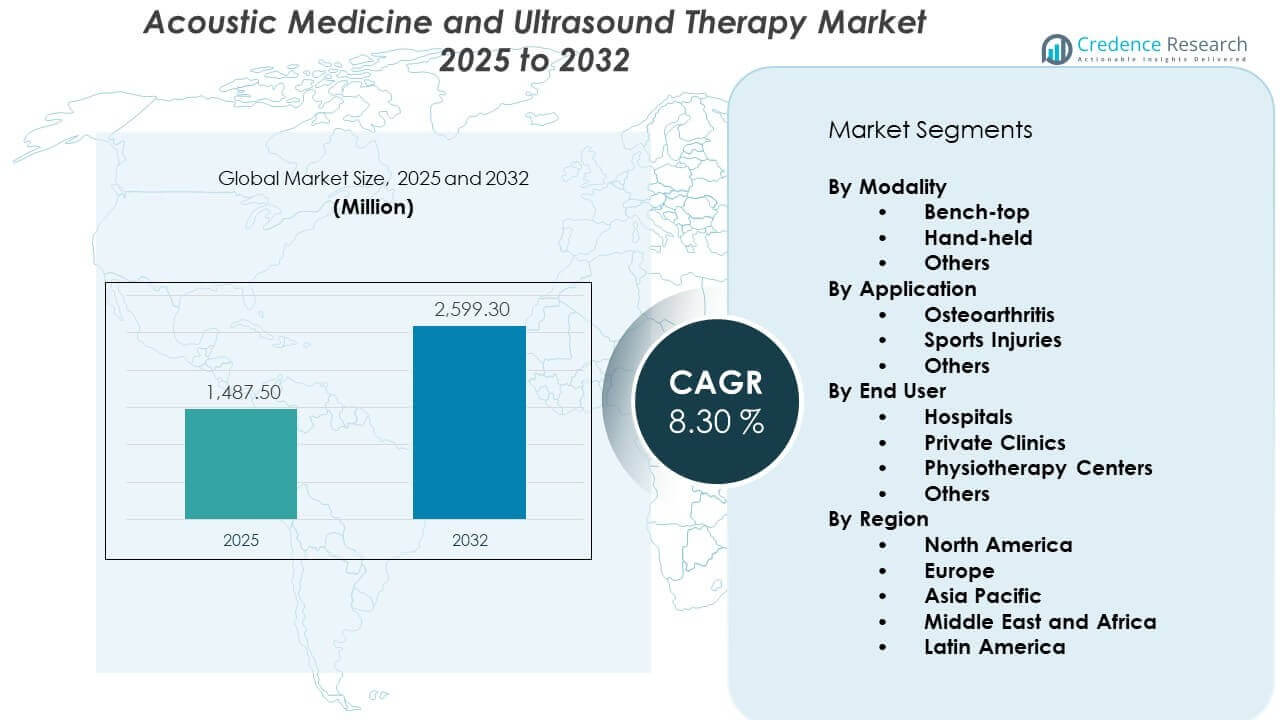
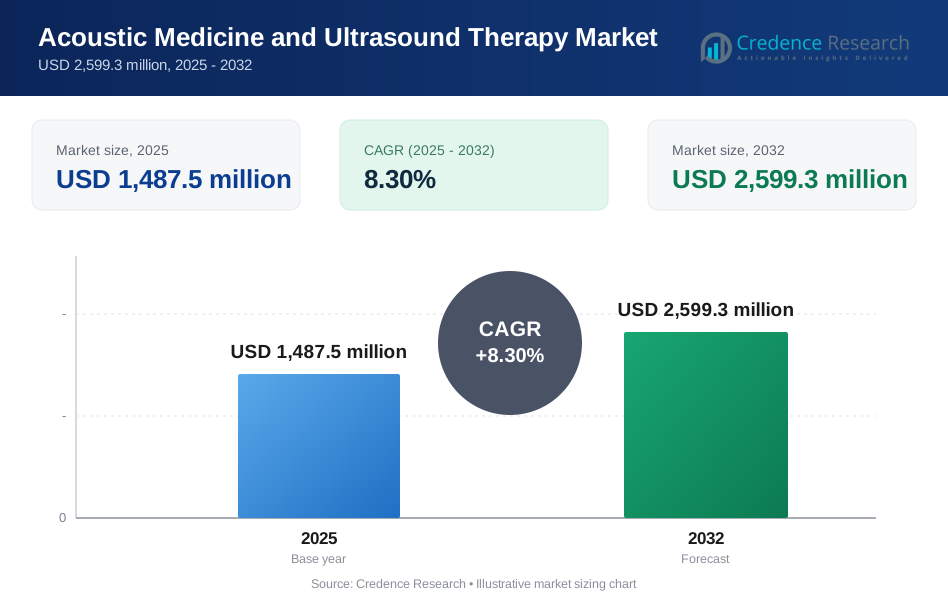
The Acoustic Medicine and Ultrasound Therapy Market is projected to grow from USD 1,487.5 million in 2025 to an estimated USD 2,599.3 million by 2032, registering a CAGR of 8.30% from 2025 to 2032.
| REPORT ATTRIBUTE | DETAILS |
|---|---|
| Historical Period | 2020-2023 |
| Base Year | 2024 |
| Forecast Period | 2025-2032 |
| Acoustic Medicine and Ultrasound Therapy Market Size 2025 | USD 1,487.5 million |
| Acoustic Medicine and Ultrasound Therapy Market, CAGR | 8.30% |
| Acoustic Medicine and Ultrasound Therapy Market Size 2032 | USD 2,599.3 million |
Market expansion is driven by the growing prevalence of musculoskeletal disorders, sports injuries, and chronic pain conditions. Healthcare providers increasingly adopt ultrasound therapy to reduce reliance on surgery and long-term drug use. Technological improvements have enhanced treatment precision, portability, and energy control, supporting wider clinical acceptance. Rising awareness among patients and clinicians also supports demand. In addition, expanding use in physical therapy, orthopedics, and wound healing continues to strengthen the overall adoption of acoustic medicine solutions.
Regionally, North America leads the Acoustic Medicine and Ultrasound Therapy Market due to strong healthcare infrastructure, high therapy adoption, and early use of advanced medical devices. Europe follows, supported by rehabilitation-focused care models and aging populations. Asia Pacific is an emerging growth region, driven by expanding hospital capacity, rising healthcare spending, and improving access to physiotherapy services in countries such as China and India. Latin America and the Middle East show gradual adoption as awareness and medical investment increase.
Market Insights:
- The Acoustic Medicine and Ultrasound Therapy Market was valued at USD 1,487.5 million in 2025 and is projected to reach USD 2,599.3 million by 2032, growing at a CAGR of 8.30% from 2024 to 2032.
- North America (38%), Europe (27%), and Asia Pacific (22%) lead the market due to advanced infrastructure, aging populations, and increased adoption of non-invasive therapies in hospitals and physiotherapy centers.
- Asia Pacific, the fastest-growing region, holds a 22% share, driven by expanding healthcare infrastructure, rising awareness of non-drug therapies, and strong growth in rehabilitation services.
- By modality, the hand-held segment accounts for over 45% of the market, driven by demand for portability and home-based care solutions across outpatient and physiotherapy settings.
- By application, osteoarthritis holds around 50% market share, supported by the rising prevalence of age-related joint conditions and widespread integration of therapeutic ultrasound in elderly care.
Market Drivers:
Rising Demand for Non-Invasive Pain and Rehabilitation Therapies Across Clinical Settings
The Acoustic Medicine and Ultrasound Therapy Market is gaining traction due to the growing preference for non-invasive treatment methods. Physicians and therapists are turning to ultrasound therapy to reduce surgical risks and post-operative complications. It supports faster tissue recovery, making it suitable for chronic pain, soft tissue injuries, and joint conditions. Healthcare systems encourage these methods to reduce patient recovery time and hospital readmissions. Insurers are expanding reimbursement coverage, which improves treatment accessibility. Portable ultrasound devices also enable in-home care options, supporting convenience for aging populations. Hospitals and clinics prefer these tools for their minimal training requirements and fast deployment. This shift continues to strengthen the use of acoustic modalities in daily clinical workflows.
- For instance, studies show daily therapeutic ultrasound applications can reduce pain scores by more than 30% over 12 treatment sessions, improving strength and function in tendons and joints. ZetrOZ Systems’ wearable SAM device delivers 18,720 J over a four‑hour treatment period, enabling home‑based therapy with measurable outcomes.
Expanding Geriatric Population With Increased Risk of Musculoskeletal Disorders
Aging populations in both developed and emerging regions are increasing the need for effective therapy solutions. Elderly individuals face a higher incidence of osteoarthritis, ligament injuries, and limited mobility. The Acoustic Medicine and Ultrasound Therapy Market benefits from this growing patient base that needs frequent, non-surgical interventions. These systems reduce pain, improve circulation, and promote localized healing without requiring invasive methods. Geriatric care centers integrate such therapies into routine rehabilitation programs. Demand for outpatient physiotherapy sessions has grown in tandem with elderly populations. As life expectancy rises globally, healthcare systems face mounting pressure to manage aging-related disorders affordably. Acoustic therapies meet this demand with a balance of efficacy, safety, and accessibility.
- For instance, the World Health Organization notes that global life expectancy at birth rose from 66.8 years in 2000 to 73.1 years in 2019, before declining to 72.5 years in 2020 due to the COVID-19 pandemic.
Increased Utilization in Sports Medicine and Physical Therapy Applications
Sports injuries and physical training-related complications are contributing to wider therapy adoption. Athletes, fitness enthusiasts, and orthopedic patients are frequent users of ultrasound therapy. The Acoustic Medicine and Ultrasound Therapy Market is increasingly relevant in sports clinics, physical therapy centers, and rehabilitation hospitals. It helps reduce inflammation, accelerates muscle recovery, and supports tendon healing. These benefits appeal to both amateur and professional athletes seeking faster return-to-play timelines. The non-invasive nature of the therapy allows for consistent, repetitive use without added strain. Many physical therapists integrate acoustic therapy with manual therapy and exercise routines for optimized outcomes. Usage continues to expand in wellness centers and athletic training facilities.
Technological Advancements Improving Treatment Precision and Customization
Innovations in device engineering and energy modulation are enhancing treatment outcomes. Modern ultrasound therapy units now feature multi-frequency control, deeper penetration, and programmable cycles. The Acoustic Medicine and Ultrasound Therapy Market is responding to the demand for targeted, patient-specific care. Developers focus on miniaturization, smart monitoring, and AI-powered systems for enhanced diagnostics and therapy tracking. Integration with wearables and digital health platforms is also rising. These technologies ensure real-time feedback and consistent energy delivery across sessions. Clinics adopt newer systems to provide advanced services and remain competitive. Smart therapeutic ultrasound units enable more consistent care across provider types.
Market Trends:
Integration of Wearable Therapeutic Devices and Remote Therapy Platforms
Technological convergence is transforming the delivery model for ultrasound-based care. Developers are launching compact, wearable devices that enable patients to undergo therapy remotely. The Acoustic Medicine and Ultrasound Therapy Market now includes connected units that link with smartphone apps for session control. Remote therapy helps maintain compliance, especially for chronic users and elderly patients. It also expands access in underserved areas where physiotherapy clinics are limited. These platforms collect treatment data, allowing physicians to adjust protocols remotely. Adoption is high among wellness start-ups and telehealth providers offering digital rehabilitation. Consumer-friendly interfaces support self-guided therapy in home environments.
- For instance, ZetrOZ Systems developed the sam® x1 wearable device, the first and only FDA-cleared wearable ultrasound to deliver 4 hours of continuous Sustained Acoustic Medicine. The system utilizes a Bluetooth-connected mobile app to track patient adherence, reporting a 93% user compliance rate in clinical studies compared to traditional clinic-based therapy.
Growing Use in Veterinary Care and Animal Rehabilitation Programs
Veterinary clinics are turning to acoustic and ultrasound therapy for musculoskeletal and post-operative recovery in animals. The Acoustic Medicine and Ultrasound Therapy Market is finding new traction in animal healthcare, particularly in developed markets. Pets with joint pain or injuries respond well to localized ultrasound therapy. Equine and canine therapy centers are adopting these technologies to reduce lameness and enhance muscle repair. Portable units enable use in mobile veterinary services and field-based animal care. Demand has increased from pet owners seeking drug-free options. Animal hospitals prefer these systems for their simplicity, safety, and repeatability. Veterinary ultrasound therapy continues to evolve in both domestic and performance animal care.
Increased Focus on Regenerative Therapies Using Acoustic Stimulation
Therapeutic ultrasound is now being studied for its regenerative impact on damaged tissues and nerves. The Acoustic Medicine and Ultrasound Therapy Market is witnessing experimental use cases in wound healing, stem cell activation, and nerve repair. Researchers explore low-intensity pulsed ultrasound (LIPUS) for bone healing and tissue regeneration. It opens new therapeutic pathways beyond pain management and inflammation control. Clinical studies in orthobiologics and neuro-rehabilitation are expanding. Manufacturers are investing in units optimized for regenerative use, with precise energy modulation. These advancements may reshape how clinicians approach long-term recovery. Hospitals and academic centers play a key role in driving early adoption.
- For instance, Bioventus utilizes LIPUS technology in its EXOGEN system, which delivers a signal of 1.5 MHz at an intensity of 30 \(mW/cm^{2}\). This specific acoustic stimulation has been shown to achieve a 38% faster heal rate for fresh fractures and a 86% success rate in treating established non-union fractures that failed to heal on their own.
Emergence of AI-Based Acoustic Therapy Systems for Precision Treatment Delivery
Artificial intelligence integration is optimizing treatment protocols and outcome tracking. Smart ultrasound systems now feature embedded algorithms to adjust dosage, duration, and energy levels in real time. The Acoustic Medicine and Ultrasound Therapy Market is slowly shifting toward personalized, feedback-driven therapy. Devices capture skin impedance, tissue feedback, and patient response for better control. AI tools also reduce operator variability, improving consistency across treatment sessions. Clinics with high patient volumes benefit from such automation. Predictive analytics support proactive treatment scheduling and plan refinement. These advancements are changing how physical therapy is documented and managed.
Market Challenges Analysis:
Limited Clinical Awareness and Underutilization in Primary and Community Healthcare
A major challenge for the Acoustic Medicine and Ultrasound Therapy Market lies in the lack of widespread clinical awareness. Many primary care physicians and community health workers are unfamiliar with its therapeutic potential. This results in low referral rates and underuse outside specialist clinics. Despite its proven benefits, ultrasound therapy is often overshadowed by pharmacological treatments or traditional physical therapy methods. Smaller hospitals may not invest in equipment or training due to cost perceptions. Patients also lack information about acoustic therapy as an alternative to drugs or surgery. Without broader education campaigns, market penetration will remain limited in rural and non-specialist facilities. Encouraging institutional training and promoting therapy guidelines could improve integration.
Inconsistent Reimbursement Coverage and High Cost of Advanced Equipment
Reimbursement barriers continue to restrict broader adoption of therapeutic ultrasound. While some countries cover certain indications, others exclude them from public or private insurance plans. The Acoustic Medicine and Ultrasound Therapy Market faces slow uptake in regions where patients pay out-of-pocket. High-end therapy systems remain costly for small clinics and solo practitioners. Equipment upgrades and servicing also add financial strain. This reduces accessibility, especially in low- and middle-income countries. Manufacturers must address pricing flexibility and leasing options. Healthcare policy updates and advocacy are crucial to improve financial viability. Without cost management and insurance support, deployment will remain uneven.
Market Opportunities:
Rising Adoption in Emerging Economies With Growing Outpatient Rehabilitation Demand
Emerging economies are investing heavily in outpatient care and physiotherapy infrastructure. The Acoustic Medicine and Ultrasound Therapy Market can scale in regions like Southeast Asia, Latin America, and parts of Africa. Governments are funding rehabilitation centers, and demand is rising for non-drug treatments. Urban hospitals and private clinics now explore advanced therapy solutions. Portable ultrasound units suit low-resource settings. Manufacturers can tap into these markets with training, bundled pricing, and localized service support.
Potential Expansion in Chronic Disease Management and Home-Based Therapies
Chronic conditions such as arthritis, back pain, and nerve disorders need long-term management. The Acoustic Medicine and Ultrasound Therapy Market offers solutions that support at-home treatment for these cases. Compact, user-friendly devices now target the home care segment. These tools reduce clinical visits while maintaining therapeutic outcomes. The model fits aging patients and post-surgical cases requiring continued care. Demand for remote care aligns with this opportunity.
Market Segmentation Analysis:
By Modality
The market includes bench-top, hand-held, and other device formats. Bench-top systems dominate in hospital settings due to their advanced features and higher intensity capabilities. Hand-held units are gaining traction across outpatient and home-use settings for their portability and ease of use. Clinics and physiotherapists prefer compact units for in-field treatment sessions. It supports consistent therapy delivery without the need for large space or infrastructure. Hand-held devices also align with the growing trend of mobile and remote care. The "others" segment covers emerging modalities under development, including wearable ultrasound units.
- For instance, Mettler Electronics offers the Sonicator 740, a portable hand-held unit weighing only 3.75 pounds, which delivers continuous or pulsed ultrasound at frequencies of 1 MHz or 3 MHz. The device is engineered with a specialized crystal-to-patient coupling sensor that ensures therapeutic delivery only when contact is at 80% efficiency or higher, preventing ineffective treatment sessions in mobile environments.
By Application
Osteoarthritis leads in application share, driven by rising cases among aging populations and demand for non-drug therapies. Acoustic stimulation helps reduce pain, improve joint function, and accelerate healing. Sports injuries represent a fast-growing area, with adoption in athlete recovery, sprain management, and rehabilitation. Clinics integrate ultrasound into treatment protocols for tendon, muscle, and ligament injuries. The "others" segment includes conditions such as post-operative recovery, tissue regeneration, and chronic pain.
By End User
Hospitals are major users due to high patient volume and availability of advanced equipment. It enables post-surgical recovery support and pain management. Private clinics use mid-range systems for outpatient rehabilitation. Physiotherapy centers rely on portable or mid-sized devices for daily therapeutic sessions. The "others" category includes wellness centers, elderly care facilities, and sports organizations expanding into acoustic therapy services.
- For instance, BTL’s BTL-4000 Smart/Premium series offers over 50 preset protocols and features HandsFree Sono® technology. This system uses a multi-crystal applicator to deliver ultrasound across an 18 cm² area, enabling a single therapist to manage up to 3 patients at once without compromising dosage accuracy.
Segmentation:
By Modality
- Bench-top
- Hand-held
- Others
By Application
- Osteoarthritis
- Sports Injuries
- Others
By End User
- Hospitals
- Private Clinics
- Physiotherapy Centers
- Others
By Region
- North America
- U.S.
- Canada
- Mexico
- Europe
- Germany
- France
- U.K.
- Italy
- Spain
- Rest of Europe
- Asia Pacific
- China
- Japan
- India
- South Korea
- South-east Asia
- Rest of Asia Pacific
- Latin America
- Brazil
- Argentina
- Rest of Latin America
- Middle East & Africa
- GCC Countries
- South Africa
- Rest of the Middle East and Africa
Regional Analysis:
North America
North America holds the largest market share, accounting for approximately 38% of the global Acoustic Medicine and Ultrasound Therapy Market. The region benefits from advanced healthcare infrastructure, high awareness of non-invasive treatments, and strong insurance coverage. The U.S. leads adoption with widespread availability of therapeutic ultrasound in hospitals, sports clinics, and rehabilitation centers. Canada is also expanding access through outpatient physiotherapy programs and elderly care facilities. Innovation from domestic manufacturers supports consistent technology upgrades. The region shows steady growth due to increased usage in chronic pain and musculoskeletal disorder management.
Europe
Europe follows closely, representing around 27% of the total market share. Demand remains high across Germany, the UK, France, and Italy, supported by structured rehabilitation programs and public healthcare systems. Hospitals and physiotherapy centers actively deploy ultrasound therapy for osteoarthritis, post-surgery care, and injury recovery. Aging populations in Western Europe drive increased usage in elderly care facilities. Governments promote non-pharmacological treatments, which enhances therapy access. It continues to grow with rising partnerships between medical device makers and national health authorities.
Asia Pacific, Latin America, and Middle East & Africa
Asia Pacific holds approximately 22% of the market share, with rapid expansion in China, India, Japan, and South Korea. Rising healthcare investments, growing medical tourism, and increased focus on physical rehabilitation fuel adoption. Latin America contributes about 7% of the global share, led by Brazil and Mexico, where outpatient therapy clinics are increasing. The Middle East and Africa collectively account for roughly 6%, with the UAE and South Africa leading in adoption. It sees future potential in these regions due to improving infrastructure and growing awareness. Strategic distribution partnerships and affordable device options are essential to capture emerging market demand.
Key Player Analysis:
- BTL
- ZetrOZ Systems
- Dynatronics Corporation
- Mettler Electronics Corp.
- Compass Health Brands
Competitive Analysis:
The competitive landscape of the Acoustic Medicine and Ultrasound Therapy Market features a mix of established medical device firms and focused therapy solution providers. Companies compete through product performance, device portability, and clinical versatility. Innovation remains central, with emphasis on compact systems, precision energy control, and user-friendly interfaces. Firms invest in clinical validation to strengthen physician trust and expand approved use cases. Distribution reach and after-sales support play a key role in customer retention. Strategic partnerships with physiotherapy networks and sports medicine centers support market presence. It continues to evolve as players align product portfolios with outpatient and home-care demand.
Recent Developments:
- In December 2025, ZetrOZ Systems expanded the reach of its wearable sustained acoustic medicine (sam) devices through high‑profile partnerships and increased visibility in sports medicine circles, enhancing access to non‑invasive ultrasound therapy.
- In September 2025, ZetrOZ Systems deepened its partnership with the Arthritis Foundation to educate patients on using the sam® wearable ultrasound device for treating knee osteoarthritis and other soft tissue conditions through sustained acoustic medicine.
Report Coverage:
The research report offers an in-depth analysis based on By Modality, By Application, By End User, and By Region. It details leading market players, providing an overview of their business, product offerings, investments, revenue streams, and key applications. Additionally, the report includes insights into the competitive environment, SWOT analysis, current market trends, as well as the primary drivers and constraints. Furthermore, it discusses various factors that have driven market expansion in recent years. The report also explores market dynamics, regulatory scenarios, and technological advancements that are shaping the industry. It assesses the impact of external factors and global economic changes on market growth. Lastly, it provides strategic recommendations for new entrants and established companies to navigate the complexities of the market.
Future Outlook:
- Demand will increase across hospitals and outpatient centers for non-invasive treatment options that reduce patient recovery time and improve mobility.
- Hand-held and wearable ultrasound therapy devices will dominate future growth due to portability, low cost, and ease of integration in home-care environments.
- Manufacturers will prioritize smart therapy platforms with data-tracking features to support personalized treatment plans and improve compliance.
- Sports rehabilitation and athletic performance sectors will expand use of acoustic medicine, driven by demand for faster healing and injury prevention.
- Aging demographics across North America, Europe, and parts of Asia will fuel sustained demand for osteoarthritis and chronic pain management therapies.
- Strategic collaborations between device manufacturers and physiotherapy networks will strengthen distribution and expand market reach in underserved areas.
- Technological innovations, including AI-powered energy modulation and multi-frequency ultrasound heads, will improve precision and clinical outcomes.
- Government support for non-drug therapy options and pressure to reduce healthcare costs will drive institutional adoption of therapeutic ultrasound.
- Emerging economies will experience rapid market entry due to rising healthcare investments, demand for outpatient treatment, and increasing awareness.
- The market will evolve with bundled service models, integrating acoustic therapy with digital health, physiotherapy programs, and chronic disease management platforms.
Request a Free Sample
Fill in your details and we'll send you a free sample report.
- Sample data tables & charts
- Research methodology
Need a Custom Version of This Report?
Tailor the scope, geography, or segments to your exact requirements.
- Custom geography or segment scope
- Direct access to our analyst team
Frequently Asked Questions
What is the current market size for Acoustic Medicine and Ultrasound Therapy Market, and what is its projected size in 2032?
At what Compound Annual Growth Rate is the Acoustic Medicine and Ultrasound Therapy Market projected to grow between 2025 and 2032?
Which Acoustic Medicine and Ultrasound Therapy Market segment held the largest share in 2025?
What are the primary factors fueling the growth of the Acoustic Medicine and Ultrasound Therapy Market?
Who are the leading companies in the Acoustic Medicine and Ultrasound Therapy Market?
Which region commanded the largest share of the Acoustic Medicine and Ultrasound Therapy Market in 2025?
Table of Content
Chapter 1. Report Introduction
- 1.1 Report Description & Purpose
- 1.1.1 Report Title & Market Definition
- 1.1.2 Unique Selling Propositions (USP) & Key Differentiators
- 1.1.3 Value Proposition for Stakeholders
- 1.2 Research Objectives
- 1.2.1 Market Sizing Objectives (Volume & Revenue)
- 1.2.2 Segmentation Objectives
- 1.2.3 Competitive Intelligence Objectives
- 1.2.4 Forecast & Scenario Objectives
- 1.3 Report Scope
- 1.3.1 Acoustic Medicine and Ultrasound Therapy Scope – Types & Subtypes Covered
- 1.3.2 Geographic Scope – Regions & Countries Covered
- 1.3.3 Historical Period, Base Year & Forecast Period (2025; forecast to 2032)
- 1.3.4 Inclusions & Exclusions
- 1.4 HS Code & Classification Framework
- 1.5 Currency, Units & Pricing Basis
- 1.6 Target Stakeholders
- 1.7 Limitations & Assumptions
Chapter 2. Executive Summary
- 2.1 Global Acoustic Medicine and Ultrasound Therapy Market Snapshot
- 2.1.1 Market Size – Historical (2025) & Forecast (2025-2032) (2025: USD 1,487.5 million → 2032: USD 2,599.3 million)
- 2.1.2 Volume & Revenue – Global Totals
- 2.1.3 Key Market Highlights – Top Five Facts
- 2.2 Acoustic Medicine and Ultrasound Therapy Market Segmentation Snapshot
- 2.2.1 Market Split by Region – 2025 vs. 2032
- 2.3 Competitive Snapshot
- 2.3.1 Top 10 Players by Revenue Share – 2025
- 2.3.2 Top 10 Players by Volume Share – 2025
- 2.3.3 Recent Strategic Developments (18-Month Summary)
- 2.4 Key Investment Highlights & Strategic Conclusions
Chapter 3. Acoustic Medicine and Ultrasound Therapy Market Dynamics & Industry Analysis
- 3.1 Market Overview & Context
- 3.1.1 Acoustic Medicine and Ultrasound Therapy Market Position in the Broader Automotive Value Chain
- 3.1.2 OEM vs. Replacement Market Dynamics
- 3.1.3 Market Maturity & Development Stage by Region
- 3.2 Acoustic Medicine and Ultrasound Therapy Market Drivers
- 3.3 Acoustic Medicine and Ultrasound Therapy Market Restraints & Challenges
- 3.4 Acoustic Medicine and Ultrasound Therapy Market Opportunities
- 3.5 Porter's Five Forces Analysis
- 3.5.1 Threat of New Entrants
- 3.5.2 Bargaining Power of Suppliers
- 3.5.3 Bargaining Power of Buyers
- 3.5.4 Threat of Substitutes
- 3.5.5 Competitive Rivalry – Intensity Assessment
- 3.6 Acoustic Medicine and Ultrasound Therapy Value Chain Analysis
- 3.6.1 Upstream – Raw Material/Input Suppliers
- 3.6.1.1 Raw Material/Input 1
- 3.6.1.2 Raw Material/Input 2
- 3.6.1.3 Raw Material/Input 3
- 3.6.2 Midstream – Production/Manufacturing/Service Delivery
- 3.6.2.1 Production/Process Overview
- 3.6.2.2 Key Facility Locations & Capacity by Manufacturer
- 3.6.3 Downstream – Distribution & End Consumer
- 3.6.3.1 Primary Channel – B2B/OEM
- 3.6.3.2 Secondary Channels – Dealer, Retail, Online, Direct
- 3.6.4 Value Chain Profitability Analysis
- 3.6.1 Upstream – Raw Material/Input Suppliers
- 3.7 PESTEL Analysis
- 3.7.1 Political Factors
- 3.7.2 Economic Factors
- 3.7.3 Social Factors
- 3.7.4 Technological Factors
- 3.7.5 Environmental Factors
- 3.7.6 Legal Factors
- 3.8 Acoustic Medicine and Ultrasound Therapy Supply Chain Analysis
- 3.8.1 Raw Material/Input Supply Risk Assessment
- 3.8.2 Manufacturing Concentration Risk (Geographic Exposure)
- 3.8.3 Trade Disruption Impact Analysis
- 3.9 Regulatory & Policy Landscape
Note: The regulatory and policy landscape section covers regulations based on their applicability to the market, Acoustic Medicine and Ultrasound Therapy category, geography, and scope of the study. Only regulatory frameworks with a material impact on operations, compliance, trade, sustainability, or market access are analyzed in detail.
Chapter 4. Key Investment Pockets & Opportunity Analysis
- 4.1 Acoustic Medicine and Ultrasound Therapy Market Attractiveness Analysis
- 4.1.1 By Region – Investment Attractiveness Matrix (Volume × CAGR)
- 4.2 Absolute Revenue Growth Opportunity
- 4.2.1 By Region – Absolute USD Growth Through 2032
- 4.3 Incremental Volume Opportunity
- 4.3.1 By Region – Incremental Volume Through 2032
- 4.3.2 Segment – Incremental Volume
- 4.4 Emerging Submarket Opportunity Deep Dive (Subject to Applicability)
- 4.5 Emerging Market Opportunity Scorecards
- 4.5.1 United States
- 4.5.2 Europe
- 4.5.3 Asia
- 4.5.4 Middle East & Africa
Note: Emerging Market Opportunity Scorecards will be included based on relevance and strategic importance. Regions listed are indicative and may vary depending on data availability and market dynamics.
Chapter 5. Acoustic Medicine and Ultrasound Therapy Import-Export Analysis & Trade Flows
- 5.1 Global Trade Overview
- 5.1.1 Global Export Value by Country (2025)
- 5.1.2 Global Export Volume by Country (2025)
- 5.1.3 Global Import Value by Country (2025)
- 5.1.4 Global Import Volume by Country (2025)
- 5.1.5 Net Trade Balance by Country (2025)
- 5.2 Export Analysis – Segment
- 5.2.1 Type 1 (HS Code)
- 5.2.2 Type 2 (HS Code)
- 5.2.3 Type 3 (HS Code)
- 5.2.4 Type 4 (HS Code)
- 5.2.5 Type 5 (HS Code)
- 5.3 Import Analysis – Segment
- 5.3.1 Type 1 (HS Code)
- 5.3.2 Type 2 (HS Code)
- 5.3.3 Type 3 (HS Code)
- 5.3.4 Type 4 (HS Code)
- 5.3.5 Type 5 (HS Code)
- 5.4 Average Unit Trade Prices
- 5.4.1 Average Export Price – Segment & Country
- 5.4.2 Average Import Price – Segment & Source Country
- 5.4.3 Price Trends (2025)
- 5.5 Key Trade Route Analysis
- 5.5.1 Trade Route 1
- 5.5.2 Trade Route 2
- 5.5.3 Trade Route 3
- 5.5.4 Trade Route 4
- 5.5.5 Trade Route 5
- 5.6 Trade Policy Impact Assessment
- 5.6.1 US Anti-Dumping & Section 301 Tariffs
- 5.6.2 EU Customs Union Impact
- 5.6.3 Major Free Trade Agreements
- 5.6.4 USMCA Rules of Origin
Note: Trade policy analysis will be included only where relevant to the Acoustic Medicine and Ultrasound Therapy market.
Chapter 6. Competitive Landscape & Company Benchmarking
- 6.1 Acoustic Medicine and Ultrasound Therapy Market Concentration & Structure
- 6.1.1 Herfindahl-Hirschman Index (HHI) – vs. 2025
- 6.1.2 Tier 1, Tier 2 & Tier 3 Market Structure
- 6.1.3 Global, Regional & Local Player Dynamics
- 6.2 Acoustic Medicine and Ultrasound Therapy Market Share Analysis – 2025
- 6.2.1 Global Revenue Share by Company
- 6.2.2 Global Volume Share by Company
- 6.2.3 Regional Revenue Share
- 6.2.4 Market Share Evolution ( vs. 2025)
- 6.2.5 OEM Segment Share by Company
- 6.2.6 Replacement Segment Share by Company
- 6.3 Production/Delivery Capacity & Facility Analysis
- 6.3.1 Global Installed Capacity
- 6.3.2 Capacity Utilization Rates
- 6.3.3 Production/Output Volume
- 6.3.4 Facility Locations & Capacity Map
- 6.3.5 Planned Capacity Additions
- 6.4 Acoustic Medicine and Ultrasound Therapy Competitive Benchmarking Matrix
- 6.4.1 Revenue, Volume, CAGR & Profitability Comparison
- 6.4.2 Channel Revenue Mix
- 6.4.3 Geographic Revenue Exposure
- 6.4.4 R&D Intensity
- 6.4.5 Sustainability Maturity
- 6.5 Strategic Developments in Acoustic Medicine and Ultrasound Therapy (Last 24 Months)
- 6.5.1 Mergers, Acquisitions & Divestments
- 6.5.2 New Acoustic Medicine and Ultrasound Therapy Launches
- 6.5.3 Facility Expansions
- 6.5.4 Strategic Alliances, Joint Ventures & Partnerships
- 6.5.5 Distribution Expansion & Market Entry
- 6.5.6 Sustainability & ESG Initiatives
- 6.6 Competitive Strategy Mapping
- 6.6.1 Leader, Challenger, Follower & Niche Classification
- 6.6.2 Pricing Strategy Comparison
- 6.6.3 Channel Strategy Matrix
Note: Strategic developments are included based on their materiality and the availability of reliable information.
Chapter 7. Global Acoustic Medicine and Ultrasound Therapy Market – By Distribution Channel
- 7.1 Segment Overview
- 7.1.1 Volume & Revenue Split by Channel (2025 & 2032)
- 7.1.2 Channel Mix Evolution (2025-2032)
Chapter 8. Regional Market Analysis – Global Overview
- 8.1 Global Regional Overview
- 8.1.1 Regional Volume Share
- 8.1.2 Regional Revenue Share
- 8.1.3 Regional Volume by Region
- 8.1.4 Regional Revenue by Region
- 8.1.5 Regional Forecast Through 2032
- 8.2 Cross-Regional Segment Analysis
- 8.2.1 By Distribution Channel
- 8.2.2 By Brand/Price Tier
Chapter 9. North America Acoustic Medicine and Ultrasound Therapy Market
- 9.1 United States
- 9.2 Canada
- 9.3 Mexico
Chapter 10. Europe Acoustic Medicine and Ultrasound Therapy Market
- 10.1 Germany
- 10.2 France
- 10.3 Italy
- 10.4 United Kingdom
- 10.5 Spain
- 10.6 Poland
- 10.7 Russia
- 10.8 Netherlands
- 10.9 Belgium
- 10.10 Sweden
- 10.11 Denmark
- 10.12 Norway
- 10.13 Rest of Europe
Chapter 11. Asia Pacific Acoustic Medicine and Ultrasound Therapy Market
- 11.1 China
- 11.2 India
- 11.3 Japan
- 11.4 South Korea
- 11.5 Thailand
- 11.6 Indonesia
- 11.7 Vietnam
- 11.8 Malaysia
- 11.9 Australia
- 11.10 Rest of Asia Pacific
Chapter 12. Latin America Acoustic Medicine and Ultrasound Therapy Market
- 12.1 Brazil
- 12.2 Argentina
- 12.3 Colombia
- 12.4 Chile
- 12.5 Rest of Latin America
Chapter 13. Middle East Acoustic Medicine and Ultrasound Therapy Market
- 13.1 Saudi Arabia
- 13.2 United Arab Emirates
- 13.3 Turkey
- 13.4 Israel
- 13.5 Iran
- 13.6 Rest of the Middle East
Chapter 14. Africa Acoustic Medicine and Ultrasound Therapy Market
- 14.1 South Africa
- 14.2 Egypt
- 14.3 Nigeria
- 14.4 Morocco
- 14.5 Rest of Africa
Chapter 15. Acoustic Medicine and Ultrasound Therapy Company Profiles
- 15.1 [Company 01]
- 15.1.1 Company Overview
- 15.1.2 Key Management Personnel
- 15.1.3 Products & Services Portfolio
- 15.1.4 Financial Performance
- 15.1.5 Key Market Focus & Geographic Presence
- 15.1.6 Recent Developments & Strategic Initiatives
Note: The company profile list is preliminary and may change based on research findings, market developments, data availability, and client requirements.
Chapter 16. Appendices
- Appendix A – List of Abbreviations & Acronyms
- Appendix B – Industry Classification Code Reference – Full Series
- Appendix C – Production & Capacity Data Tables
- Appendix D – End-Use & Demand Base Tables
- Appendix E – Consumption & Replacement Rate Assumptions
- Appendix F – ASP Reference Tables
- Appendix G – Manufacturing & Facility Database
- Appendix H – Import-Export Data Tables
- Appendix I – Regulatory Summary Tables
- Appendix J – Primary Research Participant List (Anonymized)
- Appendix K – Primary Research Questionnaire Framework
- Appendix L – Data Sources & Bibliography
- Appendix M – Market Size Divergence & Source Comparison
Chapter 17. Research Methodology
- 17.1 Research Framework & Philosophy
- 17.2 Secondary Research – Sources, Hierarchy & Data Extraction
- 17.3 Data Modeling – Bottom-Up & Top-Down Market Sizing
- 17.4 Primary Research – Stakeholder Framework, LOI & Sample Sizes
- 17.5 Forecast Methodology – Regression, Scenario & Sensitivity Analysis
- 17.6 Quality Control – Four-Layer Validation Framework
- 17.7 Limitations & Standard Assumptions
- 17.8 Disclaimer
