
Asia Pacific Smart Medical Devices Market Overview:
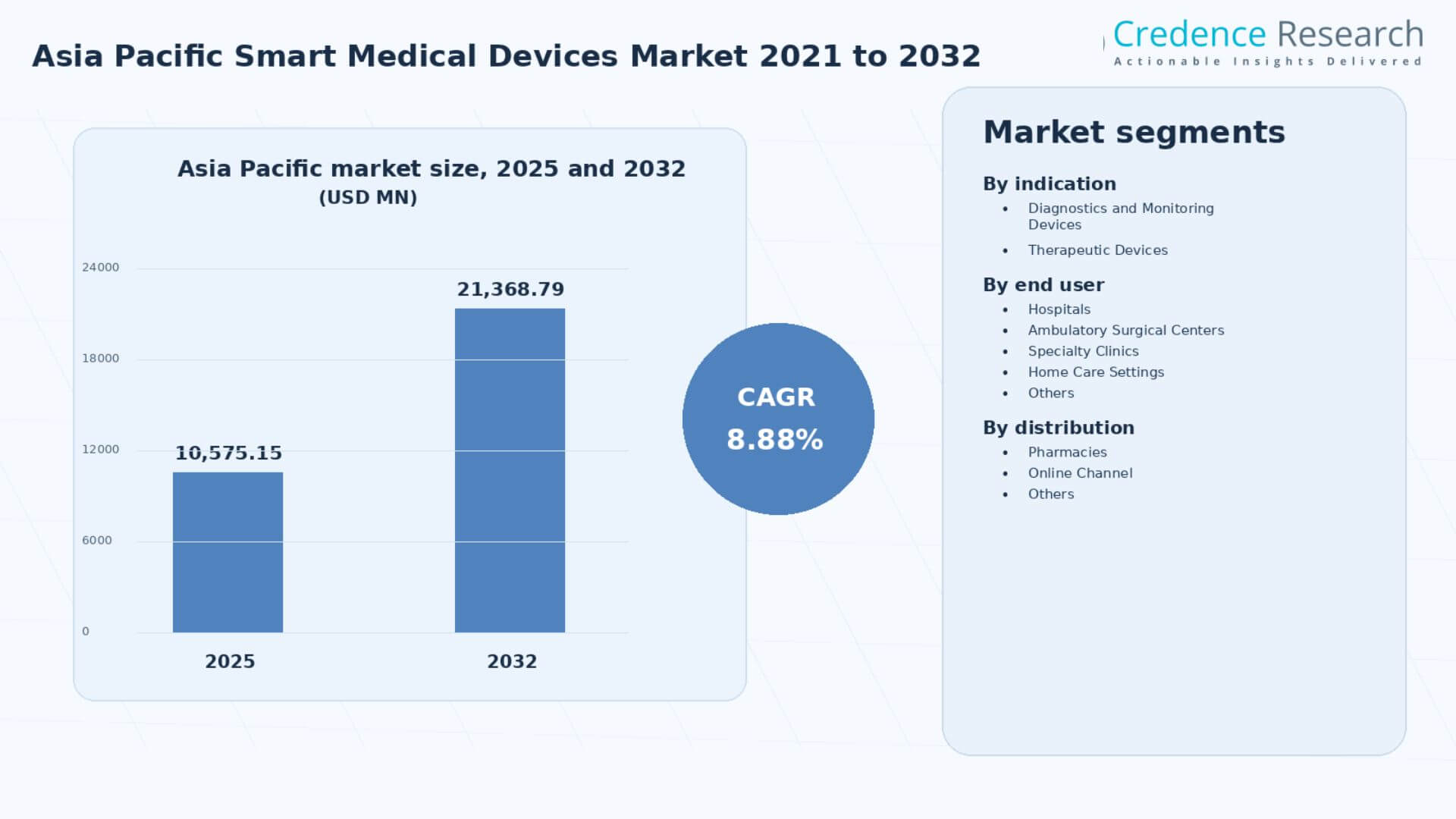
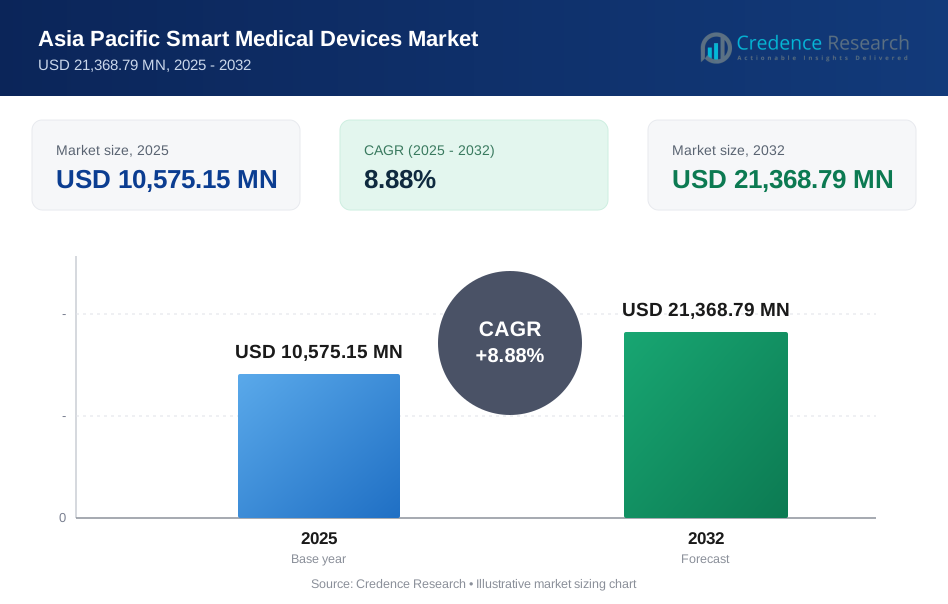
The Asia Pacific Smart Medical Devices Market size was valued at USD 7,333.22 MN in 2021 and reached USD 10,575.15 MN in 2025. It is anticipated to reach USD 21,368.79 MN by 2032, growing at a CAGR of 8.88% during the forecast period.
| REPORT ATTRIBUTE | DETAILS |
|---|---|
| Historical Period | 2021-2024 |
| Base Year | 2025 |
| Forecast Period | 2025-2032 |
| Asia Pacific Smart Medical Devices Market Size 2025 | USD 10,575.15 million |
| Asia Pacific Smart Medical Devices Market, CAGR | 8.88% |
| Asia Pacific Smart Medical Devices Market Size 2032 | USD 21,368.79 million |
Asia Pacific Smart Medical Devices Market Insights
- Market growth is supported by diabetes monitoring, cardiovascular risk tracking, remote patient monitoring, connected therapeutic devices, digital health adoption and rising use of home-based health technologies.
- Diagnostics and Monitoring Devices hold a strong position because hospitals, specialty clinics and home care users increasingly rely on connected glucose monitors, blood pressure devices, ECG monitors, pulse oximeters and digital diagnostic tools.
- Therapeutic Devices are gaining momentum through connected insulin delivery, respiratory support, smart adherence systems, digital therapeutics, hearing devices and patient-facing disease management platforms.
- Home Care Settings and Online Channel are expanding as patients shift toward self-monitoring, app-enabled care, remote clinician review and digital purchasing of connected medical devices.
Asia Pacific Smart Medical Devices Market Segment Insights
By indication
By indication, Diagnostics and Monitoring Devices held the strongest position in 2025 because smart medical devices are widely used for glucose monitoring, blood pressure tracking, ECG capture, oxygen saturation monitoring, respiratory assessment and connected diagnostics. Diabetes and cardiovascular disease monitoring remain the largest demand areas due to high chronic disease burden and rising use of app-enabled devices. Therapeutic Devices are expanding through insulin delivery systems, smart inhalation support, digitally connected rehabilitation, adherence tools and hearing-related devices. Growth in Therapeutic Devices depends on clinical validation, reimbursement, patient training and integration with care pathways. Diagnostics and Monitoring Devices will continue to lead, while Therapeutic Devices will grow faster as connected treatment models mature.
By end user
By end user, Home Care Settings gained strong relevance in 2025 because smart medical devices support continuous monitoring, chronic disease management, early warning alerts and remote clinician review outside hospitals. Hospitals remain important for acute monitoring, discharge planning, connected patient surveillance and device-based diagnostics. Specialty Clinics support diabetes, cardiology, respiratory, audiology, neurology and chronic care workflows. Ambulatory Surgical Centers use smart devices for perioperative monitoring, recovery tracking and selected outpatient procedures. Others include telehealth providers, diagnostic networks, employer health programs and assisted living providers. Growth will depend on patient education, device affordability, reimbursement, interoperability and clinician workflow adoption.
By distribution channel
By distribution channel, Pharmacies held a strong position in 2025 because glucose monitors, blood pressure monitors, respiratory devices, test-related supplies and home health devices are commonly purchased through trusted health retail outlets. Online Channel is gaining momentum due to product comparison, home delivery, subscriptions, digital onboarding and direct-to-consumer access. Others include hospital procurement, specialty distributors, direct sales, device company programs and clinic-led dispensing. Distribution growth will depend on product classification, reimbursement, prescription requirements, patient support, device authenticity and after-sales service. Online Channel will expand fastest where consumers are comfortable buying connected medical devices and accessories digitally.
Key Market Drivers
Diabetes burden and connected glucose monitoring demand
Diabetes burden and connected glucose monitoring demand represent major growth drivers for the Asia Pacific Smart Medical Devices Market. WHO reported that nearly 246 million people aged 30 years and above are estimated to have diabetes in the WHO South-East Asia Region, while less than one in three adults with diabetes are on treatment and less than 15% have the disease under control. Abbott reported that sales of its continuous glucose monitoring systems totaled USD 7.6 billion in 2025, compared with USD 6.4 billion in 2024. Dexcom reported 2025 revenue of USD 4.662 billion and said it expanded CGM access and launched the Dexcom G7 15 Day System. This driver supports Diagnostics and Monitoring Devices, Therapeutic Devices, Home Care Settings, Pharmacies and Online Channel.
Digital health and remote care adoption
Digital health and remote care adoption are strengthening market growth as Asia Pacific health systems use connected devices to extend care beyond hospitals and clinics. WHO Western Pacific reported that the COVID-19 pandemic accelerated adoption and acceptance of digital health services, especially remote care, disease management, telemedicine and digital surveillance. OECD/WHO’s Health at a Glance: Asia/Pacific 2024 noted that lessons from the pandemic in telemedicine, home-based care, supply chain management and public-private partnerships provide a foundation for health system innovation.
Cardiovascular risk monitoring and smart vital sign devices
Cardiovascular risk monitoring and smart vital sign devices support adoption across hospitals, specialty clinics and homes. WHO South-East Asia states that cardiovascular diseases remain the leading cause of death globally and in the WHO South-East Asia Region, accounting for 32% of deaths due to noncommunicable diseases. OMRON Healthcare announced in September 2025 that cumulative worldwide sales of its blood pressure monitors exceeded 400 million units and said its Complete monitor combines blood pressure and ECG readings that can be shared with physicians through the OMRON connect app.
Hospital monitoring and connected patient safety platforms
Hospital monitoring and connected patient safety platforms are expanding as providers seek continuous surveillance, better alarm management, earlier deterioration detection and workflow efficiency. Masimo said its SET technology is used on more than 200 million patients worldwide each year and reported an estimated installed base of about 2.6 million technology boards and monitors. The company’s 2025 investor materials also highlighted hospital automation, remote monitoring, clinician notification and next-generation monitoring innovation.
Aging population and smart assistive device adoption
Aging population and smart assistive device adoption support demand for connected monitoring, hearing-related devices, chronic disease support and home care technologies. WHO reported that the global population aged 60 years and older will double to 2.1 billion by 2050 and that common conditions in older age include hearing loss, cardiovascular disease, diabetes, chronic obstructive pulmonary disease and dementia. Demant reported that it improved more than 12.1 million lives with hearing aids in 2025 and that its Hearing Care business revenue grew 10% in local currencies.
Key Trends and Opportunities
CGM ecosystems become core smart device platforms
CGM ecosystems are becoming core smart device platforms because diabetes management increasingly depends on sensors, mobile apps, alerts, data sharing and connected therapy decisions. Dexcom reported U.S. revenue growth of 15% and international revenue growth of 16% in 2025, supported by expanded CGM access and launch activity. Abbott’s CGM sales growth also shows strong global momentum for sensor-based diabetes care. This trend supports Diagnostics and Monitoring Devices, Therapeutic Devices, Home Care Settings, Pharmacies and Online Channel. Vendors with longer sensor wear, strong app design, data-sharing tools and payer evidence will gain advantage.
Connected insulin delivery and therapeutic devices expand
Connected insulin delivery and therapeutic devices are expanding as manufacturers combine pumps, sensors, mobile applications and automated insulin delivery algorithms. Medtronic reported that its Diabetes products include insulin pumps, continuous glucose monitoring systems and consumables, and said net sales growth was driven by strong international growth due to continued adoption of the MiniMed 780G AID system, including Simplera Sync and Guardian 4 CGM sensors. The company also reported that MiniMed 780G received CE Mark in July 2025 for expanded indications in children as young as two, pregnancy and type 2 diabetes. This trend supports Therapeutic Devices, Specialty Clinics, Home Care Settings and Online Channel.
Remote monitoring moves from hospital to home
Remote monitoring is moving from hospital to home as connected medical devices help clinicians follow patients after discharge, track chronic disease and reduce unnecessary visits. WHO Western Pacific says remote care and disease management are among the clearest areas where digital health adoption changed health-seeking and provider behavior. Philips’ 2025 annual filing described Connected Care as including hospital patient monitoring, ambulatory monitoring, enterprise informatics and sleep and respiratory care. This trend supports Hospitals, Home Care Settings, Diagnostics and Monitoring Devices and respiratory-linked care models.
Online channel strengthens direct-to-patient access
Online Channel is strengthening direct-to-patient access for smart medical devices and accessories. Connected monitors, glucose sensors, blood pressure devices, hearing-related products, batteries, test supplies and home health devices are increasingly compatible with digital onboarding and subscription models. Online Channel growth will be strongest in urban China, India, South Korea, Japan, Australia and Southeast Asia where e-commerce adoption and digital payments are strong. Growth will depend on product authenticity, warranty support, device education, data privacy and linkage with pharmacies or clinics. Companies that combine online access with clinician support will improve customer retention.
Key Market Challenges
Regulatory classification and clinical validation burden
Regulatory classification and clinical validation burden remain key challenges for the Asia Pacific Smart Medical Devices Market. Smart devices may sit between consumer electronics, diagnostics, therapeutic devices, software as a medical device and connected care platforms. Manufacturers must prove accuracy, safety, cybersecurity and clinical relevance across different regulatory systems. CGM, insulin delivery, ECG monitoring, respiratory devices and connected hospital monitors require stronger evidence than wellness devices. This challenge affects Diagnostics and Monitoring Devices, Therapeutic Devices, Hospitals, Specialty Clinics and Online Channel. Companies with strong regulatory affairs, clinical evidence and post-market surveillance will gain trust.
Affordability and reimbursement limitations
Affordability and reimbursement limitations can slow adoption of CGM, insulin pumps, smart hearing devices, connected monitoring systems and advanced therapeutic devices. Many Asia Pacific markets still rely heavily on out-of-pocket payment for home health devices and recurring supplies. Sensors, accessories, device upgrades and app-linked services can increase long-term patient cost. Pharmacies and Online Channel can improve access, but affordability remains a barrier for sustained use. Vendors must offer value-tier devices, subscription models, payer evidence, local distribution and patient support programs.
Data privacy and interoperability risk
Data privacy and interoperability risk affect adoption because smart medical devices generate continuous patient data across mobile apps, cloud platforms, clinician dashboards and electronic health records. Asia Pacific countries have different privacy laws, localization rules and health data standards. Poor interoperability can limit clinical workflow integration, while weak cybersecurity can reduce patient and provider trust. Hospitals and Specialty Clinics require secure, standards-based data flows, audit trails and clear device accountability. Manufacturers must prioritize consent management, encryption, integration support and cybersecurity updates.
Digital divide and adherence barriers
Digital divide and adherence barriers can reduce real-world benefit. Smart medical devices often require smartphones, internet access, app literacy, sensor replacement, charging, calibration, alerts and long-term engagement. Older adults, rural patients and lower-income groups may face greater barriers. WHO Western Pacific notes that digital health adoption is uneven across the region and that its potential remains largely untapped in many settings. This challenge affects Home Care Settings, Online Channel, Diagnostics and Monitoring Devices and Therapeutic Devices. Manufacturers and providers must simplify onboarding, provide caregiver access, offer multilingual support and reduce maintenance burden.
Regional Analysis
China
China represents a major market within the Asia Pacific Smart Medical Devices Market due to its large chronic disease population, strong hospital system, digital commerce ecosystem and domestic connected-device manufacturing base. Diagnostics and Monitoring Devices are supported by glucose monitoring, blood pressure monitoring, ECG devices, respiratory monitoring and connected hospital platforms. Therapeutic Devices will gain demand through diabetes technologies, hearing devices, respiratory support and digital adherence systems. Online Channel is especially important because e-commerce platforms can reach urban and semi-urban consumers. Growth will depend on regulatory approval, local competition, reimbursement, data governance, affordability and hospital partnerships.
Japan
Japan is a mature market supported by aging demographics, advanced health care infrastructure, high home monitoring awareness and strong medical device quality standards. Diagnostics and Monitoring Devices are important for blood pressure, ECG, glucose, sleep and respiratory monitoring. Therapeutic Devices benefit from diabetes management, hearing care, rehabilitation, home respiratory care and connected support for older adults. WHO’s aging data reinforces the long-term need for smart devices addressing chronic conditions and sensory impairment among older adults. Growth will depend on reimbursement, physician acceptance, data integration, pharmacy access and home care policy.
India
India is an expanding market due to diabetes burden, smartphone adoption, online health retail and growing private specialty care. WHO South-East Asia’s diabetes estimate indicates major need for connected glucose monitoring, chronic disease tracking and protocol-based management. Pharmacies and Online Channel are important distribution routes, while Hospitals and Specialty Clinics drive device recommendation. Diagnostics and Monitoring Devices will lead near-term adoption, while Therapeutic Devices will grow as insulin delivery, respiratory support and connected care models become more affordable. Growth will depend on pricing, local service, awareness, reimbursement and physician training.
South Korea
South Korea represents a high-value market supported by strong digital health infrastructure, advanced hospitals, connected consumer electronics and high chronic disease awareness. Diagnostics and Monitoring Devices are expected to gain demand across cardiology, diabetes, sleep monitoring, respiratory care and home health. Therapeutic Devices will benefit from connected care platforms, smart hearing devices and diabetes management tools. Hospitals and Specialty Clinics will remain important for medical-grade adoption, while Online Channel will support consumer access. Growth will depend on regulatory clarity, clinical validation, data privacy compliance and interoperability with hospital systems.
Australia and New Zealand
Australia and New Zealand represent mature smart medical device markets supported by advanced pharmacies, high health awareness, structured chronic disease care and digital health adoption. Diagnostics and Monitoring Devices support diabetes, blood pressure, cardiac, sleep and respiratory care, while Therapeutic Devices support connected insulin delivery, hearing care and home-based therapy. Home Care Settings are gaining relevance as patients and providers use connected tools for remote follow-up and chronic disease management. Growth will depend on reimbursement, pharmacy integration, telehealth adoption, device education and evidence-based prescribing.
Southeast Asia
Southeast Asia offers long-term growth potential due to rising chronic disease burden, growing middle-class health spending, improving pharmacy access and rapid digital adoption. Singapore and Thailand support premium smart medical devices, while Indonesia, Vietnam and the Philippines offer large-volume opportunity for affordable diagnostics and monitoring devices. WHO Western Pacific notes that digital health development is occurring at unprecedented scale but remains uneven across the region. Growth will depend on affordability, device education, e-commerce trust, clinician engagement, data privacy and health system readiness.
Report Attribute Details
| Report Attribute | Details |
| Historical Period | 2021–2024 |
| Base Year | 2025 |
| Forecast Period | 2025–2032 |
| Market Size in 2021 | USD 7,333.22 MN |
| Market Size in 2025 | USD 10,575.15 MN |
| Market Size in 2032 | USD 21,368.79 MN |
| CAGR | 8.88% |
| Segments Covered | Indication, End User, Distribution Channel and Geography |
| Key Companies Covered | Abbott Laboratories, Medtronic plc, F. Hoffmann-La Roche Ltd, Dexcom, Inc., Masimo, Drägerwerk AG & Co. KGaA, Shenzhen Ztsense Hi Tech Co., Ltd, Smartcardia, Microlife Corporation, Beurer GmbH, Adherium, LifeScan, Inc., ARKRAY, Inc, Sensoria, Demant A/S and WS Audiology |
Asia Pacific Smart Medical Devices Market segmentations
By Indication
- Diagnostics and Monitoring Devices
- Therapeutic Devices
By End User
- Hospitals
- Ambulatory Surgical Centers
- Specialty Clinics
- Home Care Settings
- Others
By Distribution Channel
- Pharmacies
- Online Channel
- Others
Key Players
- Abbott Laboratories
- Medtronic plc
- F. Hoffmann-La Roche Ltd
- Dexcom, Inc.
- Masimo
- Drägerwerk AG & Co. KGaA
- Shenzhen Ztsense Hi Tech Co., Ltd
- Smartcardia
- Microlife Corporation
- Beurer GmbH
- Adherium
- LifeScan, Inc.
- ARKRAY, Inc
- Sensoria
- Demant A/S
- WS Audiology
Recent Developments
- In 2025, Abbott reported that continuous glucose monitoring system sales totaled USD 7.6 billion, compared with USD 6.4 billion in 2024, showing strong demand for connected diabetes monitoring.
- In 2025, Dexcom reported revenue of USD 4.662 billion, international revenue growth of 16% on a reported basis and launch progress for the Dexcom G7 15 Day System.
- In July 2025, Medtronic’s MiniMed 780G insulin pump system received CE Mark for expanded indications in children as young as two, during pregnancy and for type 2 diabetes.
- In 2025, Masimo said its SET technology was used on more than 200 million patients worldwide each year and highlighted next-generation monitoring, hospital automation and remote monitoring initiatives.
- In 2025, Demant reported revenue of DKK 22,971 million and said it improved more than 12.1 million lives with hearing aids, supporting continued adoption of smart assistive health technologies.
Report Coverage
The research report offers an in-depth analysis based on indication, end user, distribution channel and geography. It details leading market players, providing an overview of their business positioning, smart medical device portfolios, glucose monitoring systems, insulin delivery platforms, vital sign monitors, hospital monitoring technologies, respiratory devices, smart hearing solutions, digital health platforms and strategic relevance in the Asia Pacific Smart Medical Devices Market. The report includes insights into the competitive environment, market trends, growth drivers, restraints and opportunities. It also examines diabetes burden, cardiovascular monitoring demand, digital health adoption, remote patient monitoring, aging population needs, connected therapeutics, online distribution and data integration as major factors shaping market development. The report assesses the impact of regulatory classification, clinical validation, affordability barriers, reimbursement limitations, data privacy risk, interoperability constraints and digital divide issues on market growth. It provides strategic recommendations for smart medical device manufacturers, hospitals, specialty clinics, home care providers, pharmacies, online channels, distributors, investors and new entrants seeking to navigate Asia Pacific’s smart medical devices ecosystem.
Future Outlook
- Demand for smart medical devices will continue to rise as Asia Pacific health systems expand remote monitoring, chronic disease care and home-based health management.
- Diagnostics and Monitoring Devices will remain the leading indication category due to glucose monitoring, ECG capture, blood pressure tracking and respiratory monitoring.
- Therapeutic Devices will grow through connected insulin delivery, smart respiratory support, digital adherence systems and hearing-related devices.
- Hospitals will remain important for acute monitoring, connected patient safety and device-based clinical workflows.
- Home Care Settings will gain share as patients use smart devices for continuous monitoring and long-term disease management.
- Specialty Clinics will expand use of smart devices in diabetes, cardiology, audiology, respiratory care and chronic disease management.
- Pharmacies will remain important for trusted access, patient guidance and recurring device-related supplies.
- Online Channel will grow quickly through direct-to-consumer access, subscription supplies and digital onboarding.
- Data integration, cybersecurity and interoperability will become key purchase criteria for medical-grade smart devices.
- Competition will increase as companies compete on device accuracy, sensor life, app usability, clinical evidence, reimbursement support, affordability and connected ecosystem strength.
Request a Free Sample
Fill in your details and we'll send you a free sample report.
- Sample data tables & charts
- Research methodology
Need a Custom Version of This Report?
Tailor the scope, geography, or segments to your exact requirements.
- Custom geography or segment scope
- Direct access to our analyst team
Frequently Asked Questions
What is the current market size for the Asia Pacific Smart Medical Devices Market and what is its projected size in 2032?
At what CAGR is the Asia Pacific Smart Medical Devices Market projected to grow?
Which indication segment is expected to lead the market?
Which end-user segment is gaining momentum?
Which distribution channel is growing quickly?
Who are the leading companies in the market?
Which countries are important in the Asia Pacific market?
Table of Content
Chapter 1. Report Introduction
- 1.1 Report Description & Purpose
- 1.1.1 Report Title & Market Definition
- 1.1.2 Unique Selling Propositions (USP) & Key Differentiators
- 1.1.3 Value Proposition for Stakeholders
- 1.2 Research Objectives
- 1.2.1 Market Sizing Objectives (Volume & Revenue)
- 1.2.2 Segmentation Objectives
- 1.2.3 Competitive Intelligence Objectives
- 1.2.4 Forecast & Scenario Objectives
- 1.3 Report Scope
- 1.3.1 Asia Pacific Smart Medical Devices Scope – Types & Subtypes Covered
- 1.3.2 Geographic Scope – Regions & Countries Covered
- 1.3.3 Historical Period, Base Year & Forecast Period (2025; forecast to 2032)
- 1.3.4 Inclusions & Exclusions
- 1.4 HS Code & Classification Framework
- 1.5 Currency, Units & Pricing Basis
- 1.6 Target Stakeholders
- 1.7 Limitations & Assumptions
Chapter 2. Executive Summary
- 2.1 Global Asia Pacific Smart Medical Devices Market Snapshot
- 2.1.1 Market Size – Historical (2025) & Forecast (2025-2032) (2025: USD 10,575.15 MN → 2032: USD 21,368.79 MN)
- 2.1.2 Volume & Revenue – Global Totals
- 2.1.3 Key Market Highlights – Top Five Facts
- 2.2 Asia Pacific Smart Medical Devices Market Segmentation Snapshot
- 2.2.1 Market Split by Region – 2025 vs. 2032
- 2.3 Competitive Snapshot
- 2.3.1 Top 10 Players by Revenue Share – 2025
- 2.3.2 Top 10 Players by Volume Share – 2025
- 2.3.3 Recent Strategic Developments (18-Month Summary)
- 2.4 Key Investment Highlights & Strategic Conclusions
Chapter 3. Asia Pacific Smart Medical Devices Market Dynamics & Industry Analysis
- 3.1 Market Overview & Context
- 3.1.1 Asia Pacific Smart Medical Devices Market Position in the Broader Automotive Value Chain
- 3.1.2 OEM vs. Replacement Market Dynamics
- 3.1.3 Market Maturity & Development Stage by Region
- 3.2 Asia Pacific Smart Medical Devices Market Drivers
- 3.3 Asia Pacific Smart Medical Devices Market Restraints & Challenges
- 3.4 Asia Pacific Smart Medical Devices Market Opportunities
- 3.5 Porter's Five Forces Analysis
- 3.5.1 Threat of New Entrants
- 3.5.2 Bargaining Power of Suppliers
- 3.5.3 Bargaining Power of Buyers
- 3.5.4 Threat of Substitutes
- 3.5.5 Competitive Rivalry – Intensity Assessment
- 3.6 Asia Pacific Smart Medical Devices Value Chain Analysis
- 3.6.1 Upstream – Raw Material/Input Suppliers
- 3.6.1.1 Raw Material/Input 1
- 3.6.1.2 Raw Material/Input 2
- 3.6.1.3 Raw Material/Input 3
- 3.6.2 Midstream – Production/Manufacturing/Service Delivery
- 3.6.2.1 Production/Process Overview
- 3.6.2.2 Key Facility Locations & Capacity by Manufacturer
- 3.6.3 Downstream – Distribution & End Consumer
- 3.6.3.1 Primary Channel – B2B/OEM
- 3.6.3.2 Secondary Channels – Dealer, Retail, Online, Direct
- 3.6.4 Value Chain Profitability Analysis
- 3.6.1 Upstream – Raw Material/Input Suppliers
- 3.7 PESTEL Analysis
- 3.7.1 Political Factors
- 3.7.2 Economic Factors
- 3.7.3 Social Factors
- 3.7.4 Technological Factors
- 3.7.5 Environmental Factors
- 3.7.6 Legal Factors
- 3.8 Asia Pacific Smart Medical Devices Supply Chain Analysis
- 3.8.1 Raw Material/Input Supply Risk Assessment
- 3.8.2 Manufacturing Concentration Risk (Geographic Exposure)
- 3.8.3 Trade Disruption Impact Analysis
- 3.9 Regulatory & Policy Landscape
Note: The regulatory and policy landscape section covers regulations based on their applicability to the market, Asia Pacific Smart Medical Devices category, geography, and scope of the study. Only regulatory frameworks with a material impact on operations, compliance, trade, sustainability, or market access are analyzed in detail.
Chapter 4. Key Investment Pockets & Opportunity Analysis
- 4.1 Asia Pacific Smart Medical Devices Market Attractiveness Analysis
- 4.1.1 By Region – Investment Attractiveness Matrix (Volume × CAGR)
- 4.2 Absolute Revenue Growth Opportunity
- 4.2.1 By Region – Absolute USD Growth Through 2032
- 4.3 Incremental Volume Opportunity
- 4.3.1 By Region – Incremental Volume Through 2032
- 4.3.2 Segment – Incremental Volume
- 4.4 Emerging Submarket Opportunity Deep Dive (Subject to Applicability)
- 4.5 Emerging Market Opportunity Scorecards
- 4.5.1 United States
- 4.5.2 Europe
- 4.5.3 Asia
- 4.5.4 Middle East & Africa
Note: Emerging Market Opportunity Scorecards will be included based on relevance and strategic importance. Regions listed are indicative and may vary depending on data availability and market dynamics.
Chapter 5. Asia Pacific Smart Medical Devices Import-Export Analysis & Trade Flows
- 5.1 Global Trade Overview
- 5.1.1 Global Export Value by Country (2025)
- 5.1.2 Global Export Volume by Country (2025)
- 5.1.3 Global Import Value by Country (2025)
- 5.1.4 Global Import Volume by Country (2025)
- 5.1.5 Net Trade Balance by Country (2025)
- 5.2 Export Analysis – Segment
- 5.2.1 Type 1 (HS Code)
- 5.2.2 Type 2 (HS Code)
- 5.2.3 Type 3 (HS Code)
- 5.2.4 Type 4 (HS Code)
- 5.2.5 Type 5 (HS Code)
- 5.3 Import Analysis – Segment
- 5.3.1 Type 1 (HS Code)
- 5.3.2 Type 2 (HS Code)
- 5.3.3 Type 3 (HS Code)
- 5.3.4 Type 4 (HS Code)
- 5.3.5 Type 5 (HS Code)
- 5.4 Average Unit Trade Prices
- 5.4.1 Average Export Price – Segment & Country
- 5.4.2 Average Import Price – Segment & Source Country
- 5.4.3 Price Trends (2025)
- 5.5 Key Trade Route Analysis
- 5.5.1 Trade Route 1
- 5.5.2 Trade Route 2
- 5.5.3 Trade Route 3
- 5.5.4 Trade Route 4
- 5.5.5 Trade Route 5
- 5.6 Trade Policy Impact Assessment
- 5.6.1 US Anti-Dumping & Section 301 Tariffs
- 5.6.2 EU Customs Union Impact
- 5.6.3 Major Free Trade Agreements
- 5.6.4 USMCA Rules of Origin
Note: Trade policy analysis will be included only where relevant to the Asia Pacific Smart Medical Devices market.
Chapter 6. Competitive Landscape & Company Benchmarking
- 6.1 Asia Pacific Smart Medical Devices Market Concentration & Structure
- 6.1.1 Herfindahl-Hirschman Index (HHI) – vs. 2025
- 6.1.2 Tier 1, Tier 2 & Tier 3 Market Structure
- 6.1.3 Global, Regional & Local Player Dynamics
- 6.2 Asia Pacific Smart Medical Devices Market Share Analysis – 2025
- 6.2.1 Global Revenue Share by Company
- 6.2.2 Global Volume Share by Company
- 6.2.3 Regional Revenue Share
- 6.2.4 Market Share Evolution ( vs. 2025)
- 6.2.5 OEM Segment Share by Company
- 6.2.6 Replacement Segment Share by Company
- 6.3 Production/Delivery Capacity & Facility Analysis
- 6.3.1 Global Installed Capacity
- 6.3.2 Capacity Utilization Rates
- 6.3.3 Production/Output Volume
- 6.3.4 Facility Locations & Capacity Map
- 6.3.5 Planned Capacity Additions
- 6.4 Asia Pacific Smart Medical Devices Competitive Benchmarking Matrix
- 6.4.1 Revenue, Volume, CAGR & Profitability Comparison
- 6.4.2 Channel Revenue Mix
- 6.4.3 Geographic Revenue Exposure
- 6.4.4 R&D Intensity
- 6.4.5 Sustainability Maturity
- 6.5 Strategic Developments in Asia Pacific Smart Medical Devices (Last 24 Months)
- 6.5.1 Mergers, Acquisitions & Divestments
- 6.5.2 New Asia Pacific Smart Medical Devices Launches
- 6.5.3 Facility Expansions
- 6.5.4 Strategic Alliances, Joint Ventures & Partnerships
- 6.5.5 Distribution Expansion & Market Entry
- 6.5.6 Sustainability & ESG Initiatives
- 6.6 Competitive Strategy Mapping
- 6.6.1 Leader, Challenger, Follower & Niche Classification
- 6.6.2 Pricing Strategy Comparison
- 6.6.3 Channel Strategy Matrix
Note: Strategic developments are included based on their materiality and the availability of reliable information.
Chapter 7. Global Asia Pacific Smart Medical Devices Market – By Distribution Channel
- 7.1 Segment Overview
- 7.1.1 Volume & Revenue Split by Channel (2025 & 2032)
- 7.1.2 Channel Mix Evolution (2025-2032)
Chapter 8. Regional Market Analysis – Global Overview
- 8.1 Global Regional Overview
- 8.1.1 Regional Volume Share
- 8.1.2 Regional Revenue Share
- 8.1.3 Regional Volume by Region
- 8.1.4 Regional Revenue by Region
- 8.1.5 Regional Forecast Through 2032
- 8.2 Cross-Regional Segment Analysis
- 8.2.1 By Distribution Channel
- 8.2.2 By Brand/Price Tier
Chapter 9. North America Asia Pacific Smart Medical Devices Market
- 9.1 United States
- 9.2 Canada
- 9.3 Mexico
Chapter 10. Europe Asia Pacific Smart Medical Devices Market
- 10.1 Germany
- 10.2 France
- 10.3 Italy
- 10.4 United Kingdom
- 10.5 Spain
- 10.6 Poland
- 10.7 Russia
- 10.8 Netherlands
- 10.9 Belgium
- 10.10 Sweden
- 10.11 Denmark
- 10.12 Norway
- 10.13 Rest of Europe
Chapter 11. Asia Pacific Asia Pacific Smart Medical Devices Market
- 11.1 China
- 11.2 India
- 11.3 Japan
- 11.4 South Korea
- 11.5 Thailand
- 11.6 Indonesia
- 11.7 Vietnam
- 11.8 Malaysia
- 11.9 Australia
- 11.10 Rest of Asia Pacific
Chapter 12. Latin America Asia Pacific Smart Medical Devices Market
- 12.1 Brazil
- 12.2 Argentina
- 12.3 Colombia
- 12.4 Chile
- 12.5 Rest of Latin America
Chapter 13. Middle East Asia Pacific Smart Medical Devices Market
- 13.1 Saudi Arabia
- 13.2 United Arab Emirates
- 13.3 Turkey
- 13.4 Israel
- 13.5 Iran
- 13.6 Rest of the Middle East
Chapter 14. Africa Asia Pacific Smart Medical Devices Market
- 14.1 South Africa
- 14.2 Egypt
- 14.3 Nigeria
- 14.4 Morocco
- 14.5 Rest of Africa
Chapter 15. Asia Pacific Smart Medical Devices Company Profiles
- 15.1 [Company 01]
- 15.1.1 Company Overview
- 15.1.2 Key Management Personnel
- 15.1.3 Products & Services Portfolio
- 15.1.4 Financial Performance
- 15.1.5 Key Market Focus & Geographic Presence
- 15.1.6 Recent Developments & Strategic Initiatives
Note: The company profile list is preliminary and may change based on research findings, market developments, data availability, and client requirements.
Chapter 16. Appendices
- Appendix A – List of Abbreviations & Acronyms
- Appendix B – Industry Classification Code Reference – Full Series
- Appendix C – Production & Capacity Data Tables
- Appendix D – End-Use & Demand Base Tables
- Appendix E – Consumption & Replacement Rate Assumptions
- Appendix F – ASP Reference Tables
- Appendix G – Manufacturing & Facility Database
- Appendix H – Import-Export Data Tables
- Appendix I – Regulatory Summary Tables
- Appendix J – Primary Research Participant List (Anonymized)
- Appendix K – Primary Research Questionnaire Framework
- Appendix L – Data Sources & Bibliography
- Appendix M – Market Size Divergence & Source Comparison
Chapter 17. Research Methodology
- 17.1 Research Framework & Philosophy
- 17.2 Secondary Research – Sources, Hierarchy & Data Extraction
- 17.3 Data Modeling – Bottom-Up & Top-Down Market Sizing
- 17.4 Primary Research – Stakeholder Framework, LOI & Sample Sizes
- 17.5 Forecast Methodology – Regression, Scenario & Sensitivity Analysis
- 17.6 Quality Control – Four-Layer Validation Framework
- 17.7 Limitations & Standard Assumptions
- 17.8 Disclaimer
