
Middle East Medical Consumables Market Overview:
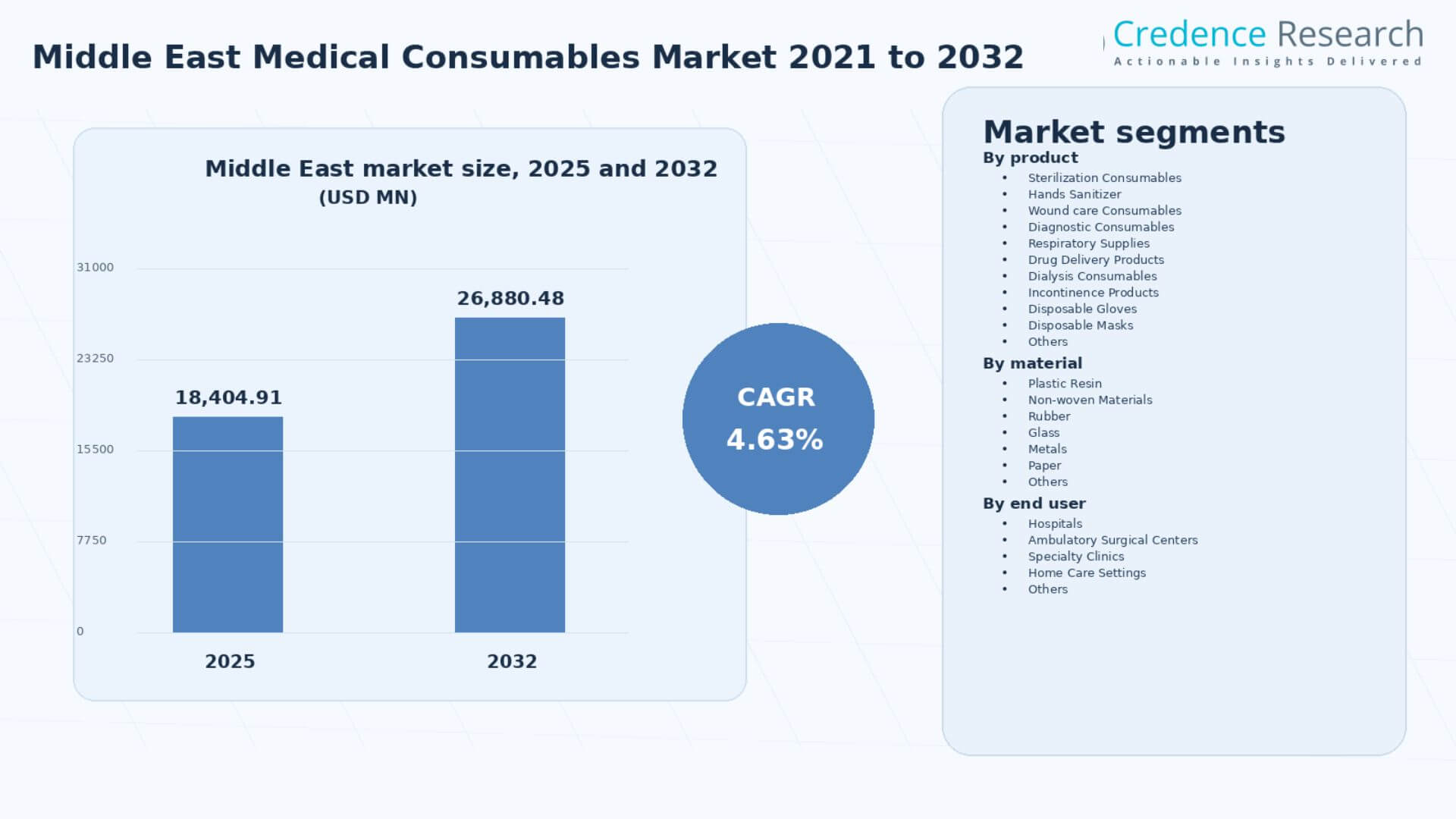
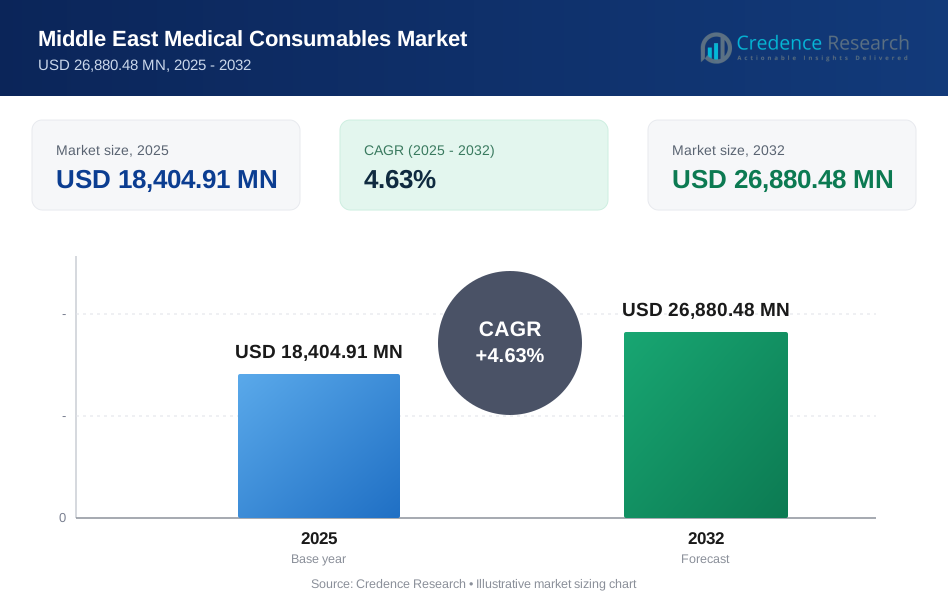
The Middle East Medical Consumables Market size was valued at USD 14,903.54 MN in 2021 and reached USD 18,404.91 MN in 2025. It is anticipated to reach USD 26,880.48 MN by 2032, growing at a CAGR of 4.63% during the forecast period.
| REPORT ATTRIBUTE | DETAILS |
|---|---|
| Historical Period | 2021-2024 |
| Base Year | 2025 |
| Forecast Period | 2025-2032 |
| Middle East Medical Consumables Market Size 2025 | USD 18,404.91 million |
| Middle East Medical Consumables Market, CAGR | 4.63% |
| Middle East Medical Consumables Market Size 2032 | USD 26,880.48 million |
Middle East Medical Consumables Market Insights
- Market growth is supported by hospital infection prevention, surgical procedure volume, chronic disease management, diagnostic testing demand, dialysis expansion, wound care needs and rising home-based care consumption.
- Diagnostic Consumables and Disposable Gloves hold strong positions because hospitals, clinics and independent laboratories require recurring use of specimen collection products, protective gloves, swabs, tubes and test-related consumables.
- Wound care Consumables, Drug Delivery Products and Dialysis Consumables are gaining momentum due to chronic disease burden, surgical recovery needs, diabetes-related complications, infusion therapy and kidney disease treatment.
- Hospitals remain the leading end-user segment because inpatient care, emergency departments, operating rooms, ICUs, laboratories and dialysis units generate high recurring consumption of disposable medical products.
Middle East Medical Consumables Market Segment Insights
By product
By product, Diagnostic Consumables held a strong position in 2025 because hospitals, laboratories and clinics require recurring use of sample collection tubes, swabs, reagents-linked accessories, slides, pipette tips, containers and other test-related disposables. Disposable Gloves and Disposable Masks remain essential for infection prevention, operating rooms, emergency departments, laboratories and outpatient care. Sterilization Consumables and Hands Sanitizer support hygiene programs, procedure safety and facility-level infection control. Wound care Consumables are supported by surgical wounds, diabetic foot ulcers, trauma care and chronic wound management. Drug Delivery Products include syringes, IV sets, catheters, infusion consumables and related disposables. Respiratory Supplies, Dialysis Consumables, Incontinence Products and Others support chronic care, critical care and home-based use.
By material
By material, Plastic Resin held the strongest position in 2025 because many medical consumables use plastic-based components, including syringes, IV sets, tubing, sample containers, dialysis accessories, diagnostic consumables and packaging. Non-woven Materials are critical for disposable masks, drapes, gowns, wound dressings, sterilization wraps and other infection control products. Rubber supports gloves, seals, stoppers and tubing components. Glass remains important for vials, ampoules, laboratory products and selected drug delivery packaging. Metals are used in needles, guide components, clips and surgical consumables. Paper supports sterilization packaging, medical documentation labels, disposable wipes and selected hygiene products. Others include composites, adhesives, hydrogels, silicones and advanced wound dressing materials.
By end user
By end user, Hospitals held the strongest position in 2025 because they consume large volumes of gloves, masks, sterilization products, wound care materials, diagnostic disposables, respiratory supplies, drug delivery products and dialysis consumables. Ambulatory Surgical Centers generate demand for sterile packs, gloves, masks, dressings, syringes, drapes and procedure-specific consumables. Specialty Clinics use wound care products, diagnostic consumables, injection supplies, respiratory consumables and incontinence products. Home Care Settings are expanding as dialysis, respiratory therapy, wound care, diabetes management and post-discharge care move closer to patients. Others include diagnostic centers, long-term care facilities, emergency response providers and research facilities.
Key Market Drivers
Infection prevention and health care-associated infection control
Infection prevention and health care-associated infection control represent major growth drivers for the Middle East Medical Consumables Market. Disposable Gloves, Disposable Masks, Sterilization Consumables, Hands Sanitizer and Diagnostic Consumables remain essential because hospitals and clinics require continuous protective and aseptic supplies. WHO’s global infection prevention report states that health care-associated infections affect patients and health systems every day and are a major driver of antimicrobial resistance, while lack of water, sanitation and hygiene in health care settings undermines infection prevention and control. WHO EMRO also says the Eastern Mediterranean Region has one of the highest frequencies of health care-associated infections in the world.
Chronic disease burden and recurring care consumption
Chronic disease burden and recurring care consumption support demand for wound care, diagnostic, drug delivery, respiratory and dialysis consumables. WHO reported that noncommunicable diseases account for 66% of all deaths in the Eastern Mediterranean Region, with diabetes, cardiovascular diseases, cancers and chronic respiratory conditions forming a large clinical burden. This burden drives recurring lab tests, injectable therapies, wound care, respiratory supplies and hospital visits. It also supports Home Care Settings as patients require long-term consumables after discharge or during chronic disease management. The market will benefit from stronger primary care, specialty clinic expansion and disease screening programs.
Dialysis demand and kidney care consumables
Dialysis demand and kidney care consumables are strengthening the market because kidney failure treatment requires repeated use of dialyzers, tubing, catheters, concentrates, filters, syringes, dressings and disinfection products. WHO reported in 2026 that an estimated 674 million people have chronic kidney disease worldwide and that kidney replacement therapy, including dialysis or transplantation, may be required for kidney failure. B. Braun reported in fiscal 2025 that dynamic momentum came from consumables, regional anesthesia products, neurosurgery and minimally invasive surgery, while the company commissioned the ACTIVE plant for infusion therapy single-use products in Melsungen. This driver supports Dialysis Consumables, Drug Delivery Products, Wound care Consumables, Plastic Resin and Hospitals.
Diagnostic testing and specimen management growth
Diagnostic testing and specimen management growth supports sustained demand for Diagnostic Consumables. Hospitals, clinics and laboratories require blood collection tubes, swabs, specimen containers, needles, collection sets, labels, sample transport materials and infection control supplies. BD said its Specimen Management business celebrated major manufacturing milestones in 2025 at two U.S. sites that produce billions of products each year, including BD Vacutainer blood collection products that are critical to diagnostics, treatment and medical research. BD’s annual filing also describes the company as developing and selling medical supplies, laboratory equipment and diagnostic products used by health care institutions, physicians, clinical laboratories and the general public.
Health sector transformation and hospital investment
Health sector transformation and hospital investment are supporting consumables demand across the Middle East. Saudi Arabia’s Ministry of Health released its 2025 Health Sector Annual Report aligned with Vision 2030 goals to improve prevention, quality of life, health care spending efficiency and investment, while the Health Sector Transformation Program reported progress toward a more integrated and efficient health care ecosystem. Saudi Arabia also launched a health care financing initiative in 2025 to promote high-quality investment opportunities and improve health care services.
Key Trends and Opportunities
Non-woven and protective consumables remain strategic
Non-woven and protective consumables remain strategic because infection prevention, surgical safety and outpatient procedure expansion require masks, drapes, gowns, sterilization wraps and wound dressings. WHO’s infection prevention guidance reinforces the need for basic WASH services, protective practices and IPC systems in care settings. Disposable Gloves and Disposable Masks will remain high-volume product categories, while Non-woven Materials will gain from procedure growth and hygiene compliance. Ansell reported fiscal 2025 total sales of approximately USD 2 billion and highlighted its role in gloves for medical and industrial use.
Advanced wound care and chronic wound products expand
Advanced wound care and chronic wound products are expanding as diabetes, surgery, trauma and aging populations increase demand for dressings, negative pressure wound therapy consumables, skin protection products and infection management materials. Smith+Nephew reported in 2025 that its Advanced Wound Management business delivered underlying revenue growth and maintained a leading global position in wound care. This trend supports Wound care Consumables, Non-woven Materials, Plastic Resin, Specialty Clinics, Hospitals and Home Care Settings. Suppliers with evidence-backed products, clinical education and strong tender access will gain advantage.
Drug delivery and infusion consumables gain recurring demand
Drug delivery and infusion consumables are gaining recurring demand because injectable therapies, oncology treatment, biologics administration, emergency care, anesthesia and home infusion models require syringes, IV sets, catheters, tubing, connectors and sterile packaging. B. Braun’s 2025 reporting highlighted continued portfolio evolution toward integrated systems that combine devices, software, consumables and services, and the company emphasized reliable supply as a core customer need. This trend supports Drug Delivery Products, Plastic Resin, Glass, Metals, Hospitals and Home Care Settings. Demand will grow with chronic therapy, hospital modernization and day-care infusion models.
Home care consumables create long-term channel opportunity
Home care consumables create a long-term channel opportunity as patients use respiratory supplies, wound care products, incontinence products, dialysis consumables, drug delivery products and diagnostic supplies outside hospitals. Cardinal Health reported fiscal 2025 Global Medical Products and Distribution revenue of USD 12.636 billion and said its Other segment revenue increased 19% to USD 5.4 billion due to growth across at-Home Solutions, Nuclear and Precision Health Solutions and OptiFreight Logistics. This trend supports Home Care Settings, Specialty Clinics and pharmacy-linked fulfillment. Growth will depend on patient training, distributor reach, insurance coverage, product availability and digital ordering.
Key Market Challenges
Supply chain dependence and price volatility
Supply chain dependence and price volatility remain major challenges for the Middle East Medical Consumables Market. Medical consumables rely on plastic resin, non-woven fabric, rubber, glass, paper, metals, packaging materials and global shipping networks. Price swings in raw materials can pressure margins, while import dependence can affect product availability. Hospitals and distributors need reliable inventory of gloves, masks, syringes, wound dressings, dialysis supplies and diagnostic consumables. Suppliers with regional warehousing, supplier diversification and local manufacturing partnerships will be better positioned.
Quality control and counterfeit risk
Quality control and counterfeit risk can affect patient safety and buyer confidence. Medical consumables are high-volume products, and weak procurement controls may expose health systems to substandard gloves, masks, syringes, wound dressings or diagnostic supplies. Hospitals and ASCs need validated suppliers, traceability, labeling compliance, sterilization assurance and product documentation. The risk is higher in fragmented markets with multiple distributors and price-driven purchasing. Regulatory strengthening, centralized procurement and post-market surveillance will remain important.
Waste management and sustainability pressure
Waste management and sustainability pressure is increasing because disposable gloves, masks, packaging, syringes, tubing and non-woven products generate large medical waste volumes. Infection control needs will keep disposables essential, but hospitals and suppliers face pressure to reduce packaging, improve segregation, optimize inventory and evaluate lower-impact materials. Plastic Resin and Non-woven Materials face the greatest sustainability scrutiny. Manufacturers that reduce packaging weight, improve recyclability where safe and provide waste management support will gain stronger positioning.
Uneven access across conflict-affected and lower-resource settings
Uneven access across conflict-affected and lower-resource settings restricts demand visibility and product availability. WHO reported that the Eastern Mediterranean Region faced multiple overlapping crises during 2024–2025, affecting more than 115 million people and placing pressure on already overburdened health systems. These conditions can disrupt procurement, cold-chain support, routine diagnostic testing, wound care access and hospital consumables supply. Humanitarian demand may rise quickly, but funding, logistics and facility capacity can constrain market execution.
Regional Analysis
Saudi Arabia
Saudi Arabia leads the Middle East Medical Consumables Market due to large public health investment, hospital modernization, Vision 2030 health transformation and rising demand for surgical, diagnostic, respiratory, dialysis and wound care supplies. Hospitals remain the dominant end users, while Specialty Clinics and Home Care Settings are gaining relevance. Saudi Arabia’s 2025 Health Sector Annual Report aligned health transformation with prevention, quality of life, efficient spending and investment, supporting ongoing consumables procurement. Growth will depend on public procurement, private hospital investment, local manufacturing incentives and distributor reliability.
United Arab Emirates
The United Arab Emirates represents a high-value market supported by advanced hospitals, medical tourism, private health care, specialty clinics and strong logistics infrastructure. Disposable Gloves, Disposable Masks, Diagnostic Consumables, Drug Delivery Products and Wound care Consumables benefit from high standards for infection control and patient care. Home Care Settings are gaining relevance due to chronic disease management and post-discharge support. Growth will depend on private insurance, hospital expansion, specialty care demand, local distributor strength and high-quality product sourcing.
Qatar, Kuwait, Bahrain and Oman
Qatar, Kuwait, Bahrain and Oman represent steady demand markets supported by public health spending, hospital upgrades, preventive care and specialty treatment access. Hospitals dominate consumables use, while Ambulatory Surgical Centers and Specialty Clinics are expanding in selected urban centers. Diagnostic Consumables, Disposable Gloves, Sterilization Consumables, Drug Delivery Products and Respiratory Supplies remain core demand categories. Growth will depend on tender cycles, national procurement systems, private health care growth and product availability. WHO reported that Qatar expanded use of collaborative registration procedures to accelerate access to recognized medical products, supporting faster product availability.
Israel
Israel is an advanced market supported by strong hospitals, specialty clinics, digital health systems, home care adoption and clinical research. Diagnostic Consumables, Drug Delivery Products, Wound care Consumables, Respiratory Supplies and Disposable Gloves remain important across hospitals and clinics. Home Care Settings support incontinence products, wound dressings, respiratory supplies and chronic disease consumables. Growth will depend on reimbursement, procurement quality, clinical standards, innovation adoption and supply chain resilience. Specialty clinics and research-linked health systems also support demand for higher-quality consumables and procedure-specific products.
Turkey and Iran
Turkey and Iran represent large-volume markets with strong demand for routine hospital consumables, diagnostic supplies, drug delivery products, respiratory supplies and wound care products. Turkey benefits from a broad hospital base, manufacturing capability and regional export potential. Iran has significant clinical need but faces supply, currency and procurement constraints. Hospitals remain the largest end users, while Specialty Clinics and Home Care Settings support outpatient and chronic care consumables. Growth will depend on affordability, local production, procurement policy, distribution and regulatory access.
Rest of Middle East
Rest of Middle East includes markets with varied health infrastructure, procurement capacity and supply stability. Countries with strong tertiary hospitals and private health networks will adopt higher-quality consumables faster, while lower-resource and conflict-affected settings will prioritize essential products such as gloves, masks, wound dressings, syringes, diagnostic supplies and respiratory consumables. WHO’s regional results report highlights pressure on health systems from overlapping crises, reinforcing the importance of resilient supply chains and essential medical product access. Long-term growth will depend on donor support, local warehousing, procurement transparency and emergency preparedness.
Report Attribute Details
| Report Attribute | Details |
| Historical Period | 2021–2024 |
| Base Year | 2025 |
| Forecast Period | 2025–2032 |
| Market Size in 2021 | USD 14,903.54 MN |
| Market Size in 2025 | USD 18,404.91 MN |
| Market Size in 2032 | USD 26,880.48 MN |
| CAGR | 4.63% |
| Segments Covered | Product, Material, End User and Geography |
| Key Companies Covered | Jamjoom Medical Industries, 3M, Ansell Ltd., Avanos Medical Inc., Avery Dennison Corp., B.Braun SE, Baxter International Inc., Becton Dickinson and Co., Cardinal Health Inc., Coloplast AS, ConvaTec Group PLC, Cook Group Inc., Hollister Inc., Johnson and Johnson, Kimberly Clark Corp., Medline Industries LP, Medtronic PLC, Smith and Nephew PLC, Teleflex Inc., Terumo Corp. and Thermo Fisher Scientific Inc. |
Middle East Medical Consumables Market Segmentations
By Product
- Sterilization Consumables
- Hands Sanitizer
- Wound care Consumables
- Diagnostic Consumables
- Respiratory Supplies
- Drug Delivery Products
- Dialysis Consumables
- Incontinence Products
- Disposable Gloves
- Disposable Masks
- Others
By Material
- Plastic Resin
- Non-woven Materials
- Rubber
- Glass
- Metals
- Paper
- Others
By End User
- Hospitals
- Ambulatory Surgical Centers
- Specialty Clinics
- Home Care Settings
- Others
Key Players
- Jamjoom Medical Industries
- 3M
- Ansell Ltd.
- Avanos Medical Inc.
- Avery Dennison Corp.
- B.Braun SE
- Baxter International Inc.
- Becton Dickinson and Co.
- Cardinal Health Inc.
- Coloplast AS
- ConvaTec Group PLC
- Cook Group Inc.
- Hollister Inc.
- Johnson and Johnson
- Kimberly Clark Corp.
- Medline Industries LP
- Medtronic PLC
- Smith and Nephew PLC
- Teleflex Inc.
- Terumo Corp.
- Thermo Fisher Scientific Inc.
Recent Developments
- In fiscal 2025, B. Braun said particularly dynamic momentum came from consumables, regional anesthesia products, neurosurgery and minimally invasive surgery, and it commissioned the ACTIVE plant for infusion therapy single-use products.
- In fiscal 2025, BD said its Specimen Management business celebrated manufacturing milestones at two major sites that produce billions of products each year, including BD Vacutainer blood collection products.
- In fiscal 2025, Cardinal Health reported Global Medical Products and Distribution revenue of USD 12.636 billion and 19% revenue growth in its Other segment, supported by at-Home Solutions, Nuclear and Precision Health Solutions and OptiFreight Logistics.
- In 2025, Smith+Nephew reported Advanced Wound Management underlying revenue growth and launched its RISE strategy, while noting continued opportunity in PICO negative pressure wound therapy for outpatient and home settings.
- In fiscal 2025, Ansell reported approximately USD 2 billion in total sales and highlighted its role in medical and industrial protective gloves.
Report Coverage
The research report offers an in-depth analysis based on product, material, end user and geography. It details leading market players, providing an overview of their business positioning, medical consumables portfolios, sterilization products, hand hygiene supplies, wound care consumables, diagnostic consumables, respiratory supplies, drug delivery products, dialysis consumables, incontinence products, disposable gloves, disposable masks, material exposure and strategic relevance in the Middle East Medical Consumables Market. The report includes insights into the competitive environment, market trends, growth drivers, restraints and opportunities. It also examines infection prevention, chronic disease care, diagnostic testing, dialysis expansion, hospital investment, protective consumables, home care adoption and supply chain resilience as major factors shaping market development. The report assesses the impact of raw material price volatility, counterfeit risk, waste management pressure, supply dependence and uneven access across conflict-affected settings on market growth. It provides strategic recommendations for consumables manufacturers, hospitals, ASCs, specialty clinics, home care providers, distributors, procurement agencies, investors and new entrants seeking to navigate the Middle East medical consumables ecosystem.
Future Outlook
- Demand for medical consumables will continue to rise as Middle Eastern health systems expand hospital capacity, infection control and chronic disease care.
- Diagnostic Consumables will remain a major product category due to recurring laboratory testing, specimen collection and disease monitoring.
- Disposable Gloves and Disposable Masks will remain essential for infection prevention, operating rooms, emergency care and outpatient services.
- Wound care Consumables will gain demand through surgical recovery, diabetic wounds, trauma care and home-based chronic wound management.
- Drug Delivery Products will expand with injectable therapies, infusion care, oncology treatment and chronic disease management.
- Dialysis Consumables will grow as kidney disease diagnosis and dialysis access expand.
- Plastic Resin will remain the leading material due to use in syringes, tubing, sample containers, packaging and dialysis accessories.
- Non-woven Materials will gain importance through masks, drapes, gowns, wound dressings and sterilization products.
- Hospitals will remain the leading end-user segment due to high procedure volume, laboratory testing, ICU care and infection control requirements.
- Competition will increase as companies compete on supply reliability, local inventory, product quality, pricing, distributor reach, tender access and sustainability.
Request a Free Sample
Fill in your details and we'll send you a free sample report.
- Sample data tables & charts
- Research methodology
Need a Custom Version of This Report?
Tailor the scope, geography, or segments to your exact requirements.
- Custom geography or segment scope
- Direct access to our analyst team
Frequently Asked Questions
What is the current market size for the Middle East Medical Consumables Market and what is its projected size in 2032?
At what CAGR is the Middle East Medical Consumables Market projected to grow?
Which product segment is expected to hold strong demand?
Which material segment leads the market?
Which end-user segment leads the market?
Who are the leading companies in the market?
Which countries are important in the Middle East market?
Table of Content
Chapter 1. Report Introduction
- 1.1 Report Description & Purpose
- 1.1.1 Report Title & Market Definition
- 1.1.2 Unique Selling Propositions (USP) & Key Differentiators
- 1.1.3 Value Proposition for Stakeholders
- 1.2 Research Objectives
- 1.2.1 Market Sizing Objectives (Volume & Revenue)
- 1.2.2 Segmentation Objectives
- 1.2.3 Competitive Intelligence Objectives
- 1.2.4 Forecast & Scenario Objectives
- 1.3 Report Scope
- 1.3.1 Middle East Medical Consumables Scope – Types & Subtypes Covered
- 1.3.2 Geographic Scope – Regions & Countries Covered
- 1.3.3 Historical Period, Base Year & Forecast Period (2025; forecast to 2032)
- 1.3.4 Inclusions & Exclusions
- 1.4 HS Code & Classification Framework
- 1.5 Currency, Units & Pricing Basis
- 1.6 Target Stakeholders
- 1.7 Limitations & Assumptions
Chapter 2. Executive Summary
- 2.1 Global Middle East Medical Consumables Market Snapshot
- 2.1.1 Market Size – Historical (2025) & Forecast (2025-2032) (2025: USD 18,404.91 MN → 2032: USD 26,880.48 MN)
- 2.1.2 Volume & Revenue – Global Totals
- 2.1.3 Key Market Highlights – Top Five Facts
- 2.2 Middle East Medical Consumables Market Segmentation Snapshot
- 2.2.1 Market Split by Region – 2025 vs. 2032
- 2.3 Competitive Snapshot
- 2.3.1 Top 10 Players by Revenue Share – 2025
- 2.3.2 Top 10 Players by Volume Share – 2025
- 2.3.3 Recent Strategic Developments (18-Month Summary)
- 2.4 Key Investment Highlights & Strategic Conclusions
Chapter 3. Middle East Medical Consumables Market Dynamics & Industry Analysis
- 3.1 Market Overview & Context
- 3.1.1 Middle East Medical Consumables Market Position in the Broader Automotive Value Chain
- 3.1.2 OEM vs. Replacement Market Dynamics
- 3.1.3 Market Maturity & Development Stage by Region
- 3.2 Middle East Medical Consumables Market Drivers
- 3.3 Middle East Medical Consumables Market Restraints & Challenges
- 3.4 Middle East Medical Consumables Market Opportunities
- 3.5 Porter's Five Forces Analysis
- 3.5.1 Threat of New Entrants
- 3.5.2 Bargaining Power of Suppliers
- 3.5.3 Bargaining Power of Buyers
- 3.5.4 Threat of Substitutes
- 3.5.5 Competitive Rivalry – Intensity Assessment
- 3.6 Middle East Medical Consumables Value Chain Analysis
- 3.6.1 Upstream – Raw Material/Input Suppliers
- 3.6.1.1 Raw Material/Input 1
- 3.6.1.2 Raw Material/Input 2
- 3.6.1.3 Raw Material/Input 3
- 3.6.2 Midstream – Production/Manufacturing/Service Delivery
- 3.6.2.1 Production/Process Overview
- 3.6.2.2 Key Facility Locations & Capacity by Manufacturer
- 3.6.3 Downstream – Distribution & End Consumer
- 3.6.3.1 Primary Channel – B2B/OEM
- 3.6.3.2 Secondary Channels – Dealer, Retail, Online, Direct
- 3.6.4 Value Chain Profitability Analysis
- 3.6.1 Upstream – Raw Material/Input Suppliers
- 3.7 PESTEL Analysis
- 3.7.1 Political Factors
- 3.7.2 Economic Factors
- 3.7.3 Social Factors
- 3.7.4 Technological Factors
- 3.7.5 Environmental Factors
- 3.7.6 Legal Factors
- 3.8 Middle East Medical Consumables Supply Chain Analysis
- 3.8.1 Raw Material/Input Supply Risk Assessment
- 3.8.2 Manufacturing Concentration Risk (Geographic Exposure)
- 3.8.3 Trade Disruption Impact Analysis
- 3.9 Regulatory & Policy Landscape
Note: The regulatory and policy landscape section covers regulations based on their applicability to the market, Middle East Medical Consumables category, geography, and scope of the study. Only regulatory frameworks with a material impact on operations, compliance, trade, sustainability, or market access are analyzed in detail.
Chapter 4. Key Investment Pockets & Opportunity Analysis
- 4.1 Middle East Medical Consumables Market Attractiveness Analysis
- 4.1.1 By Region – Investment Attractiveness Matrix (Volume × CAGR)
- 4.2 Absolute Revenue Growth Opportunity
- 4.2.1 By Region – Absolute USD Growth Through 2032
- 4.3 Incremental Volume Opportunity
- 4.3.1 By Region – Incremental Volume Through 2032
- 4.3.2 Segment – Incremental Volume
- 4.4 Emerging Submarket Opportunity Deep Dive (Subject to Applicability)
- 4.5 Emerging Market Opportunity Scorecards
- 4.5.1 United States
- 4.5.2 Europe
- 4.5.3 Asia
- 4.5.4 Middle East & Africa
Note: Emerging Market Opportunity Scorecards will be included based on relevance and strategic importance. Regions listed are indicative and may vary depending on data availability and market dynamics.
Chapter 5. Middle East Medical Consumables Import-Export Analysis & Trade Flows
- 5.1 Global Trade Overview
- 5.1.1 Global Export Value by Country (2025)
- 5.1.2 Global Export Volume by Country (2025)
- 5.1.3 Global Import Value by Country (2025)
- 5.1.4 Global Import Volume by Country (2025)
- 5.1.5 Net Trade Balance by Country (2025)
- 5.2 Export Analysis – Segment
- 5.2.1 Type 1 (HS Code)
- 5.2.2 Type 2 (HS Code)
- 5.2.3 Type 3 (HS Code)
- 5.2.4 Type 4 (HS Code)
- 5.2.5 Type 5 (HS Code)
- 5.3 Import Analysis – Segment
- 5.3.1 Type 1 (HS Code)
- 5.3.2 Type 2 (HS Code)
- 5.3.3 Type 3 (HS Code)
- 5.3.4 Type 4 (HS Code)
- 5.3.5 Type 5 (HS Code)
- 5.4 Average Unit Trade Prices
- 5.4.1 Average Export Price – Segment & Country
- 5.4.2 Average Import Price – Segment & Source Country
- 5.4.3 Price Trends (2025)
- 5.5 Key Trade Route Analysis
- 5.5.1 Trade Route 1
- 5.5.2 Trade Route 2
- 5.5.3 Trade Route 3
- 5.5.4 Trade Route 4
- 5.5.5 Trade Route 5
- 5.6 Trade Policy Impact Assessment
- 5.6.1 US Anti-Dumping & Section 301 Tariffs
- 5.6.2 EU Customs Union Impact
- 5.6.3 Major Free Trade Agreements
- 5.6.4 USMCA Rules of Origin
Note: Trade policy analysis will be included only where relevant to the Middle East Medical Consumables market.
Chapter 6. Competitive Landscape & Company Benchmarking
- 6.1 Middle East Medical Consumables Market Concentration & Structure
- 6.1.1 Herfindahl-Hirschman Index (HHI) – vs. 2025
- 6.1.2 Tier 1, Tier 2 & Tier 3 Market Structure
- 6.1.3 Global, Regional & Local Player Dynamics
- 6.2 Middle East Medical Consumables Market Share Analysis – 2025
- 6.2.1 Global Revenue Share by Company
- 6.2.2 Global Volume Share by Company
- 6.2.3 Regional Revenue Share
- 6.2.4 Market Share Evolution ( vs. 2025)
- 6.2.5 OEM Segment Share by Company
- 6.2.6 Replacement Segment Share by Company
- 6.3 Production/Delivery Capacity & Facility Analysis
- 6.3.1 Global Installed Capacity
- 6.3.2 Capacity Utilization Rates
- 6.3.3 Production/Output Volume
- 6.3.4 Facility Locations & Capacity Map
- 6.3.5 Planned Capacity Additions
- 6.4 Middle East Medical Consumables Competitive Benchmarking Matrix
- 6.4.1 Revenue, Volume, CAGR & Profitability Comparison
- 6.4.2 Channel Revenue Mix
- 6.4.3 Geographic Revenue Exposure
- 6.4.4 R&D Intensity
- 6.4.5 Sustainability Maturity
- 6.5 Strategic Developments in Middle East Medical Consumables (Last 24 Months)
- 6.5.1 Mergers, Acquisitions & Divestments
- 6.5.2 New Middle East Medical Consumables Launches
- 6.5.3 Facility Expansions
- 6.5.4 Strategic Alliances, Joint Ventures & Partnerships
- 6.5.5 Distribution Expansion & Market Entry
- 6.5.6 Sustainability & ESG Initiatives
- 6.6 Competitive Strategy Mapping
- 6.6.1 Leader, Challenger, Follower & Niche Classification
- 6.6.2 Pricing Strategy Comparison
- 6.6.3 Channel Strategy Matrix
Note: Strategic developments are included based on their materiality and the availability of reliable information.
Chapter 7. Global Middle East Medical Consumables Market – By Distribution Channel
- 7.1 Segment Overview
- 7.1.1 Volume & Revenue Split by Channel (2025 & 2032)
- 7.1.2 Channel Mix Evolution (2025-2032)
Chapter 8. Regional Market Analysis – Global Overview
- 8.1 Global Regional Overview
- 8.1.1 Regional Volume Share
- 8.1.2 Regional Revenue Share
- 8.1.3 Regional Volume by Region
- 8.1.4 Regional Revenue by Region
- 8.1.5 Regional Forecast Through 2032
- 8.2 Cross-Regional Segment Analysis
- 8.2.1 By Distribution Channel
- 8.2.2 By Brand/Price Tier
Chapter 9. North America Middle East Medical Consumables Market
- 9.1 United States
- 9.2 Canada
- 9.3 Mexico
Chapter 10. Europe Middle East Medical Consumables Market
- 10.1 Germany
- 10.2 France
- 10.3 Italy
- 10.4 United Kingdom
- 10.5 Spain
- 10.6 Poland
- 10.7 Russia
- 10.8 Netherlands
- 10.9 Belgium
- 10.10 Sweden
- 10.11 Denmark
- 10.12 Norway
- 10.13 Rest of Europe
Chapter 11. Asia Pacific Middle East Medical Consumables Market
- 11.1 China
- 11.2 India
- 11.3 Japan
- 11.4 South Korea
- 11.5 Thailand
- 11.6 Indonesia
- 11.7 Vietnam
- 11.8 Malaysia
- 11.9 Australia
- 11.10 Rest of Asia Pacific
Chapter 12. Latin America Middle East Medical Consumables Market
- 12.1 Brazil
- 12.2 Argentina
- 12.3 Colombia
- 12.4 Chile
- 12.5 Rest of Latin America
Chapter 13. Middle East Middle East Medical Consumables Market
- 13.1 Saudi Arabia
- 13.2 United Arab Emirates
- 13.3 Turkey
- 13.4 Israel
- 13.5 Iran
- 13.6 Rest of the Middle East
Chapter 14. Africa Middle East Medical Consumables Market
- 14.1 South Africa
- 14.2 Egypt
- 14.3 Nigeria
- 14.4 Morocco
- 14.5 Rest of Africa
Chapter 15. Middle East Medical Consumables Company Profiles
- 15.1 [Company 01]
- 15.1.1 Company Overview
- 15.1.2 Key Management Personnel
- 15.1.3 Products & Services Portfolio
- 15.1.4 Financial Performance
- 15.1.5 Key Market Focus & Geographic Presence
- 15.1.6 Recent Developments & Strategic Initiatives
Note: The company profile list is preliminary and may change based on research findings, market developments, data availability, and client requirements.
Chapter 16. Appendices
- Appendix A – List of Abbreviations & Acronyms
- Appendix B – Industry Classification Code Reference – Full Series
- Appendix C – Production & Capacity Data Tables
- Appendix D – End-Use & Demand Base Tables
- Appendix E – Consumption & Replacement Rate Assumptions
- Appendix F – ASP Reference Tables
- Appendix G – Manufacturing & Facility Database
- Appendix H – Import-Export Data Tables
- Appendix I – Regulatory Summary Tables
- Appendix J – Primary Research Participant List (Anonymized)
- Appendix K – Primary Research Questionnaire Framework
- Appendix L – Data Sources & Bibliography
- Appendix M – Market Size Divergence & Source Comparison
Chapter 17. Research Methodology
- 17.1 Research Framework & Philosophy
- 17.2 Secondary Research – Sources, Hierarchy & Data Extraction
- 17.3 Data Modeling – Bottom-Up & Top-Down Market Sizing
- 17.4 Primary Research – Stakeholder Framework, LOI & Sample Sizes
- 17.5 Forecast Methodology – Regression, Scenario & Sensitivity Analysis
- 17.6 Quality Control – Four-Layer Validation Framework
- 17.7 Limitations & Standard Assumptions
- 17.8 Disclaimer
