
Latin America Infusion Therapy Devices Market Overview:
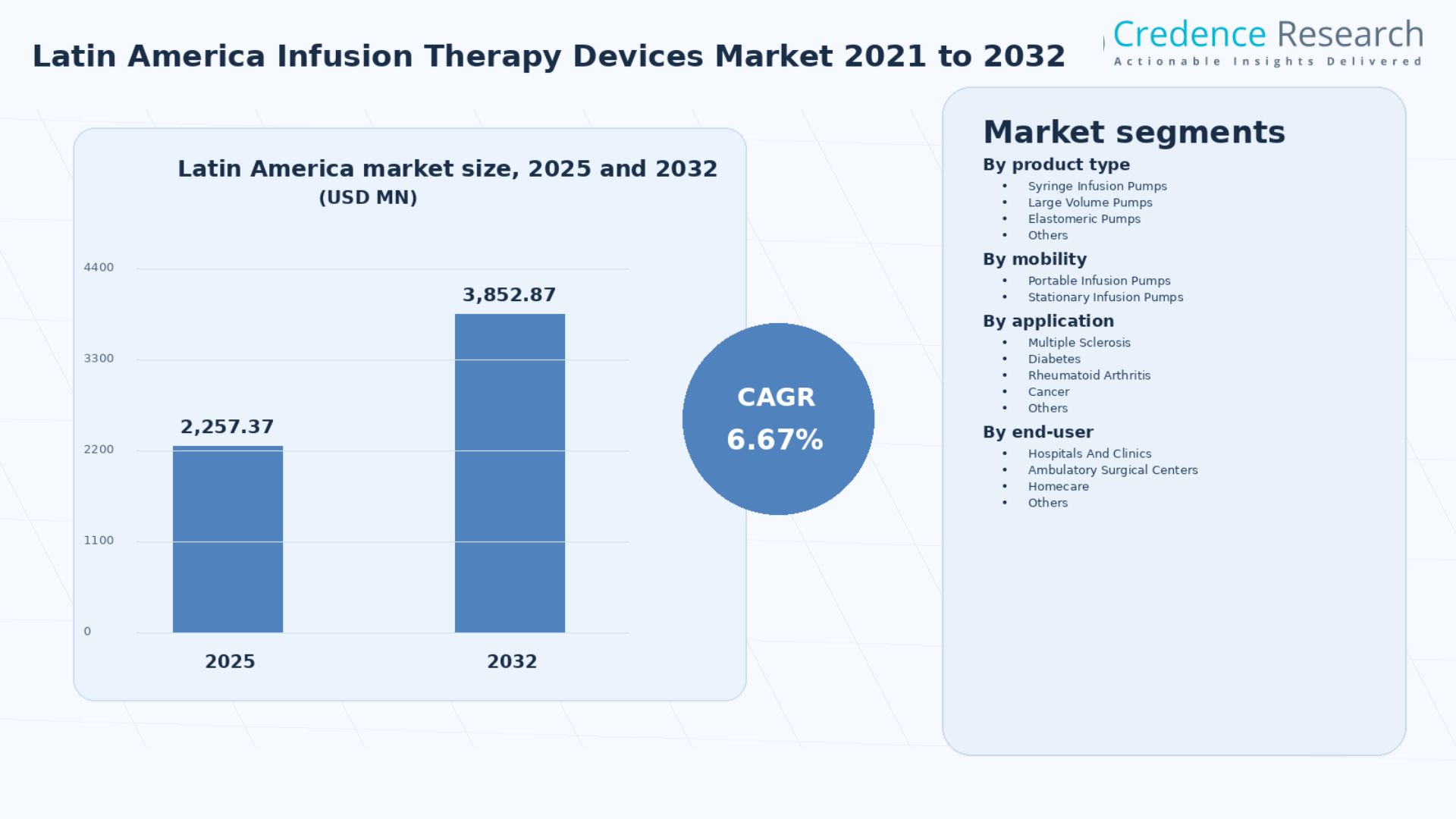
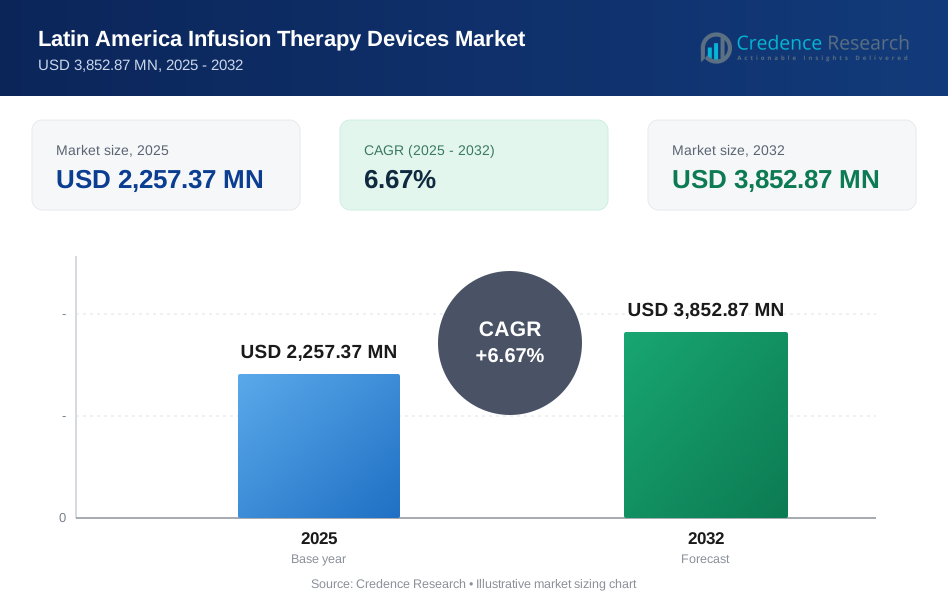
The Latin America Infusion Therapy Devices Market size was valued at USD 1,704.07 MN in 2021 and reached USD 2,257.37 MN in 2025. It is anticipated to reach USD 3,852.87 MN by 2032, growing at a CAGR of 6.67% during the forecast period.
| REPORT ATTRIBUTE | DETAILS |
|---|---|
| Historical Period | 2021-2024 |
| Base Year | 2025 |
| Forecast Period | 2025-2032 |
| Latin America Infusion Therapy Devices Market Size 2025 | USD 2,257.37 million |
| Latin America Infusion Therapy Devices Market , CAGR | 6.67% |
| Latin America Infusion Therapy Devices Market Size 2032 | USD 3,852.87 million |
Latin America Infusion Therapy Devices Market Insights
- Market growth is supported by cancer therapy demand, diabetes management, biologics administration, hospital infusion safety, ambulatory care expansion and homecare-based infusion models.
- Large Volume Pumps hold a strong position because hospitals and clinics use them for IV fluids, chemotherapy, parenteral nutrition, antibiotics, pain management and critical care infusion.
- Portable Infusion Pumps are gaining momentum due to homecare, ambulatory chemotherapy, chronic therapy, diabetes care and outpatient infusion models.
- Hospitals And Clinics remain the leading end-user segment because infusion therapy requires clinical oversight, medication safety protocols, trained nurses, pump programming and monitoring.
Latin America Infusion Therapy Devices Market Segment Insights
By product type
By product type, Large Volume Pumps held a strong position in 2025 because hospitals and clinics depend on them for high-volume medication delivery, IV fluids, antibiotics, chemotherapy, parenteral nutrition, anesthesia support and critical care. Syringe Infusion Pumps remain important in neonatal care, intensive care, anesthesia, oncology and specialty drug administration where precise low-volume delivery is required. Elastomeric Pumps are gaining relevance in ambulatory chemotherapy, postoperative analgesia and home infusion because they are portable and mechanically simple. Others include ambulatory pumps, enteral pumps, specialty infusion accessories and pump-related software platforms. Demand will depend on drug administration complexity, patient safety, maintenance, reimbursement and hospital procurement.
By mobility
By mobility, Stationary Infusion Pumps held the strongest position in 2025 because hospital wards, ICUs, operating rooms, oncology departments and emergency units require stable, programmable and connected infusion systems. Portable Infusion Pumps are expected to grow faster as treatment shifts toward outpatient and homecare settings. Portable devices support chemotherapy, pain management, diabetes, antibiotics, biologics and selected chronic therapies outside inpatient facilities. Mobility demand will depend on battery life, programming safety, alarm systems, patient training, ambulatory workflow compatibility and availability of consumables. Hospitals will continue to use both stationary and portable systems depending on procedure type and care setting.
By application
By application, Cancer held a strong position in 2025 because chemotherapy, immunotherapy support, pain management and supportive care often require infusion pumps and controlled drug delivery. Diabetes supports demand for insulin infusion and portable systems, while Multiple Sclerosis and Rheumatoid Arthritis support infusion therapy through biologics and specialty medicines administered in clinics or homecare settings. Others include antibiotics, pain management, nutrition, hydration, anesthesia and critical care medication delivery. Application growth will be shaped by chronic disease burden, drug pipeline evolution, specialty clinic networks, reimbursement and clinician comfort with home-based infusion.
By end-user
By end-user, Hospitals And Clinics held the strongest position in 2025 because most infusion therapies require medication preparation, nurse supervision, pump programming, adverse event management and clinical documentation. Ambulatory Surgical Centers generate demand for perioperative fluids, anesthesia, pain management and recovery support. Homecare is expanding as payers and providers shift selected therapies outside hospitals to reduce inpatient burden and improve patient convenience. Others include oncology centers, specialty infusion centers, long-term care facilities and emergency providers. Growth will depend on training, device reliability, medication safety, patient selection and home infusion service capacity.
Key Market Drivers
Cancer treatment and chemotherapy infusion demand
Cancer treatment and chemotherapy infusion demand represent major growth drivers for the Latin America Infusion Therapy Devices Market. Latin America and the Caribbean recorded 1,551,060 new cancer cases and 749,242 cancer deaths in 2022, creating sustained demand for oncology infusion, supportive care and pain management pathways. Infusion therapy devices support chemotherapy, hydration, antiemetics, antibiotics, analgesics and supportive drug administration across hospitals, clinics, ambulatory infusion centers and selected homecare programs. This driver supports Large Volume Pumps, Syringe Infusion Pumps, Portable Infusion Pumps, Hospitals And Clinics and Cancer applications.
Diabetes burden and insulin delivery needs
Diabetes burden and insulin delivery needs strengthen demand for infusion and controlled drug delivery systems. PAHO reported that 112 million adults in the Region of the Americas lived with diabetes in 2022, equal to an age-standardized prevalence of 13.1%. Diabetes care supports demand for portable infusion pumps, insulin delivery support, homecare training and chronic disease management technologies. Infusion devices are also relevant for hospitalized diabetic patients who require precise insulin administration during surgery, critical care or acute illness. This driver supports Portable Infusion Pumps, Syringe Infusion Pumps, Homecare, Hospitals And Clinics and Diabetes applications.
Medication safety and smart infusion pump adoption
Medication safety and smart infusion pump adoption are supporting replacement demand because infusion errors can create avoidable patient harm. WHO states that unsafe medication practices and medication errors are a leading cause of injury and avoidable harm in health care systems worldwide, with medication error costs estimated at USD 42 billion annually. Infusion therapy devices with dose-error reduction, alarms, drug libraries, connectivity and workflow integration can reduce administration risk in hospitals and clinics. This driver supports Large Volume Pumps, Syringe Infusion Pumps, Stationary Infusion Pumps, Hospitals And Clinics and Ambulatory Surgical Centers.
Infusion and nutrition systems investment by global suppliers
Infusion and nutrition systems investment by global suppliers supports product availability and clinical adoption across Latin America. Fresenius said its 2025 organic growth benefited from development in Europe, Latin America and the United States, while Fresenius Kabi increased EBIT by 7% to EUR 1,413 million. Fresenius also described its MedTech Infusion and Nutrition Systems portfolio as including infusion and nutrition pumps, dedicated disposables and software-based solutions focused on application safety, therapy efficiency and interoperability with hospital systems. This driver supports Syringe Infusion Pumps, Large Volume Pumps, Portable Infusion Pumps, Stationary Infusion Pumps and hospital modernization.
Growth in connected infusion and medication management systems
Growth in connected infusion and medication management systems is improving infusion therapy safety and workflow efficiency. BD reported fiscal 2025 Medication Delivery Solutions revenue of USD 4.575 billion and referenced Medication Management Solutions strength in infusion systems and higher utilization of infusion sets. ICU Medical said it develops and sells medical products used in infusion therapy, vascular access and vital care applications, with revenue reported by product line in its 2025 annual filing. This driver supports Large Volume Pumps, Syringe Infusion Pumps, Hospitals And Clinics, Ambulatory Surgical Centers and medication management platforms.
Key Trends and Opportunities
Portable infusion expands homecare and ambulatory treatment
Portable infusion is expanding homecare and ambulatory treatment because oncology, pain management, antibiotics, diabetes and specialty therapies increasingly require flexible drug delivery outside inpatient settings. PAHO reported in 2026 that 14.4% of people aged 65 and older in Latin America and the Caribbean, or about 8 million people, require long-term care, with the share projected to rise to 16% by 2050. This trend supports Portable Infusion Pumps, Elastomeric Pumps, Homecare and chronic therapy applications. Adoption will depend on patient training, nurse follow-up, pump reliability, payer coverage and consumable supply.
Elastomeric pumps gain use in outpatient infusion
Elastomeric pumps are gaining use in outpatient infusion because they offer a portable option for selected chemotherapy, pain management and antibiotic therapies. These devices can reduce facility time when patients are clinically appropriate for ambulatory treatment. Latin America’s growing oncology burden and long-term care needs support demand for simpler portable delivery systems in hospitals, clinics and homecare programs. Growth will depend on medication compatibility, flow accuracy, clinician acceptance, infection control, reimbursement and distributor availability.
Interoperability becomes a purchase criterion
Interoperability is becoming a purchase criterion as hospitals seek infusion devices that connect with medication management platforms, drug libraries, electronic health records and clinical monitoring systems. Fresenius Kabi’s Infusion and Nutrition Systems portfolio includes software-based solutions focused on application safety, user workflows, therapy efficiency and interoperability with hospital systems. This trend supports Stationary Infusion Pumps, Large Volume Pumps, Hospitals And Clinics and Ambulatory Surgical Centers. Suppliers with integrated software, cybersecurity controls, service support and training will gain stronger procurement advantage.
Specialty biologics support infusion center growth
Specialty biologics support infusion center growth because Multiple Sclerosis, Rheumatoid Arthritis, Cancer and other chronic diseases require periodic administration in controlled settings. PAHO reported that NCD deaths in the Americas reached 6 million in 2021, with cardiovascular diseases, cancer, diabetes and chronic respiratory conditions forming the largest burden. Specialty clinics and ambulatory infusion centers can help manage recurring therapies while reducing hospital crowding. This trend supports Large Volume Pumps, Syringe Infusion Pumps, Stationary Infusion Pumps, Portable Infusion Pumps and Specialty infusion end users included under Hospitals And Clinics and Others.
Key Market Challenges
High equipment cost and budget pressure
High equipment cost and budget pressure remain major challenges for the Latin America Infusion Therapy Devices Market. Smart infusion pumps, syringe pumps, large volume pumps and connected systems require capital spending, maintenance, software updates, drug library management and staff training. Public hospitals often face procurement delays and budget constraints, while private clinics must justify investment through patient volume and payer coverage. Cost pressure can also slow replacement cycles and limit adoption of advanced safety features. Vendors must offer financing, managed service models and value-tier systems to improve adoption.
Training and medication safety workflow burden
Training and medication safety workflow burden can limit effective pump utilization. Infusion therapy requires accurate dose programming, line management, alarm response, drug library updates, patient monitoring and documentation. WHO’s Medication Without Harm initiative highlights medication errors as a major global safety issue, reinforcing the need for safer medication systems and practices. Hospitals must train nurses, pharmacists, biomedical engineers and physicians to use connected pumps correctly. Suppliers that provide clinical education, software support and protocol integration will improve device adoption.
Consumable availability and maintenance risk
Consumable availability and maintenance risk can disrupt infusion therapy. Pumps require administration sets, tubing, syringes, connectors, elastomeric reservoirs, batteries, spare parts and software support. Supply interruption can delay chemotherapy, antibiotics, nutrition and pain management. Latin America’s imported device dependence, currency volatility and distributor fragmentation can increase availability risk. Vendors with regional warehousing, preventive maintenance programs, local engineers and reliable consumable supply will be better positioned.
Regulatory and product recall pressure
Regulatory and product recall pressure affects infusion pump adoption because these devices are safety-critical and require strong quality controls. Baxter’s 2025 annual filing referenced voluntary correction activity for Novum LVP due to potential under-infusion when the pump remained in standby mode for an extended period. Such issues can increase hospital scrutiny around device safety, software updates, alarms and post-market support. Manufacturers must maintain strong quality systems, timely field actions, clear training materials and responsive regulatory communication.
Regional Analysis
Brazil
Brazil leads the Latin America Infusion Therapy Devices Market due to its large hospital network, oncology demand, chronic disease burden and established private health care sector. Hospitals And Clinics remain the leading end users, while Homecare and ambulatory infusion models are gaining relevance. Large Volume Pumps, Syringe Infusion Pumps and Stationary Infusion Pumps remain core hospital categories. Portable Infusion Pumps and Elastomeric Pumps will gain demand in oncology, antibiotics and pain management. Growth will depend on public procurement, private hospital investment, regulatory approvals, clinical training and local distributor strength.
Mexico
Mexico represents a major growth market supported by private hospital networks, cancer care demand, diabetes burden and proximity to North American medical technology supply chains. Hospitals And Clinics dominate demand, while Ambulatory Surgical Centers and Homecare are expanding gradually. Cancer, Diabetes and Others applications support infusion therapy use across oncology, chronic disease care, surgery and emergency treatment. Growth will depend on reimbursement, product availability, hospital budgets, distributor service capability and adoption of safer infusion systems.
Argentina
Argentina offers steady demand for infusion therapy devices through hospitals, oncology clinics, chronic disease management and specialty infusion services. Large Volume Pumps and Syringe Infusion Pumps remain important in public and private hospitals. Portable Infusion Pumps and Elastomeric Pumps will gain selective demand where ambulatory chemotherapy and homecare programs are available. Macroeconomic pressure, currency volatility and import dependency may affect procurement and replacement cycles. Growth will depend on funding stability, device service networks, affordability and clinical evidence.
Colombia
Colombia is an expanding market supported by public-private health care participation, specialty clinics and growing demand for oncology and chronic disease treatment. Hospitals And Clinics generate the largest infusion device demand, while Homecare has long-term opportunity as health systems manage older adults and chronic therapy patients outside inpatient settings. Portable Infusion Pumps and Elastomeric Pumps can support outpatient care. Growth will depend on payer coverage, care coordination, clinical training, consumable availability and regulatory access.
Chile
Chile represents a relatively mature market in the region due to structured health care access, private hospital activity and chronic disease management. Infusion therapy devices are used across oncology, surgery, pain management, critical care, diabetes and specialty drug administration. Hospitals And Clinics remain the main end users, while Ambulatory Surgical Centers and Homecare offer growth potential. Adoption of connected infusion platforms will depend on procurement policy, medication safety programs, hospital digitalization and supplier support.
Rest of Latin America
Rest of Latin America includes markets with varied hospital infrastructure, reimbursement, homecare access and specialty infusion capacity. Countries with larger private hospital networks will adopt connected and portable infusion devices faster, while lower-resource markets will prioritize essential pumps, consumables and basic infusion safety. PAHO’s NCD data for the Americas shows a sustained chronic disease burden that will continue to drive drug administration and long-term care needs. Growth will depend on distributor reach, product affordability, public procurement and nurse training.
Report Attribute Details
| Report Attribute | Details |
| Historical Period | 2021–2024 |
| Base Year | 2025 |
| Forecast Period | 2025–2032 |
| Market Size in 2021 | USD 1,704.07 MN |
| Market Size in 2025 | USD 2,257.37 MN |
| Market Size in 2032 | USD 3,852.87 MN |
| CAGR | 6.67% |
| Segments Covered | Product Type, Mobility, Application, End-User and Geography |
| Key Companies Covered | Mindray, Fresenius Kabi AG, Ossila, Ace-medical, ICU Medical, Chmyx Inc., Baxter, Becton, Dickinson and Company, Micrel Medical Devices SA, AKAS Infusions, Narang Medical Limited, Monidor Oy, Smiths Group plc, B. Braun SE, Trivitron Healthcare and Eitan Medical |
Latin America Infusion Therapy Devices Market Segmentations
By Product Type
- Syringe Infusion Pumps
- Large Volume Pumps
- Elastomeric Pumps
- Others
By Mobility
- Portable Infusion Pumps
- Stationary Infusion Pumps
By Application
- Multiple Sclerosis
- Diabetes
- Rheumatoid Arthritis
- Cancer
- Others
By End-User
- Hospitals And Clinics
- Ambulatory Surgical Centers
- Homecare
- Others
Key Players
- Mindray
- Fresenius Kabi AG
- Ossila
- Ace-medical
- ICU Medical
- Chmyx Inc.
- Baxter
- Becton, Dickinson and Company
- Micrel Medical Devices SA
- AKAS Infusions
- Narang Medical Limited
- Monidor Oy
- Smiths Group plc
- B. Braun SE
- Trivitron Healthcare
- Eitan Medical
Recent Developments
- In 2025, Fresenius reported that Fresenius Kabi revenue reached EUR 8,612 million and that organic growth benefited from good development in Europe, Latin America and the United States.
- In 2025, Fresenius said its MedTech business advanced infusion therapy with the rollout of the Ivenix Infusion System.
- In fiscal 2025, BD reported Medication Delivery Solutions revenue of USD 4.575 billion and continued activity across medication delivery and medication management platforms.
- In 2025, Baxter reported that its Medical Products & Therapies segment included sterile IV solutions, infusion systems, administration sets, parenteral nutrition therapies and surgical products.
- In fiscal 2025, B. Braun commissioned the highly automated ACTIVE plant for infusion therapy single-use products in Melsungen.
Report Coverage
The research report offers an in-depth analysis based on product type, mobility, application, end-user and geography. It details leading market players, providing an overview of their business positioning, infusion therapy device portfolios, syringe infusion pumps, large volume pumps, elastomeric pumps, portable infusion systems, stationary infusion platforms, software-enabled infusion safety features, administration sets, consumables and strategic relevance in the Latin America Infusion Therapy Devices Market. The report includes insights into the competitive environment, market trends, growth drivers, restraints and opportunities. It also examines cancer treatment demand, diabetes care, biologics administration, medication safety, ambulatory infusion, homecare adoption, pump interoperability, equipment maintenance and regulatory scrutiny as major factors shaping market development. The report assesses the impact of high equipment cost, reimbursement limits, staff training needs, consumable supply risk, product recall pressure and service limitations on market growth. It provides strategic recommendations for infusion device manufacturers, hospitals, clinics, ambulatory surgical centers, homecare providers, distributors, payers, investors and new entrants seeking to navigate Latin America’s infusion therapy device ecosystem.
Future Outlook
- Demand for infusion therapy devices will continue to rise as Latin America expands cancer treatment, chronic disease care and outpatient infusion services.
- Large Volume Pumps will remain a major product category due to high use in hospitals, clinics, oncology departments and critical care settings.
- Syringe Infusion Pumps will gain demand in neonatal care, anesthesia, ICU care and precise specialty drug administration.
- Elastomeric Pumps will expand through ambulatory chemotherapy, postoperative analgesia, antibiotics and homecare-based infusion.
- Portable Infusion Pumps will grow faster as providers shift selected therapies from hospitals to outpatient and homecare settings.
- Stationary Infusion Pumps will remain essential in hospitals, operating rooms, ICUs and oncology units.
- Cancer will remain a leading application due to chemotherapy, supportive care and pain management needs.
- Diabetes will support demand for controlled insulin delivery and hospital-based acute insulin management.
- Hospitals And Clinics will remain the leading end-user segment due to clinical oversight, nurse supervision and medication safety requirements.
- Competition will increase as companies compete on pump safety, interoperability, drug libraries, service uptime, consumable availability, pricing and training support.
Request a Free Sample
Fill in your details and we'll send you a free sample report.
- Sample data tables & charts
- Research methodology
Need a Custom Version of This Report?
Tailor the scope, geography, or segments to your exact requirements.
- Custom geography or segment scope
- Direct access to our analyst team
Frequently Asked Questions
What is the current market size for the Latin America Infusion Therapy Devices Market and what is its projected size in 2032?
At what CAGR is the Latin America Infusion Therapy Devices Market projected to grow?
Which product type segment is expected to hold strong demand?
Which mobility segment is growing faster?
Which application segment supports strong demand?
Who are the leading companies in the market?
Which countries are important in the Latin America market?
Table of Content
Chapter 1. Report Introduction
- 1.1 Report Description & Purpose
- 1.1.1 Report Title & Market Definition
- 1.1.2 Unique Selling Propositions (USP) & Key Differentiators
- 1.1.3 Value Proposition for Stakeholders
- 1.2 Research Objectives
- 1.2.1 Market Sizing Objectives (Volume & Revenue) (Volume Where Applicable)
- 1.2.2 Segmentation Objectives
- 1.2.3 Competitive Intelligence Objectives
- 1.2.4 Forecast & Scenario Objectives
- 1.3 Report Scope
- 1.3.1 Latin America Infusion Therapy Devices Scope – Segments & Subsegments Covered
- 1.3.2 Geographic Scope – Regions & Countries Covered
- 1.3.3 Historical Period, Base Year & Forecast Period (2025; forecast to 2032)
- 1.3.4 Inclusions & Exclusions
- 1.4 Industry Classification & Applicable Codes
- 1.5 Currency, Measurement Units & Valuation Basis
- 1.6 Target Stakeholders
- 1.7 Limitations & Assumptions
Chapter 2. Executive Summary
- 2.1 Global Latin America Infusion Therapy Devices Market Snapshot
- 2.1.1 Market Size – Historical (2025) & Forecast (2025-2032) (2025: USD 2,257.37 MN → 2032: USD 3,852.87 MN)
- 2.1.2 Volume & Revenue – Global Totals (Volume Where Applicable)
- 2.1.3 Key Market Highlights – Top Five Facts
- 2.2 Latin America Infusion Therapy Devices Market Segmentation Snapshot
- 2.2.1 Market Split by Region – 2025 vs. 2032
- 2.3 Competitive Snapshot
- 2.3.1 Top 10 Players by Revenue Share – 2025
- 2.3.2 Top 10 Players by Volume Share – 2025 (Volume Where Applicable)
- 2.3.3 Recent Strategic Developments (18-Month Summary)
- 2.4 Key Investment Highlights & Strategic Conclusions
Chapter 3. Latin America Infusion Therapy Devices Market Dynamics & Industry Analysis
- 3.1 Market Overview & Context
- 3.1.1 Latin America Infusion Therapy Devices Market Position in the Broader Industry Value Chain
- 3.1.2 Demand Structure & Purchasing Dynamics
- 3.1.3 Market Maturity & Development Stage by Region
- 3.2 Latin America Infusion Therapy Devices Market Drivers
- 3.3 Latin America Infusion Therapy Devices Market Restraints & Challenges
- 3.4 Latin America Infusion Therapy Devices Market Opportunities
- 3.5 Porter's Five Forces Analysis
- 3.5.1 Threat of New Entrants
- 3.5.2 Bargaining Power of Suppliers
- 3.5.3 Bargaining Power of Buyers
- 3.5.4 Threat of Substitutes
- 3.5.5 Competitive Rivalry – Intensity Assessment
- 3.6 Latin America Infusion Therapy Devices Value Chain Analysis
- 3.6.1 Upstream – Key Inputs, Resources & Suppliers
- 3.6.1.1 Key Input/Resource 1
- 3.6.1.2 Key Input/Resource 2
- 3.6.1.3 Key Input/Resource 3
- 3.6.2 Midstream – Core Operations & Value Creation
- 3.6.2.1 Operating Model & Process Overview
- 3.6.2.2 Key Operating Locations & Capabilities by Company
- 3.6.3 Downstream – Market Channels & End Users
- 3.6.3.1 Direct Sales & Customer Engagement Channels
- 3.6.3.2 Indirect Sales, Intermediaries & Partner Channels
- 3.6.4 Value Chain Profitability Analysis
- 3.6.1 Upstream – Key Inputs, Resources & Suppliers
- 3.7 PESTEL Analysis
- 3.7.1 Political Factors
- 3.7.2 Economic Factors
- 3.7.3 Social Factors
- 3.7.4 Technological Factors
- 3.7.5 Environmental Factors
- 3.7.6 Legal Factors
- 3.8 Latin America Infusion Therapy Devices Supply Chain Analysis
- 3.8.1 Critical Input & Resource Availability Risk Assessment
- 3.8.2 Supplier & Operational Concentration Risk (Geographic Exposure)
- 3.8.3 Supply & Service Disruption Impact Analysis
- 3.9 Regulatory & Policy Landscape
Note: The regulatory and policy landscape section covers regulations based on their applicability to the market, Latin America Infusion Therapy Devices category, geography, and scope of the study. Only regulatory frameworks with a material impact on operations, compliance, trade, sustainability, or market access are analyzed in detail.
Chapter 4. Key Investment Pockets & Opportunity Analysis
- 4.1 Latin America Infusion Therapy Devices Market Attractiveness Analysis
- 4.1.1 By Region – Investment Attractiveness Matrix (Market Size × CAGR)
- 4.2 Absolute Revenue Growth Opportunity
- 4.2.1 By Region – Absolute Revenue Growth Through 2032
- 4.3 Incremental Demand Opportunity
- 4.3.1 By Region – Incremental Demand Through 2032
- 4.3.2 Segment – Incremental Demand
- 4.4 Emerging Submarket Opportunity Deep Dive (Subject to Applicability)
- 4.5 Priority Market Opportunity Scorecards
- 4.5.1 United States
- 4.5.2 Europe
- 4.5.3 Asia
- 4.5.4 Middle East & Africa
Note: Priority market opportunity scorecards reflect the geographic scope and strategic relevance of the study. Listed markets are indicative and may be adapted to the industry.
Chapter 5. Latin America Infusion Therapy Devices Cross-Border Trade & Market Access Analysis
- 5.1 International Trade & Cross-Border Activity Overview
- 5.1.1 Global Export Value by Country (2025)
- 5.1.2 Global Export Volume by Country (2025) (Volume Where Applicable)
- 5.1.3 Global Import Value by Country (2025)
- 5.1.4 Global Import Volume by Country (2025) (Volume Where Applicable)
- 5.1.5 Net Trade Balance by Country (2025)
- 5.2 Export Analysis – Segment
- 5.2.1 Category 1 (Applicable Classification Code)
- 5.2.2 Category 2 (Applicable Classification Code)
- 5.2.3 Category 3 (Applicable Classification Code)
- 5.2.4 Category 4 (Applicable Classification Code)
- 5.2.5 Category 5 (Applicable Classification Code)
- 5.3 Import Analysis – Segment
- 5.3.1 Category 1 (Applicable Classification Code)
- 5.3.2 Category 2 (Applicable Classification Code)
- 5.3.3 Category 3 (Applicable Classification Code)
- 5.3.4 Category 4 (Applicable Classification Code)
- 5.3.5 Category 5 (Applicable Classification Code)
- 5.4 Cross-Border Pricing & Transaction Benchmarks
- 5.4.1 Export Pricing – Segment & Country
- 5.4.2 Import Pricing – Segment & Source Country
- 5.4.3 Price Trends (2025)
- 5.5 Key Cross-Border Trade & Delivery Routes
- 5.5.1 Cross-Border Trade/Delivery Route 1
- 5.5.2 Cross-Border Trade/Delivery Route 2
- 5.5.3 Cross-Border Trade/Delivery Route 3
- 5.5.4 Cross-Border Trade/Delivery Route 4
- 5.5.5 Cross-Border Trade/Delivery Route 5
- 5.6 Trade Policy & Market Access Impact Assessment
- 5.6.1 Tariff & Non-Tariff Barriers
- 5.6.2 Regional Trade & Economic Integration Frameworks
- 5.6.3 Bilateral & Multilateral Trade Agreements
- 5.6.4 Cross-Border Operating, Licensing & Localization Requirements
Note: This chapter applies where cross-border trade or delivery is relevant to Latin America Infusion Therapy Devices. Goods, services, and digital offerings are assessed using applicable classifications and transaction measures. Import-export volumes, trade balances, and route analyses are included only where meaningful to the market.
Chapter 6. Competitive Landscape & Company Benchmarking
- 6.1 Latin America Infusion Therapy Devices Market Concentration & Structure
- 6.1.1 Herfindahl-Hirschman Index (HHI) – vs. 2025
- 6.1.2 Leading, Mid-Sized & Emerging Player Structure
- 6.1.3 Global, Regional & Local Player Dynamics
- 6.2 Latin America Infusion Therapy Devices Market Share Analysis – 2025
- 6.2.1 Global Revenue Share by Company
- 6.2.2 Global Volume Share by Company (Volume Where Applicable)
- 6.2.3 Regional Revenue Share
- 6.2.4 Market Share Evolution ( vs. 2025)
- 6.2.5 Company Market Share by Key Segment
- 6.2.6 Company Market Share by Customer Group
- 6.3 Operating Scale, Capacity & Infrastructure Analysis
- 6.3.1 Global Operating Scale & Supply Capacity
- 6.3.2 Resource Utilization & Operating Efficiency
- 6.3.3 Output, Service Delivery & Activity Metrics
- 6.3.4 Operating Footprint & Infrastructure Map
- 6.3.5 Planned Operational & Capacity Expansion
- 6.4 Latin America Infusion Therapy Devices Competitive Benchmarking Matrix
- 6.4.1 Revenue, Growth, Profitability & Operating Metric Comparison
- 6.4.2 Channel Revenue Mix
- 6.4.3 Geographic Revenue Exposure
- 6.4.4 R&D Intensity
- 6.4.5 Sustainability Maturity
- 6.5 Strategic Developments in Latin America Infusion Therapy Devices (Last 24 Months)
- 6.5.1 Mergers, Acquisitions & Divestments
- 6.5.2 New Products, Services & Solutions in Latin America Infusion Therapy Devices
- 6.5.3 Operational & Infrastructure Expansions
- 6.5.4 Strategic Alliances, Joint Ventures & Partnerships
- 6.5.5 Distribution Expansion & Market Entry
- 6.5.6 Sustainability & ESG Initiatives
- 6.6 Competitive Strategy Mapping
- 6.6.1 Leader, Challenger, Follower & Niche Classification
- 6.6.2 Pricing Strategy Comparison
- 6.6.3 Channel Strategy Matrix
Note: Strategic developments are included based on their materiality and the availability of reliable information.
Chapter 7. Global Latin America Infusion Therapy Devices Market – By Sales & Delivery Channel
- 7.1 Segment Overview
- 7.1.1 Volume & Revenue Split by Channel (2025 & 2032) (Volume Where Applicable)
- 7.1.2 Channel Mix Evolution (2025-2032)
Chapter 8. Regional Market Analysis – Global Overview
- 8.1 Global Regional Overview
- 8.1.1 Regional Volume Share (Volume Where Applicable)
- 8.1.2 Regional Revenue Share
- 8.1.3 Regional Volume by Region (Volume Where Applicable)
- 8.1.4 Regional Revenue by Region
- 8.1.5 Regional Forecast Through 2032
- 8.2 Cross-Regional Segment Analysis
- 8.2.1 By Sales & Delivery Channel
- 8.2.2 By Competitive Positioning & Price Tier
Chapter 9. North America Latin America Infusion Therapy Devices Market
- 9.1 United States
- 9.2 Canada
- 9.3 Mexico
Chapter 10. Europe Latin America Infusion Therapy Devices Market
- 10.1 Germany
- 10.2 France
- 10.3 Italy
- 10.4 United Kingdom
- 10.5 Spain
- 10.6 Poland
- 10.7 Russia
- 10.8 Netherlands
- 10.9 Belgium
- 10.10 Sweden
- 10.11 Denmark
- 10.12 Norway
- 10.13 Rest of Europe
Chapter 11. Asia Pacific Latin America Infusion Therapy Devices Market
- 11.1 China
- 11.2 India
- 11.3 Japan
- 11.4 South Korea
- 11.5 Thailand
- 11.6 Indonesia
- 11.7 Vietnam
- 11.8 Malaysia
- 11.9 Australia
- 11.10 Rest of Asia Pacific
Chapter 12. Latin America Latin America Infusion Therapy Devices Market
- 12.1 Brazil
- 12.2 Argentina
- 12.3 Colombia
- 12.4 Chile
- 12.5 Rest of Latin America
Chapter 13. Middle East Latin America Infusion Therapy Devices Market
- 13.1 Saudi Arabia
- 13.2 United Arab Emirates
- 13.3 Turkey
- 13.4 Israel
- 13.5 Iran
- 13.6 Rest of the Middle East
Chapter 14. Africa Latin America Infusion Therapy Devices Market
- 14.1 South Africa
- 14.2 Egypt
- 14.3 Nigeria
- 14.4 Morocco
- 14.5 Rest of Africa
Chapter 15. Latin America Infusion Therapy Devices Company Profiles
- 15.1 [Company 01]
- 15.1.1 Company Overview
- 15.1.2 Key Management Personnel
- 15.1.3 Products & Services Portfolio
- 15.1.4 Financial Performance
- 15.1.5 Key Market Focus & Geographic Presence
- 15.1.6 Recent Developments & Strategic Initiatives
Note: The company profile list is preliminary and may change based on research findings, market developments, data availability, and client requirements.
Chapter 16. Appendices
- Appendix A – List of Abbreviations & Acronyms
- Appendix B – Industry Classification Code Reference – Full Series
- Appendix C – Supply, Output & Operating Capacity Data Tables
- Appendix D – End-Use & Demand Base Tables
- Appendix E – Demand, Adoption & Usage Assumptions
- Appendix F – Pricing & Revenue Metric Reference Tables
- Appendix G – Company Operations & Infrastructure Database
- Appendix H – Cross-Border Trade & Activity Data Tables (Where Applicable)
- Appendix I – Regulatory Summary Tables
- Appendix J – Primary Research Participant List (Anonymized)
- Appendix K – Primary Research Questionnaire Framework
- Appendix L – Data Sources & Bibliography
- Appendix M – Market Size Divergence & Source Comparison
Chapter 17. Research Methodology
- 17.1 Research Framework & Philosophy
- 17.2 Secondary Research – Sources, Hierarchy & Data Extraction
- 17.3 Data Modeling – Bottom-Up & Top-Down Market Sizing
- 17.4 Primary Research – Stakeholder Framework, LOI & Sample Sizes
- 17.5 Forecast Methodology – Regression, Scenario & Sensitivity Analysis
- 17.6 Quality Control – Four-Layer Validation Framework
- 17.7 Limitations & Standard Assumptions
- 17.8 Disclaimer
