
Asia-Pacific Wearable Medical Devices Market Overview:
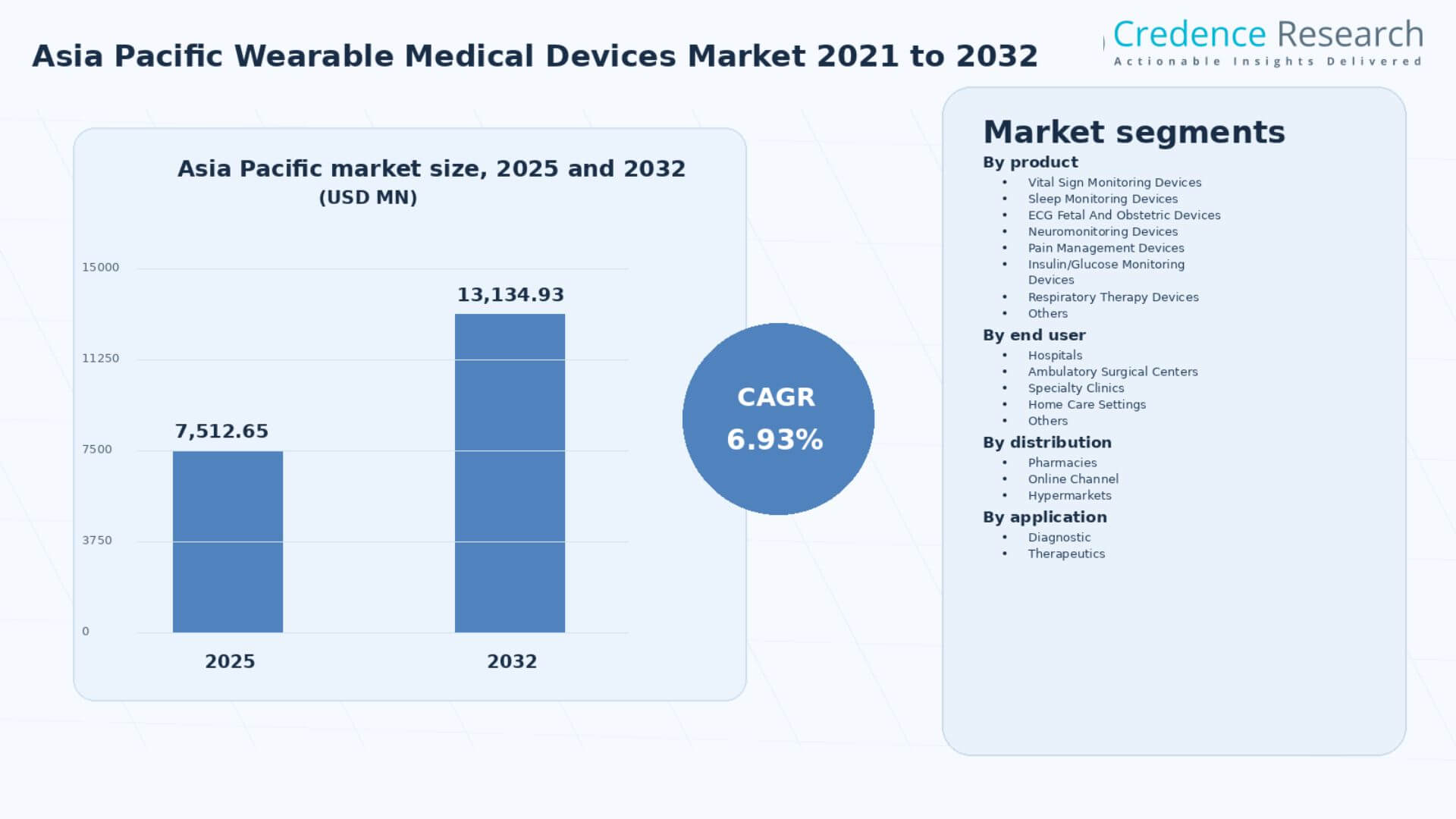
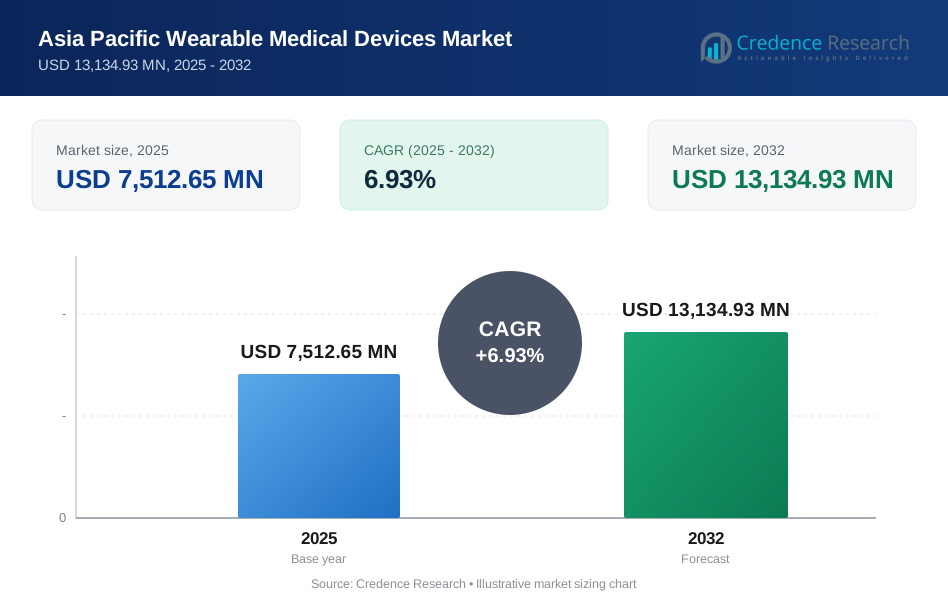
The Asia Pacific Wearable Medical Devices Market size was valued at USD 5,524.70 MN in 2021 and reached USD 7,512.65 MN in 2025. It is anticipated to reach USD 13,134.93 MN by 2032, growing at a CAGR of 6.93% during the forecast period.
| REPORT ATTRIBUTE | DETAILS |
|---|---|
| Historical Period | 2021-2024 |
| Base Year | 2025 |
| Forecast Period | 2025-2032 |
| Asia-Pacific Wearable Medical Devices Market Size 2025 | USD 7,512.65 million |
| Asia-Pacific Wearable Medical Devices Market, CAGR | 6.93% |
| Asia-Pacific Wearable Medical Devices Market Size 2032 | USD 13,134.93 million |
Asia-Pacific Wearable Medical Devices Market Insights
- Market growth is supported by diabetes monitoring demand, cardiovascular risk tracking, home-based care, connected patient monitoring, digital health adoption and growing consumer acceptance of wearable health devices.
- Insulin/Glucose Monitoring Devices hold a strong position because diabetes care increasingly depends on continuous glucose monitoring, connected insulin delivery and app-enabled treatment support.
- Vital Sign Monitoring Devices are gaining momentum as hospitals, specialty clinics and home care settings use connected monitoring for blood pressure, heart rate, oxygen saturation and recovery tracking.
- Home Care Settings and Online Channel are expanding as wearable devices shift diagnostics and therapeutics closer to patients through remote monitoring, chronic disease management and digital purchasing.
Market Segment Insights
By product
By product, Insulin/Glucose Monitoring Devices held a strong position in 2025 because continuous glucose monitoring, patch pumps and connected insulin delivery systems are becoming central to diabetes management. Vital Sign Monitoring Devices remain important due to demand for blood pressure, pulse, ECG, oxygen saturation and temperature monitoring. Sleep Monitoring Devices are supported by sleep apnea awareness, respiratory therapy needs and consumer-connected health behavior. Electrocardiographs Fetal And Obstetric Devices support maternal and cardiac monitoring. Neuromonitoring Devices and Pain Management Devices address specialty care and chronic symptom tracking. Respiratory Therapy Devices support home care and sleep-related breathing conditions. Others include activity-linked medical wearables, rehabilitation devices and connected therapeutic platforms.
By end user
By end user, Home Care Settings gained strong relevance in 2025 because wearable medical devices are designed for continuous monitoring, chronic disease management, patient self-use and remote clinician review. Hospitals remain important for patient monitoring, discharge planning, cardiac assessment and acute care-linked wearable use. Specialty Clinics support diabetes, cardiology, sleep medicine, neurology, pain management and respiratory care. Ambulatory Surgical Centers use wearable monitoring in perioperative recovery and selected outpatient care pathways. Others include diagnostic chains, telehealth providers, wellness clinics and employer health programs. Growth will depend on patient education, reimbursement, device accuracy, app integration and clinician workflow adoption.
By distribution channel
By distribution channel, Pharmacies held a strong position in 2025 because glucose monitors, blood pressure monitors, respiratory devices and selected wearable health products are commonly purchased through trusted health retail outlets. Online Channel is gaining fast momentum due to product comparison, home delivery, subscription supplies, app-linked onboarding and consumer-directed digital purchasing. Hypermarkets support selected mass-market wearable health devices, blood pressure monitors and wellness-linked products, particularly in urban markets. Distribution growth will depend on product classification, prescription requirements, reimbursement, after-sales support, device authenticity and customer education.
By application
By application, Diagnostic held a strong position in 2025 because wearable medical devices are widely used for glucose tracking, vital sign monitoring, ECG capture, sleep assessment, respiratory status and maternal health monitoring. Therapeutics is expanding through insulin delivery, pain management, respiratory therapy, rehabilitation support and connected care platforms. Diagnostic adoption is driven by early detection, risk tracking and remote disease management, while therapeutic adoption depends on clinical validation, adherence support, integration with care teams and payer acceptance. Growth will favor devices that combine diagnostic data with actionable treatment guidance.
Key Market Drivers
Diabetes burden and continuous glucose monitoring adoption
Diabetes burden and continuous glucose monitoring adoption represent major growth drivers for the Asia Pacific Wearable Medical Devices Market. WHO reported that nearly 246 million people aged 30 years and above are estimated to have diabetes in the WHO South-East Asia Region, while less than one in three adults with diabetes are on treatment and less than 15% have the disease under control. Abbott reported that sales of its continuous glucose monitoring systems totaled USD 7.6 billion in 2025, up from USD 6.4 billion in 2024. This driver supports Insulin/Glucose Monitoring Devices, Pharmacies, Online Channel, Home Care Settings, Specialty Clinics and Therapeutics.
Cardiovascular monitoring and home blood pressure tracking
Cardiovascular monitoring and home blood pressure tracking are strengthening demand for vital sign monitoring and ECG-enabled wearable devices. WHO South-East Asia says cardiovascular diseases remain the leading cause of death globally and in the WHO South-East Asia Region, accounting for 32% of deaths due to noncommunicable diseases. OMRON Healthcare announced in September 2025 that cumulative worldwide sales of its blood pressure monitors exceeded 400 million units, and said its Complete monitor combines blood pressure and ECG readings that can be shared with physicians through the OMRON connect app.
Digital health and remote care adoption
Digital health and remote care adoption are accelerating wearable medical device use across hospitals, clinics and homes. WHO Western Pacific reported that the COVID-19 pandemic increased adoption and acceptance of digital health services, especially remote care, disease management, telemedicine and digital surveillance. OECD/WHO’s Health at a Glance: Asia/Pacific 2024 also noted that lessons from the pandemic in telemedicine, home-based care, supply chain management and public-private partnerships provide a foundation for innovation in health systems.
Aging population and chronic disease monitoring needs
Aging population and chronic disease monitoring needs support demand for wearable monitoring across Asia Pacific. WHO reported that the global share of people aged 60 and older will nearly double from 12% to 22% between 2015 and 2050, while common conditions in older age include diabetes, chronic obstructive pulmonary disease, cardiovascular conditions, depression and dementia. The Western Pacific Region already hosts more than one-third of the world’s population aged 65 and older, making connected monitoring especially relevant for long-term care and chronic disease management.
Connected diabetes technology and insulin delivery innovation
Connected diabetes technology and insulin delivery innovation are creating strong growth opportunities for therapeutics-focused wearables. Insulet reported 2025 revenue of USD 2.708 billion and said international revenue grew strongly, while its business focuses on proprietary continuous insulin delivery systems for people with insulin-dependent diabetes. Tandem Diabetes Care reported that its insulin pumps are compatible with mobile applications and cloud-based diabetes management applications, and it began global commercial rollout of t X2 integration with Abbott FreeStyle Libre 3 Plus CGM sensor in 2025. This driver supports Insulin/Glucose Monitoring Devices, Therapeutics, Online Channel and Specialty Clinics.
Key Trends and Opportunities
CGM and insulin delivery ecosystems expand
CGM and insulin delivery ecosystems are expanding as patients and clinicians seek continuous data, automated alerts, app-based insights and connected therapy decisions. Dexcom reported 2025 revenue of USD 4.662 billion and said it expanded CGM access, launched Dexcom G7 15 Day System and achieved 16% international revenue growth on a reported basis. This trend supports Insulin/Glucose Monitoring Devices, Therapeutics, Home Care Settings and Online Channel. Vendors with strong sensors, app experience, cloud platforms and partner integrations will gain share.
Wearable ECG and vital sign monitoring gain clinical relevance
Wearable ECG and vital sign monitoring are gaining clinical relevance as patients, clinicians and health systems focus on early detection, blood pressure control and cardiac risk management. OMRON’s integrated blood pressure and ECG monitoring portfolio, along with its global device scale, shows how home monitoring is moving from basic measurement to connected cardiovascular risk management. This trend supports Vital Sign Monitoring Devices, Electrocardiographs Fetal And Obstetric Devices, Diagnostic applications, Specialty Clinics and Home Care Settings.
Hospital-to-home monitoring creates new care pathways
Hospital-to-home monitoring is creating new care pathways as hospitals and specialty clinics use connected devices for discharge monitoring, chronic disease follow-up and remote patient management. Philips’ 2025 annual filing described Connected Care as including hospital patient monitoring, ambulatory monitoring, enterprise informatics and sleep and respiratory care, highlighting the role of connected systems in care continuity. This trend supports Hospitals, Home Care Settings, Respiratory Therapy Devices, Sleep Monitoring Devices and Vital Sign Monitoring Devices. Adoption will depend on interoperability, reimbursement and clinical workflow integration.
Consumer wearables move closer to medical monitoring
Consumer wearables are moving closer to medical monitoring as health, fitness and wellness devices incorporate heart rate, sleep, activity, stress and recovery features. Garmin’s 2025 annual report said fitness revenue growth was primarily driven by strong demand for wearables, while third-party applications are available on compatible Garmin wearable devices. This trend supports Diagnostic applications, Online Channel, Pharmacies and the Others product category. Medical-grade adoption will depend on validation, regulatory positioning, accuracy and integration with clinician-facing platforms.
Key Market Challenges
Accuracy, validation and regulatory classification
Accuracy, validation and regulatory classification remain major challenges for the Asia Pacific Wearable Medical Devices Market. Devices used for glucose monitoring, ECG, sleep assessment, fetal monitoring, respiratory therapy and therapeutic insulin delivery require strong clinical evidence, quality systems and regulatory clearance. Consumer-facing wearables may generate interest, but medical adoption requires validated performance and clear claims. Companies must manage device classification, cybersecurity, data privacy, post-market surveillance and country-specific registration across China, Japan, India, South Korea, Australia, Southeast Asia and other markets.
Affordability and reimbursement limitations
Affordability and reimbursement limitations can slow adoption, especially for continuous glucose monitoring systems, insulin pumps, sleep devices and advanced connected monitoring platforms. Many Asia Pacific markets rely on out-of-pocket spending for wearable health devices, and reimbursement varies widely across countries. High sensor replacement costs, device upgrades and app-linked service fees can limit sustained use. Vendors must offer value-tier models, pharmacy access, subscription options and payer evidence showing lower complications, fewer hospital visits and better disease control.
Data privacy and interoperability concerns
Data privacy and interoperability concerns affect wearable medical device integration. Devices generate continuous patient data that must be shared securely with mobile apps, cloud platforms, electronic health records and clinician dashboards. Asia Pacific countries have different data governance rules, localization requirements and health information standards. Poor interoperability can reduce clinician adoption, while weak privacy controls can reduce patient trust. Vendors must prioritize secure data transfer, consent management, cybersecurity, standards-based integration and clear clinical workflows.
Digital divide and patient adherence barriers
Digital divide and patient adherence barriers can limit market expansion. Wearable medical devices require smartphones, internet access, app literacy, sensor replacement habits and user engagement. Older adults, rural patients and lower-income groups may face access barriers. WHO Western Pacific has emphasized remote care and digital disease management, but digital health adoption can vary by infrastructure and population readiness. Manufacturers and providers must support training, multilingual apps, simple onboarding, offline functionality and caregiver access to improve long-term adherence.
Regional Analysis
China
China represents a major market within the Asia Pacific Wearable Medical Devices Market due to its large diabetes and cardiovascular patient base, strong digital commerce ecosystem and expanding connected health infrastructure. Insulin/Glucose Monitoring Devices, Vital Sign Monitoring Devices, Sleep Monitoring Devices and Online Channel adoption are supported by urban health awareness and mobile health platforms. However, reimbursement variation, local competition and regulatory requirements can shape adoption. Growth will depend on device affordability, hospital partnerships, pharmacy access, e-commerce distribution, clinician acceptance and domestic manufacturing capacity.
Japan
Japan is a mature market supported by aging demographics, high chronic disease monitoring needs, advanced hospitals and strong consumer acceptance of home health devices. Vital Sign Monitoring Devices, Sleep Monitoring Devices, ECG-enabled products and Insulin/Glucose Monitoring Devices are important categories. OMRON’s home-use health device base and Japan-based digital health initiatives support continued monitoring adoption. Home Care Settings and Specialty Clinics will gain relevance as older adults require continuous monitoring, fall-risk management, cardiovascular tracking and diabetes management.
India
India is an expanding market due to large diabetes burden, rising smartphone penetration, pharmacy access and growing private specialty care. WHO South-East Asia reported nearly 246 million people aged 30 years and older with diabetes in the region, indicating strong long-term demand for glucose monitoring and chronic disease management. Pharmacies and Online Channel are important distribution routes, while Hospitals and Specialty Clinics drive device recommendation. Growth will depend on affordability, local distribution, physician awareness, reimbursement, rural access and availability of lower-cost monitoring devices.
South Korea
South Korea represents a high-value market supported by advanced digital health infrastructure, strong hospital systems, connected consumer electronics and chronic disease monitoring demand. Vital Sign Monitoring Devices, Sleep Monitoring Devices, Insulin/Glucose Monitoring Devices and Diagnostic applications are expected to gain demand across hospitals, specialty clinics and home care settings. Growth will depend on reimbursement, integration with hospital information systems, data privacy compliance and clinical validation. Domestic technology strength can support connected monitoring platforms and app-enabled care models.
Australia and New Zealand
Australia and New Zealand represent mature wearable medical device markets supported by high health awareness, structured diabetes care, advanced pharmacies and digital health adoption. Insulin/Glucose Monitoring Devices, Vital Sign Monitoring Devices, Sleep Monitoring Devices and Respiratory Therapy Devices are important categories. Home Care Settings are gaining relevance through remote monitoring, chronic disease management and post-discharge follow-up. Growth will depend on reimbursement, patient access programs, clinical guidelines, pharmacy distribution and integration with primary care.
Southeast Asia
Southeast Asia offers strong long-term growth potential due to large populations, rising diabetes burden, growing middle-class health spending and expanding online health retail. Indonesia, Thailand, Malaysia, Vietnam, the Philippines and Singapore show different adoption levels. Singapore and Thailand support premium connected devices, while Indonesia, Vietnam and the Philippines offer volume potential for affordable glucose monitors, blood pressure monitors and sleep monitoring products. Growth will depend on device pricing, pharmacy reach, online channel trust, clinician education and mobile health infrastructure.
Report Attribute Details
| Report Attribute | Details |
| Historical Period | 2021–2024 |
| Base Year | 2025 |
| Forecast Period | 2025–2032 |
| Market Size in 2021 | USD 5,524.70 MN |
| Market Size in 2025 | USD 7,512.65 MN |
| Market Size in 2032 | USD 13,134.93 MN |
| CAGR | 6.93% |
| Segments Covered | Product, End User, Distribution Channel, Application and Geography |
| Key Companies Covered | Garmin Ltd, Polar Electro, Sotera, Inc., Medtronic, Abbott, Koninklijke Philips N.V., GE HealthCare, OMRON Healthcare, Inc., Dexcom, Inc., Insulet Corporation, Tandem Diabetes Care, Inc., Fresenius Medical Care AG, Cognita Labs and AliveCor, Inc. |
Asia-Pacific Wearable Medical Devices Market Segmentations
By Product
- Vital Sign Monitoring Devices
- Sleep Monitoring Devices
- Electrocardiographs Fetal And Obstetric Devices
- Neuromonitoring Devices
- Pain Management Devices
- Insulin/Glucose Monitoring Devices
- Respiratory Therapy Devices
- Others
By End User
- Hospitals
- Ambulatory Surgical Centers
- Specialty Clinics
- Home Care Settings
- Others
By Distribution Channel
- Pharmacies
- Online Channel
- Hypermarkets
By Application
- Diagnostic
- Therapeutics
Key Players
- Garmin Ltd
- Polar Electro
- Sotera, Inc.
- Medtronic
- Abbott
- Koninklijke Philips N.V.
- GE HealthCare
- OMRON Healthcare, Inc.
- Dexcom, Inc.
- Insulet Corporation
- Tandem Diabetes Care, Inc.
- Fresenius Medical Care AG
- Cognita Labs
- AliveCor, Inc.
Recent Developments
- In 2025, Abbott reported that sales of its continuous glucose monitoring systems totaled USD 7.6 billion, compared with USD 6.4 billion in 2024.
- In 2025, Dexcom reported revenue of USD 4.662 billion and international revenue growth of 16% on a reported basis, supported by expanded CGM access and launch activity.
- In 2025, Insulet reported full-year revenue of USD 2.708 billion, and its international revenue increased strongly as Omnipod adoption expanded outside the United States.
- In September 2025, OMRON Healthcare announced that cumulative worldwide sales of OMRON blood pressure monitors exceeded 400 million units.
- In 2025, Tandem Diabetes Care began global commercial rollout of t X2 pump integration with Abbott FreeStyle Libre 3 Plus continuous glucose monitoring sensor.
Report Coverage
The research report offers an in-depth analysis based on product, end user, distribution channel, application and geography. It details leading market players, providing an overview of their business positioning, wearable medical device portfolios, glucose monitoring platforms, insulin delivery systems, vital sign monitoring devices, sleep monitoring products, ECG-enabled devices, respiratory therapy products, digital health ecosystems and strategic relevance in the Asia Pacific Wearable Medical Devices Market. The report includes insights into the competitive environment, market trends, growth drivers, restraints and opportunities. It also examines diabetes burden, cardiovascular monitoring demand, digital health adoption, home-based care expansion, connected therapeutics, online distribution and consumer wearable convergence as major factors shaping market development. The report assesses the impact of affordability, reimbursement limits, validation requirements, data privacy, interoperability and adherence barriers on market growth. It provides strategic recommendations for wearable device manufacturers, hospitals, specialty clinics, home care providers, pharmacies, online channels, investors and new entrants seeking to navigate Asia Pacific’s wearable medical devices ecosystem.
Future Outlook
- Demand for wearable medical devices will continue to rise as Asia Pacific health systems expand remote monitoring, chronic disease care and home-based health management.
- Insulin/Glucose Monitoring Devices will remain a leading product category due to diabetes burden and CGM adoption.
- Vital Sign Monitoring Devices will gain demand through blood pressure, ECG, pulse, oxygen saturation and recovery monitoring.
- Sleep Monitoring Devices and Respiratory Therapy Devices will expand as sleep apnea, respiratory care and home monitoring adoption improve.
- Therapeutics will grow through insulin delivery, pain management, respiratory therapy and connected treatment support.
- Diagnostic applications will remain dominant due to continuous tracking, early warning alerts and remote clinician review.
- Home Care Settings will gain share as patients use wearable devices for long-term monitoring outside hospitals.
- Online Channel will expand through subscriptions, direct-to-consumer sales, device refills and digital onboarding.
- Pharmacies will remain important for trusted access, patient education and recurring consumable purchases.
- Competition will increase as companies compete on accuracy, app usability, interoperability, reimbursement evidence, sensor life, pricing and clinical integration.
Request a Free Sample
Fill in your details and we'll send you a free sample report.
- Sample data tables & charts
- Research methodology
Need a Custom Version of This Report?
Tailor the scope, geography, or segments to your exact requirements.
- Custom geography or segment scope
- Direct access to our analyst team
Frequently Asked Questions
What is the current market size for the Asia Pacific Wearable Medical Devices Market and what is its projected size in 2032?
At what CAGR is the Asia Pacific Wearable Medical Devices Market projected to grow?
Which product segment is expected to hold strong demand?
Which application leads the market?
Which end-user segment is gaining momentum?
Who are the leading companies in the market?
Which countries are important in the Asia Pacific market?
Table of Content
Chapter 1. Report Introduction
- 1.1 Report Description & Purpose
- 1.1.1 Report Title & Market Definition
- 1.1.2 Unique Selling Propositions (USP) & Key Differentiators
- 1.1.3 Value Proposition for Stakeholders
- 1.2 Research Objectives
- 1.2.1 Market Sizing Objectives (Volume & Revenue)
- 1.2.2 Segmentation Objectives
- 1.2.3 Competitive Intelligence Objectives
- 1.2.4 Forecast & Scenario Objectives
- 1.3 Report Scope
- 1.3.1 Asia Pacific Wearable Medical Devices Scope – Types & Subtypes Covered
- 1.3.2 Geographic Scope – Regions & Countries Covered
- 1.3.3 Historical Period, Base Year & Forecast Period (2025; forecast to 2032)
- 1.3.4 Inclusions & Exclusions
- 1.4 HS Code & Classification Framework
- 1.5 Currency, Units & Pricing Basis
- 1.6 Target Stakeholders
- 1.7 Limitations & Assumptions
Chapter 2. Executive Summary
- 2.1 Global Asia Pacific Wearable Medical Devices Market Snapshot
- 2.1.1 Market Size – Historical (2025) & Forecast (2025-2032) (2025: USD 7,512.65 MN → 2032: USD 13,134.93 MN)
- 2.1.2 Volume & Revenue – Global Totals
- 2.1.3 Key Market Highlights – Top Five Facts
- 2.2 Asia Pacific Wearable Medical Devices Market Segmentation Snapshot
- 2.2.1 Market Split by Region – 2025 vs. 2032
- 2.3 Competitive Snapshot
- 2.3.1 Top 10 Players by Revenue Share – 2025
- 2.3.2 Top 10 Players by Volume Share – 2025
- 2.3.3 Recent Strategic Developments (18-Month Summary)
- 2.4 Key Investment Highlights & Strategic Conclusions
Chapter 3. Asia Pacific Wearable Medical Devices Market Dynamics & Industry Analysis
- 3.1 Market Overview & Context
- 3.1.1 Asia Pacific Wearable Medical Devices Market Position in the Broader Automotive Value Chain
- 3.1.2 OEM vs. Replacement Market Dynamics
- 3.1.3 Market Maturity & Development Stage by Region
- 3.2 Asia Pacific Wearable Medical Devices Market Drivers
- 3.3 Asia Pacific Wearable Medical Devices Market Restraints & Challenges
- 3.4 Asia Pacific Wearable Medical Devices Market Opportunities
- 3.5 Porter's Five Forces Analysis
- 3.5.1 Threat of New Entrants
- 3.5.2 Bargaining Power of Suppliers
- 3.5.3 Bargaining Power of Buyers
- 3.5.4 Threat of Substitutes
- 3.5.5 Competitive Rivalry – Intensity Assessment
- 3.6 Asia Pacific Wearable Medical Devices Value Chain Analysis
- 3.6.1 Upstream – Raw Material/Input Suppliers
- 3.6.1.1 Raw Material/Input 1
- 3.6.1.2 Raw Material/Input 2
- 3.6.1.3 Raw Material/Input 3
- 3.6.2 Midstream – Production/Manufacturing/Service Delivery
- 3.6.2.1 Production/Process Overview
- 3.6.2.2 Key Facility Locations & Capacity by Manufacturer
- 3.6.3 Downstream – Distribution & End Consumer
- 3.6.3.1 Primary Channel – B2B/OEM
- 3.6.3.2 Secondary Channels – Dealer, Retail, Online, Direct
- 3.6.4 Value Chain Profitability Analysis
- 3.6.1 Upstream – Raw Material/Input Suppliers
- 3.7 PESTEL Analysis
- 3.7.1 Political Factors
- 3.7.2 Economic Factors
- 3.7.3 Social Factors
- 3.7.4 Technological Factors
- 3.7.5 Environmental Factors
- 3.7.6 Legal Factors
- 3.8 Asia Pacific Wearable Medical Devices Supply Chain Analysis
- 3.8.1 Raw Material/Input Supply Risk Assessment
- 3.8.2 Manufacturing Concentration Risk (Geographic Exposure)
- 3.8.3 Trade Disruption Impact Analysis
- 3.9 Regulatory & Policy Landscape
Note: The regulatory and policy landscape section covers regulations based on their applicability to the market, Asia Pacific Wearable Medical Devices category, geography, and scope of the study. Only regulatory frameworks with a material impact on operations, compliance, trade, sustainability, or market access are analyzed in detail.
Chapter 4. Key Investment Pockets & Opportunity Analysis
- 4.1 Asia Pacific Wearable Medical Devices Market Attractiveness Analysis
- 4.1.1 By Region – Investment Attractiveness Matrix (Volume × CAGR)
- 4.2 Absolute Revenue Growth Opportunity
- 4.2.1 By Region – Absolute USD Growth Through 2032
- 4.3 Incremental Volume Opportunity
- 4.3.1 By Region – Incremental Volume Through 2032
- 4.3.2 Segment – Incremental Volume
- 4.4 Emerging Submarket Opportunity Deep Dive (Subject to Applicability)
- 4.5 Emerging Market Opportunity Scorecards
- 4.5.1 United States
- 4.5.2 Europe
- 4.5.3 Asia
- 4.5.4 Middle East & Africa
Note: Emerging Market Opportunity Scorecards will be included based on relevance and strategic importance. Regions listed are indicative and may vary depending on data availability and market dynamics.
Chapter 5. Asia Pacific Wearable Medical Devices Import-Export Analysis & Trade Flows
- 5.1 Global Trade Overview
- 5.1.1 Global Export Value by Country (2025)
- 5.1.2 Global Export Volume by Country (2025)
- 5.1.3 Global Import Value by Country (2025)
- 5.1.4 Global Import Volume by Country (2025)
- 5.1.5 Net Trade Balance by Country (2025)
- 5.2 Export Analysis – Segment
- 5.2.1 Type 1 (HS Code)
- 5.2.2 Type 2 (HS Code)
- 5.2.3 Type 3 (HS Code)
- 5.2.4 Type 4 (HS Code)
- 5.2.5 Type 5 (HS Code)
- 5.3 Import Analysis – Segment
- 5.3.1 Type 1 (HS Code)
- 5.3.2 Type 2 (HS Code)
- 5.3.3 Type 3 (HS Code)
- 5.3.4 Type 4 (HS Code)
- 5.3.5 Type 5 (HS Code)
- 5.4 Average Unit Trade Prices
- 5.4.1 Average Export Price – Segment & Country
- 5.4.2 Average Import Price – Segment & Source Country
- 5.4.3 Price Trends (2025)
- 5.5 Key Trade Route Analysis
- 5.5.1 Trade Route 1
- 5.5.2 Trade Route 2
- 5.5.3 Trade Route 3
- 5.5.4 Trade Route 4
- 5.5.5 Trade Route 5
- 5.6 Trade Policy Impact Assessment
- 5.6.1 US Anti-Dumping & Section 301 Tariffs
- 5.6.2 EU Customs Union Impact
- 5.6.3 Major Free Trade Agreements
- 5.6.4 USMCA Rules of Origin
Note: Trade policy analysis will be included only where relevant to the Asia Pacific Wearable Medical Devices market.
Chapter 6. Competitive Landscape & Company Benchmarking
- 6.1 Asia Pacific Wearable Medical Devices Market Concentration & Structure
- 6.1.1 Herfindahl-Hirschman Index (HHI) – vs. 2025
- 6.1.2 Tier 1, Tier 2 & Tier 3 Market Structure
- 6.1.3 Global, Regional & Local Player Dynamics
- 6.2 Asia Pacific Wearable Medical Devices Market Share Analysis – 2025
- 6.2.1 Global Revenue Share by Company
- 6.2.2 Global Volume Share by Company
- 6.2.3 Regional Revenue Share
- 6.2.4 Market Share Evolution ( vs. 2025)
- 6.2.5 OEM Segment Share by Company
- 6.2.6 Replacement Segment Share by Company
- 6.3 Production/Delivery Capacity & Facility Analysis
- 6.3.1 Global Installed Capacity
- 6.3.2 Capacity Utilization Rates
- 6.3.3 Production/Output Volume
- 6.3.4 Facility Locations & Capacity Map
- 6.3.5 Planned Capacity Additions
- 6.4 Asia Pacific Wearable Medical Devices Competitive Benchmarking Matrix
- 6.4.1 Revenue, Volume, CAGR & Profitability Comparison
- 6.4.2 Channel Revenue Mix
- 6.4.3 Geographic Revenue Exposure
- 6.4.4 R&D Intensity
- 6.4.5 Sustainability Maturity
- 6.5 Strategic Developments in Asia Pacific Wearable Medical Devices (Last 24 Months)
- 6.5.1 Mergers, Acquisitions & Divestments
- 6.5.2 New Asia Pacific Wearable Medical Devices Launches
- 6.5.3 Facility Expansions
- 6.5.4 Strategic Alliances, Joint Ventures & Partnerships
- 6.5.5 Distribution Expansion & Market Entry
- 6.5.6 Sustainability & ESG Initiatives
- 6.6 Competitive Strategy Mapping
- 6.6.1 Leader, Challenger, Follower & Niche Classification
- 6.6.2 Pricing Strategy Comparison
- 6.6.3 Channel Strategy Matrix
Note: Strategic developments are included based on their materiality and the availability of reliable information.
Chapter 7. Global Asia Pacific Wearable Medical Devices Market – By Distribution Channel
- 7.1 Segment Overview
- 7.1.1 Volume & Revenue Split by Channel (2025 & 2032)
- 7.1.2 Channel Mix Evolution (2025-2032)
Chapter 8. Regional Market Analysis – Global Overview
- 8.1 Global Regional Overview
- 8.1.1 Regional Volume Share
- 8.1.2 Regional Revenue Share
- 8.1.3 Regional Volume by Region
- 8.1.4 Regional Revenue by Region
- 8.1.5 Regional Forecast Through 2032
- 8.2 Cross-Regional Segment Analysis
- 8.2.1 By Distribution Channel
- 8.2.2 By Brand/Price Tier
Chapter 9. North America Asia Pacific Wearable Medical Devices Market
- 9.1 United States
- 9.2 Canada
- 9.3 Mexico
Chapter 10. Europe Asia Pacific Wearable Medical Devices Market
- 10.1 Germany
- 10.2 France
- 10.3 Italy
- 10.4 United Kingdom
- 10.5 Spain
- 10.6 Poland
- 10.7 Russia
- 10.8 Netherlands
- 10.9 Belgium
- 10.10 Sweden
- 10.11 Denmark
- 10.12 Norway
- 10.13 Rest of Europe
Chapter 11. Asia Pacific Asia Pacific Wearable Medical Devices Market
- 11.1 China
- 11.2 India
- 11.3 Japan
- 11.4 South Korea
- 11.5 Thailand
- 11.6 Indonesia
- 11.7 Vietnam
- 11.8 Malaysia
- 11.9 Australia
- 11.10 Rest of Asia Pacific
Chapter 12. Latin America Asia Pacific Wearable Medical Devices Market
- 12.1 Brazil
- 12.2 Argentina
- 12.3 Colombia
- 12.4 Chile
- 12.5 Rest of Latin America
Chapter 13. Middle East Asia Pacific Wearable Medical Devices Market
- 13.1 Saudi Arabia
- 13.2 United Arab Emirates
- 13.3 Turkey
- 13.4 Israel
- 13.5 Iran
- 13.6 Rest of the Middle East
Chapter 14. Africa Asia Pacific Wearable Medical Devices Market
- 14.1 South Africa
- 14.2 Egypt
- 14.3 Nigeria
- 14.4 Morocco
- 14.5 Rest of Africa
Chapter 15. Asia Pacific Wearable Medical Devices Company Profiles
- 15.1 [Company 01]
- 15.1.1 Company Overview
- 15.1.2 Key Management Personnel
- 15.1.3 Products & Services Portfolio
- 15.1.4 Financial Performance
- 15.1.5 Key Market Focus & Geographic Presence
- 15.1.6 Recent Developments & Strategic Initiatives
Note: The company profile list is preliminary and may change based on research findings, market developments, data availability, and client requirements.
Chapter 16. Appendices
- Appendix A – List of Abbreviations & Acronyms
- Appendix B – Industry Classification Code Reference – Full Series
- Appendix C – Production & Capacity Data Tables
- Appendix D – End-Use & Demand Base Tables
- Appendix E – Consumption & Replacement Rate Assumptions
- Appendix F – ASP Reference Tables
- Appendix G – Manufacturing & Facility Database
- Appendix H – Import-Export Data Tables
- Appendix I – Regulatory Summary Tables
- Appendix J – Primary Research Participant List (Anonymized)
- Appendix K – Primary Research Questionnaire Framework
- Appendix L – Data Sources & Bibliography
- Appendix M – Market Size Divergence & Source Comparison
Chapter 17. Research Methodology
- 17.1 Research Framework & Philosophy
- 17.2 Secondary Research – Sources, Hierarchy & Data Extraction
- 17.3 Data Modeling – Bottom-Up & Top-Down Market Sizing
- 17.4 Primary Research – Stakeholder Framework, LOI & Sample Sizes
- 17.5 Forecast Methodology – Regression, Scenario & Sensitivity Analysis
- 17.6 Quality Control – Four-Layer Validation Framework
- 17.7 Limitations & Standard Assumptions
- 17.8 Disclaimer
