
Africa Patient Monitoring Devices Market Overview:
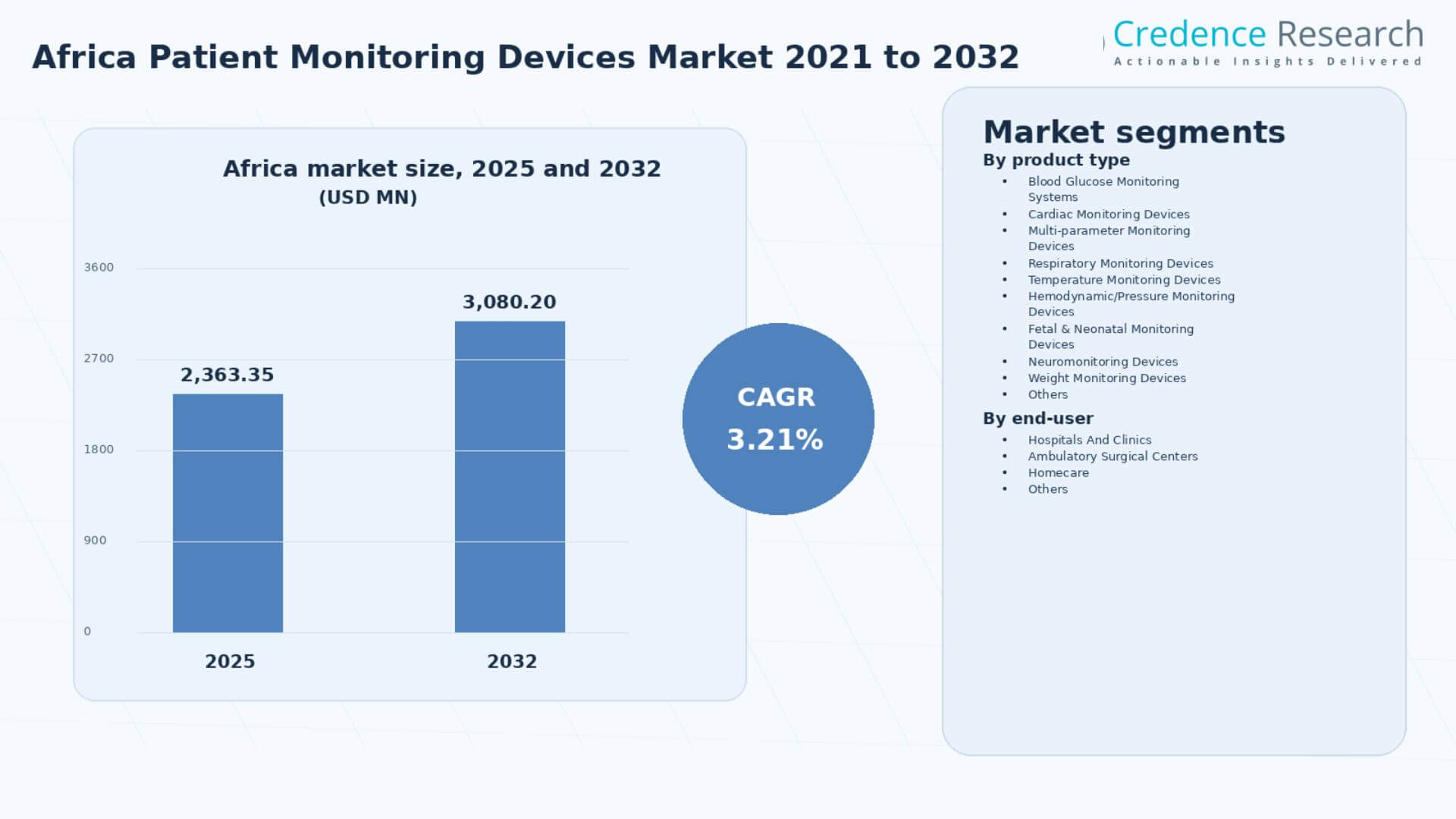
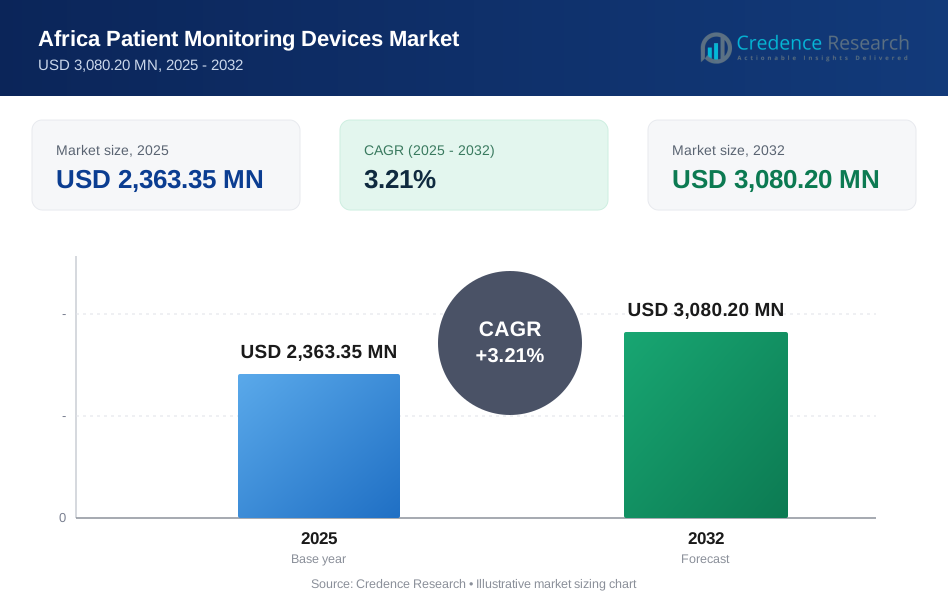
The Africa Patient Monitoring Devices Market size was valued at USD 2,046.71 MN in 2021 and reached USD 2,363.35 MN in 2025. It is anticipated to reach USD 3,080.20 MN by 2032, growing at a CAGR of 3.21% during the forecast period.
| REPORT ATTRIBUTE | DETAILS |
|---|---|
| Historical Period | 2021-2024 |
| Base Year | 2025 |
| Forecast Period | 2025-2032 |
| Africa Patient Monitoring Devices Market Size 2025 | USD 2,363.35 million |
| Africa Patient Monitoring Devices Market , CAGR | 3.21% |
| Africa Patient Monitoring Devices Market Size 2032 | USD 3,080.20 million |
Africa Patient Monitoring Devices Market Insights
- Market growth is supported by diabetes monitoring demand, hypertension and cardiovascular disease burden, maternal and neonatal care needs, respiratory monitoring requirements and hospital modernization.
- Blood Glucose Monitoring Systems hold a strong position because diabetes diagnosis, treatment adjustment and self-monitoring require recurring use of meters, sensors, lancets, strips and connected monitoring tools.
- Multi-parameter Monitoring Devices and Cardiac Monitoring Devices remain important because hospitals and clinics need continuous patient surveillance in emergency departments, ICUs, operating rooms and specialty wards.
- Hospitals And Clinics remain the leading end-user segment because most patient monitoring requires clinical oversight, trained staff, alarm response, documentation and integration with care workflows.
Africa Patient Monitoring Devices Market Segment Insights
By product type
By product type, Blood Glucose Monitoring Systems held a strong position in 2025 because diabetes care requires frequent measurement, home monitoring and clinician review. Cardiac Monitoring Devices are supported by hypertension, stroke risk, heart failure and perioperative monitoring needs. Multi-parameter Monitoring Devices remain essential in hospitals because they combine ECG, oxygen saturation, blood pressure, respiration and temperature monitoring in critical and acute care. Respiratory Monitoring Devices are gaining relevance due to oxygen therapy, pneumonia, neonatal care and emergency medicine. Temperature Monitoring Devices support infection screening, perioperative care and inpatient monitoring. Hemodynamic/Pressure Monitoring Devices support ICU care and surgery. Fetal & Neonatal Monitoring Devices address maternal and newborn health needs. Neuromonitoring Devices, Weight Monitoring Devices and Others support specialty care, chronic disease tracking and connected monitoring.
By end-user
By end-user, Hospitals And Clinics held the strongest position in 2025 because inpatient wards, operating rooms, emergency departments, ICUs, maternity units and neonatal units require continuous monitoring infrastructure. Ambulatory Surgical Centers generate demand for vital sign monitors, cardiac monitors, respiratory monitors and temperature monitoring devices during perioperative care. Homecare is expanding as chronic disease management, diabetes care, post-discharge follow-up and remote monitoring shift closer to patients. Others include long-term care facilities, emergency medical services, diagnostic centers, telehealth providers and community health programs. Growth will depend on equipment affordability, training, service support, consumables availability, reimbursement and digital connectivity.
Key Market Drivers
Diabetes burden and glucose monitoring demand
Diabetes burden and glucose monitoring demand represent major growth drivers for the Africa Patient Monitoring Devices Market. WHO reported that an estimated 54 million adults aged 18 and above had diabetes in the WHO African Region in 2022, with more than half undiagnosed and untreated. WHO also reported in 2025 that more than 24 million adults aged 20 to 79 were living with diabetes in the African Region, reinforcing the need for equitable and comprehensive diabetes care. This driver supports Blood Glucose Monitoring Systems, Homecare, Hospitals And Clinics and Specialty monitoring pathways. Growth will depend on screening coverage, meter affordability, strip availability, primary care integration and patient education.
Hypertension and cardiovascular monitoring needs
Hypertension and cardiovascular monitoring needs are strengthening demand for cardiac monitors, blood pressure devices, multi-parameter monitors and home-based monitoring. WHO’s 2025 global hypertension report highlights the urgent need to scale up detection, treatment and control of high blood pressure, especially at the primary health care level. WHO Africa also states that drug treatment of diabetes, hypertension and high blood lipids may be necessary to reduce cardiovascular risk and prevent heart attacks and strokes.
Respiratory monitoring and oxygen access priorities
Respiratory monitoring and oxygen access priorities support demand for pulse oximeters, respiratory monitors, multi-parameter monitors and hospital monitoring systems. WHO states that all levels of the health system require oxygen and pulse oximeters to monitor oxygen saturation in patients. WHO also identifies pulse oximetry as the most accurate non-invasive method for detecting hypoxaemia and calls a pulse oximeter an essential medical device for monitoring and patient safety.
Maternal and neonatal monitoring demand
Maternal and neonatal monitoring demand supports fetal monitors, neonatal monitors, temperature monitoring devices, respiratory monitoring and multi-parameter systems. WHO Africa reported that although stillbirth and neonatal mortality rates declined between 2000 and 2023, sub-Saharan Africa still accounted for 47% of stillbirths and 46% of global newborn deaths. This clinical burden supports Fetal & Neonatal Monitoring Devices, Temperature Monitoring Devices, Respiratory Monitoring Devices and Hospitals And Clinics. Demand will rise as maternity units, neonatal intensive care units and referral hospitals invest in monitoring equipment, trained staff and neonatal emergency care.
Hospital monitoring modernization and connected care platforms
Hospital monitoring modernization and connected care platforms are improving demand for multi-parameter monitors, central stations, mobile monitors and clinical information systems. GE HealthCare’s 2025 annual filing said its patient monitoring portfolio ranges from spot-check to continuous monitoring and includes comprehensive multi-parameter monitors, central stations, wearable and mobile monitors, transport monitors, cardiac telemetry and care team collaboration solutions. Philips’ 2025 annual filing described Connected Care as including hospital patient monitoring, ambulatory monitoring, enterprise informatics and sleep and respiratory care.
Key Trends and Opportunities
Homecare monitoring expands chronic disease management
Homecare monitoring is expanding as diabetes, hypertension, obesity, heart disease and respiratory conditions require frequent tracking outside hospitals. Blood Glucose Monitoring Systems, Weight Monitoring Devices, Cardiac Monitoring Devices and Respiratory Monitoring Devices can support early warning, patient self-management and remote clinician review. WHO’s diabetes technology report highlights the importance of availability and affordability of blood glucose meters, test strips, lancets, blood pressure measurement devices and glycated haemoglobin analysers for diabetes management. Homecare growth will depend on affordability, patient education, mobile connectivity, consumable supply and primary care follow-up.
Multi-parameter monitors become central to hospital capacity
Multi-parameter monitors are becoming central to hospital capacity because ICUs, emergency departments, operating rooms and inpatient wards need continuous monitoring of ECG, oxygen saturation, blood pressure, respiration and temperature. These systems reduce the need for separate single-parameter equipment and support faster clinical response. GE HealthCare reported that its Patient Monitoring business includes proprietary parameters, complementary consumables and OEM parameters integrated into its monitoring fleet, creating recurring revenue streams.
Neonatal and obstetric monitoring gains policy relevance
Neonatal and obstetric monitoring is gaining policy relevance because maternal and newborn survival remains a high-priority health objective across Africa. Fetal & Neonatal Monitoring Devices, respiratory monitors, temperature monitors and multi-parameter monitors are needed in maternity wards, delivery rooms and neonatal units. WHO Africa’s 2025 maternal and newborn mortality update underlines slow progress and the need for stronger investment in maternal and newborn health. Vendors with rugged devices, battery backup, training programs and local service support can gain stronger adoption in public hospitals and referral centers.
Connected monitoring and telemetry improve workflow
Connected monitoring and telemetry are improving clinical workflow by allowing care teams to view patient status across wards, step-down units and mobile care settings. Dräger’s 2025 annual report said the company launched the Dräger Vista T100, a portable telemetry monitor for reliable continuous monitoring of mobile patients, and expanded the functions of its Infinity Acute Care System patient monitoring platform. This trend supports Cardiac Monitoring Devices, Multi-parameter Monitoring Devices, Respiratory Monitoring Devices and hospital digitalization. Adoption will depend on network infrastructure, training, cybersecurity and service reliability.
Key Market Challenges
Affordability and procurement constraints
Affordability and procurement constraints remain major challenges for the Africa Patient Monitoring Devices Market. Patient monitors, telemetry systems, neonatal monitors, glucose monitoring supplies and respiratory monitoring devices require upfront capital, recurring consumables, maintenance and staff training. Public hospitals may face delayed tenders and budget pressure, while smaller clinics may prioritize basic devices over connected monitoring platforms. Homecare adoption can also be limited when patients must pay for glucose strips, batteries, sensors and device replacements. Vendors must offer value-tier systems, financing models, local service and reliable consumable supply.
Limited biomedical engineering and maintenance capacity
Limited biomedical engineering and maintenance capacity can restrict equipment uptime. Patient monitoring systems require installation, calibration, software updates, spare parts and preventive maintenance. When service networks are weak, hospitals may have installed monitors that are underused or out of service. This challenge is especially relevant outside major cities, where technical support and replacement parts may be limited. Manufacturers and distributors must build local engineer networks, training programs, spare-parts inventory and preventive maintenance contracts.
Workforce training and alarm response gaps
Workforce training and alarm response gaps affect patient safety and device utilization. Monitoring devices generate continuous data, alarms and clinical signals that require trained nurses, physicians and technicians. Poor alarm management can create fatigue, while insufficient training can lead to missed deterioration, incorrect readings or inconsistent documentation. Hospitals and clinics need standard protocols for glucose monitoring, ECG monitoring, pulse oximetry, neonatal monitoring and multi-parameter surveillance. Suppliers that provide clinical education, onboarding and workflow support will improve adoption.
Connectivity and data integration limitations
Connectivity and data integration limitations slow adoption of advanced patient monitoring platforms. Central monitoring, telemetry, remote monitoring and digital dashboards require reliable networks, cybersecurity controls, health information systems and interoperability. Many facilities still operate with fragmented records and limited IT support. These constraints affect Multi-parameter Monitoring Devices, Cardiac Monitoring Devices, Homecare and connected hospital platforms. Adoption will depend on digital infrastructure, vendor integration support, training and hospital investment in informatics.
Regional Analysis
South Africa
South Africa leads the Africa Patient Monitoring Devices Market due to stronger hospital infrastructure, private health care investment, specialist capacity and broader access to advanced monitoring equipment. Hospitals And Clinics dominate demand for multi-parameter monitors, cardiac monitors, respiratory monitoring devices, fetal and neonatal monitors and glucose monitoring systems. Homecare is gaining relevance through chronic disease monitoring and post-discharge care. Growth will depend on private hospital upgrades, public procurement, diabetes care, ICU capacity, device replacement cycles and service availability.
Egypt
Egypt represents a major growth market due to its large population, public hospital network, private hospital expansion and rising chronic disease burden. Blood Glucose Monitoring Systems, Cardiac Monitoring Devices, Multi-parameter Monitoring Devices and Respiratory Monitoring Devices are key demand areas. Hospitals And Clinics remain the leading end users, while Homecare has long-term potential through diabetes and hypertension monitoring. Growth will depend on public procurement, distributor reach, affordability, physician adoption, consumable availability and device maintenance.
Nigeria
Nigeria offers long-term growth potential due to large unmet monitoring needs, diabetes and hypertension burden, neonatal care needs and private hospital expansion. Demand is strongest in urban hospitals and clinics, where multi-parameter monitors, cardiac monitors and respiratory monitoring devices support acute care and surgical capacity. Homecare adoption is growing slowly due to affordability barriers and uneven access to connected health services. Growth will depend on insurance expansion, public-private partnerships, primary care strengthening and biomedical engineering support.
Kenya
Kenya is an emerging market supported by referral hospitals, private health care investment, maternal and newborn health programs and chronic disease monitoring needs. Hospitals And Clinics generate demand for multi-parameter monitors, fetal and neonatal monitors, blood glucose monitoring systems and respiratory monitoring devices. Homecare can expand through diabetes, blood pressure and post-discharge monitoring. Growth will depend on county-level investment, equipment financing, technical support, clinician training and digital health integration.
Rest of Africa
Rest of Africa includes markets with varied hospital infrastructure, monitoring access, procurement capacity and service coverage. Countries with stronger tertiary hospitals and private health systems will adopt connected monitoring faster, while lower-resource settings will prioritize essential monitoring such as pulse oximetry, blood glucose meters, blood pressure monitors, thermometers and basic multi-parameter monitors. WHO’s oxygen guidance emphasizes that all health system levels require oxygen and pulse oximeters, reinforcing the importance of essential monitoring access. Long-term growth will depend on donor support, national procurement, workforce training, local distribution and maintenance capacity.
Report Attribute Details
| Report Attribute | Details |
| Historical Period | 2021–2024 |
| Base Year | 2025 |
| Forecast Period | 2025–2032 |
| Market Size in 2021 | USD 2,046.71 MN |
| Market Size in 2025 | USD 2,363.35 MN |
| Market Size in 2032 | USD 3,080.20 MN |
| CAGR | 3.21% |
| Segments Covered | Product Type, End-User and Geography |
| Key Companies Covered | NemoCare Wellness, Narang Medical, Medtronic plc, GE Healthcare, Philips Healthcare, Nihon Kohden Corporation, Abbott Laboratories, Minday Medical International Ltd, Drägerwerk AG & Co. KGaA, Welch Allyn and Natus Medical |
Africa Patient Monitoring Devices Market Segmentations
By Product Type
- Blood Glucose Monitoring Systems
- Cardiac Monitoring Devices
- Multi-parameter Monitoring Devices
- Respiratory Monitoring Devices
- Temperature Monitoring Devices
- Hemodynamic/Pressure Monitoring Devices
- Fetal & Neonatal Monitoring Devices
- Neuromonitoring Devices
- Weight Monitoring Devices
- Others
By End-User
- Hospitals And Clinics
- Ambulatory Surgical Centers
- Homecare
- Others
Key players
- NemoCare Wellness
- Narang Medical
- Medtronic plc
- GE Healthcare
- Philips Healthcare
- Nihon Kohden Corporation
- Abbott Laboratories
- Minday Medical International Ltd
- Drägerwerk AG & Co. KGaA
- Welch Allyn
- Natus Medical
Recent Developments
- In 2025, Abbott reported that sales of its continuous glucose monitoring systems totaled USD 7.6 billion, compared with USD 6.4 billion in 2024, supporting growth in connected glucose monitoring.
- In 2025, GE HealthCare reported that its patient monitoring portfolio includes spot-check, continuous, multi-parameter, central station, wearable, mobile, transport and cardiac telemetry monitoring solutions.
- In 2025, Philips reported that Connected Care includes hospital patient monitoring, ambulatory monitoring, enterprise informatics and sleep and respiratory care.
- In 2025, Dräger launched the Dräger Vista T100 portable telemetry monitor and expanded the functions of its Infinity Acute Care System patient monitoring platform.
- In FY2025, Nihon Kohden reported that its patient monitor category includes central monitors, bedside monitors, wireless monitors, remote access software, clinical information systems and related consumables such as electrodes and sensors.
Report Coverage
The research report offers an in-depth analysis based on product type, end-user and geography. It details leading market players, providing an overview of their business positioning, patient monitoring device portfolios, blood glucose monitoring systems, cardiac monitoring devices, multi-parameter monitors, respiratory monitoring devices, temperature monitors, hemodynamic monitoring systems, fetal and neonatal monitors, neuromonitoring systems, weight monitoring devices, connected monitoring platforms and strategic relevance in the Africa Patient Monitoring Devices Market. The report includes insights into the competitive environment, market trends, growth drivers, restraints and opportunities. It also examines diabetes burden, hypertension care, oxygen and respiratory monitoring, neonatal survival needs, hospital modernization, homecare monitoring, telemetry adoption, equipment maintenance and workforce training as major factors shaping market development. The report assesses the impact of affordability constraints, procurement delays, limited biomedical engineering capacity, alarm response gaps, connectivity limitations and consumable availability on market growth. It provides strategic recommendations for patient monitoring device manufacturers, hospitals, clinics, ASCs, homecare providers, distributors, procurement agencies, investors and new entrants seeking to navigate Africa’s patient monitoring device ecosystem.
Future Outlook
- Demand for patient monitoring devices will continue to rise as African health systems expand chronic disease care, emergency monitoring and hospital capacity.
- Blood Glucose Monitoring Systems will remain a major product category due to diabetes burden and the need for regular self-monitoring.
- Cardiac Monitoring Devices will gain demand through hypertension, cardiovascular risk tracking, ICU care and perioperative monitoring.
- Multi-parameter Monitoring Devices will remain essential in ICUs, emergency departments, operating rooms and inpatient wards.
- Respiratory Monitoring Devices will grow through oxygen access programs, pneumonia care, critical care and neonatal respiratory support.
- Fetal & Neonatal Monitoring Devices will gain importance as countries strengthen maternal and newborn care.
- Homecare will expand gradually as patients use monitoring devices for diabetes, blood pressure, weight and post-discharge follow-up.
- Hospitals And Clinics will remain the leading end-user segment due to patient acuity, procedure volume and clinical oversight needs.
- Connected monitoring, telemetry and central stations will gain adoption in advanced hospitals and private networks.
- Competition will increase as companies compete on affordability, accuracy, durability, battery life, consumable availability, service support and connectivity.
Request a Free Sample
Fill in your details and we'll send you a free sample report.
- Sample data tables & charts
- Research methodology
Need a Custom Version of This Report?
Tailor the scope, geography, or segments to your exact requirements.
- Custom geography or segment scope
- Direct access to our analyst team
Frequently Asked Questions
What is the current market size for the Africa Patient Monitoring Devices Market and what is its projected size in 2032?
At what CAGR is the Africa Patient Monitoring Devices Market projected to grow?
Which product type segment is expected to hold strong demand?
Which hospital monitoring segment remains important?
Which end-user segment leads the market?
Who are the leading companies in the market?
Which countries are important in the Africa market?
Table of Content
Chapter 1. Report Introduction
- 1.1 Report Description & Purpose
- 1.1.1 Report Title & Market Definition
- 1.1.2 Unique Selling Propositions (USP) & Key Differentiators
- 1.1.3 Value Proposition for Stakeholders
- 1.2 Research Objectives
- 1.2.1 Market Sizing Objectives (Volume & Revenue) (Volume Where Applicable)
- 1.2.2 Segmentation Objectives
- 1.2.3 Competitive Intelligence Objectives
- 1.2.4 Forecast & Scenario Objectives
- 1.3 Report Scope
- 1.3.1 Africa Patient Monitoring Devices Scope – Segments & Subsegments Covered
- 1.3.2 Geographic Scope – Regions & Countries Covered
- 1.3.3 Historical Period, Base Year & Forecast Period (2025; forecast to 2032)
- 1.3.4 Inclusions & Exclusions
- 1.4 Industry Classification & Applicable Codes
- 1.5 Currency, Measurement Units & Valuation Basis
- 1.6 Target Stakeholders
- 1.7 Limitations & Assumptions
Chapter 2. Executive Summary
- 2.1 Global Africa Patient Monitoring Devices Market Snapshot
- 2.1.1 Market Size – Historical (2025) & Forecast (2025-2032) (2025: USD 2,363.35 MN → 2032: USD 3,080.20 MN)
- 2.1.2 Volume & Revenue – Global Totals (Volume Where Applicable)
- 2.1.3 Key Market Highlights – Top Five Facts
- 2.2 Africa Patient Monitoring Devices Market Segmentation Snapshot
- 2.2.1 Market Split by Region – 2025 vs. 2032
- 2.3 Competitive Snapshot
- 2.3.1 Top 10 Players by Revenue Share – 2025
- 2.3.2 Top 10 Players by Volume Share – 2025 (Volume Where Applicable)
- 2.3.3 Recent Strategic Developments (18-Month Summary)
- 2.4 Key Investment Highlights & Strategic Conclusions
Chapter 3. Africa Patient Monitoring Devices Market Dynamics & Industry Analysis
- 3.1 Market Overview & Context
- 3.1.1 Africa Patient Monitoring Devices Market Position in the Broader Industry Value Chain
- 3.1.2 Demand Structure & Purchasing Dynamics
- 3.1.3 Market Maturity & Development Stage by Region
- 3.2 Africa Patient Monitoring Devices Market Drivers
- 3.3 Africa Patient Monitoring Devices Market Restraints & Challenges
- 3.4 Africa Patient Monitoring Devices Market Opportunities
- 3.5 Porter's Five Forces Analysis
- 3.5.1 Threat of New Entrants
- 3.5.2 Bargaining Power of Suppliers
- 3.5.3 Bargaining Power of Buyers
- 3.5.4 Threat of Substitutes
- 3.5.5 Competitive Rivalry – Intensity Assessment
- 3.6 Africa Patient Monitoring Devices Value Chain Analysis
- 3.6.1 Upstream – Key Inputs, Resources & Suppliers
- 3.6.1.1 Key Input/Resource 1
- 3.6.1.2 Key Input/Resource 2
- 3.6.1.3 Key Input/Resource 3
- 3.6.2 Midstream – Core Operations & Value Creation
- 3.6.2.1 Operating Model & Process Overview
- 3.6.2.2 Key Operating Locations & Capabilities by Company
- 3.6.3 Downstream – Market Channels & End Users
- 3.6.3.1 Direct Sales & Customer Engagement Channels
- 3.6.3.2 Indirect Sales, Intermediaries & Partner Channels
- 3.6.4 Value Chain Profitability Analysis
- 3.6.1 Upstream – Key Inputs, Resources & Suppliers
- 3.7 PESTEL Analysis
- 3.7.1 Political Factors
- 3.7.2 Economic Factors
- 3.7.3 Social Factors
- 3.7.4 Technological Factors
- 3.7.5 Environmental Factors
- 3.7.6 Legal Factors
- 3.8 Africa Patient Monitoring Devices Supply Chain Analysis
- 3.8.1 Critical Input & Resource Availability Risk Assessment
- 3.8.2 Supplier & Operational Concentration Risk (Geographic Exposure)
- 3.8.3 Supply & Service Disruption Impact Analysis
- 3.9 Regulatory & Policy Landscape
Note: The regulatory and policy landscape section covers regulations based on their applicability to the market, Africa Patient Monitoring Devices category, geography, and scope of the study. Only regulatory frameworks with a material impact on operations, compliance, trade, sustainability, or market access are analyzed in detail.
Chapter 4. Key Investment Pockets & Opportunity Analysis
- 4.1 Africa Patient Monitoring Devices Market Attractiveness Analysis
- 4.1.1 By Region – Investment Attractiveness Matrix (Market Size × CAGR)
- 4.2 Absolute Revenue Growth Opportunity
- 4.2.1 By Region – Absolute Revenue Growth Through 2032
- 4.3 Incremental Demand Opportunity
- 4.3.1 By Region – Incremental Demand Through 2032
- 4.3.2 Segment – Incremental Demand
- 4.4 Emerging Submarket Opportunity Deep Dive (Subject to Applicability)
- 4.5 Priority Market Opportunity Scorecards
- 4.5.1 United States
- 4.5.2 Europe
- 4.5.3 Asia
- 4.5.4 Middle East & Africa
Note: Priority market opportunity scorecards reflect the geographic scope and strategic relevance of the study. Listed markets are indicative and may be adapted to the industry.
Chapter 5. Africa Patient Monitoring Devices Cross-Border Trade & Market Access Analysis
- 5.1 International Trade & Cross-Border Activity Overview
- 5.1.1 Global Export Value by Country (2025)
- 5.1.2 Global Export Volume by Country (2025) (Volume Where Applicable)
- 5.1.3 Global Import Value by Country (2025)
- 5.1.4 Global Import Volume by Country (2025) (Volume Where Applicable)
- 5.1.5 Net Trade Balance by Country (2025)
- 5.2 Export Analysis – Segment
- 5.2.1 Category 1 (Applicable Classification Code)
- 5.2.2 Category 2 (Applicable Classification Code)
- 5.2.3 Category 3 (Applicable Classification Code)
- 5.2.4 Category 4 (Applicable Classification Code)
- 5.2.5 Category 5 (Applicable Classification Code)
- 5.3 Import Analysis – Segment
- 5.3.1 Category 1 (Applicable Classification Code)
- 5.3.2 Category 2 (Applicable Classification Code)
- 5.3.3 Category 3 (Applicable Classification Code)
- 5.3.4 Category 4 (Applicable Classification Code)
- 5.3.5 Category 5 (Applicable Classification Code)
- 5.4 Cross-Border Pricing & Transaction Benchmarks
- 5.4.1 Export Pricing – Segment & Country
- 5.4.2 Import Pricing – Segment & Source Country
- 5.4.3 Price Trends (2025)
- 5.5 Key Cross-Border Trade & Delivery Routes
- 5.5.1 Cross-Border Trade/Delivery Route 1
- 5.5.2 Cross-Border Trade/Delivery Route 2
- 5.5.3 Cross-Border Trade/Delivery Route 3
- 5.5.4 Cross-Border Trade/Delivery Route 4
- 5.5.5 Cross-Border Trade/Delivery Route 5
- 5.6 Trade Policy & Market Access Impact Assessment
- 5.6.1 Tariff & Non-Tariff Barriers
- 5.6.2 Regional Trade & Economic Integration Frameworks
- 5.6.3 Bilateral & Multilateral Trade Agreements
- 5.6.4 Cross-Border Operating, Licensing & Localization Requirements
Note: This chapter applies where cross-border trade or delivery is relevant to Africa Patient Monitoring Devices. Goods, services, and digital offerings are assessed using applicable classifications and transaction measures. Import-export volumes, trade balances, and route analyses are included only where meaningful to the market.
Chapter 6. Competitive Landscape & Company Benchmarking
- 6.1 Africa Patient Monitoring Devices Market Concentration & Structure
- 6.1.1 Herfindahl-Hirschman Index (HHI) – vs. 2025
- 6.1.2 Leading, Mid-Sized & Emerging Player Structure
- 6.1.3 Global, Regional & Local Player Dynamics
- 6.2 Africa Patient Monitoring Devices Market Share Analysis – 2025
- 6.2.1 Global Revenue Share by Company
- 6.2.2 Global Volume Share by Company (Volume Where Applicable)
- 6.2.3 Regional Revenue Share
- 6.2.4 Market Share Evolution ( vs. 2025)
- 6.2.5 Company Market Share by Key Segment
- 6.2.6 Company Market Share by Customer Group
- 6.3 Operating Scale, Capacity & Infrastructure Analysis
- 6.3.1 Global Operating Scale & Supply Capacity
- 6.3.2 Resource Utilization & Operating Efficiency
- 6.3.3 Output, Service Delivery & Activity Metrics
- 6.3.4 Operating Footprint & Infrastructure Map
- 6.3.5 Planned Operational & Capacity Expansion
- 6.4 Africa Patient Monitoring Devices Competitive Benchmarking Matrix
- 6.4.1 Revenue, Growth, Profitability & Operating Metric Comparison
- 6.4.2 Channel Revenue Mix
- 6.4.3 Geographic Revenue Exposure
- 6.4.4 R&D Intensity
- 6.4.5 Sustainability Maturity
- 6.5 Strategic Developments in Africa Patient Monitoring Devices (Last 24 Months)
- 6.5.1 Mergers, Acquisitions & Divestments
- 6.5.2 New Products, Services & Solutions in Africa Patient Monitoring Devices
- 6.5.3 Operational & Infrastructure Expansions
- 6.5.4 Strategic Alliances, Joint Ventures & Partnerships
- 6.5.5 Distribution Expansion & Market Entry
- 6.5.6 Sustainability & ESG Initiatives
- 6.6 Competitive Strategy Mapping
- 6.6.1 Leader, Challenger, Follower & Niche Classification
- 6.6.2 Pricing Strategy Comparison
- 6.6.3 Channel Strategy Matrix
Note: Strategic developments are included based on their materiality and the availability of reliable information.
Chapter 7. Global Africa Patient Monitoring Devices Market – By Sales & Delivery Channel
- 7.1 Segment Overview
- 7.1.1 Volume & Revenue Split by Channel (2025 & 2032) (Volume Where Applicable)
- 7.1.2 Channel Mix Evolution (2025-2032)
Chapter 8. Regional Market Analysis – Global Overview
- 8.1 Global Regional Overview
- 8.1.1 Regional Volume Share (Volume Where Applicable)
- 8.1.2 Regional Revenue Share
- 8.1.3 Regional Volume by Region (Volume Where Applicable)
- 8.1.4 Regional Revenue by Region
- 8.1.5 Regional Forecast Through 2032
- 8.2 Cross-Regional Segment Analysis
- 8.2.1 By Sales & Delivery Channel
- 8.2.2 By Competitive Positioning & Price Tier
Chapter 9. North America Africa Patient Monitoring Devices Market
- 9.1 United States
- 9.2 Canada
- 9.3 Mexico
Chapter 10. Europe Africa Patient Monitoring Devices Market
- 10.1 Germany
- 10.2 France
- 10.3 Italy
- 10.4 United Kingdom
- 10.5 Spain
- 10.6 Poland
- 10.7 Russia
- 10.8 Netherlands
- 10.9 Belgium
- 10.10 Sweden
- 10.11 Denmark
- 10.12 Norway
- 10.13 Rest of Europe
Chapter 11. Asia Pacific Africa Patient Monitoring Devices Market
- 11.1 China
- 11.2 India
- 11.3 Japan
- 11.4 South Korea
- 11.5 Thailand
- 11.6 Indonesia
- 11.7 Vietnam
- 11.8 Malaysia
- 11.9 Australia
- 11.10 Rest of Asia Pacific
Chapter 12. Latin America Africa Patient Monitoring Devices Market
- 12.1 Brazil
- 12.2 Argentina
- 12.3 Colombia
- 12.4 Chile
- 12.5 Rest of Latin America
Chapter 13. Middle East Africa Patient Monitoring Devices Market
- 13.1 Saudi Arabia
- 13.2 United Arab Emirates
- 13.3 Turkey
- 13.4 Israel
- 13.5 Iran
- 13.6 Rest of the Middle East
Chapter 14. Africa Africa Patient Monitoring Devices Market
- 14.1 South Africa
- 14.2 Egypt
- 14.3 Nigeria
- 14.4 Morocco
- 14.5 Rest of Africa
Chapter 15. Africa Patient Monitoring Devices Company Profiles
- 15.1 [Company 01]
- 15.1.1 Company Overview
- 15.1.2 Key Management Personnel
- 15.1.3 Products & Services Portfolio
- 15.1.4 Financial Performance
- 15.1.5 Key Market Focus & Geographic Presence
- 15.1.6 Recent Developments & Strategic Initiatives
Note: The company profile list is preliminary and may change based on research findings, market developments, data availability, and client requirements.
Chapter 16. Appendices
- Appendix A – List of Abbreviations & Acronyms
- Appendix B – Industry Classification Code Reference – Full Series
- Appendix C – Supply, Output & Operating Capacity Data Tables
- Appendix D – End-Use & Demand Base Tables
- Appendix E – Demand, Adoption & Usage Assumptions
- Appendix F – Pricing & Revenue Metric Reference Tables
- Appendix G – Company Operations & Infrastructure Database
- Appendix H – Cross-Border Trade & Activity Data Tables (Where Applicable)
- Appendix I – Regulatory Summary Tables
- Appendix J – Primary Research Participant List (Anonymized)
- Appendix K – Primary Research Questionnaire Framework
- Appendix L – Data Sources & Bibliography
- Appendix M – Market Size Divergence & Source Comparison
Chapter 17. Research Methodology
- 17.1 Research Framework & Philosophy
- 17.2 Secondary Research – Sources, Hierarchy & Data Extraction
- 17.3 Data Modeling – Bottom-Up & Top-Down Market Sizing
- 17.4 Primary Research – Stakeholder Framework, LOI & Sample Sizes
- 17.5 Forecast Methodology – Regression, Scenario & Sensitivity Analysis
- 17.6 Quality Control – Four-Layer Validation Framework
- 17.7 Limitations & Standard Assumptions
- 17.8 Disclaimer
