
Advanced Cardiovascular Life Support (ACLS) Market Overview:
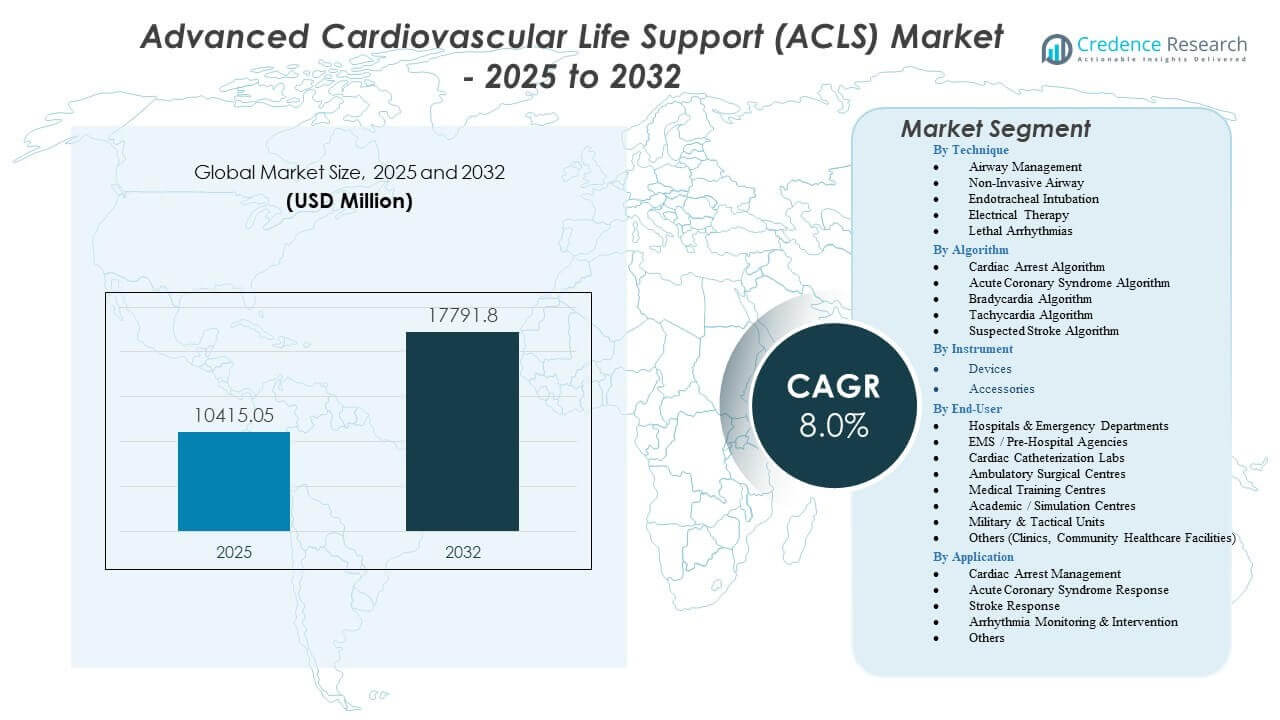
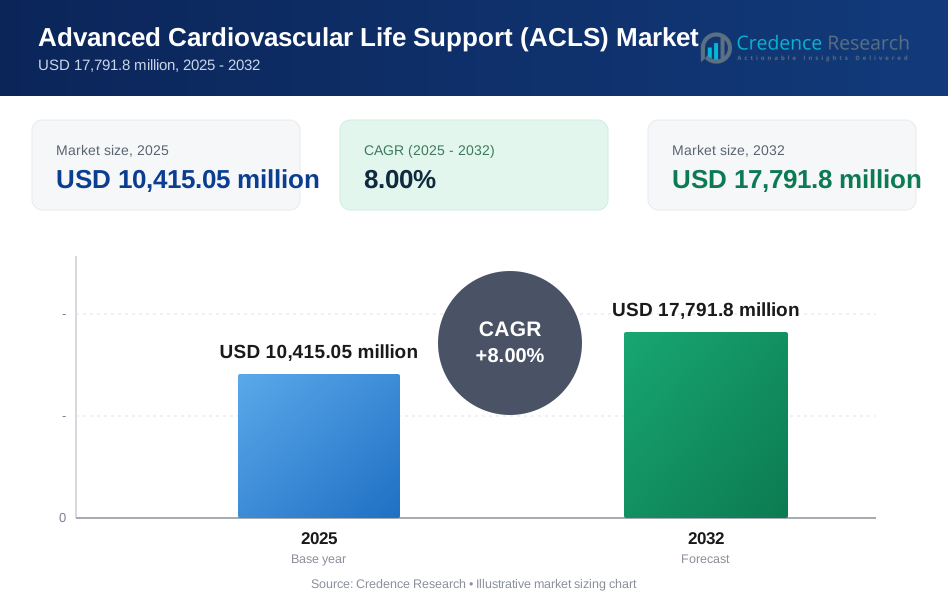
The Advanced Cardiovascular Life Support (ACLS) Market is projected to grow from USD 10,415.05 million in 2025 to an estimated USD 17,791.8 million by 2032, with a compound annual growth rate (CAGR) of 8.0% from 2025 to 2032.
| REPORT ATTRIBUTE | DETAILS |
|---|---|
| Historical Period | 2020-2023 |
| Base Year | 2024 |
| Forecast Period | 2025-2032 |
| Advanced Cardiovascular Life Support (ACLS) Market Size 2025 | USD 10,415.05 Million |
| Advanced Cardiovascular Life Support (ACLS) Market, CAGR | 8.0% |
| Advanced Cardiovascular Life Support (ACLS) Market Size 2032 | USD 17,791.8 Million |
Advanced Cardiovascular Life Support (ACLS) Market Insights:
- Rising demand for structured ACLS training, simulation systems, and protocol-driven intervention strengthens market momentum across hospitals and emergency units.
- Limited access to advanced training centers and high equipment costs continue to restrain adoption in low-resource healthcare environments.
- North America leads the market due to strong clinical standards and broad implementation of ACLS protocols, while Europe maintains stable growth supported by established training networks.
- Asia-Pacific emerges as the fastest-growing region fueled by expanding healthcare infrastructure and rising focus on improving emergency response capability.
Advanced Cardiovascular Life Support (ACLS) Market Drivers
Rising Cardiac Emergency Burden and Demand for Skilled Clinical Teams
The growing incidence of cardiac arrest cases strengthens demand for structured ACLS training programs. Healthcare providers seek advanced skills that improve survival outcomes in time-critical settings. The need for rapid rhythm interpretation and evidence-based protocols drives strong adoption. The Advanced Cardiovascular Life Support (ACLS) Market expands with hospitals updating resuscitation teams to meet guideline requirements. Many systems now prioritize standardized certification to improve workflow safety. Digital modules support flexible training access for busy clinical staff. Simulation platforms help reinforce decision-making under high pressure. It supports stronger readiness for both in-hospital and out-of-hospital cardiac events.
Greater Emphasis on Real-Time Clinical Decision Support and Protocol Accuracy
Demand rises for tools that guide clinicians through complex resuscitation steps with higher accuracy. Many hospitals adopt advanced algorithms to reduce errors during code events. Automated prompts help teams follow updated protocols without delay. The market benefits from investments in defibrillators and airway devices that enhance emergency preparedness. Integration of real-time data helps staff respond with precision. The Advanced Cardiovascular Life Support (ACLS) Market grows as organizations invest in improved emergency workflows. Hospitals seek seamless coordination between team members during lifesaving procedures. It supports consistent protocol delivery across varied care environments.
- For instance, ZOLL Medical Corporation’s Real CPR Help® technology provides real-time feedback on compression depth and rate, and clinical evaluations show it significantly improves the proportion of compressions delivered within guideline targets.
Growth in Simulation-Based Training and Technology-Enabled Skill Development
Simulation centers expand across hospitals, academic institutes, and emergency training programs. High-fidelity manikins help providers practice complex techniques safely. Many organizations adopt blended formats that combine digital lessons and hands-on sessions. These models improve retention of critical skills required during cardiac arrest. Rising demand for scalable platforms strengthens investments in virtual learning tools. The market benefits from training modules designed for team coordination. The Advanced Cardiovascular Life Support (ACLS) Market leverages technology to enhance confidence among clinicians. It supports standardized competence across diverse clinical teams.
- For instance, Laerdal Medical’s SimMan 3G PLUS supports advanced simulation of critical events such as airway obstruction, arrhythmias, and cardiac arrest, with real-time physiological responses that help clinical teams improve time-to-first-shock and overall code performance during controlled training sessions.
Regulatory Pressure and Frequent Revisions of Global Resuscitation Guidelines
Guideline authorities issue periodic updates that require workforce retraining. Hospitals respond by expanding their ACLS certification cycles. Many systems adopt structured programs to meet compliance expectations. Organizations also upgrade equipment to align with new clinical recommendations. The need for audit-ready certifications supports sustained training demand. Digital credentialing tools help simplify workforce tracking. The Advanced Cardiovascular Life Support (ACLS) Market grows with every update in emergency response protocols. It strengthens accountability and promotes better adherence to safety standards.
Advanced Cardiovascular Life Support (ACLS) Market Trends
Shift Toward Blended and Remote Learning Models Across Clinical Training Programs
Training centers adopt hybrid learning pathways to increase flexibility for clinicians. Online modules reduce time spent away from clinical duties. Remote assessments support continuous learning without burdening hospitals. Growth in cloud-based learning platforms enhances access in underserved regions. Many organizations prefer hybrid delivery to scale training capacity. The Advanced Cardiovascular Life Support (ACLS) Market benefits from digital adoption across healthcare systems. Simulation add-ons support practical skill refinement. It strengthens training consistency across varied locations.
Expansion of AI-Enhanced Resuscitation Tools and Smart Emergency Devices
AI integration supports faster rhythm assessment and improved protocol adherence. Many systems embed predictive analytics to optimize treatment decisions. Smart defibrillators guide providers with automated instructions. Connected devices collect performance data for post-event review. Hospitals adopt these tools to improve response times. Growth in AI-enabled emergency platforms elevates resuscitation quality. The Advanced Cardiovascular Life Support (ACLS) Market gains traction as hospitals modernize code-blue infrastructure. It aligns technology with frontline emergency workflows.
- For instance, Philips Healthcare integrated its IntelliVue Guardian Software with early warning scoring (EWS), enabling automated detection of patient deterioration through validated predictive algorithms that alert clinicians hours before a critical event.
Rising Institutional Focus on Team-Based Response Coordination and Performance Review
Hospitals now emphasize coordinated action during cardiac emergencies. Teams use structured debriefing tools to strengthen performance. Video-assisted review platforms support detailed analysis of response quality. Many providers implement continuous improvement programs to refine outcomes. This focus enhances clarity during high-pressure events. Demand rises for tools that support reproducible teamwork. The Advanced Cardiovascular Life Support (ACLS) Market expands with organizational focus on workflow optimization. It ensures consistent skill application across all shifts.
Growing Investment in Public Access Resuscitation Infrastructure and Community Training
Governments expand AED availability in public spaces. Community training programs help bystanders respond confidently during emergencies. Schools and workplaces adopt structured CPR and early-response courses. Public health campaigns elevate awareness of early intervention. Emergency networks strengthen their outreach to support quick action. This trend widens the ecosystem beyond clinical settings. The Advanced Cardiovascular Life Support (ACLS) Market benefits from broader engagement across society. It supports stronger survival chances for out-of-hospital cardiac arrests.
- For instance, Stryker’s HeartSine® samaritan® PAD devices use a single-cartridge Pad-Pak® system with a validated 4-year shelf life, reducing maintenance demands and supporting rapid readiness for public-access defibrillation programs.
Advanced Cardiovascular Life Support (ACLS) Market Challenges Analysis
High Skill Variability and Limited Training Access Across Clinical Environments
Many regions struggle with inconsistent access to advanced training centers. Workforce shortages create uneven skill levels across hospitals. Training delays can reduce competence among frontline teams. Some facilities lack modern simulation equipment required for complex skill development. This gap affects adherence to evolving guidelines. The Advanced Cardiovascular Life Support (ACLS) Market faces challenges when clinical staff cannot maintain proficiency. Certification costs also restrain participation in low-resource settings. It requires strategic investment to ensure uniform readiness.
Operational Barriers, Cost Pressures, and Resistance to Technology Integration
Organizations often face budget constraints when upgrading training infrastructure. Advanced manikins and digital systems require significant investment. Many staff express hesitation when shifting from traditional classroom models to digital formats. Time limitations reduce participation in extended programs. Integration of analytics and smart devices demands new workflows that may disrupt routine operations. Hospitals also face challenges aligning training schedules with shift demands. The Advanced Cardiovascular Life Support (ACLS) Market must address these barriers to achieve broader adoption. It needs streamlined solutions that support practical implementation.
Advanced Cardiovascular Life Support (ACLS) Market Opportunities
Expansion of Digital Learning Ecosystems and Scalable Simulation Platforms
Growth in virtual simulation opens strong opportunities for cost-effective training. Remote modules help hospitals train large teams without disrupting clinical operations. AI-assisted feedback tools improve skill accuracy during practice. Many regions with limited instructors can adopt digital systems to close training gaps. Vendors can introduce modular platforms adaptable to various clinical skill levels. The Advanced Cardiovascular Life Support (ACLS) Market gains opportunities through technology tailored for global scalability. It supports flexible certification pathways that enhance workforce competence.
Global Push Toward Strengthening Emergency Response Networks and Public Health Capacity
Governments and health systems invest in broader emergency preparedness programs. Expansion of AED networks increases public awareness of resuscitation skills. Hospitals adopt integrated command systems to improve response coordination. Growth in cardiac care units boosts demand for ACLS-ready teams. Rising focus on improving survival rates elevates the need for standardized protocols. Vendors can collaborate with training centers to expand certification outreach. The Advanced Cardiovascular Life Support (ACLS) Market benefits from initiatives that promote early intervention. It strengthens adoption across emerging and developed regions.
Advanced Cardiovascular Life Support (ACLS) Market Segmentation Analysis:
By Technique
The Advanced Cardiovascular Life Support (ACLS) Market strengthens demand for airway management methods that guide clinicians through rapid stabilization. Airway Management supports oxygen delivery in critical events. Non-Invasive Airway tools help providers keep ventilation steady with minimal effort. Endotracheal Intubation supports controlled breathing during high-risk episodes. Electrical Therapy drives rhythm correction in urgent care. Lethal Arrhythmias require structured steps that improve clinical accuracy. It supports consistent intervention across complex scenarios.
- For instance, Medtronic’s McGRATH™ MAC video laryngoscope has demonstrated higher first-pass intubation success rates compared with traditional direct laryngoscopy across multiple clinical studies, helping teams achieve faster airway stabilization during emergency scenarios.
By Algorithm
The Advanced Cardiovascular Life Support (ACLS) Market aligns closely with algorithms that direct time-sensitive care. Cardiac Arrest Algorithm guides early shock decisions. Acute Coronary Syndrome Algorithm supports swift assessment of evolving symptoms. Bradycardia and Tachycardia Algorithms help providers correct rhythm instability. Suspected Stroke Algorithm directs rapid evaluation for neurological risk. It improves decision flow and promotes uniform care quality.
- For instance, GE HealthCare’s Marquette™ 12SL™ ECG analysis program applies validated clinical algorithms to identify ischemic patterns and ST-segment abnormalities, enabling clinicians to activate the ACS algorithm much earlier during patient assessment.
By Instrument
The Advanced Cardiovascular Life Support (ACLS) Market relies on instruments that strengthen frontline readiness. Devices such as defibrillators, ECG systems and airway tools support direct emergency action. Accessories extend usability through masks, tubing and training components. These tools improve response coordination across diverse care environments. It enhances the reliability of resuscitation workflows.
By End-User
The Advanced Cardiovascular Life Support (ACLS) Market sees strong use within hospitals and emergency departments where high acuity drives protocol adoption. EMS teams apply structured steps during transport. Catheterization labs use ACLS support during invasive cardiac procedures. Ambulatory centres, training institutes, military units and clinics invest in workforce readiness. It supports broad operational coverage.
By Application
The Advanced Cardiovascular Life Support (ACLS) Market spans cardiac arrest management, acute coronary response and stroke care. Arrhythmia monitoring supports continuous oversight across critical units. Other uses support education and skill reinforcement. It guides providers through essential interventions that support better outcomes.
Segmentation:
By Technique
- Airway Management
- Non-Invasive Airway
- Endotracheal Intubation
- Electrical Therapy
- Lethal Arrhythmias
By Algorithm
- Cardiac Arrest Algorithm
- Acute Coronary Syndrome Algorithm
- Bradycardia Algorithm
- Tachycardia Algorithm
- Suspected Stroke Algorithm
By Instrument
- Devices
- Accessories
By End-User
- Hospitals & Emergency Departments
- EMS / Pre-Hospital Agencies
- Cardiac Catheterization Labs
- Ambulatory Surgical Centres
- Medical Training Centres
- Academic / Simulation Centres
- Military & Tactical Units
- Others (Clinics, Community Healthcare Facilities)
By Application
- Cardiac Arrest Management
- Acute Coronary Syndrome Response
- Stroke Response
- Arrhythmia Monitoring & Intervention
- Others
By Region
- North America
- U.S.
- Canada
- Mexico
- Europe
- Germany
- France
- U.K.
- Italy
- Spain
- Rest of Europe
- Asia Pacific
- China
- Japan
- India
- South Korea
- South-east Asia
- Rest of Asia Pacific
- Latin America
- Brazil
- Argentina
- Rest of Latin America
- Middle East & Africa
- GCC Countries
- South Africa
- Rest of the Middle East and Africa
Regional Analysis:
The Advanced Cardiovascular Life Support (ACLS) Market in North America holds the largest market share, driven by established healthcare infrastructure and mandatory training standards. Hospitals and emergency networks in the United States and Canada continually update protocols, which supports ongoing demand for advanced training and devices. It benefits from strong reimbursement frameworks that encourage adoption of advanced resuscitation tools. European markets follow with significant share due to broad guideline implementation and skilled clinical workforces in Germany, the UK, and France. Providers in Europe focus on standardized care paths that strengthen market uptake. It encourages investment in both training systems and emergency devices.
In the Asia-Pacific region, growth accelerates with expanding hospital networks and rising cardiovascular disease burden. Countries such as China and India allocate resources to upgrade emergency response capabilities and training access. It increases demand for systems that support protocol-driven care. Latin America shows moderate share with growing focus on improving emergency readiness in urban centers. Healthcare agencies in Brazil and Mexico improve structured resuscitation efforts to reduce mortality rates. It generates opportunities for vendors to expand footprint.
The Middle East & Africa hold a smaller share but show emerging potential with healthcare modernization plans. Gulf Cooperation Council countries invest in advanced clinical training and emergency facilities. South Africa and Nigeria advance resuscitation readiness through partnerships and external training programs. It fosters interest in digital and simulation-based ACLS solutions. Regional growth reflects improving clinical frameworks and rising focus on critical care outcomes.
Key Player Analysis:
- Medtronic
- Philips Healthcare (Koninklijke Philips N.V.)
- ZOLL Medical Corporation
- Stryker Corporation (including Physio-Control)
- GE Healthcare (General Electric)
- Abbott Laboratories
- Laerdal Medical
- Cardiac Science Corporation
- Nihon Kohden Corporation
- Mindray Medical International Limited
- Michigan Instruments
- Asahi Kasei Corporation
- Boston Scientific Corporation
- Novartis AG
- GlaxoSmithKline plc
Competitive Analysis:
The Advanced Cardiovascular Life Support (ACLS) Market features several key players that drive innovation and expand global reach. Leading companies such as ZOLL Medical Corporation, Stryker Corporation, and Philips Healthcare focus on broad portfolios that include defibrillators, training platforms, and diagnostic tools. It benefits from their strong distribution networks and service support across hospitals and emergency care providers. Major players differentiate through product upgrades, certification programs, and alliances with training bodies. It enhances their ability to respond to evolving clinical guidelines and customer needs. Other competitors invest in digital solutions and simulation systems to improve user engagement and skill retention. It promotes competitive dynamics that strengthen accessibility to standardized ACLS protocols across regions. Emerging companies focus on niche segments such as AI-enhanced devices and remote training solutions to capture targeted demand. It pushes legacy providers to adapt with technology-backed offerings. Competitive positioning reflects a balance between established brand trust and new entrants that offer specialized tools. Pricing strategies and service reliability remain key differentiators in the market.
Recent Developments:
- In January 2026, Emergency Care Holdings completed the acquisition of Philips Emergency Care business, rebranding it as Heartstream to build a global emergency medical technology platform focused on products like AEDs and monitors used in ACLS scenarios.
- In July 2025, Medtronic announced a strategic partnership with Philips to integrate next-generation technologies like Nellcor™ pulse oximetry and Microstream™ capnography into Philips' monitoring solutions, expanding access to advanced patient monitoring.
- In August 2024, MedLern officially partnered with Aster CMI Hospital in Bengaluru to implement the American Heart Association's (AHA) Resuscitation Quality Improvement (RQI) Program.
Report Coverage:
The research report offers an in-depth analysis based on Technique, Algorithm, Instrument, End-User, Application and Region. It details leading market players, providing an overview of their business, product offerings, investments, revenue streams, and key applications. Additionally, the report includes insights into the competitive environment, SWOT analysis, current market trends, as well as the primary drivers and constraints. Furthermore, it discusses various factors that have driven market expansion in recent years. The report also explores market dynamics, regulatory scenarios, and technological advancements that are shaping the industry. It assesses the impact of external factors and global economic changes on market growth. Lastly, it provides strategic recommendations for new entrants and established companies to navigate the complexities of the market.
Future Outlook:
- Expanding clinical demand will push providers to adopt advanced training systems that improve emergency response readiness.
- Technology-enabled devices will gain traction as hospitals prioritize precision rhythm management and safer intervention pathways.
- Simulation platforms will grow quickly due to rising interest in scalable training for large clinical teams.
- Algorithm-based decision tools will influence real-time care, supporting rapid action in complex cardiac emergencies.
- Remote and hybrid certification models will strengthen reach across regions with limited training infrastructure.
- Growth in cardiovascular disease burden will increase long-term adoption of standardized ACLS protocols.
- Integration of smart defibrillators and connected monitoring systems will improve workflow coordination.
- Healthcare modernization efforts in emerging markets will create new opportunities for vendors.
- Government programs focused on emergency preparedness will support broader ACLS adoption.
- Industry collaboration with training institutes will expand access to evidence-based clinical education.
Request a Free Sample
Fill in your details and we'll send you a free sample report.
- Sample data tables & charts
- Research methodology
Need a Custom Version of This Report?
Tailor the scope, geography, or segments to your exact requirements.
- Custom geography or segment scope
- Direct access to our analyst team
Frequently Asked Questions
What is the current market size for the Advanced Cardiovascular Life Support (ACLS) Market, and what is its projected size in 2032?
At what Compound Annual Growth Rate is the Advanced Cardiovascular Life Support (ACLS) Market projected to grow between 2025 and 2032?
Which Advanced Cardiovascular Life Support (ACLS) Market segment held the largest share in 2025?
What are the primary factors fueling the growth of the Advanced Cardiovascular Life Support (ACLS) Market?
Who are the leading companies in the Advanced Cardiovascular Life Support (ACLS) Market?
Which region commanded the largest share of the Advanced Cardiovascular Life Support (ACLS) Market in 2025?
Table of Content
Chapter 1. Report Introduction
- 1.1 Report Description & Purpose
- 1.1.1 Report Title & Market Definition
- 1.1.2 Unique Selling Propositions (USP) & Key Differentiators
- 1.1.3 Value Proposition for Stakeholders
- 1.2 Research Objectives
- 1.2.1 Market Sizing Objectives (Volume & Revenue)
- 1.2.2 Segmentation Objectives
- 1.2.3 Competitive Intelligence Objectives
- 1.2.4 Forecast & Scenario Objectives
- 1.3 Report Scope
- 1.3.1 Advanced Cardiovascular Life Support (ACLS) Scope – Types & Subtypes Covered
- 1.3.2 Geographic Scope – Regions & Countries Covered
- 1.3.3 Historical Period, Base Year & Forecast Period (2025; forecast to 2032)
- 1.3.4 Inclusions & Exclusions
- 1.4 HS Code & Classification Framework
- 1.5 Currency, Units & Pricing Basis
- 1.6 Target Stakeholders
- 1.7 Limitations & Assumptions
Chapter 2. Executive Summary
- 2.1 Global Advanced Cardiovascular Life Support (ACLS) Market Snapshot
- 2.1.1 Market Size – Historical (2025) & Forecast (2025-2032) (2025: USD 10,415.05 million → 2032: USD 17,791.8 million)
- 2.1.2 Volume & Revenue – Global Totals
- 2.1.3 Key Market Highlights – Top Five Facts
- 2.2 Advanced Cardiovascular Life Support (ACLS) Market Segmentation Snapshot
- 2.2.1 Market Split by Region – 2025 vs. 2032
- 2.3 Competitive Snapshot
- 2.3.1 Top 10 Players by Revenue Share – 2025
- 2.3.2 Top 10 Players by Volume Share – 2025
- 2.3.3 Recent Strategic Developments (18-Month Summary)
- 2.4 Key Investment Highlights & Strategic Conclusions
Chapter 3. Advanced Cardiovascular Life Support (ACLS) Market Dynamics & Industry Analysis
- 3.1 Market Overview & Context
- 3.1.1 Advanced Cardiovascular Life Support (ACLS) Market Position in the Broader Automotive Value Chain
- 3.1.2 OEM vs. Replacement Market Dynamics
- 3.1.3 Market Maturity & Development Stage by Region
- 3.2 Advanced Cardiovascular Life Support (ACLS) Market Drivers
- 3.3 Advanced Cardiovascular Life Support (ACLS) Market Restraints & Challenges
- 3.4 Advanced Cardiovascular Life Support (ACLS) Market Opportunities
- 3.5 Porter's Five Forces Analysis
- 3.5.1 Threat of New Entrants
- 3.5.2 Bargaining Power of Suppliers
- 3.5.3 Bargaining Power of Buyers
- 3.5.4 Threat of Substitutes
- 3.5.5 Competitive Rivalry – Intensity Assessment
- 3.6 Advanced Cardiovascular Life Support (ACLS) Value Chain Analysis
- 3.6.1 Upstream – Raw Material/Input Suppliers
- 3.6.1.1 Raw Material/Input 1
- 3.6.1.2 Raw Material/Input 2
- 3.6.1.3 Raw Material/Input 3
- 3.6.2 Midstream – Production/Manufacturing/Service Delivery
- 3.6.2.1 Production/Process Overview
- 3.6.2.2 Key Facility Locations & Capacity by Manufacturer
- 3.6.3 Downstream – Distribution & End Consumer
- 3.6.3.1 Primary Channel – B2B/OEM
- 3.6.3.2 Secondary Channels – Dealer, Retail, Online, Direct
- 3.6.4 Value Chain Profitability Analysis
- 3.6.1 Upstream – Raw Material/Input Suppliers
- 3.7 PESTEL Analysis
- 3.7.1 Political Factors
- 3.7.2 Economic Factors
- 3.7.3 Social Factors
- 3.7.4 Technological Factors
- 3.7.5 Environmental Factors
- 3.7.6 Legal Factors
- 3.8 Advanced Cardiovascular Life Support (ACLS) Supply Chain Analysis
- 3.8.1 Raw Material/Input Supply Risk Assessment
- 3.8.2 Manufacturing Concentration Risk (Geographic Exposure)
- 3.8.3 Trade Disruption Impact Analysis
- 3.9 Regulatory & Policy Landscape
Note: The regulatory and policy landscape section covers regulations based on their applicability to the market, Advanced Cardiovascular Life Support (ACLS) category, geography, and scope of the study. Only regulatory frameworks with a material impact on operations, compliance, trade, sustainability, or market access are analyzed in detail.
Chapter 4. Key Investment Pockets & Opportunity Analysis
- 4.1 Advanced Cardiovascular Life Support (ACLS) Market Attractiveness Analysis
- 4.1.1 By Region – Investment Attractiveness Matrix (Volume × CAGR)
- 4.2 Absolute Revenue Growth Opportunity
- 4.2.1 By Region – Absolute USD Growth Through 2032
- 4.3 Incremental Volume Opportunity
- 4.3.1 By Region – Incremental Volume Through 2032
- 4.3.2 Segment – Incremental Volume
- 4.4 Emerging Submarket Opportunity Deep Dive (Subject to Applicability)
- 4.5 Emerging Market Opportunity Scorecards
- 4.5.1 United States
- 4.5.2 Europe
- 4.5.3 Asia
- 4.5.4 Middle East & Africa
Note: Emerging Market Opportunity Scorecards will be included based on relevance and strategic importance. Regions listed are indicative and may vary depending on data availability and market dynamics.
Chapter 5. Advanced Cardiovascular Life Support (ACLS) Import-Export Analysis & Trade Flows
- 5.1 Global Trade Overview
- 5.1.1 Global Export Value by Country (2025)
- 5.1.2 Global Export Volume by Country (2025)
- 5.1.3 Global Import Value by Country (2025)
- 5.1.4 Global Import Volume by Country (2025)
- 5.1.5 Net Trade Balance by Country (2025)
- 5.2 Export Analysis – Segment
- 5.2.1 Type 1 (HS Code)
- 5.2.2 Type 2 (HS Code)
- 5.2.3 Type 3 (HS Code)
- 5.2.4 Type 4 (HS Code)
- 5.2.5 Type 5 (HS Code)
- 5.3 Import Analysis – Segment
- 5.3.1 Type 1 (HS Code)
- 5.3.2 Type 2 (HS Code)
- 5.3.3 Type 3 (HS Code)
- 5.3.4 Type 4 (HS Code)
- 5.3.5 Type 5 (HS Code)
- 5.4 Average Unit Trade Prices
- 5.4.1 Average Export Price – Segment & Country
- 5.4.2 Average Import Price – Segment & Source Country
- 5.4.3 Price Trends (2025)
- 5.5 Key Trade Route Analysis
- 5.5.1 Trade Route 1
- 5.5.2 Trade Route 2
- 5.5.3 Trade Route 3
- 5.5.4 Trade Route 4
- 5.5.5 Trade Route 5
- 5.6 Trade Policy Impact Assessment
- 5.6.1 US Anti-Dumping & Section 301 Tariffs
- 5.6.2 EU Customs Union Impact
- 5.6.3 Major Free Trade Agreements
- 5.6.4 USMCA Rules of Origin
Note: Trade policy analysis will be included only where relevant to the Advanced Cardiovascular Life Support (ACLS) market.
Chapter 6. Competitive Landscape & Company Benchmarking
- 6.1 Advanced Cardiovascular Life Support (ACLS) Market Concentration & Structure
- 6.1.1 Herfindahl-Hirschman Index (HHI) – vs. 2025
- 6.1.2 Tier 1, Tier 2 & Tier 3 Market Structure
- 6.1.3 Global, Regional & Local Player Dynamics
- 6.2 Advanced Cardiovascular Life Support (ACLS) Market Share Analysis – 2025
- 6.2.1 Global Revenue Share by Company
- 6.2.2 Global Volume Share by Company
- 6.2.3 Regional Revenue Share
- 6.2.4 Market Share Evolution ( vs. 2025)
- 6.2.5 OEM Segment Share by Company
- 6.2.6 Replacement Segment Share by Company
- 6.3 Production/Delivery Capacity & Facility Analysis
- 6.3.1 Global Installed Capacity
- 6.3.2 Capacity Utilization Rates
- 6.3.3 Production/Output Volume
- 6.3.4 Facility Locations & Capacity Map
- 6.3.5 Planned Capacity Additions
- 6.4 Advanced Cardiovascular Life Support (ACLS) Competitive Benchmarking Matrix
- 6.4.1 Revenue, Volume, CAGR & Profitability Comparison
- 6.4.2 Channel Revenue Mix
- 6.4.3 Geographic Revenue Exposure
- 6.4.4 R&D Intensity
- 6.4.5 Sustainability Maturity
- 6.5 Strategic Developments in Advanced Cardiovascular Life Support (ACLS) (Last 24 Months)
- 6.5.1 Mergers, Acquisitions & Divestments
- 6.5.2 New Advanced Cardiovascular Life Support (ACLS) Launches
- 6.5.3 Facility Expansions
- 6.5.4 Strategic Alliances, Joint Ventures & Partnerships
- 6.5.5 Distribution Expansion & Market Entry
- 6.5.6 Sustainability & ESG Initiatives
- 6.6 Competitive Strategy Mapping
- 6.6.1 Leader, Challenger, Follower & Niche Classification
- 6.6.2 Pricing Strategy Comparison
- 6.6.3 Channel Strategy Matrix
Note: Strategic developments are included based on their materiality and the availability of reliable information.
Chapter 7. Global Advanced Cardiovascular Life Support (ACLS) Market – By Distribution Channel
- 7.1 Segment Overview
- 7.1.1 Volume & Revenue Split by Channel (2025 & 2032)
- 7.1.2 Channel Mix Evolution (2025-2032)
Chapter 8. Regional Market Analysis – Global Overview
- 8.1 Global Regional Overview
- 8.1.1 Regional Volume Share
- 8.1.2 Regional Revenue Share
- 8.1.3 Regional Volume by Region
- 8.1.4 Regional Revenue by Region
- 8.1.5 Regional Forecast Through 2032
- 8.2 Cross-Regional Segment Analysis
- 8.2.1 By Distribution Channel
- 8.2.2 By Brand/Price Tier
Chapter 9. North America Advanced Cardiovascular Life Support (ACLS) Market
- 9.1 United States
- 9.2 Canada
- 9.3 Mexico
Chapter 10. Europe Advanced Cardiovascular Life Support (ACLS) Market
- 10.1 Germany
- 10.2 France
- 10.3 Italy
- 10.4 United Kingdom
- 10.5 Spain
- 10.6 Poland
- 10.7 Russia
- 10.8 Netherlands
- 10.9 Belgium
- 10.10 Sweden
- 10.11 Denmark
- 10.12 Norway
- 10.13 Rest of Europe
Chapter 11. Asia Pacific Advanced Cardiovascular Life Support (ACLS) Market
- 11.1 China
- 11.2 India
- 11.3 Japan
- 11.4 South Korea
- 11.5 Thailand
- 11.6 Indonesia
- 11.7 Vietnam
- 11.8 Malaysia
- 11.9 Australia
- 11.10 Rest of Asia Pacific
Chapter 12. Latin America Advanced Cardiovascular Life Support (ACLS) Market
- 12.1 Brazil
- 12.2 Argentina
- 12.3 Colombia
- 12.4 Chile
- 12.5 Rest of Latin America
Chapter 13. Middle East Advanced Cardiovascular Life Support (ACLS) Market
- 13.1 Saudi Arabia
- 13.2 United Arab Emirates
- 13.3 Turkey
- 13.4 Israel
- 13.5 Iran
- 13.6 Rest of the Middle East
Chapter 14. Africa Advanced Cardiovascular Life Support (ACLS) Market
- 14.1 South Africa
- 14.2 Egypt
- 14.3 Nigeria
- 14.4 Morocco
- 14.5 Rest of Africa
Chapter 15. Advanced Cardiovascular Life Support (ACLS) Company Profiles
- 15.1 [Company 01]
- 15.1.1 Company Overview
- 15.1.2 Key Management Personnel
- 15.1.3 Products & Services Portfolio
- 15.1.4 Financial Performance
- 15.1.5 Key Market Focus & Geographic Presence
- 15.1.6 Recent Developments & Strategic Initiatives
Note: The company profile list is preliminary and may change based on research findings, market developments, data availability, and client requirements.
Chapter 16. Appendices
- Appendix A – List of Abbreviations & Acronyms
- Appendix B – Industry Classification Code Reference – Full Series
- Appendix C – Production & Capacity Data Tables
- Appendix D – End-Use & Demand Base Tables
- Appendix E – Consumption & Replacement Rate Assumptions
- Appendix F – ASP Reference Tables
- Appendix G – Manufacturing & Facility Database
- Appendix H – Import-Export Data Tables
- Appendix I – Regulatory Summary Tables
- Appendix J – Primary Research Participant List (Anonymized)
- Appendix K – Primary Research Questionnaire Framework
- Appendix L – Data Sources & Bibliography
- Appendix M – Market Size Divergence & Source Comparison
Chapter 17. Research Methodology
- 17.1 Research Framework & Philosophy
- 17.2 Secondary Research – Sources, Hierarchy & Data Extraction
- 17.3 Data Modeling – Bottom-Up & Top-Down Market Sizing
- 17.4 Primary Research – Stakeholder Framework, LOI & Sample Sizes
- 17.5 Forecast Methodology – Regression, Scenario & Sensitivity Analysis
- 17.6 Quality Control – Four-Layer Validation Framework
- 17.7 Limitations & Standard Assumptions
- 17.8 Disclaimer
