
| REPORT ATTRIBUTE | DETAILS |
|---|---|
| Historical Period | 2020-2023 |
| Base Year | 2024 |
| Forecast Period | 2025-2032 |
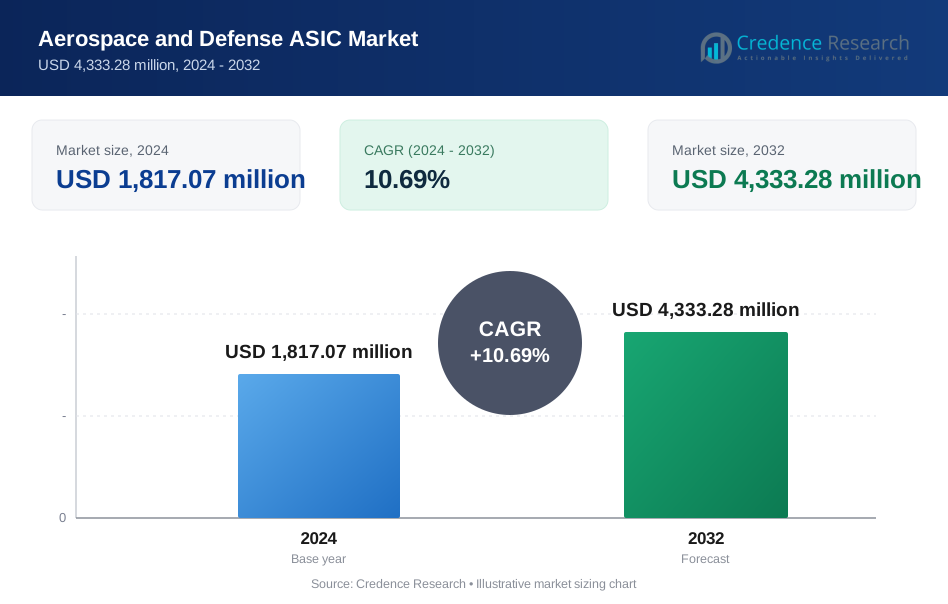
| Aerospace and Defense ASIC Market Size 2024 | USD 1,817.07 million |
| Aerospace and Defense ASIC Market , CAGR | 10.69% |
| Aerospace and Defense ASIC Market Size 2032 | USD 4,333.28 million |
Market Overview:
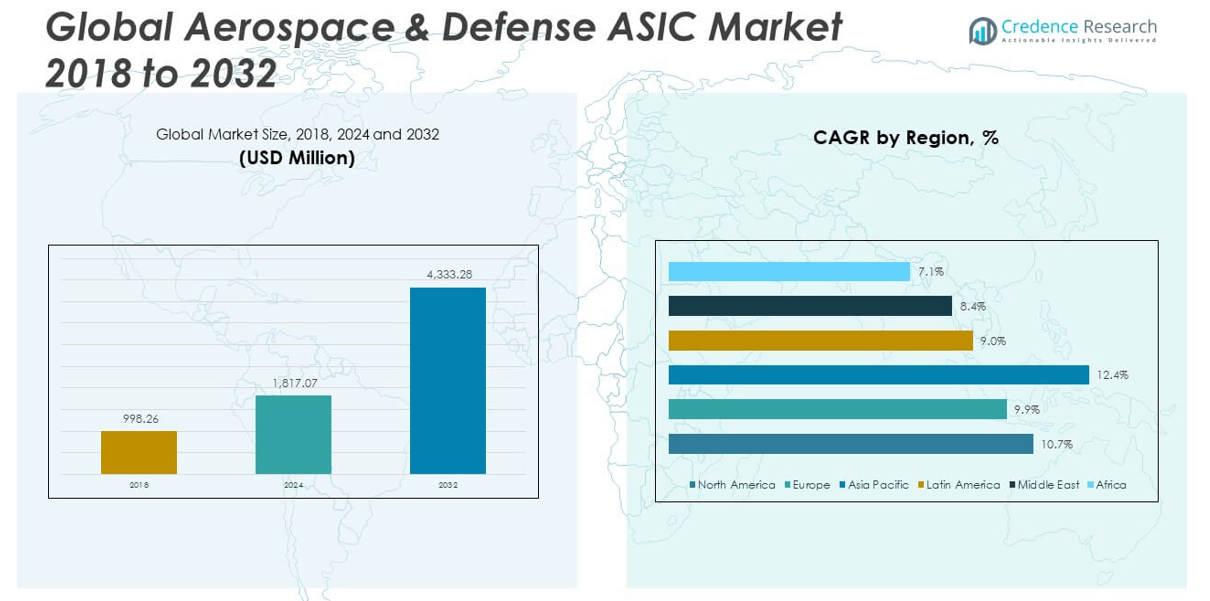
The Global Aerospace & Defense ASIC Market size was valued at USD 998.26 million in 2018 to USD 1,817.07 million in 2024 and is anticipated to reach USD 4,333.28 million by 2032, at a CAGR of 10.69% during the forecast period.
The market is primarily driven by several key factors. Increasing global defense expenditure is prompting governments and private contractors to modernize equipment with advanced technologies, including ASIC-based systems for radar, navigation, signal processing, and space electronics. These chips offer tailored functionality, enhanced performance, and better energy efficiency compared to general-purpose processors, making them ideal for rugged aerospace and defense environments. Moreover, the proliferation of unmanned systems such as drones and autonomous military vehicles has heightened the need for lightweight, power-optimized ASICs capable of performing AI and ML tasks on edge devices. Additionally, the commercial aerospace sector is embracing digital transformation, integrating ASICs in aircraft maintenance systems, avionics, and in-flight connectivity platforms. Together, these drivers are fostering a dynamic shift toward high-reliability, application-specific solutions across both defense and aerospace domains.
Regionally, North America dominates the global Aerospace & Defense ASIC Market due to its advanced defense infrastructure, significant R&D funding, and the presence of major aerospace companies and chip manufacturers. The U.S. continues to lead in deploying ASICs across a broad range of military and space applications. Europe follows closely, propelled by collaborative defense initiatives, increased military spending across NATO countries, and strong aerospace sectors in France, Germany, and the UK. Meanwhile, Asia Pacific is emerging as the fastest-growing region, driven by rising defense modernization in China, India, South Korea, and Japan. These nations are investing heavily in indigenous aerospace programs and next-gen military capabilities, which require robust, localized semiconductor development. Other regions like the Middle East and Latin America are also gradually increasing their adoption of ASICs for surveillance systems, secure communications, and regional aerospace programs, further expanding the global market footprint.
Market Insights:
- The market size reached USD 1,817.07 million in 2024 and is projected to grow to USD 4,333.28 million by 2032, expanding at a CAGR of 10.69%.
- Rising defense budgets and modernization programs are accelerating adoption of ASIC-based systems for radar, navigation, signal processing, and space applications.
- The proliferation of UAVs and autonomous military vehicles is increasing demand for power-efficient, AI-capable ASICs designed for real-time edge computing.
- Custom ASICs are preferred in harsh aerospace environments due to their secure communication capabilities, radiation tolerance, and optimized SWaP attributes.
- High development costs, long design cycles, and regulatory compliance are key challenges limiting broader market participation and innovation speed.
- North America leads the market share due to its advanced defense infrastructure, while Asia Pacific is the fastest-growing region, driven by defense self-reliance in China, India, and Japan.
- Global shifts toward domestic semiconductor supply chains and IP control are shaping long-term strategies, with countries investing in sovereign ASIC capabilities.
Market Drivers:
Rising Demand for Customized and Mission-Critical Electronics in Aerospace and Defense Systems
The Global Aerospace & Defense ASIC Market is gaining momentum due to the growing need for specialized, mission-specific electronics in both commercial aerospace and military platforms. ASICs offer tailored functionalities that meet stringent size, weight, and power (SWaP) constraints critical in avionics, radar systems, missile guidance, and satellite payloads. Defense programs increasingly prioritize compact and efficient systems that can withstand extreme environmental conditions and deliver consistent performance. Custom ASICs enable secure communication, high-speed data processing, and fault-tolerant operations in complex systems. Governments and defense contractors are investing heavily in next-generation platforms that depend on semiconductor innovation. This has created steady demand for ASICs tailored to perform critical functions across airborne, naval, and space-based defense infrastructure.
- For example, ON Semiconductor’s collaboration with ICs LLC produced radiation-hardened ASICs using the ONC110 110nm process, specifically designed for high-reliability environments such as satellite communication, avionics, and unmanned aerial vehicles.
Modernization of Defense Infrastructure and Growing Government Expenditure
Modern defense strategies rely on advanced electronics to improve precision, situational awareness, and system integration. The Global Aerospace & Defense ASIC Market benefits directly from increased military spending by countries seeking technological superiority. Programs related to unmanned aerial vehicles (UAVs), hypersonic weapons, space-based surveillance, and electronic warfare all require custom chipsets that deliver optimized processing capabilities. ASICs play an integral role in enhancing radar resolution, enabling secure telemetry, and powering onboard control systems. Many countries are shifting from legacy systems toward modular, upgradable electronics platforms that rely on ASICs for seamless interoperability. This focus on defense modernization continues to strengthen demand for ASICs designed for long lifecycle use and secure data handling.
- For example, the U.S. Department of Defense’s FY2025 budget allocated $6.9 billion for hypersonic research, up from $4.7 billion in FY2023, reflecting a substantial increase in investment for next-generation electronic systems.
Integration of Artificial Intelligence and Edge Computing in Defense Applications
Military operations increasingly depend on artificial intelligence (AI) and edge computing to support real-time decision-making and autonomous capabilities. The Global Aerospace & Defense ASIC Market is expanding as ASICs enable low-latency processing and energy-efficient execution of AI models at the device level. Drones, robotic systems, and advanced surveillance equipment now incorporate AI algorithms that must function in environments with limited connectivity and power resources. Standard processors often fail to meet the performance-to-power ratio required in such conditions, making ASICs the preferred choice. These chips offer embedded intelligence without compromising speed, accuracy, or security. The growing convergence of aerospace systems with AI technologies elevates the importance of custom silicon in operational readiness.
Shift Toward Secure, Sovereign Semiconductor Supply Chains
Geopolitical tensions and export control regulations have prompted governments to secure local supply chains for critical defense technologies. The Global Aerospace & Defense ASIC Market reflects this shift, with countries encouraging domestic ASIC design and fabrication to ensure strategic independence. National defense strategies increasingly include semiconductor self-sufficiency to avoid dependency on foreign chipmakers. It also helps mitigate risks of component shortages and cybersecurity breaches associated with imported hardware. Leading aerospace contractors collaborate with local foundries and IP providers to co-develop application-specific chips that meet national standards. This shift supports consistent investment in indigenous ASIC capabilities and reinforces the strategic value of semiconductors in national security planning.
Market Trends:
Adoption of Radiation-Hardened ASICs for Space and High-Altitude Applications
The Global Aerospace & Defense ASIC Market is experiencing strong interest in radiation-hardened (rad-hard) chip technologies, particularly for satellites, deep-space missions, and high-altitude defense systems. These environments expose electronics to extreme levels of radiation that can corrupt data and damage standard semiconductor components. Rad-hard ASICs ensure continued functionality by withstanding ionizing radiation without performance degradation. Space agencies and defense contractors prioritize these chips in missile defense systems, orbital surveillance, and secure satellite communication platforms. Demand continues to grow as governments fund more space-based initiatives. The focus on resilient electronics drives innovation in materials, layout design, and shielding techniques specific to aerospace-grade ASICs.
Increased Use of System-on-Chip (SoC) Designs for Compact Electronic Platforms
There is a noticeable shift toward integrating multiple subsystems into single-chip solutions using System-on-Chip (SoC) architecture. The Global Aerospace & Defense ASIC Market is embracing this trend to reduce board space, weight, and power consumption in mission-critical applications. SoCs combine processing units, memory, input/output controls, and specialized logic onto a single silicon die. It enables real-time performance improvements and simplifies system integration in platforms such as drones, fighter aircraft, and portable command systems. Design consolidation through SoC enhances reliability while reducing interconnect failure risks. The trend aligns with the sector’s broader objective of miniaturizing electronics without compromising capability.
- For instance, Microchip Technology's PolarFire Core SoCs and FPGAs are tailored for aerospace and defense, integrating quad-core, 64-bit RISC-V processors and offering single-event upset immunity for mission-critical reliability. These devices achieve up to 30% cost savings by eliminating integrated transceivers while maintaining low power consumption and robust security.
Growing Emphasis on Lifecycle Support and Upgradability of ASIC-Based Systems
Defense procurement programs are emphasizing longer system lifecycles with upgradable electronics. The Global Aerospace & Defense ASIC Market is aligning with this shift by developing reconfigurable and modular ASIC designs. These chips support post-deployment updates through programmable logic blocks or hybrid analog-digital architectures. Manufacturers now provide extended product support, simulation tools, and lifecycle documentation to facilitate sustainment over decades. Lifecycle adaptability reduces the need for complete hardware replacement during system modernization efforts. It also ensures compatibility with evolving mission profiles and communication protocols. This trend reflects the sector’s preference for future-proof electronics that reduce total ownership cost.
Expansion of 3D IC and Heterogeneous Integration in Aerospace ASIC Designs
Advanced packaging methods such as 3D IC stacking and heterogeneous integration are gaining traction in aerospace ASIC manufacturing. The Global Aerospace & Defense ASIC Market benefits from these methods by enabling high-density interconnects and faster signal transmission between components. 3D architectures allow vertical stacking of dies to boost performance without enlarging the device footprint. Heterogeneous integration combines diverse technologies such as RF, digital, and photonic elements on a single substrate. These innovations enhance data processing speed and bandwidth, which are essential for real-time threat detection, navigation, and autonomous decision systems. Design flexibility and space optimization make these techniques vital in next-generation defense platforms.
- For instance, Alchip Technologieshas launched silicon-proven 3DIC ASIC design services, optimizing power delivery, die-to-die electrical interconnect, and system-wide thermal characterization for high-performance aerospace ASICs. Their 3DIC design flow utilizes through-silicon vias (TSVs) and hybrid bonding, achieving higher data transfer rates, reduced power consumption, and minimized device footprint.
Market Challenges Analysis:
High Development Costs and Extended Design Cycles Limit Market Accessibility
The Global Aerospace & Defense ASIC Market faces considerable barriers due to the high cost and time requirements associated with custom chip development. Designing an ASIC demands extensive verification, prototyping, and qualification processes to meet strict aerospace and defense standards. These requirements lead to prolonged development timelines and elevated non-recurring engineering (NRE) expenses. Smaller firms and new market entrants often struggle to justify the investment in low-volume applications where return on investment remains uncertain. It also creates dependency on a limited pool of specialized design firms and fabrication partners. This financial and technical complexity reduces market agility and slows innovation adoption across some defense segments.
Stringent Regulatory Compliance and Export Control Restrictions Hinder Global Collaboration
The Global Aerospace & Defense ASIC Market operates within a tightly regulated environment marked by export controls, intellectual property restrictions, and national security policies. Governments impose strict compliance mandates to protect sensitive technologies, especially in defense-grade semiconductors. These controls complicate international collaboration, delay cross-border supply chains, and limit access to advanced fabrication nodes for certain countries. Companies must navigate evolving geopolitical dynamics while maintaining secure design environments and traceable component sourcing. Regulatory risk also increases the operational burden on manufacturers, often requiring localized production or special licensing agreements. It places pressure on timelines and resources, particularly for multinational defense programs involving ASIC integration.
Market Opportunities:
Expansion of Commercial Space Programs and Private Aerospace Ventures
The Global Aerospace & Defense ASIC Market presents strong growth potential through the rise of commercial space exploration and private aerospace enterprises. Companies such as SpaceX, Blue Origin, and Rocket Lab are developing satellites, launch systems, and autonomous spacecraft that require high-performance, radiation-hardened ASICs. These private initiatives drive demand for advanced onboard computing, telemetry, and communication systems optimized for harsh space environments. It allows ASIC manufacturers to tap into a growing commercial segment that complements traditional government contracts. The expanding satellite internet and Earth observation markets also contribute to increased ASIC deployment in low-Earth orbit systems.
Integration of Quantum and Photonic Technologies into Defense Applications
Emerging quantum and photonic technologies create long-term opportunities for innovation in the Global Aerospace & Defense ASIC Market. Governments are funding research into secure quantum communication, ultra-precise navigation, and advanced sensing systems. These technologies require custom ASICs to support low-latency processing, ultra-fast data conversion, and interface control with new physical architectures. It opens pathways for collaborative development between defense agencies and semiconductor firms specializing in next-generation materials and packaging. The demand for novel chip architectures aligned with quantum systems is expected to grow steadily, creating a new frontier for specialized ASIC adoption.
Market Segmentation Analysis:
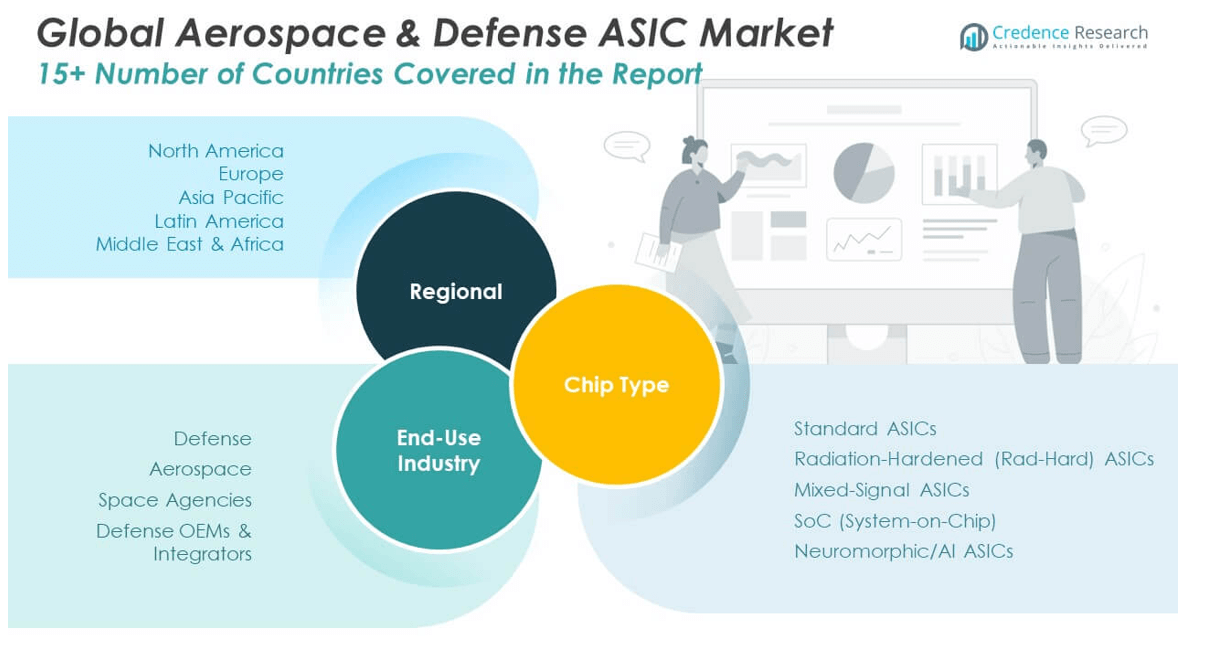
The Global Aerospace & Defense ASIC Market is segmented by chip type and end-use industry, reflecting the diverse applications and specialized demands of this sector.
By chip type, Standard ASICs account for a significant share due to their versatility and use in general defense electronics. Radiation-Hardened (Rad-Hard) ASICs dominate critical space and high-altitude systems where resilience against cosmic radiation is essential. Mixed-Signal ASICs serve in communication, navigation, and signal-processing platforms, combining analog and digital functionalities. System-on-Chip (SoC) designs are gaining traction for compact, integrated solutions in avionics and UAVs. Neuromorphic/AI ASICs represent an emerging segment, driven by the integration of AI in autonomous defense systems and real-time surveillance.
- For example, BAE Systems’ RH12™ ASICs are deployed in geosynchronous satellites and deep-space probes. These chips are engineered to withstand radiation doses exceeding 1 megarad, ensuring uninterrupted operation in high-radiation environments such as NASA’s Mars missions and DoD missile defense satellites.
By end-use industry, the Defense segment leads the market, driven by consistent government spending on radar systems, electronic warfare, and missile guidance. The Aerospace segment follows closely, with demand for ASICs in flight control systems, avionics, and in-flight connectivity. Space Agencies increasingly deploy ASICs in satellite payloads and deep-space missions due to reliability and radiation tolerance. Defense OEMs & Integrators use customized ASICs to meet performance, security, and interoperability requirements across platforms. The market reflects a balanced mix of innovation, reliability, and mission-specific customization across all segments.
- For instance, Honeywell’s Application-Specific Integrated Circuits are embedded in the Primus Epic avionics suite, providing flight control, navigation, and in-flight connectivity for commercial and military aircraft, including the Gulfstream G650 and Embraer E2 jets.
Segmentation:
By Chip Type
- Standard ASICs
- Radiation-Hardened (Rad-Hard) ASICs
- Mixed-Signal ASICs
- SoC (System-on-Chip)
- Neuromorphic/AI ASICs
By End-Use Industry
- Defense
- Aerospace
- Space Agencies
- Defense OEMs & Integrators
By Region
- North America
- U.S.
- Canada
- Mexico
- Europe
- Germany
- France
- U.K.
- Italy
- Spain
- Rest of Europe
- Asia Pacific
- China
- Japan
- India
- South Korea
- South-east Asia
- Rest of Asia Pacific
- Latin America
- Brazil
- Argentina
- Rest of Latin America
- Middle East & Africa
- GCC Countries
- South Africa
- Rest of the Middle East and Africa
Regional Analysis:
North America
The North America Aerospace & Defense ASIC Market size was valued at USD 397.76 million in 2018 to USD 715.77 million in 2024 and is anticipated to reach USD 1,712.14 million by 2032, at a CAGR of 10.7% during the forecast period. North America holds the largest share in the Global Aerospace & Defense ASIC Market, accounting for nearly 38% of global revenue. The region benefits from substantial defense budgets, advanced R&D ecosystems, and the presence of major aerospace OEMs and chipmakers. The U.S. Department of Defense continues to prioritize ASIC-based technologies for applications in radar, electronic warfare, and satellite systems. It maintains a strong focus on domestic chip manufacturing and secure supply chains under initiatives such as CHIPS and Science Act. Defense primes like Lockheed Martin, Raytheon, and Northrop Grumman collaborate with semiconductor specialists to deliver customized, high-reliability ASICs. The region’s mature infrastructure and regulatory frameworks support continuous innovation and rapid deployment across land, air, sea, and space platforms.
Europe
The Europe Aerospace & Defense ASIC Market size was valued at USD 314.79 million in 2018 to USD 554.41 million in 2024 and is anticipated to reach USD 1,252.80 million by 2032, at a CAGR of 9.9% during the forecast period. Europe represents nearly 29% of the Global Aerospace & Defense ASIC Market share, driven by joint defense programs and increased military modernization across EU and NATO countries. France, Germany, and the UK lead regional spending on ASIC-based systems in aircraft, missile systems, and communication platforms. European defense agencies actively pursue sovereignty in semiconductor technologies to reduce dependence on foreign suppliers. It also benefits from a growing number of space missions and satellite deployments under ESA and national programs. Firms like Airbus, BAE Systems, and Leonardo are accelerating ASIC adoption for modular avionics and secure data processing. The region emphasizes interoperability, long-term lifecycle support, and environmental compliance in its ASIC design standards.
Asia Pacific
The Asia Pacific Aerospace & Defense ASIC Market size was valued at USD 198.00 million in 2018 to USD 389.73 million in 2024 and is anticipated to reach USD 1,049.17 million by 2032, at a CAGR of 12.4% during the forecast period. Asia Pacific accounts for approximately 23% of the Global Aerospace & Defense ASIC Market and is the fastest-growing region due to aggressive defense modernization and expanding space programs. China, India, Japan, and South Korea are increasing investments in domestically developed ASICs to support indigenous missile, radar, and UAV systems. It is also driving innovation through public-private partnerships in semiconductor R&D and localized chip fabrication. National security strategies across the region prioritize ASIC deployment in surveillance, navigation, and cyber-defense platforms. The growth in commercial space ventures further supports regional ASIC demand. Regulatory support and growing defense exports contribute to Asia Pacific’s leadership in next-generation defense electronics.
Latin America
The Latin America Aerospace & Defense ASIC Market size was valued at USD 46.04 million in 2018 to USD 82.74 million in 2024 and is anticipated to reach USD 174.09 million by 2032, at a CAGR of 9.0% during the forecast period. Latin America holds a modest 4% share of the Global Aerospace & Defense ASIC Market, with Brazil and Mexico leading regional demand. Governments are investing selectively in satellite communications, border surveillance, and aerospace research centers that require reliable ASIC solutions. It faces challenges due to budget constraints and import dependencies, yet regional defense agencies are exploring co-development agreements to access advanced chip technologies. Strategic partnerships with European and U.S.-based defense firms are helping Latin America improve its ASIC capabilities. It presents niche opportunities in modernization programs for air traffic management and military avionics. Regional priorities include cost-effective, rugged ASICs that comply with international standards.
Middle East
The Middle East Aerospace & Defense ASIC Market size was valued at USD 28.07 million in 2018 to USD 46.73 million in 2024 and is anticipated to reach USD 94.10 million by 2032, at a CAGR of 8.4% during the forecast period. The Middle East contributes around 3% to the Global Aerospace & Defense ASIC Market and continues to grow steadily due to strategic defense procurement and sovereign capability building. Countries like Saudi Arabia and the UAE are investing in military electronics, satellite systems, and localized production of defense equipment. It emphasizes ASIC adoption in border security, air defense systems, and integrated command platforms. National Vision initiatives are pushing local semiconductor and defense tech development. Regional demand focuses on robust, secure chips with minimal power requirements for extreme operational environments. International collaborations are critical to boosting ASIC access and technical know-how.
Africa
The Africa Aerospace & Defense ASIC Market size was valued at USD 13.60 million in 2018 to USD 27.69 million in 2024 and is anticipated to reach USD 50.96 million by 2032, at a CAGR of 7.1% during the forecast period. Africa holds under 2% of the Global Aerospace & Defense ASIC Market but is beginning to adopt advanced electronics for strategic applications. Countries such as South Africa, Nigeria, and Egypt are strengthening defense and aerospace infrastructure, creating demand for surveillance and communication ASICs. It is engaging in limited space missions, border monitoring systems, and drone programs that rely on custom chip solutions. Budget limitations and lack of domestic semiconductor capabilities pose ongoing challenges. International aid, defense partnerships, and academic collaborations are shaping ASIC-related capacity building. Growth is gradual, but focused investment in specific defense programs is helping the region enter the ASIC value chain.
Key Player Analysis:
- Honeywell International Inc.
- Raytheon Technologies
- Northrop Grumman
- BAE Systems
- Lockheed Martin
- General Electric (GE Aerospace)
- Airbus
- Boeing
- Siemens
- Thales Group
Competitive Analysis:
The Global Aerospace & Defense ASIC Market is highly competitive, with a mix of established semiconductor manufacturers and specialized defense contractors. Key players include BAE Systems, Lockheed Martin, Raytheon Technologies, Northrop Grumman, Intel, Xilinx (AMD), and Microsemi (Microchip Technology). It benefits from vertically integrated capabilities where companies manage design, fabrication, and testing to meet stringent aerospace requirements. Leading firms focus on developing radiation-hardened, secure, and low-power ASICs tailored for avionics, radar, and space systems. Strategic partnerships with defense agencies and space organizations enhance product development and long-term contracts. The market shows high entry barriers due to IP protection, compliance standards, and significant R&D costs. Innovation, reliability, and supply chain resilience define competitive positioning across this sector.
Recent Developments:
- In February 2025, Honeywell announced a strategic collaborationwith ForwardEdge ASIC LLC, a subsidiary of Lockheed Martin Corporation, to develop reliable and radiation-hardened microelectronics for space applications. This partnership aims to combine Honeywell’s proven foundry technology with ForwardEdge ASIC’s advanced architecture and design solutions, focusing on the creation of innovative Application Specific Integrated Circuits (ASICs) for satellites and other space missions.
- In late June 2025, TransDigm Group revealed its acquisition of Simmonds Precision Products from RTX Corp for $765 million in cash. Simmonds is known for its expertise in fuel, proximity sensing, and structural health monitoring technologies-fields deeply intertwined with aerospace and defense electronics. By adding Simmonds to its portfolio, TransDigm strengthens its position in ASIC-powered sensor systems across both commercial and military aircraft platforms.
Market Concentration & Characteristics:
The Global Aerospace & Defense ASIC Market exhibits moderate to high market concentration, with a few dominant players holding a significant share due to specialized expertise and long-term defense contracts. It is characterized by high entry barriers, driven by complex design requirements, strict regulatory compliance, and the need for secure, mission-specific performance. The market favors vertically integrated companies capable of handling end-to-end ASIC development under secure, defense-grade environments. Long product development cycles and extended system lifespans define procurement behavior. It relies heavily on trusted supply chains, domestic sourcing policies, and government-backed funding for R&D. The demand for reliability, fault tolerance, and environmental durability shapes both product features and vendor selection.
Report Coverage:
The research report offers an in-depth analysis based on Chip Type and End-Use Industry. It details leading market players, providing an overview of their business, product offerings, investments, revenue streams, and key applications. Additionally, the report includes insights into the competitive environment, SWOT analysis, current market trends, as well as the primary drivers and constraints. Furthermore, it discusses various factors that have driven market expansion in recent years. The report also explores market dynamics, regulatory scenarios, and technological advancements that are shaping the industry. It assesses the impact of external factors and global economic changes on market growth. Lastly, it provides strategic recommendations for new entrants and established companies to navigate the complexities of the market.
Future Outlook:
- Increasing investments in AI-powered defense platforms will drive demand for low-latency, application-specific ASICs.
- Expansion of commercial space programs will create new opportunities for radiation-hardened chip solutions.
- Growing emphasis on edge computing in UAVs and autonomous systems will support ASIC integration.
- Enhanced government focus on semiconductor self-sufficiency will boost domestic ASIC development.
- Advancements in 3D IC and heterogeneous integration will redefine performance benchmarks.
- Rising cybersecurity threats will accelerate adoption of secure and tamper-resistant ASIC architectures.
- Long-term defense contracts will ensure consistent revenue streams for established ASIC vendors.
- Miniaturization of aerospace electronics will favor compact, high-density ASICs over traditional processors.
- International collaborations will lead to co-development of mission-specific ASIC platforms.
- Sustainable procurement policies will encourage energy-efficient and lifecycle-optimized chip designs.
Request a Free Sample
Fill in your details and we'll send you a free sample report.
- Sample data tables & charts
- Research methodology
Need a Custom Version of This Report?
Tailor the scope, geography, or segments to your exact requirements.
- Custom geography or segment scope
- Direct access to our analyst team
Frequently Asked Questions
What is the current size of the Global Aerospace & Defense ASIC Market?
What are the key segments within the Global Aerospace & Defense ASIC Market?
What are some challenges faced by the Global Aerospace & Defense ASIC Market?
Who are the major players in the Global Aerospace & Defense ASIC Market?
Table of Content
Chapter 1. Report Introduction
- 1.1 Report Description & Purpose
- 1.1.1 Report Title & Market Definition
- 1.1.2 Unique Selling Propositions (USP) & Key Differentiators
- 1.1.3 Value Proposition for Stakeholders
- 1.2 Research Objectives
- 1.2.1 Market Sizing Objectives (Volume & Revenue) (Volume Where Applicable)
- 1.2.2 Segmentation Objectives
- 1.2.3 Competitive Intelligence Objectives
- 1.2.4 Forecast & Scenario Objectives
- 1.3 Report Scope
- 1.3.1 Aerospace and Defense ASIC Scope – Segments & Subsegments Covered
- 1.3.2 Geographic Scope – Regions & Countries Covered
- 1.3.3 Historical Period, Base Year & Forecast Period (2024; forecast to 2032)
- 1.3.4 Inclusions & Exclusions
- 1.4 Industry Classification & Applicable Codes
- 1.5 Currency, Measurement Units & Valuation Basis
- 1.6 Target Stakeholders
- 1.7 Limitations & Assumptions
Chapter 2. Executive Summary
- 2.1 Global Aerospace and Defense ASIC Market Snapshot
- 2.1.1 Market Size – Historical (2024) & Forecast (2024-2032) (2024: USD 1,817.07 million → 2032: USD 4,333.28 million)
- 2.1.2 Volume & Revenue – Global Totals (Volume Where Applicable)
- 2.1.3 Key Market Highlights – Top Five Facts
- 2.2 Aerospace and Defense ASIC Market Segmentation Snapshot
- 2.2.1 Market Split by Region – 2024 vs. 2032
- 2.3 Competitive Snapshot
- 2.3.1 Top 10 Players by Revenue Share – 2024
- 2.3.2 Top 10 Players by Volume Share – 2024 (Volume Where Applicable)
- 2.3.3 Recent Strategic Developments (18-Month Summary)
- 2.4 Key Investment Highlights & Strategic Conclusions
Chapter 3. Aerospace and Defense ASIC Market Dynamics & Industry Analysis
- 3.1 Market Overview & Context
- 3.1.1 Aerospace and Defense ASIC Market Position in the Broader Industry Value Chain
- 3.1.2 Demand Structure & Purchasing Dynamics
- 3.1.3 Market Maturity & Development Stage by Region
- 3.2 Aerospace and Defense ASIC Market Drivers
- 3.3 Aerospace and Defense ASIC Market Restraints & Challenges
- 3.4 Aerospace and Defense ASIC Market Opportunities
- 3.5 Porter's Five Forces Analysis
- 3.5.1 Threat of New Entrants
- 3.5.2 Bargaining Power of Suppliers
- 3.5.3 Bargaining Power of Buyers
- 3.5.4 Threat of Substitutes
- 3.5.5 Competitive Rivalry – Intensity Assessment
- 3.6 Aerospace and Defense ASIC Value Chain Analysis
- 3.6.1 Upstream – Key Inputs, Resources & Suppliers
- 3.6.1.1 Key Input/Resource 1
- 3.6.1.2 Key Input/Resource 2
- 3.6.1.3 Key Input/Resource 3
- 3.6.2 Midstream – Core Operations & Value Creation
- 3.6.2.1 Operating Model & Process Overview
- 3.6.2.2 Key Operating Locations & Capabilities by Company
- 3.6.3 Downstream – Market Channels & End Users
- 3.6.3.1 Direct Sales & Customer Engagement Channels
- 3.6.3.2 Indirect Sales, Intermediaries & Partner Channels
- 3.6.4 Value Chain Profitability Analysis
- 3.6.1 Upstream – Key Inputs, Resources & Suppliers
- 3.7 PESTEL Analysis
- 3.7.1 Political Factors
- 3.7.2 Economic Factors
- 3.7.3 Social Factors
- 3.7.4 Technological Factors
- 3.7.5 Environmental Factors
- 3.7.6 Legal Factors
- 3.8 Aerospace and Defense ASIC Supply Chain Analysis
- 3.8.1 Critical Input & Resource Availability Risk Assessment
- 3.8.2 Supplier & Operational Concentration Risk (Geographic Exposure)
- 3.8.3 Supply & Service Disruption Impact Analysis
- 3.9 Regulatory & Policy Landscape
Note: The regulatory and policy landscape section covers regulations based on their applicability to the market, Aerospace and Defense ASIC category, geography, and scope of the study. Only regulatory frameworks with a material impact on operations, compliance, trade, sustainability, or market access are analyzed in detail.
Chapter 4. Key Investment Pockets & Opportunity Analysis
- 4.1 Aerospace and Defense ASIC Market Attractiveness Analysis
- 4.1.1 By Region – Investment Attractiveness Matrix (Market Size × CAGR)
- 4.2 Absolute Revenue Growth Opportunity
- 4.2.1 By Region – Absolute Revenue Growth Through 2032
- 4.3 Incremental Demand Opportunity
- 4.3.1 By Region – Incremental Demand Through 2032
- 4.3.2 Segment – Incremental Demand
- 4.4 Emerging Submarket Opportunity Deep Dive (Subject to Applicability)
- 4.5 Priority Market Opportunity Scorecards
- 4.5.1 United States
- 4.5.2 Europe
- 4.5.3 Asia
- 4.5.4 Middle East & Africa
Note: Priority market opportunity scorecards reflect the geographic scope and strategic relevance of the study. Listed markets are indicative and may be adapted to the industry.
Chapter 5. Aerospace and Defense ASIC Cross-Border Trade & Market Access Analysis
- 5.1 International Trade & Cross-Border Activity Overview
- 5.1.1 Global Export Value by Country (2024)
- 5.1.2 Global Export Volume by Country (2024) (Volume Where Applicable)
- 5.1.3 Global Import Value by Country (2024)
- 5.1.4 Global Import Volume by Country (2024) (Volume Where Applicable)
- 5.1.5 Net Trade Balance by Country (2024)
- 5.2 Export Analysis – Segment
- 5.2.1 Category 1 (Applicable Classification Code)
- 5.2.2 Category 2 (Applicable Classification Code)
- 5.2.3 Category 3 (Applicable Classification Code)
- 5.2.4 Category 4 (Applicable Classification Code)
- 5.2.5 Category 5 (Applicable Classification Code)
- 5.3 Import Analysis – Segment
- 5.3.1 Category 1 (Applicable Classification Code)
- 5.3.2 Category 2 (Applicable Classification Code)
- 5.3.3 Category 3 (Applicable Classification Code)
- 5.3.4 Category 4 (Applicable Classification Code)
- 5.3.5 Category 5 (Applicable Classification Code)
- 5.4 Cross-Border Pricing & Transaction Benchmarks
- 5.4.1 Export Pricing – Segment & Country
- 5.4.2 Import Pricing – Segment & Source Country
- 5.4.3 Price Trends (2024)
- 5.5 Key Cross-Border Trade & Delivery Routes
- 5.5.1 Cross-Border Trade/Delivery Route 1
- 5.5.2 Cross-Border Trade/Delivery Route 2
- 5.5.3 Cross-Border Trade/Delivery Route 3
- 5.5.4 Cross-Border Trade/Delivery Route 4
- 5.5.5 Cross-Border Trade/Delivery Route 5
- 5.6 Trade Policy & Market Access Impact Assessment
- 5.6.1 Tariff & Non-Tariff Barriers
- 5.6.2 Regional Trade & Economic Integration Frameworks
- 5.6.3 Bilateral & Multilateral Trade Agreements
- 5.6.4 Cross-Border Operating, Licensing & Localization Requirements
Note: This chapter applies where cross-border trade or delivery is relevant to Aerospace and Defense ASIC. Goods, services, and digital offerings are assessed using applicable classifications and transaction measures. Import-export volumes, trade balances, and route analyses are included only where meaningful to the market.
Chapter 6. Competitive Landscape & Company Benchmarking
- 6.1 Aerospace and Defense ASIC Market Concentration & Structure
- 6.1.1 Herfindahl-Hirschman Index (HHI) – vs. 2024
- 6.1.2 Leading, Mid-Sized & Emerging Player Structure
- 6.1.3 Global, Regional & Local Player Dynamics
- 6.2 Aerospace and Defense ASIC Market Share Analysis – 2024
- 6.2.1 Global Revenue Share by Company
- 6.2.2 Global Volume Share by Company (Volume Where Applicable)
- 6.2.3 Regional Revenue Share
- 6.2.4 Market Share Evolution ( vs. 2024)
- 6.2.5 Company Market Share by Key Segment
- 6.2.6 Company Market Share by Customer Group
- 6.3 Operating Scale, Capacity & Infrastructure Analysis
- 6.3.1 Global Operating Scale & Supply Capacity
- 6.3.2 Resource Utilization & Operating Efficiency
- 6.3.3 Output, Service Delivery & Activity Metrics
- 6.3.4 Operating Footprint & Infrastructure Map
- 6.3.5 Planned Operational & Capacity Expansion
- 6.4 Aerospace and Defense ASIC Competitive Benchmarking Matrix
- 6.4.1 Revenue, Growth, Profitability & Operating Metric Comparison
- 6.4.2 Channel Revenue Mix
- 6.4.3 Geographic Revenue Exposure
- 6.4.4 R&D Intensity
- 6.4.5 Sustainability Maturity
- 6.5 Strategic Developments in Aerospace and Defense ASIC (Last 24 Months)
- 6.5.1 Mergers, Acquisitions & Divestments
- 6.5.2 New Products, Services & Solutions in Aerospace and Defense ASIC
- 6.5.3 Operational & Infrastructure Expansions
- 6.5.4 Strategic Alliances, Joint Ventures & Partnerships
- 6.5.5 Distribution Expansion & Market Entry
- 6.5.6 Sustainability & ESG Initiatives
- 6.6 Competitive Strategy Mapping
- 6.6.1 Leader, Challenger, Follower & Niche Classification
- 6.6.2 Pricing Strategy Comparison
- 6.6.3 Channel Strategy Matrix
Note: Strategic developments are included based on their materiality and the availability of reliable information.
Chapter 7. Global Aerospace and Defense ASIC Market – By Sales & Delivery Channel
- 7.1 Segment Overview
- 7.1.1 Volume & Revenue Split by Channel (2024 & 2032) (Volume Where Applicable)
- 7.1.2 Channel Mix Evolution (2024-2032)
Chapter 8. Regional Market Analysis – Global Overview
- 8.1 Global Regional Overview
- 8.1.1 Regional Volume Share (Volume Where Applicable)
- 8.1.2 Regional Revenue Share
- 8.1.3 Regional Volume by Region (Volume Where Applicable)
- 8.1.4 Regional Revenue by Region
- 8.1.5 Regional Forecast Through 2032
- 8.2 Cross-Regional Segment Analysis
- 8.2.1 By Sales & Delivery Channel
- 8.2.2 By Competitive Positioning & Price Tier
Chapter 9. North America Aerospace and Defense ASIC Market
- 9.1 United States
- 9.2 Canada
- 9.3 Mexico
Chapter 10. Europe Aerospace and Defense ASIC Market
- 10.1 Germany
- 10.2 France
- 10.3 Italy
- 10.4 United Kingdom
- 10.5 Spain
- 10.6 Poland
- 10.7 Russia
- 10.8 Netherlands
- 10.9 Belgium
- 10.10 Sweden
- 10.11 Denmark
- 10.12 Norway
- 10.13 Rest of Europe
Chapter 11. Asia Pacific Aerospace and Defense ASIC Market
- 11.1 China
- 11.2 India
- 11.3 Japan
- 11.4 South Korea
- 11.5 Thailand
- 11.6 Indonesia
- 11.7 Vietnam
- 11.8 Malaysia
- 11.9 Australia
- 11.10 Rest of Asia Pacific
Chapter 12. Latin America Aerospace and Defense ASIC Market
- 12.1 Brazil
- 12.2 Argentina
- 12.3 Colombia
- 12.4 Chile
- 12.5 Rest of Latin America
Chapter 13. Middle East Aerospace and Defense ASIC Market
- 13.1 Saudi Arabia
- 13.2 United Arab Emirates
- 13.3 Turkey
- 13.4 Israel
- 13.5 Iran
- 13.6 Rest of the Middle East
Chapter 14. Africa Aerospace and Defense ASIC Market
- 14.1 South Africa
- 14.2 Egypt
- 14.3 Nigeria
- 14.4 Morocco
- 14.5 Rest of Africa
Chapter 15. Aerospace and Defense ASIC Company Profiles
- 15.1 [Company 01]
- 15.1.1 Company Overview
- 15.1.2 Key Management Personnel
- 15.1.3 Products & Services Portfolio
- 15.1.4 Financial Performance
- 15.1.5 Key Market Focus & Geographic Presence
- 15.1.6 Recent Developments & Strategic Initiatives
Note: The company profile list is preliminary and may change based on research findings, market developments, data availability, and client requirements.
Chapter 16. Appendices
- Appendix A – List of Abbreviations & Acronyms
- Appendix B – Industry Classification Code Reference – Full Series
- Appendix C – Supply, Output & Operating Capacity Data Tables
- Appendix D – End-Use & Demand Base Tables
- Appendix E – Demand, Adoption & Usage Assumptions
- Appendix F – Pricing & Revenue Metric Reference Tables
- Appendix G – Company Operations & Infrastructure Database
- Appendix H – Cross-Border Trade & Activity Data Tables (Where Applicable)
- Appendix I – Regulatory Summary Tables
- Appendix J – Primary Research Participant List (Anonymized)
- Appendix K – Primary Research Questionnaire Framework
- Appendix L – Data Sources & Bibliography
- Appendix M – Market Size Divergence & Source Comparison
Chapter 17. Research Methodology
- 17.1 Research Framework & Philosophy
- 17.2 Secondary Research – Sources, Hierarchy & Data Extraction
- 17.3 Data Modeling – Bottom-Up & Top-Down Market Sizing
- 17.4 Primary Research – Stakeholder Framework, LOI & Sample Sizes
- 17.5 Forecast Methodology – Regression, Scenario & Sensitivity Analysis
- 17.6 Quality Control – Four-Layer Validation Framework
- 17.7 Limitations & Standard Assumptions
- 17.8 Disclaimer
