
Market Overview
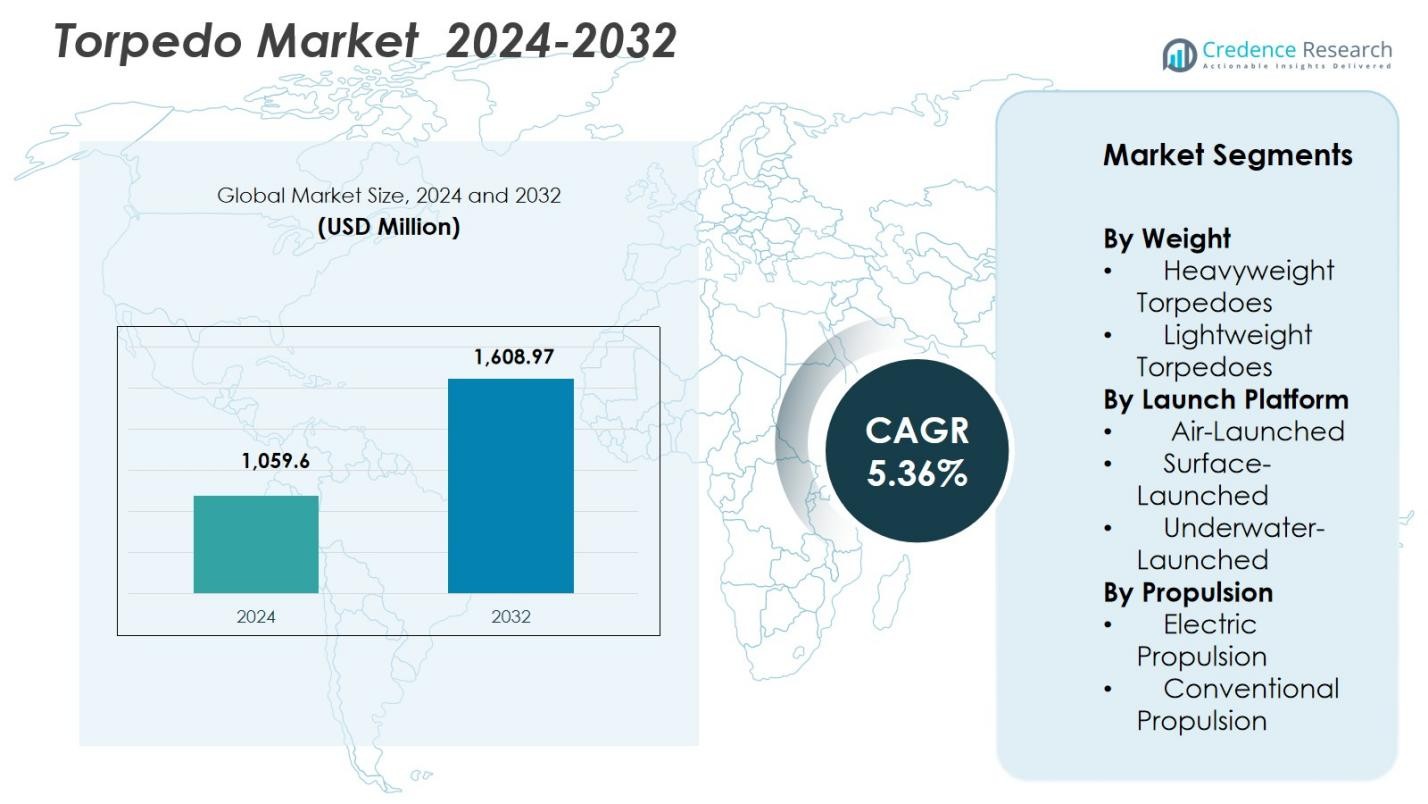
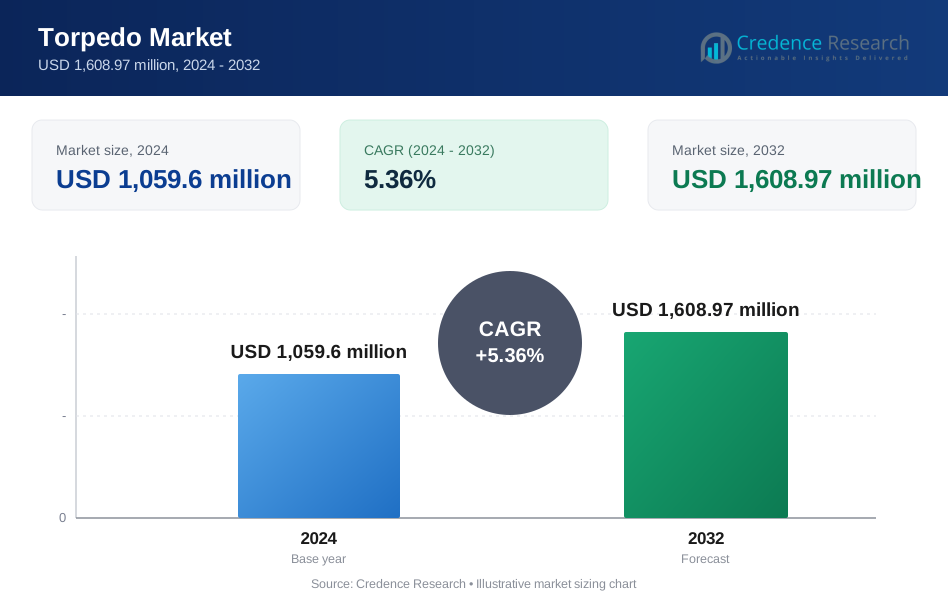
The Torpedo Market size was valued at USD 1,059.6 million in 2024 and is anticipated to reach USD 1,608.97 million by 2032, growing at a CAGR of 5.36% during the forecast period.
| REPORT ATTRIBUTE | DETAILS |
|---|---|
| Historical Period | 2020-2023 |
| Base Year | 2024 |
| Forecast Period | 2025-2032 |
| Torpedo Market Size 2024 | USD 1,059.6 Million |
| Torpedo Market , CAGR | 5.36% |
| Torpedo Market Size 2032 | USD 1,608.97 Million |
The Torpedo Market is shaped by the presence of established defense manufacturers including BAE Systems PLC, Lockheed Martin Corporation, Raytheon Technologies Corporation, Leonardo S.p.A., Naval Group, Northrop Grumman Corporation, Atlas Elektronik GmbH, ASELSAN A.Ş., Bharat Dynamics Limited, and Honeywell International Inc. These companies focus on advanced guidance systems, electric propulsion, acoustic stealth, and integration with modern naval platforms to support evolving undersea warfare requirements. North America leads the Torpedo Market with a 34.6% market share, driven by sustained naval modernization programs, strong submarine fleets, and continuous investment in anti-submarine warfare capabilities. Europe and Asia Pacific follow, supported by fleet expansion, regional security priorities, and long-term defense procurement programs.
Market Insights
- The Torpedo Market was valued at USD 1,059.6 million in 2024 and is expected to grow at a CAGR of 5.36% through 2032, supported by steady defense spending and long-term naval procurement programs.
- Market growth is driven by naval modernization, submarine fleet expansion, and rising emphasis on anti-submarine warfare, with heavyweight torpedoes holding a 63.4% segment share due to their extended range and higher lethality.
- Key market trends include growing adoption of electric propulsion, which accounts for 58.9% share, and increased integration of advanced guidance, stealth, and autonomous technologies to enhance undersea combat effectiveness.
- Leading companies focus on technology upgrades, long-term defense contracts, and platform integration to strengthen their market position amid high entry barriers and complex development requirements.
- Regionally, North America leads with 34.6% share, followed by Europe at 28.3% and Asia Pacific at 26.1%, driven by submarine modernization, maritime security priorities, and expanding naval capabilities.
Market Segmentation Analysis:
By Weight:
By weight, the Torpedo Market is led by heavyweight torpedoes, which accounted for 63.4% market share in 2024. Heavyweight torpedoes dominate due to their extended range, higher payload capacity, and superior lethality, making them the preferred choice for submarine-launched anti-ship and anti-submarine missions. Navies prioritize these systems for blue-water operations and strategic deterrence roles. Rising submarine fleet modernization programs, increased procurement of advanced attack submarines, and the need for long-range underwater strike capabilities continue to drive the dominance of heavyweight torpedoes in the Torpedo Market.
- For instance, BAE Systems’ Spearfish heavyweight torpedo deployed by the Royal Navy weighs roughly 1,850 kg, can exceed 80 knots and 30+ nautical miles in range, and carries an insensitive-munition warhead of about 300 kg optimized for under‑keel detonation against large warships and submarines
By Launch Platform:
By launch platform, underwater-launched torpedoes held the largest share of the Torpedo Market at 54.8% in 2024. This dominance is driven by the growing importance of submarines in naval warfare, where stealth, survivability, and first-strike capability are critical. Underwater-launched systems offer superior concealment and operational flexibility compared to surface- or air-launched alternatives. Expanding submarine fleets, rising investments in undersea warfare capabilities, and increasing deployment of advanced sonar and combat management systems are reinforcing demand for underwater-launched torpedoes across major naval forces.
- For instance, the U.S. Navy's Mk 48 torpedo launches from all classes of submarines, including Virginia-class attack submarines, using wire guidance and active/passive homing for anti-submarine and anti-surface roles.
By Propulsion:
By propulsion type, electric propulsion torpedoes captured 58.9% market share in 2024, making them the dominant sub-segment in the Torpedo Market. Electric propulsion systems offer lower acoustic signatures, enhanced stealth, and improved operational efficiency compared to conventional propulsion. Navies increasingly favor electric torpedoes to counter advanced anti-submarine warfare systems and reduce detectability during missions. Technological advancements in battery energy density, thermal management, and propulsion efficiency, combined with stricter noise-reduction requirements, continue to drive adoption of electric propulsion torpedoes globally.
Key Growth Drivers
Naval Modernization and Submarine Fleet Expansion
Naval modernization programs strongly drive the Torpedo Market as countries upgrade submarines and surface combat vessels to enhance undersea warfare capabilities. Growing geopolitical tensions and maritime boundary disputes are pushing governments to invest in advanced naval weapon systems. Modern submarines require next-generation torpedoes with improved range, accuracy, and survivability. Replacement of legacy torpedo inventories, induction of new attack submarines, and integration with advanced combat management systems continue to generate sustained procurement demand across developed and emerging naval forces.
- For instance, the US Navy's Office of Naval Research is advancing the Revolver Multi-Payload program for Virginia-class submarines, enabling multi-packed launches of 6.75-inch Mark 58 Compact Rapid Attack Weapon torpedoes from a single 21-inch tube to increase magazine depth.
Rising Emphasis on Anti-Submarine Warfare (ASW)
The increasing focus on anti-submarine warfare is a major driver for the Torpedo Market as stealthier and more capable submarines enter global fleets. Navies prioritize torpedoes as a core ASW weapon due to their effectiveness in detecting, tracking, and neutralizing underwater threats. Growing deployment of sonar networks and underwater surveillance systems further supports torpedo adoption. Continuous upgrades in guidance systems, seekers, and propulsion technologies are reinforcing demand for advanced torpedoes tailored to complex ASW operations.
- For instance, Lockheed Martin upgraded the U.S. Navy's MK 48 Mod 7 torpedo with the Common Broadband Advanced Sonar System (CBASS), expanding sonar bandwidth for better signal processing in challenging acoustic environments.
Expanding Defense Budgets and Maritime Security Priorities
Rising defense budgets and renewed emphasis on maritime security significantly support growth in the Torpedo Market. Governments are prioritizing naval strength to safeguard sea lanes, protect offshore assets, and deter hostile activities. Increased funding enables procurement of advanced torpedo systems and modernization of existing arsenals. Long-term naval defense programs provide stability for manufacturers and encourage innovation. As maritime dominance becomes central to national defense strategies, torpedoes remain a critical investment area.
Key Trends & Opportunities
Advancements in Smart and Stealth Torpedo Technologies
A prominent trend in the Torpedo Market is the rapid advancement of smart and stealth-enabled torpedo technologies. Manufacturers are incorporating advanced guidance algorithms, autonomous target recognition, and low-acoustic propulsion systems to enhance mission success. These capabilities improve survivability in contested underwater environments and reduce detection risks. The transition toward intelligent torpedoes creates opportunities for suppliers to deliver high-value solutions aligned with modern naval doctrines and next-generation undersea warfare requirements.
- For instance, DRDO's Supersonic Missile-Assisted Release of Torpedo (SMART), flight-tested on May 1, 2024, from Dr. APJ Abdul Kalam Island, integrates a two-stage solid propulsion system with precision inertial navigation to deliver lightweight torpedoes via parachute release.
Growing Adoption of Electric Propulsion Systems
The rising preference for electric propulsion presents a strong opportunity within the Torpedo Market. Electric propulsion offers reduced acoustic signatures, higher efficiency, and improved stealth compared to conventional propulsion systems. Navies increasingly favor these systems to counter advanced sonar and detection technologies. Ongoing improvements in battery energy density, thermal management, and endurance further enhance operational performance. This trend supports development of quieter, longer-range torpedoes suited for modern submarine warfare.
- For instance, Atlas Elektronik's SeaHake mod4 heavyweight torpedo employs a modular silver-zinc or lithium-ion battery system with a high-frequency permanent magnet motor. This setup delivers over 50 km range at speeds exceeding 50 knots, with closed-loop cooling for low self-noise.
Key Challenges
High Development Costs and Integration Complexity
High research and development costs pose a significant challenge in the Torpedo Market. Advanced torpedo systems require sophisticated propulsion, guidance, and sensor technologies, increasing overall program expenses. Integration with submarine platforms, launch mechanisms, and combat management systems adds further technical complexity. Budget limitations in certain regions can slow procurement or restrict fleet-wide upgrades. Manufacturers face pressure to balance technological advancement with cost efficiency to remain competitive.
Stringent Regulations and Lengthy Procurement Cycles
Stringent defense regulations and lengthy procurement cycles challenge growth in the Torpedo Market. Defense acquisitions involve extensive testing, certification, and compliance with national security standards, often extending timelines. Long approval processes can delay contract execution and revenue realization. Export restrictions and geopolitical sensitivities may further limit market access. These factors require companies to adopt long-term planning strategies and maintain operational resilience within complex regulatory environments.
Regional Analysis
North America
North America accounted for 34.6% market share in 2024, leading the Torpedo Market due to strong naval capabilities and sustained defense spending. The United States drives regional demand through continuous modernization of submarine fleets and surface combat vessels. Emphasis on undersea dominance, anti-submarine warfare readiness, and integration of advanced torpedo guidance and propulsion technologies supports procurement activity. Long-term defense programs, regular fleet upgrades, and investments in next-generation naval weapons reinforce market stability. Strong presence of major defense contractors and advanced research infrastructure further positions North America as a key contributor to global torpedo development and deployment.
Europe
Europe held 28.3% market share in 2024, supported by active naval modernization across NATO member states. Countries such as the United Kingdom, France, Italy, and Germany continue to invest in submarine and surface fleet upgrades to strengthen maritime security. Regional demand benefits from collaborative defense programs, joint procurement initiatives, and emphasis on undersea warfare interoperability. European navies prioritize advanced torpedoes with improved stealth, precision, and endurance. Ongoing geopolitical tensions and focus on protecting maritime borders and sea lanes continue to drive consistent demand for torpedo systems across the region.
Asia Pacific
Asia Pacific captured 26.1% market share in 2024, reflecting rapid naval expansion and rising defense budgets among regional powers. Countries including China, India, Japan, and South Korea are strengthening submarine fleets to address regional security challenges. Growing maritime disputes and focus on blue-water naval capabilities support strong torpedo procurement. Investments in indigenous defense manufacturing and technology transfer programs further accelerate market growth. The region emphasizes both heavyweight and lightweight torpedoes for diverse operational needs, positioning Asia Pacific as a fast-growing and strategically important market segment.
Middle East & Africa
The Middle East & Africa region represented 6.5% market share in 2024, driven by increasing focus on maritime security and naval force modernization. Gulf countries are investing in submarines and advanced naval platforms to protect critical shipping routes and offshore assets. Torpedo demand is supported by rising defense budgets and procurement of advanced underwater warfare systems. African naval investments remain selective but are gradually increasing to enhance coastal defense capabilities. Strategic partnerships with global defense suppliers play a key role in supporting torpedo acquisition and capability development across the region.
Latin America
Latin America accounted for 4.5% market share in 2024, supported by gradual modernization of naval forces in countries such as Brazil and Chile. Regional demand focuses on maintaining undersea defense capabilities and upgrading aging submarine fleets. Budget-conscious procurement strategies emphasize cost-effective torpedo systems with proven reliability. While overall spending remains moderate, long-term naval programs and growing awareness of maritime security contribute to steady market presence. Partnerships with international defense manufacturers support technology access and capability enhancement, sustaining torpedo demand across select Latin American naval forces.
Market Segmentations:
By Weight
- Heavyweight Torpedoes
- Lightweight Torpedoes
By Launch Platform
- Air-Launched
- Surface-Launched
- Underwater-Launched
By Propulsion
- Electric Propulsion
- Conventional Propulsion
By Geography
- North America
- U.S.
- Canada
- Mexico
- Europe
- Germany
- France
- U.K.
- Italy
- Spain
- Rest of Europe
- Asia Pacific
- China
- Japan
- India
- South Korea
- South-east Asia
- Rest of Asia Pacific
- Latin America
- Brazil
- Argentina
- Rest of Latin America
- Middle East & Africa
- GCC Countries
- South Africa
- Rest of the Middle East and Africa
Competitive Landscape
The competitive landscape of the Torpedo Market includes key players such as BAE Systems PLC, Lockheed Martin Corporation, Raytheon Technologies Corporation, Leonardo S.p.A., Naval Group, Northrop Grumman Corporation, Atlas Elektronik GmbH, ASELSAN A.Ş., Bharat Dynamics Limited, and Honeywell International Inc. The market is characterized by high entry barriers due to complex technology requirements, stringent defense regulations, and long development cycles. Leading companies focus on continuous innovation in guidance systems, propulsion efficiency, and acoustic stealth to maintain competitive advantage. Strategic contracts with national defense agencies, long-term supply agreements, and participation in submarine modernization programs are central to competitive positioning. Players also pursue collaborations, joint ventures, and technology transfers to strengthen regional presence and comply with localization policies. Investment in electric propulsion, advanced sensors, and autonomous capabilities further intensifies competition, while strong after-sales support and lifecycle management services play a critical role in securing repeat defense contracts.
Key Player Analysis
- Honeywell International Inc.
- Naval Group
- Lockheed Martin Corporation
- ASELSAN A.Ş.
- Raytheon Technologies Corporation
- Bharat Dynamics Limited
- Leonardo S.p.A.
- Atlas Elektronik GmbH
- Northrop Grumman Corporation
- BAE Systems PLC
Recent Developments
- In May 2025, Saab received an order from Sweden’s Defence Materiel Administration (FMV) for Saab Lightweight Torpedoes (SLWT) and torpedo tubes, valued at about SEK 1.3 billion, with deliveries starting in 2026.
- In January 2025, Fincantieri completed the acquisition of WASS Submarine Systems from Leonardo, bringing the historic torpedo and underwater systems specialist under its control to strengthen its undersea weapons portfolio.
- In September 2025, Gabler introduced concepts for torpedo-tube launched uncrewed surface vessels (USVs) designed to expand torpedo deployment options.
- In November 2025, Ultra Maritime announced selection to provide next‑generation torpedo defence capabilities for the Royal Australian Navy’s Hunter-class frigate program, expanding its anti-submarine warfare solutions across crewed and uncrewed vessels.
Report Coverage
The research report offers an in-depth analysis based on Weight, Launch Platform, Propulsion and Geography. It details leading market players, providing an overview of their business, product offerings, investments, revenue streams, and key applications. Additionally, the report includes insights into the competitive environment, SWOT analysis, current market trends, as well as the primary drivers and constraints. Furthermore, it discusses various factors that have driven market expansion in recent years. The report also explores market dynamics, regulatory scenarios, and technological advancements that are shaping the industry. It assesses the impact of external factors and global economic changes on market growth. Lastly, it provides strategic recommendations for new entrants and established companies to navigate the complexities of the market.
Future Outlook
- Naval forces will continue prioritizing undersea warfare capabilities, sustaining long-term demand for advanced torpedo systems.
- Submarine fleet expansion programs will drive steady procurement of both heavyweight and lightweight torpedoes.
- Electric propulsion adoption will increase as navies seek quieter and more energy-efficient torpedo designs.
- Advances in guidance, sensing, and autonomous decision-making will enhance torpedo accuracy and mission effectiveness.
- Integration with next-generation combat management and sonar systems will become a standard requirement.
- Demand for multi-role torpedoes capable of anti-ship and anti-submarine missions will strengthen.
- Indigenous manufacturing and technology transfer initiatives will gain importance in emerging defense markets.
- Modernization of aging naval arsenals will support replacement demand across multiple regions.
- Lifecycle support, upgrades, and maintenance services will contribute more significantly to overall market activity.
- Geopolitical tensions and maritime security concerns will continue reinforcing investments in torpedo capabilities.
Request a Free Sample
Fill in your details and we'll send you a free sample report.
- Sample data tables & charts
- Research methodology
Need a Custom Version of This Report?
Tailor the scope, geography, or segments to your exact requirements.
- Custom geography or segment scope
- Direct access to our analyst team
Frequently Asked Questions
What is the current market size for the Torpedo Market, and what is its projected size in 2032?
At what Compound Annual Growth Rate is the Torpedo Market projected to grow between 2024 and 2032?
Which Torpedo Market segment held the largest share in 2024?
What are the primary factors fueling the growth of the Torpedo Market?
Who are the leading companies in the Torpedo Market?
Which region commanded the largest share of the Torpedo Market in 2024?
Table of Content
Chapter 1. Report Introduction
- 1.1 Report Description & Purpose
- 1.1.1 Report Title & Market Definition
- 1.1.2 Unique Selling Propositions (USP) & Key Differentiators
- 1.1.3 Value Proposition for Stakeholders
- 1.2 Research Objectives
- 1.2.1 Market Sizing Objectives (Volume & Revenue)
- 1.2.2 Segmentation Objectives
- 1.2.3 Competitive Intelligence Objectives
- 1.2.4 Forecast & Scenario Objectives
- 1.3 Report Scope
- 1.3.1 Torpedo Scope – Types & Subtypes Covered
- 1.3.2 Geographic Scope – Regions & Countries Covered
- 1.3.3 Historical Period, Base Year & Forecast Period (2024; forecast to 2032)
- 1.3.4 Inclusions & Exclusions
- 1.4 HS Code & Classification Framework
- 1.5 Currency, Units & Pricing Basis
- 1.6 Target Stakeholders
- 1.7 Limitations & Assumptions
Chapter 2. Executive Summary
- 2.1 Global Torpedo Market Snapshot
- 2.1.1 Market Size – Historical (2024) & Forecast (2024-2032) (2024: USD 1,059.6 million → 2032: USD 1,608.97 million)
- 2.1.2 Volume & Revenue – Global Totals
- 2.1.3 Key Market Highlights – Top Five Facts
- 2.2 Torpedo Market Segmentation Snapshot
- 2.2.1 Market Split by Region – 2024 vs. 2032
- 2.3 Competitive Snapshot
- 2.3.1 Top 10 Players by Revenue Share – 2024
- 2.3.2 Top 10 Players by Volume Share – 2024
- 2.3.3 Recent Strategic Developments (18-Month Summary)
- 2.4 Key Investment Highlights & Strategic Conclusions
Chapter 3. Torpedo Market Dynamics & Industry Analysis
- 3.1 Market Overview & Context
- 3.1.1 Torpedo Market Position in the Broader Automotive Value Chain
- 3.1.2 OEM vs. Replacement Market Dynamics
- 3.1.3 Market Maturity & Development Stage by Region
- 3.2 Torpedo Market Drivers
- 3.3 Torpedo Market Restraints & Challenges
- 3.4 Torpedo Market Opportunities
- 3.5 Porter's Five Forces Analysis
- 3.5.1 Threat of New Entrants
- 3.5.2 Bargaining Power of Suppliers
- 3.5.3 Bargaining Power of Buyers
- 3.5.4 Threat of Substitutes
- 3.5.5 Competitive Rivalry – Intensity Assessment
- 3.6 Torpedo Value Chain Analysis
- 3.6.1 Upstream – Raw Material/Input Suppliers
- 3.6.1.1 Raw Material/Input 1
- 3.6.1.2 Raw Material/Input 2
- 3.6.1.3 Raw Material/Input 3
- 3.6.2 Midstream – Production/Manufacturing/Service Delivery
- 3.6.2.1 Production/Process Overview
- 3.6.2.2 Key Facility Locations & Capacity by Manufacturer
- 3.6.3 Downstream – Distribution & End Consumer
- 3.6.3.1 Primary Channel – B2B/OEM
- 3.6.3.2 Secondary Channels – Dealer, Retail, Online, Direct
- 3.6.4 Value Chain Profitability Analysis
- 3.6.1 Upstream – Raw Material/Input Suppliers
- 3.7 PESTEL Analysis
- 3.7.1 Political Factors
- 3.7.2 Economic Factors
- 3.7.3 Social Factors
- 3.7.4 Technological Factors
- 3.7.5 Environmental Factors
- 3.7.6 Legal Factors
- 3.8 Torpedo Supply Chain Analysis
- 3.8.1 Raw Material/Input Supply Risk Assessment
- 3.8.2 Manufacturing Concentration Risk (Geographic Exposure)
- 3.8.3 Trade Disruption Impact Analysis
- 3.9 Regulatory & Policy Landscape
Note: The regulatory and policy landscape section covers regulations based on their applicability to the market, Torpedo category, geography, and scope of the study. Only regulatory frameworks with a material impact on operations, compliance, trade, sustainability, or market access are analyzed in detail.
Chapter 4. Key Investment Pockets & Opportunity Analysis
- 4.1 Torpedo Market Attractiveness Analysis
- 4.1.1 By Region – Investment Attractiveness Matrix (Volume × CAGR)
- 4.2 Absolute Revenue Growth Opportunity
- 4.2.1 By Region – Absolute USD Growth Through 2032
- 4.3 Incremental Volume Opportunity
- 4.3.1 By Region – Incremental Volume Through 2032
- 4.3.2 Segment – Incremental Volume
- 4.4 Emerging Submarket Opportunity Deep Dive (Subject to Applicability)
- 4.5 Emerging Market Opportunity Scorecards
- 4.5.1 United States
- 4.5.2 Europe
- 4.5.3 Asia
- 4.5.4 Middle East & Africa
Note: Emerging Market Opportunity Scorecards will be included based on relevance and strategic importance. Regions listed are indicative and may vary depending on data availability and market dynamics.
Chapter 5. Torpedo Import-Export Analysis & Trade Flows
- 5.1 Global Trade Overview
- 5.1.1 Global Export Value by Country (2024)
- 5.1.2 Global Export Volume by Country (2024)
- 5.1.3 Global Import Value by Country (2024)
- 5.1.4 Global Import Volume by Country (2024)
- 5.1.5 Net Trade Balance by Country (2024)
- 5.2 Export Analysis – Segment
- 5.2.1 Type 1 (HS Code)
- 5.2.2 Type 2 (HS Code)
- 5.2.3 Type 3 (HS Code)
- 5.2.4 Type 4 (HS Code)
- 5.2.5 Type 5 (HS Code)
- 5.3 Import Analysis – Segment
- 5.3.1 Type 1 (HS Code)
- 5.3.2 Type 2 (HS Code)
- 5.3.3 Type 3 (HS Code)
- 5.3.4 Type 4 (HS Code)
- 5.3.5 Type 5 (HS Code)
- 5.4 Average Unit Trade Prices
- 5.4.1 Average Export Price – Segment & Country
- 5.4.2 Average Import Price – Segment & Source Country
- 5.4.3 Price Trends (2024)
- 5.5 Key Trade Route Analysis
- 5.5.1 Trade Route 1
- 5.5.2 Trade Route 2
- 5.5.3 Trade Route 3
- 5.5.4 Trade Route 4
- 5.5.5 Trade Route 5
- 5.6 Trade Policy Impact Assessment
- 5.6.1 US Anti-Dumping & Section 301 Tariffs
- 5.6.2 EU Customs Union Impact
- 5.6.3 Major Free Trade Agreements
- 5.6.4 USMCA Rules of Origin
Note: Trade policy analysis will be included only where relevant to the Torpedo market.
Chapter 6. Competitive Landscape & Company Benchmarking
- 6.1 Torpedo Market Concentration & Structure
- 6.1.1 Herfindahl-Hirschman Index (HHI) – vs. 2024
- 6.1.2 Tier 1, Tier 2 & Tier 3 Market Structure
- 6.1.3 Global, Regional & Local Player Dynamics
- 6.2 Torpedo Market Share Analysis – 2024
- 6.2.1 Global Revenue Share by Company
- 6.2.2 Global Volume Share by Company
- 6.2.3 Regional Revenue Share
- 6.2.4 Market Share Evolution ( vs. 2024)
- 6.2.5 OEM Segment Share by Company
- 6.2.6 Replacement Segment Share by Company
- 6.3 Production/Delivery Capacity & Facility Analysis
- 6.3.1 Global Installed Capacity
- 6.3.2 Capacity Utilization Rates
- 6.3.3 Production/Output Volume
- 6.3.4 Facility Locations & Capacity Map
- 6.3.5 Planned Capacity Additions
- 6.4 Torpedo Competitive Benchmarking Matrix
- 6.4.1 Revenue, Volume, CAGR & Profitability Comparison
- 6.4.2 Channel Revenue Mix
- 6.4.3 Geographic Revenue Exposure
- 6.4.4 R&D Intensity
- 6.4.5 Sustainability Maturity
- 6.5 Strategic Developments in Torpedo (Last 24 Months)
- 6.5.1 Mergers, Acquisitions & Divestments
- 6.5.2 New Torpedo Launches
- 6.5.3 Facility Expansions
- 6.5.4 Strategic Alliances, Joint Ventures & Partnerships
- 6.5.5 Distribution Expansion & Market Entry
- 6.5.6 Sustainability & ESG Initiatives
- 6.6 Competitive Strategy Mapping
- 6.6.1 Leader, Challenger, Follower & Niche Classification
- 6.6.2 Pricing Strategy Comparison
- 6.6.3 Channel Strategy Matrix
Note: Strategic developments are included based on their materiality and the availability of reliable information.
Chapter 7. Global Torpedo Market – By Distribution Channel
- 7.1 Segment Overview
- 7.1.1 Volume & Revenue Split by Channel (2024 & 2032)
- 7.1.2 Channel Mix Evolution (2024-2032)
Chapter 8. Regional Market Analysis – Global Overview
- 8.1 Global Regional Overview
- 8.1.1 Regional Volume Share
- 8.1.2 Regional Revenue Share
- 8.1.3 Regional Volume by Region
- 8.1.4 Regional Revenue by Region
- 8.1.5 Regional Forecast Through 2032
- 8.2 Cross-Regional Segment Analysis
- 8.2.1 By Distribution Channel
- 8.2.2 By Brand/Price Tier
Chapter 9. North America Torpedo Market
- 9.1 United States
- 9.2 Canada
- 9.3 Mexico
Chapter 10. Europe Torpedo Market
- 10.1 Germany
- 10.2 France
- 10.3 Italy
- 10.4 United Kingdom
- 10.5 Spain
- 10.6 Poland
- 10.7 Russia
- 10.8 Netherlands
- 10.9 Belgium
- 10.10 Sweden
- 10.11 Denmark
- 10.12 Norway
- 10.13 Rest of Europe
Chapter 11. Asia Pacific Torpedo Market
- 11.1 China
- 11.2 India
- 11.3 Japan
- 11.4 South Korea
- 11.5 Thailand
- 11.6 Indonesia
- 11.7 Vietnam
- 11.8 Malaysia
- 11.9 Australia
- 11.10 Rest of Asia Pacific
Chapter 12. Latin America Torpedo Market
- 12.1 Brazil
- 12.2 Argentina
- 12.3 Colombia
- 12.4 Chile
- 12.5 Rest of Latin America
Chapter 13. Middle East Torpedo Market
- 13.1 Saudi Arabia
- 13.2 United Arab Emirates
- 13.3 Turkey
- 13.4 Israel
- 13.5 Iran
- 13.6 Rest of the Middle East
Chapter 14. Africa Torpedo Market
- 14.1 South Africa
- 14.2 Egypt
- 14.3 Nigeria
- 14.4 Morocco
- 14.5 Rest of Africa
Chapter 15. Torpedo Company Profiles
- 15.1 [Company 01]
- 15.1.1 Company Overview
- 15.1.2 Key Management Personnel
- 15.1.3 Products & Services Portfolio
- 15.1.4 Financial Performance
- 15.1.5 Key Market Focus & Geographic Presence
- 15.1.6 Recent Developments & Strategic Initiatives
Note: The company profile list is preliminary and may change based on research findings, market developments, data availability, and client requirements.
Chapter 16. Appendices
- Appendix A – List of Abbreviations & Acronyms
- Appendix B – Industry Classification Code Reference – Full Series
- Appendix C – Production & Capacity Data Tables
- Appendix D – End-Use & Demand Base Tables
- Appendix E – Consumption & Replacement Rate Assumptions
- Appendix F – ASP Reference Tables
- Appendix G – Manufacturing & Facility Database
- Appendix H – Import-Export Data Tables
- Appendix I – Regulatory Summary Tables
- Appendix J – Primary Research Participant List (Anonymized)
- Appendix K – Primary Research Questionnaire Framework
- Appendix L – Data Sources & Bibliography
- Appendix M – Market Size Divergence & Source Comparison
Chapter 17. Research Methodology
- 17.1 Research Framework & Philosophy
- 17.2 Secondary Research – Sources, Hierarchy & Data Extraction
- 17.3 Data Modeling – Bottom-Up & Top-Down Market Sizing
- 17.4 Primary Research – Stakeholder Framework, LOI & Sample Sizes
- 17.5 Forecast Methodology – Regression, Scenario & Sensitivity Analysis
- 17.6 Quality Control – Four-Layer Validation Framework
- 17.7 Limitations & Standard Assumptions
- 17.8 Disclaimer
